
For the past few years, most legal AI tools have worked like assistants. A lawyer asks a question, uploads a contract, requests a summary, or asks for a first draft. The software responds, and the lawyer decides what to do next.
That model is now starting to change.
A new generation of legal technology is moving beyond answering questions. These systems are being designed to complete larger parts of legal work. They can receive a goal, break it into smaller steps, search approved information, compare documents, prepare drafts, update trackers, identify problems, and send the work back to a lawyer for review.
These systems are often described as AI agents or agentic AI.
The distinction matters because legal work is rarely a single task. A lawyer does not simply “summarize a contract.” The real job may involve finding the right documents, extracting key terms, comparing them with a playbook, identifying unusual language, checking related agreements, adding findings to a diligence tracker, preparing questions for the other side, and drafting a client update.
An AI assistant helps with one of those steps.
An AI agent tries to connect several of them.
For New York law firms, this shift deserves close attention. The New York legal market combines one of the world’s largest concentrations of lawyers with very high labor costs, complex transactions, major litigation, demanding corporate clients, and an increasingly digital court system.
That makes New York an unusually important test market for agentic legal work.
The biggest question is not whether AI can write legal text.
It is whether law firms can redesign repeatable parts of legal work around AI while keeping lawyers firmly responsible for judgment, confidentiality, strategy, accuracy, and client advice.
This article explores that question in detail.
The Short Version: Legal AI Is Moving From Answers to Work
The easiest way to understand agentic AI is to look at how legal technology has developed.
Traditional research tools helped lawyers find information.
Generative AI assistants helped lawyers create or summarize information.
Agentic systems are designed to perform a sequence of connected actions.
| Type of technology | Lawyer provides | System does | Typical result |
| Legal search | Search terms | Finds relevant material | Cases, statutes, documents |
| Generative AI assistant | Prompt or question | Produces an answer | Summary, explanation, draft |
| Automated workflow | Structured input | Runs fixed steps | Standardized output |
| AI agent | Desired outcome | Plans and performs several tasks | Review-ready work product |
The final category is the important one.
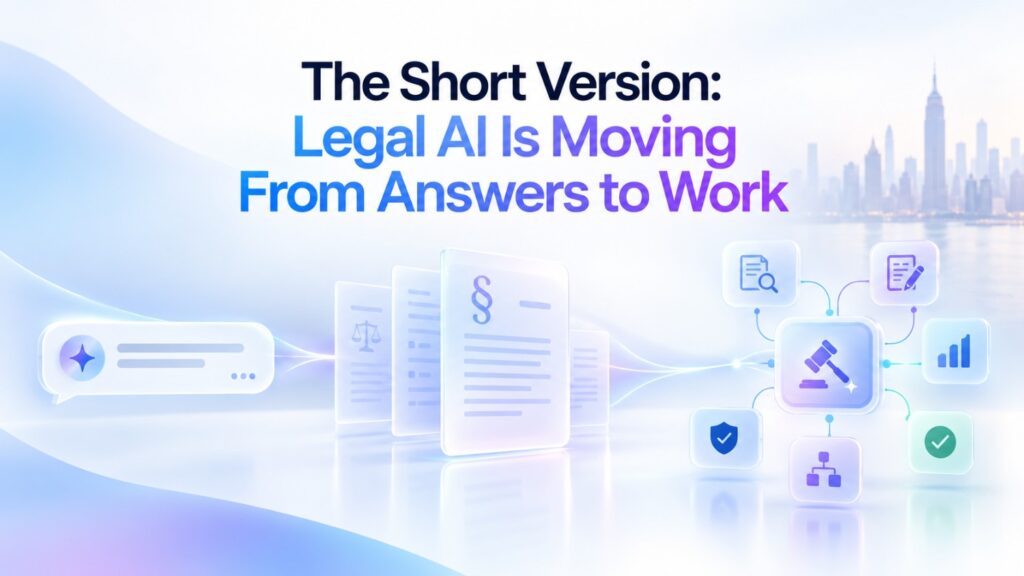
Instead of asking an AI system five separate questions, the lawyer can increasingly describe what the finished work should look like.
The system then works backward.
From Individual Prompts to Legal Objectives
Consider a private-equity transaction.
An associate may currently review dozens of customer contracts and repeatedly perform the same process. The lawyer finds a change-of-control clause, copies the relevant language, checks whether consent is required, compares the clause against deal criteria, records the result in a tracker, and writes a short explanation.
With a simple AI assistant, the lawyer might ask for help one document at a time.
With an agent, the instruction could be much broader.
The lawyer might ask the system to review all approved agreements, identify change-of-control restrictions, compare them with an internal playbook, cite the exact source language, create an exceptions table, and prepare a first draft of the relevant diligence section.
The agent would perform the mechanical sequence.
The lawyer would review the important conclusions.
That is the core shift.
The Lawyer Becomes the Supervisor of the Workflow
This does not mean the lawyer disappears.
In many cases, the opposite happens.
Human judgment becomes more visible because the machine handles more of the routine movement of information.
The lawyer decides what question should be answered, what sources can be trusted, what standards apply, what exceptions matter, and whether the final output is good enough to use.
That is a more senior role than copying information between documents.
Why New York Is an Ideal Market for Agentic Legal AI
New York is not important merely because many famous firms have Manhattan offices.
The region has structural characteristics that make automation unusually valuable.
Legal work is highly concentrated. Legal labor is expensive. Court activity is heavily digitized. Clients are sophisticated. Many matters involve large financial stakes. And the city contains dense networks of law firms, banks, private-equity firms, insurers, technology companies, media businesses, healthcare organizations, and multinational companies.
All of these organizations buy or produce large amounts of legal work.
New York Has an Unusually Dense Legal Workforce
Bureau of Labor Statistics data for the New York metropolitan area show that legal occupations represent a much larger share of total employment than they do nationally.
Legal occupations account for roughly 1.4% of employment in the New York metro, compared with about 0.8% across the United States.
That gives New York an employment concentration of roughly 1.75 times the national level.
Legal Employment Concentration
Share of total employment
New York metro 1.4% ██████████████
United States 0.8% ████████
New York relative concentration: approximately 1.75x
The figure matters because automation creates more economic value when large amounts of similar professional work are concentrated in one market.
A workflow improvement used by ten people is useful.
The same improvement applied across tens of thousands of professionals can become economically significant.
New York Legal Time Is Expensive
The average hourly wage across legal occupations in the New York metro is also much higher than the national figure.
The New York figure is about $87.83 per hour compared with roughly $67.07 nationally.
That represents a premium of around 31%.
Mean Hourly Pay for Legal Occupations
New York metro $87.83 ██████████████████████████
United States $67.07 ████████████████████
New York premium: approximately 31%
This creates a simple but powerful economic reality.
Saving professional time in New York can be unusually valuable.
A system that saves several minutes once is not transformational.
A system that repeatedly removes small amounts of low-value work from thousands of expensive professionals can be.
NYC Tech Journal Original Research: Measuring the Economic Surface Area
To understand that opportunity more clearly, NYC Tech Journal created an original model using publicly available employment and wage data.
The purpose of the model is not to claim that AI will automatically generate billions of dollars in savings.
That would be unrealistic.
Instead, the analysis measures how much wage-equivalent professional labor sits inside two New York legal occupations that are likely to encounter document-heavy, research-heavy, and process-heavy work.
Those occupations are lawyers and paralegals or legal assistants.
The Methodology
The analysis uses May 2025 employment and wage estimates for the wider New York-Newark-Jersey City metropolitan area.
The available data indicate approximately 94,610 lawyers and about 33,850 paralegals and legal assistants in the region.
Average annual pay is roughly $224,840 for lawyers and about $80,260 for paralegals and legal assistants.
We multiplied estimated employment by estimated mean annual pay.
This creates what we call the annual wage-equivalent labor pool.
It is important to understand what this number is and what it is not.
It is not law-firm revenue.
It is not partner compensation.
It is not the size of the legal AI market.
It is not the amount of money firms can automatically save.
It is simply an analytical way to measure how much professional labor value exists across these two occupations.
New York Metro Legal Labor Base
| Occupation | Estimated workers | Mean annual wage | Wage-equivalent labor pool |
| Lawyers | 94,610 | $224,840 | $21.27 billion |
| Paralegals and legal assistants | 33,850 | $80,260 | $2.72 billion |
| Combined | 128,460 | — | $23.99 billion |
The result is approximately $24 billion in annual wage-equivalent labor.
And that number covers only two occupational categories.
It excludes many people who support modern legal work, including knowledge lawyers, legal operations teams, litigation-support specialists, secretaries, information professionals, project managers, technology teams, compliance professionals, and other staff.
The full legal-work economy is therefore much larger.
Finding 1: Tiny Productivity Gains Become Large at New York Scale
The most useful part of this model comes from testing small improvements.
What happens if AI does not save hundreds of hours?
What happens if it saves just one hour per month?
Using the employment and wage figures above, NYC Tech Journal created a simple sensitivity analysis.
Estimated Wage-Equivalent Capacity From Recovered Time
| Average productive time recovered | Approximate annual wage-equivalent capacity |
| 1 hour per worker per month | $138 million |
| 2 hours per month | $277 million |
| 3 hours per month | $415 million |
| 5 hours per month | $692 million |
| 10 hours per month | $1.38 billion |
These values should not be read as projected savings.
They measure capacity.
That distinction matters.
Recovered Time Does Not Automatically Become Profit
A lawyer who saves an hour may not create an additional dollar of revenue.
The person may spend the time on another client matter, professional development, business development, supervision, internal work, or simply finish earlier.
AI systems also cost money.
They require implementation, training, security controls, testing, licensing, data integration, and human review.
Some automated work will fail.
Some outputs will need heavy editing.
Some saved time cannot be monetized.
Even with all of those limitations, the model demonstrates something important.
New York firms do not need enormous productivity improvements for agentic AI to become economically interesting.
At the scale of the city’s legal market, very small gains can add up quickly.
Finding 2: Legal Employment Has Continued to Grow
One common assumption about AI is that automation automatically means fewer lawyers.
Recent New York employment data make that conclusion less obvious.
Around 80,900 lawyers were employed in the New York metro in 2018.
The figure increased to roughly 85,180 in 2021, 89,700 in 2022, 90,980 in 2023, and approximately 94,610 by 2025.
New York Metro Lawyer Employment
2018 80,900 ███████████████████████████████
2021 85,180 █████████████████████████████████
2022 89,700 ███████████████████████████████████
2023 90,980 ████████████████████████████████████
2025 94,610 ██████████████████████████████████████
That represents growth of roughly 17% between 2018 and 2025.
Over roughly the same period, estimated mean annual lawyer wages increased from around $172,020 to approximately $224,840.
That is an increase of more than 30% in nominal terms.
Lawyer Employment and Mean Pay
| Year | Estimated lawyers | Mean annual wage |
| 2018 | 80,900 | $172,020 |
| 2021 | 85,180 | $183,870 |
| 2022 | 89,700 | $193,280 |
| 2023 | 90,980 | $213,420 |
| 2025 | 94,610 | $224,840 |
This does not prove that AI will increase legal employment.
It does show that technological progress and employment growth can exist together.
The more useful question may therefore be what work lawyers perform rather than whether lawyers exist.
Agentic AI is more likely to change the task mix first.
Finding 3: New York Courts Already Produce AI-Scale Digital Work
AI agents become more useful when information is digital.
That is already happening throughout New York’s court system.
Electronic filing now produces enormous volumes of documents.
During 2025, New York’s electronic filing system processed close to 1.1 million cases and estates and more than 16.6 million documents.
That is important because legal AI operates best when information can be searched, classified, compared, extracted, linked, and processed programmatically.
Scale of New York Electronic Court Activity
2025 electronic filing activity
Cases and estates ~1.1 million
Documents >16.6 million
Documents from self-
represented litigants ~225,000
Self-represented
litigants ~60,000
The raw document count should not be used to calculate the average number of documents in a New York case because documents filed during a year may belong to matters created in earlier years.
But the overall scale is still clear.
New York legal work has become deeply digital.
That creates the raw material agents need.
Finding 4: Even Specialized New York Legal Work Has Large Digital Volume
Surrogate’s Court provides a useful example.
Public filing data show tens of thousands of electronically filed Surrogate’s Court matters within New York City.
Using available county-level figures, NYC Tech Journal calculated approximately 22,924 electronically filed Surrogate’s Court cases across the five boroughs during the analyzed period.
E-Filed Surrogate’s Court Matters Across NYC
| Borough | County | Cases | Share of NYC total |
| Queens | Queens | 7,405 | 32.3% |
| Brooklyn | Kings | 6,147 | 26.8% |
| Manhattan | New York | 5,096 | 22.2% |
| Bronx | Bronx | 2,216 | 9.7% |
| Staten Island | Richmond | 2,060 | 9.0% |
| Total | — | 22,924 | 100% |
NYC Surrogate’s Court E-Filing Distribution
Queens 32.3% ████████████████
Brooklyn 26.8% █████████████
Manhattan 22.2% ███████████
Bronx 9.7% █████
Staten Island 9.0% ████
This does not mean estate-law work should be automated.
It shows that even highly specialized legal areas can generate enough repeatable digital work for workflow automation to become relevant.
The same logic applies to many practice areas.
Finding 5: AI Adoption Is Moving Faster Than Law-Firm Strategy
Generative AI adoption inside legal organizations has increased rapidly.
Recent industry research indicates that reported GenAI use among law firms rose from roughly 28% to around 41% within a year.
Corporate legal departments increased even faster.
Reported Generative AI Adoption
LAW FIRMS
Previous period 28% ██████████████
Later period 41% ████████████████████
CORPORATE LEGAL
Previous period 23% ███████████
Later period 47% ███████████████████████
The interesting part is not simply that more lawyers are using AI.
The gap between usage and formal strategy remains large.
A firm can have hundreds of lawyers using AI while still having no shared operating model for how AI should fit into client work.
That creates inconsistency.
One associate may use AI only for brainstorming.
Another may use it for contract review.
Another may paste confidential material into an unapproved system.
Another may avoid AI completely.
That is not transformation.
It is fragmented experimentation.
Agentic AI will force firms to become more deliberate because the systems can potentially touch much larger parts of a matter.
What AI Agents Can Actually Do for Law Firms
The value of agents becomes clearer when we move away from abstract discussions and examine actual workflows.
Lawyers receive goals, not isolated tasks.
A partner does not usually tell an associate to “use a language model.”
The instruction sounds more like:
“Find out whether this argument works.”
“Tell me what is different in these agreements.”
“Build the chronology.”
“Review the data room.”
“Prepare me for the deposition.”
“Find out what we still need from the seller.”
These assignments contain several steps.
That is exactly why agents matter.
Legal Research Could Become a Managed Workflow
Traditional legal research requires continuous human steering.
The lawyer defines an issue, searches, reviews cases, changes the search, checks authorities, looks for contrary law, identifies factual differences, and eventually writes an analysis.
An agent could perform more of that sequence.
It could break a broad question into sub-issues.
It could search multiple approved sources.
It could compare authorities.
It could identify conflicting cases.
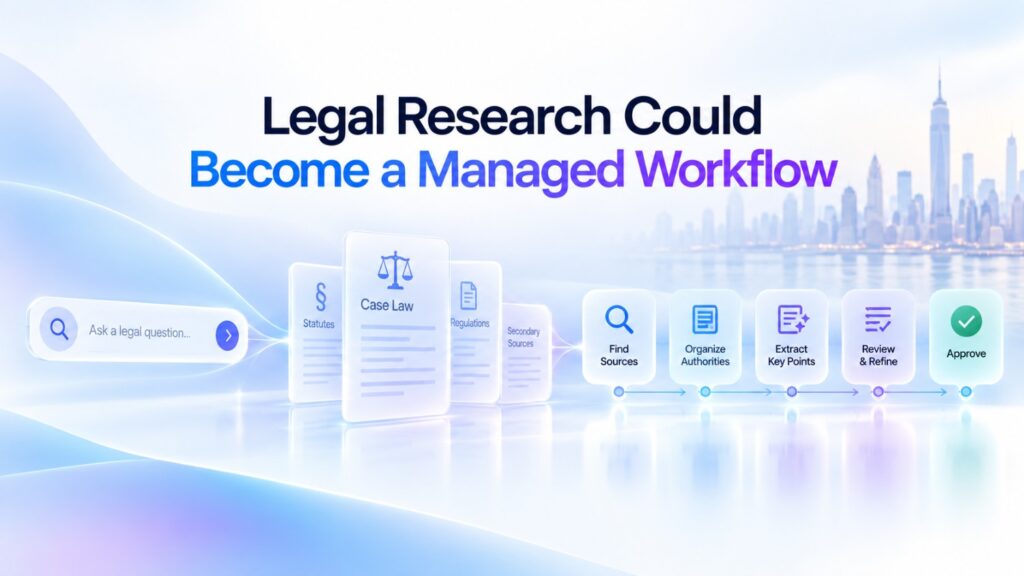
It could produce a draft argument with linked sources.
The lawyer would then review the reasoning.
The Important Shift Is From Finding to Verifying
This changes the lawyer’s role.
A junior associate may spend less time finding every relevant case manually.
Instead, the lawyer spends more time deciding whether the agent searched the right issues and interpreted the authorities correctly.
That does not reduce the importance of legal knowledge.
It may increase it.
A lawyer cannot identify a weak AI-generated argument without knowing what a strong argument looks like.
Litigation Is Likely to Be One of the Largest Agentic Use Cases
Litigation creates enormous information problems.
A complex matter can contain pleadings, transcripts, emails, contracts, expert reports, internal notes, discovery responses, exhibits, court orders, timelines, and millions of pages of produced material.
No individual lawyer can keep all of that information active in memory.
Software can.
Agents Can Keep Updating Their Understanding of a Matter
Consider a deposition transcript uploaded to an approved litigation workspace.
An agent could identify names, dates, claims, contradictions, admissions, new factual issues, and references to important exhibits.
It could compare those statements with prior testimony.
It could update a chronology.
It could add possible impeachment points to a review list.
It could identify documents that should be examined again.
The litigation team still decides whether any of those findings matter.
But the agent reduces the amount of manual connecting work.
The Real Opportunity Is Continuous Case Memory
The most useful litigation agent may not be a tool that drafts a motion in ten seconds.
It may be a system that remembers everything the team has already learned.
Litigation teams repeatedly lose time because information becomes scattered across email, notes, transcripts, review platforms, and shared drives.
An agent connected to approved sources can help rebuild that context whenever new information arrives.
That could become more valuable than pure text generation.
Contract Review Is Moving Beyond Clause Extraction
Contract-analysis tools have existed for years.
The agentic change is that extraction can become connected to workflow.
A standard contract tool may identify a change-of-control clause.
An agent could identify the clause, classify it against the firm’s playbook, identify unusual language, locate notice requirements, compare related agreements, update a diligence tracker, and prepare a review note.
The lawyer still decides whether the clause creates real business risk.
That distinction matters.
Firm-Specific Playbooks Will Become Extremely Valuable
Generic legal AI will become widely available.
A firm’s internal standards will not.
A strong transaction agent may know:
Which clauses the firm usually accepts.
Which positions require partner approval.
Which client preferences apply.
Which fallback language has worked in earlier negotiations.
Which risks matter in specific industries.
Which issues should automatically be escalated.
Those rules can turn general AI into firm-specific operating knowledge.
That is where competitive advantage begins.
Due Diligence Could Become a Persistent Agent Workflow
Due diligence is especially suitable for agents because the work is repetitive but constantly changing.
Documents arrive over time.
New findings create new questions.
Several lawyers review different areas.
Information needs to flow into trackers, risk summaries, disclosure schedules, purchase agreements, and closing checklists.
Today, humans often perform those connections manually.
The Agent Can Maintain State as the Deal Changes
Imagine a seller uploads 200 documents on Monday.
An agent reviews them against the diligence request list.
It identifies which requests appear complete.
It highlights missing information.
It extracts relevant clauses.
It creates a list of possible issues.
Two days later, another 100 documents arrive.
The agent does not need to start again.
It compares the new material with the existing review state.
It updates the tracker.
It closes requests that are now satisfied.
It identifies contradictions.
It creates new follow-up questions.
That is more powerful than document summarization because the system maintains continuity.
Employment Law Could Be Another Strong New York Use Case
Employment practices handle large volumes of policies, claims, investigations, handbooks, correspondence, personnel documents, agreements, state requirements, city requirements, and recurring client questions.
Much of that work involves repeated patterns.
That makes employment law a natural area for narrowly defined agents.
A firm could create an agent for policy comparison.
Another could organize investigation material.
Another could prepare a chronology.
Another could compare handbook language across jurisdictions.
Another could help prepare first-pass responses to recurring questions.
The key is not building one system that “does employment law.”
The safer model is creating multiple agents with limited jobs.
The Legal AI Stack Is Starting to Change
Traditional legal technology was usually organized by software category.
Research lived in one system.
Documents lived in another.
Knowledge management lived somewhere else.
Contracts, discovery, timekeeping, matter management, and collaboration all had their own platforms.
Agents can sit across those layers.
From Separate Tools to Connected Legal Workflows
| Layer | Traditional function | Agentic function |
| Legal research | Find authority | Research connected issues and prepare analysis |
| Document management | Store files | Retrieve authorized matter context |
| Knowledge system | Help people find precedent | Feed approved precedent into workflows |
| Contract software | Identify terms | Compare, classify, escalate, and draft |
| Discovery platform | Search evidence | Build issue maps and update case understanding |
| Matter management | Track progress | Trigger recurring work |
| Lawyer | Operate each system | Define goal, supervise, judge, approve |
This is why legal AI increasingly becomes an integration problem.
A powerful model with no access to the firm’s approved knowledge may provide limited value.
A well-controlled system connected to the right information can be much more useful.
Institutional Memory May Become the Biggest Competitive Advantage
Law firms contain an enormous amount of experience.
Unfortunately, much of it is difficult to reuse.
A partner remembers a similar deal.
An associate remembers an old memo.
A precedent exists somewhere in the document system.
A knowledge lawyer may know which matters contain useful language.
But finding the right example can take hours.
Agents could make that experience easier to access.
The Best Question Is Not “Give Me a Clause”
Generic AI can generate a clause.
The better question is:
“How has our firm handled this issue before?”
A firm might ask an agent to identify how similar indemnity provisions were negotiated in earlier private-equity transactions involving healthcare companies.
The agent could separate buyer-side and seller-side examples.
It could show final language.
It could identify common fallback positions.
It could surface comments from past negotiations if those records are authorized for reuse.
That is much more valuable than generic drafting.
Permission Controls Become Essential
The same capability creates risk.
Law firms contain highly sensitive information.
Some matters are restricted.
Some teams are separated by ethical walls.
Some clients prohibit certain uses of their data.
An AI agent should never treat every document in the firm as part of one unrestricted knowledge pool.
Permissions must follow the user and the matter.
If a lawyer cannot manually access a restricted document, an agent operating for that lawyer should not be able to retrieve it either.
That principle must be built into the architecture.
New York Ethics Rules Make Human Oversight Essential
Law firms cannot treat AI governance as a technology-only problem.
Professional duties continue to apply.
New York legal ethics guidance has already highlighted issues such as competence, confidentiality, conflicts, client communication, supervision, candor, and fees when lawyers use generative AI.
Agentic systems make those questions more serious because the technology can perform more actions without constant human prompting.
Confidentiality Must Come Before Convenience
Before giving an agent client material, a firm should understand what happens to the information.
Where is it stored?
How long is it kept?
Can the provider train on it?
Can administrators inspect it?
Are subcontractors involved?
Can the system access data from unrelated matters?
What logs exist?
What happens when the contract ends?
Those questions are not merely for the IT department.
They directly affect legal-service risk.
The Safest Agent Usually Has Limited Access
A well-designed agent should not know everything.
A research agent may need access to legal research platforms and a limited set of matter documents.
It probably does not need every document in the firm.
A litigation agent working on one case should not search unrelated matters.
An intake agent should not automatically access sensitive litigation files.
Limiting access reduces both privacy risk and operational risk.
Verification Must Be Designed Into the Workflow
AI-generated legal errors have already created serious problems.
The most widely discussed cases involved lawyers relying on nonexistent or incorrect authorities.
Agentic systems create a new version of this risk.
A bad answer is dangerous.
A bad assumption that affects ten later steps may be worse.
That means firms should require verification gates.
Different Tasks Need Different Levels of Human Review
An agent may be able to extract termination dates from hundreds of agreements with limited supervision.
That does not mean it should decide whether those dates create a material risk.
An agent can identify cases.
A lawyer should confirm the authorities and assess their importance.
An agent can produce a draft motion.
A lawyer must fully review the motion before filing.
The level of review should increase as the legal consequence increases.
Supervision Will Become a New Management Skill
Law firms already know how to supervise people.
They will increasingly need to supervise automated workflows.
That requires ownership.
Someone must decide what the agent is allowed to do.
Someone must approve changes.
Someone must monitor error rates.
Someone must investigate failures.
Someone must decide whether a workflow remains safe after the underlying model changes.
This means agentic AI is not simply another software license.
It becomes part of legal operations.
Meeting and Recording Agents Create Their Own Risks
AI note takers are becoming common in professional work.
They can record calls, transcribe meetings, summarize discussion, and create follow-up actions.
In legal environments, that convenience creates additional questions.
Recording may affect privacy.
Transcripts may become discoverable.
Automated summaries may misstate important points.
Clients or counterparties may not want calls recorded.
A firm therefore needs clear rules about when meeting agents may be used.
Technology should never make recording the automatic default simply because recording became easy.
Billing May Become One of the Hardest Business Questions
Agentic AI can create an uncomfortable problem for traditional law-firm economics.
Suppose a task previously required four billable hours.
An agent helps the lawyer complete the same work to the same standard in 45 minutes.
How should the firm charge?
The answer is not obvious.
Efficiency and Hourly Billing Can Conflict
Clients naturally want the benefit of faster work.
Firms need to recover technology costs and earn a return on their expertise.
Both sides have valid interests.
The long-term result may be more experimentation with fixed fees, subscriptions, portfolio pricing, success-based elements, and other models that focus more on value than time.
Hourly billing will not disappear.
Many legal matters remain unpredictable.
But agentic AI makes time-based pricing harder to defend for work that becomes highly standardized.
The Junior Associate Role Will Change Significantly
Partners often describe AI as a way to eliminate low-value work.
That sounds attractive.
But junior work also serves as training.
Associates learn contracts by reading them.
They learn research by finding cases.
They learn litigation by organizing evidence.
They learn drafting by making mistakes and receiving edits.
If agents remove too much of that experience, firms can create a training gap.
The Answer Is Better Training, Not Preserving Bad Work
Law firms should not require young lawyers to perform inefficient manual work simply because earlier generations had to do it.
Instead, training should shift.
If an agent creates the first draft, a junior lawyer should learn how to audit it.
If an agent organizes the research, the associate should explain why certain cases matter.
If an agent extracts 200 clauses, the junior lawyer should identify which five create real deal risk.
This can make training more intellectually demanding.
That may be a good thing.
Human Judgment Becomes More Valuable
Many of the hardest legal questions involve uncertainty rather than information.
Should the client settle?
Should a company accept a particular risk?
Will a witness perform well?
Will a judge find an argument convincing?
Is the other side bluffing?
Should a board delay the transaction?
Which concession matters more?
How should the lawyer explain a difficult choice to the client?
AI can provide information.
It cannot own the consequences.
As machines make information easier to produce, professional judgment becomes more important.
A Practical Risk Map for Legal AI Agents
Firms should avoid treating AI as either fully permitted or fully banned.
A better approach is to classify workflows based on risk.
Agentic Legal Work Risk Framework
| Workflow | Automation potential | Risk | Recommended human control |
| Document classification | High | Low to medium | Quality sampling |
| Meeting action-item extraction | High | Medium | Consent and confidentiality review |
| Clause extraction | High | Medium | Exception review |
| Diligence tracker updates | High | Medium | Lawyer approval of material findings |
| Legal research | High | Medium to high | Authority verification |
| First-draft memo | High | Medium to high | Full substantive review |
| Contract redline | Medium to high | High | Lawyer clause review |
| Litigation strategy | Medium | High | Lawyer controls strategy |
| Client legal advice | Medium | Very high | Responsible attorney approval |
| Court filing | Medium | Very high | Full attorney verification |
| Settlement decision | Low | Very high | Human decision |
| Final negotiation position | Low to medium | Very high | Human decision |
The goal should not be maximum autonomy.
The goal should be the highest safe level of automation for each workflow.
New York Firms Should Start With Workflows, Not Products
A weak AI strategy starts with software.
“We bought this tool. How should we use it?”
A stronger strategy starts with the work.
“Where are our lawyers spending expensive time on repeatable tasks?”
That second question leads to better projects.
Good First Workflows Have Clear Inputs and Outputs
The best first agent projects are usually measurable.
Contract extraction has a clear output.
A chronology can be checked.
A diligence tracker can be reviewed.
A research memo can be compared with known authority.
A client intake process has defined steps.
The narrower the first workflow, the easier it is to test.
A Practical 90-Day Law-Firm Agent Plan
Law firms do not need to transform every practice at once.
A focused 90-day pilot can teach the organization a great deal.
90-Day Rollout Framework
| Period | Main goal | Output |
| Days 1–15 | Select one workflow | Process map and baseline |
| Days 16–30 | Define controls | Permissions and review rules |
| Days 31–45 | Build and test | Working agent workflow |
| Days 46–60 | Run controlled pilot | Live lawyer-reviewed matters |
| Days 61–75 | Measure performance | Quality and productivity metrics |
| Days 76–90 | Decide whether to scale | Business case |
Days 1–15: Measure the Current Process
Do not automate an unknown process.
Watch how lawyers perform the work today.
Measure how long it takes.
Identify which people are involved.
Track how often information moves between systems.
Find the points where mistakes happen.
Separate administrative work from true legal judgment.
Without a baseline, firms cannot prove whether AI improved anything.
Days 16–30: Define the Boundaries
Next, decide what the agent can access and what it can do.
Specify the approved systems.
Set matter permissions.
Identify actions the agent may perform.
Define which steps always require a human.
Create escalation rules.
A particularly useful rule is simple.
When the system does not have enough information, it should stop and ask for review instead of inventing an answer.
Days 31–45: Test Against Known Results
Use completed matters or controlled examples.
Run the workflow against work where the firm already knows what good looks like.
Measure whether the agent catches important issues.
Check citations.
Record missed items.
Track false positives.
Look for hallucinations.
Compare its output with the lawyer-produced version.
This creates a reliable benchmark.
Days 46–60: Move Carefully Into Live Matters
Once testing reaches an acceptable level, use the workflow on a small number of suitable matters.
Keep lawyer review high.
The goal is not to prove the agent is perfect.
The goal is to learn how it fails under real conditions.
A pilot that reveals important weaknesses can be extremely valuable.
Days 61–75: Measure Review Time
Do not measure only how fast the agent produces something.
Measure how long a lawyer needs to turn that output into approved work.
This is critical.
If the old process took four hours and the agent generates a draft in two minutes but requires three hours of review, the real gain is roughly one hour.
Generation speed is not the same as workflow productivity.
Days 76–90: Decide Whether to Scale
A workflow should earn the right to expand.
Look at accuracy.
Look at time saved after review.
Look at failure rates.
Look at security.
Look at user adoption.
Look at client concerns.
Look at software cost.
If the numbers work, expand.
If they do not, redesign or stop.
The KPI Dashboard Every Law Firm Should Build
One of the biggest weaknesses in legal AI adoption is poor measurement.
Many organizations can say they are using AI.
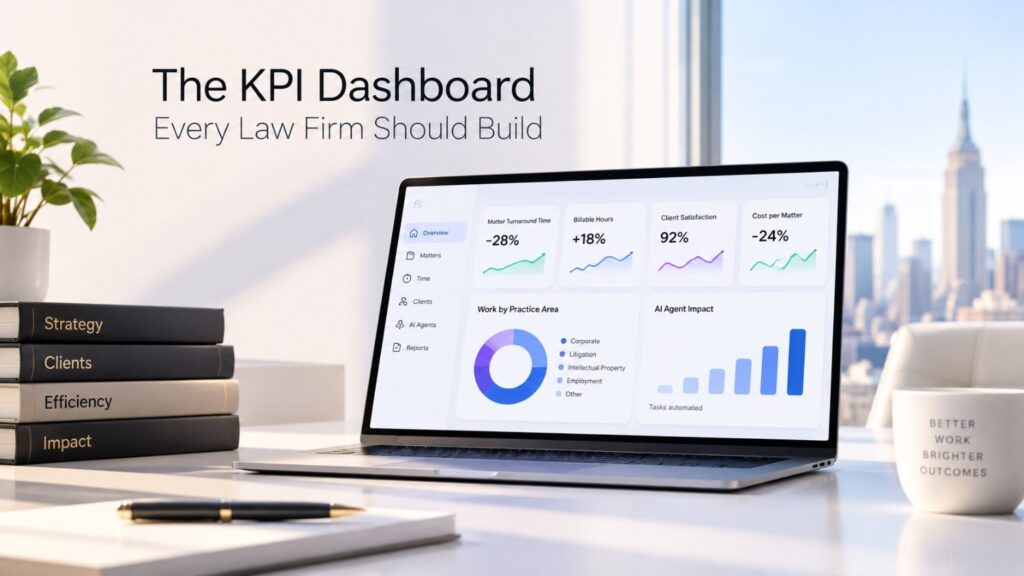
Far fewer can say exactly what the technology has improved.
A serious law firm needs workflow-level metrics.
Core Legal Agent KPIs
| KPI | Why it matters |
| Total cycle time | Shows whether work finishes faster |
| Human review time | Measures true professional effort |
| Material error rate | Measures risk |
| Citation accuracy | Measures research reliability |
| Issue recall | Shows whether important items are missed |
| False-positive rate | Measures review noise |
| Rework rate | Shows whether speed creates later problems |
| Escalation rate | Shows whether the agent knows its limits |
| Cost per workflow | Measures economics |
| User adoption | Shows whether lawyers find it useful |
| Client acceptance | Shows whether the service model works |
| Final output quality | Measures whether the work is actually better |
The Best Metric May Be Human Minutes per Approved Output
This may become one of the most useful measures in legal AI.
Imagine two agents.
Both produce a diligence report in ten minutes.
The first requires 20 minutes of lawyer review.
The second requires two hours.
Their generation speed is identical.
Their business value is completely different.
That suggests a better metric:
Human review minutes required per approved work product.
That measures the real bottleneck.
Trust.
Build Agents Around Exceptions
Legal work is often valuable because of unusual facts.
The routine provision is rarely the most dangerous one.
The unexpected provision matters.
That means agents should not simply be designed to complete tasks quickly.
They should be good at finding exceptions.
A strong contract agent should say that a clause differs from the normal position.
A research agent should identify conflicting authority.
A diligence agent should highlight missing documents.
A litigation agent should surface inconsistent statements.
A high-quality system should also be comfortable saying that it cannot determine the answer.
That may be safer than a system optimized to sound confident.
Large New York Firms Are Already Moving Toward Workflow AI
The market is increasingly moving beyond experimental chat tools.
Major firms have publicly discussed AI deployments involving research, drafting, document analysis, structured workflows, litigation review, and knowledge systems.
The important trend is not which vendor wins.
The important trend is where firms are investing.
They are moving toward repeatable workflows.
They are connecting AI with internal knowledge.
They are training lawyers.
They are thinking about security and governance.
They are experimenting with systems that can perform connected tasks rather than isolated prompts.
That is a much more important change than simply giving every lawyer a chatbot.
Smaller New York Firms May Have Their Own Advantage
Large firms have money and specialized teams.
Smaller firms can often move faster.
A 20-lawyer or 50-lawyer firm may be able to redesign a workflow without going through dozens of committees.
That creates an opportunity.
Smaller Firms Should Target Bottlenecks
A small firm should not try to copy a global law firm’s AI program.
It should ask where limited professional capacity hurts most.
Maybe intake takes too long.
Maybe partners spend hours reviewing standard leases.
Maybe every employment matter begins with the same document collection process.
Maybe associates repeatedly research the same New York law issues.
Maybe client updates require too much administrative preparation.
Those are good starting points.
The goal is leverage.
Client Intake Could Become a Highly Practical Agent Workflow
Not every legal agent needs to perform legal reasoning.
Intake is a strong example.
A prospective client may send a long email with several documents.
Someone must identify the parties.
Someone must run conflicts.
Someone must understand the type of matter.
Someone must collect missing information.
Someone must route the matter to the right attorney.
Someone must create an initial summary.
An agent could help coordinate much of that process while leaving the decision to accept representation with lawyers.
Faster intake can also improve business development.
Potential clients rarely enjoy waiting days for an initial response.
Agents Could Change Business Development
Law firms contain a large amount of relationship knowledge.
Unfortunately, it is usually fragmented.
One partner knows a client is considering an acquisition.
Another knows the target industry.
A third worked on a similar matter.
The CRM contains an old relationship.
The knowledge system contains a relevant precedent.
Today, these connections often happen by chance.
Controlled AI systems could eventually help firms identify those links.
That creates a commercial use case that goes beyond efficiency.
A firm that understands a client sooner can act sooner.
Procurement Is Becoming a Strategic Legal Decision
Buying an AI agent is not the same as buying basic office software.
Once the system can access matter information and perform work, it becomes part of legal service delivery.
Procurement must therefore become more demanding.
Questions Every Firm Should Ask an AI Vendor
| Question | Why it matters |
| Where is client data stored? | Confidentiality |
| Is client data used to train models? | Information control |
| Can permissions match ethical walls? | Matter security |
| Does every important claim link to a source? | Verification |
| Can the firm audit agent actions? | Supervision |
| Can administrators inspect logs? | Governance |
| Can tools and actions be disabled? | Scope control |
| Can approved sources be restricted? | Quality |
| How are model changes tested? | Reliability |
| Can outputs be preserved with matter records? | Recordkeeping |
| What happens to data when the contract ends? | Exit risk |
The decision should involve legal leadership, information security, privacy, procurement, knowledge management, operations, and technology.
Shadow AI May Be More Dangerous Than Controlled AI
Some firms respond to AI risk by delaying deployment.
That can create another risk.
Lawyers may use unapproved tools anyway.
If employees believe approved systems are too slow or unavailable, they may turn to consumer products.
That can create confidentiality and governance problems the firm cannot even see.
A good AI policy therefore needs more than restrictions.
It needs usable approved options.
Tell people what they can use.
Train them.
Make the secure system easier than the unsafe workaround.
Every Agent Should Have a Digital Job Description
A useful way to govern legal agents is to define them like tightly controlled roles.
Consider a contract-review agent.
Purpose
Compare selected commercial agreements against an approved playbook.
Approved Inputs
Documents stored in the authorized matter workspace.
Allowed Actions
Extract clauses, compare language, identify deviations, cite source passages, and prepare an issues table.
Prohibited Actions
Give final client advice, approve contract language, negotiate directly with counterparties, or access unrelated matters.
Human Owner
The supervising attorney responsible for the matter.
Required Review
Lawyer approval before client-facing use.
Failure Rule
Escalate when the document is unclear, the language falls outside the playbook, or the system lacks enough information.
This approach is much safer than telling a firm that everyone may simply “use AI.”
Every Agent Also Needs a Stop Rule
Organizations spend a great deal of time deciding what AI should do.
They should spend just as much time deciding when it should stop.
A legal agent should stop when information is missing.
It should stop when documents conflict.
It should stop when a matter falls outside approved jurisdiction.
It should stop when privileged material creates uncertainty.
It should stop when the system cannot confidently classify an issue.
It should stop before making decisions reserved for lawyers.
A useful legal agent is not simply one that completes work.
It is one that knows when not to continue.
Agentic AI Could Change Law-Firm Structure
Most law firms still operate as professional pyramids.
Partners supervise senior associates.
Senior associates supervise junior associates.
Junior associates and staff perform large amounts of research, drafting, review, and process work.
Agents can change that structure.
Legal Teams May Become More Senior-Leveraged
A partner may be able to manage more work with fewer manual production steps.
Senior associates may supervise AI workflows.
Legal engineers may help create reusable processes.
Knowledge lawyers may become directly involved in service delivery.
Paralegals may supervise automated review rather than manually extracting every field.
This does not mean the pyramid disappears.
It means the work inside each layer changes.
The New Moat Is Not Access to AI
Every serious law firm will eventually have access to capable AI.
That means access alone will not create lasting advantage.
The moat will come from what the firm builds around the models.
Firm Knowledge
A generic model is available to competitors.
Your best internal work is not.
Workflow Design
A firm that understands how excellent work is produced can encode those steps.
A firm that does not understand its own process will struggle to automate it.
Evaluation Data
A firm that stores examples of successful and failed agent outputs can test new systems more rigorously.
Over time, that becomes a valuable internal dataset.
Client Integration
Agents designed around a client’s recurring legal work can deepen the relationship.
The service becomes harder to replace.
Human Expertise
The strongest moat may still be expert lawyers who know when the system is wrong.
AI makes their judgment more scalable.
It does not make that judgment unnecessary.
The Bigger Story: Legal Work Is Moving From Documents to Systems
Historically, law firms think in terms of documents.
The memo.
The contract.
The brief.
The diligence report.
The client email.
Agentic AI encourages firms to think in terms of the systems that produce those documents.
That is a much larger change.
A Diligence Report Becomes the Output of a Workflow
The report is no longer simply a Word document written at the end.
It is the visible output of a system connecting data-room documents, review rules, risk classifications, lawyer comments, issue trackers, and transaction knowledge.
The same thing can happen in litigation.
A chronology becomes a living system that updates as evidence arrives.
A regulatory tracker becomes a system that continuously compares new developments with client obligations.
A contract playbook becomes something the agent can actually apply.
Knowledge becomes executable.
That may be the real promise of agentic legal AI.
What New York Law Firms Should Automate First
The strongest first candidates generally have several things in common.
They happen frequently.
They consume meaningful professional time.
Their outputs can be checked.
And the final legal judgment can remain with a lawyer.
That usually points toward activities such as contract extraction, first-pass research, chronology building, diligence organization, document comparison, intake, recurring monitoring, internal knowledge search, and first-draft preparation.
The best first project is rarely the most impressive demo.
It is the workflow with the clearest business case.
What Firms Should Not Automate First
High-risk final judgment is usually a poor starting point.
Do not make the first project an autonomous court filing.
Do not give a new agent unrestricted access to firm data.
Do not allow an untested system to communicate directly with clients.
Do not measure success by how quickly it produces attractive text.
Do not assume that purchasing a legal AI product removes the firm’s responsibility to understand how it works.
Trust should come before scale.
A Better Business Case for Agentic AI
Law firms often ask one question:
“How many hours will this save?”
That is useful, but incomplete.
A stronger business case should examine at least four areas.
Capacity
How much lawyer or staff time does the workflow release?
Quality
Does the system reduce mistakes, improve consistency, or help lawyers identify important information?
Speed
Can clients receive useful work sooner?
Strategic Leverage
Can the firm offer something that was previously too expensive or too difficult to deliver?
The fourth category may eventually create the biggest value.
AI becomes transformational when it helps the firm create a new service, not merely make an old process faster.
The $24 Billion Question
Return to the NYC Tech Journal model.
Approximately 94,610 lawyers and 33,850 paralegals and legal assistants work in the wider New York metropolitan area based on the data used in this analysis.
Their combined wage-equivalent labor pool is roughly $24 billion per year.
If agentic workflows recovered just one productive hour per month across that workforce, the modeled annual wage-equivalent capacity would be about $138 million.
At five hours per month, the modeled figure approaches $692 million.
Again, these values are not projected cost savings.
They show the size of the opportunity.
New York does not need science-fiction automation for legal AI to matter.
It needs thousands of small workflows to become slightly better.
Original Research Summary
| Finding | Result | Why it matters |
| New York legal employment concentration vs. U.S. | About 1.75x | Legal work is unusually concentrated |
| New York legal wage premium | About 31% | Professional time is expensive |
| Lawyers and paralegals analyzed | About 128,460 | Large automation surface |
| Combined wage-equivalent pool | About $24B | Small improvements can scale |
| One hour/month capacity model | About $138M/year | Small time gains become meaningful |
| Lawyer employment growth, 2018–2025 | About 17% | Technology has not simply removed legal jobs |
| Lawyer nominal wage growth | More than 30% | High-value labor remains expensive |
| Electronic court documents in 2025 | More than 16.6M | Legal work is increasingly digital |
| NYC Surrogate’s Court matters analyzed | 22,924 | Specialized practices also have scale |
| Law-firm GenAI adoption | Rapidly rising | AI is becoming operational rather than experimental |
Limitations of the Original Analysis
The data used for the labor analysis cover the wider New York metropolitan area rather than New York City alone.
That means the employment figures include nearby areas outside the five boroughs.
The wage calculations also do not represent law-firm revenue, total compensation, partnership income, or profits.
The productivity scenarios are sensitivity models.
They are not forecasts.
We do not assume every worker will use AI, every workflow can be automated, or every hour recovered can be converted into financial value.
The point of the analysis is to measure the scale of professional work exposed to potential process improvement.
It should be interpreted in that limited way.
Five Changes New York Legal Leaders Should Expect
Research Will Become More Supervised
Lawyers will increasingly give systems research objectives rather than running every individual query themselves.
The professional skill will shift toward framing, verification, and judgment.
Firm Knowledge Will Become Executable
Precedents will increasingly become part of active workflows.
They will no longer exist only as files lawyers need to find manually.
Training Will Move Toward Verification
Junior lawyers will need to become excellent at checking AI work.
Knowing what to question will become a core legal skill.
Pricing Will Slowly Move Beyond Pure Time
As some work becomes faster, clients will put more pressure on firms to experiment with pricing based on outputs and value.
AI Governance Will Move Into Individual Matters
The future AI policy may not be one firmwide document.
Different clients and matters may require different rules.
One client may permit a particular workflow.
Another may prohibit it.
One matter may allow internal AI summarization.
Another may require additional controls.
AI governance will increasingly become part of matter management.
What Managing Partners Should Do Now
The most useful question is not whether AI will replace lawyers.
That question is too broad.
A better question is:
Where are our lawyers spending expensive time moving information rather than exercising judgment?
Find one workflow.
Measure it.
Break it into steps.
Identify where legal judgment actually occurs.
Automate the repeatable parts carefully.
Test the workflow against known results.
Measure human review time.
Track failures.
Improve the process.
Then decide whether to expand.

That is how agentic AI becomes an operating advantage rather than another software expense.
Conclusion
The first generation of generative AI gave lawyers faster answers.
The next generation is trying to complete work.
That shift matters everywhere, but New York is an especially important market because of the scale, cost, complexity, and digital nature of its legal industry.
The original analysis in this article helps explain why.
The wider New York metro contains roughly 128,000 lawyers and paralegals within the two occupations analyzed here. Their combined wage-equivalent labor pool approaches $24 billion. Electronic court systems process millions of filings. Legal AI adoption continues to grow. Major firms are moving toward repeatable workflows, knowledge integration, and systems that can perform connected tasks.
The winning model is unlikely to be fully autonomous law.
It is more likely to be controlled automation wrapped around human judgment.
The agent searches.
The agent compares.
The agent organizes.
The agent drafts.
The agent checks.
The lawyer decides.
New York firms do not need to automate everything to benefit.
They need to understand their work in enough detail to identify what should be automated, what should remain human, and how the two should connect.
That is the larger change behind AI agents for law firms.
Legal technology is no longer simply becoming a better assistant.
It is starting to become part of the operating system of the law firm.