

Legal AI in New York is entering a very different stage.
A few years ago, most legal AI tools behaved like smarter search boxes. A lawyer uploaded a contract, asked a question, requested a summary, or generated a first draft. The tool was useful, but the lawyer still managed almost every step around it.
AI agents are changing that model.
Instead of waiting for one instruction at a time, an AI agent can increasingly take a goal, gather the needed information, follow a legal playbook, work across several documents, complete multiple steps, check parts of its own work, and return a more finished result for human review.
That distinction matters in New York City because few markets contain such a dense combination of law firms, banks, private equity funds, insurance companies, real estate businesses, media groups, technology companies, regulators, and corporate legal departments.
The economics are also unusually strong. Legal occupations represented about 1.4% of total employment in the New York-Newark-Jersey City metropolitan area in May 2025, compared with around 0.8% nationally, according to the U.S. Bureau of Labor Statistics. Average hourly pay for legal occupations in the metro area was also significantly higher than the national average.
In simple terms, New York has more legal work, more expensive legal work, and more organizations willing to pay to make that work faster.
That makes NYC a natural laboratory for agentic legal AI.
For this report, NYC Tech Journal reviewed 12 New York-based or strongly New York-connected legal AI companies. Rather than asking which company has the loudest marketing or biggest funding round, we looked at a more useful question:
How much of a real legal workflow can the AI complete before a human needs to take control?
Our research suggests that the New York legal AI market has already moved well beyond simple document chat.
The companies worth watching are trying to automate workflows.
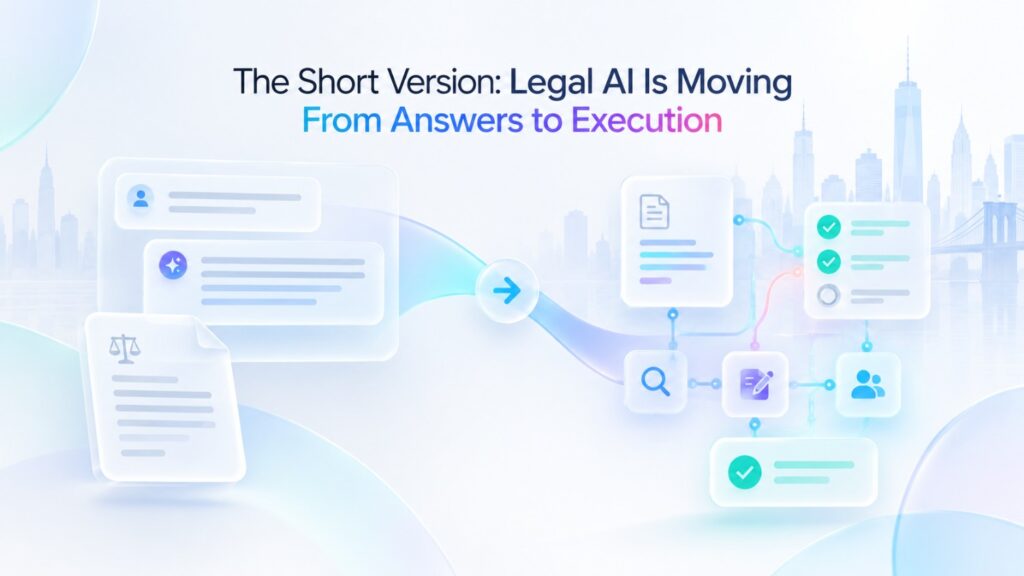
The Short Version: Legal AI Is Moving From Answers to Execution
The easiest way to understand the new legal AI market is to separate assistants from agents.
An AI assistant mainly responds.
A lawyer might ask, “Summarize this contract,” “Find cases discussing this issue,” or “Draft a confidentiality clause.” The system completes that request and waits for another instruction.
An agent can operate across several steps.
A lawyer might instead say, “Review this contract against our standard playbook, identify major deviations, compare it with our last three deals with this counterparty, draft suggested changes, and escalate anything outside our approved risk limits.”
That is a very different type of software.
The user is no longer directing every individual action. The system is deciding how to complete parts of the job.
This shift is beginning across professional services. Thomson Reuters reported in its 2026 research that only a minority of professional organizations had already deployed agentic AI, but a much larger group was either planning or considering it. Most respondents also expected agents to become an important part of professional workflows over the rest of the decade.
New York legal AI startups are already building toward that future.
Norm AI is turning laws and compliance requirements into executable systems.
Sandstone is connecting legal requests, contracts, company data, and institutional knowledge inside an agentic operating layer.
Crosby is combining licensed attorneys with AI agents inside an AI-native law firm.
Newcode is helping legal teams turn firm playbooks into reusable AI workflows.
Irys is building an agentic workspace that can move between research, files, drafting, and connected applications.
Darrow is using AI to identify potential legal claims by continuously analyzing outside information.
These companies solve different problems, but they share a common idea.
The future of legal AI is not simply a better chatbot.
It is software that can help move legal work from beginning to end.
NYC Tech Journal Original Research: Building the NYC Legal AI Agent Index
Comparing legal AI startups is harder than it looks.
Almost every product now uses phrases such as “AI-powered,” “agentic,” “autonomous,” “copilot,” “workflow automation,” or “AI associate.” Those words do not necessarily describe the same level of capability.
A company that summarizes documents should not automatically be placed in the same category as one that can gather information from several systems, apply firm rules, draft work, and route an exception to a lawyer.
We therefore created the NYC Tech Journal Legal AI Agent Index.
The goal was not to predict which startup will become the most valuable company. Funding, brand recognition, and valuation can tell us something about market confidence, but they do not prove that a product can reliably complete legal work.
Instead, we scored companies according to how deeply their products appear to operate inside actual workflows.
How We Scored the Companies
We used six factors.
| Factor | Maximum Score | What We Evaluated |
| Agent execution depth | 30 | Whether the system can complete multi-step work rather than answer isolated questions |
| Legal specialization | 20 | How deeply the product is designed around actual legal work |
| Workflow breadth | 15 | How much of the legal process the platform can support |
| Trust and auditability | 15 | Citations, permissions, verification, human review, security, and audit controls |
| Market validation | 10 | Funding, deployments, customers, partnerships, and public traction |
| NYC depth | 10 | Headquarters, major operations, founding roots, or strong New York market presence |
| Maximum score | 100 | Overall agentic legal workflow strength |
We deliberately limited market validation to 10 points.
A startup can raise a large amount of capital without having the best product. A smaller company can also have excellent technology while publishing very little information about its customer base.
The score should therefore be treated as an analytical market map rather than a final purchasing recommendation.
The NYC Legal AI Agent Index
| Rank | Company | Agent Depth | Legal Fit | Breadth | Trust | Validation | NYC | Total |
| 1 | Norm AI | 29 | 20 | 14 | 14 | 10 | 10 | 97 |
| 2 | Sandstone | 28 | 20 | 15 | 12 | 9 | 10 | 94 |
| 3 | Crosby | 27 | 20 | 12 | 13 | 10 | 10 | 92 |
| 4 | Newcode.ai | 28 | 20 | 15 | 12 | 7 | 10 | 92 |
| 5 | Irys | 28 | 20 | 15 | 14 | 4 | 10 | 91 |
| 6 | Darrow | 29 | 20 | 11 | 13 | 9 | 8 | 90 |
| 7 | August | 26 | 20 | 14 | 12 | 7 | 10 | 89 |
| 8 | Hebbia | 28 | 11 | 15 | 14 | 10 | 10 | 88 |
| 9 | Lucio AI | 22 | 20 | 13 | 12 | 7 | 10 | 84 |
| 10 | Ares | 21 | 20 | 11 | 11 | 5 | 10 | 78 |
| 11 | Unfold Legal AI | 17 | 20 | 9 | 9 | 5 | 10 | 70 |
| 12 | Rendex | 15 | 18 | 8 | 15 | 3 | 10 | 69 |
The scoring reveals something more useful than the ranking itself.
Eight of the 12 companies scored at least 26 out of 30 for agent execution depth.
That means roughly two-thirds of our sample is already building products that appear capable of going beyond one-step legal AI assistance.
Agentic Legal Workflow Score
| Company | Score |
| Norm AI | ████████████████████ 97 |
| Sandstone | ███████████████████ 94 |
| Crosby | ██████████████████ 92 |
| Newcode.ai | ██████████████████ 92 |
| Irys | ██████████████████ 91 |
| Darrow | ██████████████████ 90 |
| August | ██████████████████ 89 |
| Hebbia | ██████████████████ 88 |
| Lucio AI | █████████████████ 84 |
| Ares | ████████████████ 78 |
| Unfold Legal AI | ██████████████ 70 |
| Rendex | ██████████████ 69 |
That is an important market signal.
Agentic legal AI is no longer just a concept being discussed by large software vendors. It is increasingly becoming a product strategy across New York’s startup ecosystem.
Original Finding #1: NYC Legal AI Is Dividing Into Two Different Markets
Our analysis also showed a clear split between broad platforms and specialist products.
Seven of the 12 companies we reviewed are primarily focused on a particular legal workflow, practice area, or buyer type. Five are building broader platforms designed to support many forms of legal work.
How the Market Splits
| Strategy | Companies | Share |
| Specialized workflow or practice-area products | 7 | 58.3% |
| Broader legal AI platforms | 5 | 41.7% |
This creates two competing strategies for building a legal AI company.
The broad-platform approach tries to become the place where lawyers perform a large amount of everyday work.
The specialist approach goes much deeper into one expensive problem.
Ares focuses heavily on personal injury workflows.
Unfold focuses on immigration.
Darrow focuses on finding and evaluating potential litigation.
Norm AI is deeply oriented toward regulatory and compliance work.
Crosby has centered much of its model around commercial legal work delivered through an AI-native law firm.
Specialization has one major advantage: it makes performance easier to define.
A personal injury platform can be tested against known medical records and case files.
An immigration agent can be evaluated against completed petitions.
A compliance agent can be tested against specific rules.
The more clearly a task can be defined, the easier it becomes to determine whether an AI system completed it correctly.
That could give highly specialized companies an important advantage as legal buyers become more demanding about accuracy.
Original Finding #2: Selected NYC Legal AI Companies Announced More Than $216 Million in Major 2026 Rounds
Capital is moving aggressively into the legal AI market.
Among four companies in our sample with clearly disclosed major 2026 financing announcements, announced rounds totaled at least $216.5 million.
Norm AI accounted for the largest portion.
The company announced a $120 million Series C during 2026.
Crosby announced a $60 million Series B.
Sandstone announced a $30 million Series A.
Newcode disclosed more than $6.5 million in seed financing.
Selected 2026 Funding in the NYC Legal AI Sample
| Company | Major 2026 Round | Share of Selected Total |
| Norm AI | $120M | 55.4% |
| Crosby | $60M | 27.7% |
| Sandstone | $30M | 13.9% |
| Newcode.ai | $6.5M+ | 3.0% |
| Selected total | $216.5M+ | 100% |
This is not the total amount invested in New York legal technology during 2026.
It is simply the combined value of these selected publicly announced rounds.
Even so, the distribution is revealing.
Norm AI alone represented more than half of the selected capital.
The broader legal-tech market has also been attracting significant venture investment, suggesting investors increasingly believe AI will capture a larger part of professional legal work.
The investment story has moved beyond better search.
Capital is increasingly backing systems that want to own larger workflows.
Original Finding #3: Trust Is Becoming Part of the Product
There is a basic problem with legal AI.
A system can sound extremely confident while being wrong.
That is uncomfortable in normal business software.
In law, it can become dangerous.
A false case citation, incorrect clause interpretation, missed filing issue, or poorly handled confidential document can create consequences far beyond wasted time.
Agents make this problem more important because they may perform several connected actions before a person sees the result.
Our research therefore gave trust and auditability a maximum of 15 points.
Half of the companies in our sample scored 13 or higher.
That is encouraging because the market increasingly appears to understand that reliability cannot be handled with a disclaimer at the bottom of the screen.
What Trust Looks Like in an Agentic Legal Product
The strongest platforms tend to emphasize several controls.
They show sources.
They preserve citations.
They respect user permissions.
They create audit trails.
They allow human approval.
They restrict what the agent can do.
They test changes to the system before deployment.
They make it possible to understand how an answer was produced.
These capabilities may seem less exciting than a dramatic AI demo, but they become more important as the software takes more actions.
The best legal agent may not be the product with the highest theoretical intelligence.
It may be the one that performs a clearly defined set of tasks within reliable boundaries.
1. Norm AI — Turning Regulation Into Executable AI Workflows
Norm AI ranks first in our index because its approach goes beyond putting a language model on top of legal documents.
The company is trying to turn legal and regulatory rules into systems that agents can actually use.
That is a much deeper technical and legal problem.
The Core Idea Behind Norm AI
Many legal AI products start with text.
Norm starts with rules.
Its Legal Engineering model is designed around translating laws, policies, regulations, interpretations, and internal guidelines into structured systems that AI can apply.
That makes Norm particularly relevant for regulated industries.
Banks, asset managers, insurers, pharmaceutical companies, and other heavily regulated businesses constantly produce communications, documents, disclosures, policies, and transactions that must stay inside complex legal boundaries.
Traditional compliance often happens after work is created.
An agentic model can move compliance closer to the moment the work happens.
Compliance Can Become Part of the Workflow
Consider a financial company preparing marketing material.
Traditionally, employees create the content and then send it to a compliance team.
The compliance professional checks language, disclosures, rules, approved sources, and firm policy.
That creates delay.
Norm’s model points toward an alternative where an AI agent can inspect the material while it is being produced.
The system can check required disclosures, compare statements against approved sources, identify potential problems, and leave an audit trail for human review.
The compliance professional is still important.
The difference is that much of the mechanical checking can happen before the matter reaches the professional.
Why Norm Fits New York
New York is unusually well suited to this model.
The city contains a dense concentration of banks, asset managers, hedge funds, insurers, fintech companies, broker-dealers, and other businesses operating under complex regulatory requirements.
Those organizations spend enormous amounts of money on compliance.
Even modest improvements in review time can therefore create meaningful economic value.
Norm is not simply trying to make legal professionals write faster.
It is trying to put legal rules directly into business operations.
That is why the opportunity could be much larger than document automation alone.
2. Sandstone — Creating an Agentic Operating System for In-House Legal Teams
Corporate legal teams have a different problem.
Their challenge is often not a lack of legal knowledge.
It is operational chaos.
Requests arrive through email, Slack, forms, meetings, Salesforce, contract platforms, and direct messages.
Information about the same matter can live across several systems.
A lawyer may spend more time gathering context than actually performing legal analysis.
Sandstone is attacking that problem.
The Legal Request Is Only the Beginning
Imagine a salesperson asking legal to review an agreement.
The contract itself is only one piece of the job.
The lawyer may need to understand who the customer is, the size of the deal, whether the company has worked with the customer before, what language was accepted previously, which internal business owner is responsible, and whether the deal requires approval from finance or security.
A normal chatbot knows none of this unless someone feeds it the information.
Sandstone’s strategy is to connect the information before the lawyer begins.
Its system brings together requests, contracts, counterparties, company information, previous decisions, and legal knowledge.
Agents can then use that context when performing work.
Why Context Is the Real Legal AI Moat
Language models are becoming widely available.
Context is not.
A general AI system may understand contract law, but it does not automatically know that a particular New York software company never accepts unlimited liability unless the CEO approves it.
It does not know that a certain bank already agreed to a fallback clause in three previous deals.
It does not know that a sales opportunity is worth $8 million.
Those details can completely change a legal recommendation.
Platforms that combine AI with institutional memory can therefore create deeper value than tools focused only on drafting.
That is the opportunity Sandstone is pursuing.
3. Crosby — Building the Law Firm Around AI Instead of Adding AI Later
Crosby is one of the most interesting companies in the New York market because it changes the basic structure of legal AI adoption.
Most technology companies sell software to lawyers.
Crosby provides legal services.
It combines licensed attorneys with AI agents inside a law-firm model.
The Difference Between AI Software and an AI-Native Law Firm
A traditional firm already has systems, billing methods, staffing structures, training programs, and established ways of working.
Introducing AI requires changing those systems.
An AI-native firm has a different advantage.
It can build the workflow around AI from the beginning.
That means the question is no longer:
“How do we make this old process slightly faster?”
The better question becomes:
“If we were designing this legal service today, how should humans and AI divide the work?”
That could lead to more dramatic productivity gains.
Commercial Agreements Are a Natural Starting Point
Commercial contract work is especially suitable for this model.
Many agreements contain repeatable structures.
Lawyers regularly review NDAs, data processing agreements, master service agreements, order forms, and vendor contracts against known company positions.
The difficult part is not always understanding what the clause means.
It is determining whether that clause fits the client’s risk policy and what should happen next.
Agents can help identify deviations, propose alternative wording, compare previous agreements, and prepare the first response.
A human lawyer can then spend more time on unusual issues, negotiation strategy, and business judgment.
Crosby Also Tests a New Legal Pricing Model
AI creates an uncomfortable question for hourly billing.
Suppose work that previously required six lawyer hours can now be completed in one.
Under a traditional model, greater efficiency can reduce billable hours.
That can place the interests of the firm and client in tension.
An AI-native firm can build pricing around outcomes, fixed fees, or recurring services instead.
This makes Crosby important even to firms that never use it.
The company is testing whether AI changes not just how legal work is produced, but how legal services are sold.
4. Newcode.ai — Turning Firm Playbooks Into Reusable Workflows
Every serious law firm has institutional knowledge.
The problem is that much of it is difficult to use.
Knowledge may sit in old documents, partner preferences, internal notes, templates, checklists, and the memories of experienced lawyers.
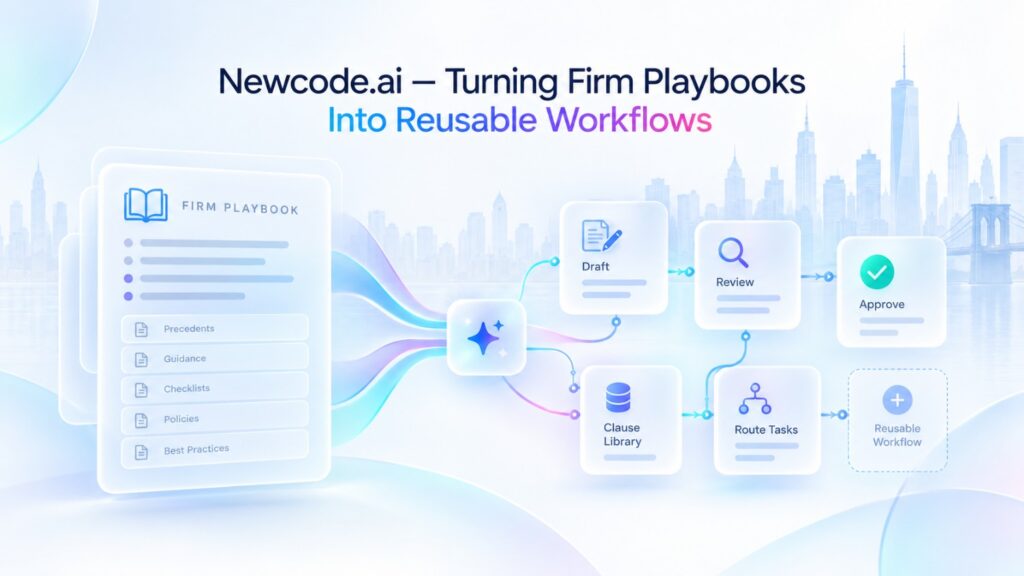
Newcode is trying to turn that knowledge into something AI can execute.
A Firm’s Playbook Can Become Software
Consider acquisition agreement review.
A firm may have very specific views on indemnities, liability caps, representations, closing conditions, and dozens of other provisions.
A junior lawyer learns those preferences slowly.
An AI agent can potentially receive them directly.
Instead of giving the model a long prompt every time, a firm can build a reusable process.
The process can define the documents to examine, preferred clauses, risk limits, required sources, escalation rules, and human review points.
That turns legal knowledge into infrastructure.
Why Configurability Matters
Law firms often resist software that forces them into someone else’s workflow.
Newcode’s configurable model addresses that concern.
Different practices can create different workflows.
An M&A group may need one process.
A litigation team may need another.
A real estate group may need another.
The platform becomes valuable when firms can adapt the agent around their own methods rather than changing their methods to fit the tool.
This could become an important competitive category because legal AI is moving beyond generic intelligence.
The next fight is about whose workflow the AI follows.
5. Irys — Building an Agentic Workspace Around Legal Matters
Irys takes a broad-platform approach.
Instead of focusing only on research or contracts, the company is building a legal workspace where AI can move between research, drafting, matter context, documents, and external applications.
That is important because lawyers rarely perform a task inside one software window.
The Problem With Isolated Legal AI
Imagine preparing a legal memo.
The lawyer may need to review client emails.
Then search the firm’s documents.
Then research authorities.
Then compare previous work.
Then write in Word.
Then send the draft to someone else.
A chatbot sitting in a separate browser tab only helps with fragments of this workflow.
An agentic workspace can potentially coordinate the steps.
Irys has built integrations with common business applications and allows the system to conduct work across connected information.
This Starts to Look Like an AI Associate
The assistant model waits for instructions.
An associate receives an assignment.
The associate determines what information is needed, finds the information, conducts the research, prepares a work product, and brings it back to a supervising lawyer.
That is the mental model agentic legal platforms are moving toward.
The human remains responsible.
The AI performs more of the preparation.
The difference could be economically significant because preparation consumes an enormous portion of professional time.
6. Darrow — Using AI to Find Legal Opportunities Before Lawyers Know They Exist
Darrow approaches legal AI from another direction.
Instead of helping lawyers after a matter has begun, it uses AI to identify possible legal issues before the firm has a case.
That makes the company particularly interesting for litigation.
Finding the Matter Can Be Harder Than Working the Matter
Plaintiff-side firms often depend on referrals, complaints, news stories, industry contacts, or manual research to discover possible cases.
Those methods are limited.
A human research team cannot continuously examine enormous amounts of public information.
AI can.
Darrow analyzes large pools of information to identify signals that may indicate legal exposure.
The system can then help firms understand which opportunities deserve closer examination.
Agents Can Monitor Instead of Search
This represents one of the most important ways AI agents differ from normal research tools.
Traditional search begins when the lawyer types something.
An agent can keep watching.
It can examine new information as it appears.
It can compare those signals with predefined legal patterns.
It can identify changes.
It can prioritize them.
This turns research from an occasional action into a continuous system.
For litigation firms, that could create value long before a complaint is drafted.
7. August — Bringing Advanced Legal AI to Midsize Firms
The largest global law firms have substantial technology budgets.
They can hire innovation teams, data specialists, engineers, knowledge lawyers, and consultants.
Most midsize firms cannot.
That creates a market gap.
August is trying to fill it.
Midsize Firms Need Capability Without Huge Implementation Teams
A 150-lawyer firm still performs complex work.
It still reviews thousands of documents.
It still handles due diligence.
It still drafts motions.
It still performs legal research.
It still negotiates agreements.
What it may not have is a 25-person AI implementation team.
August’s strategy is to make advanced workflows easier to configure and adopt.
The product supports areas including research, drafting, document review, due diligence, discovery, and legal communications.
The Opportunity Is Larger Than Small-Firm Automation
August has also gained attention from larger firms.
That matters because a product that begins by solving the usability problem for midsize firms can eventually compete higher in the market.
The dividing line between “Big Law AI” and “midsize AI” may therefore disappear.
The companies that make advanced workflows easiest to deploy could gain ground across both categories.
8. Hebbia — Large-Scale Document Reasoning for Legal Work
Hebbia is different from most companies in our ranking because it is not exclusively a legal technology startup.
Its broader focus is knowledge work.
But legal work is one of the clearest applications of its technology.
Legal Matters Are Often Massive Data Problems
A simple AI demonstration usually starts with one document.
Real legal matters do not.
A lawyer may need to analyze 250 leases.
A diligence team may review thousands of contracts.
A litigation group may work through enormous discovery collections.
A corporate team may need to compare hundreds of agreements against the same set of questions.
The difficulty is not merely understanding each document.
It is performing consistent analysis across all of them.
Why Structured Reasoning Matters
Hebbia’s Matrix product was built around large collections of information.
Users can define questions or workflows, examine results across many documents, and trace answers back to sources.
That becomes valuable in law because a conclusion is only useful when the lawyer can verify it.
The ability to show where information came from is therefore not simply convenient.
It is part of the legal product.
9. Lucio AI — Combining Legal Research, Drafting, and Firm Knowledge
Lucio AI is building a broader legal workspace.
Its approach reflects another major trend in the market: legal AI products are moving away from isolated features.
Research alone is not enough.
Drafting alone is not enough.
Document review alone is not enough.
Lawyers increasingly want those capabilities connected.
The Workspace May Become More Important Than the Model
The biggest AI labs can all produce increasingly capable language models.
Legal software companies therefore need a different advantage.
One advantage is workflow design.
Another is firm context.
A third is integration.
If the lawyer can search legal authorities, inspect firm knowledge, review documents, draft in Word, and work with email without constantly moving information manually, the software becomes more valuable.
Lucio is positioned around that broader idea.
The real competition will be whether legal professionals prefer one unified environment or a combination of specialized agents.
10. Ares — Building Legal AI Around Personal Injury Work
Ares shows why vertical legal AI may become a powerful category.
Instead of building for every type of lawyer, the company focuses heavily on personal injury firms.
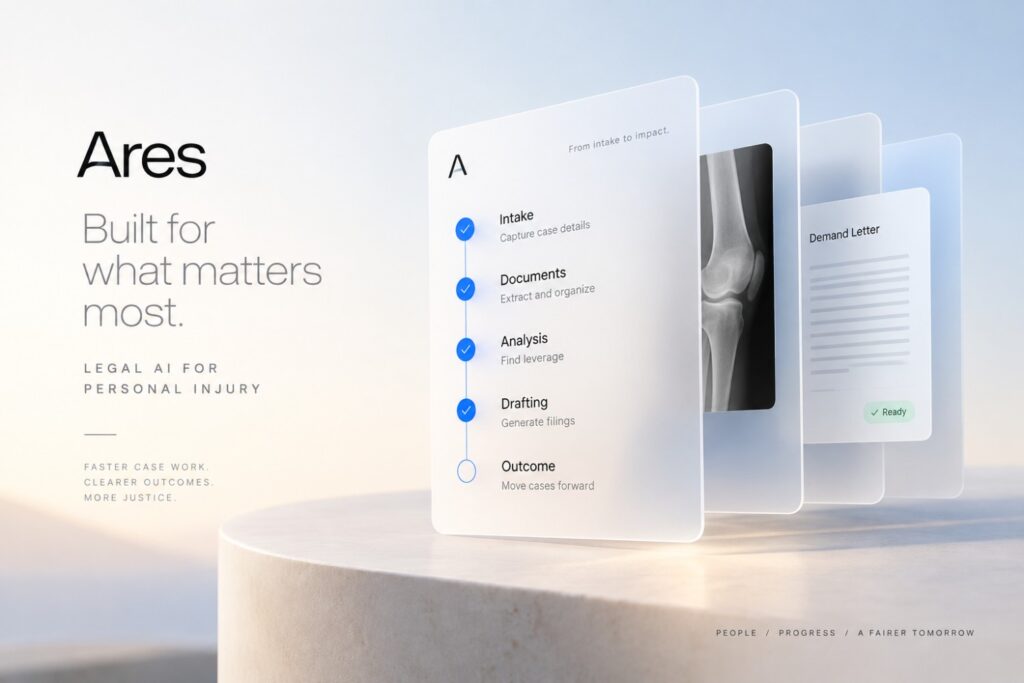
That allows it to design around a very specific set of documents and processes.
Personal Injury Contains Repetitive, Data-Heavy Work
A personal injury matter can involve hundreds or thousands of pages of medical information.
Someone needs to understand the treatment timeline.
Bills need to be reviewed.
Important medical events must be identified.
Demand letters need to connect the facts with the claim.
Discovery can create another large document load.
Much of this work is necessary but highly time consuming.
AI can organize the information before the attorney applies legal judgment.
Vertical AI Has a Clear Measurement Advantage
A broad AI platform can be difficult to evaluate because it performs many different tasks.
A personal injury tool can be tested against real personal injury cases.
Did it identify every important treatment event?
Did it correctly calculate medical costs?
Did it cite the supporting records?
Did it miss a major fact?
Those questions produce concrete performance measures.
That makes vertical legal AI especially interesting.
11. Unfold Legal AI — Automating Immigration Petition Preparation
Immigration law is another strong vertical for workflow automation.
The work combines structured requirements with large amounts of client information and supporting evidence.
Unfold is focused on helping legal teams prepare those matters more efficiently.
Petition Work Contains Many Steps Before Drafting Begins
An immigration petition does not begin with writing.
The firm must gather information.
Documents must be collected.
Evidence must be classified.
Missing material must be identified.
The legal theory needs to be supported.
Only then can the final package be prepared.
A system that automates only the writing stage leaves most of the operational work untouched.
An agentic system can potentially assist much earlier.
That is where the larger opportunity lies.
12. Rendex — Making Private Legal AI Part of the Infrastructure
Rendex is one of the younger companies in our analysis, but it represents a problem that could become increasingly important as agents gain more access.
Privacy.
A simple chatbot might receive one uploaded document.
An agent may eventually access email, case files, deal documents, research systems, client records, and internal knowledge.
The security question therefore becomes much larger.
More Useful Agents Need More Sensitive Access
Every additional integration increases capability.
It also increases risk.
A firm might want an agent to understand its entire matter history.
That would make the system extremely useful.
It would also mean giving the system access to enormous amounts of privileged information.
Rendex is focused on private and controlled AI deployment models that give legal organizations tighter control over where sensitive information is processed.
The company is early, but the issue it is addressing is likely to grow.
Why Legora Still Matters to the New York Market
Legora is not included in our main NYC ranking because it is not headquartered in New York.
It still deserves attention.
The company has expanded its U.S. presence in New York and has been building a larger engineering and operating footprint in the city.
That reinforces a broader conclusion from our research.
New York is becoming important not only because it produces legal AI startups.
It is becoming a place where international legal AI companies want engineers, customers, lawyers, and product teams.
The local market is valuable enough that companies increasingly need a meaningful NYC presence.
Original Finding #4: Drafting Is Crowded, but Workflow Coordination Is Still Wide Open
When we mapped what the companies in our sample actually do, one pattern stood out.
Drafting and document analysis are heavily contested areas.
Workflow coordination is less crowded.
Where the Companies Are Concentrating
| Workflow Layer | Selected Companies |
| Research and knowledge | Irys, Hebbia, Lucio AI, August, Newcode |
| Drafting and document review | Crosby, Irys, August, Lucio AI, Newcode, Ares |
| Legal intake and operations | Sandstone, Newcode, Irys |
| Compliance and regulatory workflows | Norm AI, Lucio AI |
| Litigation intelligence | Darrow, Ares, Irys |
| Practice-specific case production | Ares, Unfold |
| Private AI infrastructure | Rendex, Newcode, Irys |
| AI-native legal-service delivery | Crosby, Norm-related legal services |
This tells us where the next opportunity may be.
Generating the first draft is useful.
Coordinating everything before and after the draft can be even more valuable.
The Bigger Opportunity Is Automating the Work Between Legal Tasks
Consider what actually happens when a contract reaches a corporate legal department.
The agreement arrives.
Someone decides whether the matter is urgent.
The business owner may need to provide missing information.
The lawyer checks the customer or vendor.
Previous contracts may need to be found.
The firm’s playbook must be located.
The agreement is reviewed.
Changes are drafted.
Unusual terms are escalated.
Comments return from the other side.
A second review begins.
Approvals may be needed.
The contract gets signed.
Important obligations may then need to be tracked.
If AI only generates the redline, it automates one step.
The much larger opportunity is coordinating the entire chain.
That is why integrations, workflow engines, permissions, and institutional memory matter so much.
The winning legal AI platform may not have the most impressive single response.
It may be the system that eliminates the most unnecessary movement between people and software.
Original Finding #5: Institutional Memory Could Become the Strongest Legal AI Moat
Almost every serious AI company can access powerful foundation models.
That makes raw model intelligence less unique.
A firm’s own knowledge is different.
Its previous deals cannot be downloaded from a public dataset.
Its partner preferences are not available to competitors.
Its client history is private.
Its risk tolerance has developed over years.
Its negotiation patterns are specific.
Its best arguments have been shaped through real matters.
This creates a major opportunity.
The Firm That Remembers Every Matter Has an Advantage
Imagine a lawyer beginning a negotiation with a large commercial counterparty.
Today, that lawyer may search old emails and documents to learn what happened before.
A future agent could immediately know.
It could identify the last five agreements.
It could show which clauses created problems.
It could identify what the counterparty eventually accepted.
It could surface the partner’s preferred fallback language.
It could even show how long the previous negotiations took.
That is much more valuable than a generic contract summary.
The AI becomes useful because it remembers the organization.
This is one reason companies such as Sandstone, Newcode, Irys, August, and Crosby are important.
They are not only trying to provide intelligence.
They are trying to connect intelligence with institutional context.
Law Firms Should Stop Testing AI With Impressive Demo Questions
Legal AI demos can be misleading.
The cleanest demonstrations use carefully selected documents and predictable questions.
Real work is messier.
Files are missing.
Documents have confusing names.
Emails contradict contracts.
The client changes instructions halfway through the matter.
One version of a document is wrong.
A partner has an unwritten preference.
That is where an AI system needs to prove itself.
Test Historical Matters Instead
A better evaluation method starts with completed work.
Choose old matters where the firm already knows the correct answer.
Then give the system the same source information.
Measure what happens.
Did the agent find every important issue?
Did it cite the correct sources?
Did it follow the firm’s rules?
Did it know when information was missing?
Did it ask for clarification at the right point?
Did it escalate risky issues?
How much human correction was needed?
How long did the entire workflow take?
Those questions reveal far more than asking whether the interface looks impressive.
The KPI Dashboard Every Law Firm Should Build
Legal teams should not measure agent performance with vague statements such as “people seem faster.”
They need a dashboard.
The correct unit is not the number of AI prompts.
It is the amount and quality of completed legal work.
Metrics That Actually Matter
| KPI | What It Reveals |
| Human minutes per completed matter | Whether lawyer time is actually falling |
| End-to-end turnaround time | Whether work reaches clients faster |
| Material issue recall | Whether the system finds important problems |
| False-positive rate | Whether lawyers waste time checking meaningless flags |
| Human correction rate | How much AI output must be repaired |
| Citation accuracy | Whether research and factual claims can be trusted |
| Escalation accuracy | Whether the agent knows when human judgment is required |
| Playbook adherence | Whether firm rules are being followed |
| Cost per completed workflow | Whether AI is economically useful |
| User adoption | Whether lawyers are actually using the product |
| Client satisfaction | Whether faster service is still good service |
| Margin impact | Whether efficiency improves the economics of the matter |
The last point matters.
A system can be technically impressive while producing little business value.
Suppose an AI drafts an answer in 30 seconds but a lawyer needs 50 minutes to correct it.
That may be worse than a system that takes three minutes and requires only five minutes of review.
Legal leaders should measure the full workflow.
Client Pressure Could Accelerate Agent Adoption
Law firms are not evaluating AI in isolation.
Clients are watching.
Corporate legal departments increasingly understand that AI should reduce at least some of the cost and time required for legal work.
That creates pressure on outside counsel.

If a client believes a firm can perform a routine review far faster with AI, the client may eventually question why traditional billing remains unchanged.
This creates a pricing problem for the legal industry.
Hourly Billing Does Not Naturally Reward Automation
If technology reduces a ten-hour task to two hours, a pure hourly model can reduce firm revenue.
That creates the wrong incentive.
Fixed-fee work behaves differently.
Subscription arrangements behave differently.
Portfolio pricing behaves differently.
Outcome-based pricing behaves differently.
Those models allow firms and clients to share productivity gains.
Agentic AI could therefore accelerate changes in law-firm pricing even if the technology never replaces a single attorney.
Doing Nothing Does Not Eliminate AI Risk
Some firms respond to uncertainty by delaying formal AI adoption.
That can create a different problem.
Lawyers may use consumer AI tools anyway.
This is often called shadow AI.
The firm may believe it has avoided risk because it has not approved a platform.
In reality, it may simply have lost visibility into how employees are using AI.
Governed AI Can Be Safer Than Invisible AI
The better strategy is to provide approved systems with clear rules.
Lawyers need to understand what information can be entered.
They need to know which tools can access client material.
They need to know when human review is mandatory.
They need training on citation checking and hallucination risk.
Most importantly, the approved tools need to be useful.
A policy will fail if the secure system is so frustrating that employees quietly return to consumer products.
A Practical 90-Day Legal Agent Plan
Law firms do not need to automate everything at once.
That is usually a bad idea.
The better approach is to choose one high-volume workflow and test it rigorously.
Contract review is one option.
Due diligence is another.
Litigation chronology creation can work.
Regulatory checking can work.
Immigration preparation can work.
The best starting workflow is repetitive enough to measure but important enough that improvements matter.
Days 1–30: Measure the Current Process
Start without AI.
Document how the workflow operates today.
How long does it take?
Who touches the matter?
Where does the lawyer search for information?
Which tasks require legal judgment?
Which tasks are mainly reading, checking, copying, formatting, or organizing?
Where do errors occur?
What causes delay?
This baseline is essential.
Without it, the firm cannot know whether AI created value.
Days 31–60: Run the Agent Beside the Human Process
Do not replace the old workflow immediately.
Run both.
Let the AI complete the task.
Then compare its output with the normal process.
Record every correction.
Track every missed issue.
Measure review time.
Examine hallucinations.
Watch whether the system escalates uncertain cases.
This stage reveals the boundaries of the technology.
Days 61–90: Redesign the Workflow
If the system performs well, do not simply insert it into the old process.
Change the process.
Suppose a junior associate previously spent three hours building a factual chronology.
If the agent can produce a reliable first version in minutes, the associate should not spend the saved time recreating the same work manually.
The associate should verify the chronology and spend the remaining time thinking about what the facts mean.
That is where the real gain appears.
AI should reduce mechanical production and create more room for professional judgment.
Which NYC Legal AI Companies Should Different Buyers Study?
Different buyers have different needs.
A highly regulated bank does not face the same problem as an immigration boutique.
A litigation practice does not need the same workflow as a corporate legal department.
The right product depends on the job.
| Buyer | Companies Worth Studying | Why |
| Regulated enterprise | Norm AI | Strong regulatory and compliance focus |
| Corporate legal department | Sandstone | Intake, operations, context, and institutional knowledge |
| Company needing commercial legal services | Crosby | AI-native legal delivery |
| Firm building custom workflows | Newcode.ai, August | Configurable legal processes |
| Firm seeking broad legal workspace | Irys, Lucio AI | Research, drafting, review, and matter context |
| Plaintiff litigation practice | Darrow | Identifying and evaluating legal exposure |
| Personal injury firm | Ares | Medical and case-specific workflow automation |
| Immigration practice | Unfold Legal AI | Petition preparation |
| Privacy-sensitive legal organization | Rendex | Private deployment and data control |
| Document-heavy professional team | Hebbia | Large-scale structured document analysis |
No law firm should select a product based entirely on a market map.
A serious buyer should run competing platforms against its own work.
Five Questions to Ask Every Legal AI Agent Vendor
What Can the System Complete Without Another Prompt?
Ask the company to demonstrate a complete workflow.
Pay attention to how often the salesperson needs to intervene.
A platform is not highly agentic if a human secretly guides every step.
You want to understand which decisions the software makes itself.
What Causes the Agent to Stop?
This is one of the most important questions in legal AI.
A useful agent must know its limits.
Can administrators define situations where the system must stop?
Can unusual risk trigger human review?
Can certain actions require approval?
Different matters may need different controls.
Autonomy without boundaries is not a strength.
Can the Lawyer Verify Every Important Claim?
Ask to see the evidence.
A legal answer should connect back to the underlying document or authority whenever possible.
Beautiful prose is not proof.
The faster AI becomes, the more valuable verification becomes.
Can the Platform Learn Our Firm’s Way of Working?
Ask whether it can use playbooks.
Ask about templates.
Ask about previous matters.
Ask about approved clauses.
Ask about partner preferences.
Ask how that knowledge is stored.
Ask which users can access it.
The strongest long-term value often comes from firm-specific context.
How Is the Agent Evaluated?
AI systems change.
Models are upgraded.
Prompts are modified.
New features are added.
A vendor should have a process for testing whether those changes make the system better or worse.
Ask about benchmark matters.
Ask about regression testing.
Ask how hallucinations are measured.
Ask whether your organization can create its own evaluations.
A serious enterprise product should have serious answers.
The Human Review Layer Is Not Going Away
The rise of AI agents does not mean professional judgment is disappearing.
In many ways, judgment becomes more important.
When software performs more of the routine work, the human increasingly becomes responsible for reviewing, deciding, approving, and managing risk.
That changes the job.
Lawyers Move From Producing Everything to Controlling the Process
A junior lawyer today may spend hours building a first draft.
A junior lawyer in an agentic workflow may receive a first draft almost immediately.
The work then becomes different.
Is the source correct?
What did the AI miss?
Which assumption is unsafe?
What question should have been asked?
What does the client actually want?
Which risk is worth accepting?
Those are more difficult questions.
They are also more valuable.
The Junior Associate Model Will Need to Change
There is one major problem law firms should not ignore.
Many tasks most suitable for AI are the same tasks firms traditionally use to train junior lawyers.
Research.
Document review.
First drafts.
Due diligence.
Chronologies.
Basic contract analysis.
Those assignments may feel repetitive, but they also teach pattern recognition.
If firms remove the work without replacing the learning, associate development could suffer.
Firms Need a New Training System
Junior lawyers may need more direct exposure to decision-making.
They may need to review AI work against expert examples.
Partners may need to explain why an answer is wrong rather than simply rewriting it.
Associates may spend more time comparing alternatives.
They may participate in client conversations earlier.
They may learn through supervision rather than production volume.
This transition could ultimately produce stronger lawyers.
It will not happen automatically.
Why New York Could Become the World’s Most Important Legal AI Test Market
New York does not necessarily need to become the place where every foundation model is built.
Its strength is somewhere else.
It has customers.
A legal AI founder in Manhattan can reach some of the world’s largest law firms, financial institutions, insurers, asset managers, private equity firms, media companies, technology companies, and real estate businesses without leaving the city.
That creates unusually fast product feedback.
Buyer Density Can Become a Startup Advantage
A compliance startup can work directly with regulated financial organizations.
A transaction platform can speak with M&A lawyers.
An in-house legal product can recruit experienced general counsel.
A litigation company can learn from major trial practices.
An AI-native firm can serve fast-growing startups and established companies.
The distance between builder and buyer is small.
That matters in a product category where understanding the workflow is often harder than building the interface.
What Could Slow the Legal Agent Market?
The opportunity is large.
The risks are equally real.
Hallucinations Become More Dangerous When Agents Take More Steps
A chatbot can make one mistake.
An agent can build several later actions on top of that mistake.
Imagine an agent incorrectly identifying a contract provision during step two.
It then uses that conclusion when drafting revisions, preparing a risk summary, and recommending an approval path.
The final work can look polished even though the foundation is wrong.
That is why verification must exist throughout the workflow.
Access Control Becomes Harder
Useful agents need information.
More useful agents need more information.
That may include email, document systems, client records, CRM platforms, billing data, internal chats, and previous matters.
Permissions must follow the underlying systems.
An AI agent should not gain access to information simply because the model can technically search for it.
Client Rules May Differ
One client may allow AI use.
Another may restrict it.
A third may allow some tools but not others.
The firm therefore needs matter-level governance.
One universal AI policy may not be enough.
AI Still Has a Cost
Automation is not free.
Firms may pay for software licenses, model usage, cloud infrastructure, integrations, security reviews, training, data preparation, and internal technical staff.
The correct question is not whether AI costs less than a human per minute.
The correct question is whether the complete AI-supported workflow costs less while maintaining or improving quality.
The Bigger Story: Legal AI Is Becoming an Operating-System Competition
The first stage of the legal AI market focused heavily on models.
Which model gives the best answer?
Which model produces the best draft?
Which model understands the longest document?
Those questions still matter.
They are becoming less decisive.
The larger question is now:
Which system can reliably run the legal workflow?
That requires more than intelligence.
It requires permissions.
Data.
Firm knowledge.
Integrations.
Templates.
Playbooks.
Evaluation.
Security.
Audit logs.
Sources.
Approval gates.
Matter context.
Human supervision.
The company that connects those pieces becomes much harder to replace than a standalone chatbot.
That is why so many legal AI startups are expanding toward platform territory.
Three Predictions for the Next Stage of NYC Legal AI
Specialized Agents Will Mature Faster Than Universal AI Lawyers
A universal AI lawyer sounds exciting.
A specialized agent is easier to trust.
Personal injury work has repeatable data.
Immigration petitions follow recognizable structures.
Compliance can be tested against known rules.
Contract playbooks can define acceptable positions.
Specialization makes evaluation easier.
For that reason, narrow agents may become production-ready faster than fully general legal systems.
Workflow Libraries Will Replace Prompt Libraries
Many firms currently maintain collections of useful prompts.
That is an early-stage approach.
A workflow is more valuable.
Instead of saving a prompt called “Review NDA,” the firm can save the complete NDA process.
The system can know which playbook applies.
It can find the correct documents.
It can identify deviations.
It can draft changes.
It can request approval when needed.
It can record the final outcome.
That turns AI from a writing aid into a reusable legal process.
Buyers Will Demand Measurable Outcomes
“Save time with AI” will stop being enough.
Law firms and legal departments will want evidence.
How much faster is the workflow?
How often does the AI miss material issues?
How often does a lawyer correct the result?
What does each completed matter cost?
How many more matters can the team handle?
Does client satisfaction improve?
The vendors that can answer those questions will be in a stronger position than those relying on impressive demonstrations.
What New York Legal Leaders Should Do Now
The legal AI market is mature enough that ignoring it has become difficult.
It is not mature enough to justify blind deployment.
The right strategy sits between those extremes.
Choose one important workflow.
Measure the current process.
Identify the repetitive steps.
Decide where human judgment must remain.
Test multiple vendors using historical matters.
Measure accuracy as carefully as speed.
Create approval rules.
Train lawyers to supervise AI.
Then expand only when the data supports expansion.
The goal should never be “use more AI.”
The goal should be a measurable business outcome.
Reduce contract turnaround from four days to one.
Review 500 agreements without hiring five additional associates.
Build litigation chronologies in hours rather than days.
Find compliance problems before they reach final approval.

Answer routine internal legal requests without repeatedly rebuilding the same analysis.
Prepare the first version of a petition while keeping an attorney responsible for the final work.
Those are real goals.
The technology matters only when it helps achieve them.
Conclusion: The Legal Agent Race Is Really a Race to Redesign Legal Work
New York’s legal AI market is becoming much more interesting than a competition over who can build the smartest chatbot.
Norm AI is trying to turn law and regulation into executable systems.
Sandstone is rebuilding the operating layer of corporate legal departments.
Crosby is redesigning the law firm itself around humans and AI agents.
Newcode is turning firm knowledge into repeatable processes.
Irys is connecting research, documents, drafting, and applications inside an agentic workspace.
Darrow is using AI to find legal opportunities before lawyers would traditionally know where to look.
August, Hebbia, Lucio AI, Ares, Unfold, and Rendex are approaching the same transformation from different directions.
The common pattern is clear.
Legal AI is moving from helping professionals complete isolated tasks to helping organizations run complete workflows.
That does not mean the lawyer disappears.
It means the lawyer’s role changes.
The most valuable legal teams will probably not be the teams that give AI the most freedom.
They will be the teams that understand exactly which work should be automated, exactly where a human should intervene, and exactly how to measure whether the new system is better than the one it replaced.
For New York law firms and corporate legal departments, that is the real opportunity.
The next legal technology advantage will not come from generating more words.
It will come from building a better system for getting legal work done.