


New York’s artificial intelligence story is becoming far more interesting than the usual race to build larger language models or more powerful general-purpose assistants. Some of the most promising AI companies in the city are taking a different path by focusing on specific industries where New York already has enormous strength, including finance, accounting, healthcare, law, insurance, real estate, private equity, restaurants, travel, industrial operations, and professional services.
This is the rise of vertical AI, and New York may be one of the best cities in the world for building it. Instead of creating one AI assistant that tries to help every kind of worker, vertical AI startups build highly specialized systems that understand the processes, documents, data, rules, and decisions inside one particular industry.
A finance-focused AI platform, for example, may understand earnings calls, SEC filings, valuation models, confidential deal documents, and investment committee workflows. A healthcare AI company may focus on medical referrals, patient intake, insurance requirements, clinical documents, and scheduling. A real estate AI platform may understand leasing, renewals, maintenance requests, energy use, building systems, and property-management software.
The difference is important because valuable enterprise AI needs to do more than produce good-looking answers. It must understand how work actually moves through an organization, where information comes from, who is allowed to see it, which actions require approval, and what happens when something unusual occurs.
This is exactly why New York has become such an interesting market for vertical AI.
The city contains one of the highest concentrations of banks, investment firms, hospitals, law firms, accounting companies, property owners, insurers, media companies, restaurants, and professional-services businesses in the world. Those organizations employ large numbers of highly paid workers who still spend significant amounts of time reading documents, moving information between systems, checking rules, updating spreadsheets, preparing reports, responding to requests, and completing repetitive administrative tasks.
That creates a very attractive environment for specialized AI.
The New York metropolitan area attracted approximately $28.5 billion in venture investment in 2024, making it the second-largest venture capital market in the United States. Software and technology services represented more than half of total regional investment, while AI-related companies have increasingly attracted some of the largest funding rounds in the market.
The underlying employment base is just as important. New York City has hundreds of thousands of workers in financial services and professional business services, along with well over one million people working across education and healthcare. These are precisely the industries where specialized AI can create significant value because the work is expensive, complicated, document-heavy, and often governed by detailed rules.
To understand where the market is actually moving, NYC Tech Journal created an original dataset of 20 vertical AI companies with meaningful New York operations. We analyzed their sectors, products, disclosed financing activity, workflow focus, and strategic position to identify the patterns shaping the city’s vertical AI economy.
The clearest conclusion from our research is that New York is not simply becoming another general AI startup hub. It is emerging as one of the strongest environments for building artificial intelligence that understands how real industries operate.
What Is Vertical AI?
Vertical AI refers to artificial intelligence software built around the needs of a particular industry, profession, or tightly defined business workflow. Unlike general-purpose tools, these products are designed to understand the language, documents, rules, data structures, and operational steps that are common inside one specific market.
A general AI assistant might summarize a financial document. A vertical AI system for investment professionals could potentially review hundreds of documents in a virtual data room, compare management forecasts with historical results, identify customer concentration risk, create a draft investment memo, and show the original source behind each conclusion.
That second product is much harder to build because the AI cannot rely on general language ability alone. It must understand how investment professionals work, which numbers matter, how information should be checked, and where an error could create financial or regulatory problems.

The same principle applies in other industries. Healthcare AI must understand medical terminology and patient workflows. Accounting AI must work with ledgers, journal entries, reconciliations, tax rules, and audit evidence. Real estate AI needs to understand buildings, tenants, leases, maintenance, and property-management systems.
Vertical AI Is Moving Beyond the Copilot Model
The first wave of enterprise generative AI largely focused on assistants that helped employees complete individual tasks faster. Workers could ask AI to summarize a report, write an email, explain a document, or generate a first draft.
The next stage is moving much deeper into business operations.
Instead of simply helping someone understand a healthcare referral, an AI system may process the referral, identify missing information, check whether payer requirements have been met, route the case to the correct team, and follow up when action is needed. Instead of explaining an accounting issue, an AI agent may prepare a reconciliation, generate a journal entry, attach supporting evidence, and send the work to a human reviewer.
The important change is that AI is becoming part of the workflow itself rather than sitting beside it. Companies are beginning to move from asking AI for assistance toward allowing specialized systems to complete meaningful portions of operational work under defined controls.
That shift is one of the biggest reasons vertical AI has become such a valuable enterprise software category.
Why New York Is a Natural Home for Vertical AI
Silicon Valley remains exceptionally strong in foundational AI research, infrastructure, engineering talent, and venture funding. New York has a different advantage because it contains an unusually dense collection of large industries where even small improvements in productivity can be worth millions of dollars.
New York Has Expensive Problems Worth Automating
The economics are easiest to understand by looking at the people working inside the city’s major industries. New York employs hundreds of thousands of people in finance and professional services, and average compensation in many of these occupations is considerably higher than the national average.
That means the financial return from automation can be substantial even when an AI product saves only a modest amount of time. If a platform saves a banker, accountant, attorney, analyst, or property manager several hours each week, the value can quickly exceed the cost of the software.
This is very different from markets where labor is inexpensive and workflows are simple. In New York, companies often employ highly paid professionals to perform repetitive but important work, creating exactly the kind of environment where vertical AI can produce an attractive return on investment.
The Buyers Are Close to the Builders
New York also gives vertical AI founders access to customers who can provide detailed product feedback.
A startup building AI for investment banking can meet bankers without leaving Manhattan. A company developing software for private equity can speak directly with investment teams, operating partners, and fund managers. Legal AI founders can work with major law firms, while real estate startups can test products with some of the country’s largest property owners and managers.
Healthcare companies have access to hospitals, research institutions, physicians, insurers, medical schools, and healthcare operators. Restaurant technology startups can work with major chains and hospitality groups, while industrial companies can reach large operators through New York’s broader business network.
This proximity matters because vertical AI companies need more than talented engineers. They also need professionals who understand why a workflow exists, where mistakes usually happen, which exceptions matter, and what customers will trust enough to use in production.
New York Industries Produce Huge Amounts of Unstructured Data
Many of New York’s largest industries still depend heavily on documents, emails, PDFs, spreadsheets, transcripts, contracts, reports, forms, and older software systems. Employees often spend hours searching for information, transferring data between platforms, checking whether documents are complete, and producing recurring reports.
That creates a large opportunity for AI because language models are especially useful when information is scattered across many different formats. The value becomes even greater when specialized software can combine that information with industry rules and operating systems.
Vertical AI is therefore not simply about writing faster. It is increasingly about connecting information that was previously fragmented across entire organizations.
NYC Tech Journal Original Research: The NTJ Vertical AI 20 Dataset
For this article, NYC Tech Journal created the NTJ Vertical AI 20, an original editorial dataset covering 20 companies with a meaningful New York presence and a product that applies artificial intelligence to a defined industry or professional workflow.
Our objective was not to produce a ranking based only on funding or valuation. Instead, we wanted to understand where specialized AI companies are forming, which industries are receiving the most attention, and how capital is being distributed across the market.
How We Built the Dataset
Companies were included when they met four main conditions. Each business needed to have a meaningful New York headquarters or operating presence, use AI as a central part of its product, focus primarily on a specific industry or professional workflow, and show evidence of commercial progress through customers, enterprise adoption, institutional investment, partnerships, or deployment activity.
For financing analysis, we used the most recent publicly disclosed round for which a clear amount was available. This approach creates a more comparable dataset than mixing valuations, total funding, estimated capital, and undisclosed strategic investments.
The methodology still has limitations. Several companies have raised additional strategic funding without publishing the amount, while some funding databases report slightly different totals. Our figures should therefore be read as a standardized view of recent disclosed financing rather than a definitive measure of every dollar each company has raised.
The 20 Companies in the NTJ Vertical AI Dataset
| Company | Main vertical | Core AI workflow | Most recent disclosed round amount |
|---|---|---|---|
| EliseAI | Housing / healthcare | Leasing, resident and patient operations | $250M |
| Rogo | Finance | Financial research and investment workflows | $160M |
| Hebbia | Finance / legal | Large-scale document analysis | $130M |
| Norm AI | Legal / compliance | Regulatory and legal workflows | $120M |
| Tennr | Healthcare | Referral and patient-access operations | $101M |
| Basis | Accounting | Accounting, tax and audit agents | $100M |
| Rillet | Accounting / ERP | AI-native general ledger and finance operations | $100M |
| Runwise | Real estate / buildings | Automated building operations | $55M |
| Nayya | Employee benefits | Health and benefits guidance | $55M |
| Siro | Field sales | Conversation analysis and coaching | $50M |
| Daloopa | Finance | Structured fundamental financial data | $47M |
| Patlytics | Legal / IP | Patent research and analysis | $40M |
| Finster AI | Finance | Banking research and financial analysis | $26.5M |
| Aiera | Finance | Earnings and market intelligence | $25M |
| Ezra | Healthcare | AI-enabled MRI screening | $21M |
| Ataraxis AI | Healthcare | Cancer prognosis and treatment guidance | $20.4M |
| ToltIQ | Private markets | AI-powered due diligence | $12M |
| PreciTaste | Foodservice | Demand forecasting and kitchen planning | $6.36M |
| CVector | Industrial operations | Industrial decision intelligence | $5M |
| Acai Travel | Travel | AI-powered travel operations | $4M |
Chart 1: Where NYC Vertical AI Startups Are Concentrating
Our 20-company sample shows a strong concentration in finance and other professional industries.
| Sector | Companies | Share of sample |
|---|---|---|
| Finance and private markets | 6 | 30% |
| Healthcare and benefits | 4 | 20% |
| Accounting | 2 | 10% |
| Legal, IP and compliance | 2 | 10% |
| Real estate and buildings | 2 | 10% |
| Field sales | 1 | 5% |
| Travel | 1 | 5% |
| Industrial operations | 1 | 5% |
| Foodservice | 1 | 5% |
The most important finding is not simply that finance leads the market. The deeper point is that the distribution closely reflects New York’s existing economic strengths.
Six companies in the dataset directly target finance and private markets. When accounting, legal, and compliance businesses are added, half of the entire sample serves high-value professional work closely tied to New York’s business-services economy.
Healthcare contributes another significant group, which suggests that vertical AI startup geography may increasingly follow customer density rather than engineering density alone. Founders are building where they can sit close to buyers who understand the workflows they are trying to automate.
Chart 2: Capital Is Concentrated in High-Value Professional Industries
Using the latest disclosed round figures in our dataset, the 20 companies account for approximately $1.33 billion in standardized financing activity.
| Sector | Latest-round capital represented | Approximate share |
|---|---|---|
| Finance and private markets | $400.5M | 30.2% |
| Real estate and buildings | $305M | 23.0% |
| Accounting | $200M | 15.1% |
| Healthcare and benefits | $197.4M | 14.9% |
| Legal, IP and compliance | $160M | 12.0% |
| Field sales | $50M | 3.8% |
| Foodservice | $6.36M | 0.5% |
| Industrial | $5M | 0.4% |
| Travel | $4M | 0.3% |
Finance, real estate, accounting, healthcare, legal, and compliance together represent roughly 95% of the standardized funding pool. This concentration strongly suggests that investors are directing the largest amounts of capital toward industries where labor is expensive, workflows are difficult to automate, and customers have significant budgets.
The pattern also shows that vertical AI is not spreading evenly across the economy. Capital is moving fastest into sectors where a successful product can become deeply embedded in everyday business processes.
Chart 3: A Small Number of Companies Account for Most of the Capital
The funding distribution becomes even more interesting when we look at concentration among individual companies.
| Group | Capital represented | Share of sample capital |
|---|---|---|
| Top 3 companies | $540M | 40.7% |
| Top 5 companies | $761M | 57.3% |
| Top 7 companies | $961M | 72.4% |
| Top 10 companies | $1.121B | 84.4% |
| All 20 companies | $1.328B | 100% |
EliseAI, Rogo, Hebbia, Norm AI, Tennr, Basis, and Rillet account for more than 72% of the capital represented in our standardized dataset. This highlights how quickly venture funding is concentrating around companies that have already demonstrated strong enterprise demand.
The pattern matches the broader venture market, where larger deals have increasingly taken a greater share of total investment. In vertical AI, investors appear willing to place much larger bets once a company demonstrates that specialized AI can become part of a critical business workflow.
The Top 20 Vertical AI Startups in NYC to Watch

1. EliseAI — AI for Housing and Healthcare Operations
EliseAI is one of the clearest examples of how a vertical AI company can expand from a narrow workflow into a broader operating platform. The company initially focused on housing, where its technology helps property managers handle conversations and operational tasks involving prospective tenants and current residents.
Its platform can answer questions, schedule apartment tours, manage maintenance requests, support renewals, and coordinate communication across text, email, phone, and web channels. This gives property managers a way to automate a large amount of repetitive communication without building separate systems for each channel.
EliseAI has since moved into healthcare, showing how a company can take expertise in complex service workflows and apply it to another industry with similar communication challenges. The company raised a $250 million Series E in 2025 and later reported annual recurring revenue above $200 million.
Why EliseAI Matters
EliseAI matters because it shows what vertical AI can become when software moves beyond answering questions and begins managing real operations. The deeper the platform becomes connected to leasing, resident service, and property-management systems, the harder it becomes for customers to replace it with a basic chatbot.
The company also demonstrates one possible growth strategy for vertical AI. A startup can begin with one narrow workflow, become deeply embedded in that workflow, and then expand into additional industries where similar operational problems exist.
2. Rogo — Building an AI Analyst for Wall Street
Rogo is one of the strongest examples of New York’s financial industry turning directly into an AI startup opportunity. The company builds software for investment banks, asset managers, private equity firms, and other financial institutions that need to process large amounts of financial information quickly.
Its platform is designed around research, analysis, modeling, and document-heavy workflows rather than general conversation. Financial professionals can use the system to work with company filings, internal documents, market information, and investment materials while maintaining the controls required by institutional environments.
Rogo raised a $160 million Series D in 2026, taking its total funding above $300 million. The company has also reported serving more than 250 investment banks and investment firms.
Why Rogo Matters
Finance is one of the most difficult markets for generic AI because answers often need to be numerically correct, traceable, confidential, and consistent with internal information. A system that can meet those requirements has the potential to become much more valuable than a simple productivity tool.
Rogo also benefits directly from New York’s industry density. The company can hire people with banking experience, work closely with financial institutions, and receive detailed feedback from the very professionals whose work it is trying to improve.
3. Norm AI — Turning Regulation Into AI Workflows
Compliance and regulatory work represent one of the strongest possible vertical AI markets because the work is expensive, complicated, and difficult to automate safely. Norm AI is building systems that combine legal expertise with artificial intelligence to help institutions manage regulatory requirements.
The company’s approach is based on turning rules, legal obligations, policies, and controls into structured systems that AI agents can reason over. Rather than merely summarizing a regulation, the goal is to help organizations understand how that regulation applies to specific business activities.
Norm AI raised a $120 million Series C in 2026 at a reported valuation of $1.2 billion. It has also expanded into legal services through Norm Law, an affiliated AI-native law firm.
Why Norm AI Matters
The key challenge in compliance is that the answer cannot simply sound reasonable. Businesses need to know what rule applies, where the rule comes from, why a decision was made, and whether the process can survive review by lawyers, auditors, customers, and regulators.
This requirement creates a strong advantage for specialized AI products. The better the system becomes at connecting legal rules with real workflows, the more difficult it becomes for a generic assistant to compete.
4. Tennr — Fixing the Healthcare Referral Problem
Healthcare referrals often look simple from the outside, yet they involve a complicated chain of administrative work. Information may arrive through fax, email, scanned records, online portals, phone calls, or electronic health systems, and staff must often determine whether the referral is complete before a patient can move forward.
Tennr has built AI around this process. Its software helps healthcare providers extract information from referral documents, identify missing details, check requirements, route cases to the correct teams, and improve the visibility of patients moving through referral-based care.
The company raised a $101 million Series C in 2025 at a reported valuation above $600 million. Tennr has also said its system has processed millions of patients across hundreds of provider organizations.
Why Tennr Matters
Tennr shows how much opportunity exists in healthcare administration rather than diagnosis alone. Administrative friction can delay care, frustrate staff, and cause patients to disappear between providers.
An AI system that reliably improves referral operations can therefore create value for both healthcare organizations and patients. The company also illustrates why healthcare AI often needs specialized models and workflows rather than a generic language model placed on top of existing software.
5. Basis — AI Agents for Accountants
Accounting is becoming one of the most active vertical AI markets because many workflows combine structured financial information with repetitive professional judgment. Accountants need to prepare reconciliations, create journal entries, review documents, write technical memos, support audits, and complete tax-related work.
Basis is building AI agents specifically for these tasks. Rather than simply answering accounting questions, its systems are designed to complete longer workflows that may involve several steps, multiple documents, and human review.
The company raised $100 million in Series B financing in 2026 at a valuation above $1 billion. Its rapid growth reflects strong demand for tools that can help accounting firms handle more work without increasing staff at the same rate.
Why Basis Matters
The accounting industry faces a structural talent problem because many firms are finding it difficult to recruit and retain enough qualified accountants. At the same time, experienced professionals continue to spend large amounts of time on repetitive tasks that require attention but not always deep judgment.
If AI agents can complete meaningful portions of that work while maintaining accuracy and auditability, accounting firms may be able to increase capacity without relying entirely on additional hiring.
6. Rillet — Rebuilding the ERP Around AI
Rillet is approaching accounting AI from a different direction. Instead of adding AI to an existing accounting workflow, the company is building an AI-native financial system centered on the general ledger.
Its platform is designed to automate journal entries, reconciliations, close processes, financial reporting, and other accounting operations while preserving approvals and audit trails. This moves AI closer to the core system where financial records are actually maintained.
Rillet announced a $100 million Series C in August 2026 at a valuation of approximately $1 billion. The company has reported serving hundreds of customers and has also formed partnerships with major professional-services firms.
Why Rillet Matters
Rillet represents a major strategic question for the enterprise software market. The biggest threat AI creates for traditional software may not come from assistants added beside existing products, but from entirely new platforms designed around AI agents from the beginning.
If AI can reliably perform parts of accounting inside the system of record, the structure of ERP software could change significantly over the next several years.
7. Hebbia — Deep Research for Finance and Legal Work
Hebbia became one of the early New York companies to show how generative AI could be used for large-scale professional research. Its Matrix platform allowed users to analyze large collections of documents, ask structured questions across them, and organize results into useful outputs.
The product found strong adoption in finance and legal environments where professionals regularly review large quantities of material. Hebbia raised a $130 million Series B in 2024 at a reported valuation of roughly $700 million.
The company has since expanded its product beyond document analysis as competition in enterprise AI has increased. Newer versions of its software aim to help professionals create reports, tables, presentations, and other work products from large collections of information.
Why Hebbia Matters
Hebbia illustrates both the opportunity and the challenge of vertical AI. A strong product can gain attention quickly, but generic AI capabilities continue improving at an extraordinary rate.
That means vertical companies must keep moving deeper into customer workflows. Durable advantages are more likely to come from integrations, proprietary data, specialized workflows, and strong distribution than from a clever interface alone.
8. Runwise — AI Meets New York’s Buildings
Runwise brings vertical AI into the physical world. The company combines hardware, sensors, software, and intelligent controls to help building operators manage heating and related systems more efficiently.
This is especially relevant in New York because a large portion of the city’s building stock is older and expensive to operate. Many properties still rely on heating systems that can waste substantial amounts of energy when they are poorly controlled.
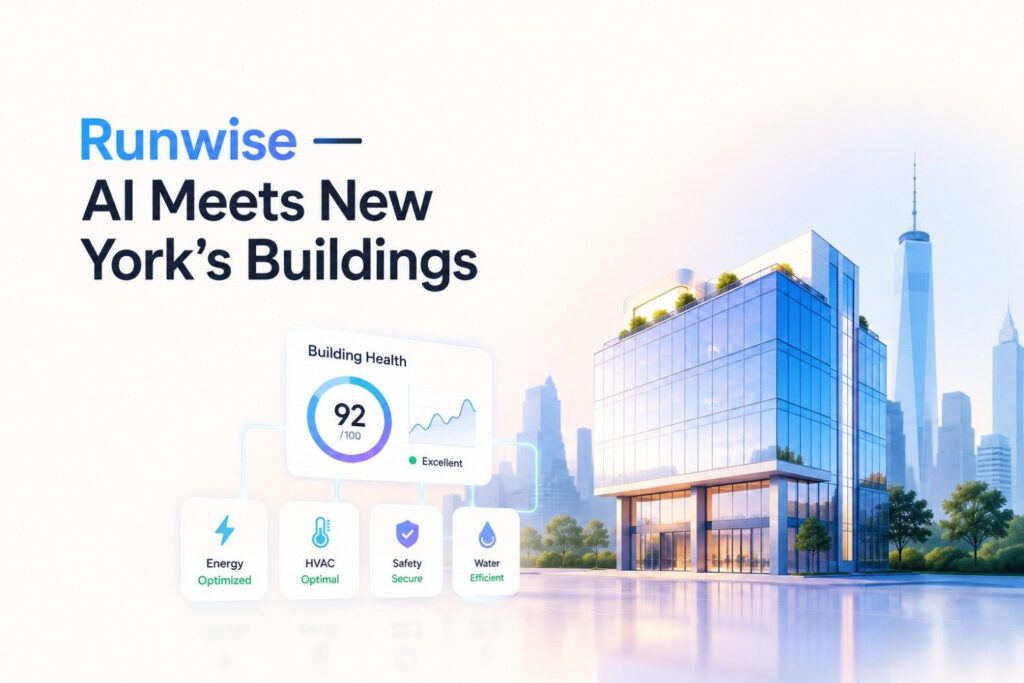
Runwise raised a $55 million Series B in 2025 and has reported deployments across thousands of buildings. Its technology gives property owners a way to reduce waste while improving visibility into how buildings are performing.
Why Runwise Matters
Runwise demonstrates that vertical AI is not limited to office work. Physical systems produce enormous amounts of valuable information, including temperature, weather, equipment performance, operating schedules, and energy consumption.
When AI can connect those signals and automatically adjust operations, the software begins to behave more like an operating system for the building than a simple analytics dashboard.
9. Siro — AI for Face-to-Face Sales
Most modern sales software has been designed around digital communication. Emails, video calls, online meetings, and CRM activity create large amounts of structured data that companies can analyze.
Face-to-face selling has remained much harder to measure. Siro is solving this problem by capturing in-person sales conversations and turning them into structured information that businesses can use for coaching and performance analysis.
Its technology is particularly relevant to industries such as home services, automotive sales, construction, and field-based selling. The company raised a $50 million Series B in 2025.
Why Siro Matters
Siro is important because it creates data where very little existed before. Field sales teams have traditionally depended heavily on manager observation, self-reported information, and final sales results.
Once conversations become measurable, companies can identify successful behaviors, understand customer objections, compare representatives, and improve coaching. This creates a new data layer that can support increasingly sophisticated AI applications.
10. Daloopa — Building the Data Layer for Financial AI
AI systems cannot produce reliable financial work if the underlying data is incomplete or inaccurate. Daloopa focuses on this foundational problem by extracting, organizing, and standardizing financial information from company filings and other primary sources.
Its platform creates structured datasets that analysts and AI systems can use for financial research and modeling. Importantly, the information can be connected back to the source so users can verify where a number came from.
Daloopa raised a $47 million Series C in 2026, taking total funding above $100 million. The company has positioned its data infrastructure as a foundation for both human analysts and AI agents.
Why Daloopa Matters
As financial institutions move AI into production, trusted data becomes increasingly valuable. A model may be excellent at reasoning, but it cannot compensate for incorrect financial inputs.
Daloopa therefore occupies an important position in the AI stack. It focuses less on the visible assistant and more on the reliable information required to make those assistants useful.
11. Patlytics — Vertical AI for Patents and Intellectual Property
Patent work involves large volumes of technical and legal information, making it an attractive market for specialized AI. Attorneys and corporate IP teams regularly conduct prior-art research, analyze claims, compare patent families, study technical documents, and investigate possible infringement.
Patlytics has built a platform specifically around these workflows. Its system aims to bring patent research, analysis, and related work into one environment rather than forcing professionals to move repeatedly between research tools, spreadsheets, and document systems.
The company raised a $40 million Series B, bringing total reported funding to approximately $65 million.
Why Patlytics Matters
Patent professionals do not simply need a better search engine. They need software that understands the structure and meaning of patent information, including claims, prosecution histories, patent families, technical language, and legal questions.
This specialization creates a stronger competitive position than generic document summarization. The more deeply Patlytics becomes embedded in intellectual-property workflows, the more useful its domain-specific knowledge becomes.
12. Finster AI — AI Infrastructure for Financial Professionals
Finster AI is another example of New York’s expanding financial AI cluster. The company is building an intelligence layer that combines structured financial data, unstructured information, and internal institutional knowledge.
Its platform is designed for research, banking, advisory, and other financial workflows where professionals need to work with both public information and confidential internal material. The company has also received strategic backing from major financial institutions and data providers.
Why Finster Matters
The opportunity in financial AI is not simply to create another chatbot. Financial institutions need systems that can connect trusted market data with internal knowledge while maintaining strict controls around access and confidentiality.
Finster is positioning itself around that need. If financial AI becomes an intelligence layer spread across existing systems, companies like Finster could become important infrastructure providers.
13. Aiera — Making Financial Information AI-Ready
Aiera focuses on financial research content, including earnings calls, investor events, transcripts, market information, and research materials. The company has developed tools that help professionals monitor and analyze these sources more efficiently.
It raised a $25 million Series B with participation from several major Wall Street research firms. The company has since expanded its positioning around the delivery of authorized research content into AI workflows.
Why Aiera Matters
One of the less obvious problems in enterprise AI is permission. A model may technically be able to analyze information, yet the customer may not have the right to reuse that information inside an AI system.
Financial firms must therefore consider licensing, ownership, access controls, and traceability. Aiera’s strategy addresses this problem by helping trusted research content move into AI systems without ignoring the rights attached to that information.
14. Ataraxis AI — Using AI to Guide Cancer Treatment
Ataraxis AI represents a very different side of New York’s vertical AI market. Instead of focusing on administrative work, the company applies artificial intelligence to precision medicine and cancer treatment.
Its systems analyze pathology images to help predict cancer outcomes and support treatment decisions. The company was spun out of New York University and raised a $20.4 million Series A in 2025.
Why Ataraxis Matters
Healthcare AI is often discussed in the context of diagnosis, but treatment decisions may represent an equally important opportunity. A system that helps identify which patients are more likely to benefit from aggressive treatment could potentially improve outcomes while reducing unnecessary side effects and costs.
This makes Ataraxis a strong example of vertical AI being applied to high-value clinical decisions rather than administrative productivity alone.
15. Ezra — Making MRI-Based Cancer Screening More Accessible
Ezra is another New York company applying AI to cancer care. Its platform combines artificial intelligence with MRI technology to support earlier cancer detection and improve the efficiency of full-body scanning.
The company has raised significant funding to expand its scanning network and develop AI that can reduce the time and cost associated with advanced imaging.
Why Ezra Matters
Healthcare AI does not need to replace doctors to create meaningful value. If software can reduce scanning time, improve image-processing workflows, and help medical infrastructure serve more patients, the economic effect can still be significant.
Ezra therefore represents a different form of healthcare automation where AI improves the efficiency of an expensive diagnostic process.
16. Nayya — AI for Health and Employee Benefits
Employee benefits are difficult to understand because workers often need to make decisions across health insurance, deductibles, claims, prescriptions, retirement plans, and employer programs. The information is complex, personal, and spread across multiple systems.
Nayya uses AI and employee data to help people understand and use their benefits more effectively. The company has also expanded toward agentic systems designed to guide workers through both health and financial-benefit decisions.
Why Nayya Matters
Benefits represent a strong vertical AI market because the problem combines complicated rules with personal information and time-sensitive decisions. A useful system must understand more than the meaning of an insurance term.
The long-term opportunity is to build software that can understand an employee’s situation, explain available options, recommend useful actions, and eventually help complete those actions.
17. ToltIQ — AI for Private Equity Due Diligence
Private equity professionals often need to review enormous amounts of information under strict deadlines. Investment teams may work through financial reports, customer data, legal documents, management presentations, and operational information before deciding whether to complete a transaction.
ToltIQ, formerly known as DiligentIQ, has built AI specifically for this due diligence process. The platform helps investment teams analyze documents, identify important information, structure findings, and create materials used during the investment process.
Why ToltIQ Matters
Private equity is one of the clearest examples of AI following expensive professional labor. Associates and other investment professionals spend large amounts of time reading documents, recreating analyses, and preparing recurring materials.
If AI can automate a meaningful percentage of that work while maintaining reliability, the financial return can be significant. The long-term opportunity is even larger if systems eventually connect sourcing, diligence, investment committee work, and portfolio monitoring.
18. CVector — AI for Industrial Decision-Making
CVector expands the New York vertical AI landscape beyond professional services. The company builds software for energy-intensive industrial businesses that need to understand how operational decisions affect production, energy use, downtime, and cost.
Its platform brings different streams of operational data together so industrial teams can make better decisions. CVector raised a $5 million seed round in early 2026.
Why CVector Matters
Industrial businesses already produce huge amounts of sensor and operational data, yet much of that information remains difficult to interpret in context. Traditional dashboards may show what happened without explaining what decision should be made next.
Vertical AI has the potential to connect engineering knowledge, operating conditions, cost data, and recommendations. This could make industrial systems significantly more responsive and efficient.
19. Acai Travel — AI for Travel Operations
Travel is filled with repetitive but complicated work. Agents must handle bookings, cancellations, airline rules, schedule changes, hotel information, customer requests, and corporate travel policies.
Acai Travel builds generative AI tools specifically for these workflows. Its software is aimed at travel agencies, airlines, hotels, travel-management companies, and other organizations where employees need to resolve large numbers of operational requests.
Why Acai Travel Matters
A generic AI system may understand the sentence “change my flight,” but that is only the beginning of the real workflow. A useful travel system needs to understand whether the ticket is changeable, what the airline allows, whether another flight is available, what the corporate travel policy permits, and which systems need to be updated.
This is a clear example of the difference between general language ability and genuine workflow automation.
20. PreciTaste — AI Inside the Restaurant Kitchen
Restaurants operate on thin margins and must constantly balance food preparation, customer demand, staffing, waste, and inventory. Managers often have to decide how much food to prepare before they know exactly how busy the next several hours will be.
PreciTaste applies AI to this problem through demand forecasting and kitchen planning. Its software can help restaurant teams decide what to prepare, when to prepare it, and how operational tasks should be prioritized.
Why PreciTaste Matters
Restaurant AI is useful only when it improves operating economics. A restaurant does not need a chatbot that sounds impressive if food waste remains high or staff continue preparing the wrong amount of product.
PreciTaste therefore represents a very practical form of vertical AI. Its value can be measured through lower waste, fewer stockouts, improved labor use, and more consistent kitchen execution.
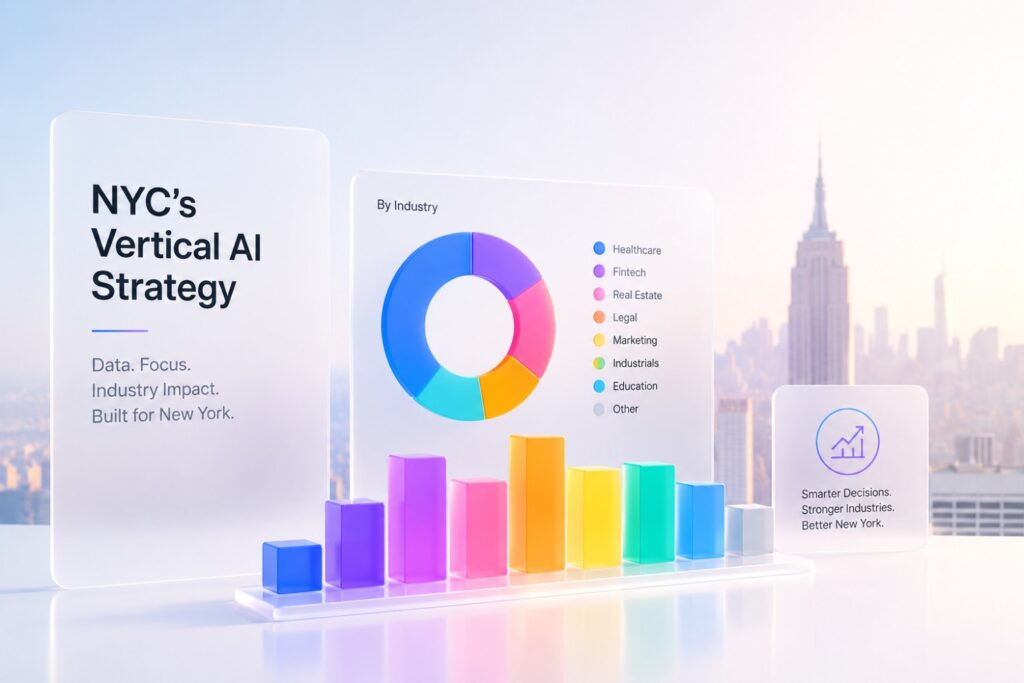
What Our Dataset Says About New York’s Vertical AI Strategy
Looking across all 20 companies reveals several patterns that are more useful than simply comparing funding rounds.
Finance Is Becoming an Entire AI Ecosystem
Finance represents 30% of the companies in our sample, but the companies are not all building the same product. Rogo focuses on financial workflows, Hebbia on document-heavy research, Daloopa on structured data, Finster on financial intelligence, Aiera on research content, and ToltIQ on private-market diligence.
This suggests that the financial AI market may support several major companies operating at different layers of the technology stack. Rather than one platform owning all financial AI, the industry may develop specialized systems for data, analysis, workflow automation, research, compliance, and transaction execution.
For New York, that is strategically important because it creates the possibility of an entire AI ecosystem growing around one of the city’s largest industries.
Vertical AI Is Moving Closer to the System of Record
Early generative AI tools often existed outside normal business systems. Employees copied information into a chatbot, received an answer, and then copied the result somewhere else.
The newer generation of vertical AI companies is moving directly into the workflow. Rillet sits close to the general ledger, EliseAI connects with property-management operations, Tennr becomes part of referral processing, and Runwise directly influences building systems.
This matters because software becomes more valuable when it is connected to the system where actual work takes place. A tool that controls important data, approvals, and actions is much harder to replace than a standalone assistant.
Workflow Knowledge May Be the Real Competitive Advantage
Most vertical AI companies use foundation models that competitors can also access. Model access alone is therefore unlikely to provide a long-term advantage.
The stronger moat often comes from the knowledge surrounding the model.
| Potential moat | Why it matters |
|---|---|
| Proprietary workflows | Generic AI does not automatically understand how industry work gets completed |
| Unique data | Specialized data can improve relevance and accuracy |
| Integrations | The product becomes connected to real operating systems |
| Human experts | Domain experts help encode complicated judgment |
| Auditability | Critical in finance, law, healthcare and accounting |
| Permissions | Important when information is confidential or licensed |
| Distribution | Existing industry relationships reduce sales friction |
| Customer feedback | Continuous use reveals important edge cases |
This explains why many successful vertical AI startups hire bankers, attorneys, accountants, doctors, operators, and industry specialists alongside engineers. Domain expertise is becoming part of the technical advantage rather than something separate from product development.
High Wages Make Vertical AI Easier to Justify
The economics of AI adoption depend heavily on whose time the software saves. In New York, many target users are highly paid professionals, which means relatively small productivity improvements can create meaningful financial returns.
Consider a 50-person investment team with an average fully loaded employee cost of $200,000. If an AI platform saves each person five hours every week, the business gains thousands of hours of professional capacity over the course of a year.
The company does not necessarily need to eliminate jobs to capture value. Employees can spend less time searching through documents, rebuilding recurring analyses, and moving information between systems, while using more time for client work, decision-making, negotiation, and other high-value activities.
This is why the best vertical AI companies often sell capacity rather than headcount reduction. The message is not simply that fewer people are required, but that the existing team can handle more valuable work.
Healthcare Could Become New York’s Next Major Vertical AI Market
Finance currently has the strongest presence in our dataset, but healthcare may eventually become an even larger opportunity.
New York has one of the country’s largest healthcare workforces, along with major hospitals, medical schools, research institutions, insurers, and technology companies. The industry also contains enormous amounts of administrative work that remains fragmented across outdated systems.
Tennr, Ataraxis AI, Ezra, and Nayya are already attacking different parts of the market, while EliseAI has also expanded into healthcare workflows.
The most important point is that healthcare AI is not one category. It includes clinical decision support, imaging, referrals, scheduling, benefits, documentation, revenue-cycle work, patient communication, and insurance operations.
Each of those areas could support several large companies.
What Businesses Should Learn From New York’s Vertical AI Startups
Companies evaluating AI should avoid beginning with the question, “Where can we use AI?” That framing is so broad that it often leads to expensive experiments with no measurable result.
A better approach is to begin with the workflow.
Find Expensive Repetition
Businesses should identify processes that consume significant skilled employee time and occur frequently. These might include reviewing similar documents, responding to recurring requests, transferring information between systems, preparing standard reports, rebuilding spreadsheets, checking work against rules, or searching repeatedly through the same sources.
Those tasks often provide much stronger AI opportunities than creative demonstrations because their cost can be measured clearly.
Measure the Existing Process Before Buying Software
Organizations should establish a baseline before introducing AI. Leaders need to know how long the process currently takes, how many employees are involved, how often mistakes happen, how much rework is required, and how long customers or internal teams wait for a result.
Without those numbers, it becomes difficult to determine whether the AI created any meaningful improvement.
A Practical Vertical AI Vendor Scorecard
Vertical AI should be evaluated more carefully than ordinary productivity software because the systems may eventually perform important business actions.
| Question | What a strong answer looks like |
|---|---|
| Does it understand our workflow? | The vendor can explain the process and important exceptions clearly |
| Can outputs be verified? | Sources and supporting evidence are available when needed |
| Does it integrate with existing systems? | Employees do not rely heavily on manual copying and pasting |
| Can humans approve important actions? | Review and escalation controls are built into the process |
| How does it handle unusual cases? | The vendor has designed workflows for exceptions |
| What happens to our data? | Privacy, security, and retention rules are clearly defined |
| Can permissions be enforced? | Users only access information they are authorized to see |
| What happens when the AI is uncertain? | The system can escalate rather than invent an answer |
| Can ROI be measured? | The vendor agrees on measurable success indicators |
| Can we leave later? | Data portability and switching costs are understood in advance |
The more important the workflow, the less weight businesses should place on an impressive demonstration. A reliable system that completes routine work correctly every day is far more valuable than a flashy assistant employees cannot trust.
What Investors Should Watch
Vertical AI investing also requires a different way of thinking about defensibility.
Be Careful With Thin AI Wrappers
A company can make a general-purpose language model look specialized by adding a strong prompt and a new user interface. That may create a useful product in the short term, but it does not automatically create a durable business.
Investors should ask what becomes harder to copy as the company grows. A strong answer might involve proprietary data, unique integrations, specialized workflows, regulatory expertise, customer relationships, distribution advantages, or access to a system of record.
If none of those advantages are developing, the product may eventually be absorbed into a larger software platform.
Watch Workflow Penetration Instead of User Count Alone
Monthly active users can be useful, but a more important metric may be how much of a customer’s workflow the product actually touches.
If an AI system is used for only 5% of an employee’s work, switching is easy. If the platform processes 70% of a workflow, connects to internal systems, stores approvals, and produces required outputs, replacement becomes much more difficult.
Vertical software has historically become powerful through deep workflow ownership. AI is likely to follow the same pattern.
What Could Go Wrong for Vertical AI?
The opportunity is large, but the market also carries meaningful risks.
General AI Models Will Continue Improving
Some capabilities that currently require specialized software may become standard features inside general AI platforms. If a company’s entire advantage is that it summarizes documents for accountants or lawyers, foundation-model improvements may eventually remove that advantage.
Vertical companies therefore need to move deeper into workflows, integrations, data, and decision processes.
Existing Software Companies Already Own Distribution
Major enterprise companies such as Microsoft, Oracle, Salesforce, SAP, Workday, ServiceNow, Intuit, Bloomberg, and Thomson Reuters already have enormous customer bases.
Those companies can add AI features directly into software businesses already use. Vertical startups must therefore create enough additional value to justify introducing another vendor into the organization.
Reliability Becomes Harder as Automation Deepens
The consequences of an incorrect AI answer increase as the system becomes more involved in real operations.
A mistake in accounting, medicine, law, compliance, finance, or industrial operations can create serious consequences. Successful vertical AI products will therefore need approval controls, evidence, audit trails, permissions, monitoring, and clear fallback processes.
That may make enterprise AI look less autonomous than some people expect. In reality, those controls are what make the software useful in high-stakes environments.
Why 2026 Feels Different From the Early Generative AI Boom
During the first wave of generative AI excitement, companies were largely asking what language models could do. Businesses experimented with writing, summarization, research, coding, and chat interfaces.
The question has now changed.
Businesses increasingly want to know which workflows AI can reliably handle from beginning to end.
Can the system process a healthcare referral? Can it complete private equity due diligence? Can it prepare part of the accounting close? Can it control building heating? Can it analyze patent portfolios? Can it improve cancer-treatment decisions? Can it manage renter communication from the first inquiry through renewal?
Companies that can answer those questions with measurable results are becoming much more valuable than businesses that simply provide another conversational interface.
The New York Vertical AI Flywheel
Our analysis suggests that New York may be developing a self-reinforcing advantage in vertical AI.
Large industries create expensive and complicated problems. Professionals working inside those industries understand where the biggest inefficiencies exist, while engineers can build specialized software around those problems.
Because many potential customers are nearby, founders can test products directly with experienced users. Those deployments reveal exceptions, integration requirements, data problems, and control needs that would be difficult to understand from the outside.
As the product becomes more specialized, customer value increases and the company becomes harder to copy. Stronger adoption then attracts additional investment, allowing the startup to improve its technology and expand into more workflows.
This creates a flywheel in which New York’s industry density produces domain knowledge, domain knowledge produces specialized software, and specialized software attracts both customers and capital.
New York’s Biggest Vertical AI Opportunity May Be Boring Work
One of the most important findings from our research is also one of the least glamorous.
Many of the strongest vertical AI opportunities involve tasks that receive very little attention outside the industries where they occur. Healthcare staff process referrals, investment professionals review diligence documents, accountants prepare reconciliations, property managers respond to resident requests, compliance teams check requirements, restaurant workers forecast food preparation, and building operators adjust equipment.
These are not the types of AI demonstrations that usually become viral videos.
They are valuable because companies already spend enormous amounts of money doing them manually.
Vertical AI turns those cost centers into software opportunities. New York is particularly well positioned because the city contains an extraordinary amount of complicated, expensive, repetitive professional work.
In many cases, that “boring” work may create larger and more durable companies than highly visible consumer AI products.
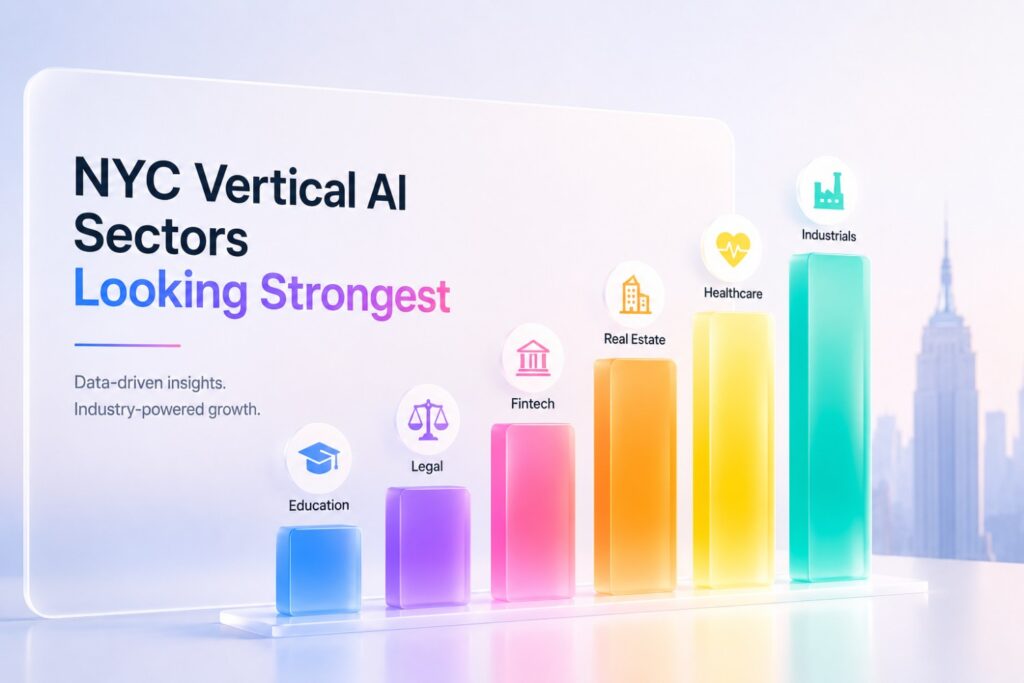
Which NYC Vertical AI Sectors Look Strongest?
Based on our dataset and the structure of New York’s economy, four areas currently stand out.
Financial AI Is the Most Developed
Finance has the largest number of companies in our sample and the broadest range of product strategies. New York now has startups building financial research systems, data infrastructure, diligence platforms, document-analysis products, and AI intelligence layers.
The question is no longer whether financial institutions will use generative AI. The more important question is which layers of the financial technology stack will be rebuilt around specialized AI.
Accounting AI Is Moving Extremely Quickly
Basis and Rillet have both reached billion-dollar valuations while pursuing different strategies. Basis is building AI agents that perform accounting work, while Rillet is redesigning the financial system itself.
Both companies are based on the belief that AI can do far more than answer accounting questions. If their approach succeeds, accounting software could experience one of its most significant changes in decades.
Legal and Compliance AI Could Build Strong Defensibility
Law and regulation are especially attractive because they involve complex rules, expensive professional labor, and high costs for mistakes.
Norm AI and Patlytics illustrate different versions of this opportunity. One focuses on regulation and compliance, while the other focuses on patents and intellectual property.
These markets may require more trust and longer sales cycles than general productivity software, but successful products can become deeply embedded once customers rely on them.
Healthcare May Be the Largest Long-Term Opportunity
Healthcare combines massive labor costs, outdated systems, fragmented information, regulation, staffing shortages, and administrative complexity.
The opportunity extends far beyond diagnosis. Companies can build around referrals, scheduling, patient communication, insurance, medical imaging, benefits, documentation, clinical decision support, and financial operations.
Tennr is particularly interesting because it focuses on the operational infrastructure that determines whether patients successfully move through the care system.
Final Takeaway: New York’s AI Advantage Is Industry Knowledge
New York does not need to beat Silicon Valley at building foundational models in order to become one of the world’s most important AI cities. The city has another path that may be just as valuable.
It can build the systems that take increasingly powerful AI models and make them useful inside industries where mistakes are expensive, workflows are complicated, and customers have large budgets.
That is already happening across the city.
EliseAI is reshaping housing operations. Rogo, Hebbia, Daloopa, Finster, Aiera, and ToltIQ are attacking different layers of financial work. Basis and Rillet are redesigning accounting around AI. Norm AI is applying artificial intelligence to regulation, while Tennr is automating the complicated infrastructure behind healthcare referrals.
Runwise is bringing intelligence into buildings. Patlytics is applying AI to patents. Siro is turning face-to-face sales into measurable data. Ataraxis and Ezra are applying artificial intelligence to cancer care, while CVector, Nayya, Acai Travel, and PreciTaste demonstrate how far vertical AI can spread beyond traditional software markets.
The strongest signal from our 20-company analysis is therefore not the amount of funding these startups have raised. The more important signal is how specialized they are becoming.
New York’s strongest AI startups are increasingly choosing narrow, difficult, high-value problems and going deep enough into the workflow to become genuinely useful. That specialization may ultimately become the city’s greatest competitive advantage in artificial intelligence.
New York already has the banks, hospitals, law firms, accounting firms, property companies, insurers, investment funds, restaurants, corporations, and professional talent. Vertical AI gives the city a way to turn that industry knowledge into technology companies that can eventually sell their products to businesses around the world.