

Artificial intelligence spent its first big enterprise wave helping people write, search, summarize, and analyze. The next wave is much more important. AI is starting to do the work itself.
That is the basic idea behind agentic AI. Instead of asking an AI tool to summarize an invoice, a finance team can give an agent rules for checking the invoice, matching it to a purchase order, coding it, flagging anything unusual, and sending it into the right approval flow. Instead of asking AI to research a prospect, a sales team can let an agent research the account, decide whether it fits, update the CRM, route the lead, and trigger the next action.
New York is becoming one of the most interesting places to watch this shift.
NYC does not have to beat Silicon Valley at building every foundation model. Its bigger opportunity may be turning AI into working software for industries where New York already has deep expertise: finance, accounting, insurance, law, property management, healthcare, sales, media, and large-enterprise operations.
The numbers already point in that direction. The New York City metropolitan area attracted $28.5 billion in venture investment in 2024, making it the second-largest VC market in the United States. Software and technology services represented 52.4% of NYC venture activity that year. Nationally, AI’s share of venture investment jumped from 16% in 2021 to 45% in 2024.
The momentum accelerated again in 2026. AlleyWatch counted $4.70 billion invested across 81 NYC companies in June 2026 alone, its highest monthly total on record. Forty-one of those companies were classified as AI-focused, and they collected $2.61 billion, or 55.5% of the month’s capital.
But funding by itself does not tell us where the market is going. For this article, NYC Tech Journal built a new dataset of New York agentic AI companies and examined what their products actually do.
The result is clear: New York’s agentic AI market is becoming an application market.
The city’s most important agent startups are not simply making general-purpose digital assistants. They are building autonomous workers for expensive business processes.
And that may prove to be a much bigger opportunity.
The Short Version: New York Is Building AI That Does the Work
Agentic AI is one of the most overused terms in technology right now. A chatbot with a new name is not automatically an AI agent.
For this research, we used a stricter definition.
A system had to do more than generate information. It needed to make decisions, call tools, trigger actions, work through multiple steps, update business systems, or complete part of a real enterprise process.
Under that definition, our research identified 16 notable NYC companies with meaningful agentic products or infrastructure.
Together, the companies in our strict sample have raised roughly $4.8 billion or more in disclosed capital. That number is not evenly distributed. Ramp alone represents more than 60% of the total, while the four best-funded companies account for roughly 82%.
The more interesting finding, however, is where these companies are building.
NYC Tech Journal Original Research: The NYC Agentic AI Market at a Glance
| Metric | Our Finding |
| Companies in strict NYC sample | 16 |
| Approximate disclosed capital | $4.8B+ |
| Capital excluding Ramp | $1.8B+ |
| Median disclosed funding | ~$90M |
| Application-layer companies | 13 of 16 |
| Infrastructure-layer companies | 3 of 16 |
| Companies focused on regulated or high-stakes workflows | 9 of 16 |
| Companies with identifiable new funding announced in 2026 | At least 9 of 16 |
| Capital held by four best-funded companies | ~82% |
| Share of sample capital represented by Ramp | ~62% |
Source: NYC Tech Journal analysis of company announcements, product documentation, funding databases, press releases, company profiles and public reporting. Funding is a rounded lower-bound estimate based on disclosed figures available through September 8, 2026. Pending rounds were excluded.
That tells us something important.
More than four out of every five companies in our sample are building the application layer rather than basic agent infrastructure. More than half are working directly inside regulated or high-stakes processes.
That combination is very New York.
The city’s advantage is not simply access to engineers. It is access to bankers, accountants, lawyers, property managers, insurers, healthcare operators, enterprise buyers, compliance teams, and enormous amounts of domain knowledge.
Those people understand where expensive work gets stuck.
Agentic AI startups are turning that knowledge into software.
What Agentic AI Actually Means for a Business
It is useful to separate three generations of enterprise AI.
The first generation answered questions. You gave a model a prompt and received text.
The second generation became a copilot. It could read company information and help an employee perform a task faster.
The third generation is increasingly becoming an operator.
An operator has a goal, access to tools, context about the business, rules it must follow, and permission to take certain actions. It can work through a process rather than waiting for a human to tell it what to do at every step.
From Answering to Acting
| AI Model | Typical Request | Typical Result |
| Chatbot | “What does this contract say?” | Answer |
| Copilot | “Draft a response to this contract.” | Draft |
| Workflow AI | “Check this contract against our policy.” | Analysis and recommendation |
| AI agent | “Check it, identify problems, request missing information and route it to the correct lawyer.” | Actions across a workflow |
| Autonomous enterprise system | “Manage this process within our rules and involve a person only when needed.” | Outcome |
This difference sounds small until you look at labor economics.
If an AI tool helps an employee write an email in two minutes instead of ten, it saves eight minutes.
If an agent handles an entire repetitive workflow without requiring the employee to touch it, the company may remove the task from that employee’s workload entirely.
That is why agentic AI could have a much larger economic impact than enterprise chatbots.
The important unit is no longer tokens generated.
It is work completed.
Original Research: How We Built the NYC Agentic AI Company Dataset
A list like this can become meaningless very quickly if every company that mentions “agents” gets included. We therefore used a stricter research process.
Our research cutoff was September 8, 2026.
Step 1: We Screened for a Real New York Connection
The company needed to be headquartered in New York City or have a clearly documented primary New York operating base.
A company did not qualify simply because it had customers or a sales office in Manhattan. This removed several companies that frequently appear on broader “NYC AI” lists but are actually headquartered elsewhere.
Step 2: We Looked for Action, Not Just Generation
We searched company product pages, technical documents, funding announcements, customer materials, and recent releases for evidence that the product could do at least one of the following:
| Agent Capability | What We Looked For |
| Reason across multiple steps | Does the AI plan or break work into stages? |
| Use tools | Can it call databases, APIs, software or business systems? |
| Take actions | Can it update, send, schedule, approve, route or execute? |
| Maintain context | Can it remember the state of a workflow or account? |
| Operate asynchronously | Can work continue without a user sitting in front of the system? |
| Escalate intelligently | Does the agent know when human review is needed? |
| Work within permissions | Are actions limited by role, policy or approval rules? |
Products that mainly generated content, summarized documents, or offered a conversational interface without meaningful workflow execution were not enough.
Step 3: We Classified Each Company by Layer
We divided the companies into two broad groups.
Application agents perform business work. They might handle accounting, financial analysis, leasing, customer service, compliance, patent work, or sales.
Agent infrastructure makes those applications more dependable. This includes context systems, orchestration, verification, deployment, and platforms used to build agents.
This distinction produced one of the strongest findings in the research: 13 of the 16 companies fell primarily into the application category.
Step 4: We Coded Workflow Risk
We also classified companies according to whether their main use case involved high-stakes or heavily controlled work.
Finance, accounting, legal, healthcare, housing, insurance, patent, and similar workflows were put in the high-stakes group. Sales and general customer engagement were classified separately.
Nine of 16 companies landed in the high-stakes group.
Step 5: We Built a Conservative Funding Dataset
Funding data for private companies is messy. Different databases sometimes include debt, secondary share sales, tender offers, or other financing differently.
We therefore used disclosed company figures where possible and treated uncertain numbers conservatively. For example, Ramp says it has raised more than $3 billion in total equity financing, so our calculation uses $3 billion as a floor rather than attempting to create false precision.
The same principle applies throughout the analysis. The purpose is to understand the shape of the NYC agent market, not claim that every private-company financing figure is exact to the last dollar.
The NYC Agentic AI Leaderboard
Here is the resulting research set.
| Company | Main Market | What Its Agentic Layer Does | Approx. Disclosed Capital |
| Ramp | Finance operations | Reviews, codes, controls and executes financial workflows | $3B+ |
| EliseAI | Housing and healthcare | Automates communication and operating tasks; Apollo can act inside EliseCRM | ~$400M+ |
| Rogo | Investment banking and finance | Felix produces financial deliverables and runs autonomous finance workflows | $300M+ |
| Norm Ai | Law and compliance | Legal agents apply rules and perform regulated legal work | $260M+ |
| Clay | Sales and GTM | Agents research accounts, make decisions and trigger workflows | ~$202M primary |
| Hebbia | Finance | Multi-agent systems research documents and automate analyst workflows | ~$161M |
| Basis | Accounting | Agents perform accounting, tax and audit work end-to-end | ~$138M |
| Emergence AI | Agent infrastructure | Builds verified autonomy for enterprise systems | $97.2M |
| Regal | Customer experience | Voice agents handle conversations and trigger actions in business systems | $82.1M |
| Patlytics | Patent and IP work | Agent performs patent-specific reasoning and builds professional outputs | ~$65M |
| Notch | Insurance and regulated operations | Agents complete controlled customer and back-office workflows | $45M |
| Harmony | Enterprise services | Agents resolve employee requests across IT, HR, finance, legal and procurement | $34M |
| Jedify | Agent context infrastructure | Builds a live context graph agents can use to understand a company | $33M+ |
| Thoughtly | Revenue operations | CRM-native agents call, text and email leads across channels | $8M+ |
| Artian | Financial services | Multi-agent systems plan and execute enterprise processes | $8M |
| Hatz AI | MSP and SMB AI | Lets managed service providers deploy AI apps and agents for clients | $2.5M |
These companies are at very different stages. Ramp is a giant private fintech with more than 70,000 customers, while several others are still young startups.
That difference is useful.
It shows that agentic AI is not one market. It is becoming a new software architecture that can appear inside companies of almost any size.
Original Finding #1: Agentic AI Capital in NYC Is Extremely Concentrated
The first striking result is how much money has accumulated around a small number of companies.
Chart: Approximate Disclosed Funding in Our NYC Agentic AI Sample
| Company | Capital | Relative Scale |
| Ramp | $3.0B+ | ██████████████████████████████ |
| EliseAI | ~$400M+ | ████ |
| Rogo | $300M+ | ███ |
| Norm Ai | $260M+ | ███ |
| Clay | ~$202M | ██ |
| Hebbia | ~$161M | ██ |
| Basis | ~$138M | █ |
| Emergence AI | $97M | █ |
| Regal | $82M | █ |
| Patlytics | ~$65M | █ |
| Remaining six companies combined | ~$131M | █ |
Bars are illustrative rather than a linear investment chart because Ramp would otherwise make most smaller companies nearly invisible.
The four biggest companies in this dataset—Ramp, EliseAI, Rogo and Norm Ai—represent roughly 82% of all disclosed capital in the sample.
Ramp alone represents about 62% using our conservative $3 billion funding floor.
There are two ways to read this.
The first is that late-stage winners are already forming. Investors are willing to place very large bets on companies that have connected AI to important business systems and clear enterprise budgets.
The second is that much of the market remains young. Remove Ramp from the sample and the other 15 companies still represent roughly $1.8 billion in disclosed financing.
That is not a tiny experiment.
It is a sizeable new enterprise software category developing underneath one unusually large company.
Original Finding #2: New York Is an Agent Application Market
The second finding may matter more over the long term.
Only three of the 16 companies in our strict dataset are primarily infrastructure businesses: Emergence AI, Jedify and Hatz AI.
The other 13 are closer to the business user.
Chart: Where NYC Agentic AI Companies Are Building
| Layer | Companies | Share |
| Business application agents | 13 | 81% |
| Agent infrastructure | 3 | 19% |
This is important because the economics of AI software may move upward through the stack.
Models can become cheaper. Model performance can converge. Businesses can switch between underlying model providers.
But a system that knows how a private equity firm performs diligence, how an accounting firm prepares a tax return, how an insurer processes a submission, or how a property manager handles a resident request has something much harder to copy.
It has workflow knowledge.
It may also have integrations, customer data structures, historical feedback, permission systems, evaluation sets, and years of edge cases.
That is where several New York startups are trying to build their moat.
Original Finding #3: More Than Half the Market Is Going After High-Stakes Work
Nine of the 16 companies in the study primarily operate in fields where errors can be expensive, regulated, legally important, or operationally sensitive.
Chart: Primary Workflow Type
| Workflow Group | Companies | Share |
| Regulated or high-stakes work | 9 | 56% |
| Revenue, CX and general enterprise work | 4 | 25% |
| Agent infrastructure | 3 | 19% |
This is a major clue about New York’s place in the AI economy.
Generic AI can be developed almost anywhere.
But turning AI into a dependable accounting worker requires accounting knowledge. Turning it into an investment banking agent requires finance knowledge. Automating insurance operations requires understanding insurance systems, controls, permissions, and regulation.
New York has unusually dense concentrations of exactly these buyers and workers.
That makes the city a natural laboratory for high-value vertical agents.
Original Finding #4: 2026 Is Looking Like the Year Agents Move From Product Feature to Company Strategy
At least nine companies in our 16-company set announced identifiable new financing rounds during 2026.
That group includes Ramp, Rogo, Norm Ai, Basis, Patlytics, Notch, Harmony, Jedify and Thoughtly.
What is more interesting is what the funding announcements say.
Basis is talking about agents completing accounting work end-to-end. Rogo is scaling Felix as an agent for finance. Notch is positioning around production-ready agents for regulated companies. Harmony describes software that resolves employee work instead of simply routing tickets.
This language is materially different from enterprise AI announcements two or three years ago.
The market was previously selling intelligence.
It is increasingly selling execution.
1. Ramp — Building an Autonomous Finance Department
Ramp is the largest company in this analysis by a wide margin.
Founded in New York in 2019, Ramp started with corporate cards and spend management. It has steadily expanded into expenses, accounts payable, procurement, travel and broader financial operations.
In June 2026, Ramp raised $750 million at a $44 billion valuation. The company said it had more than 70,000 customers, more than $1 billion in annualized revenue, and more than $200 billion in annualized purchase volume. It also said total equity financing had passed $3 billion.
Ramp’s Real Agentic Opportunity Is Control
The interesting part is not that Ramp can add AI to an expense report.
It is that Ramp already sits inside the flow of corporate money.
Its agents can review transactions, code expenses, flag fraud, enforce policies and assist with workflows that used to require finance employees to move between systems. Ramp began describing this direction publicly in 2025, when it said its first agents were reviewing, approving and coding transactions and updating policies.
That creates an unusually powerful position.
The closer an AI product gets to actually moving money, the more valuable permissions, policy controls, audit trails and reliable data become.
For CFOs evaluating agentic AI, Ramp illustrates an important rule: the best agent may be the one already sitting inside the system where the action needs to happen.
2. EliseAI — Taking Agents Into Housing and Healthcare Operations
EliseAI is another example of a New York company moving beyond conversational AI.
The company has built deeply into housing and healthcare operations. It said in June 2026 that it had crossed $200 million in annual recurring revenue after five consecutive years of 100% year-over-year growth.
Its housing products already automate tasks across leasing, resident communication, maintenance, renewals and delinquency. The company’s newer Apollo product pushes that idea further.
Apollo can take actions inside EliseCRM based on the same permissions available to the user. EliseAI says those actions include sending messages, updating knowledge, reassigning tasks and tours, changing settings and creating dashboards. The company says Apollo has been tested across 7,000 evaluations.
Why EliseAI Matters Beyond Real Estate
Property management is an excellent test environment for agentic AI because the work does not fit neatly into one screen.
A resident problem might begin as a phone call, require information from a property management system, create a maintenance task, trigger scheduling and need escalation later.
That is exactly where an agent becomes more useful than a chatbot.
EliseAI shows why vertical software companies may have a structural advantage in the agent era. If the software already understands the workflow, stores the context and controls the actions, adding an intelligent decision layer can be much easier than starting with a general AI model and trying to bolt the workflow on afterward.
3. Rogo — Building an AI Agent for High Finance
Rogo is one of the clearest examples of New York’s financial knowledge becoming an AI product.
The company raised $160 million in April 2026, taking total funding above $300 million. At the time, Rogo said it served more than 250 investment banks and investment firms. By August, the company said its technology was running inside more than 300 institutions and reaching more than 40,000 finance professionals.
The central product is Felix.
Felix is designed to move beyond financial search. A user can delegate work and have the system create PowerPoint decks, financial models, Word documents, dashboards and sourced research. Rogo also supports custom agents and scheduled autonomous work that can continue in the background.
The Valuable Part Is the Finished Deliverable
This distinction matters.
Investment bankers do not get paid simply to locate information. They get paid to turn information into decisions, models, recommendations and client materials.
An AI product that finds an EBITDA number saves some time.
An agent that gathers the relevant information, analyzes it, creates the model and prepares a first version of the presentation attacks a much larger block of labor.
The strategic lesson for other enterprise AI companies is simple: move as close as possible to the deliverable the customer is actually paid to produce.
4. Norm Ai — Turning Law Into Agent Infrastructure
Norm Ai is attacking one of the hardest problems in agentic software: getting autonomous systems to operate inside rules.
The New York company announced a $120 million Series C in July 2026 at a $1.2 billion valuation, taking its total funding above $260 million. Norm describes its business as “agentic law,” with legal and engineering teams working together to embed legal rules into agents.
The company also powers Norm Law, an affiliated AI-native law firm where senior attorneys supervise and improve the agents.
That structure is interesting because it addresses a problem that will affect almost every autonomous enterprise.
Agents Eventually Need Rules, Not Just Intelligence
A model can be highly capable and still make a decision a company is not allowed to make.
That becomes more dangerous as the AI gains the ability to act.
An enterprise agent therefore needs more than reasoning. It needs to know what it may do, what it must not do, what evidence is required, when regulation applies and when a human should step in.
Norm’s client base represents more than $30 trillion in combined assets under management, according to the company. Its move into One World Trade Center in 2026 also reinforces how tightly the business is positioning itself alongside large New York financial and legal institutions.
If autonomous companies become real, governance may become one of the most valuable layers in the stack.
5. Basis — AI Agents That Do Accounting Work
Accounting may look less exciting than consumer AI, but it could be one of the strongest markets for autonomous enterprise software.
Basis shows why.
The NYC company raised $100 million at a $1.15 billion valuation in February 2026. Public funding databases put its total financing at roughly $138 million.
Basis says its agents can perform complex journal entries, reconciliation work, accounting memos and other tasks. It has also demonstrated an agent completing a partnership tax workbook end-to-end.
Accounting Has the Right Shape for Agents
Accounting work contains a powerful combination.
There are clear rules, repeatable processes, structured data, expensive labor, deadlines, documents and a strong need for review.
That makes it a much better environment for enterprise agents than many loosely defined knowledge jobs.
The likely near-term model is not an AI agent replacing the accountant. It is an agent doing large blocks of preparation while the accountant reviews exceptions, judgment calls and final outputs.
For accounting firms, that could change the relationship between headcount and revenue.
If one professional can supervise far more work, growth may no longer require hiring at the same historical rate.
6. Clay — Turning GTM Automation Into an Agent System
Clay has grown from a data-enrichment tool into one of the most important AI platforms for go-to-market teams.
Its Claygent product can plan, browse and reason through multiple steps. In August 2026, Clay said Claygent had passed five billion runs.
The more important evolution is what happens after the research.
Clay’s Account Agents can maintain context about an account and then choose an action inside a workflow. For example, an agent can review CRM history, product signals and past conversations, decide how a lead should be handled, and allow the workflow to execute the relevant routing or follow-up.
Deterministic Workflows Plus Agent Judgment Could Be a Winning Pattern
Clay’s architecture points toward a useful enterprise design.
Not everything should be autonomous.
Some steps are better handled by fixed rules. Others require judgment.
Clay Workflows allows companies to combine deterministic steps, code, enrichment, integrations and AI judgment in the same process. It also gives operators visibility into the path taken by individual records.
That hybrid model could become common.
The enterprise may not turn into one enormous AI agent. It may become thousands of controlled workflows with agents inserted only where flexible reasoning adds value.
7. Hebbia — Building AI Analysts for Finance
Hebbia has built its strongest position in finance, where professionals work with huge amounts of complex information.
The New York company has raised roughly $161 million according to CB Insights. Hebbia says investment banks and more than 40% of the largest asset managers by assets under management use its AI agents.
Its Matrix product evolved from document analysis toward a multi-agent architecture.
Hebbia has described a system where an orchestrator divides work among specialized subagents for tasks such as retrieval, context extraction and output creation.
Multi-Agent Systems Make Sense When the Work Is Complex
This is important because one general agent does not necessarily need to do everything.
A financial workflow might require one component to collect information, another to reason over documents, another to check numbers and another to format the result.
That structure looks more like a team.
The practical benefit is not simply scale. Specialized agents can be tested more precisely, and responsibilities can be separated.
For high-stakes companies, that can make an agent system easier to monitor than one giant black box trying to handle every step.
8. Regal — Making the Contact Center Agentic
Voice is another market where agentic AI can produce an immediate business result.
New York-based Regal builds AI agents for customer communication. Its agents can conduct inbound and outbound conversations, work through sequential steps, use first-party customer data, update internal systems, send follow-up messages, transfer conversations and schedule future actions.
The company has raised roughly $82.1 million according to CB Insights. Regal says that during 2025 its customers completed 350 million calls and 570 million agentic workflows through the platform.
Voice Agents Have a Simple ROI Test
The attraction for businesses is easy to understand.
Call centers already know their cost per call, handle time, conversion rate, abandonment rate, staffing expense and service levels.
That makes voice agents much easier to measure than a general employee chatbot.
A company can compare the agent directly against the existing process.
The lesson for enterprise buyers is useful: the best first AI-agent project is often one where the business already measures the human workflow in detail.
9. Emergence AI — Building the Control Layer for Autonomous Systems
Not every important agent company needs to own the final business application.
Emergence AI is working lower in the stack.
The New York-headquartered company describes its focus as verified autonomy for mission-critical enterprise systems. Its work covers memory, coordination, verification and safe execution, with an emphasis on keeping autonomous systems inside defined boundaries.
The company emerged publicly in 2024 with $97.2 million in funding, plus additional credit facilities that we do not count in our equity-focused dataset.
Reliability Could Become a Huge Infrastructure Market
As agents become more capable, model intelligence alone may become less important as a differentiator.
Enterprises will increasingly ask different questions.
Can the agent be controlled? Can its action be verified? Can the company prove why something happened? What happens when a model behaves unpredictably? Can the system operate within permissions across several applications?
Those questions create a large market for agent infrastructure.
Emergence is betting that the winning enterprise architecture will not simply maximize autonomy. It will provide bounded autonomy.
That is an important distinction.
10. Notch — Agents for Regulated Operations
Notch is building around the same reliability problem, but much closer to the business workflow.
The New York company raised a $30 million Series A in March 2026, taking total funding to $45 million. Its initial markets include insurers, brokers, banks and other financial institutions.
Notch’s architecture combines conversational AI with structured execution logic, permissions, validation and mandatory escalation when the system reaches uncertain territory. Its agents can work across customer-facing and back-office tasks, including areas such as policy servicing, claims intake and underwriting submissions.
This Is What Enterprise Autonomy Will Probably Look Like
The phrase “autonomous enterprise” can create the wrong picture.
It probably will not mean allowing an unrestricted AI to control the company.
In regulated industries, autonomy is more likely to mean that the agent can act freely inside a carefully designed box.
It can complete normal cases automatically. It can follow hard rules where required. It can produce an audit trail. And when something falls outside the box, it can hand the case to a person.
That is much more practical than attempting unlimited autonomy.
11. Patlytics — Bringing Agentic Reasoning to Patent Work
Patent work is highly specialized, document-heavy and expensive.
That makes it another strong vertical market for AI.
Patlytics announced a $40 million Series B in 2026, bringing total funding to about $65 million. The company is headquartered in New York City and provides software across the patent lifecycle.
In August 2026, Patlytics launched Agent, which it describes as a patent-specific reasoning layer. A user can provide a filing or report, have the system conduct analysis and then turn that analysis into professional work inside the platform.
Deep Vertical Knowledge Can Be a Better Moat Than a Bigger Model
Patent work illustrates why some of the strongest agent companies may look narrow at first.
A general model knows a little about a vast range of subjects.
A good vertical agent must know how a particular job is actually completed.
That includes the documents, sources, output formats, terminology, review process and professional standards surrounding that job.
This is one reason New York’s professional-services economy could produce many more vertical AI companies.
12. Harmony — Replacing the Internal Ticket With Resolution
Most large companies have a hidden operational tax.
Employees need something from HR, IT, finance, legal or procurement, so they submit a ticket. Somebody reads it, finds information, routes it, asks another question and eventually performs the task.
Harmony wants the AI to resolve more of that work itself.
The company announced $34 million in seed funding in July 2026. Its agents operate inside tools such as Slack and Microsoft Teams and support requests across IT, HR, finance, procurement and legal.
The Target Is Not the Help Desk. It Is the Service Layer.
This distinction could become important for enterprise software.
Traditional ticketing systems are designed around routing work to people.
Agent-native software can be designed around resolving the work before it ever needs a person.
The business case therefore should not be measured only by fewer support tickets.
A better metric is autonomous resolution rate: the percentage of eligible employee requests completed correctly without human handling.
That is the metric enterprise service software may increasingly compete on.
13. Jedify — Solving the Context Problem
Enterprise agents have another difficult problem: they do not automatically understand how a company works.
Revenue might mean one thing to finance and another to sales. A customer name might be stored differently in three systems. Permissions, definitions and relationships can live across databases, documents, Slack messages and internal tools.
Jedify is building infrastructure for this context layer.
The New York company raised $24 million in June 2026, bringing total funding above $33 million. Its system builds what it calls a live context graph across structured and unstructured enterprise information.
Better Context May Matter More Than Better Prompts
Companies often respond to poor AI output by rewriting prompts.
That can help, but prompts cannot fix missing organizational knowledge.
An agent needs to know what the company’s data means, which source should be trusted, how entities relate to each other and what information a particular employee is allowed to access.
That makes context infrastructure one of the less visible but potentially critical parts of the autonomous enterprise.
The better the action an agent takes, the more dangerous bad context becomes.
14. Thoughtly — Giving the CRM an Autonomous Communication Layer
Thoughtly is going after the large amount of pipeline that sales teams never manage to contact properly.
The New York startup announced a $5.5 million seed round in April 2026, bringing total funding above $8 million. Its platform coordinates voice, SMS and email directly with CRM workflows.
Thoughtly describes itself as a fully autonomous CRM layer where AI agents can call, text and email leads until a person is ready for the next stage. Its New York office is at 228 Park Avenue South.
Agentic Sales Should Be Measured on Pipeline, Not Message Volume
The danger in sales AI is easy to see.
If automation simply makes it easier to send more messages, businesses may create more noise rather than more revenue.
A useful sales agent must therefore be measured on outcomes such as qualified conversations, appointments, pipeline created, conversion and cost per successful contact.
Automating activity is easy.
Automating useful activity is the real product.
15. Artian — Multi-Agent Automation for Financial Services
Artian is another New York company using the city’s finance base as its starting point.
The company announced $8 million in funding in 2025 and described its goal as creating reliable autonomous multi-agent systems for critical enterprise processes. Its initial focus is financial services.
Artian’s approach includes an agentic planner, multi-agent orchestration and execution tools designed around finance workflows.
Smaller Companies Can Attack the Orchestration Layer From a Vertical
Artian is interesting because it sits between infrastructure and application software.
It is not simply building one finance task. It is trying to provide a way for financial companies to create reliable agent-driven processes.
That hybrid position could become common.
A vertical agent company may start with a narrow workflow, discover reusable infrastructure inside that workflow and then expand into a broader operating platform.
16. Hatz AI — Taking Agents Through the MSP Channel
Hatz AI approaches the market through a very different distribution model.
The New York company launched with $2.5 million in seed funding and built a platform allowing managed service providers to deliver AI applications, agents and related infrastructure to their own customers. The company operates from New York’s Flatiron District.
This matters because millions of smaller businesses will not build agent infrastructure themselves.
SMB Agent Adoption May Be Sold Through Trusted IT Providers
Large enterprises can hire AI engineers, security teams and consultants.
Small companies usually cannot.
Many already depend on managed service providers for security, cloud systems, devices and IT support.
If AI agents become another core layer of company technology, MSPs could become an important distribution channel.
That makes Hatz worth watching even though it has raised far less capital than the larger names in this report.
The Bigger Pattern: NYC Is Turning Domain Expertise Into Agent Software
Looking across all 16 companies produces a stronger insight than looking at any one startup.
New York’s agentic AI opportunity is based on domain density.
Wall Street supplies finance knowledge.
The city’s accounting, insurance and legal sectors supply regulated workflow knowledge.
Its enormous property market creates property-management knowledge.
Its enterprise headquarters generate demand for internal operations software.
Its advertising, sales and media industries create large markets for customer and revenue agents.
This gives NYC founders access to something models cannot simply download from the internet: detailed knowledge about how organizations really get work done.
The Real Moat Will Be Workflow Depth
There is a tempting assumption that the company with the smartest model will automatically win agentic AI.
That is unlikely to be true across most enterprise markets.
The underlying model will certainly matter, but many application companies will have access to similar frontier models.
The difficult part comes after the model.
The Agentic AI Moat Stack
| Layer | Why It Matters |
| Model | Provides reasoning and generation |
| Proprietary context | Helps the agent understand the company |
| Workflow knowledge | Tells it how the job gets done |
| Integrations | Give it access to the tools where work happens |
| Permissions | Define what it can and cannot do |
| Evaluations | Test whether the agent works reliably |
| Audit trail | Makes actions inspectable |
| Feedback data | Improves decisions over time |
| Distribution | Gets the agent into real businesses |
| System of record | Gives the company control over the workflow |
The deeper a company gets into this stack, the harder it becomes to replace with a simple chatbot.
That is why companies such as Ramp, EliseAI and Clay are strategically interesting.
They already control significant parts of the workflow where the agent acts.
The Biggest Agentic AI Opportunity Is Not Replacing Entire Jobs
Businesses should be careful with the popular idea of the “AI employee.”
Jobs are messy combinations of tasks, relationships, judgment, accountability and company knowledge.
Workflows are much easier to define.
An accounts payable process can be mapped.
A lead qualification flow can be mapped.
An employee access request can be mapped.
A property maintenance request can be mapped.
A patent research process can be mapped.
This suggests a better way for companies to think about automation.
Do not start by asking which employee AI can replace. Start by asking which workflow can run with fewer human touches.
That question is more practical, easier to measure and less likely to produce an expensive AI project with no clear result.
Where Businesses Should Deploy Agents First
The best first agent workflow usually has several characteristics.
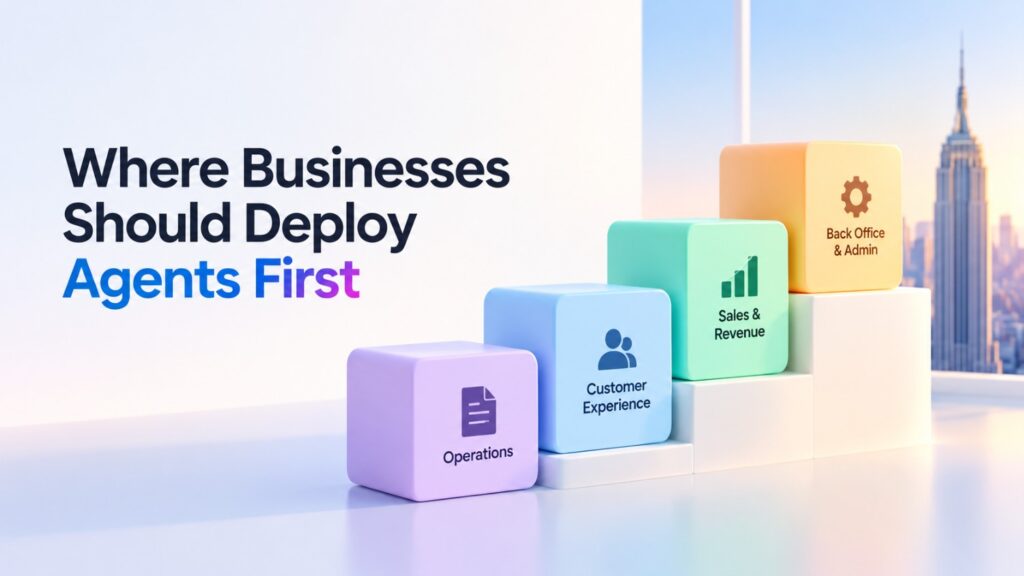
It happens often. The process follows recognizable steps. The company has reasonably clean data. Each case has a measurable outcome. Errors are visible. A person can review exceptions. And the business can put a dollar value on the work.
Agent Opportunity Scorecard
| Question | Weak Candidate | Strong Candidate |
| How often does the task happen? | A few times a year | Daily or thousands of times |
| Is the process repeatable? | Every case is unique | Clear common path |
| Is the input available digitally? | Mostly offline | Systems and documents |
| Can success be measured? | Subjective | Clear outcome |
| Can exceptions be identified? | Unclear | Yes |
| Can a person review risky cases? | Difficult | Easy |
| Is the current work expensive? | Low-cost | High labor or delay cost |
| Does speed matter? | Not much | Strongly |
A workflow does not need a perfect score.
But the more boxes that fall on the right side of this table, the better the first agent pilot is likely to be.
A Better 90-Day Agentic AI Pilot for New York Businesses
Businesses should resist the urge to start by buying an “AI transformation.”
Start with one workflow.
The purpose of the first 90 days should be to prove that the agent can complete real work reliably enough to create measurable economic value.
Days 1–30: Measure the Existing Process Before Automating It
Before deploying anything, record how the process works today.
You need a baseline.
Baseline Metrics
| Metric | What to Measure |
| Monthly volume | Number of cases or tasks |
| Human time | Minutes spent per case |
| Fully loaded labor cost | Real cost of the people doing the work |
| Cycle time | Start-to-finish duration |
| Error rate | Percentage requiring correction |
| Escalation rate | Cases already needing senior review |
| Customer impact | Conversion, response time, satisfaction or revenue |
| Cost per completed case | Total operating cost divided by output |
Without these numbers, almost any AI pilot can be made to look successful.
The demo will be faster. Employees may like it. Executives will see impressive outputs.
But nobody will know whether it improved the business.
Days 31–60: Give the Agent a Bounded Job
Do not begin with broad autonomy.
Give the agent a clearly defined goal and limited tools.
For example, an accounting agent might be allowed to collect documents, perform reconciliations, prepare workpapers and flag anomalies while final posting remains with an accountant.
A customer-service agent might resolve a known group of requests but send refunds above a fixed amount to a manager.
The key is to define both what the agent may do and what it must never do.
Days 61–90: Measure Outcomes, Not AI Activity
This is where many companies make the wrong comparison.
Do not celebrate because the agent processed 100,000 tokens or conducted 20,000 conversations.
Ask what happened to the business.
The Agent Pilot Scorecard
| KPI | Why It Matters |
| Autonomous completion rate | Shows how much work truly disappeared |
| Human minutes per completed case | Measures remaining labor |
| First-pass accuracy | Shows quality before correction |
| Exception rate | Reveals how often the agent gets stuck |
| Human override rate | Shows where judgment remains necessary |
| Cost per outcome | Measures real economics |
| Cycle-time reduction | Measures speed |
| Revenue or savings impact | Connects agent to business results |
| Serious-error rate | Prevents productivity from hiding risk |
| User or customer satisfaction | Checks whether automation damages experience |
The strongest agent project improves several of these measures at the same time.
A system that cuts labor by 50% but doubles serious errors is not successful.
Neither is a system that produces beautiful answers but fails to remove any work.
Calculate Agent ROI in Dollars
Agentic AI becomes much easier to evaluate when the calculation is simple.
Imagine a company processes 20,000 cases each month.
Each case currently requires 12 minutes of employee work.
That equals 4,000 labor hours.
If the fully loaded cost of that labor is $50 an hour, the workflow costs about $200,000 each month before other overhead.
Now imagine an agent autonomously handles 65% of cases while the remaining cases still require people.
The gross addressable labor reduction is approximately $130,000 per month.
From there, subtract software costs, implementation, oversight and remaining review costs.
That is a business case.
“The team uses AI every day” is not.
Do Not Automate a Broken Process
There is another trap.
Companies sometimes use agents to automate workflows that should not exist in their current form.
If six approvals are unnecessary, an AI agent moving a request through all six approvals faster does not solve the underlying problem.
It merely automates waste.
Before adding an agent, ask whether the process itself can be simplified.
Remove unnecessary steps first.
Then automate the remaining work.
This is one of the biggest differences between companies that will receive real ROI from agentic AI and those that will simply add another layer of software.
Give Agents Permissions Like Employees, Not Like Gods
As agent capabilities grow, access control becomes much more important.
A chatbot that gives a bad answer is annoying.
An agent with broad write access can create a much larger problem.
An enterprise should therefore treat every agent almost like a new employee account.
Minimum Control Framework
| Control | Practical Question |
| Identity | Which agent took the action? |
| Access | What systems can it enter? |
| Read permissions | What information can it see? |
| Write permissions | What may it change? |
| Money limits | How much can it approve or spend? |
| Approval rules | Which actions still need a person? |
| Logging | Is every meaningful action recorded? |
| Reversibility | Can the action be undone? |
| Escalation | When must it stop and ask? |
| Evaluation | How is behavior continuously tested? |
This area could become an enormous software category of its own.
As enterprises deploy hundreds or thousands of agents, they will need ways to identify, authorize, monitor, evaluate and retire them.
The autonomous enterprise may eventually require something similar to identity management for software workers.
Human Review Should Shrink as Evidence Improves
Companies should also avoid two extremes.
The first is allowing a new agent to execute everything immediately.
The second is requiring human approval for every action forever.
If a human must inspect every routine output, much of the economic value disappears.
A better deployment model expands autonomy gradually.
The Agent Autonomy Ladder
| Stage | Agent Role | Human Role |
| 1. Observe | Agent watches workflow | Human does everything |
| 2. Recommend | Agent suggests action | Human decides |
| 3. Prepare | Agent completes work | Human approves |
| 4. Execute normal cases | Agent acts within rules | Human handles exceptions |
| 5. Manage workflow | Agent coordinates process | Human supervises outcomes |
Most businesses should not jump from Stage 1 to Stage 5.
They should earn autonomy through measured reliability.
That is especially important in the exact industries where New York’s startups are strongest.
Why Auditability Could Become More Valuable Than Raw Intelligence
Today’s AI conversation often focuses on model benchmarks.
Enterprise buyers eventually care about something less glamorous.
They need to know what happened.
If an agent denied a request, changed a record, approved a payment or sent a customer a promise, somebody may later ask why.
That means an enterprise-grade agent needs more than a final answer.
It needs evidence.
This is why products from companies such as Clay, Notch, Norm Ai, Emergence and others emphasize ideas such as reasoning visibility, permissions, bounded actions, evaluation, validation and auditability.
The ability to produce trustworthy records of agent behavior may become a major competitive advantage.
The Autonomous Enterprise Will Probably Be a Network of Agents
It is tempting to imagine one super-agent controlling an entire company.
That is probably the wrong architecture.
Companies are made of different processes with different data, risks, owners and rules.
Finance should not have the same permissions as sales.
A customer-service agent should not automatically have access to payroll.
An accounting agent may need precise controls that a marketing research agent does not.
The more likely future is a network.
A finance agent handles finance work.
A legal agent handles legal review.
A support agent handles customers.
An employee-service agent handles internal requests.
A sales agent manages account research.
A context layer gives these systems the right company knowledge.
A governance layer decides what each agent can do.
People sit above the system, designing policies, managing exceptions and taking responsibility for important decisions.
That is much closer to what New York’s agent companies are already building.
Why New York Could Become the Capital of Vertical Agentic AI
San Francisco remains the world’s most important concentration of frontier AI talent and model development.
New York does not need to replicate it.
Its strongest opportunity may be downstream.
The city contains dense markets where intelligence can immediately be turned into enterprise action.
A founder building finance software can talk to banks, investment firms and asset managers.
A legal AI founder sits close to some of the world’s largest law firms.
A property AI company can work with enormous owners and operators.
An insurance startup can find carriers, brokers and financial institutions.
An advertising or sales startup can find thousands of potential enterprise customers.
That proximity creates fast feedback.
And feedback is particularly important for agents because agents must learn the ugly details that a product demo hides.
What happens when a document is missing?
What happens when two policies conflict?
What happens when an account has unusual history?
What happens when the customer changes direction halfway through the interaction?
What happens when the agent does not have permission?
What happens when the software it depends on is unavailable?
Solving those edge cases is how an impressive prototype becomes enterprise infrastructure.
New York has an unusually large collection of companies willing to pay for that infrastructure if it works.
The Most Important Shift: Software Is Starting to Sell Labor, Not Seats
Traditional SaaS economics are built around users.
A company buys 100 seats because 100 employees need access to the software.
Agents change that relationship.
If software performs the work itself, the customer may care less about how many employees log in.
The important measure becomes output.
How many invoices were processed?
How many accounts were researched?
How many support cases were solved?
How many workpapers were prepared?
How many property inquiries were converted?
How many internal requests were resolved?
This could eventually change software pricing.
Companies such as Norm are already discussing outcome-oriented economics rather than traditional hourly legal billing.
Other agent companies may increasingly charge based on workflows, completed tasks, conversations, successful actions, managed volume or economic value.
That moves software closer to the labor budget.
The potential market becomes much larger.
What NYC Business Leaders Should Do Now
Companies do not need an “agent strategy” document that sits in a presentation.
They need to understand their workflows.
Start by identifying the five repetitive processes in the company that consume the most expensive human time.
Measure them.
Find out where employees are copying information, checking rules, researching documents, routing requests, preparing standard outputs, following up manually, reconciling systems or waiting for another person to act.
Those are the places to look for agents.
Then decide whether to buy from a vertical vendor, extend an existing software platform, or build a controlled internal system.
The right answer will differ by workflow.
What should remain constant is the measurement.
If an agent cannot eventually improve cost, speed, quality, capacity, revenue or customer experience, the company does not have a successful agent deployment.
It has an AI demonstration.
What Investors Should Watch Next
Funding totals are useful, but they should not be the main signal.
The next stage of the market will be about production evidence.
Watch how much work agents complete without human intervention.
Watch whether customers expand deployments from one workflow into several.
Watch whether vertical agents become systems of record.
Watch whether agent platforms begin pricing against labor budgets.

Watch which companies collect proprietary feedback from completed workflows.
And most importantly, watch how often AI moves from producing an answer to producing an outcome.
That is the line separating an assistant from an autonomous business system.
Final Takeaway
New York’s agentic AI story is becoming much clearer.
The city is not simply producing another generation of chatbots.
Ramp is pushing deeper into autonomous finance. Rogo and Hebbia are building agents for financial work. Basis is attacking accounting. Norm Ai is applying agents to law and compliance. EliseAI is automating housing and healthcare operations. Clay is building agents into go-to-market systems. Regal and Thoughtly are automating customer conversations. Notch is targeting regulated operations. Harmony is trying to resolve internal employee work. Emergence, Jedify and Hatz are building infrastructure that helps these systems operate.
Our original analysis found that 81% of the companies in the strict NYC sample are primarily application-layer businesses, while 56% focus on regulated or high-stakes workflows. The 16 companies together represent roughly $4.8 billion or more in disclosed capital, even under a conservative methodology.
Those figures point toward a distinct New York model for AI.
Silicon Valley may continue building many of the world’s most powerful models.
New York has a chance to build something just as valuable on top of them:
the software layer that actually runs the enterprise.