
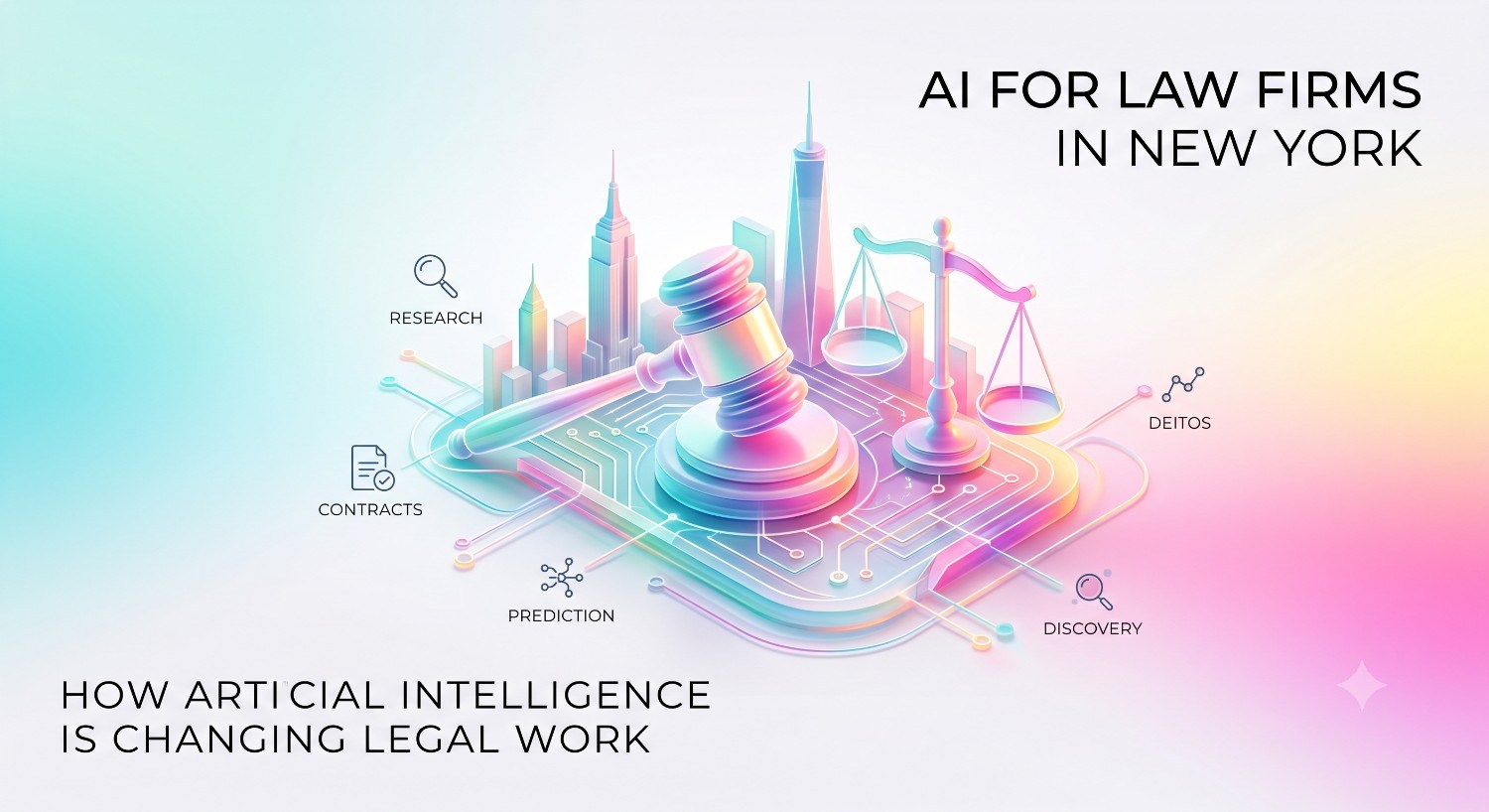
Artificial intelligence is moving into New York law firms much faster than many people expected.
It is no longer limited to lawyers experimenting with ChatGPT after work. Major New York firms are putting specialized AI inside research systems, document platforms, drafting workflows, due diligence processes and internal knowledge tools. Some are building their own AI systems. Others are helping technology companies design the next generation of legal AI.
This matters more in New York than in almost any other American city.
New York is not simply a large legal market. It is one of the most concentrated legal economies in the country. The New York-Newark-Jersey City metro has a much larger share of workers in legal occupations than the United States overall. The New York bar also includes hundreds of thousands of attorneys working inside New York, elsewhere in the United States and internationally.
At the same time, New York lawyers handle exactly the kinds of work that modern AI systems are getting better at: reviewing huge sets of documents, comparing contracts, finding legal authorities, preparing first drafts, extracting facts, checking disclosures, building timelines, summarizing depositions and turning complex information into structured analysis.
That does not mean the lawyer disappears.
It means something more important is happening.
The basic unit of legal work is changing.
For decades, law firms created value by putting people against documents. A transaction might require associates to read hundreds of contracts. Litigation might require teams to review thousands of records. Research could consume hours before a lawyer even started writing.
AI changes that equation because software can increasingly perform the first pass.
The winning law firm may therefore not be the firm with the most lawyers doing repetitive work. It may be the firm that combines strong lawyers, trusted data, good technology, clear review systems and reusable AI workflows better than its competitors.
For New York firms, that change is already underway.
The Short Answer: AI Is Changing Legal Work Before It Changes the Legal Profession
Artificial intelligence is unlikely to eliminate New York law firms. It is much more likely to change what lawyers inside those firms spend their time doing.
AI is already useful for legal research, document summarization, contract review, due diligence, drafting, discovery analysis, knowledge retrieval, meeting summaries and basic administrative work. More advanced systems are beginning to move from answering questions to completing several connected steps in a workflow.
That distinction matters.
A chatbot gives you an answer.
A legal AI workflow might receive 150 agreements, identify change-of-control clauses, compare them with a buyer’s rules, flag exceptions, produce a table, link every conclusion to its source and prepare a draft summary for the transaction team.
That is closer to work than search.
The latest platforms are increasingly designed around this idea. Google Cloud’s Gemini Enterprise for Legal, announced on August 25, 2026, is being built around specialized legal skills, secure connectors and AI agents that can work across existing legal systems. Cleary Gottlieb and Weil are among the firms working with Google on the platform.
Paul, Weiss has gone in a similar direction with Harvey. The firm became the first to launch custom workflows using Harvey’s Workflow Builder and also helped design the system. Rather than simply asking AI random questions, lawyers can create repeatable processes containing firm knowledge, rules and review steps.
This is where the legal AI market is heading.
The important question is no longer:
“Can AI write a legal paragraph?”
The better question is:
“How much of a legal workflow can be completed by software before a lawyer needs to apply judgment?”
For some work, the answer may eventually be a very large percentage.
For other work, human involvement will remain central.
Understanding the difference is where law-firm strategy begins.
Original Research: Why New York May Be More Exposed to Legal AI Than Almost Any Other U.S. Market
NYC Tech Journal analyzed public data from the U.S. Bureau of Labor Statistics, the New York State Unified Court System, legal-industry surveys and publicly disclosed AI initiatives from major New York law firms.
The goal was not to predict how many lawyers AI will replace. There is not enough reliable evidence to make such a claim.
Instead, we looked at three questions.
How concentrated is legal work in the New York economy?
How has the legal workforce changed during the years leading into the AI transition?
And how large could the productivity effect become if widely reported AI time savings eventually reached a meaningful share of New York lawyers?
Methodology Behind the NYC Tech Journal Analysis
For employment analysis, we used BLS occupational data for the New York metropolitan area where comparable figures were available. Readers should note that the BLS New York-Newark-Jersey City metro is larger than New York City itself. It includes the five boroughs as well as surrounding parts of New York and New Jersey. We therefore describe these figures as New York metro data, not city-only data.
For the attorney-population analysis, we used figures published in the New York State Unified Court System’s 2025 Annual Report.
For AI adoption, we used reported figures from the American Bar Association and Thomson Reuters. These surveys have different samples and methods, so we do not treat them as one continuous dataset.
For our productivity scenario, we combined publicly reported BLS employment and wage figures with the 190 annual hours of expected AI time savings reported by law-firm professionals in Thomson Reuters research. This is a scenario model, not a forecast of actual cost savings.
That difference is critical.
An hour saved is not automatically an hour of salary eliminated, an hour billed to a client or an hour converted into profit.
It is simply additional capacity.
New York Has a Much Higher Concentration of Legal Work Than America Overall
The first result helps explain why legal AI could matter so much here.
In May 2025, legal occupations represented approximately 1.4% of employment in the New York-Newark-Jersey City metro, compared with 0.8% nationally.
The average hourly wage across legal occupations was also considerably higher.
| Legal labor measure | New York metro | United States |
|---|---|---|
| Share of employment in legal occupations | 1.4% | 0.8% |
| Mean hourly wage for legal occupations | $87.83 | $67.07 |
| New York employment concentration vs. U.S. | About 1.75x | Baseline |
Source: U.S. Bureau of Labor Statistics, May 2025 OEWS.
This means New York does not simply have many lawyers because it is large.
Legal work itself occupies a greater share of the local economy.
Chart 1: Legal Work Is Far More Concentrated in the New York Metro
Share of total employment
New York metro██████████████ 1.4%
United States████████ 0.8%
The New York share is roughly 75% higher.
That concentration makes AI productivity unusually important here. A technology that changes the economics of legal research or document review has a larger local effect when thousands of expensive professionals perform those tasks every day.
New York’s Bar Has Also Become More Geographically Distributed
The New York Unified Court System reported 193,536 registered attorneys located inside New York State in 2025.
Another 136,283 were located elsewhere in the United States, while 37,772 were outside the country.
Compare that with 2015.
| Location of New York-admitted attorneys | 2015 | 2025 | Change |
|---|---|---|---|
| Inside New York State | 175,195 | 193,536 | +10.5% |
| Outside New York State | 104,069 | 136,283 | +31.0% |
| Outside the United States | 25,571 | 37,772 | +47.7% |
| Total | 304,835 | 367,591 | +20.6% |
Source data: New York State Unified Court System 2025 Annual Report. Percentage calculations by NYC Tech Journal.
There is an interesting technology story hidden inside these numbers.
The number of New York-admitted attorneys based outside the state and outside the country grew much faster than the number located inside New York.
Chart 2: Growth in New York-Admitted Attorneys, 2015-2025
Outside USA████████████████████████ +47.7%
Outside New York State████████████████ +31.0%
Inside New York State█████ +10.5%
This does not prove AI adoption.
But it tells us something important about the environment in which legal AI is arriving.
New York legal work is already highly distributed.
Lawyers collaborate across offices, countries and time zones. Documents live in digital systems. Knowledge must move between teams. Large matters can involve hundreds of people.
AI systems that can search firm knowledge, summarize information and standardize workflows become much more useful in that environment.
The Legal Workforce Was Growing Before the Current AI Wave
There is another popular assumption worth testing.
If technology automates legal work, one might expect support jobs to have already collapsed.
The data do not show that.
BLS data reported approximately 75,840 lawyers in the New York metro in 2016. The figure was about 90,980 in 2023 and approximately 94,610 in May 2025.
That represents roughly 25% growth between 2016 and 2025.
Paralegal and legal-assistant employment also expanded sharply.
The BLS counted approximately 22,900 in 2016 and 32,460 in 2023. May 2025 data put the figure at roughly 33,850.
Chart 3: New York Metro Legal Employment Growth
| Occupation | 2016 | 2025 | Approx. growth |
|---|---|---|---|
| Lawyers | 75,840 | 94,610 | +24.7% |
| Paralegals and legal assistants | 22,900 | 33,850 | +47.8% |
Calculations by NYC Tech Journal using publicly available BLS-based data.
The paralegal result is especially important.
Technology has been improving document search, e-discovery and legal databases for years, yet the number of paralegals did not simply disappear.
Instead, firms changed what people did.
That pattern may continue with generative AI.
The BLS now expects little or no national employment growth for paralegals and legal assistants between 2025 and 2035 and specifically notes that AI may make these workers more efficient in research and document preparation. At the same time, it still expects tens of thousands of openings each year because workers leave or change occupations.
For lawyers, the BLS projects 5% employment growth nationally from 2025 to 2035. It explicitly says that while some routine work may be automated, greater efficiency is expected to allow lawyers to spend more time on client work and strategy rather than eliminating overall demand.
That is probably the more useful framework for thinking about AI.
Tasks disappear before professions disappear.
Original Research: How Much Legal Capacity Could AI Create in New York?
The next question is economic.
Thomson Reuters reported in 2025 that law-firm professionals expected AI to free approximately 190 hours per professional each year on average.
We wanted to understand what that could mean in a market the size of New York.
The New York metro had approximately 94,610 lawyer jobs in May 2025. The median annual lawyer wage was about $208,880, or roughly $100.42 per hour.
Suppose 190 hours of annual AI-created capacity eventually reached only part of that workforce.
The results become large very quickly.
Chart 4: Potential Annual Lawyer Capacity Released by AI
| Share of metro lawyers reaching 190 hours saved | Lawyer hours released | Wage-equivalent capacity* |
|---|---|---|
| 25% | 4.49 million hours | $451 million |
| 50% | 8.99 million hours | $903 million |
| 75% | 13.48 million hours | $1.35 billion |
| 100% | 17.98 million hours | $1.81 billion |
*NYC Tech Journal scenario using 94,610 lawyers, 190 hours and a $100.42 median hourly wage equivalent. This is not a forecast of cash savings, profit or layoffs.
The 50% scenario is worth thinking about.
If only half of New York metro lawyers eventually generated 190 additional hours of annual capacity, that would equal almost nine million lawyer hours.
That is the equivalent of more than 4,300 full-time working years if one uses a simple 2,080-hour working-year calculation.
Again, firms would not simply fire 4,300 lawyers.
Much of that capacity could be absorbed through additional matters, faster client responses, reduced write-offs, more business development, more analysis, better work-life balance or lower staffing needs on future matters.
But the economic pressure would be real.
Clients will eventually ask a simple question:
“If AI allowed this work to be completed faster, why does the bill still look exactly the same?”
That may become one of the biggest strategic questions facing New York BigLaw.
Legal AI Adoption Is Moving From Experimentation to Infrastructure
The legal profession was initially cautious about generative AI.
That made sense.
Lawyers deal with confidential information, privilege, precise citations and enormous financial risk. A chatbot inventing a restaurant recommendation is annoying. A legal AI system inventing a case inside a federal brief can lead to sanctions.
But adoption has accelerated.
The ABA’s 2024 Artificial Intelligence TechReport found that 30.2% of responding attorneys said their offices were using AI-based technology tools. Usage was highest in firms with at least 500 lawyers, where the figure reached 47.8%.
Thomson Reuters found that use of generative AI within legal organizations rose from 14% in 2024 to 26% in 2025. Within law firms specifically, the reported rate was 28%.
The survey methodologies are different, so the percentages should not be directly compared.
But the direction is hard to miss.
AI is becoming normal legal infrastructure.
What Makes New York Different Is Who Is Experimenting
Some of the firms testing advanced systems sit at the top of the legal market.
That matters because BigLaw does not usually redesign important workflows around software simply because the software is fashionable.
These firms handle high-risk litigation, billion-dollar deals, regulated financial institutions, private-equity transactions and board-level advice.
Their willingness to integrate AI is therefore an important signal.
NYC Tech Journal’s Public AI Deployment Tracker
We reviewed publicly disclosed activity at several major firms strongly associated with the New York legal market.
This is not intended to rank firms. Public disclosure varies significantly. A firm may be doing sophisticated internal work without announcing it.
The table measures visible deployment signals, not overall technological quality.
| Firm | Publicly visible AI development |
|---|---|
| Paul, Weiss | First law firm to launch Harvey custom workflows; helped design Workflow Builder |
| Willkie | Firmwide Harvey rollout; proprietary Wendell Intelligence platform; Harvey workflows; LexisNexis Protégé integration; ISO 42001 certification |
| Debevoise | Built STAAR 2.0 client-facing AI system using Legora Portal architecture |
| Cleary Gottlieb | Working with Google Cloud on Gemini Enterprise for Legal |
| Weil | Early Gemini Enterprise for Legal adopter; strategic Google Cloud collaboration |
| Simpson Thacher | Public reports describe Harvey and DeepJudge as part of its growing AI toolkit |
Sources include firm announcements, technology-provider disclosures and other public reports.
The pattern is more interesting than the individual products.
Leading firms are moving through roughly four stages:
Stage 1: Give lawyers access to AI.
Stage 2: Connect AI to trusted legal information.
Stage 3: Connect AI to internal firm knowledge.
Stage 4: Turn repeated legal processes into reusable AI workflows or agents.
The fourth stage may create the biggest competitive difference.
How AI Is Actually Being Used Inside Legal Work
Legal AI often gets described too broadly.
“AI helps lawyers work faster” is true, but it does not tell a managing partner where the value actually comes from.
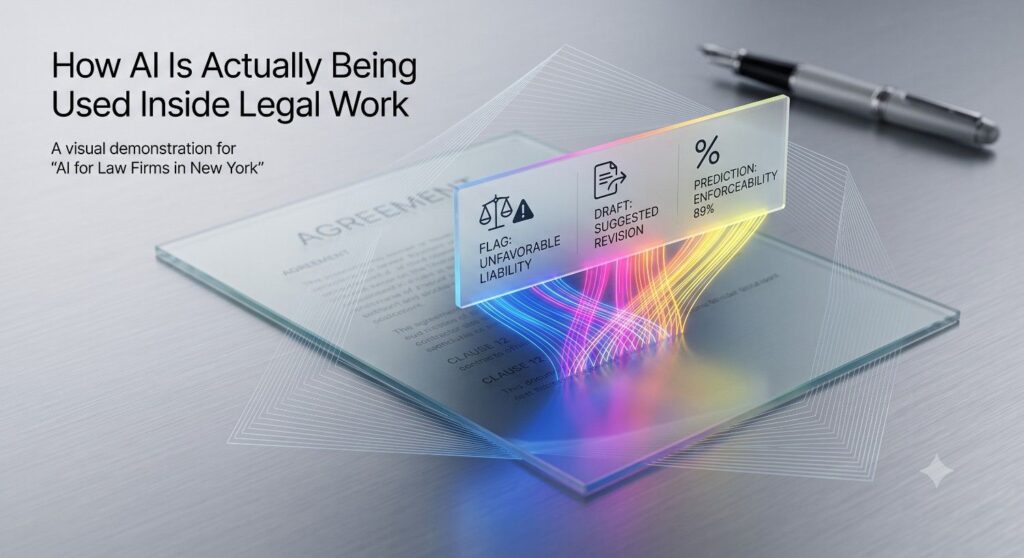
The easiest way to understand the change is to break legal work into tasks.
Legal Research Is Becoming an Answer-and-Verification Workflow
Traditional digital legal research still requires a lawyer to create search terms, open cases, scan results, follow citations and build an argument.
AI changes the starting point.
A lawyer can ask a complex natural-language question and receive an organized explanation with suggested authorities.
The important word is suggested.
The attorney still needs to check whether the cases exist, whether they remain good law and whether they actually support the proposition claimed.
That verification step is not optional.
Research therefore moves from:
search → read → organize → analyze
toward:
ask → inspect sources → verify → analyze.
Good legal AI does not eliminate research. It compresses the early stages.
Contract Review Is Becoming Exception Detection
Contract work may be an even better use case.
Imagine a private-equity acquisition in which 600 commercial contracts must be reviewed.
A traditional team might build a spreadsheet containing assignment provisions, change-of-control restrictions, termination rights, governing law, renewal dates and unusual liabilities.
AI can increasingly perform the first extraction.
The lawyer’s value then shifts toward questions such as:
Which clauses actually threaten the transaction?
Which counterparties should be contacted?
Which deviations matter economically?
Which findings require disclosure?
Which clauses are ambiguous?
That is higher-value work.
Due Diligence Could Change Dramatically
M&A due diligence has long been a classic junior-lawyer task.
It is document-heavy, structured and repetitive.
Those characteristics make it attractive for AI.
An advanced system can potentially classify documents, extract defined information, compare language against a playbook, identify missing documents and create an initial issue list.
Humans still need to investigate exceptions and understand the deal.
But the staffing model can change.
A task that once needed ten people reviewing everything may instead need fewer people reviewing what the AI has flagged.
That is a significant difference.
Drafting Is Shifting Toward Editing
AI is very good at generating a first version of text.
That makes drafting one of its most obvious legal uses.
But the value is not simply “AI writes the contract.”
In sophisticated practice, the better workflow may be:
AI creates a first draft using firm precedents.
The lawyer checks the structure.
AI compares it with the agreed term sheet.
The lawyer changes commercial positions.
AI checks defined terms and cross-references.
The lawyer reviews the final document.
In that process, AI acts more like a drafting assistant than an autonomous attorney.
Litigation Teams Can Search Facts Differently
Litigation produces enormous quantities of information.
Emails, messages, contracts, transcripts, exhibits, filings, expert reports and internal records can all become part of a matter.
Finding relationships across that information takes time.
AI systems are increasingly useful for building timelines, summarizing depositions, finding contradictory statements, grouping documents around issues and identifying relevant passages.
The lawyer still decides what the evidence means.
But searching the evidence can become far faster.
AI Can Turn Law-Firm Knowledge Into an Active Asset
This may be one of the most underrated uses.
Large New York firms possess enormous internal knowledge.
They have decades of precedents, memos, closing documents, deal experience, litigation strategies and specialist insights.
Historically, accessing that knowledge depended heavily on knowing who to ask.
AI can change that.
Instead of emailing ten partners asking whether anyone has dealt with an obscure issue, a lawyer may be able to search approved firm knowledge conversationally.
The firm’s historical work starts functioning more like a database.
That could create an important competitive advantage because every firm’s knowledge is different.
The AI model may eventually be widely available.
The proprietary knowledge sitting behind it will not be.
Which Legal Tasks Are Most Exposed to AI?
NYC Tech Journal created a simple task-level framework based on five characteristics:
How repetitive is the task?
How much text does it involve?
How easy is the result to verify?
How much original legal judgment is required?
How costly would an error be?
This produces a more useful picture than asking whether an entire job is “automatable.”
Chart 5: NYC Tech Journal Legal AI Task Exposure Matrix
| Legal task | AI fit | Human judgment required | Likely near-term model |
|---|---|---|---|
| Document summarization | Very high | Medium | AI first pass |
| Basic legal research | High | High | AI research + lawyer verification |
| Contract data extraction | Very high | Medium | Mostly automated first pass |
| Due-diligence review | Very high | High | AI review + exception handling |
| First-draft memos | High | High | AI draft + lawyer rewrite |
| Contract comparison | Very high | Medium | AI-led |
| Deposition summaries | Very high | High | AI summary + lawyer analysis |
| Citation checking | High | Medium | Increasingly automated |
| Discovery classification | Very high | High | AI-assisted at scale |
| Internal knowledge search | Very high | Medium | AI-led |
| Client counseling | Medium | Very high | Lawyer-led |
| Negotiation | Medium | Very high | Lawyer-led |
| Cross-examination | Low | Extremely high | Human-led |
| Board advice | Medium | Extremely high | Human-led |
| Bet-the-company strategy | Low | Extremely high | Human-led |
This matrix points toward an important conclusion.
AI exposure is usually highest when the work involves finding, extracting, comparing, formatting or summarizing information.
Human value remains highest when work requires judgment, persuasion, trust, accountability, negotiation and strategic choice.
That line will move as technology improves.
But it is unlikely to disappear.
Junior Associates May Feel the Change Before Partners Do
The legal profession has an unusual training system.
Junior lawyers often learn by doing large amounts of basic work.
They research. They summarize cases. They review documents. They prepare first drafts. They build closing checklists.
Those tasks are also highly compatible with AI.
This creates a management problem.
A law firm can automate part of junior work while accidentally automating part of junior training.
The Associate Apprenticeship Model Needs to Be Redesigned
A first-year associate does not review 100 contracts because contract review is intellectually fascinating.
The work teaches pattern recognition.
After seeing enough agreements, the lawyer begins to understand what normal language looks like and what unusual language looks like.
If AI reviews the first 100 agreements instead, the junior lawyer may get the result without gaining the experience.
Firms therefore need a new training model.
Associates should learn how to inspect AI output, understand why an exception matters, review source documents and challenge the system’s conclusions.
AI literacy cannot replace legal literacy.
It must sit on top of it.
The Best Junior Lawyers May Become More Valuable
There is another side to the story.
A talented associate equipped with strong AI could perform far more work.
Instead of spending six hours creating a first draft, that associate may spend one hour creating, testing and improving an AI-assisted version.
The remaining time can be used for deeper analysis.
This could make strong juniors unusually productive.
The gap between lawyers who use AI well and lawyers who ignore it may therefore widen.
What Happens to Paralegals and Legal Assistants?
The same logic applies to support staff.
AI can already automate parts of document organization, summarization, data extraction, proofreading and filing preparation.
That will affect some roles.
But “AI replaces paralegals” is too simple.
Remember the New York employment data.
Paralegal and legal-assistant employment expanded substantially between 2016 and 2025 even as legal technology improved.
Future roles may become more technical.
A paralegal may supervise document pipelines, validate extracted data, manage AI-assisted due diligence, maintain matter databases or operate advanced litigation tools.
The lower-value part of the role may shrink while the technology-enabled part becomes more important.
AI Could Challenge the Traditional BigLaw Leverage Model
Large law firms have traditionally operated with a pyramid.
Partners win and manage work.
Associates perform large amounts of the execution.
Support professionals help move the work through the system.
Profit comes partly from leverage.
A partner can oversee the work of several associates whose billable hours generate revenue.
AI creates a strange problem.
The better the technology becomes, the fewer human hours some matters may require.
That can improve productivity while putting pressure on a business model based heavily on hours.
A 20-Hour Task Becoming a Five-Hour Task Is Good and Bad
For the client, it is excellent.
For the lawyer, it can also be excellent.
For a firm paid entirely according to time, the economics become more complicated.
If AI turns a 20-hour research assignment into five hours, billing five hours produces less revenue than billing twenty.
Trying to bill twenty anyway creates obvious ethical and client problems.
ABA Formal Opinion 512 makes clear that lawyers cannot simply bill clients for time they did not actually spend because AI allowed a task to be completed faster.
The long-term answer may therefore be different pricing.
AI May Push New York Firms Toward More Value-Based Fees
Alternative fee arrangements are not new.
AI could make them more important.
A firm using AI efficiently may be able to quote a fixed price for a predictable piece of work and complete it with fewer human hours.
That changes the incentive.
Under hourly billing:
Faster work can reduce revenue.
Under a fixed fee:
Faster work can increase margin.
That is a major economic difference.
The Firms That Know Their Costs Will Have an Advantage
Suppose Firm A needs 100 lawyer hours to perform a particular review.
Firm B develops an AI workflow that produces the same quality with 35 lawyer hours.
Under a $100,000 fixed fee, Firm B has a huge structural advantage.
It can keep the margin.
It can lower its price.
It can perform more matters.
Or it can spend some saved capacity on deeper analysis.
This is why legal AI eventually becomes more than a technology project.
It becomes a pricing project.
New York’s AI Rules Make Human Verification Non-Negotiable
The biggest mistake a law firm can make is to confuse useful AI with trustworthy AI.
They are not the same thing.
Generative AI can produce an answer that sounds extremely confident while being completely wrong.
Lawyers remain responsible for what they submit.
New York has made that point increasingly clear.
New York Courts Do Not Ban AI-Prepared Papers
New York’s Unified Court System adopted Part 161 governing the use of artificial intelligence in preparing court papers.
The policy takes a practical approach.
AI use itself is not prohibited.
Attorneys and parties generally are not required simply to disclose that AI helped prepare a filing.
But the lawyer submitting the paper remains responsible for it.
The model rule states that attorneys using AI are expected to understand the system’s capabilities and limitations and independently ensure that filings contain no fabricated cases, statutes or other fictitious material. Failure can lead to sanctions or other action.
That is an important signal.
New York is not saying, “Do not use AI.”
It is effectively saying:
Use it if you want, but the responsibility stays with you.
Fabricated Cases Are Not a Theoretical Risk
New York has already seen famous examples of AI-related legal errors.
The profession learned early from cases in which lawyers relied on AI-generated citations that did not exist.
The risk has not disappeared.
In March 2026, the New York Advisory Committee on Judicial Ethics addressed a situation in which a court attorney-referee concluded that an attorney had submitted papers containing nonexistent cases, fabricated quotations and other serious errors linked to AI-generated work.
The lesson is simple.
A fluent answer is not a verified answer.
Confidentiality May Be an Even Bigger Risk Than Hallucinations
Hallucinations receive most of the headlines because they are easy to understand.
Confidentiality may create the more serious operational challenge.
A lawyer cannot simply copy sensitive client material into any AI website that happens to be convenient.
The firm needs to understand where the data goes, how it is stored, who can access it, whether the provider trains models on it, which subprocessors receive it and whether the client has imposed additional restrictions.
The New York City Bar’s Formal Opinion 2024-5 specifically identifies confidentiality, competence, supervision, client communication, conflicts, fees and candor among the ethical issues lawyers must consider when using generative AI.
ABA Formal Opinion 512 makes a similar point. Lawyers need a reasonable understanding of the AI systems they use and must consider the risk that client information could be exposed or accessed improperly.
This is why enterprise legal AI differs from simply giving every employee a consumer chatbot account.
Governance matters.
Privilege Has Become Part of the AI Discussion
A February 2026 decision in the Southern District of New York made the issue even more concrete.
Judge Jed Rakoff ruled that AI-generated documents a client created using a commercial generative AI tool and then sent to counsel were not protected by attorney-client privilege or work product on the facts before the court.
Debevoise’s analysis of the decision emphasized the need to think carefully about confidentiality settings, enterprise tools and how work is created at the direction of counsel.
This does not mean every use of AI destroys privilege.
It means lawyers cannot assume privilege automatically follows information into any technology platform.
The details matter.
Even AI Meeting Notes Need a Policy
One of the easiest AI products to adopt is also easy to underestimate.
AI meeting assistants can join video calls, create transcripts and generate summaries.
For ordinary internal meetings, that may be convenient.
For attorney-client conversations, the consequences are different.
The New York City Bar issued Formal Opinion 2025-6 specifically addressing AI tools used to record, transcribe and summarize client conversations.
Among other things, it states that attorneys should obtain client consent before recording and should consider confidentiality, privilege and the accuracy of summaries.
This is a useful reminder for law firms.
AI governance is not only about the large legal research platform purchased by the CIO.
It includes the small tools lawyers install because they save ten minutes.
What a Safe New York Law-Firm AI Policy Should Cover
A practical AI policy should be readable.
If lawyers need twenty minutes to work out whether they can use a tool, many will either avoid it or ignore the policy.
A good system should answer a few basic questions clearly.
Which Tools Are Approved?
The firm should maintain a simple list of systems that may receive client information.
Consumer systems and approved enterprise systems should not automatically be treated the same way.
What Information Can Be Entered?
The policy should explain whether attorneys can input privileged information, personal data, deal terms, confidential client materials, source code or regulated information.
Restrictions may vary by tool.
Which Outputs Require Verification?
The safest answer for substantive legal work is usually all of them.
But verification procedures can vary.
A contract summary may need source links.
A litigation citation should be checked against an authoritative database.
A calculation may need separate validation.
When Must Clients Be Told?
Not every small AI use will require a special client conversation.
Certain matters may.
Client outside-counsel guidelines may also impose their own rules.
Firms should identify this at matter opening rather than discover the restriction halfway through a transaction.
Who Owns the Final Work?
A simple rule helps enormously:
The lawyer does.
AI may draft it.
AI may summarize it.
AI may research it.
The responsible attorney still owns the result.
Why Generic Chatbots Will Not Be Enough for Sophisticated Legal Work
Consumer AI is excellent for many general tasks.
But sophisticated legal work has requirements that general chatbots do not automatically solve.
A law firm needs permissions.
It needs matter-level security.
It needs connections to document-management systems.
It needs trusted legal sources.
It needs audit trails.
It needs reliable citations.
It needs internal precedents.
It needs conflict controls.
It may need ethical walls preventing one team from seeing information belonging to another.
This explains the current movement toward specialized legal infrastructure.
Google’s new legal platform, for example, emphasizes secure connections into legal systems, permission inheritance, specialized skills and governance. Its announced workflows include contract review, regulatory work, litigation, due diligence, brief drafting and citation verification.
Harvey has similarly moved beyond a simple assistant toward document vaults, workflows and more agent-like systems.
The legal AI contest may therefore become less about whose chatbot writes the nicest paragraph.
The real battle may be over workflow ownership.
Legal AI Is Moving From Prompts to Agents
This transition deserves special attention.
A prompt asks an AI system to perform one action.
An agent can potentially plan and execute several actions.
For legal work, that might look like this:
Receive a new document.
Identify its type.
Find the relevant client playbook.
Review the agreement against that playbook.
Flag deviations.
Find supporting precedent.
Draft proposed changes.
Place findings in the matter workspace.
Alert the responsible attorney.
The lawyer then reviews the result.
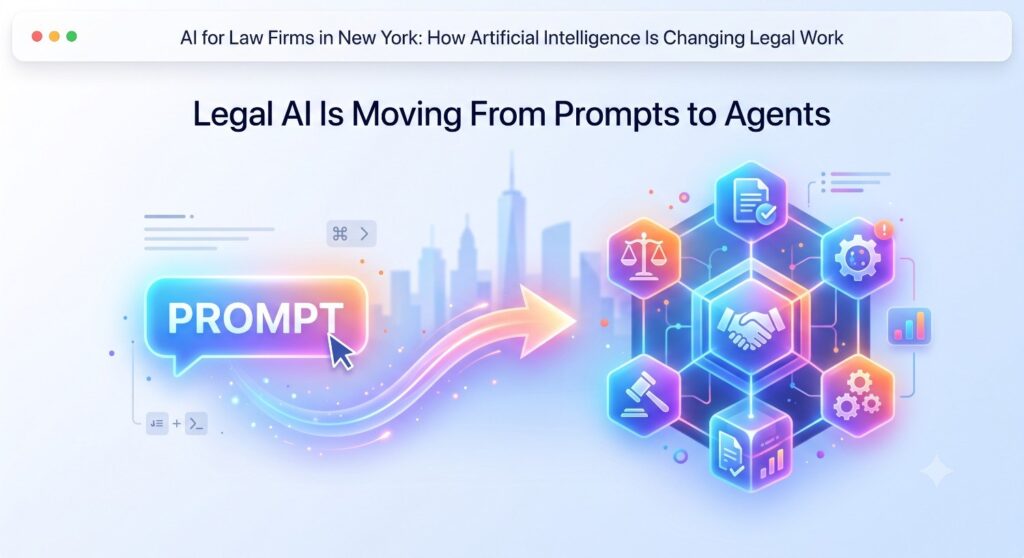
That is much closer to a junior workflow.
Agentic AI Could Produce the Largest Productivity Gains
Single prompts save minutes.
Workflows can save hours.
Agents could eventually coordinate entire categories of repetitive work.
That is why the shift toward agentic legal AI matters.
Paul, Weiss’s work with Harvey Workflow Builder provides an early example of the direction. The goal is to turn firm expertise, best practices and guardrails into repeatable systems.
Willkie’s deployment goes further by combining Harvey with its own Wendell Intelligence platform and other legal tools.
These systems are not autonomous law firms.
But they show how law firms could begin converting institutional knowledge into software.
AI Could Make Firm Knowledge More Important Than Firm Size
For years, scale offered a simple advantage.
A large firm could put more lawyers on a difficult problem.
AI changes the meaning of scale.
Imagine two law firms with 1,000 attorneys.
The first has disorganized documents, inconsistent precedents and no structured AI strategy.
The second has clean knowledge systems, validated templates, connected databases, clear playbooks and reusable AI workflows.
They technically employ the same number of lawyers.
They do not have the same production capacity.
The second firm has effectively turned previous legal work into an operating asset.
This suggests a new strategic equation:
Human expertise + proprietary knowledge + AI workflows + governance = modern law-firm capacity.
The technology component may become widely available.
The proprietary knowledge and workflows may become the real moat.
Clients Will Drive AI Adoption Even Faster Than Law Firms
Some firms will adopt AI because partners want better tools.
Others will adopt it because clients demand lower costs.
That second force may prove stronger.
Large New York law firms serve sophisticated clients that are themselves deploying artificial intelligence.
Banks are automating compliance work.
Private-equity firms are using AI for research and operations.
Technology companies are building agentic systems.
Corporate legal departments are purchasing their own legal AI tools.
These clients will become less willing to pay premium hourly rates for work that they believe software can accelerate.
The conversation may change from:
“Do you use AI?”
to:
“Why aren’t you using AI for this?”
And later:
“What efficiency did AI create, and how is that reflected in our fee?”
That is a much more difficult question.
The Firms That Win Will Measure AI, Not Simply Buy It
Buying licenses is easy.
Creating business value is harder.
A firm can announce an AI rollout and still achieve almost nothing if attorneys rarely use the system.
This is where many technology programs fail.
The firm measures adoption instead of outcomes.
The Wrong Metric Is Logins
Suppose 800 lawyers log into an AI system every month.
That sounds impressive.
But what happened?
Did turnaround time improve?
Did realization improve?
Did client satisfaction improve?
Were fewer hours written off?
Did drafting errors fall?
Did associate capacity increase?
Did fixed-fee matters become more profitable?
Those are better questions.
A Practical Legal AI Scorecard
| Metric | What it tells management |
|---|---|
| Active users | Whether people are trying the system |
| Workflows completed | Whether AI is entering real work |
| Hours saved per workflow | Productivity effect |
| Human corrections required | Output quality |
| Error rate | Risk |
| Matter turnaround time | Client impact |
| Write-offs | Economic impact |
| Fixed-fee margin | Profitability impact |
| Client satisfaction | Market impact |
| Reuse rate | Whether workflows are becoming institutional assets |
A firm that cannot measure these outcomes may have an AI tool.
It does not yet have an AI strategy.
A Practical 12-Month AI Roadmap for New York Law Firms
The smartest way to adopt AI is not to automate everything.
Start where the work is repetitive, expensive and verifiable.
Months 1-2: Map the Work
Choose two or three practice groups.
Ask lawyers where time disappears.
Do not begin with technology.
Begin with friction.
Find tasks that repeatedly consume large amounts of associate or paralegal time.
Months 2-3: Rank Use Cases
Score each workflow by volume, time consumed, risk and ease of verification.
A high-volume contract extraction process may be an excellent pilot.
A one-off Supreme Court argument probably is not.
Months 3-4: Establish Governance
Approve platforms.
Review contracts with vendors.
Understand data handling.
Define verification rules.
Create client-disclosure procedures.
Train lawyers before they use the tools on live matters.
Months 4-6: Build Narrow Pilots
Do not ask AI to “do M&A.”
Ask it to identify specific provisions in a defined class of agreements.
Narrow systems are easier to measure and easier to verify.
Months 6-8: Measure Against a Control
Compare AI-assisted work with the traditional process.
Measure time, accuracy and corrections.
Without a baseline, claims of “productivity” mean very little.
Months 8-10: Productize Successful Workflows
If the same process succeeds repeatedly, turn it into a standard workflow.
Add firm templates.
Add review rules.
Add source requirements.
Reduce the amount of prompting lawyers must invent themselves.
Months 10-12: Connect AI to Pricing
This is the stage many firms will avoid.
They should not.
If a workflow cuts matter effort significantly, the firm should decide how that efficiency affects price, staffing and margin.
Technology value should eventually appear in the economics.
Should Small and Mid-Sized New York Firms Care?
Absolutely.
In some ways, AI could be even more important for smaller firms.
A 20-lawyer firm cannot assign six associates to every research project.
AI can provide a form of digital leverage.
A small litigation boutique might use AI to summarize discovery.
An employment firm might analyze large sets of workplace records.
A real-estate firm might extract lease provisions.
An immigration practice might organize client information.
A small corporate firm might accelerate first drafts.
The technology does not remove the need for expertise.
It allows expertise to operate across more work.
Small Firms Should Avoid One Common Mistake
Do not try to copy BigLaw’s technology stack.
A 30-lawyer practice probably does not need a giant custom AI engineering team.
It needs one or two secure systems, a clear policy and a handful of high-value workflows.
Simplicity is an advantage.
Can AI Replace New York Lawyers?
Not in the way the most dramatic headlines suggest.
AI can already replace pieces of lawyer work.
That is different.
It can replace some time spent searching.
Some time spent summarizing.
Some time spent formatting.
Some time spent comparing documents.
Some time spent creating basic first drafts.
As these systems improve, that list will grow.
But legal practice contains another layer that is much harder to automate.
A CEO does not hire a major law firm only because the firm can locate a case.
The CEO hires counsel because a difficult decision must be made.
Should we settle?
Should we sue?
Can we close this deal?
How much risk should the board accept?
What will the regulator think?
Will this negotiating position destroy the transaction?
What do we do tomorrow morning?
Those questions require judgment.
They also require accountability.
Clients want a person they trust to make the call.
What AI Is Really Replacing Is the Old Legal Production System
This is the deeper change.
The traditional legal production system assumes that information must pass through large amounts of human labor.
AI weakens that assumption.
The future workflow may increasingly look like this:
Software performs the first pass.
A lawyer investigates exceptions.
Software checks the revised work.
A lawyer applies judgment.
Software organizes the final material.
A lawyer takes responsibility.
The amount of human attention goes down.
The importance of the remaining human attention goes up.
That is why describing legal AI only as “automation” misses the point.
The real change is attention allocation.
The New Competitive Advantage Will Be Better Judgment Per Lawyer Hour
For decades, law firms often competed through reputation, relationships, expertise and headcount.
Those things will remain important.
AI adds another factor.
How effectively can the firm turn each hour of expensive human judgment into client value?
A firm whose lawyers spend half their day organizing information manually will eventually compete against firms whose technology performs that work automatically.
The second firm’s lawyers have more attention available for strategy.
That is difficult to beat.
What NYC Tech Journal Will Be Watching Next
The next stage of New York’s legal AI market will be much more interesting than the first.
The first phase was experimentation.
The second was enterprise deployment.
The third appears to be workflow automation.
The fourth may be full economic redesign.
We will be watching whether firms begin publicly connecting AI to alternative fees, whether clients require specific AI efficiencies in outside-counsel arrangements and whether associate staffing changes on document-heavy matters.
We will also watch the growth of proprietary law-firm AI.
Debevoise’s STAAR platform is an early example of a firm turning legal expertise into a client-facing technology product. STAAR 2.0 allows in-house teams to access Debevoise-approved guidance, policies, risk assessments and other material through an AI interface grounded in vetted firm content.
If that model spreads, the line between law firm and software company becomes less clear.

A client may eventually buy legal advice in several forms:
partner time,
associate work,
fixed-fee workflows,
subscriptions,
AI tools,
or some combination of all five.
That could become one of the most important changes to the New York legal market in decades.
The Bottom Line for New York Law Firms
Artificial intelligence is not waiting outside the legal industry anymore.
It is already moving through the front door.
The strongest evidence is not a futuristic prediction. It is what leading firms are doing now.
Paul, Weiss is helping develop reusable AI legal workflows.
Willkie has combined enterprise legal AI with its own internal platform and formal AI governance.
Debevoise has turned firm expertise into an AI-powered client product.
Cleary and Weil are helping shape Google’s newest agentic legal platform.
Meanwhile, New York courts and bar organizations are building practical rules around competence, confidentiality, verification and responsibility rather than attempting to prohibit the technology.
The data also suggest caution toward the most extreme employment predictions.
New York metro lawyer employment grew significantly between 2016 and 2025. Paralegal employment grew even faster over the same broad period. Technology has historically changed the tasks performed inside legal jobs before eliminating the profession itself.
AI may follow that pattern, although the scale and speed could be greater.
The most exposed work is repetitive, document-heavy and easy to check.
The least exposed work depends on judgment, persuasion, trust and responsibility.
That means the future New York lawyer may spend less time finding information and more time deciding what the information means.
The future associate may draft less from a blank page and spend more time reviewing and improving machine-created work.
The future paralegal may manage automated document systems rather than manually organizing every document.
And the future partner may have to think just as carefully about technology, workflows and pricing as about leverage and billable hours.
The important question for New York firms is therefore not whether artificial intelligence will replace lawyers.
A much more useful question is:
What happens when every excellent lawyer has an AI system capable of performing hours of routine legal work in minutes?
The answer is beginning to emerge.
Lawyers remain.
But the way legal work gets produced may never be the same.