
Private equity has always been an information business.
The best investors do not simply find companies with attractive numbers. They find an important fact before somebody else does. They ask a question that another buyer missed. They notice that revenue growth is coming from price rather than volume. They discover that a major customer is preparing to leave. They understand why a market that looks fragmented is actually difficult to consolidate.
For decades, getting those answers required a huge amount of human work.
Associates opened hundreds of documents. Analysts rebuilt tables from PDFs and Excel files. Investment teams searched old deal folders for comparable companies. Consultants interviewed customers. Lawyers reviewed contracts. Teams went through expert-call transcripts, management presentations, customer data, operating reports, market studies and financial models.
Artificial intelligence is starting to change that process.
The important change is not that private equity professionals can ask a chatbot to summarize a confidential information memorandum. That was the first stage.
The more important shift is toward AI agents that can carry out parts of the investment workflow.
An agent can receive a goal, gather information from several approved sources, work through a series of steps, produce an output, show where the information came from and, in more advanced systems, update another part of the deal process.
That changes the private-equity AI question.
The old question was:
Can AI help an associate research a company faster?
The new question is:
How much of the path from incoming deal to investment decision can software complete before a human needs to take control?
That distinction matters enormously in New York.
Some of the world’s largest alternative asset managers operate from Manhattan. At the same time, several important financial AI companies—including Rogo, Hebbia, Grata and Keye—have built significant operations in New York. Rogo is based in New York; Grata lists its headquarters at 3 Columbus Circle; Keye is headquartered in New York; and Hebbia lists New York as its primary location.
The result is the beginning of a private-markets AI cluster in which investors, bankers, data providers, consultants, lawyers and software developers sit unusually close to one another.
And the technology is arriving at an important time.
McKinsey reported that buyout and growth deals above $500 million increased 44% in 2025 to more than $1 trillion. At the same time, the firm says AI experimentation is now widespread across sourcing, diligence and portfolio monitoring, although actual productivity gains remain uneven. Some general partners are reporting 30% to 40% gains in analyst-heavy work.
That combination—more activity, more data, higher expectations and pressure to create value—makes private equity an unusually strong environment for agentic AI.
But it also makes mistakes unusually expensive.
An AI-generated marketing paragraph can be rewritten.
A bad number in a buyout model can change the price somebody is willing to pay for a company.
So the private-equity winners will probably not be the firms that automate the most work.
They will be the firms that learn which work should be automated, which work should be checked and which decisions must remain human.
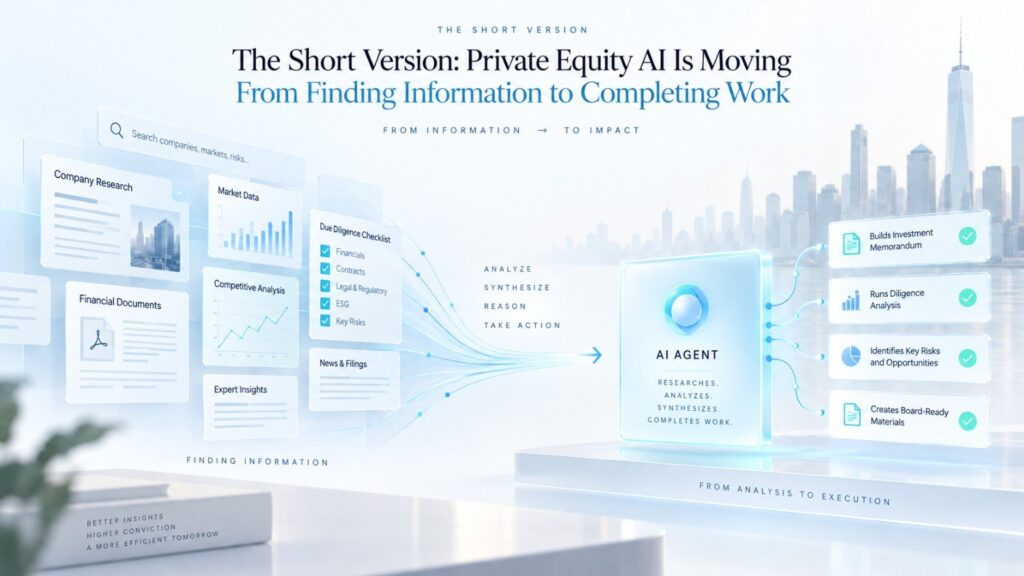
The Short Version: Private Equity AI Is Moving From Finding Information to Completing Work
Private-equity teams have already been experimenting with generative AI for research, summaries and information retrieval. The next stage is connecting those abilities to the actual sequence of work required to evaluate an investment.
That means going from this:
“Summarize this CIM.”
To something much closer to this:
“Review the data room, rebuild monthly revenue by customer, calculate retention by cohort, identify unusual margin movements, compare the business with our previous software deals, create the key diligence questions and show me the source behind every important number.”
The second request is much more powerful because it is not one task.
It is a workflow.
That is where agents become interesting.
Blackstone provides one of the clearest public examples of the direction of travel. In May 2026, CTO John Stecher said that a deal may involve reviewing thousands of documents and that work that once consumed an entire weekend can now be carried out in minutes. He also said Blackstone is using AI near the top of the funnel to evaluate opportunities faster and that its private-equity and real-estate teams are using targeted tools to move from raw deal documents toward financial models.
This is much more significant than employees receiving access to a general-purpose chatbot.
It means AI is entering the production line of investing.
The Market Is Beginning to Validate the Idea
McKinsey’s January 2026 private-markets research found that 67% of surveyed investors believe generative AI will have a transformational effect on their business within five years, while 82% consider its use a high priority. McKinsey also warns that speed alone is dangerous because investment teams must still validate sources and control false precision.
Accenture found something similar from the diligence side. Its research says 83% of private-equity leaders believe their current diligence process has significant room for improvement, while 62% expect technologies such as analytics and generative AI to fundamentally change deal screening and diligence. Accenture estimates that generative AI could automate as much as 30% of diligence tasks and augment another 20%.
Those percentages should not be treated as forecasts carved in stone.
They should be read as evidence of the size of the problem.
Private equity spends an enormous amount of money and human time turning messy information into an investment decision.
AI companies are attacking that conversion process.
What an AI Agent Actually Means in Private Equity
“AI agent” is quickly becoming an overused term.
Private-equity leaders should be careful not to buy software merely because the vendor places the word “agent” on its website.
A useful private-equity agent needs more than a language model.
A Chatbot Answers a Question
A basic assistant receives a prompt and returns an answer.
For example, an associate might upload an industry report and ask:
“What are the five largest risks in this market?”
That may save time, but the user still controls almost every stage of the process.
The person gathers the document, chooses what to ask, checks the answer, finds other sources and decides what happens next.
An Agent Pursues an Objective
An agent is more useful when it can perform several connected actions.
Imagine telling a system:
“Prepare the first-pass diligence package for Project Hudson.”
The system could identify newly uploaded data-room files, extract revenue information, compare customer lists between files, update a diligence tracker, locate inconsistent figures, search approved market-data sources, prepare management questions and draft an initial investment-committee section.
The important feature is not clever writing.
It is orchestration.
The software is coordinating several pieces of work around a business objective.
The Best PE Systems Are Likely to Be Hybrid Systems
Private equity exposes a basic weakness of pure language models: numbers must reconcile.
A model that writes an excellent paragraph but occasionally invents financial data is not enough.
That is why some emerging platforms combine large language models with more deterministic software.
Keye, for example, says its private-equity diligence system combines AI with deterministic data pipelines, shows the formula behind calculations, links outputs to underlying documents and exports analysis into Excel with dynamic formulas. The company says it is designed to move from raw data-room files to analyses such as customer cohorts, retention curves, pricing-versus-volume changes and cost structures.
The strategic lesson is important.
The private-equity agent of the future may not be one enormous model.
It may be a collection of specialized systems.
One model understands language.
Another retrieves documents.
A calculation engine handles math.
A rules system controls permissions.
A financial-data provider supplies market information.
An audit layer stores citations.
Excel remains the final environment for certain analyses.
Humans approve the investment.
That architecture is less magical than the idea of an autonomous investor.
It is also much more practical.
Original NYC Tech Journal Research: Mapping the Private-Equity Agent Stack in New York
To understand how far this market has actually moved, NYC Tech Journal created an original workflow analysis of four PE-facing AI companies with major New York operations: Rogo, Hebbia, Grata and Keye.
This is not a ranking of which product is “best.”
Their products have different goals.
Instead, we asked a narrower question:
Across how many parts of a normal private-equity research and diligence workflow can we find explicit public evidence of product capability?
Our Methodology
We created nine workflow categories:
- Market mapping and sourcing
- Screening and prioritization
- Virtual data room or private-document ingestion
- Financial or operating analysis
- External market research
- Source-linked risk review
- Deliverable generation
- Workflow or CRM integration
- Cross-deal institutional memory
We gave a platform one point only where company materials reviewed through September 11, 2026 explicitly described functionality that fits the category.
We did not award points based on what the software might theoretically be able to do.
The evidence base included current product pages and announcements from Rogo, Hebbia, Grata and Keye. Rogo now describes whole-data-room analysis, cited outputs, risk identification, financial modeling, diligence tracking and IC memo creation. Hebbia publicly demonstrates large-document analysis, financial and valuation workflows, origination scoring and integrations. Grata describes sourcing, market mapping, private financials, industry research, agentic automation and CRM connectivity. Keye describes data-room ingestion, deterministic financial analysis, risk flagging, source tracing, Excel output and benchmarking against prior deals.
Because this research depends on vendors’ published materials, it measures publicly documented workflow coverage, not independent product performance.
That distinction is critical.
Table 1: NYC Tech Journal Private-Equity Agent Workflow Map
| Workflow capability | Rogo | Hebbia | Grata | Keye |
| Market mapping / sourcing | ✓ | ✓ | ✓ | — |
| Screening / prioritization | ✓ | ✓ | ✓ | ✓ |
| VDR / private-document ingestion | ✓ | ✓ | — | ✓ |
| Financial / operating analysis | ✓ | ✓ | ✓ | ✓ |
| External / market research | ✓ | ✓ | ✓ | — |
| Source-linked risk review | ✓ | ✓ | ✓ | ✓ |
| Deliverable generation | ✓ | ✓ | — | ✓ |
| Workflow / CRM integration | ✓ | ✓ | ✓ | — |
| Cross-deal institutional memory | ✓ | —* | — | ✓ |
| Documented workflow coverage | 9/9 | 8/9 | 6/9 | 6/9 |
*The scoring standard was deliberately conservative. A feature received credit only when the reviewed public material supported that exact category clearly enough for coding.
Chart 1: Publicly Documented Workflow Breadth
| Platform | Coverage | Visual |
| Rogo | 100% | █████████ |
| Hebbia | 89% | ████████░ |
| Grata | 67% | ██████░░░ |
| Keye | 67% | ██████░░░ |
The result is more interesting than the ranking.
Across four platforms and nine categories, there were 29 documented capability matches out of 36 possible slots.
That equals roughly 81% coverage.
In other words, the emerging New York private-markets AI ecosystem already has publicly documented products addressing most stages of the research-and-diligence chain.
Chart 2: Where Agent Capability Is Most Concentrated
| Deal stage | Platforms with documented capability | Coverage |
| Screening / prioritization | 4 of 4 | 100% |
| Financial / operating analysis | 4 of 4 | 100% |
| Source-linked risk review | 4 of 4 | 100% |
| Market mapping / sourcing | 3 of 4 | 75% |
| VDR / private-document ingestion | 3 of 4 | 75% |
| External / market research | 3 of 4 | 75% |
| Deliverable generation | 3 of 4 | 75% |
| Workflow / CRM integration | 3 of 4 | 75% |
| Cross-deal institutional memory | 2 of 4 | 50% |
This tells us something important about where the market is going.
The strongest overlap is not in writing emails or making prettier summaries.
It is in screening, analytical work and evidence-backed risk review.
Those are much closer to the economic core of private equity.
Finding #1: Screening Could Be the First Part of PE to Become Agent-Led
Private-equity teams frequently see far more opportunities than they can examine deeply.
That creates a hidden allocation problem.
Every hour an associate spends investigating an obviously weak opportunity is an hour that cannot be spent understanding a potentially excellent one.
Agents can change that equation.
From Searching for Companies to Continuously Ranking Them
Traditional sourcing platforms require users to search databases using industries, revenue ranges, locations, funding information and keywords.
AI makes the search much more flexible.
Instead of saying:
“Show me healthcare software companies with $20 million to $100 million revenue.”
A firm could define its actual investment logic:
“Find founder-owned healthcare workflow businesses with recurring revenue, strong retention signals, low customer concentration and evidence that the product sits inside a mission-critical process.”
The agent can turn those ideas into multiple searches, combine data and continuously improve the target list.
Grata is already pushing in this direction. Its private-equity product describes AI-generated taxonomies, market mapping, seller-intent signals, private-company financials and agentic automation across the deal lifecycle. The company says its database covers more than 22 million private companies.
Rogo has also connected private-capital information directly into its AI environment. In May 2026 it expanded its PitchBook integration so users could work with company profiles, financing histories, cap tables, investor portfolios, financial information and research alongside internal documents.
That creates the foundation for something much bigger than search.
The Future Inbox Could Already Be Ranked
Imagine a deal team arriving Monday morning.
Instead of 15 new opportunities sitting in a shared inbox, an agent has already built a preliminary assessment.
It has checked each company against the firm’s investment criteria.
It has identified which industries fit current themes.
It has compared the businesses against previous deals.
It has reviewed basic market signals.
It has highlighted three opportunities deserving immediate attention.
The associate begins with the exceptions and uncertainties, not with data collection.
That could fundamentally change junior private-equity work.
Finding #2: Data Rooms Are Becoming Machine-Readable Working Environments
The data room is one of the clearest places where AI agents can create immediate value.
A live process may contain thousands or tens of thousands of documents.
The problem has never been merely reading them.
The problem is maintaining a coherent picture as the room changes.
Rogo Is Connecting AI Directly to Live Deal Rooms
The pace of development during 2026 is revealing.
Rogo announced in August that it had acquired Rivanna, whose AI-native diligence technology had been used across hundreds of live transactions. Rogo said the technology could query tens of thousands of files, provide fine-grained citations, proactively identify risks and manage diligence Q&A and trackers.
Then on September 8, 2026, Rogo announced a partnership with Datasite.
The integration is important because it lets approved content remain connected to the live data room rather than requiring investment professionals to repeatedly download sensitive files and upload them somewhere else. Rogo says the content can then support diligence analysis, IC memos, financial models, valuations, management-meeting preparation, trackers and process updates.
It had already announced an integration with SS&C Intralinks in June.
This suggests that the data room may evolve from a storage location into a live input stream for agents.
That Changes Diligence From a Batch Process to a Continuous Process
Historically, an associate might review a folder after new documents arrive.
Then management uploads another file.
The associate returns.
A consultant updates an analysis.
A new question appears.
Somebody changes the model.
Each movement creates another handoff.
An agent can watch the approved information environment continuously.
A newly uploaded customer file could trigger an updated retention analysis.
A new contract could change a risk tracker.
A revised forecast could trigger a comparison against the previous model.
A management answer could close one question while opening another.
The diligence room begins behaving less like a folder and more like an operating system.
Finding #3: The Biggest Breakthrough May Be Turning Messy Data Into Reliable Analysis
Summarizing documents is useful.
Private equity needs something harder.
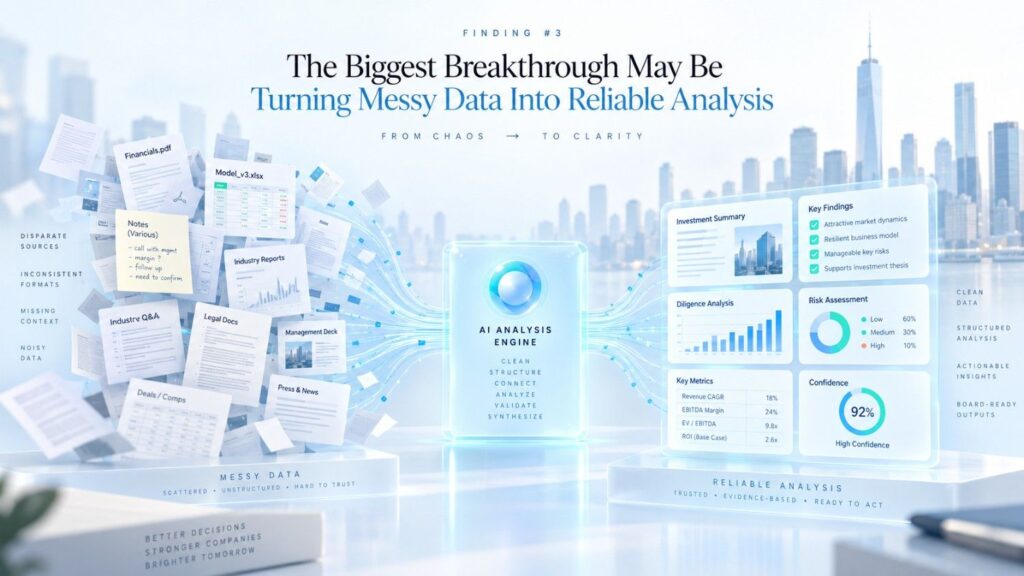
It needs math.
Most Important Diligence Questions Live Beneath the Headline Numbers
Suppose a company reports 20% revenue growth.
That figure alone tells the investor very little.
How much came from new customers?
How much came from price increases?
Did existing customers buy more?
Are small customers leaving while one large customer grows?
Did gross margin improve because of a sustainable process improvement or a temporary accounting change?
What happens to EBITDA if the five largest customers leave?
Those questions require data transformation.
This is where specialized private-equity AI systems are becoming more interesting.
Keye says its platform can ingest transaction databases, ERP exports, financial statements, customer-level files and other data-room information, then perform analyses including cohorts, retention, pricing-versus-volume changes and cost structures. It can export dynamic formulas to Excel and trace analysis back to source documents.
Hebbia similarly positions Matrix around large-scale private-document and financial analysis. Its current platform displays workflows involving financials, growth, valuation, leverage, balance-sheet review, acquisition history and strategic risks, while also combining information from sources such as SEC filings, expert networks, DealCloud and private files.
The market is therefore moving toward an important design principle:
Do not ask a language model to guess a number that software can calculate.
The Private-Equity Model Will Not Disappear
Excel is not likely to vanish because AI agents arrive.
Instead, Excel may become a controlled output and review layer.
An investor may ask an agent to produce a first version of an operating analysis, but the team still needs to inspect assumptions, formulas and sensitivities.
This is especially important when leverage is involved.
Small changes can become large changes in equity returns.
Agents Should Build the First Draft, Not Own the Investment Case
A strong workflow might look like this:
The agent extracts historical financial information.
It identifies recurring and nonrecurring expenses.
It prepares customer and product analyses.
It builds draft assumptions from management’s plan.
It produces a structured model.
Then the associate tests it.
The VP challenges the operating assumptions.
The principal changes the downside case.
The partner decides what risk deserves capital.
That is a much stronger model than asking AI for an answer to:
“Should we buy this company?”
Private equity should automate production, not accountability.
Finding #4: Research Agents Could Give Middle-Market Funds Large-Firm Research Capacity
Large private-equity firms have always had a resource advantage.
They can hire industry specialists, operating partners, consultants, data scientists and expert networks.
Agents could narrow part of that gap.
One Associate Can Potentially Explore a Market Much More Broadly
Consider a fund studying commercial HVAC services.
Traditional research might require manually assembling:
market size estimates,
local competitors,
labor availability,
equipment suppliers,
regional demand,
acquisition history,
customer categories,
regulation,
pricing,
and previous sponsor activity.
An agent can attack many of those questions in parallel.
McKinsey says today’s generative-AI diligence tools can synthesize large amounts of public and proprietary information, detect trends and outliers and propose additional hypotheses for diligence teams. However, McKinsey also warns that ungoverned systems can produce weak peer sets, unrealistic cost assumptions and hallucinated metrics.
That creates a new division of labor.
Machines expand the search space.
Humans reduce it intelligently.
Research Speed Is Valuable Because It Changes Which Questions Can Be Asked
The biggest advantage is not simply saving three hours.
It is being able to run ten analyses where the team previously had time for two.
An investor can ask:
What would make this thesis wrong?
Which competitors are growing faster?
Which customer group behaves differently?
What did management say six months ago that conflicts with today’s presentation?
Which former employees describe a different strategy?
Which previous transactions had similar unit economics?
What usually happens to companies with this customer-retention profile?
This increases the number of opportunities to discover something non-obvious.
And that is much closer to real investment advantage.
Finding #5: AI Diligence Should Also Examine the Target’s AI Risk
Private-equity firms are not only using AI to study companies.
They increasingly need to study what AI will do to those companies.
That is a separate diligence problem.
Every Investment Committee Needs an AI Disruption Question
A software company may appear attractive based on five years of historical financial results.
But historical numbers may matter less if AI can eliminate part of the product’s value within the next three years.
Apollo offers a good example of how the conversation is changing. In May 2026, Apollo’s head of thematic investing said the team was spending roughly three quarters of its time on AI because the technology was affecting so many markets. Apollo has been developing frameworks for assessing disruption risk across software and business-services sectors.
Blackstone has publicly described an even more direct diligence example.
The firm said a potential investment had claimed it possessed a difficult-to-replicate data moat. Blackstone’s data-science team built a competing prototype using modern language models within hours. The result materially changed Blackstone’s view of the company’s defensibility and contributed to its decision not to invest.
That is an important preview of future technology diligence.
Instead of asking management:
“Can somebody copy your product?”
The investor may attempt to copy part of it.
The New AI Diligence Chapter
For many targets, investment teams should now examine four areas together.
The first is AI exposure. What parts of the company’s revenue are vulnerable if customers automate the work themselves?
The second is AI opportunity. Where could automation increase revenue or margins during the investment period?
The third is AI readiness. Does the company have clean enough data, technology and leadership to implement those opportunities?
The fourth is AI defensibility. Does the company possess proprietary data, workflow integration, distribution, trust or network effects that remain valuable as models improve?
McKinsey says sponsors are increasingly assigning specialized teams to examine targets’ AI readiness, data governance, code quality and deployment feasibility during diligence.
This should become part of the underwriting model rather than a slide added at the end of the IC deck.
Original NYC Tech Journal Research: What Major New York Private-Market Firms Publicly Reveal About AI
We conducted a second original analysis.
This time, instead of examining software vendors, we examined public evidence from six major investment organizations closely tied to New York private markets:
Blackstone, Apollo, KKR, Clayton Dubilier & Rice, Centerbridge and Warburg Pincus.
Again, this is not an adoption ranking.
Private-equity firms disclose very little about proprietary investment systems, and disclosure practices differ widely.
The analysis only asks where there is explicit public evidence.
Our Six Evidence Categories
We coded for:
AI in pre-deal screening or research;
AI in document-heavy diligence or modeling;
AI disruption or readiness analysis during underwriting;
AI in portfolio-company value creation;
a dedicated AI, data or technology operating capability;
and explicit governance or risk controls around AI.
Table 2: Public AI Evidence Across Selected New York Private-Market Firms
| Firm | Screening / research | Diligence / modeling | AI risk in underwriting | Portfolio value creation | Dedicated capability | AI governance / risk | Total public evidence categories |
| Blackstone | ✓ | ✓ | ✓ | ✓ | ✓ | ✓ | 6/6 |
| Apollo | — | — | ✓ | ✓ | ✓ | ✓ | 4/6 |
| KKR | — | — | ✓ | ✓ | ✓ | — | 3/6 |
| CD&R | — | — | — | ✓ | ✓ | — | 2/6 |
| Centerbridge | — | — | — | — | — | ✓ | 1/6 |
| Warburg Pincus | — | — | — | — | — | ✓ | 1/6 |
The methodology deliberately treats absence of public evidence as unknown, not as evidence that a firm is not using AI.
Chart 3: Public Evidence Coverage
| Firm | Categories with explicit public evidence | Visual |
| Blackstone | 6 | ██████ |
| Apollo | 4 | ████░░ |
| KKR | 3 | ███░░░ |
| CD&R | 2 | ██░░░░ |
| Centerbridge | 1 | █░░░░░ |
| Warburg Pincus | 1 | █░░░░░ |
Why does Blackstone score so highly?
Because it has simply disclosed much more.
The firm says its data-science organization has been embedded in investment work for years. It has publicly described AI-assisted deal screening, document analysis, financial-model preparation, technology diligence and portfolio deployment. Its earlier disclosures said more than 50 data scientists worked with deal teams and portfolio companies.
Apollo’s public evidence is strongest around understanding AI disruption and deploying AI inside portfolio businesses. In a January 2026 interview posted by Apollo, the firm’s Antoine Munfakh said Apollo was “all in on AI” and had roughly 350 AI projects across the portfolio. Apollo also describes operating partners who work from diligence through execution and focus on practical AI applications.
KKR Capstone explicitly includes early identification of technology disruption risks during diligence and lists AI strategy and execution among its digital value-creation capabilities.
CD&R went further organizationally in May 2026 by expanding its Tech Value Creation function, adding a dedicated in-house engineering capability focused on AI deployment and emphasizing engagement from diligence through exit.
Centerbridge and Warburg Pincus provide useful evidence from another direction: risk controls. Public regulatory filings discuss internal policies, accuracy problems, confidential information, third-party providers and other risks associated with machine learning or AI in investment activities.
The Main Finding Is Not That One Firm Is “Ahead”
The more interesting finding is the pattern across categories.
Four of the six firms have public evidence around AI governance or dedicated technology capabilities.
Four have evidence around portfolio value creation or specialized capabilities.
Three show evidence of incorporating AI disruption into investment thinking.
But only one in our conservative public-source sample gives very detailed evidence of AI being used directly for both top-of-funnel screening and document-heavy investment work.
That gap is unlikely to mean only one firm is experimenting.
It probably tells us that the most strategically sensitive AI use cases are also the ones firms are least likely to describe publicly.
The Bigger Opportunity: Build a Firm That Remembers Every Deal
Research and diligence create enormous amounts of knowledge.
Private-equity firms routinely lose part of it.
An associate leaves.
A principal changes sectors.
An investment memo disappears inside a folder.

An important management observation lives in someone’s notebook.
A rejected deal is forgotten.
Three years later, another team investigates a similar company and begins much of the work again.
AI agents could change this.
Every Passed Deal Is Still Valuable Data
Suppose a fund has reviewed 1,000 companies over ten years and invested in 40.
The other 960 opportunities contain enormous information.
Why did the fund pass?
Was the valuation too high?
Was customer concentration unacceptable?
Did management miss forecasts?
Did the market develop differently than expected?
Was the investment committee correct?
An agentic institutional-memory system can potentially make those historical decisions searchable and comparable.
Keye explicitly describes benchmarking new diligence work against prior deals and building longer-term intelligence from patterns across a fund’s transaction history.
Rogo is moving aggressively toward the same broader idea. Its July 2026 product announcement described a system in which presentations, models, research, diligence and conversations become institutional knowledge rather than disappearing into disconnected tools.
That could be one of the most important long-run uses of AI in investing.
The Proprietary Model May Be the Firm Itself
Large language models are increasingly available to everybody.
That means the model alone may not create much competitive advantage.
A private-equity firm’s real advantage could come from combining a strong model with decades of proprietary history:
its investment memos,
its rejected deals,
its operating data,
its expert-call notes,
its sector frameworks,
its investment-committee questions,
its portfolio results,
and the reasons experienced partners changed their minds.
That creates a different kind of AI system.
It does not simply know finance.
It knows how your firm thinks.
Management Meetings Are Becoming Part of the Data Layer
Meetings represent another major information leak.
Important facts emerge during management presentations, diligence calls, expert calls and internal discussions.
Then someone types notes.
Sometimes.
Rogo’s September 2026 acquisition of Arvo shows where this layer could go. Arvo was built as an AI meeting assistant for regulated financial institutions, with controls around retention, sensitive information and administration. Rogo says meeting context can flow into diligence rooms, trackers and CRM systems.
That sounds like a small productivity feature.
It is not.
If meeting information becomes structured, searchable and connected with documents, every conversation can become another data source for agents.
A management claim made on Tuesday can be compared with a spreadsheet uploaded on Thursday.
A diligence answer can automatically update the open-question list.
A new risk can be linked to the relevant contract.
The next management call can begin with unresolved contradictions rather than a recap of what everybody already knows.
That is a much better use of AI than automated meeting minutes.
What Private-Equity Associates Will Actually Do Differently
AI agents will not remove the need for junior investors.
They could remove a large amount of junior production work.
That distinction matters.
Less Time Moving Information
Associates currently perform countless small transformations.
PDF to Excel.
Excel to PowerPoint.
Data room to tracker.
Meeting notes to email.
Research database to memo.
Memo to investment-committee slides.
Agentic systems are attacking precisely these transitions.
The associate’s job therefore shifts upward.
More Time Questioning Information
Future associates may spend more time asking:
Why did the agent classify this expense as nonrecurring?
Why does customer retention differ from management’s number?
Which source supports that market estimate?
Why did the agent choose these comparable companies?
What information is missing?
Which assumption drives the downside case?
What would cause us to walk away?
That requires a different form of financial training.
The strongest young investors may not be the people who can produce an acceptable first draft fastest.
They may be the people who can break an apparently excellent first draft.
The New Associate Advantage Is Knowing What to Question
When producing information is expensive, the valuable employee is often the person who can produce it efficiently.
When producing information becomes cheap, the valuable employee becomes the person who can judge it.
Private equity therefore faces a paradox.
AI may reduce the amount of manual work required from associates while increasing the importance of deep investing skill.
A weak investor with powerful AI can produce more weak analysis.
A strong investor with powerful AI can investigate more possibilities and spend more time on judgment.
The gap may widen rather than shrink.
Training Programs Need to Change
Traditional analyst training focuses heavily on production.
Modeling.
PowerPoint.
Research.
Process management.
Those skills will remain important, but firms should add new ones:
source validation,
AI output testing,
scenario design,
data-quality review,
technology-risk assessment,
and structured questioning.
The young investor needs to understand not only how to build a model but how to tell whether an automatically built model is wrong.
That is a harder skill.
The KPI Dashboard Every Private-Equity Firm Should Build
One of the biggest mistakes PE firms can make is measuring AI adoption by logins.
The question is not how many people opened the application.
The question is whether investment work improved.
Table 3: A Practical Private-Equity AI Scorecard
| KPI | What it tells you |
| Time from CIM receipt to first investment view | Whether screening is actually faster |
| Deals screened per investment professional | Whether capacity is increasing |
| Hours spent on manual data preparation | Whether automation reaches real work |
| Time from data-room opening to first analytical output | Whether diligence starts faster |
| Number of source-verification errors | Whether speed is damaging quality |
| Model adjustments required after AI generation | Whether automated analysis is dependable |
| Critical issues found before management meeting | Whether AI improves preparation |
| Deals rejected earlier | Whether the system saves diligence capacity |
| Percentage of outputs with traceable sources | Whether analysis is auditable |
| Reuse of prior-deal knowledge | Whether institutional memory is improving |
| Investment-team AI adoption by workflow | Whether tools are embedded rather than occasionally tested |
| Human override rate | Where agents still struggle |
| Material errors reaching IC | The metric that should remain close to zero |
The important idea is to measure workflow economics.
A system that saves five minutes writing emails but does nothing to improve screening, diligence or portfolio work is not strategically important to a PE firm.
How to Pilot AI Agents Without Creating a Mess
Private-equity firms do not need a two-year transformation before experimenting.
They do need structure.
Start With One Painful Workflow
Do not begin with:
“We need an AI strategy.”
Begin with:
“Our associates spend eight hours rebuilding customer data every time a software deal enters diligence.”
That is measurable.
The inputs are identifiable.
The desired output is clear.
The current cost is known.
The team can compare AI-assisted work with the previous process.
Use Historical Deals Before Live Deals
A strong test environment is an old transaction.
Take a completed deal with a known outcome.
Give the system only the information that would have been available at the original diligence date.
Ask it to complete the proposed workflow.
Then compare its work with the real investment team’s work.
Did it find the same problems?
Did it miss anything important?
Did it create false positives?
Were the numbers correct?
Would the output have changed the team’s decision?
Historical testing is far more useful than watching a vendor demo built around ideal documents.
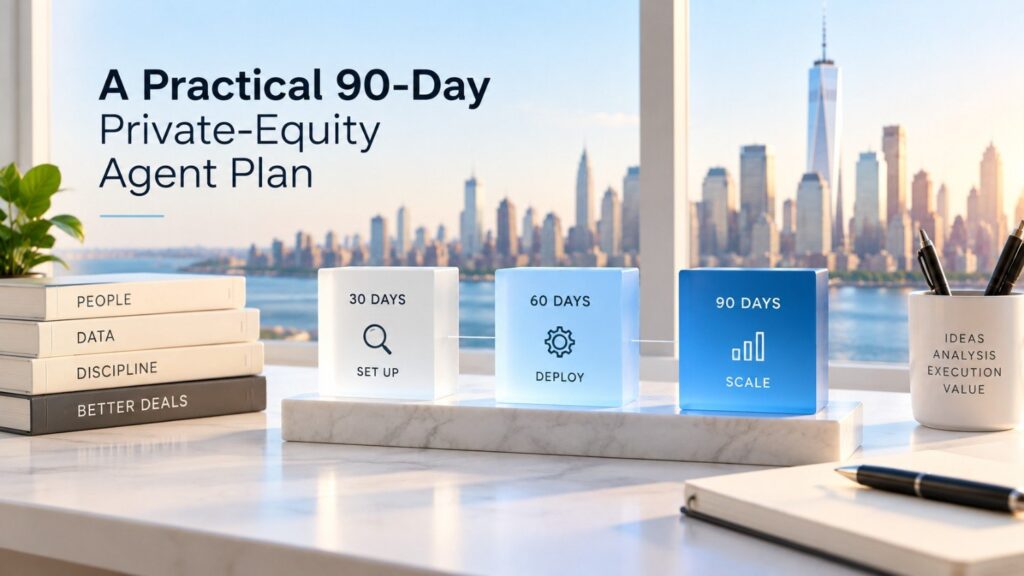
A Practical 90-Day Private-Equity Agent Plan
The first month should focus on one workflow and a controlled dataset.
Select perhaps three to five historical deals. Define exactly what the agent should produce and establish an approved environment for confidential information.
The second month should run parallel testing.
Human teams use the normal process while the AI-assisted process runs beside it. Measure time, errors, missed issues, source quality and analyst revisions.
The third month should test a narrow live workflow.
Do not let the agent become an autonomous investment committee. Let it handle a bounded activity such as incoming-deal screening, first-pass data-room analysis, customer-data preparation or diligence-question generation.
Then expand only after performance is understood.
This slower-looking approach may actually produce faster adoption because people trust tools they have tested.
Human Approval Should Be Designed Into the System
The phrase “human in the loop” is often used without explaining where the human appears.
That is not enough.
PE firms need explicit approval gates.
Not Every Action Needs the Same Level of Review
An agent finding public information about a market has a different risk profile from an agent changing a leveraged-buyout assumption.
Likewise, drafting an internal list of diligence questions is different from sending questions to management.
The approval process should match the consequence.
Low-risk information gathering can be highly automated.
Source-backed extraction can be automated with sampling and review.
Financial transformations need reconciliation.
Model assumptions require investment-team approval.
External communication usually deserves another control layer.
Investment decisions remain human.
Build the Escalation Logic Before Scaling
A mature system should know when to stop.
For example:
If two documents provide conflicting revenue figures, flag the difference.
If a calculation does not reconcile, do not fill the gap with an estimate.
If the source is missing, label the fact as unsupported.
If confidential information would need to leave an approved system, block the action.
If a deal reaches a defined risk threshold, route it to a human reviewer.
That is agent design for institutional finance.
The Compliance Problem Is Real
Private-equity firms should not treat AI controls as a problem to solve after deployment.
Sensitive transaction information can include material nonpublic information, customer data, employee information, financial records, contracts and strategic plans.
Putting that information into an uncontrolled external system can create obvious problems.
Regulators Are Already Paying Attention to AI
The SEC has already brought enforcement actions against investment advisers for making false or misleading claims regarding their AI use. In March 2024, two advisers agreed to $400,000 in combined civil penalties in cases involving misleading statements about AI capabilities.
The lesson extends beyond those cases.
Do not exaggerate what your system does.
Do not call a basic automation engine “AI-driven underwriting” in investor materials unless that description can be defended.
Do not claim improved returns without evidence.
AI enthusiasm does not suspend ordinary disclosure obligations.
Traditional Rules Still Apply
FINRA’s 2026 regulatory oversight report makes the broader point clearly: existing obligations still apply when firms use generative AI. Its guidance highlights areas including supervision, communications, recordkeeping and model integrity.
Not every private-equity manager is a FINRA member in every part of its business, but the principle is useful.
New technology does not make old responsibilities disappear.
Confidential Data Is One of the Biggest Risks
Recent investment disclosures increasingly call out this issue.
An SEC-filed disclosure involving Ardian, for example, specifically describes the danger of confidential information, including material nonpublic information and personal data, being entered into AI systems in ways that conflict with policies or nondisclosure agreements.
Every PE firm therefore needs clarity on:
where prompts go,
where files are stored,
whether vendor models train on firm data,
how long information is retained,
who can retrieve it,
which underlying models receive it,
what logs exist,
and how access changes when employees leave.
Those questions are less exciting than AI demos.
They matter more.
Do Not Automate the Wrong Part of Due Diligence
AI creates a dangerous temptation.
If a process takes 100 hours, firms naturally want to reduce it to ten.
But some parts of diligence are valuable precisely because humans struggle with them.
A two-hour debate between partners may reveal more than 50 automated pages of analysis.
A difficult management discussion may reveal whether the CEO understands the business.
A disagreement between operating and investing teams may uncover a flawed assumption.
AI should remove friction around those moments.
It should not remove the moments.
The Goal Is More Judgment per Deal
That should be the central operating principle.
Do not measure success as:
“AI reduced diligence from 200 hours to 100.”
Measure whether the remaining 100 hours contain more useful thinking.
The best outcome might be:
less formatting,
less searching,
less copying,
less repetitive calculation,
but more scenario testing, more management questioning, more debate and more investigation of risk.
The Economics Could Change Which Deals Funds Can Pursue
One underappreciated consequence of agentic diligence is that it could change deal selection itself.
Today, some opportunities are unattractive partly because the diligence burden is too high relative to expected return.
A smaller transaction with messy records may require almost as much intellectual work as a much larger transaction.
Automation can change that equation.
Smaller Deals Could Become Easier to Evaluate
If software can structure messy information, perform first-pass analytics and accelerate market research, firms may be able to evaluate smaller companies more economically.
This could be especially important for buy-and-build strategies.
A fund making ten add-on acquisitions does not want ten completely independent manual diligence processes.
It wants a repeatable machine.
Agents are well suited to repeated workflows.
The same acquisition criteria can be tested every time.
The same customer analyses can be produced.
The same red flags can be checked.
The same integration questions can be generated.
That can make a platform strategy more scalable.
Diligence Could Become Connected Directly to the Value-Creation Plan
Traditional deals contain an awkward break.
The investment team learns the company during diligence.
The transaction closes.
Then the operating team begins another process to understand how to improve it.
Some knowledge transfers.
Some does not.
Agents can reduce that loss.
Every Diligence Finding Can Become an Operating Hypothesis
Imagine the diligence system concludes:
Customer churn is highest among small healthcare customers during onboarding.
Today that insight may appear in an investment memo.
Tomorrow it could automatically become a post-close workstream:
identify onboarding bottlenecks,
measure time to activation,
compare retention by implementation approach,
test automation,
and track the result.
This connects underwriting with ownership.
Bain’s 2026 Global Private Equity Report argues that winning firms need to move from full-potential diligence into execution from Day 1 and invest in systems, talent and AI rather than relying on slogans.
That connection may be one of the most valuable uses of agents.
AI Agents Will Make Investment-Committee Standards More Important, Not Less
If AI dramatically increases the amount of analysis a deal team can produce, committees face a new problem.
Too much information.
A 200-page AI-generated diligence package is not necessarily better than a 30-page human one.
Investment committees need sharper standards.
Every IC Should Demand Provenance
For important conclusions, decision-makers should be able to ask:
Where did this number come from?
Which file?
Which tab?
Which management statement?
Which external source?
What calculation converted the source into the displayed number?
What assumptions were added?
Who approved them?
If those questions cannot be answered quickly, the AI system has increased speed while reducing control.
That is a bad trade.
The Investment Memo May Become More Dynamic
Investment memos are currently documents.
Agents could eventually make them live systems.
The committee sees a claim.
It opens the evidence.
It changes an assumption.
The model recalculates.
It requests every document that contradicts management’s statement.
It compares the current deal with five historical investments.
It asks what happened to those companies three years later.
This would turn the IC process from document consumption into interactive investigation.
That is a far more interesting future than AI writing the memo faster.
What New York PE Leaders Should Automate First
The easiest mistake is beginning with whatever AI feature looks most impressive.
A better approach is to begin where three conditions overlap:
The work consumes substantial time.
The output can be checked.
The task repeats frequently.
That tends to favor areas such as data extraction, first-pass screening, data-room Q&A, customer-data preparation, comparable-company research, diligence trackers and source-backed meeting preparation.
The closer the task gets to judgment about price, leverage, management quality or final investment approval, the stronger human control should become.
What Firms Should Avoid Automating First
Do not begin with final investment recommendations.
Do not begin with fully autonomous valuation.
Do not allow an agent to communicate externally on a sensitive live transaction without review.
Do not let the system silently invent missing assumptions.
Do not connect confidential deal information with consumer AI tools without appropriate controls.
And do not measure success using the amount of AI-generated content.
The goal is not more words.
Private equity already has enough PowerPoint.
The goal is better decisions.
Five Predictions for Private Equity’s Agentic Era
1. Every Major PE Firm Will Develop a Proprietary Research Layer
General models will become commodities.
The valuable layer will connect models to proprietary deal history, portfolio information, investment criteria and institutional judgment.
The best system will not necessarily have the smartest underlying model.
It will have the strongest context.
2. Data-Room Agents Will Become Standard
Downloading folders manually, opening individual files and rebuilding recurring analyses will increasingly look outdated.
The rapid 2026 integration activity between Rogo, Datasite and Intralinks already points toward a future in which AI sits directly on approved transaction environments.
3. AI Risk Will Become a Standard Diligence Workstream
Technology diligence once focused mainly on software architecture, cybersecurity and technical debt.
Now PE teams need to understand whether AI can strengthen or destroy the target’s economics.
McKinsey has already compared the evolution with cybersecurity diligence: what starts as a single question can eventually become an entire chapter.
4. Junior Teams Will Become Smaller in Some Workflows but More Analytical
The amount of manual production required per transaction should decline.
That does not necessarily mean private-equity firms will simply eliminate junior employees.
A strong firm may instead use the same team to examine more deals and investigate each attractive opportunity more deeply.
5. Institutional Memory Will Become a Real Competitive Asset
An AI system that understands ten years of a firm’s successes, mistakes and passed deals can become more useful with every investment cycle.
The firm effectively compounds not only capital but knowledge.
That may ultimately be the strongest private-equity application of AI.
The Bigger Story: AI Is Changing the Economics of Conviction
Private equity does not get paid for producing research.
It gets paid for making good decisions with incomplete information.
That is why the agentic shift matters.
Research has historically been expensive.
Data preparation has been expensive.
Document review has been expensive.
Financial analysis has been expensive.
Searching previous transactions has been expensive.
Maintaining institutional knowledge has been difficult.
AI is reducing the cost of many of those activities.
The direct effect is productivity.
The strategic effect is much bigger.
When research becomes cheaper, investors can investigate more companies.
When analysis becomes faster, they can run more scenarios.
When documents become searchable at scale, obscure risks are easier to find.
When prior deals become usable data, every investment can improve the next one.
When diligence connects directly to portfolio operations, the value-creation plan can begin before closing.
That is how AI could change private equity.
Not by creating a robot partner that decides which company to buy.
But by giving human investors an increasingly capable digital team underneath them.
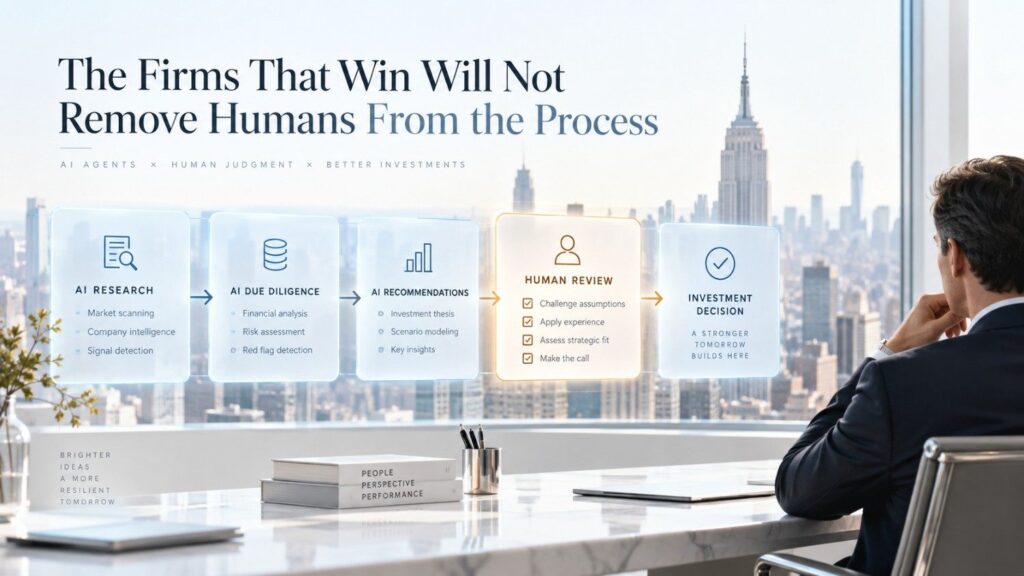
The Firms That Win Will Not Remove Humans From the Process
The strongest private-equity firms are unlikely to become autonomous.
They are more likely to become highly instrumented human organizations.
Agents will gather.
Agents will organize.
Agents will calculate.
Agents will compare.
Agents will watch for changes.
Agents will prepare drafts.
Humans will question.
Humans will negotiate.
Humans will judge management.
Humans will decide how much uncertainty they can accept.
Humans will decide what a business is worth.
And humans will remain responsible when the decision goes wrong.
That final point is the reason private equity may become one of the most important testing grounds for serious enterprise AI.
The industry offers enormous potential for automation, but it also has almost no tolerance for unsupported confidence.
The technology therefore has to grow up quickly.
It needs sources.
It needs permissions.
It needs audit trails.
It needs reliable calculations.
It needs escalation rules.
It needs to know when it does not know.
The New York market is already beginning to build that infrastructure.
Rogo is connecting agents with live data rooms, private-market data and meetings. Hebbia is expanding large-scale document and financial analysis. Grata is turning private-company discovery into increasingly agentic research. Keye is attacking structured PE diligence and financial analysis directly. Meanwhile, major investment organizations such as Blackstone, Apollo, KKR and CD&R are publicly expanding AI, data and technology capabilities around investment and portfolio work.
The next competitive advantage will not come from having access to AI.
Almost everybody will have access.
It will come from designing a better investment process around it.
For private-equity firms in New York, that work has already started.