
Compliance has always been expensive.
Banks hire armies of analysts to review alerts. Investment firms employ teams to check marketing materials, employee communications, personal trades, and regulatory filings. Fintech companies spend heavily verifying customers. Healthcare companies are building new teams just to understand whether their artificial intelligence systems follow new rules.
For decades, companies solved this problem by adding more people and more software.
Artificial intelligence is starting to change that model.
Instead of simply giving compliance officers another dashboard, a new group of startups is building AI systems that can read policies, investigate alerts, screen identities, review communications, test controls, monitor transactions, find possible violations, create audit evidence, and sometimes take the next step automatically.
New York is becoming one of the most important places where this change is happening.
The reason is not difficult to understand. New York brings together banks, hedge funds, private equity firms, insurers, fintech companies, law firms, healthcare institutions, regulators, crypto companies, and some of the largest enterprise technology buyers in the world.
That gives compliance startups something almost as valuable as capital: direct access to very difficult compliance problems.
NYC Tech Journal analyzed 12 AI-focused compliance and risk technology companies with a New York headquarters or meaningful New York operating base. We looked at publicly available company information, funding announcements, customer disclosures, product materials, regulatory coverage, and evidence of real-world adoption.
The result suggests that New York’s RegTech market is moving through a much bigger change than the arrival of another generation of compliance software.
Compliance software is beginning to turn into compliance infrastructure.
The Short Answer: The Top AI Compliance Startups in NYC
Our analysis produced the following ranking.
The score is not a measure of which company will become the most valuable. It measures how strong each company appears today across AI depth, regulatory reach, customer traction, New York importance, capital strength, and how much of the compliance workflow its technology can handle.
| Rank | Company | NYC Tech Journal Score | Main Focus |
| 1 | Norm AI | 97/100 | Agentic law and regulatory compliance |
| 2 | Hadrius | 94/100 | SEC and FINRA compliance automation |
| 3 | Alloy | 93/100 | Identity, fraud, KYC, KYB and risk |
| 4 | Chainalysis | 92/100 | Crypto compliance and investigations |
| 5 | Solidus Labs | 91/100 | Trade surveillance and market integrity |
| 6 | ThetaRay | 86/100 | AML and financial crime detection |
| 7 | Footprint | 82/100 | Identity and AI risk operations |
| 7 | ALIGNMT AI | 82/100 | Healthcare AI governance |
| 9 | ZeroDrift | 81/100 | Real-time AI communications compliance |
| 10 | Credal | 78/100 | Governed enterprise AI agents |
| 11 | Haast | 76/100 | AI-powered content compliance |
| 12 | Alinia | 74/100 | Guardrails and AI compliance infrastructure |
The most interesting part of this table is not who finishes first.
It is how different the companies are.
Norm AI is trying to encode laws into AI agents. Hadrius is rebuilding much of an investment firm’s compliance department around AI workflows. Alloy and Footprint sit closer to identity and financial crime operations. Solidus Labs focuses heavily on market surveillance. ALIGNMT AI is applying compliance infrastructure to healthcare AI.
That is a sign that RegTech itself is becoming a much larger category.
Original Research: Building the NYC AI RegTech Index
Calling every company that mentions AI an “AI compliance company” would make this analysis almost useless.
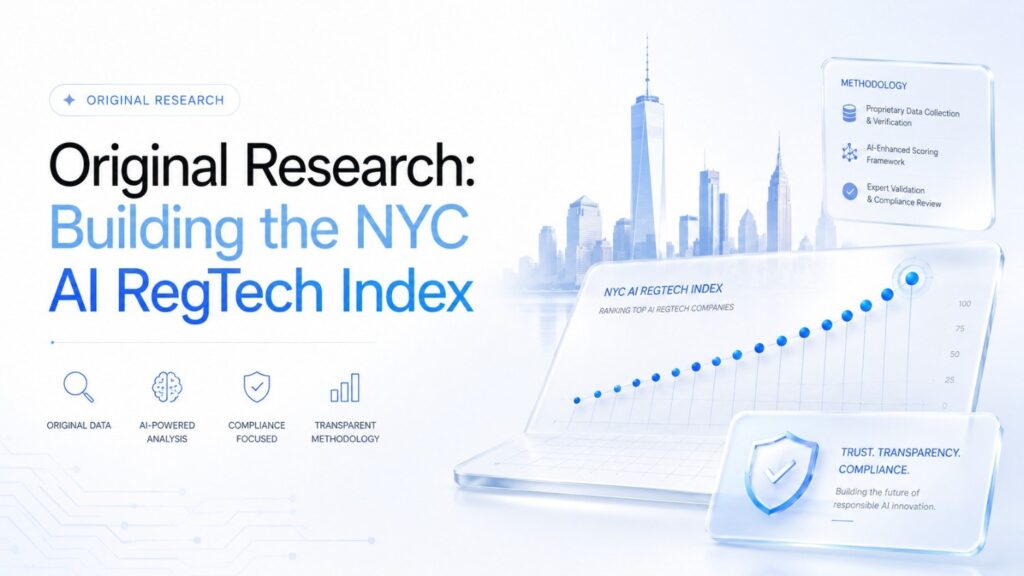
We therefore created a simple screening and scoring system.
How We Chose Companies
A company needed a New York headquarters or a meaningful New York operating presence and a product where AI, machine learning, automated reasoning, or AI agents play an important role in compliance, regulatory risk, financial crime, governance, surveillance, or regulated decision-making.
We did not limit the study to traditional AML software.
That would miss much of what is changing.
Modern compliance now includes AI governance, communications supervision, identity risk, crypto investigations, marketing review, transaction monitoring, market abuse, policy enforcement, and the governance of AI agents themselves.
We also focused primarily on independent private companies and scaleups. Companies that have already been acquired are useful evidence about the strength of the market, but they are less useful for a ranking of current startups.
WorkFusion is a good example. The New York company built AI agents for financial crime compliance and raised $45 million in September 2025, but UiPath acquired it in February 2026.
That acquisition is important, but WorkFusion is no longer ranked as an independent startup.
The NYC Tech Journal Scoring Model
We scored each company across six areas.
| Factor | Maximum Score | What We Looked For |
| AI depth | 25 | Is AI doing real compliance work or simply providing a chatbot? |
| Regulatory breadth | 20 | How many meaningful regulatory workflows can the platform address? |
| Enterprise traction | 20 | Customers, assets covered, transactions monitored and public adoption |
| NYC centrality | 15 | How important New York appears to the company’s operations |
| Capital signal | 10 | Publicly disclosed venture financing and investor support |
| Workflow scope | 10 | Whether the product handles one task or a broader compliance process |
| Total | 100 | NYC Tech Journal AI RegTech Score |
There is judgment involved in a model like this.
That is unavoidable because a customer count, assets under management covered, transaction volume, and number of investigations are not directly comparable. We therefore used public traction data to place companies into bands instead of pretending that $1 trillion of monitored transactions is mathematically equal to a certain number of customers.
This produces a much more useful picture than ranking companies purely by funding.
Chart: NYC’s AI Compliance Market Is Actually Three Markets
We grouped the 12 companies by their main job.
| Market | Companies | Share of Our Dataset | Relative Size |
| Financial crime, identity and market risk | 5 | 41.7% | ██████████ |
| Compliance execution and supervision | 4 | 33.3% | ████████ |
| AI governance and guardrails | 3 | 25.0% | ██████ |
This is important for buyers.
An AML platform should not be compared directly with a system designed to review marketing claims. An AI governance tool should not be judged by the same workflow as a KYC product.
“AI compliance” is becoming an umbrella term for several different software markets.
That will probably become even more obvious over the next few years.
Original Funding Analysis: The Capital Is Extremely Concentrated
We were able to establish clean public funding totals for ten companies in the research set.
Using a conservative $260 million figure for Norm AI, those ten companies have disclosed at least $1.25 billion in financing.
The distribution is highly uneven.
| Company | Publicly Reported Funding Used in Analysis |
| Chainalysis | $536.72 million |
| Norm AI | More than $260 million |
| Alloy | About $208.92 million |
| ThetaRay | About $155.5 million |
| Hadrius | $27 million |
| Footprint | About $19 million |
| Haast | $17.05 million |
| ZeroDrift | $12 million |
| Alinia | $7.5 million |
| ALIGNMT AI | $6.5 million |
Funding figures change and private rounds are not always disclosed. They should therefore be treated as a directional view of the market rather than a perfect accounting record.
Even with that warning, the result is striking.
Chart: Where the Disclosed Capital Sits
Using the conservative funding values above:
| Company or Group | Approx. Share of Sample Funding |
| Chainalysis | 42.9% |
| Norm AI | 20.8% |
| Alloy | 16.7% |
| ThetaRay | 12.4% |
| All six younger companies combined | 7.1% |
The four largest companies account for roughly 92.9% of the disclosed capital in this ten-company sample.
That tells us something important about the market.
New York has two AI RegTech economies developing at the same time.
One contains mature companies that have spent years building datasets, integrations, customer relationships, and regulatory trust.
The second contains young AI-native companies that can build software far faster and are trying to replace entire manual workflows.
Capital favors the first group today.
Product velocity may favor the second.
Why New York Is Becoming Such an Important RegTech Market
New York has always been a logical home for financial compliance technology.
What has changed is the number of regulatory workflows now touching software.
FINRA’s 2026 Annual Regulatory Oversight Report created a dedicated section covering generative AI. FINRA makes clear that its existing rules still apply when member firms use GenAI and specifically points to issues around supervision, communications, recordkeeping, reliability, and accuracy.
This creates a fascinating situation.
Financial institutions want to use more AI to reduce operating costs, but using more AI creates new compliance work.
The natural response is another layer of AI designed to supervise, test, document, and control the first layer.
That dynamic could create one of the largest new enterprise software categories of the decade.
New York City Is Also Regulating Algorithms Directly
The issue goes beyond Wall Street.
New York City’s Local Law 144 restricts the use of certain automated employment decision tools unless required bias audits, disclosures, and notices are completed. Enforcement began in July 2023.
That makes New York unusual.
Companies building AI here are not merely selling into regulated customers. They are operating in a city where automated decision systems themselves can become the subject of compliance.
That is one reason AI governance companies deserve to be included in the broader RegTech discussion.
Norm AI — Turning Law Into Software
Norm AI ranks first in our analysis because its ambition reaches deeper than making a compliance officer more productive.
The company is trying to encode law into AI agents.
Norm calls the approach “agentic law.” Instead of using an LLM as a general-purpose assistant and asking it legal questions, the goal is to build agents around specific legal standards, rules, and regulatory workflows.
That distinction matters.
A general chatbot can tell you what it thinks a rule means.
A compliance system has to show what rule it followed, what evidence it reviewed, what decision it reached, and why that decision should be trusted.
Norm was founded in 2023 in New York. By July 2026, the company had raised a $120 million Series C at a $1.2 billion valuation, taking total capital raised beyond $260 million.
The growth in enterprise adoption is even more interesting.
Norm’s current website says institutions using its technology manage more than $35 trillion in combined assets.
Why Norm Matters
The traditional RegTech model normally begins with a compliance workflow.
Norm begins one layer higher, with the law itself.
If that approach works, regulations could become structured logic that can be reused across large numbers of tasks.
Imagine a financial institution changing a policy.
Instead of updating a document, emailing staff, changing a checklist, changing a review process, training employees, and hoping every system reflects the new requirement, the regulatory logic could eventually sit inside the software running those workflows.
That is a much larger idea.
What Businesses Should Watch
The most important issue will be reliability.
Legal language contains exceptions, definitions, cross-references, interpretations, and facts that do not always fit neatly into simple rules. Compliance teams will therefore need strong controls around where an AI agent can act automatically and where a lawyer or compliance officer must make the final decision.
Norm appears to understand that problem. Its model combines engineers with legal experts, and its affiliated Norm Law operation gives the company another route for testing AI agents inside real legal work.
If the company succeeds, RegTech may stop being mainly about monitoring regulation.
It could become about executing regulation.
Hadrius — Building an AI-Native Compliance Department
Hadrius may be the clearest example of the new generation of New York compliance startups.
The company was founded in 2023 after its founders experienced compliance work while operating an SEC-registered investment adviser.
Instead of building another point solution, Hadrius is creating a broader compliance system for SEC- and FINRA-regulated companies.
The platform covers areas including marketing review, employee communications, trading, employee oversight, firm testing, and policy implementation.
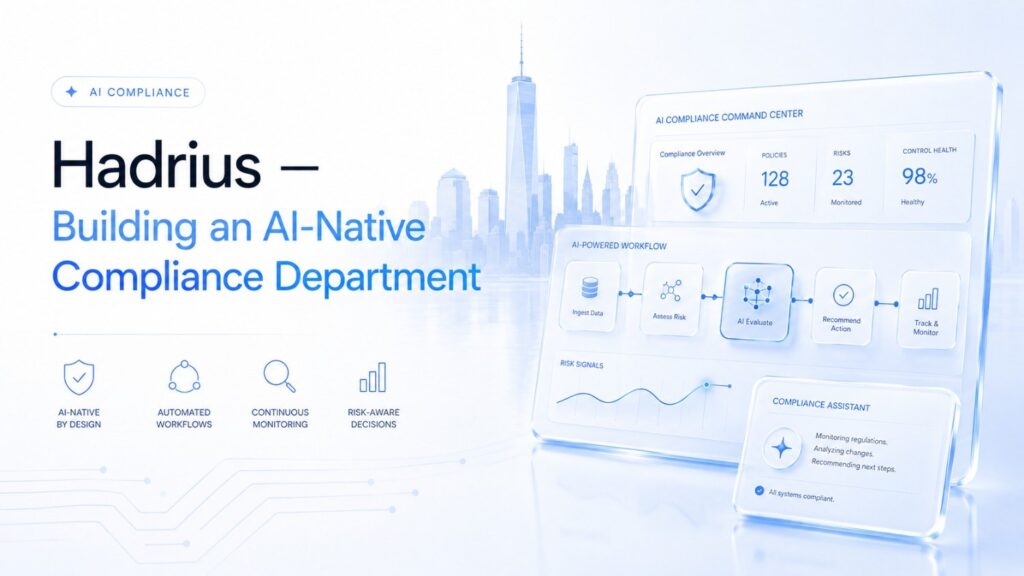
AI agents analyze activity and surface possible violations for human judgment.
Hadrius announced $27 million in combined seed and Series A financing in July 2026. The company says more than 500 financial institutions and investment firms use its technology.
Its current website says the platform covers more than $5 trillion of assets under management across its customers.
Why Hadrius Is Different
Compliance departments often run separate systems for different problems.
There may be one platform for communications, another for marketing, another for employee trading, another for books and records, and spreadsheets connecting everything together.
Hadrius is betting that AI makes consolidation possible.
Because an AI agent can interpret more unstructured information than traditional software, one system can potentially work across several different compliance workflows.
The strategic value is not simply lower software spending.
It is context.
An employee communication, trade, policy rule, and marketing approval may look unrelated in separate databases. In one system they may tell a larger story about risk.
The Metric That Buyers Should Watch
Hadrius says its customers can see major reductions in false positives and manual review time. Its site reports results including a 99% reduction in false positives in supervision workflows and more than 19 hours gained per user each week. These are vendor-reported figures, so businesses should validate comparable performance during their own pilot.
That is the right metric to test.
AI compliance does not create much value if it simply produces a different mountain of alerts.
The winning platforms will be the ones that dramatically shrink the amount of noise reaching humans.
Alloy — Moving Compliance From Onboarding to the Full Customer Lifecycle
Alloy is older than most companies in this ranking.
That is an advantage.
Founded in 2015 and headquartered in New York, Alloy has spent years building infrastructure that connects financial institutions with identity, fraud, credit, and compliance data.
The company says more than 900 financial institutions and fintech companies now use its platform.
The important change is how AI is being added to that infrastructure.
In February 2026, Alloy launched its native AI Assistant to automate parts of risk and compliance work. The system can interpret information inside Alloy’s identity infrastructure and recommend decisions that humans can approve or organizations can configure for automatic action.
Why Alloy Has a Data Advantage
Generative AI is widely available.
Trusted identity information is not.
That difference could become one of the biggest competitive advantages in RegTech.
Alloy integrates data from hundreds of services and uses that information across onboarding, identity decisions, fraud detection, KYB, ongoing customer monitoring, and compliance.
An AI agent connected to that infrastructure has more useful context than an AI agent connected only to a policy document.
This is why the future of RegTech may not be won by the company with the most impressive language model.
It may be won by companies with the best regulated data and workflow access.
Continuous Compliance Could Become the Bigger Opportunity
Traditional KYC is heavily associated with onboarding.
A customer applies. The business checks the customer. The account is approved.
Risk does not stop after account opening.
Ownership changes. Addresses change. sanctions lists change. Transaction behavior changes. Device behavior changes.
Alloy is moving toward continuous risk monitoring, including perpetual KYB capabilities that can reassess businesses when meaningful information changes.
That approach reflects a larger change across RegTech.
Compliance is moving from periodic checking toward continuous supervision.
Chainalysis — Bringing AI Agents to Blockchain Investigations
Chainalysis is by far the most heavily funded company in our sample.
The New York blockchain intelligence company has raised roughly $536.7 million according to CB Insights. Its 2022 Series F alone raised $170 million at an $8.6 billion valuation.
For years, Chainalysis has helped governments, financial institutions, exchanges, and investigators understand blockchain transactions.
In 2026, it took an important step toward agentic AI.
The company introduced blockchain intelligence agents designed to perform investigations, enrich compliance alerts, build reports, monitor activity, and turn repeatable investigations into automated workflows.
Why This Is a Natural Use Case for AI
Blockchain investigation can involve huge networks of addresses and transactions.
Humans are good at making judgments about suspicious behavior, but manually following every branch of a complex transaction trail is slow.
AI can perform much of the repetitive search and enrichment work.
The important word, however, is evidence.
A financial crime investigation cannot rely on an AI system inventing an answer.
Chainalysis says its agent architecture separates more exploratory reasoning from deterministic workflows, while recording inputs, data sources, and actions so results can be reviewed and audited.
That design idea will likely spread well beyond crypto.
The Bigger Lesson for RegTech
AI systems used in normal office work can sometimes tolerate small mistakes.
Compliance systems often cannot.
The winning architecture may therefore combine two types of computing.
AI performs research, interpretation, and investigation.
Deterministic code controls the final repeatable workflow.
That could become one of the basic design patterns of enterprise compliance AI.
Solidus Labs — AI for Market Surveillance
New York-based Solidus Labs is attacking another enormous compliance problem: market surveillance.
The company was built around digital-asset markets but is increasingly positioning its technology more broadly across modern financial markets.
Its HALO platform combines surveillance, automated workflows, transaction monitoring, case management, and agentic AI.
Solidus says it is headquartered on Wall Street and monitors more than one trillion events per day.
That scale matters.
Market manipulation does not arrive in a neat form labeled “market manipulation.”
Compliance systems need to find unusual relationships across orders, transactions, accounts, venues, instruments, and time periods.
AI is well suited to that problem because it can analyze patterns that would be impossible for a human team to review manually.
Why Surveillance Is Moving Toward Agentic Workflows
Finding an unusual event is only the start.
Someone still needs to understand what happened, pull supporting information, decide whether the alert matters, document the decision, escalate serious cases, and maintain an audit trail.
That workflow creates a large amount of expensive analyst work.
Solidus is moving from detection toward a broader compliance operating system where agentic workflows help perform more of the work after an alert appears.
This is another example of the same market shift.
Detection used to be the product.
Increasingly, resolution is becoming the product.
ThetaRay — AI Moves Deeper Into AML Investigations
ThetaRay has been using machine learning in financial crime detection long before the current agentic AI boom.
The privately held company lists New York as its headquarters and says it serves more than 100 institutional customers, reaches more than one billion end users, and monitors more than $20 trillion of transactions.
Its traditional strength is transaction monitoring.
Instead of relying only on fixed rules, ThetaRay uses machine learning to find patterns and unusual behavior that may suggest money laundering or other financial crimes.
Now it is extending that system into investigations.
Ray Turns Detection Into Investigation
ThetaRay’s newer Ray system is an agentic AI investigation layer.
The product analyzes alerts, checks transaction information against KYC information, examines historical context, identifies contradictions, and creates explainable investigation reports.
That matters because AML teams often spend huge amounts of time after an alert has already fired.
Someone needs to gather evidence, examine accounts, research parties, document conclusions, and decide whether to escalate a case.
Automating even part of that process can change the economics of financial crime operations.
Why Existing Data Infrastructure Still Matters
The latest wave of AI startups moves quickly.
ThetaRay has a different advantage.
Its AI investigation system sits on top of years of financial crime detection infrastructure.
That gives the agent access to information about why a transaction was flagged in the first place.
This illustrates an important challenge for new entrants.
A beautifully designed AI agent is not enough. In serious compliance work, the quality of the underlying signals may matter even more than the intelligence of the language model.
Footprint — Replacing Manual Risk Review With AI Agents
Footprint started by rethinking identity verification.
Now the New York company is moving deeper into risk operations.
Its platform brings together KYC, KYB, fraud detection, authentication, and secure identity data. Footprint raised a $13 million Series A in 2024, taking total funding to roughly $19 million.
The company’s newer Percy product moves Footprint directly into the AI compliance agent market.
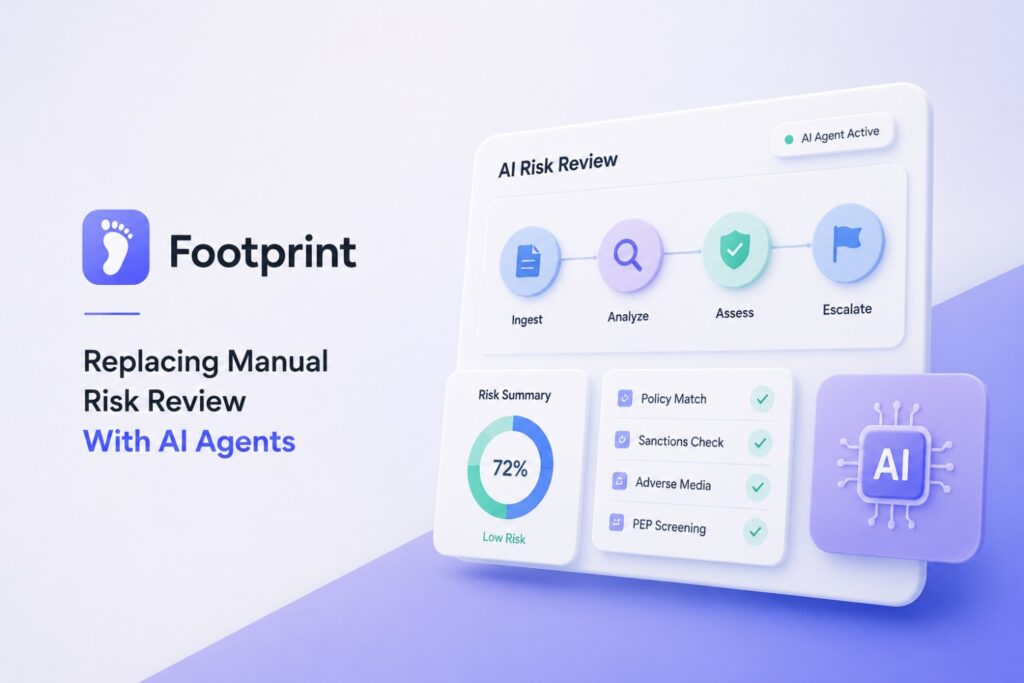
Percy can turn standard operating procedures into agents that automate tasks such as watchlist review, transaction investigations, enhanced due diligence, and KYC or KYB decisions.
Why This Approach Is Interesting
Many compliance departments depend on business process outsourcing companies.
The logic is simple.
Software produces cases. Humans need to review the cases. If the internal team is too small, the company hires an outside provider.
AI agents could disrupt that model.
Instead of sending hundreds or thousands of repetitive Level 1 investigations to outside analysts, financial institutions may increasingly ask an AI system to conduct the first review and send only difficult cases to humans.
That could become one of the clearest sources of measurable AI return on investment in compliance.
The Data Problem Could Become Footprint’s Moat
Agents need access to trusted information.
Footprint already sits close to customer identity data, verification checks, documents, watchlists, and onboarding decisions.
That gives its AI agents direct access to the material required to investigate many cases.
Once again, the lesson is that AI models themselves may become commodities.
The harder advantage is owning the workflow and the trusted context around it.
ALIGNMT AI — RegTech Expands Into Healthcare AI Governance
Financial services is not the only regulated industry creating AI compliance opportunities in New York.
Healthcare may become equally interesting.
ALIGNMT AI is a New York-based company focused on AI governance and compliance for healthcare organizations. It raised a $6.5 million seed round in 2025 and has worked with organizations including Memorial Sloan Kettering’s Innovation Hub.
Its job is different from an AML platform.
ALIGNMT helps organizations identify AI systems, map them to applicable requirements, monitor risks, capture evidence, complete attestations, and prepare for audits.
Why Healthcare AI Governance Could Become a Large Market
Healthcare organizations are adding AI to clinical, administrative, billing, communication, and operational workflows.
Every new system creates questions.
Who approved it? What information does it use? Has bias been tested? Is the model still performing correctly? What happens when it changes? What documentation exists? Which laws apply?
Manually maintaining those answers in spreadsheets becomes impossible as the number of AI systems grows.
ALIGNMT says its platform maps AI portfolios across federal frameworks and dozens of state healthcare AI laws.
That is a very different form of RegTech.
Instead of using AI to comply with banking rules, the software helps enterprises comply with rules governing AI itself.
ZeroDrift — Building a Compliance Firewall for AI
ZeroDrift is one of the youngest companies in our analysis.
Founded in 2026 and headquartered in New York, the company has already disclosed $12 million in total financing.
Its idea is simple to explain.
Before an AI-generated communication reaches the outside world, ZeroDrift checks it against applicable regulations and internal policies.
The system is designed for channels including text, voice, and video.
ZeroDrift describes the product as a “compliance firewall.”
Why This Could Matter
Companies are moving from AI assistants that help employees write messages toward AI agents that may communicate directly with customers.
That creates a new risk.
A human adviser might send hundreds of communications in a month.
An AI system could eventually generate hundreds of thousands.
Traditional manual pre-approval cannot work at that scale.
ZeroDrift is betting that compliance checks therefore need to become part of the technical path every AI communication passes through.
The concept is especially relevant for banks, asset managers, insurers, broker-dealers, and other firms where communications can create regulatory exposure.
The company says its system checks content against frameworks including SEC and FINRA requirements before a message leaves the organization.
This is one of the clearest examples of compliance moving from a department into infrastructure.
Credal — Governance Becomes Part of the AI Agent Stack
Credal sits slightly outside traditional RegTech, but it deserves attention.
The New York startup builds infrastructure for enterprises creating AI agents and AI-powered workflows. Security, permission controls, governance, and data access are built into the architecture rather than added afterward.
The company was founded in 2022 and is based in New York City. Its publicly described use cases include KYC, anti-money laundering, healthcare regulation, cybersecurity, and other sensitive workflows.
Why Infrastructure Companies Matter to Compliance
Many companies will not buy one AI agent for every business problem.
They will build internal agents.
That creates a governance problem.
Which systems can an agent access? What information can it send to a model? Which actions can it perform? Who approved the workflow? What happens when it tries to access protected information?
These questions are partly security questions and partly compliance questions.
Platforms such as Credal may therefore become an important layer beneath the compliance applications built by individual companies.
This is worth watching because the market may eventually split between companies that sell finished compliance agents and companies that provide the governed infrastructure used to build them.
Haast — Automating Content Compliance
Haast attacks a problem that is easy to underestimate.
Large organizations produce enormous amounts of content.
Marketing copy, product pages, advertisements, sales materials, emails, documents, and digital campaigns may all need legal or compliance review before publication.
AI makes content creation faster.
That creates a strange bottleneck.
If a marketing team can produce five times more material but the legal team cannot review five times more material, content simply piles up at compliance.
Haast is trying to remove that bottleneck.
The company announced a $12 million Series A in April 2026, taking its disclosed U.S. capital raised to $17.05 million.
Compliance Has to Move at Content Speed
Haast uses AI to apply organizational policies and regulatory requirements during content review.
That allows the company to move compliance closer to the moment content is being created.
For industries such as financial services, pharmaceuticals, healthcare, and insurance, that could be valuable.
These businesses cannot simply publish everything produced by a generative AI system and fix mistakes afterward.
Compliance needs to operate before publication.
That turns policy enforcement into part of the content creation system itself.
Alinia — Guardrails for High-Stakes AI Agents
Alinia represents another emerging part of the market.
Instead of automating a traditional compliance department, the company builds controls around AI systems themselves.
Alinia announced a $7.5 million seed round in December 2025 and operates offices in Barcelona, Valencia, New York, and Pittsburgh.
Its platform focuses on real-time auditing, policy enforcement, AI risk control, and guardrails for generative AI applications.
That becomes more important as enterprises move AI from experiments into production.
AI Agents Create a New Compliance Surface
A chatbot that summarizes internal documents creates one type of risk.
An autonomous agent that communicates with customers, changes records, approves transactions, or makes regulated decisions creates a much larger one.
Organizations therefore need ways to control what an agent can say and do.
Alinia’s thesis is that those controls should sit directly inside the AI system.
This is similar to what happened with cybersecurity.
Security eventually became something that had to be built into infrastructure rather than checked once at the end of a project.
AI compliance may follow the same path.
What Our Original Analysis Says About the Future of RegTech
Looking across the 12 companies reveals several changes that are more important than the individual ranking.
RegTech Is Moving From Finding Problems to Doing Work
The previous generation of compliance software focused heavily on detection.
A transaction monitoring system found an alert.
A communications system found a suspicious message.
A sanctions platform found a possible match.
Then the human work started.
Someone reviewed the information, gathered evidence, checked other systems, wrote notes, made a decision, escalated the case, and documented the result.
Agentic AI attacks everything after the alert.
That is why products from companies such as ThetaRay, Chainalysis, Solidus, Footprint, Hadrius, and Alloy are moving deeper into investigations and resolution.
The alert is no longer the end product.
The completed case may become the end product.
False Positives Could Become One of the Most Important AI Metrics
Compliance software has historically generated large numbers of alerts.
That often sounds safe.
More alerts should mean more protection.
In practice, excessive alerts can create risk because analysts become overwhelmed.
The better question for buyers is not “How many risks can your AI find?”
It is “How much useless work can your AI remove while still finding the important risks?”
This is why several startups now promote reductions in false positives, investigation hours, or manual review.
Companies buying these tools should build pilots around those numbers.
Policy-as-Code Could Be the Foundation of the Next RegTech Stack
Documents are a terrible way for computers to understand rules.
A company can have a 150-page compliance manual, but the software processing a transaction may have no direct understanding of that manual.
Policy-as-code tries to close the gap.
Regulations and company policies are converted into structured logic that software can apply.
Norm AI pushes toward this idea through agentic law. Hadrius talks about policy-aware compliance infrastructure. ZeroDrift applies policies before communications leave the company. AI governance systems perform similar work around AI behavior.
If this model succeeds, policies will increasingly become executable objects rather than PDFs people are expected to remember.
AI Will Increasingly Be Used to Govern Other AI
This may be the strangest change in the market.
Companies adopted AI to increase productivity.
Now they need AI to govern that AI.
The faster an AI system can create messages, decisions, campaigns, reports, trades, or recommendations, the less practical manual review becomes.
This creates demand for automated supervision.
ZeroDrift checks AI communications.
ALIGNMT monitors AI systems.
Alinia creates AI guardrails.
Credal governs how enterprise agents access information and systems.
This could become a separate multibillion-dollar software category.
Humans Are Not Disappearing From Serious Compliance Work
The phrase “agentic AI” sometimes creates the impression that the objective is complete automation.
That would be the wrong way to think about regulated work.
Human judgment is especially valuable when a situation is unusual, ambiguous, high value, or legally sensitive.
The better model is selective automation.
Let machines handle repetitive research, data gathering, first-level review, documentation, and straightforward decisions.
Send unclear cases to qualified people.
That could allow smaller compliance teams to supervise much larger businesses without lowering standards.
How Companies Should Evaluate an AI Compliance Vendor
Buying an AI compliance platform is different from buying normal productivity software.
The cost of a wrong answer can be much higher.
Businesses therefore need a much tougher evaluation process.
Start With a Real Workflow
Do not begin the buying process by asking a vendor to demonstrate its AI.
Start with one expensive compliance workflow.
Measure how many cases enter the workflow each month, how many employee hours they consume, how long decisions take, how many false positives appear, how often work must be repeated, and where the largest risks exist.
Then give the vendor real examples.
A polished demonstration tells you very little.
Performance on your own difficult cases tells you much more.
Measure the Entire Funnel
Suppose a compliance team receives 10,000 alerts every month.
A vendor may claim 90% accuracy.
That number alone is almost meaningless.
You need to know what percentage of alerts can be fully closed automatically, what percentage still requires human review, how many dangerous cases are missed, how many harmless cases are escalated, and how much time analysts actually save.
Demand Evidence, Not Just Answers
A compliance AI should be able to explain where its conclusion came from.
If the system says a marketing statement violates a rule, reviewers should be able to understand which rule applies.
If it clears a sanctions match, the analyst should see the evidence used.
If an investigation is closed automatically, there should be a record of what the agent checked and what it decided.
This is one reason auditability appears so often in the products examined for this article.
Test Failure Cases on Purpose
Do not build a pilot using only easy cases.
Give the system conflicting documents.
Give it incomplete information.
Give it outdated information.
Test unusual customer structures.
Use communications with jokes, slang, abbreviations, and vague wording.
Change a policy and see whether the system adapts.
The best way to understand an AI compliance product is to watch it fail.
A Practical Buyer Scorecard
| Question | Suggested Weight |
| Does it materially reduce manual work? | 20% |
| Can every important decision be audited? | 20% |
| How well does it handle false positives? | 15% |
| Does it work with our current systems and data? | 15% |
| Can humans control when automation is allowed? | 10% |
| How quickly can rules and policies be changed? | 10% |
| Can the vendor demonstrate enterprise security? | 5% |
| Does the pricing model improve as volume grows? | 5% |
The highest-scoring AI model may not be the best compliance product.
The best compliance product is the one you can trust inside the workflow that matters.
Which Type of NYC RegTech Company Fits Which Buyer?
The startup market becomes much easier to understand when viewed from the buyer’s problem.
| Buyer Problem | Companies Worth Studying |
| Turning regulation into automated workflows | Norm AI, Hadrius |
| RIA or broker-dealer compliance | Hadrius |
| KYC, KYB and identity risk | Alloy, Footprint |
| AML transaction monitoring | ThetaRay |
| Crypto investigations and AML | Chainalysis |
| Trade surveillance and market integrity | Solidus Labs |
| AI-generated regulated communications | ZeroDrift |
| Marketing and content compliance | Haast, Hadrius |
| Healthcare AI governance | ALIGNMT AI |
| Building governed internal AI agents | Credal, Alinia |
| Enterprise AI guardrails | Alinia, ALIGNMT AI, Credal |
This table also shows why businesses need to resist buying “AI” as a category.
The starting point should always be the problem.
The Most Important Competitive Moat May Not Be the AI Model
There is another lesson hidden inside the companies in this article.
Few RegTech startups are likely to win because they have exclusive access to a general-purpose language model.
The major models are increasingly available to everyone.
The stronger advantages are elsewhere.
A company may have years of blockchain transaction intelligence.
Another has connections to hundreds of identity data sources.
Another has encoded regulatory logic.
Another sits inside employee communications.
Another has millions of past investigations.
Another understands the specific controls used inside healthcare organizations.
That context is hard to copy.
The future of compliance AI may therefore belong to companies that combine strong AI with proprietary regulatory knowledge, trusted data, workflow integrations, and customer feedback.
The Next Battle Will Be Over the System of Record
The first generation of enterprise AI often sits on top of existing software.
That may not be the final state.
If an AI compliance platform reads the policy, monitors the activity, investigates exceptions, records the evidence, routes approvals, and creates the audit trail, the platform starts becoming the place where compliance work actually happens.
That makes it a system of record.
Hadrius is clearly moving in this direction.
Alloy has similar potential around identity and customer risk.
Solidus can move toward the same position in market surveillance.
AI governance platforms may become systems of record for every AI model and agent inside a company.
Owning that layer is strategically valuable because systems of record are difficult to replace.
New York May Have an Unusual Advantage in Vertical AI
Silicon Valley has enormous AI engineering talent.
New York has something different.
It has concentrated access to regulated workflows.
An AI compliance founder in New York can meet banks, asset managers, hedge funds, insurers, law firms, healthcare systems, exchanges, and regulators without leaving the region.
That matters for vertical AI because difficult enterprise software is often built through hundreds of small conversations with people doing the work.
The model architecture matters.
Understanding the workflow matters just as much.
That helps explain why so many New York AI companies are attacking deeply specific business problems rather than simply building general productivity tools.
What NYC Tech Journal Will Be Watching Next
The first question is whether AI agents move from assisting analysts to closing large numbers of cases without human review.
That would change compliance economics dramatically.
Today, many vendors still emphasize human approval. Over time, straightforward cases are likely to become increasingly automated while humans handle exceptions.
The second issue is consolidation.
A financial institution may currently use separate vendors for KYC, communications supervision, market surveillance, AML, employee monitoring, policy management, and investigations.
AI gives vendors the ability to cross some of those boundaries.
That could start a land grab around the compliance system of record.
The third issue is regulation of the AI itself.
FINRA already makes clear that normal regulatory obligations continue to apply when firms use GenAI. New York City already requires bias audits for certain employment algorithms. AI regulations and governance requirements are expanding across industries and jurisdictions.
That means compliance startups have a strange but powerful tailwind.
More AI adoption creates more compliance risk.
More compliance risk creates more demand for AI compliance infrastructure.
The fourth issue is acquisitions.
WorkFusion’s acquisition by UiPath in February 2026 shows that large automation companies see financial crime agents as strategically valuable. Droit, another important New York RegTech company, was also acquired by FIS in 2026 after years of building machine-readable regulatory decision infrastructure.
More deals are likely if large software companies decide it is faster to buy regulatory knowledge than build it internally.
Finally, we will be watching the youngest companies.
ZeroDrift, ALIGNMT AI, Haast, Alinia, Credal, Hadrius, and Footprint have nowhere near the capital accumulated by mature platforms such as Chainalysis, Alloy, or ThetaRay.
But they have been built during the agentic AI era.
That may allow them to design workflows very differently.
Final Takeaway
The biggest mistake would be to think that artificial intelligence is simply making existing compliance software a little smarter.
Something more fundamental is happening.
Compliance software used to store information, create alerts, and help humans complete work.
The new generation is beginning to perform the work.
AI agents can investigate alerts, read regulations, review marketing materials, analyze communications, compare identities, search transaction histories, draft case reports, monitor AI systems, and apply policies before a risky action happens.
That will not remove compliance officers.
It will change what they spend their time doing.
The highest-value human work will move toward judgment, policy design, investigation of difficult cases, supervision, and decisions where context matters.
Machines will increasingly handle the repetitive work around those decisions.
New York is unusually well positioned for that shift because the city contains both sides of the market: some of the world’s largest compliance problems and a growing group of startups trying to solve them.
The companies that win will probably not be the ones with the flashiest AI demonstration.
They will be the ones that can answer a much harder question:
Can your AI perform regulated work faster while making the final result easier to trust, explain, audit, and defend?
That is the real test of the next generation of RegTech.