
A purchase request lands in finance.
A department needs 30 new monitors. Another team needs a software license. A property manager needs replacement equipment. A restaurant needs packaging. A growing company has 50 software contracts coming up for renewal over the next six months.
Then the normal procurement process begins.
Someone checks the budget. Someone finds possible suppliers. Someone asks for prices. Someone compares the quotes. Finance gets involved. Legal may review the contract. Security may review the vendor. Procurement negotiates. A manager approves the purchase. A purchase order gets created. Later, somebody checks whether the invoice matches what was actually ordered.
For a $20 million agreement, all of that attention can make sense.
For a $2,000 repeat purchase, it often does not.
That difference is why AI agents could change procurement much more deeply than ordinary AI assistants.
Procurement software is starting to move beyond answering questions, summarizing contracts and helping employees write requests. New systems can increasingly find suppliers, prepare sourcing events, compare bids, negotiate commercial terms, create purchasing documents and complete parts of the buying process themselves.
Oracle now offers an Autonomous Sourcing Assistant designed to move eligible lower-dollar and high-volume purchases from requisition through negotiation and award. SAP has introduced procurement assistants that can guide requisitions, recommend suppliers and improve buying decisions. New York-based Ramp launched a suite of procurement AI agents in 2026 covering sourcing, intake, compliance and renewals. Order.co, another New York company, says its AI can source products, guide approvals and even place orders through vendor portals.
The technology is becoming real.
But that does not mean businesses should simply give an AI system access to the company bank account.
The more useful question is:
Which purchasing decisions should an AI agent actually be allowed to make?
Our analysis of New York City procurement data suggests a surprisingly clear answer.
The biggest near-term opportunity may not be giant strategic contracts.
It may be the enormous number of smaller transactions sitting underneath them.
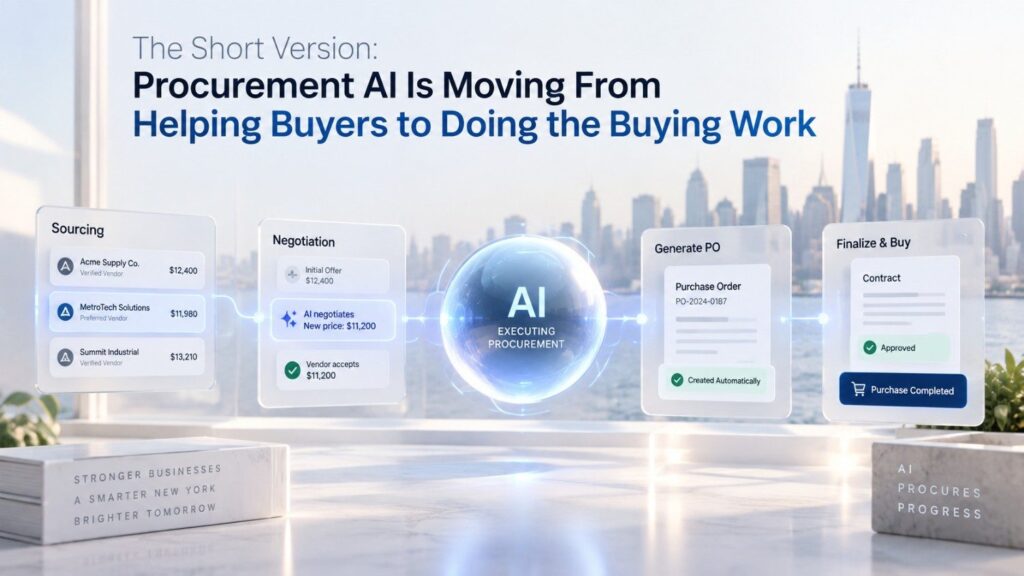
The Short Version: Procurement AI Is Moving From Helping Buyers to Doing the Buying Work
Most procurement AI used to sit on the side of the human buyer.
It could summarize a proposal.
It could classify spending.
It could recommend a supplier.
It could draft an email.
It could identify unusual pricing.
The employee still performed the important actions.
Agentic procurement changes that model.
An AI agent can increasingly move through several steps of the workflow on its own.
Imagine an employee says:
“We need 25 monitors for our Manhattan office before October. Keep the total below $10,000. Use an approved supplier.”
A traditional procurement platform may turn that request into a form.
An AI assistant may help complete the form.
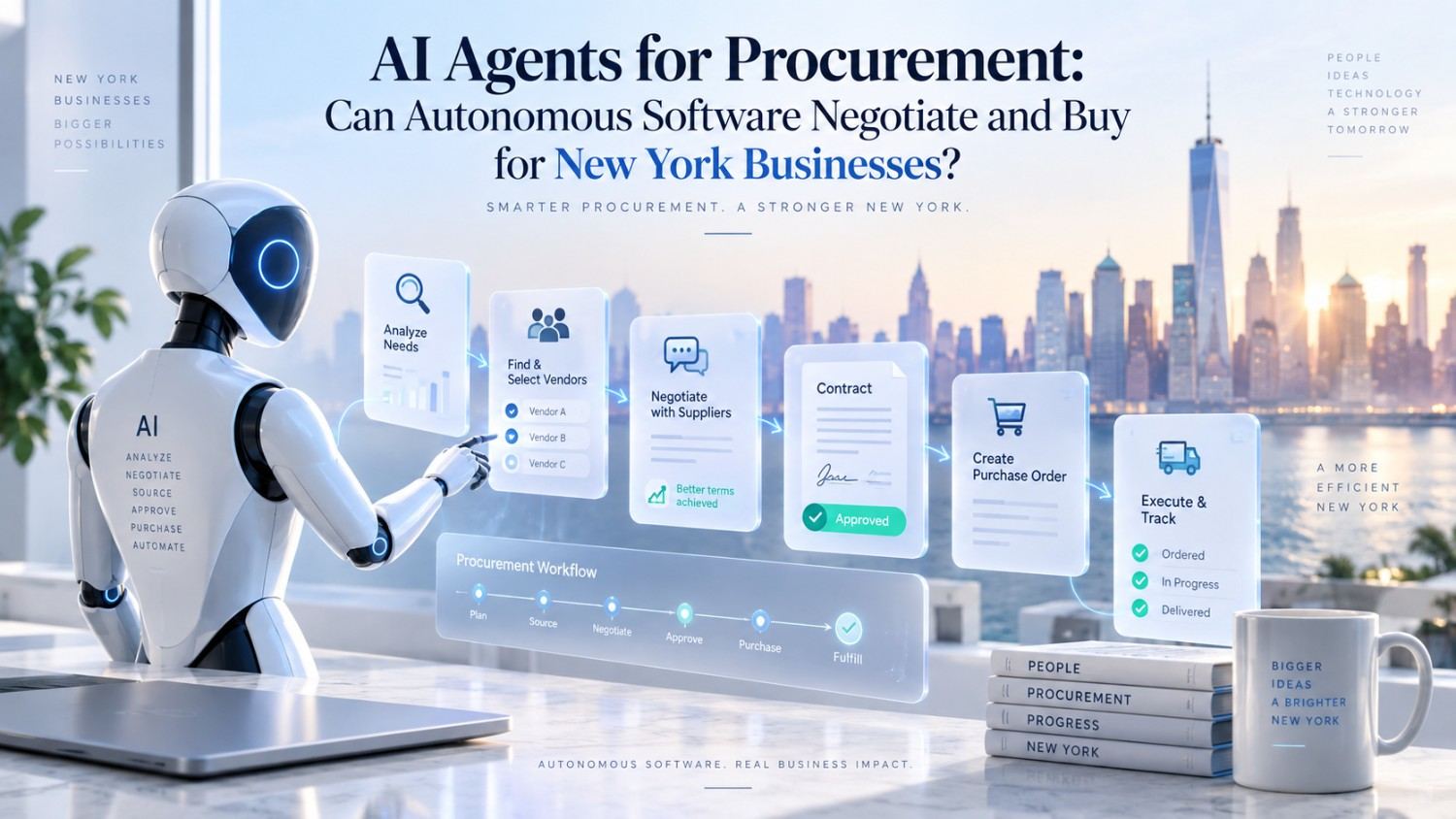
An AI procurement agent can potentially do much more. It could understand the request, identify approved products, check previous purchases, compare suppliers, collect prices, confirm the budget, recommend an option and prepare the purchase order.
If company policy allows it, the software might execute the purchase without requiring a buyer to handle every step.
That is the difference between AI that advises and AI that acts.
The strongest early opportunities are likely to be repeatable purchases where specifications are clear and mistakes are manageable.
Office products are an obvious example.
Routine IT accessories can work.
Packaging can work.
Maintenance supplies can work.
Some software renewals can work.
Some transportation purchases can work.
Purchases from already approved suppliers can work particularly well.
A major strategic outsourcing agreement is completely different.
The correct procurement model will therefore not be full autonomy.
It will be bounded autonomy.
Humans define what the system is allowed to do.
The agent executes inside those limits.
Anything unusual goes back to a person.
What Is an AI Procurement Agent?
A procurement agent is software that can take a goal and perform several steps required to achieve it.
That is different from traditional automation.
Traditional automation usually follows a fixed sequence:
If this happens, do that.
Agentic systems can make decisions inside the workflow.
Suppose the preferred supplier is out of stock.
Traditional software may simply produce an error.
A more capable agent might check approved alternatives, compare delivery dates, examine past prices and determine whether another supplier satisfies company policy.
It may then continue the workflow.
That ability to reason through exceptions is what makes agents interesting.
Procurement Is Really a Chain of Decisions
Buying something for a company sounds simple until the process is broken apart.
Someone must first determine what the employee actually needs.
The company has to determine whether the purchase is necessary.
Someone should check whether an existing contract already covers the item.
The right supplier must be identified.
Pricing must be compared.
Risk needs to be checked.
Commercial terms may need negotiation.
The correct budget must be identified.
Approval authority must be confirmed.
The transaction must be created.
Delivery has to be tracked.
The invoice eventually needs to be matched against what was ordered.
That is not one task.
It is a chain of decisions.
The future procurement department may therefore use several specialized agents rather than one giant procurement bot.
A Procurement Agent Stack Could Look Like This
An intake agent understands what an employee wants.
A policy agent checks whether the request follows company rules.
A supplier agent finds qualified vendors.
A sourcing agent requests and compares offers.
A negotiation agent works on price and commercial terms.
A contract agent checks clauses and identifies exceptions.
A buying agent creates the order.
A monitoring agent tracks delivery, invoices and supplier performance.
Humans sit above the system and define the authority each agent receives.
That distinction will become extremely important as procurement software becomes more autonomous.
Original Research: What New York City Procurement Data Reveals About Automation
To understand where procurement agents could create the greatest value, NYC Tech Journal analyzed New York City’s Fiscal Year 2025 procurement data.
The City is not a perfect model for private-sector procurement.
Government purchasing has special rules, registration requirements, public accountability standards and procedures that private companies do not face.
But NYC offers something unusually useful: a very large real-world purchasing system with detailed public data.
In FY2025, New York City reported almost $42.3 billion in procurement across more than 198,000 transactions.
Instead of looking only at total spending, we asked a different question:
Where is procurement workload concentrated relative to procurement dollars?
That matters because AI agents become more economically useful when the same administrative work must be repeated many times.
Our Research Methodology
We analyzed the NYC Comptroller’s FY2025 Annual Summary Contracts Report.
The core dataset contains 12,500 new procurement contracts with approximately $42.30 billion in registered value. The report separately shows 189,858 purchase orders with approximately $519.72 million in actual amount.
We intentionally did not add those figures together.
The datasets describe different procurement instruments, and purchase orders may operate within broader purchasing arrangements.
Instead, we compared their structure.
We calculated:
- average transaction value;
- contract-volume share by industry;
- contract-value share by industry;
- purchasing concentration;
- small-purchase concentration;
- transaction-to-value ratios;
- several automation scenarios.
We also created an original measure for this article called the NYC Tech Journal Transaction Density Index.
Transaction Density Index Formula
Transaction Density Index = Share of procurement actions ÷ Share of procurement value
A score of 1 means a category’s share of transactions is roughly equal to its share of dollars.
A score above 1 means the category creates a relatively large number of procurement actions for the amount of money involved.
A score below 1 means dollars are concentrated in relatively few large transactions.
This is not an “automation score.”
A category can have many transactions and still be risky.
However, the index gives us a useful signal for identifying categories where administrative workload may be unusually high relative to spend.
Original Finding #1: New York’s Procurement Dollars Are Extremely Concentrated
New York City registered approximately $42.3 billion of new procurement contracts during FY2025.
But the dollars were not distributed evenly.
Construction alone accounted for roughly $15.98 billion despite representing only 530 contracts. Human services produced 5,164 contracts worth roughly $15.66 billion. Goods produced 2,664 contracts worth about $2.59 billion.
NYC FY2025 New Procurement Contracts by Industry
| Industry | Contracts | Registered Value | Share of Total Contracts | Share of Value | Approx. Average Contract |
| Construction | 530 | $15.98B | 4.2% | 37.8% | $30.15M |
| Goods | 2,664 | $2.59B | 21.3% | 6.1% | $972K |
| Human services | 5,164 | $15.66B | 41.3% | 37.0% | $3.03M |
| Professional services | 2,007 | $4.31B | 16.1% | 10.2% | $2.15M |
| Standard services | 1,291 | $3.49B | 10.3% | 8.3% | $2.70M |
| Unclassified | 844 | $258.1M | 6.8% | 0.6% | $306K |
Professional services accounted for 2,007 contracts and approximately $4.31 billion, while standard services accounted for 1,291 contracts and about $3.49 billion. Another 844 contracts worth roughly $258 million could not be assigned to one of the main industry groups.
The important point is not simply which category is largest.
It is the relationship between number of transactions and money spent.
Chart 1: Share of Procurement Value
Construction
██████████████████████████████████████ 37.8%
Human services
█████████████████████████████████████ 37.0%
Professional services
██████████ 10.2%
Standard services
████████ 8.3%
Goods
██████ 6.1%
Construction and human services dominate the dollars.
But transaction volume tells another story.
Original Finding #2: Goods Create Far More Procurement Activity per Dollar
Goods represented only about 6.1% of new registered procurement value.
Yet goods represented more than 21% of procurement contracts.
That difference creates a Transaction Density Index of roughly 3.48.
Construction produces the opposite result.
It represented almost 38% of procurement value but only about 4.2% of contracts.
Its Transaction Density Index is roughly 0.11.
Chart 2: NYC Tech Journal Transaction Density Index
| Industry | Transaction Density Index |
| Goods | 3.48 |
| Professional services | 1.58 |
| Standard services | 1.25 |
| Human services | 1.12 |
| Construction | 0.11 |
We excluded the unclassified group from meaningful interpretation because it contains mixed procurement activity.
This result matters.
Construction involves enormous spending, but each transaction tends to be large.
Goods involve much smaller average contracts but far more purchasing activity relative to the amount of money being managed.
That means procurement automation should not always begin where spend is highest.
It should often begin where transaction density is highest.
Why Transaction Density Matters
Imagine two departments.
Department A makes ten purchases worth $10 million each.
Department B makes 10,000 purchases worth $5,000 each.
Department A spends twice as much.
But Department B may create hundreds of times more administrative activity.
Every purchase may require:
a request;
an approval;
supplier selection;
pricing;
data entry;
purchase-order creation;
tracking;
invoice matching.
The procurement problem is therefore not only a spend problem.
It is also a workload problem.
AI agents are particularly useful when workload grows much faster than economic value.
Original Finding #3: More Than Half of NYC Procurement Actions Sit in Small-Purchase Categories
The industry analysis gives us one view.
The procurement-method data gives us another.
During FY2025, NYC registered:
- 3,841 general small-purchase contracts worth about $111.6 million;
- 1,572 micropurchase contracts worth about $15.2 million;
- 1,144 M/WBE small-purchase contracts worth approximately $376.3 million.
Together, those three small-purchase categories represent 6,557 procurement actions.
That is roughly 52.5% of all 12,500 new procurement actions.
Yet their combined registered value was only about $503 million, or roughly 1.2% of the City’s $42.3 billion procurement value.
Chart 3: The Small-Purchase Mismatch
| Metric | Small-Purchase Categories | Rest of New Procurement |
| Approx. share of procurement actions | 52.5% | 47.5% |
| Approx. share of procurement value | 1.2% | 98.8% |
This may be the most important finding in the entire analysis.
More than half of procurement actions sit inside categories representing little more than 1% of contract value.
That is exactly the kind of mismatch autonomous systems are built to address.
General Small Purchases Average Only About $29,000
The 3,841 general small-purchase contracts totaled approximately $111.6 million.
That works out to an average of roughly $29,060 per contract.
Micropurchases were even smaller.
The 1,572 micropurchase contracts totaled around $15.2 million, producing an average transaction of approximately $9,650.
Compare that with competitive-method contracts.
NYC registered 1,085 competitive-method contracts worth approximately $13.83 billion. The average was around $12.7 million per contract.
That means a typical competitive-method contract in this dataset was more than 400 times larger than the average general small-purchase contract.
Those transactions should obviously not receive the same operating model.
A business that treats a $20,000 repeat purchase like a $10 million strategic agreement creates unnecessary friction.
Original Finding #4: The Purchase-Order Layer Makes the Long Tail Even Clearer
The Comptroller separately reported 189,858 purchase orders during FY2025.
Their total actual amount was approximately $519.7 million.
That means the average PO was only about:
$2,737
Now compare that with the new procurement-contract dataset.
Contracts Versus Purchase Orders
| Metric | New Procurement Contracts | Purchase Orders |
| Number of transactions | 12,500 | 189,858 |
| Reported value | $42.30B | $519.72M |
| Average transaction | ~$3.38M | ~$2,737 |
| Transaction count | 1x | 15.2x |
The average new procurement contract was about $3.38 million.
That is more than 1,200 times the average PO value.
At the same time, there were roughly 15 purchase orders for every new procurement contract.
The datasets measure different procurement instruments, so the values should not be added together.
But the contrast is extremely useful.
It shows what the procurement long tail looks like.
A relatively small amount of economic value can create an enormous number of purchasing actions.
That is where AI agents become compelling.
Original Finding #5: Even Partial Automation Could Affect Tens of Thousands of Transactions
Procurement agents do not need to automate everything to make a difference.
Suppose only one-quarter of the purchase-order workload in the NYC dataset were suitable for an agent-controlled workflow.
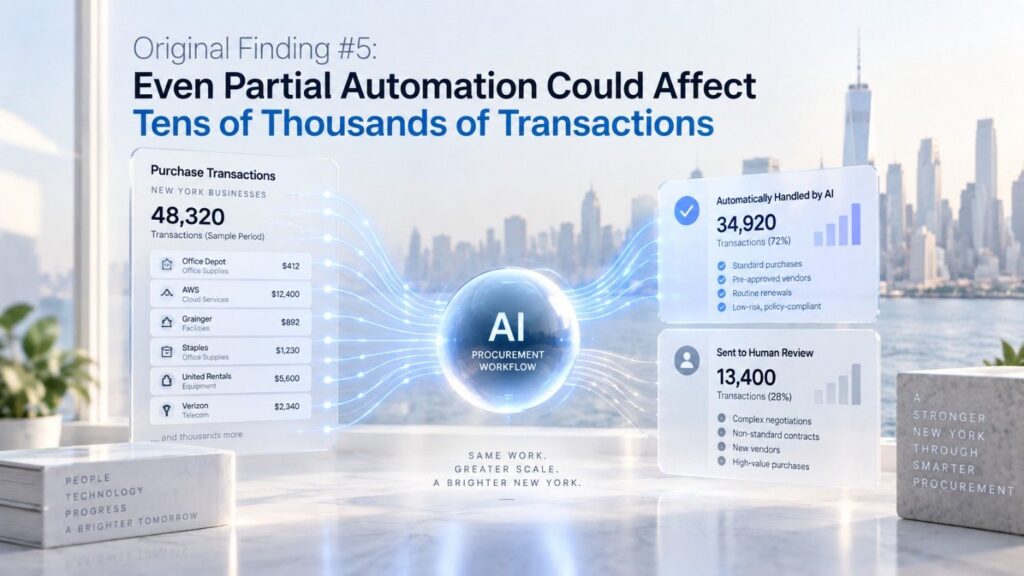
That would represent roughly 47,000 transactions.
At 50%, the number approaches 95,000.
At 75%, it exceeds 142,000.
Chart 4: Automation Scenario Based on NYC PO Volume
| Share Potentially Routed Through Agentic Workflow | Approx. Number of Transactions |
| 25% | 47,465 |
| 50% | 94,929 |
| 75% | 142,394 |
These are scenario calculations, not predictions about what NYC government should automate.
The purpose is to show how high-volume procurement changes the economics of AI.
Imagine only ten minutes of avoidable human work occurs around each transaction.
Automating 50% of this workload would theoretically remove almost 16,000 hours of repetitive activity.
At 20 minutes per transaction, it would exceed 31,000 hours.
A private company does not need 190,000 purchase orders to see the same effect.
If a New York company processes 10,000 repeat purchases every year, eliminating just 15 minutes of work from each one would save 2,500 hours.
The individual transaction does not need to be important.
The repetition makes it important.
Original Finding #6: Procurement Workload Is Often Concentrated in a Few Parts of the Organization
Another useful pattern appears when we examine which NYC agencies created the most purchase orders.
The Department of Education recorded 153,769 POs during FY2025.
HPD recorded 17,340.
NYPD recorded 2,765.
DEP recorded 1,760.
The City Council recorded 1,505.
Top NYC Agencies by Purchase-Order Volume
| Agency | Purchase Orders | PO Value | Approx. Average PO |
| Department of Education | 153,769 | $383.0M | $2,491 |
| HPD | 17,340 | $23.8M | $1,370 |
| NYPD | 2,765 | $15.7M | $5,674 |
| DEP | 1,760 | $19.4M | $11,025 |
| City Council | 1,505 | $3.9M | $2,596 |
Together, those five agencies generated approximately 177,000 purchase orders, or more than 93% of recorded PO volume based on our calculation from the reported agency figures.
That leads to another practical lesson.
Do not deploy procurement agents evenly across the company.
Find where purchasing workload is concentrated.
A real estate company may discover that building operations create most transactions.
A restaurant group may find that locations create a huge volume of packaging and maintenance purchases.
A hospital system may find the biggest repeat workload in facilities or administrative supplies.
A technology company may discover that software subscriptions create the largest procurement burden.
An AI strategy should follow the workload.
What This Original Analysis Means for New York Businesses
The data suggests that companies should think about procurement AI on two different layers.
Layer One: Strategic Procurement
These are high-value, high-risk decisions.
Examples include:
major cloud contracts;
critical professional services;
large construction agreements;
strategic outsourcing;
high-risk healthcare suppliers;
major technology platforms.
AI should be heavily involved here.
But mostly as an analyst.
It should find information, compare prices, model scenarios, identify risk and prepare negotiation strategies.
Humans should retain control over the important decisions.
Layer Two: Transactional Procurement
This includes frequent, lower-value and relatively standardized purchases.
Examples include:
office equipment;
replacement hardware;
approved maintenance supplies;
packaging;
repeat products;
certain SaaS renewals;
routine facilities purchases.
This layer is a much stronger candidate for autonomy.
The rules can be defined.
The downside is limited.
Transactions repeat.
The cost of human handling can become disproportionate to the value of the purchase.
That is where an agent can become an actual buyer.
Can AI Really Negotiate With Suppliers?
Yes.
This is no longer hypothetical.
One of the clearest examples comes from Walmart.
Walmart faced a basic procurement problem.
The company had more suppliers than human buyers could realistically negotiate with.
Many smaller suppliers therefore received standard terms because the potential financial benefit from negotiation did not justify spending hours of a professional buyer’s time on each relationship.
Walmart used AI-powered negotiation technology from Pactum to attack this long tail.
Harvard Business Review reported that the system was closing agreements with 68% of suppliers approached. The project showed something bigger than simple automation: AI made it economical to negotiate with suppliers who previously received little individual attention.
That is the real opportunity.
AI Does Not Need to Beat the Best Human Negotiator
Imagine an experienced procurement manager can save 8% during a negotiation.
An AI agent saves only 3%.
At first, the human appears better.
But now consider capacity.
The human can deeply negotiate 100 contracts.
The software can handle 5,000.
The question changes.
AI procurement does not always need to outperform people.
It can create value simply by performing commercially useful work that people would otherwise never have time to do.
That is particularly important in tail spend.
What Should an AI Agent Be Allowed to Negotiate?
Agents work best when the commercial variables are clear.
Price is clear.
Payment days are clear.
Minimum order quantity is clear.
Delivery date is clear.
Rebate percentage is clear.
Contract length is clear.
Renewal increases can be defined.
Volume commitments can be defined.
Those variables can be placed inside boundaries.
A Simple Negotiation Example
Suppose a company currently pays $82 per unit.
Management tells the agent:
Target price: $75.
Acceptable price: up to $79.
Payment terms: preferably 45 days.
Thirty-day payment is acceptable only if the supplier offers a price below $76.
Maximum contract term: 12 months.
Automatic renewal: not allowed.
Minimum required delivery performance: 97%.
The agent now has a negotiation space.
It can trade variables.
It might reject $74 if the supplier demands a three-year commitment.
It may accept $78 with better payment terms.
It could offer more volume in exchange for a lower unit cost.
The key is that management has defined what “good” means.
Simply telling an agent to “get the best deal” is not enough.
Where AI Negotiation Becomes Dangerous
A strategic relationship involves more than numbers.
Imagine negotiating with the cloud platform running your company’s core product.
Price matters.
But uptime matters.
Cybersecurity matters.
Support matters.
Data portability matters.
Liability matters.
Integration matters.
The ability to leave the vendor later matters.
Relationships between executives may matter.
Those factors are difficult to reduce to a simple optimization model.
An AI agent can still help enormously.
It can find unfavorable clauses.
It can compare pricing.
It can identify market benchmarks.
It can simulate negotiation strategies.
It can recommend a counteroffer.
But final authority should remain with humans.
Cheap Is Not Always Better
An aggressive agent could create a dangerous incentive.
Suppose supplier A is 8% cheaper.
Supplier B is more reliable and has supported the company during several emergencies.
A poorly designed agent may automatically choose supplier A.
A procurement leader may correctly decide that the extra cost is insurance.
Autonomous procurement must therefore optimize for business value, not simply purchase price.
Can AI Agents Actually Buy Things?
Increasingly, yes.
Oracle’s Autonomous Sourcing Assistant is specifically designed for lower-dollar, higher-volume negotiations. According to Oracle, eligible requisition lines can be converted into negotiations, suppliers can be selected, responses can be evaluated, awards can be made and purchasing documents can be created under policy-defined conditions.
The phrase policy-defined is important.
The agent does not receive unlimited freedom.
The organization can define categories, amount limits, bidding periods and minimum supplier-response requirements.
That is a practical model for autonomous procurement.
Order.co Is Pushing AI Down to the Purchase Itself
Order.co provides another example.
The company is headquartered in New York City and focuses on business purchasing. Its AI tools can build catalogs, identify suppliers, guide approvals, place orders through vendor websites, track deliveries and reconcile payments.
That means AI is no longer confined to procurement analysis.
It can touch the transaction itself.
This is particularly interesting when compared with our NYC PO research.
If much of procurement’s workload sits inside thousands of relatively small transactions, systems that automate the actual ordering layer may capture enormous operational value.
New York Is Becoming an Interesting Procurement-AI Market
New York has the right business mix for procurement automation.
The city has finance.
It has real estate.
It has healthcare.
It has hospitality.
It has advertising.
It has media.
It has technology companies.
It has retail.
These industries may purchase very different things, but many share the same problem.
They manage large amounts of indirect spend.
A financial firm might buy hundreds of software products.
A real estate company might coordinate purchasing across dozens of properties.
A restaurant group may buy the same operational products at 50 locations.
A media company may have hundreds of technology vendors.
A healthcare company may have thousands of administrative and facilities purchases sitting underneath tightly controlled clinical procurement.
This environment creates a large market for agents that manage repeat buying work.
Ramp Is Turning Procurement Into an Agent Workflow
Ramp operates from New York and launched a major procurement-agent update in April 2026.
The company describes agents handling sourcing, intake, approvals, compliance and renewals. A later product update described vendor sourcing, RFP workflows, policy checks, parallel security and legal evaluations and contract-renewal monitoring.
The significance is not that every one of these tasks is completely autonomous.
It is that several pieces of the purchasing process are being brought into one agent-controlled workflow.
A request can arrive in ordinary language.
The software gathers information.
Risk checks can begin.
Supplier research can begin.
Pricing can be compared.
The approval can reach the right person with much of the work already completed.
That is very different from a traditional procurement system built around forms and queues.
Order.co Is Automating the Operational Buying Layer
Order.co is another important New York example.
The company’s current AI product describes capabilities across catalog creation, sourcing, approvals, order placement, tracking and payment reconciliation.
That covers much of the procure-to-pay chain.
This type of system may be especially valuable for companies with many physical purchases.
Think of:
hotel groups;
schools;
healthcare organizations;
restaurants;
coworking businesses;
retail chains;
property companies.
A human procurement team may want to spend time on supplier strategy.
It should not need to manually place the same basic orders every week.
Tropic Shows Why Software Procurement Is Becoming a Data Problem
Software procurement is another major opportunity.
New York-based procurement company Tropic reported in April 2026 that it had crossed $20 billion in spend under management. The company is increasingly using purchasing data, negotiation history and AI to help companies understand software pricing and purchasing decisions.
Software is a perfect category for agentic procurement because the product itself is digital.
There is no warehouse.
There is no delivery truck.
But there are pricing tiers, user counts, commitments, renewals, usage data and contract terms.
An agent can monitor those things continuously.
That could change the annual renewal process.
Instead of realizing two weeks before renewal that a contract needs attention, the agent can start months earlier.
It can check usage.
It can identify unused licenses.
It can compare alternative plans.
It can estimate switching costs.
It can gather pricing information.
It can prepare the negotiation.
Eventually, it may conduct much of the negotiation itself.
Autonomous Software Negotiation Is Already Becoming Its Own Product Category
Vertice offers an autonomous negotiation agent called Ana focused on software purchasing.
The company says Ana has worked across more than 4,000 negotiations representing $500 million in spend and can operate either autonomously or as a copilot. These are company-reported figures and should not be treated as universal performance guarantees, but they show where the category is heading.
The competitive advantage in procurement AI may therefore come less from having access to a powerful general AI model and more from having strong procurement data.
A system that knows:
what companies actually paid;
which suppliers tend to discount;
when discounts occur;
how much competitors charge;
which contract terms suppliers normally accept;
and how negotiations historically ended
has an advantage over a chatbot that simply understands language.
Procurement AI is becoming a data business.
The Five Levels of Procurement Autonomy
Businesses need a better way to think about AI purchasing authority.
Treating procurement AI as either “on” or “off” is too simple.
A five-level model works better.
Level 1: Research
The agent gathers information.
It may search suppliers, analyze spending, examine contracts or identify price differences.
It cannot make changes or contact suppliers.
Risk is low.
Almost every procurement organization can start here.
Level 2: Preparation
The agent creates work but does not execute it.
It may prepare an RFP.
It may draft supplier emails.
It may recommend suppliers.
It may create a negotiation plan.
It may prepare a requisition.
A human still performs the final action.
Level 3: Execution With Human Approval
Now the agent can act.
It might contact suppliers.
It can request quotations.
It can gather responses.
It can negotiate within defined limits.
It can prepare the final award.
Before the company is committed, a person approves the decision.
This may become the dominant procurement model for many businesses.
Level 4: Bounded Autonomous Buying
The agent can complete a purchase without individual human approval if every condition is satisfied.
For example:
Approved supplier.
Approved category.
Purchase below $5,000.
Department is inside budget.
Price is inside benchmark range.
No new contract terms.
No security review required.
Required delivery date is available.
If every condition is true, the agent buys.
Anything outside those limits goes to a human.
This is where the long-tail opportunity becomes extremely powerful.
Level 5: Strategic Autonomy
At this level, an agent could identify demand, run sourcing, negotiate, award business and commit significant money with little direct human involvement.
Technically, parts of this may become possible.
That does not mean it will be wise.
For strategic procurement, humans should remain deeply involved for the foreseeable future.
Which Procurement Categories Should New York Companies Automate First?
The best category has several characteristics.
Transactions occur frequently.
Specifications are clear.
There are several suppliers.
Prices can be compared.
The downside of a bad decision is limited.
Rules can be written clearly.
Procurement Agent Opportunity Matrix
| Category | Automation Potential | Human Oversight | Why |
| Office supplies | Very high | Low | Standard products, many suppliers |
| IT accessories | Very high | Low | Clear specifications |
| Standard laptops | High | Medium | Easy comparison but security standards matter |
| SaaS renewals | High | Medium | Strong pricing opportunity |
| Packaging | High | Medium | Repeat demand and measurable specifications |
| Maintenance supplies | High | Medium | Large long tail |
| Freight spot buying | High | Medium | Structured bids and frequent transactions |
| Cleaning supplies | Very high | Low | Standard repeat purchases |
| Facilities services | Medium-high | Medium | Quality and location matter |
| Marketing vendors | Medium | Medium-high | Quality is subjective |
| Consultants | Medium | High | People and expertise matter |
| Legal services | Low-medium | High | Strategic judgment matters |
| Clinical healthcare products | Low | Very high | Safety consequences |
| Critical infrastructure | Low | Very high | Failure risk |
| Major construction | Low | Very high | High complexity and large downside |
The lesson is straightforward.
Do not ask, “Where do we spend the most money?”
Ask:
Where do we have the most repeatable purchasing decisions that can be governed by clear rules?
How Financial Firms in New York Could Use Procurement Agents
Financial companies may have one of the strongest early use cases because so much indirect spending is digital.
Software is the obvious starting point.
An agent can monitor:
license counts;
usage;
renewal dates;
price changes;
duplicate tools;
contract commitments;
unused seats.
Suppose a company has 600 employees but 800 purchased software licenses.
The agent should detect the mismatch before renewal.
It can prepare a reduction proposal.
It can benchmark pricing.
It can contact the supplier.
It can negotiate.
Then a human can approve the final commercial decision.
Professional Services Need More Human Control
Consultants, law firms and other professional-services providers are different.
Hourly rates can be compared automatically.
Standard terms can be checked.
Preferred-provider lists can be enforced.
But selecting the best adviser often depends on expertise, trust and experience.
An AI system should help evaluate the purchase.
It should not automatically decide who handles a critical lawsuit or transaction.
How New York Real Estate Companies Could Use Procurement Agents
Real estate creates huge repeat purchasing workloads.
One building needs filters.
Another needs plumbing supplies.
Another needs replacement lighting.
Another needs cleaning products.
Another needs a repair contractor.
The individual purchases are rarely transformational.
Together, they can represent a large amount of money and administrative work.
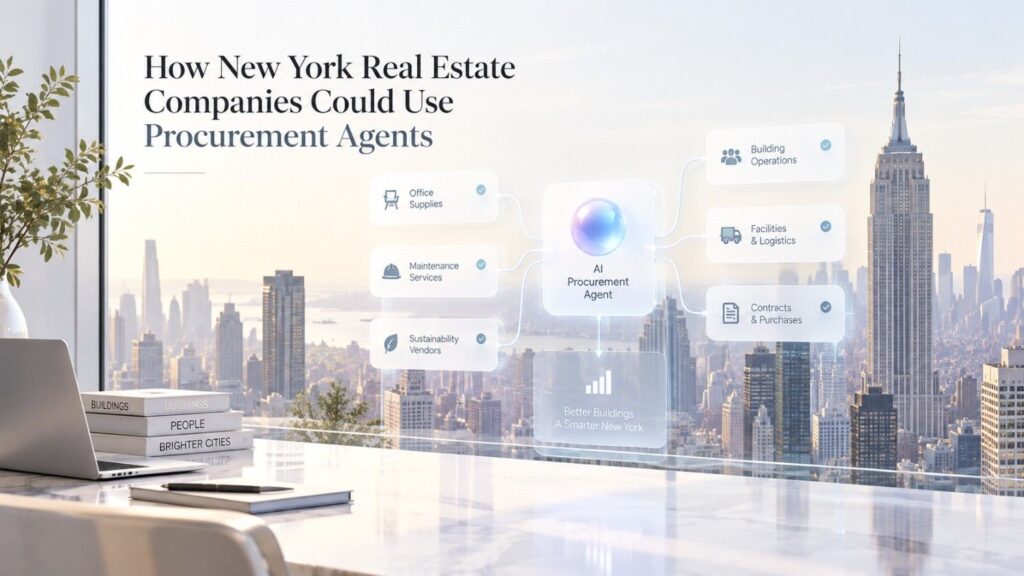
An agent can compare purchasing patterns across properties.
It might find that one building pays 22% more for an equivalent product.
It might discover that three properties are buying similar products from different suppliers.
It could combine demand.
It could request better pricing.
It could move purchases toward approved suppliers.
Most importantly, it can perform this analysis continuously.
How Restaurants and Hospitality Groups Could Use Procurement Agents
Multi-location businesses face a similar problem.
Purchasing becomes fragmented.
One location uses the preferred supplier.
Another manager buys from the easiest website.
A third pays more because the usual item was unavailable.
Those small decisions create spend leakage.
An agent can identify equivalent products, compare prices and maintain purchasing rules across every location.
If the normal supplier is unavailable, the agent can automatically search for an approved alternative.
Managers spend less time ordering.
Procurement gains more control.
How Media and Advertising Companies Could Use Procurement Agents
For many New York media businesses, software may be the largest opportunity.
A marketing department buys one AI platform.
The creative team buys another.
Sales buys a separate research platform.
Operations adds another tool.
Nobody realizes that several products overlap.
An AI agent connected to contracts, spending and usage data can detect the duplication before renewals occur.
That turns procurement from a reactive process into a continuous process.
Instead of asking, “What expires next month?”
The company can continuously ask:
“What should we stop buying?”
That may be an even more valuable question.
Healthcare Needs a Much Stricter Model
Healthcare organizations can still use procurement agents aggressively.
But they should separate clinical and nonclinical buying.
Administrative software can be automated.
Office products can be automated.
Facilities supplies can often be automated.
Routine equipment may be suitable depending on the category.
Clinical products require much tighter controls.
The cheapest product is not automatically the correct product.
Patient safety, regulatory requirements and medical standards must override savings.
The principle should be:
Automate the process without automating away professional responsibility.
Procurement Agents Need an Operating Constitution
Before a company gives an AI agent authority, it should create a written operating policy.
Think of it as the agent’s constitution.
The document should answer questions such as:
What can the agent buy?
How much can it spend?
Which suppliers can it use?
Can it contact new suppliers?
Can it negotiate price?
Can it negotiate payment terms?
Can it change the length of a contract?
Can it accept automatic renewal?
Can it commit to minimum volume?
Can it create a purchase order?
Can it cancel an existing supplier?
What requires legal review?
What requires security review?
When must it stop and ask a human?
The clearer these rules are, the safer the agent becomes.
Agents Will Force Companies to Improve Procurement Policy
This may become an unexpected benefit of agentic procurement.
A lot of procurement knowledge currently exists only inside employees’ heads.
An experienced buyer simply “knows” when something looks wrong.
AI systems force organizations to define that knowledge.
What price movement is acceptable?
What supplier risk is too high?
What contract terms are prohibited?
How much can one department approve?
When is competitive bidding required?
Companies that cannot answer these questions clearly are not ready for high autonomy.
Human Approval Should Be Triggered by Risk, Not Added Everywhere
Human approval is important.
Too much human approval destroys the value of automation.
Imagine an agent automatically gathers supplier quotes, analyzes them, negotiates the price, checks the budget, confirms the product and prepares the purchase.
Then five people must manually approve the $800 order.
The company has automated the process without removing the bottleneck.
Approval levels should rise with risk.
A $500 repeat purchase from an approved supplier may need no additional review.
A $10,000 purchase may need a manager.
A $100,000 purchase may need procurement and finance.
A $1 million commitment may need senior leadership, legal and security.
The amount alone should not determine risk.
A $5,000 purchase involving sensitive customer data may require more scrutiny than a $50,000 furniture order.
Good agents should understand both financial and operational risk.
Every Procurement Agent Needs an Audit Trail
Autonomy without visibility is dangerous.
The organization should be able to see what the agent did.
For every important action, the system should record:
what information was used;
which policy was applied;
which suppliers were considered;
which bids were received;
what negotiation happened;
why a supplier was selected;
which employee approved an exception;
what purchase document was created.
This becomes even more important when several agents work together.
One agent may select the supplier.
Another negotiates.
Another reviews the contract.
Another creates the order.
The company needs to reconstruct the entire decision chain.
Procurement Fraud Becomes a New Agent-Security Problem
AI agents introduce a less obvious risk.
Suppliers may learn how to manipulate them.
Imagine a fake vendor creates a website designed to appear highly trustworthy to procurement agents.
Or a supplier places instructions inside a document designed to influence an AI system.
A malicious invoice could contain text aimed at causing an automated system to change payment information.
This means procurement-agent security cannot be treated like ordinary chatbot security.
Agents can move money.
Access must be narrow.
Supplier identities must be verified.
Bank-detail changes should receive strong controls.
New suppliers should require additional verification.
High-risk actions should require separate approval.
The more authority an agent receives, the stronger identity and access controls must become.
A Practical 90-Day Procurement Agent Plan
Businesses do not need a three-year transformation program to begin.
A well-designed 90-day pilot can answer most of the important questions.
Days 1-30: Map the Procurement Long Tail
Start with data.
Pull 12 months of transactions.
Group purchases by:
supplier;
category;
department;
location;
average order size;
transaction volume.
Look for categories with many transactions and relatively low average value.
Then evaluate how difficult the decisions actually are.
A category with 2,000 annual transactions may look perfect until you discover that every purchase is highly customized.
Another category may have only 500 transactions but almost identical specifications every time.
The second one may be easier to automate.
Create an Automation Candidate Score
A simple score can use five questions.
How repetitive is the purchase?
How clear are the specifications?
How many qualified suppliers exist?
How expensive is a mistake?
Can the approval rules be written clearly?
Categories with high repetition, clear specifications, strong competition and low downside should go first.
Days 31-60: Run the Agent in Shadow Mode
Do not give it purchasing authority yet.
Let it watch.
The agent should make the decision it would have made.
Humans continue making the real decisions.
Then compare them.
Did the agent select the same supplier?
Did it identify the same risks?
Did it find a better price?
Did it misunderstand the requirement?
Did it miss an important contract term?
How often did it need help?
Shadow mode produces far more useful information than a generic AI demo.
You are testing the system against your own business.
Days 61-90: Give the Agent Narrow Authority
Once the company understands the failure patterns, give the agent limited execution rights.
For example:
The agent may buy approved office equipment.
Maximum purchase: $2,500.
Supplier must already be approved.
Price cannot exceed the internal benchmark by more than 3%.
Department must remain inside budget.
Delivery must arrive within the required period.
No new legal terms are allowed.
No contract may automatically renew.
If any condition fails, escalate.
That is genuine autonomous procurement.
The agent can act.
But it cannot improvise with company risk.
Build a Procurement Agent KPI Dashboard
Procurement agents should be measured like an operating team, not like a chatbot.
The question is not:
“How intelligent does it sound?”
The question is:
“Does it improve purchasing?”
Procurement Agent Scorecard
| KPI | What It Tells You |
| Cycle time | Whether purchasing is faster |
| Realized savings | Whether negotiated savings actually occurred |
| Transactions automated | How much work has moved away from people |
| Spend under agent review | How much purchasing receives analysis |
| Human escalation rate | Whether autonomy boundaries are working |
| Human override rate | Whether people disagree with agent decisions |
| Policy violation rate | Whether the system stays inside rules |
| Supplier response rate | Whether vendors cooperate with the system |
| Invoice mismatch rate | Whether execution quality is improving |
| Off-contract spend | Whether employees still bypass procurement |
| Supplier concentration | Whether automation creates overdependence |
| User satisfaction | Whether employees can actually buy what they need |
The most interesting KPI may eventually become procurement coverage.
Procurement Coverage Could Matter More Than Savings
Imagine a company spends $100 million annually.
The procurement department has enough time to deeply manage only $60 million.
The remaining $40 million sits across smaller suppliers, renewals and repeat transactions.
Traditional procurement coverage is 60%.
Now suppose agents continuously review almost all of the remaining spend.
They benchmark pricing.
They monitor contracts.
They identify duplicate vendors.
They launch sourcing events.
They flag unusual purchasing.
The company may reach 90% procurement coverage without building a much larger purchasing team.
That may be more valuable than saying an agent saved 4% on one contract.
The goal is not simply better negotiations.
It is more commercial attention across more transactions.
The Economics of Procurement Are About to Change
A human procurement professional is expensive.
That person should work on decisions worthy of their judgment.
Yet modern procurement departments spend enormous amounts of time collecting information, following up on approvals, checking spreadsheets and entering data.
Agents can push the economics in a better direction.
People handle ambiguity.
Machines handle repetition.
People build strategic supplier relationships.
Machines monitor thousands of prices.
People decide the risk strategy.
Machines enforce the rule every time.
People handle exceptions.
Machines handle the normal case.
That is a much stronger model than attempting to replace the procurement department.
Agent-to-Agent Procurement Is Already Starting
The next phase may become even stranger.
Today, a buyer’s AI agent may negotiate with a salesperson.
Tomorrow, a buyer agent may negotiate with a supplier agent.
Keelvar describes this as a two-sided agentic procurement market.
The company’s August 2026 report says 90% of sourcing events on its platform were agent-operated by July 2026, up from 71% in 2025. It also reports that average sourcing cycle times fell from around 26 days in 2023 to under two days in 2026, with a median agent-operated event completing in roughly two hours. Keelvar says supplier-side bidding agents were participating in more than 1,400 events per month by July 2026. These are platform-specific company figures rather than market-wide statistics, but they show how quickly machine-to-machine purchasing is developing.
Machine Negotiation May Stop Looking Like Human Negotiation
Humans negotiate through meetings and emails because that is how humans communicate.
Agents do not necessarily need that format.
A buyer agent could provide:
required quantity;
acceptable delivery range;
price ceiling;
payment preferences;
service requirements;
volume flexibility.
The supplier agent could provide:
capacity;
inventory;
price ranges;
discount rules;
delivery options;
commercial constraints.
The systems could evaluate thousands of combinations.
The result may be a better agreement reached in minutes instead of weeks.
This is particularly plausible in areas such as freight, packaging and standard products where prices and constraints can be clearly represented.
Public Procurement Also Shows Why Some Friction Is Necessary
It is tempting to assume every slow procurement step should disappear.
That would be a mistake.
Some friction exists because the process is badly designed.
Other friction exists because organizations deliberately require oversight.
Public procurement makes that distinction clear.
New York City purchasing includes competition rules, review requirements, documentation and transparency obligations.
Private businesses have their own versions.
Security reviews exist because vendors can create risk.
Legal review exists because contracts create obligations.
Budget approval exists because employees should not spend unlimited amounts of company money.
Compliance review exists because regulations matter.
AI should remove unnecessary friction.
It should not remove necessary control.
The Procurement Department Will Become More Strategic, Not Simply Smaller
The most interesting result of procurement automation may be what happens to human work.
Buyers spend less time:
copying data;
chasing quotes;
checking routine orders;
sending reminder emails;
creating basic POs;
tracking ordinary renewals.
They can spend more time asking questions such as:
Which suppliers are strategically important?
Where are we too dependent on one vendor?
Which categories should be consolidated?
Where should we deliberately pay more for resilience?
Which suppliers should receive longer agreements?
Where can volume be exchanged for better pricing?
Which relationships should we develop?
Where are we exposed to supply disruption?
Those are much better uses of skilled procurement employees.
Five Predictions for Procurement Agents in New York
1. The Purchase Request Form Will Slowly Disappear
Employees do not want another portal.
They want to say what they need.
AI agents will increasingly turn ordinary language into structured procurement requests.
The system can ask follow-up questions only when information is missing.
Procurement becomes a conversation at the front end and a structured workflow behind the scenes.
2. Competitive Sourcing Will Move Further Down the Spend Curve
Today, many small purchases receive little competition because obtaining three bids costs too much time.
Agents change that equation.
A $10,000 purchase may not justify hours of buyer work.
But it may easily justify several minutes of software activity.
That means competitive pressure can reach transactions that previously escaped procurement attention.
3. Negotiation Will Become Continuous
Supplier negotiation is often treated as an event.
A contract approaches renewal.
Everybody suddenly starts preparing.
Agents can monitor continuously.
They can watch:
usage;
market pricing;
supplier performance;
contract dates;
alternative vendors;
budget changes.
The negotiation process could effectively begin months before anyone sends the first supplier email.
4. Procurement Policies Will Become Machine-Readable
AI agents cannot reliably operate inside vague rules.
Companies will therefore need to turn procurement policy into something software can execute.
“Use good judgment” will not be enough.
Policies will increasingly define:
thresholds;
approved categories;
supplier requirements;
contract rules;
escalation triggers;
exceptions.
Procurement governance may become much more precise because machines require precision.
5. Buying Agents and Selling Agents Will Start Meeting Each Other
The final change may be the most important.
Suppliers will deploy agents too.
Those agents will respond to RFPs.
They will recommend discounts.
They will calculate profitable combinations.
They will negotiate delivery.
They will defend pricing.
That means procurement could become a machine-to-machine market.
Human business leaders will still set strategy.
But more of the transaction layer may operate at software speed.
What New York Business Leaders Should Do Now
Do not start by buying an “AI procurement platform.”
Start by understanding your purchasing workload.
Pull one year of data.
Find the categories generating the largest number of transactions.
Separate strategic purchases from repeat purchases.
Measure average order values.
Look for supplier fragmentation.
Find renewals.
Identify purchases where employees repeatedly perform the same steps.
Then ask one important question:
Could we write the rules for making this purchase correctly?
If the answer is no, keep the human deeply involved.
If the answer is yes, the workflow may be an excellent candidate for an agent.
Start with recommendations.
Move to supervised actions.
Then give the system narrow autonomous authority.
Expand only when the data proves that the system deserves more responsibility.
The Bigger Story: Procurement Software Is Becoming a Buyer
For decades, procurement software mostly recorded what people did.
A human selected the supplier.
A human negotiated.
A human approved the purchase.
A human created the order.
The system stored the information.
AI assistants changed the first part of that relationship.
Software began helping people make decisions.
Agents change it again.
The software can increasingly perform parts of the decision and execute the resulting work.
Our New York City analysis shows why that matters.
More than half of FY2025 new procurement actions in the three small-purchase categories we analyzed represented only about 1.2% of procurement contract value.
The City also recorded almost 190,000 purchase orders averaging only around $2,737 each.
Goods generated far more procurement contracts per dollar than construction.
And purchase-order activity was extremely concentrated in a few parts of the organization.
These patterns point toward the same conclusion.
The first great procurement-agent opportunity is not replacing the expert negotiating the biggest contract.
It is absorbing the enormous layer of repetitive purchasing work that experts should never have needed to handle manually in the first place.
That distinction matters.
A company does not need to trust an AI agent with a $100 million decision to create enormous value.
It may only need to trust it with 10,000 small decisions whose rules are already known.
Humans can set the budget.
Humans can choose approved suppliers.
Humans can define acceptable contract terms.
Humans can decide risk limits.
Humans can identify the situations where judgment matters.
Then the agent handles everything inside those boundaries.
A request arrives.
The software understands it.
It checks the budget.
It checks the policy.
It finds qualified suppliers.
It collects prices.
It compares the options.
It negotiates within defined limits.
It confirms that every requirement has been met.
Then it creates the purchase.
If something unusual happens, it stops.
A person takes over.
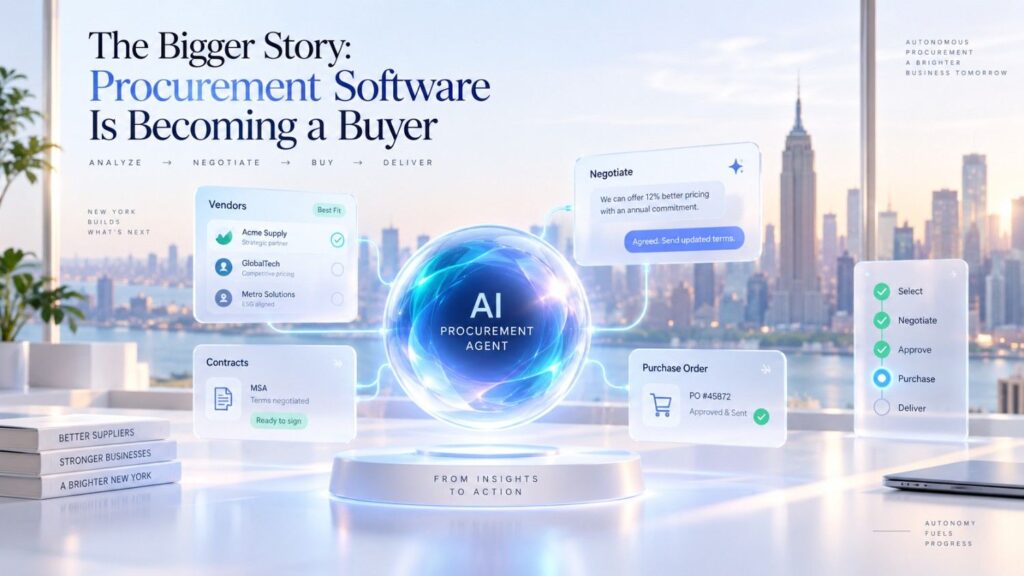
That is a far more realistic future than the idea of an unsupervised AI procurement department.
It is also much closer than many businesses realize.
The real shift is not that AI will suddenly control corporate purchasing.
It is that buying itself is becoming executable software.
And for New York businesses dealing with thousands of repeat purchases, supplier relationships and renewals, that could become one of the most practical applications of agentic AI.