

For years, artificial intelligence in real estate mostly meant better search, automated property valuations, chatbots, recommendation engines, and software that could extract information from documents.
That is changing fast.
The next stage of real estate AI is not simply software that gives a property manager an answer. It is software that can actually complete part of the job.
An AI agent can read a maintenance request, understand the problem, check the building’s records, create a work order, select the right vendor, send a message, schedule a visit, follow up when the job is late, update the property management system, and alert a human when something unusual happens.
That is a very different kind of technology.
And New York may be one of the most important markets in which to watch this transition.
New York City has an unusually large property base, an extremely tight rental market, complicated buildings, constant maintenance activity, enormous construction and permitting volumes, detailed public property records, and some of the most demanding housing and building rules in the country.
NYC Planning’s current PLUTO database alone contains about 858,000 tax lots. The Department of Finance’s rolling sales dataset contains more than 80,000 property-sale records from the previous twelve months. Meanwhile, New York City’s housing agency recorded 835,011 housing maintenance problems in Fiscal 2025.
That means there is no shortage of work for machines to help organize.
The bigger question is where they should actually be allowed to act.
That distinction matters because the best real estate agentic AI systems will probably not replace property managers, brokers, asset managers, engineers, compliance teams, or building staff. Instead, they will take over narrow chains of repeatable work while people continue to make the decisions where judgment, negotiation, relationships, safety, fairness, or legal responsibility matter.
Our analysis of public New York City data suggests that the strongest opportunity is not where many people first expect it.
It is not generating better apartment descriptions.
It is not producing prettier investment reports.
And it is not answering more questions with a chatbot.
The biggest opportunity is turning the enormous amount of administrative work surrounding New York property into workflows that software can actually complete.
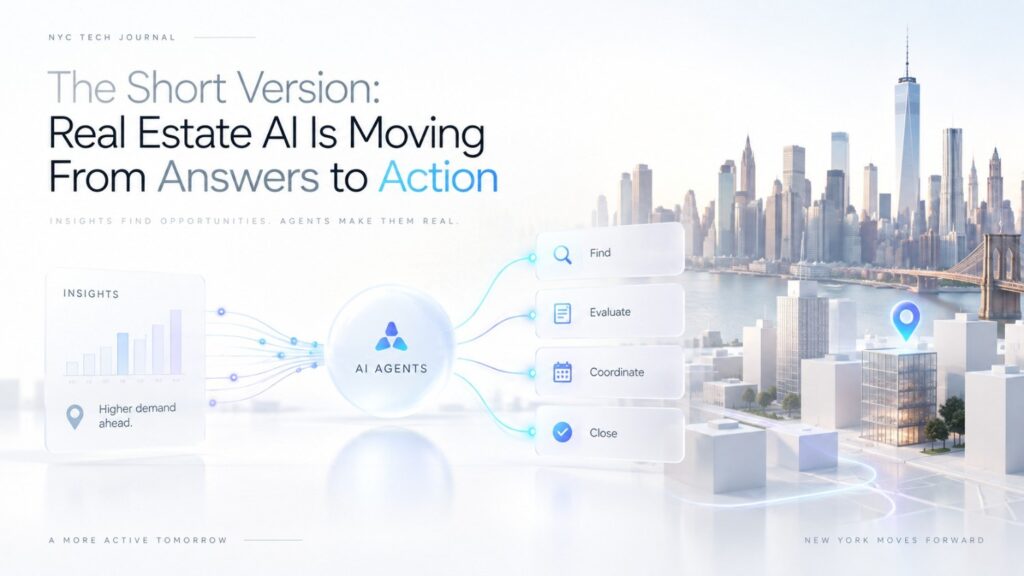
The Short Version: Real Estate AI Is Moving From Answers to Action
The easiest way to understand the shift is to compare an AI assistant with an AI agent.
An assistant waits.
A property manager asks, “Which work orders are overdue?”
The assistant searches the system and produces an answer.
An agent can go several steps further. It finds the overdue work orders, groups them by building and vendor, sends follow-up messages, reschedules appointments where permitted, updates expected completion dates, and escalates the five unusual cases to the property manager.
That difference—from describing work to completing work—is what makes agentic AI important.
The pattern is already becoming visible in property technology. New York-based EliseAI launched Apollo in September 2026 as an agent that can take actions across its property management platform. According to the company, Apollo can send messages, modify information, reassign tasks and tours, change settings, and create dashboards while operating within a user’s existing permissions.
In commercial real estate, VTS introduced AI-driven lease abstraction through Asset Intelligence in April 2026, while Visitt has introduced autonomous agents for operational workflows such as certificate-of-insurance management. Cherre has also launched infrastructure designed to let real estate companies build agents on top of connected property data.
These are different products solving different problems, but they point in the same direction.
Real estate software is slowly becoming capable of doing work instead of simply storing information about work.
Why New York Is an Unusually Good Market for Real Estate Agents
Artificial intelligence becomes most valuable when three things exist at the same time: a lot of repetitive work, enough structured data to understand that work, and an economic reason to reduce delays.
New York has all three.
The city has hundreds of thousands of tax lots. It has millions of apartments and commercial spaces. Properties generate maintenance requests, leases, permits, inspections, invoices, certificates, utility records, compliance filings, sales documents, construction applications, tenant messages, vendor communications, and dozens of other recurring tasks.
New York City also publishes unusually rich property data.
PLUTO contains roughly 858,000 tax-lot records and 108 fields. HPD’s Housing Maintenance Code Violations dataset contains about 11.2 million violation records. The city’s current Local Law 84 energy disclosure dataset contains more than 103,000 property records across reporting years.
These numbers should not be added together because they measure different things across different periods.
But they reveal something important.
New York property is surrounded by machine-readable information.
The challenge is connecting it.
New York also has very little room for slow operations
The latest New York City Housing and Vacancy Survey posted by HPD found a citywide net rental vacancy rate of only 1.41% in 2023. Just 33,210 units were available for rent out of approximately 2.357 million occupied and available rental units covered by the measure.
The shortage becomes even more striking when rents are broken down.
Chart: NYC Rental Vacancy Rate by Asking Rent
| Asking rent | Net rental vacancy rate |
| Less than $1,100 | 0.39% |
| $1,100–$1,649 | 0.91% |
| $1,650–$2,399 | 0.78% |
| $2,400+ | 3.39% |
| Citywide | 1.41% |
Source: 2023 New York City Housing and Vacancy Survey.
The data are from 2023 because that remains the latest NYCHVS published by HPD as of September 2026; the survey is normally fielded about every three years.
For property operators, tight supply does not make good service less important. It makes operational discipline more important.
When thousands of residents depend on a portfolio’s maintenance, leasing, renewals, and communication systems, small operational delays become large problems at scale.
That is exactly the environment in which agents become interesting.
NYC Tech Journal Original Research: Measuring New York’s Property Workflow Load
To understand where AI agents could create the most value, we built a simple measure we call the NYC Property Workflow Load.
The goal is not to estimate the size of New York’s real estate market.
It is to estimate the visible volume of recurring property-related events that can create administrative work.
We selected four large public datasets representing different parts of the property lifecycle.
The four workload streams
| Workflow | Public one-year-scale volume | What it represents |
| Housing maintenance problems | 835,011 | Resident-reported property problems in FY2025 |
| DOB job filings | 275,506 | DOB NOW + BIS applications in FY2025 |
| DOB work permits | 169,340 | Initial + renewal permits across DOB NOW and BIS in FY2025 |
| Rolling property sales | 80,407 | Recorded property-sale rows in NYC’s current rolling 12-month dataset |
| Combined workflow events | 1,360,264 | Not unique properties; workload indicator only |
HPD reported 835,011 housing maintenance problems in Fiscal 2025. DOB recorded 259,086 DOB NOW job filings plus 16,420 BIS filings, giving 275,506 total filings using those categories. DOB also reported 114,771 initial and 45,017 renewal DOB NOW permits, plus 705 initial and 8,847 renewal BIS permits, producing 169,340 permits. The Department of Finance rolling-sales dataset contained 80,407 rows when analyzed.
Chart: More Than 1.36 Million Visible Property Workflow Events
Housing maintenance problems 835,011 | ████████████████████████████████████████
DOB job filings 275,506 | █████████████
DOB work permits 169,340 | ████████
Rolling property sales 80,407 | ████
The total is approximately 1.36 million events, equivalent to roughly 3,700 events for every calendar day of the year.
That does not mean 3,700 different buildings require action every day.
One property can generate multiple complaints, permits, filings, and transactions. The datasets also use slightly different one-year periods. The calculation should therefore be treated as an operational workload index rather than a count of unique properties.
Even with that limitation, the scale is useful.
Chart: Where the Visible Workflow Load Sits
| Workflow | Share of our four-stream workload index |
| Housing maintenance | 61.4% |
| DOB job filings | 20.3% |
| DOB work permits | 12.4% |
| Property sales | 5.9% |
The conclusion is striking.
More than 60% of the workload represented in our model comes from maintenance problems.
Property transactions receive enormous attention from technology companies because transactions have obvious financial value. Yet the day-to-day operational workload after somebody owns or occupies a property can be far larger.
That changes how an AI strategy should be designed.
The Biggest Real Estate AI Opportunity May Be After the Deal
Real estate technology has traditionally focused heavily on the transaction.
Find a property.
Market it.
Price it.
Arrange a viewing.
Finance it.
Buy it.
Lease it.
Those are important steps, but a building spends most of its life after the transaction.
For decades, property technology has been relatively poor at this part of the market.
Buildings still generate emails, phone calls, PDFs, spreadsheets, handwritten notes, invoices, contractor messages, inspection records, lease clauses, insurance certificates, photographs, and maintenance tickets that somebody must interpret and move through a process.
Agents are particularly well suited to this messy middle.
Maintenance is a good example
A resident might send:
“The sink has been leaking since yesterday and now there is water inside the cabinet.”
Older property software creates a ticket.
Generative AI can summarize the ticket.
An agentic system could do considerably more.
It can recognize that the problem involves plumbing and possible water damage. It can check whether the same unit has had previous leaks. It can look for an approved plumber, review availability, create the work order, suggest an appointment window, message the resident, and monitor whether the job was completed.
If the system detects language suggesting flooding, electrical danger, loss of heat, or another serious condition, it can immediately escalate the case instead.
That is where agent design becomes more important than chatbot design.
The objective is not simply to understand the sentence.
The objective is to move the property toward resolution.
Maintenance Intake Should Be One of the First Agentic Workflows
HPD’s 835,011 reported housing maintenance problems in Fiscal 2025 show why maintenance deserves special attention. Heat and hot-water-related issues alone rose 12% to 161,773 during the year.
At city scale, maintenance is not an edge case.
It is a constant operating system.
What an agent can safely do
A well-designed maintenance agent can receive requests across phone transcripts, email, text, resident apps, and property portals. It can normalize the description, identify the likely trade, search the building history, check open work orders, spot duplicates, request missing information, route the job, communicate appointment options, and chase incomplete work.
The important word is workflow.
Simply using AI to classify tickets may save a few minutes.
Using an agent to carry the case from request to resolution can remove several separate handoffs.
Where humans still matter
The agent should not independently decide that a serious condition is safe.
Gas odors, major leaks, fire risks, electrical hazards, structural problems, elevator emergencies, no-heat conditions, accessibility problems, and situations that may create legal obligations need explicit escalation rules.
A reliable agent therefore needs two skills at once.
It must know when to act.
And it must know when not to act.
AI Agents Can Turn Leasing Into a Continuous Workflow
Leasing is another natural area for agents because it contains many small actions that repeat thousands of times.
A prospect asks whether a unit allows pets.
Another asks whether Saturday tours are available.
Someone misses an appointment.
A renter submits an incomplete application.
A leasing employee calls in sick and a full day’s tours need to be reassigned.
Each task is simple on its own.
At portfolio scale, they become a large operating burden.
New York-based EliseAI offers a useful example of how the category is developing. Its Apollo agent, announced September 3, 2026, can work across the company’s platform. EliseAI says a user could ask it to reschedule tours when a colleague is absent, while its product page says the agent can send prospect messages, update stored knowledge, reassign tasks and tours, change settings, and generate dashboards within existing user permissions.
The key idea is not that one particular product will run every leasing office.
It is that the interface itself is changing.
Instead of opening five screens and performing twelve clicks, an employee can increasingly state the outcome:
“Move tomorrow’s afternoon tours to available agents and tell each prospect their new contact.”
The software can then execute the steps.
The real KPI is not messages answered
Property companies should be careful about measuring these systems using chatbot metrics.
“Questions answered” is not a strong business outcome.
Better measures include inquiry-to-tour conversion, tour-show rate, application completion time, percentage of prospects requiring human intervention, median response time, cost per completed lease, and fair-housing exception rates.
Agents should be measured by completed work.
Resident Communication Can Become Actionable Instead of Reactive
Property managers spend enormous amounts of time answering questions that are connected to another task.
“When is my repair happening?”
“Did you receive my document?”
“Can I change the appointment?”
“When will the elevator be working?”
“Who should I contact about my renewal?”
A chatbot may answer the question from a knowledge base.
An agent can inspect the relevant record and potentially change the situation.
If a repair is delayed, the agent could find the updated vendor ETA and notify the resident.
If an appointment needs to move, it could check allowed slots and reschedule it.
If a required document is missing, it could explain what is needed and create a follow-up task.
This is a subtle but important difference.
The system stops behaving like a website FAQ and starts behaving like an operations coordinator.
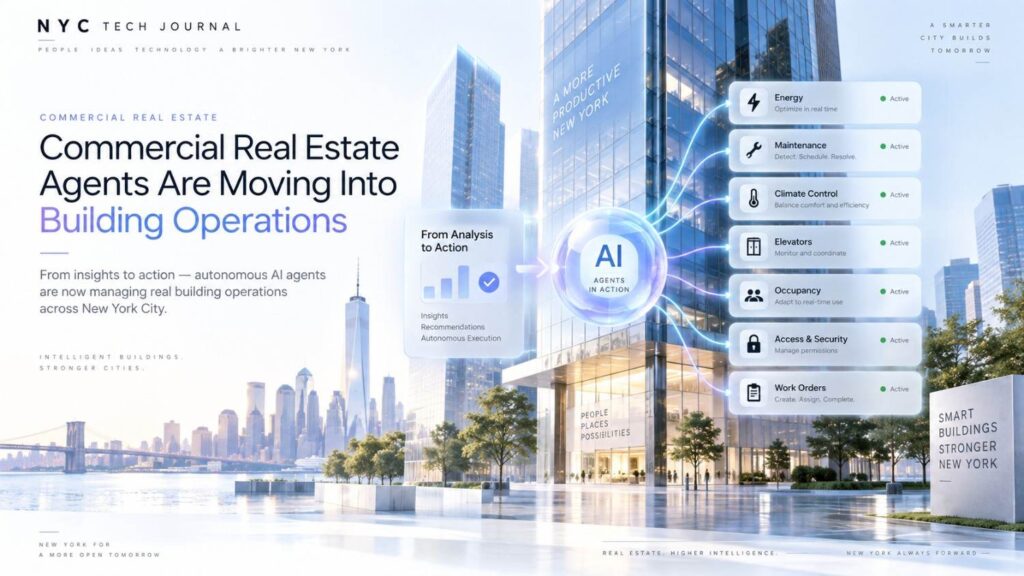
Commercial Real Estate Agents Are Moving Into Building Operations
Multifamily housing is only one part of the opportunity.
Commercial real estate buildings generate an enormous amount of administrative work around tenants, vendors, insurance, equipment, work orders, access, leases, inspections, and building systems.
Certificate-of-insurance management is a good example.
A property team may need to make sure that contractors entering a building have the required insurance coverage. Someone has to obtain the certificate, compare it with the required terms, identify missing information, contact the vendor, collect a corrected document, track expiration, and maintain a record.
Visitt introduced an autonomous COI agent designed to extract insurance requirements from contracts and leases, review incoming certificates, contact vendors or tenants for missing information, track compliance, and escalate cases when necessary. Those descriptions come from Visitt itself, so they should be treated as vendor claims rather than independent performance findings.
Still, the workflow illustrates why real estate is attractive for agent automation.
It has documents.
It has rules.
It has repetitive communication.
It has a defined desired outcome.
And most routine actions are reversible.
That is close to an ideal agentic workflow.
Lease Data Is Turning From a Static Record Into an Active System
A commercial lease may contain hundreds of important facts.
Renewal options.
Notice dates.
Rent steps.
Expense obligations.
Insurance requirements.
Repair duties.
Use restrictions.
Critical deadlines.
For years, lease abstraction meant converting parts of the document into structured fields.
AI makes it possible to go further.
VTS launched Asset Intelligence in April 2026, describing the product as AI-driven lease abstraction that feeds information into compliance, renewals, and broader asset-management decisions.
This points toward a larger shift.
The lease can become an active source of instructions.
Instead of simply storing a renewal date, an agent can monitor the date, identify the required notice period, retrieve the relevant clause, alert the asset manager, prepare the necessary information, and create the next tasks.
The same principle applies to loan documents, vendor contracts, management agreements, service contracts, and insurance policies.
Documents stop being files people search.
They become part of the operating system.
New York’s Construction and Permit Work Is a Major Agent Opportunity
The NYC Department of Buildings processed enormous volumes of construction-related workflow in Fiscal 2025.
DOB NOW recorded 259,086 job filings, up about 2% from the previous fiscal year. The older BIS system recorded another 16,420. DOB NOW issued 114,771 initial work permits and 45,017 renewals, while BIS accounted for additional permits. DOB also completed 153,551 first plan reviews in DOB NOW.
That is not just regulatory data.
It is evidence of administrative work happening across architects, engineers, developers, contractors, expediters, owners, managers, consultants, lawyers, lenders, and city staff.
An agent should not design the building
That is not the near-term use case.
The easier opportunity is everything surrounding the professional decision.
An agent could maintain a list of open filings for a portfolio, detect status changes, identify missing documents, remind teams about deadlines, connect filings to projects, organize objections, prepare status reports, reconcile internal project records with DOB data, and notify the correct employee when an action becomes necessary.
It can also prepare filing packages for human review.
This matters because administrative delay has a real cost.
Every unnecessary day between “information exists” and “somebody acts on it” can delay work.
Local Law 97 Makes Compliance Agents Particularly Important in New York
New York’s building-emissions rules create another unusually strong use case.
Local Law 97 covers most buildings over 25,000 gross square feet, along with certain groups of buildings crossing defined combined-size thresholds. The law introduced emissions limits beginning in 2024, with stricter limits scheduled for 2030. DOB says more than two-thirds of New York City’s greenhouse-gas emissions come from buildings.
Article 320-covered buildings generally need to file annual emissions reports, certified by a registered design professional. DOB’s 2026 Covered Buildings List reflects agency records as of March 2026, although owners remain responsible for confirming their actual obligations.
This is exactly the kind of work where an agent can help without pretending to replace a qualified professional.
A compliance agent could continuously prepare the file
Instead of beginning the compliance process shortly before a deadline, an agent could run all year.
It could pull utility data.
It could flag gaps.
It could compare a building’s identifiers across systems.
It could monitor whether energy records changed.
It could maintain the documentation packet.
It could calculate preliminary indicators.
It could identify properties that need professional attention.
It could remind the portfolio team when certifications or filings are approaching.
The professional still signs where professional certification is required.
The agent reduces the work required to reach that point.
That distinction matters.
New York already has a substantial digital base
The current NYC Open Data disclosure table for Local Law 84 contains more than 103,000 rows across reporting years and 265 columns. Each row represents a property record for a particular disclosure context, so the row count should not be interpreted as 103,000 unique covered buildings.
What it does show is that large quantities of building-performance data already exist in structured form.
Agents become much more useful when they can connect those public records with a property owner’s private records.
The NYC Property Data Problem Is Really an Identity Problem
Anyone who has worked with New York property data eventually discovers the same problem.
One physical place can have several identities.
A tax lot has a BBL.
A building can have a BIN.
A property management platform has its own property ID.
An energy system may have another ID.
A lease refers to suites or units.
A vendor invoice may contain only an address.
An owner may organize assets under legal entities that do not share the building name.
An AI model can be very intelligent and still make a useless recommendation if it joins the wrong records.
That is why the hidden foundation of agentic real estate is not the language model.
It is entity resolution.
The agent needs one reliable property graph
A useful data model should connect:
Property → BBL → BIN → building → unit → lease → tenant → vendor → equipment → work order → permit → violation → invoice → document.
Not every company needs a sophisticated graph database.
But every company needs a reliable answer to one question:
Does the system know that these records refer to the same real-world property?
Cherre’s Agent STUDIO is an example of vendors building specifically around this problem. The company says its agent infrastructure uses connected internal and external real estate data, including its data models and knowledge graph, to support agent workflows.
That is important because an agent that can take action makes bad data more dangerous.
A dashboard with a duplicated property is annoying.
An autonomous workflow acting on the wrong property can cause a real operational mistake.
NYC Tech Journal Original Analysis: Where Should Real Estate Companies Deploy Agents First?
Raw workload alone does not determine whether something should be automated.
A high-volume task may still be too risky.
To compare workflows, we created an Agent Opportunity Score using four factors.
The score is not a government statistic. It is an NYC Tech Journal analytical framework designed to make automation decisions more disciplined.
Methodology
We weight the factors as follows:
| Factor | Weight | What we are testing |
| Public workload volume | 40% | Is there enough visible recurring work to matter? |
| Repetition and rule structure | 25% | Does the workflow repeat in a predictable way? |
| Digital data readiness | 20% | Can software reliably access the required information? |
| Reversibility and safety | 15% | Can mistakes be caught or reversed before serious harm? |
Workload volume is scored from one to five using public NYC activity where a useful public measure exists. The other categories are editorial assessments based on workflow characteristics.
Our volume scale gives a five to workflows above 500,000 annual public events, four to 200,000–500,000, three to 100,000–200,000, two to 50,000–100,000, and one below 50,000.
Again, this is a decision framework—not a claim that every public event can or should be automated.
Chart: NYC Real Estate Agent Opportunity Score
Maintenance intake & triage 4.65 / 5 | ███████████████████
DOB filing/admin support 4.05 / 5 | ████████████████
Permit/status coordination 3.80 / 5 | ███████████████
LL84/LL97 compliance tracking 3.25 / 5 | █████████████
Sales due diligence/admin 3.05 / 5 | ████████████
Why maintenance comes first
Maintenance scores highest because it combines enormous volume with repetition.
Requests arrive constantly. Many can be categorized. Properties have recurring histories. Vendors can be mapped to trades. Statuses can be tracked. Residents need updates.
Most importantly, much of the workflow involves low-risk actions such as gathering information, opening work orders, scheduling, sending messages, and following up.
The dangerous cases can be escalated.
That is the pattern businesses should look for.
Automate the routine path.
Make the exception path very human.
Sales Due Diligence Is Valuable Even Though Its Volume Is Smaller
New York City’s rolling sales dataset currently contains roughly 80,400 rows representing recorded property sales during the prior twelve-month period.
That is much smaller than the maintenance workload.
But each transaction can have much higher financial value.
An acquisition agent could assemble property facts from public records, normalize ownership information, collect permit history, identify violations, organize energy data, compare previous sales, extract documents from a data room, and produce a structured list of issues for the investment team.
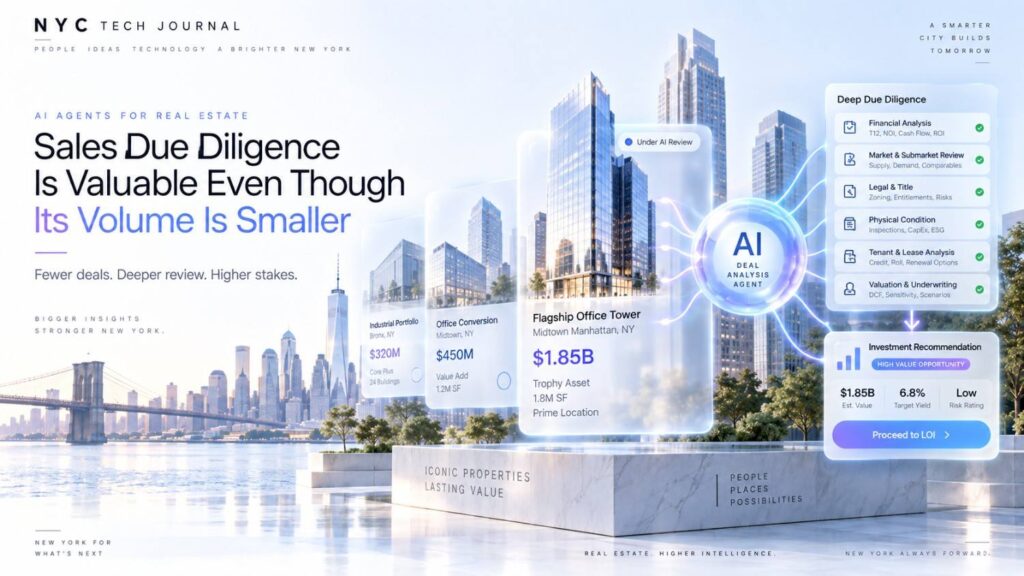
The agent should not decide whether to buy the building.
It should make the human decision faster and better informed.
Due diligence is a good example of parallel agent work
Today, an analyst often performs tasks one after another.
Search this database.
Download this document.
Check this permit.
Find this clause.
Update this spreadsheet.
An agentic system can perform many of those retrieval and organization tasks in parallel.
That changes the economics.
The biggest benefit may not be reducing analyst headcount.
It may be enabling the same team to examine more opportunities while spending a larger share of its time on judgment.
Agents Can Also Change Property-Level Financial Operations
Every property produces financial work.
Invoices arrive.
Purchase orders need matching.
Expenses require coding.
Vendors need follow-up.
Budgets need comparisons.
Rent collections need monitoring.
Accounting teams investigate unexpected changes.
Asset managers ask why a property’s expenses moved.
AI agents can connect some of these activities.
An agent might detect that water expense increased sharply, identify an open leak-related work order, find three recent plumbing invoices, compare the expense with the prior period, and prepare an explanation for the property manager.
That is far more useful than simply generating a variance chart.
The agent is connecting financial state with operational state.
Financial action needs stricter permissions
An agent should generally have much more freedom to read an invoice than to release a payment.
A practical permission design might allow automatic extraction, coding suggestions, duplicate detection, three-way matching, and exception routing while requiring human approval for payment.
Autonomy should become narrower as the cost of a mistake increases.
Tenant Screening Is Where Real Estate Companies Should Slow Down
The fact that a workflow can be automated does not mean it should be automated.
Tenant screening is one of the clearest examples.
New York City’s fair-housing guidance says screening criteria need to be applied equally and must not be influenced by protected characteristics. Questions also cannot improperly reveal protected-class information.
Federal rules create additional duties when consumer reports are involved. The FTC explains that tenant background reports can qualify as consumer reports under the Fair Credit Reporting Act, creating obligations for landlords and property managers that use them in housing decisions.
The risks are not theoretical.
In July 2026, the FTC announced a $2.25 million settlement with tenant-screening provider RentGrow over allegations that included failures to use reasonable procedures to ensure report accuracy.
AI can prepare the file without making the final decision
A safer model is:
The agent checks whether required documents are present.
It extracts factual information.
It identifies inconsistencies.
It applies clearly documented administrative rules.
It records the source of each fact.
It creates an explanation for review.
A trained person then handles the final high-impact decision using approved criteria.
The closer an agent comes to deciding who gets a home, what somebody pays, whether a lease is denied, or whether enforcement action begins, the stronger the human-control layer should become.
The Best Real Estate Agent Has an Autonomy Ladder
Companies often make an AI project harder than necessary by asking one binary question:
“Do we let AI do this or not?”
A better approach is to decide how much autonomy each workflow receives.
The five practical levels
| Level | Agent behavior | Example |
| 1. Observe | Read and summarize | Find overdue work orders |
| 2. Recommend | Suggest the next action | Recommend which vendor should receive each ticket |
| 3. Prepare | Build the action for approval | Draft work orders and resident messages |
| 4. Act within limits | Execute low-risk approved actions | Send reminders, update status, schedule routine visits |
| 5. Escalate exceptions | Run normal path and hand off unusual cases | Manage routine maintenance while escalating emergencies |
This model is safer than starting with maximum autonomy.
A new agent can begin by observing the workflow without changing anything.
The company measures whether its classifications and recommendations are correct.
Then it can prepare actions.
Then selected actions can become automatic.
Autonomy is earned through evidence.
An Agent Needs Permissions, Not Just Intelligence
A surprisingly common mistake is treating an AI agent as if intelligence is the main safety layer.
It is not.
Permissions matter more.
Imagine an employee in a property company.
The employee may know how to change a lease record, approve an invoice, alter a tenant status, send a legal notice, and schedule a vendor.
That does not mean the employee has permission to do all of those things.
Agents should work the same way.
EliseAI’s Apollo, for example, says its actions inherit existing user permissions. That is the right general principle even for companies using completely different technology.
Give every action a risk class
A useful operating model could look like this:
| Action | Suggested autonomy |
| Read property data | High |
| Search documents | High |
| Draft resident communication | High |
| Send routine appointment reminders | High after testing |
| Create maintenance tickets | High after testing |
| Reschedule non-critical work | Medium |
| Select a vendor | Medium |
| Change lease economics | Low |
| Approve payment | Low |
| Reject applicant | Very low |
| Send legal notice | Very low |
| Take safety-critical building action | Human-controlled |
The point is not to create an exact industry standard.
It is to force the company to discuss consequences before giving software access.
Every Important Agent Action Should Leave a Receipt
Traditional software provides buttons.
Someone clicks a button and the system records what happened.
Natural-language interfaces can make the process less visible.
That creates a governance problem.
If a manager says, “Take care of all overdue vendor certificates,” and the agent performs 137 actions, the company needs a record of those actions.
A useful agent receipt should answer:
What did the agent see?
What rule did it use?
What did it change?
Which external system was affected?
What message was sent?
What source supported the decision?
Was human approval required?
Can the action be reversed?
Without that record, agentic software can make property operations less transparent rather than more efficient.
Real Estate Companies Should Measure Resolved Work, Not AI Usage
AI vendors often show adoption numbers.
Messages sent.
Prompts entered.
Questions answered.
Documents summarized.
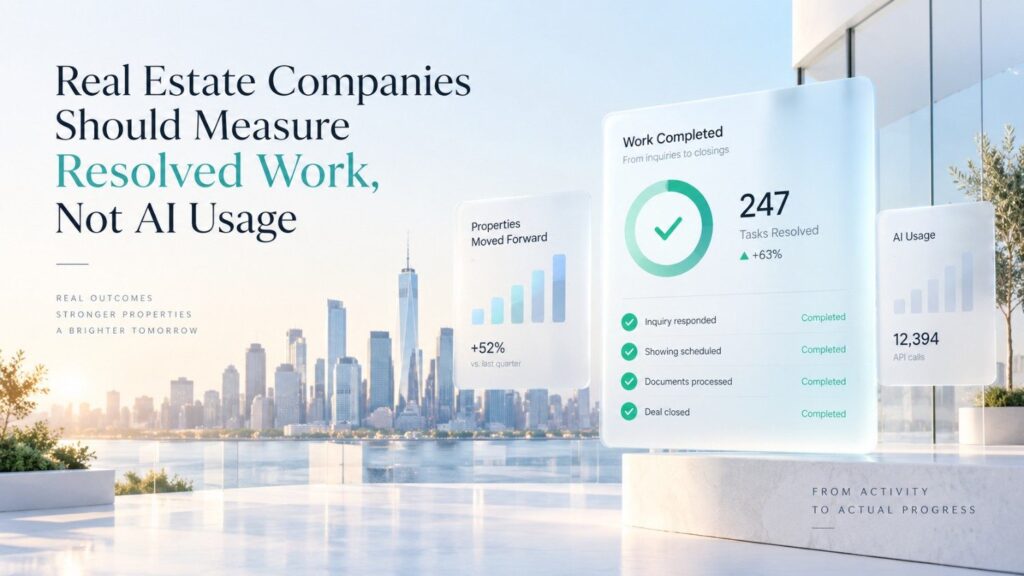
Those statistics may show that people are using the product, but they do not prove that the product is creating value.
Real estate leaders should measure operational outcomes.
A practical agent KPI dashboard
| Workflow | Weak metric | Better metric |
| Leasing | AI conversations | Qualified inquiries converted to tours |
| Tours | Messages sent | Show rate and rescheduling success |
| Maintenance | Tickets classified | Median time to resolution |
| Vendor management | Emails automated | Jobs completed within SLA |
| Compliance | Documents analyzed | Required filings completed accurately and on time |
| Lease abstraction | Pages processed | Verified fields and deadlines captured |
| Collections | Reminders sent | Resolved balances without unnecessary escalation |
| Asset management | Reports generated | Decisions accelerated or exceptions found |
One additional metric should appear on every dashboard:
Human override rate.
If employees constantly reverse the agent’s decisions, the system is not ready for greater autonomy.
A Better Real Estate AI ROI Formula
Cost savings alone are too narrow.
The value of a property-management agent can come from faster work, fewer missed tasks, better response, recovered revenue, and avoided errors.
A more useful framework is:
Monthly Agent Value = Labor Capacity Recovered + Revenue Improvement + Avoided Error Cost + Faster Resolution Value − Software Cost − Integration Cost − Human Oversight Cost
Every part should be measured conservatively.
Suppose a 5,000-unit portfolio receives 3,000 maintenance and resident-service interactions per month.
If an agent saves an average of five staff minutes on 2,000 routine interactions, that represents about 167 hours of capacity.
But the company should not immediately claim 167 hours of “savings.”
The relevant question is what happened to those hours.
Did overtime decline?
Did the portfolio avoid another hire?
Did service improve?
Did managers inspect properties more often?
Did resident response times fall?
ROI should be connected to an observable business outcome.
The Human Job Changes When Agents Handle the Normal Path
Property management has traditionally required employees to spend a great deal of time pushing information between systems.
Read the email.
Create the ticket.
Call the vendor.
Update the resident.
Check the schedule.
Follow up.
Update the ticket again.
When agents handle more of that path, human work moves toward exceptions.
The manager spends more time dealing with the resident whose problem is unusual.
The asset manager spends more time deciding what the numbers mean.
The building engineer spends more time solving physical problems.
The leasing employee spends more time with prospects who need real help.
The compliance professional focuses on cases where rules are unclear.
This can make the human role more important, not less.
But organizations need to redesign work deliberately.
Putting an agent on top of an old process while leaving every responsibility unchanged will create confusion.
A Practical 90-Day AI Agent Plan for a New York Real Estate Company
Companies do not need to redesign an entire portfolio at once.
A focused 90-day project can reveal whether agentic AI actually works.
Days 1–15: Pick one workflow
Choose something frequent, painful, measurable, and relatively safe.
Maintenance triage is a strong candidate.
So is vendor certificate collection.
Another option is permit-status monitoring.
Do not begin with five workflows.
You need enough repetition to evaluate the system quickly.
Days 16–30: Map the real process
Write down what employees actually do, not what the official process diagram says they do.
Where does information arrive?
Which system contains the source of truth?
Which decisions use clear rules?
Where do employees use judgment?
Which actions can be reversed?
Which situations should always reach a person?
This exercise often finds operational problems before AI is installed.
Days 31–45: Run the agent in shadow mode
The agent should observe real cases and recommend what it would have done.
Humans continue doing the actual work.
Compare the answers.
Measure classification accuracy, missing context, incorrect assumptions, unsafe recommendations, and situations in which the agent needs more information.
This is the cheapest time to discover weaknesses.
Days 46–60: Let the agent prepare actions
The agent now creates the ticket, message, recommendation, or system update.
A human approves it.
Record the approval rate.
When employees reject an action, capture why.
Those rejection reasons are valuable training data for the workflow.
Days 61–75: Automate the safest actions
If appointment reminders have a 99.8% approval rate, consider automating them.
If work-order classifications have a 97% approval rate but emergency detection still produces mistakes, automate classification while maintaining mandatory human review for defined emergency categories.
Autonomy does not have to apply to the entire workflow.
Days 76–90: Measure business outcomes
Compare the pilot with the previous baseline.
Did resolution become faster?
Did the backlog shrink?
Did employee time move?
Did errors increase?
Did residents contact the company fewer times about the same issue?
Did managers override the agent?
Did any protected or high-risk decision accidentally become automated?
Only after answering those questions should the company expand.
The 90-Day Scorecard
| KPI | Baseline | Pilot target | Why it matters |
| Median response time | Measure first | Lower | Tests speed |
| Median resolution time | Measure first | Lower | Tests actual completion |
| Human touches per case | Measure first | Lower | Measures workflow compression |
| Agent action approval rate | 0 | Rising toward defined threshold | Tests reliability |
| Human override rate | 0 | Low | Detects poor decisions |
| Reopened cases | Measure first | No increase | Protects quality |
| Safety escalations missed | 0 tolerance | 0 | Protects residents |
| Compliance exceptions missed | 0 tolerance | 0 | Protects company |
| Staff hours per 100 cases | Measure first | Lower | Tests capacity gain |
The most important feature of this table is the baseline column.
Companies frequently deploy AI without measuring how the process worked beforehand.
That makes ROI almost impossible to prove.
How New York Real Estate Companies Should Evaluate Agent Vendors
The best product demo is rarely enough.
Agent software needs to work inside the systems that already run the portfolio.
A property company should therefore test the vendor around actions, permissions, evidence, recovery, and integration—not just language quality.
Ask what the agent can actually change
“Uses AI” tells you almost nothing.
Ask which systems the product can write to.
Can it create a work order?
Can it alter a tour?
Can it update the PMS?
Can it send a message?
Can it modify lease data?
Can it close a case?
Can it make a payment?
Then ask which of those actions can be disabled.
Ask how the agent proves what it did
Every material action should be logged.
If the agent extracts a lease obligation, the user should be able to find the source.
If it updates a property record, the company should know which record changed and why.
If it communicates with a resident, the message should be retained according to company policy.
Ask what happens when the model is uncertain
“AI-powered” software sometimes produces a confident answer when the underlying information is incomplete.
Real property operations cannot rely on confidence alone.
The system needs a defined failure path.
When data conflict, it should ask.
When a required document is missing, it should stop.
When risk crosses a threshold, it should escalate.
Good agent design includes graceful refusal.
Ask how models are evaluated after updates
Agent behavior can change as models, prompts, integrations, and business rules change.
Testing once during procurement is not enough.
Companies should maintain a set of representative cases and rerun them after meaningful system changes.
This is especially important once agents can modify production records.
Public Data Can Become Part of the Property Operating Stack
One reason New York is especially interesting is the amount of public information that can enrich private property systems.
PLUTO can help establish tax-lot attributes.
DOB data can reveal filing and permit activity.
HPD data can provide housing violations.
Sales data can provide transaction context.
Energy datasets can support benchmarking and compliance work.
These public sources do not replace internal systems.
They provide external state.
An agent can compare that state with the company’s own records.
For example, a portfolio system may say a renovation project is awaiting a permit.
The agent can check the public status.
If the permit appears, it creates the next internal task.
If the status changes unexpectedly, it alerts the project manager.
This is more powerful than a static dashboard because the information triggers action.
The Future Property Dashboard May Not Be a Dashboard
For decades, software has asked real estate professionals to adapt to the software.
Open the application.
Select the property.
Choose the report.
Filter the date.
Export the spreadsheet.
Open another system.
Compare the numbers.
Agentic interfaces reverse that model.
A regional manager may simply ask:
“Which Brooklyn properties had a maintenance backlog increase this week, and what caused it?”
The agent can inspect the portfolio, connect open tickets with staffing and vendor information, surface the five relevant properties, explain the likely causes, and offer the next actions.
The next command might be:
“Send the property managers the cases they need to review and create a follow-up for tomorrow.”
Now the interface has moved from information retrieval to execution.
That is a major change in enterprise software.
The Bigger Story: New York Property Is Becoming Executable
The phrase “autonomous real estate” can sound like buildings operating themselves.
That is not what is happening.
At least not yet.
What is happening is more practical.
Individual pieces of property work are becoming executable by software.
A leasing inquiry can trigger an agent.
A lease clause can trigger an agent.
A work order can trigger an agent.
A permit status can trigger an agent.
A missing insurance certificate can trigger an agent.
An energy-data problem can trigger an agent.
A renewal date can trigger an agent.
The building itself does not need to become autonomous for the operating company to become far more automated.
Five Predictions for AI Agents in New York Real Estate
Property management systems will become action platforms
The major competitive question will no longer be only which platform stores the best records.
It will be which platform lets intelligent software safely act on those records.
APIs, permission models, logs, and structured data will become more valuable.
Maintenance will move faster than investment decisions
The highest-volume, most repetitive operating workflows are easier to automate than major capital decisions.
Agents will become normal in scheduling, triage, communication, compliance preparation, and administrative coordination before investment committees hand over final acquisition authority.
Our NYC workload analysis strongly supports this direction. Housing maintenance represented approximately 61% of the four public workflow streams we analyzed.
Every large portfolio will need an agent-control layer
When several agents are acting across leasing, maintenance, accounting, and compliance, companies will need one place to see what they are doing.
Management will want limits.
Approval rules.
Audit records.
Emergency stops.
Exception queues.
Performance scores.
Agent governance will become an operations discipline.
Data quality will become more valuable, not less
Generative AI can make messy information easier to use.
It cannot make incorrect property identity harmless.
When software can act, accurate data become more important.
The winners will not necessarily be companies with the most AI models.
They may be the companies with the cleanest connection between properties, units, leases, people, vendors, documents, and public identifiers.
The best property managers will become managers of exceptions
Routine work will increasingly happen automatically.
Human value moves toward negotiation, empathy, judgment, physical inspection, complex problem solving, relationships, and accountability.
A great property manager will spend less time moving data and more time managing the building.
What New York Real Estate Leaders Should Do Now
The correct first step is not buying the most impressive AI demo.
It is identifying the repetitive work already consuming the organization.
Look at maintenance.
Look at leasing follow-up.
Look at renewals.
Look at vendor coordination.
Look at permit monitoring.
Look at compliance documentation.
Look at lease abstraction.
Look at recurring reporting.
Then determine which steps are rules and which steps require judgment.
That line becomes the beginning of your agent architecture.
The safest strategy is simple:
Let AI read broadly, recommend freely, prepare extensively, act narrowly, and escalate aggressively.

As reliability improves, the action boundary can expand.
But the company should expand autonomy because its own data prove the agent deserves more responsibility—not because a vendor calls the product autonomous.
Final Takeaway
AI agents could become one of the most important changes in real estate software since property management systems moved to the cloud.
The reason is not that an AI agent sounds more intelligent than a chatbot.
The reason is that it can connect information with action.
New York makes the opportunity unusually visible.
NYC Planning’s PLUTO dataset contains roughly 858,000 tax lots. The current rolling sales database contains more than 80,000 sale records. HPD reported 835,011 housing maintenance problems in Fiscal 2025. DOB recorded more than 275,000 job filings and roughly 169,000 initial and renewal work permits across its two main systems during the fiscal year.
Our analysis of just those four workflow streams produces more than 1.36 million visible property-related events at roughly one-year scale.
That is not a measure of unique buildings or market size.
It is something more useful for thinking about AI.
It is a picture of the work.
And most of that work is not the glamorous part of real estate.
It is opening tickets, reading documents, updating systems, checking requirements, following up with vendors, tracking deadlines, communicating with residents, monitoring filings, and making sure ordinary processes reach completion.
That is exactly why AI agents matter.
The first real autonomous property company will probably not be a company where humans disappear.
It will be a company where people stop spending their days pushing routine work from one screen to another.
The software handles the normal path.
People handle the difficult path.
In a city as large, regulated, expensive, and operationally complex as New York, that could change far more than the property technology stack.
It could change how the property business itself is run.