
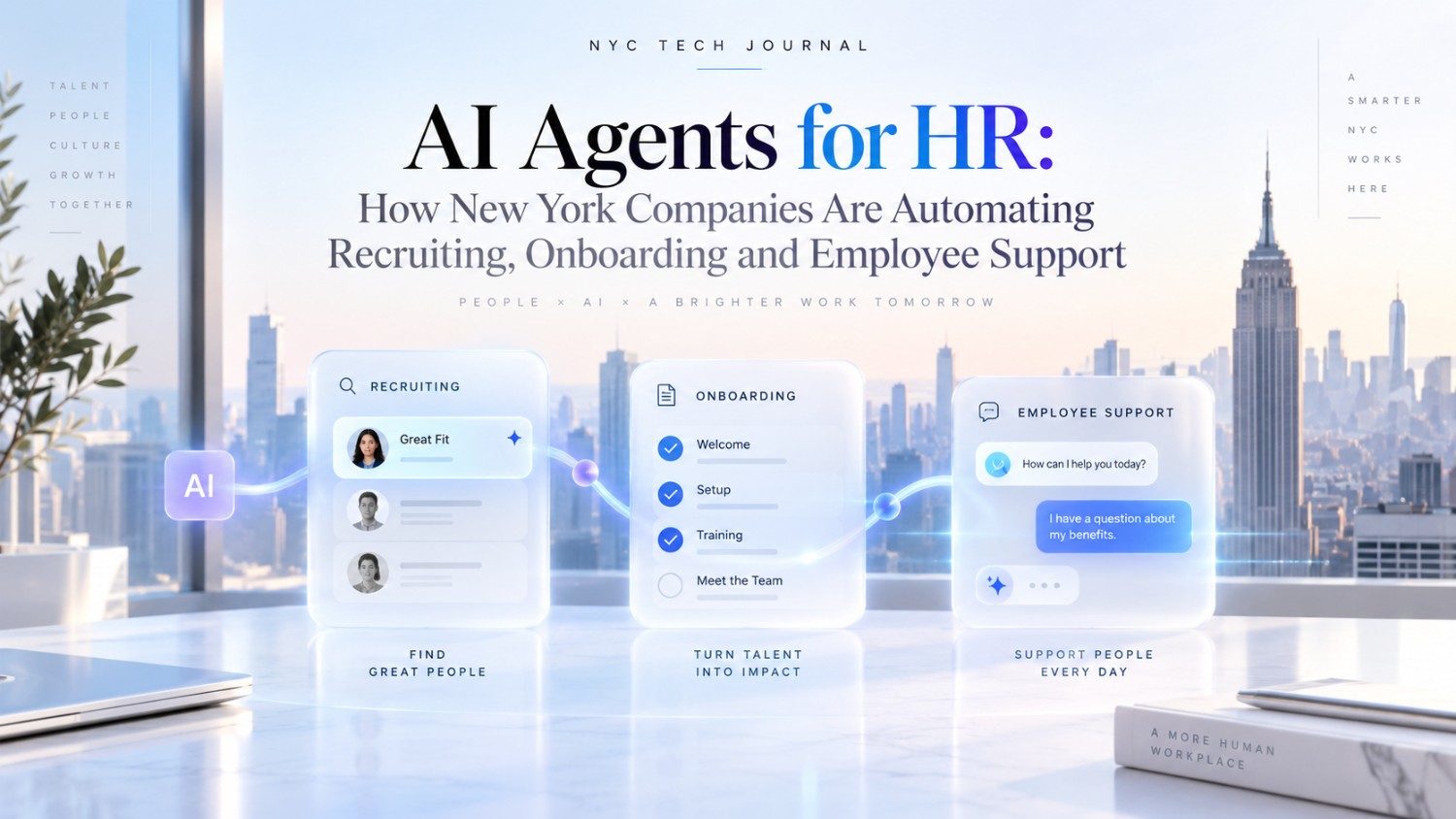
Human resources software has spent years becoming better at storing information. The next change is much bigger: HR software is starting to do work.
An HR chatbot can tell an employee where to find the parental leave policy. An AI assistant can summarize that policy. An AI agent can go several steps further. It can understand the employee’s request, find the correct policy, check which rules apply, collect missing information, open the right workflow, update another system, notify the right person and ask for human approval when the decision is sensitive.
That difference sounds small until it is applied across thousands of applicants, employees, managers and HR requests.
For New York companies, the opportunity is especially important. Labor is expensive. Hiring organizations handle large numbers of applications. Financial services, healthcare, professional services, retail, hospitality, media and technology companies often operate with complicated policies and many different employee groups.
There is also another side to the story. New York City already regulates some automated tools used in employment decisions. A company cannot treat an AI recruiting agent like a harmless productivity app if the system is actually influencing who gets hired.
The winning model, therefore, is unlikely to be “replace HR with AI.”
It is much more practical:
Let agents handle repeatable work. Let people own consequential decisions.
NYC Tech Journal analyzed current New York City hiring data and the latest available federal occupational data for the New York metro to understand how large this opportunity might be. The numbers suggest that even modest improvements in HR capacity could have significant economic value.
The latest detailed Bureau of Labor Statistics estimates show 18,480 human resources managers in the New York-Newark-Jersey City metropolitan area earning a mean annual wage of $204,790. The region also had 2,420 compensation and benefits managers earning $199,050 and 3,520 training and development managers earning $186,140.
Together, those three management categories represent about 24,420 jobs and $4.92 billion in annual salary-equivalent payroll, based on NYC Tech Journal calculations from the BLS figures.
If better automation allowed organizations to redirect just 5% of that management time from administrative work toward higher-value work, the salary-equivalent capacity would be roughly $246 million a year.
At 10%, it would be about $492 million.
Those numbers are not a prediction of layoffs or direct cash savings. They are a way to measure the economic value of time. They show why New York employers should think about HR agents as an operating-model decision rather than another software feature.
And recruiting is only the beginning.
The Short Version: HR AI Is Moving From Answering Questions to Completing Work
The easiest way to understand the change is to compare three generations of HR software.
| Type of HR AI | What it mainly does | Typical example |
| Chatbot | Answers a question | “How many vacation days do I have?” |
| Copilot | Helps a person produce work | Draft an interview guide or summarize resumes |
| AI agent | Carries a workflow forward | Schedule interviews, collect feedback, update systems and escalate exceptions |
A traditional HR chatbot usually ends after delivering information.
A copilot keeps the employee or HR professional in control of every important action.
An agent is different because it can maintain context, decide what step comes next and interact with other software.
Imagine that a new employee asks:
“Can I change my benefits because I just got married?”
A basic bot might send a link.
A better agent could determine whether the event qualifies for a benefit change, identify the deadline, explain the required documents, open the appropriate workflow, check whether the employee completed it and send a reminder before the deadline.
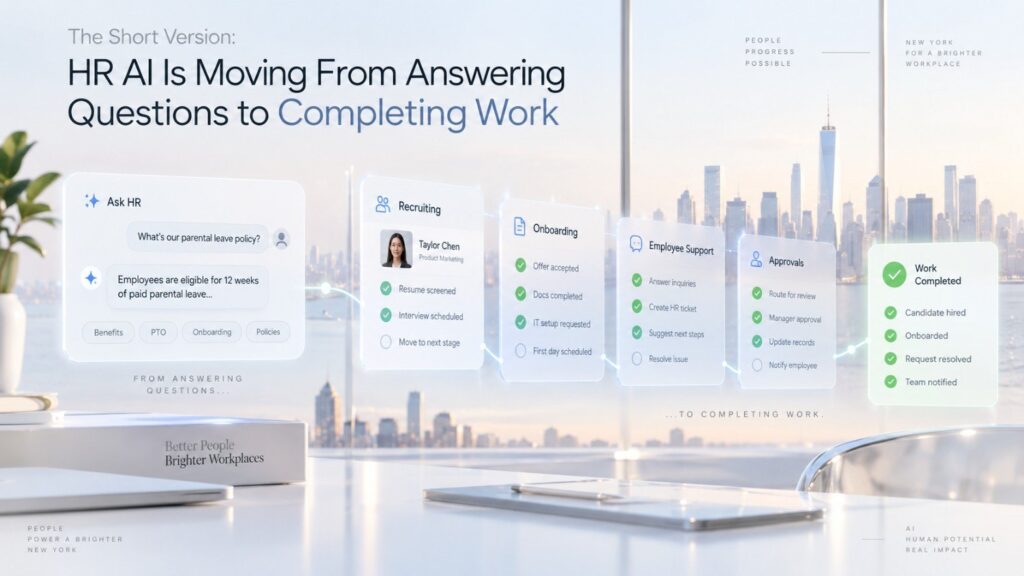
The employee still makes the benefit choice. The HR team still owns policy and exceptions. The agent deals with the administrative path between the question and the completed request.
That middle layer is where much of HR work lives.
Why HR Has Become One of the Most Logical Markets for AI Agents
Human resources contains an unusual combination of high-volume work and high-stakes decisions.
That makes it perfect for automation and dangerous for careless automation at the same time.
Recruiters repeatedly schedule interviews, answer candidate questions and move information between systems. HR operations teams repeatedly explain policies, collect forms and route requests. Managers repeatedly need help with onboarding, benefits, leave, performance processes and internal moves.
Yet a nearby task may involve rejecting somebody for a job, deciding compensation, evaluating performance or handling a disability accommodation.
Those are not equivalent activities.
The fundamental mistake is attempting to automate an entire HR department instead of breaking HR into individual workflows.
Adoption Is Already Moving Quickly
SHRM’s 2025 research found that 43% of surveyed organizations used AI to support HR-related activities, compared with 26% in 2024. Recruiting was the leading HR use case, with 51% reporting AI use in recruiting. Among recruiting users, common applications included writing job descriptions, screening resumes, candidate searches and applicant communication.
That represents a 17-percentage-point increase in overall HR AI adoption in one year.
LinkedIn’s 2025 Future of Recruiting research found a similar direction of travel. About 37% of recruiting organizations in its survey were actively integrating or experimenting with generative AI, compared with 27% the previous year. Talent professionals already using generative AI reported an average workload reduction of about 20%.
These are different surveys with different populations, so their percentages should not be directly combined. What matters is that both point toward the same change: AI is moving from occasional HR experiments into normal operating workflows.
Chart: HR AI Adoption Is Accelerating
SHRM: Organizations using AI for HR work
2024 | █████████████ 26%
2025 | ██████████████████████ 43%
LinkedIn: Recruiting teams integrating or testing GenAI
2024 | ██████████████ 27%
2025 | ███████████████████ 37%
The next stage is not simply using the same AI more often. It is moving from software that helps a recruiter perform a task to software that can coordinate several connected tasks.
That is the agent shift.
NYC Tech Journal Original Research: Measuring the HR-Agent Opportunity in New York
There is no public database showing exactly how many hours New York companies spend scheduling interviews, answering benefits questions or chasing onboarding forms.
Pretending otherwise would produce false precision.
Instead, NYC Tech Journal built a transparent model using publicly available labor and hiring data. The goal is not to claim that a certain number of jobs will disappear. The goal is to estimate the economic scale of HR capacity that could be redirected if agents remove even a small amount of repetitive work.
Our Methodology
We used three main layers of evidence.
First, we used the latest detailed BLS Occupational Employment and Wage Statistics available for the New York-Newark-Jersey City metropolitan area. The dataset measures employment and wages by occupation. Because the latest detailed figures are metropolitan rather than NYC-only, we treat them as a regional labor-cost measure rather than pretending they describe only the five boroughs.
Second, we looked at NYC’s Jobs NYC public dataset as a local hiring-volume signal. The dataset is maintained by the city’s Department of Citywide Administrative Services and contains current postings from the city’s official jobs platform. A late-August 2026 snapshot contained 2,812 postings, while an early-September view contained 2,923. The dataset is updated regularly, so those figures should be treated as snapshots rather than annual hiring totals.
Third, we compared the opportunity with public HR AI adoption research from SHRM and LinkedIn. These surveys provide useful external benchmarks but are not New York-specific, so they are used for context rather than inserted into the New York calculations.
Finding #1: Three HR Management Categories Alone Represent Nearly $5 Billion in Annual Payroll
The latest BLS estimates create a useful starting point.
| HR management occupation | NY metro employment | Mean annual pay | Location quotient | Implied annual payroll |
| Human resources managers | 18,480 | $204,790 | 1.37 | $3.785B |
| Compensation & benefits managers | 2,420 | $199,050 | 1.73 | $481.7M |
| Training & development managers | 3,520 | $186,140 | 1.20 | $655.2M |
| Total / weighted result | 24,420 | $201,533 | 1.38 | $4.921B |
Source: BLS May 2025 OEWS. Payroll totals and weighted figures are NYC Tech Journal calculations.
A location quotient above 1 means an occupation is more concentrated in the region than it is nationally. All three management categories in this analysis exceed 1, with compensation and benefits managers particularly concentrated at 1.73.
The important insight is not simply that New York HR professionals earn high salaries.
It is that administrative time in New York is economically expensive.
If an HR manager earning roughly $200,000 spends hours each week moving information between systems, answering questions that already have documented answers or reminding managers to complete forms, the company is using expensive expertise for inexpensive work.
Agents create value when they change that equation.
Finding #2: Every 1% of Time Redirected Across These Roles Represents About $49 Million in Salary-Equivalent Capacity
Using the $4.921 billion annual payroll base, we modeled four conservative scenarios.
| Share of HR management time redirected | Salary-equivalent capacity |
| 2% | $98.4M |
| 5% | $246.1M |
| 10% | $492.1M |
| 15% | $738.2M |
These are not projected cost cuts.
They represent the gross payroll value of time that could theoretically be redirected toward workforce planning, management coaching, compensation strategy, difficult employee cases, organizational design and other work requiring human expertise.
Chart: Value of HR Management Time Redirected
2% | ███ $98M
5% | ████████ $246M
10% | ████████████████ $492M
15% | ████████████████████████ $738M
A useful way to make the number easier to understand is to reduce it to one point:
Every 1% of the payroll represented by these three New York metro HR management occupations is approximately $49.2 million.
That does not mean an AI agent automatically creates $49 million of value. It means small improvements matter when the labor base is large and expensive.
Finding #3: A 10% Scenario Is Not an Extreme Automation Assumption
LinkedIn reports that talent professionals already using generative AI experienced an average workload reduction of around 20%. That survey covers a different population and different tasks, so applying 20% directly to New York HR management would be methodologically weak.
That is why our scenarios stop short of treating the LinkedIn result as a forecast.
A 5% or 10% planning case is much more useful for business decisions. An organization does not need autonomous HR to reach that level. It might only need agents to remove interview scheduling, standard employee questions, document collection, onboarding reminders and routine system updates from expensive people’s calendars.
Finding #4: New York’s Hiring Workload Makes Workflow Automation More Important Than Resume Generation
NYC’s Jobs NYC dataset gives a useful public example of the scale at which a hiring organization operates. Public snapshots around late August and early September 2026 showed roughly 2,800 to 2,900 active postings in the city system at a time.
That does not tell us how many applicants the city receives. It also should not be read as the hiring volume of private New York companies.
What it does demonstrate is something more basic: large employers manage thousands of simultaneous hiring workflows.
Each posting can create approvals, candidate communications, interview schedules, feedback requests, status changes, documentation and eventual onboarding tasks.
That is where agents become more interesting than a tool that simply writes job descriptions.
The Best HR Agent May Never Make a Hiring Decision
This sounds counterintuitive because recruiting receives so much AI attention.
But there is a strong case for designing the first generation of HR agents specifically so they do not decide who gets hired.
Consider everything surrounding the decision.
A recruiting agent could check whether an approved job requisition has all required information. It could draft the job description using an approved template. It could identify inconsistent language. It could publish the approved listing across systems.
When applications arrive, the agent could acknowledge them immediately.
It could answer basic questions about the interview process.
It could find mutually available interview times.
It could send preparation information.
After interviews, it could remind interviewers to submit scorecards.
It could identify missing feedback without deciding which candidate deserves the offer.
After the human hiring team decides, the agent could prepare the next workflow.
There is enormous room for automation before the system needs authority over a person’s employment opportunity.
That distinction is particularly useful in New York.
Recruiting Agents: Automate the Workflow Around the Decision
Job Intake Is an Excellent Starting Point
Recruiting problems often begin before a job is published.
A hiring manager wants “another analyst.” The recruiter needs to determine headcount approval, location, compensation range, reporting line, skills, job level and interview plan.
Today, that information may arrive through email, Slack, an HR system and several meetings.
An intake agent could guide the hiring manager through one controlled workflow.
If the salary range is missing, it asks for it.
If the proposed title does not match the company’s job architecture, it flags the difference.
If approval has not been granted, it does not publish the job.
If the role is in New York, it can check that the required compensation information is present before the posting moves forward.
The agent is not deciding whether the company should hire someone. It is ensuring that the hiring process starts with complete information.
Job Descriptions Should Become Structured Assets
Generative AI made job-description writing easy. That does not mean automatically producing more text is valuable.
The real opportunity is consistency.
A recruiting agent should build descriptions from the company’s approved job architecture, competencies and compensation framework rather than freely inventing requirements.
It should also flag suspicious differences.
Why does one marketing role require ten years of experience while another similar role asks for five?
Why is a degree mandatory for one position but optional for a nearly identical position?
Why does the new description contain a skill that the hiring manager never mentioned?
Those checks can improve the process without giving an algorithm authority over candidates.
Candidate Screening Requires a Different Level of Control
Resume review looks like an obvious automation target because it consumes recruiter time.
It is also where the risk increases quickly.
A system that simply extracts job-relevant information from resumes is performing a different function from a system that scores candidates, ranks them and determines who should continue.
New York companies should separate these activities technically instead of placing them inside one black box.
Extraction Is Not the Same as Judgment
Suppose a company needs candidates with an active professional license.
An agent can check whether the application contains the license information and flag missing information for verification.
That is relatively straightforward.
Now suppose the same system calculates a “fit score” from education, employer history, writing style and previous job titles, then recommends that the bottom 70% be rejected.
That is a much more consequential system.
The employer is no longer automating administration. It is automating judgment.
In New York City, that difference can also affect whether Local Law 144’s rules around automated employment decision tools become relevant.
Interview Scheduling Is Almost Built for Agents
Interview scheduling rarely deserves highly paid recruiter attention.
The work follows rules, involves repetitive coordination and normally has a reversible outcome.
An agent can collect availability, understand required interviewer combinations, reserve meeting rooms, create video links, handle time zones and reschedule when someone cancels.
It can also protect candidate experience.
Instead of allowing an applicant to hear nothing for six days because three executives are difficult to schedule, the agent can tell the person that coordination is still underway and provide a realistic update.
That may sound small. But recruiting experience is often damaged by administrative silence rather than a bad final decision.
The Agent Can Also Close the Feedback Loop
After an interview, the agent can check whether every interviewer completed the required scorecard.
If one is missing, it can remind that person.
If the interviewer still does not respond, the request can be escalated to the recruiter.
That is a perfect example of work that does not need creative human intelligence but still consumes enormous human attention.
Offers Can Become Controlled Agent Workflows
Offer generation combines compensation information, approvals, documents, start dates and candidate communication.
An agent can coordinate those steps without gaining authority to set somebody’s pay.
That distinction matters.
The system might retrieve the approved compensation band, check the proposed offer against policy, route exceptions to compensation specialists and prepare the documents after approval.
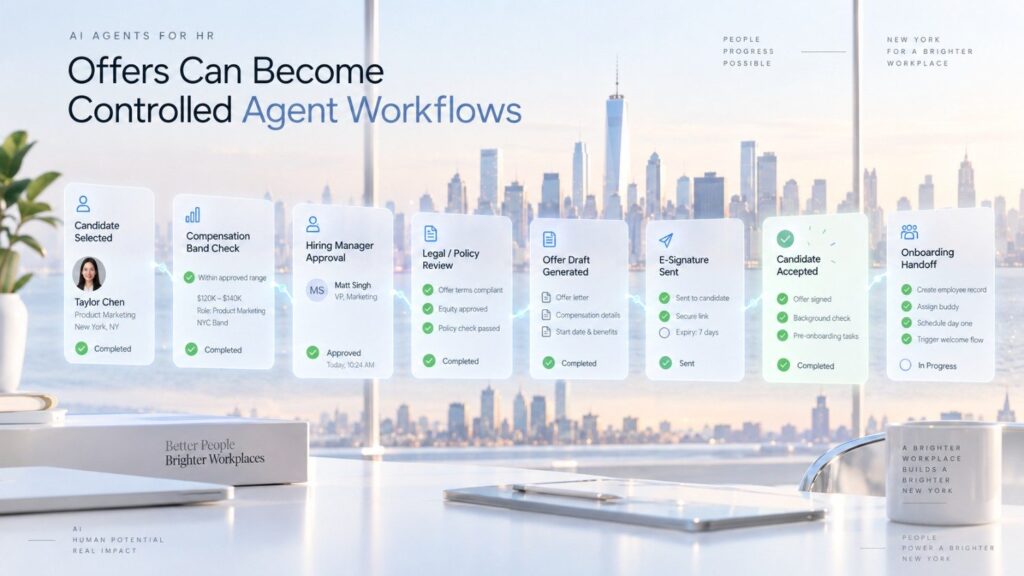
But an agent should not quietly invent compensation numbers because it predicts that one candidate will accept less.
AI should enforce the organization’s compensation policy, not create secret policy of its own.
A Practical Autonomy Model for Recruiting
New York companies need more than a yes-or-no decision about AI.
They need levels of autonomy.
| Recruiting workflow | Recommended agent role | Human control |
| Job intake | Execute routine workflow | Human approves opening |
| Job-description draft | Draft and validate | Recruiter/manager approves |
| Candidate FAQ | Answer from approved sources | Escalate unusual questions |
| Interview scheduling | Execute | Human handles exceptions |
| Resume data extraction | Extract factual fields | Human verifies where needed |
| Candidate ranking | Recommend only with strong governance | Human owns decision |
| Candidate rejection | Do not fully automate | Human-controlled decision |
| Interview reminders | Execute | Minimal supervision |
| Offer-document preparation | Execute after approval | Human sets/approves terms |
| Compensation exception | Route only | Compensation/HR decides |
The important design principle is simple:
Give an agent more freedom when an action is reversible and rule-based. Reduce its authority as the consequence to a person increases.
AI Agents Could Change Onboarding Even More Than Recruiting
Recruiting gets attention because hiring feels strategic.
Operationally, onboarding may be an even cleaner use case for agents.
Once a person accepts an offer, dozens of predictable tasks begin.
Payroll needs information. IT may need to create accounts. Security may need access details. The manager needs an onboarding plan. Equipment may need to be ordered. Training may be required. Benefits information must be delivered.
The process crosses departments, which is exactly where traditional workflow software often becomes fragile.
The Agent Should Become the Onboarding Coordinator
A strong onboarding agent would not replace the manager or HR partner.
It would make sure the operational process moves.
Several days before the person’s start date, it can check whether required documents are complete.
If the employee requires a laptop, it can verify that a hardware request exists.
If the job requires access to specific systems, it can trigger or prepare requests under predefined rules.
If a manager has not submitted a first-week schedule, it can remind them.
If mandatory training is missing after the first week, it can follow up.
The result is not “AI onboarding.”
It is fewer things falling through gaps between departments.
Role-Based Onboarding Is More Valuable Than Generic Onboarding
Many companies still onboard employees with the same checklist.
That misses an opportunity.
A salesperson joining a Manhattan enterprise team needs a different first month from a software engineer, nurse administrator or finance analyst.
An agent can assemble the correct onboarding journey based on structured company rules.
It might consider department, location, seniority, manager, employment type and required systems.
But those rules should come from approved company data. The agent should not decide that someone needs less training because it has formed an opinion about their background.
Manager Onboarding Support May Be Even More Important
New employees are not the only people who need support.
Managers often do not know what they are supposed to do.
A manager agent can say:
“Your new team member starts Monday. Their equipment is ready. Security access is still pending. Here are the three actions you need to complete before Friday.”
After two weeks:
“Your onboarding plan includes a role-expectation conversation by Day 15. It has not yet been marked complete.”
This is useful because it transforms onboarding from a static checklist into an active process.
The 30-, 60- and 90-Day Process Can Finally Become Continuous
Most companies do not need more employee surveys.
They need earlier signals that something is not working.
An onboarding agent can collect lightweight structured feedback at several points without attempting to diagnose people.
For example, it could ask whether the employee has the tools required to do the job, understands their responsibilities, knows where to find key resources and has been able to meet important colleagues.
If several operational problems appear, HR can intervene.
The agent should not conclude, “This employee is likely to quit.”
That moves from workflow support into a sensitive prediction about an individual.
A safer design focuses on observable problems the company can fix.
Employee Support May Become the Biggest HR Agent Category
Every HR team knows the pattern.
Someone asks a question.
HR sends a policy.
The employee says the policy does not answer their situation.
HR asks for more information.
Someone else must approve the request.
Another system must be updated.
The process is often described as “answering HR questions,” but it is actually a chain of small workflows.
AI agents can change that.
The HR Front Door Is Becoming Executable
IBM provides one of the clearest public examples of this model through AskHR.
IBM reports that its HR platform can handle more than 80 types of HR tasks and has evolved into a digital front door for HR transactions. The company says AskHR has achieved a 94% containment rate for common questions and contributed to a 40% reduction in HR operational costs over four years. IBM later reported more than 16 million user messages through AskHR during 2025 as the platform expanded toward coordinating multiple autonomous agents.
Those are IBM’s own reported results rather than an independent audit, so they should be interpreted as a vendor case study.
But the operating model is instructive.
The employee does not need to know which HR system owns the answer.
They start with one interface.
The system finds information, completes supported transactions and routes harder issues to people.
That pattern can work far beyond a company the size of IBM.
Policy Questions Should Be Grounded, Not Generated
An employee-support agent should never “remember” a policy and answer from its general language model knowledge.
It should retrieve the current approved company source.
That sounds technical, but the user experience can remain simple.
An employee asks:
“Can I work from another state for six weeks?”
The agent should identify the company’s remote-work policy, determine which section is relevant and explain the rule.
If the situation requires tax, legal or managerial review, it should say so and open the appropriate workflow.
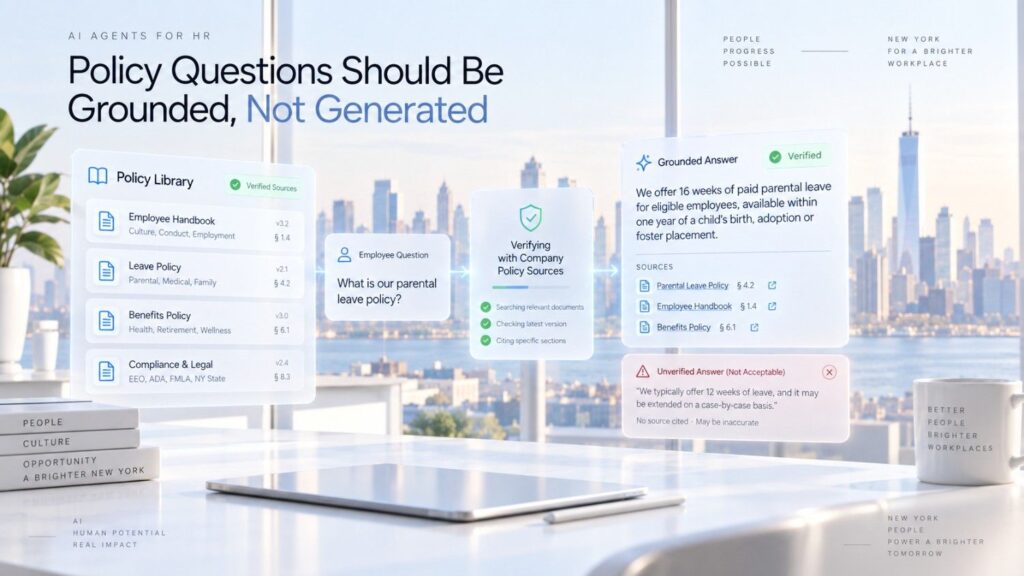
Ideally, the response also links directly to the policy section used.
That makes the system auditable.
An Answer Without a Source Should Be Treated as Lower Confidence
One useful policy is to make citations part of the HR-agent design.
If the agent cannot identify the source behind an employment-policy answer, it should not confidently invent one.
Instead, it can say that the information requires HR review.
This may slightly reduce automation rates.
That is a good trade.
The point is not to maximize how many questions AI answers. The goal is to maximize how many requests are completed correctly.
Employee Support Agents Should Complete Transactions
The biggest mistake would be building a beautiful HR chatbot that still leaves the employee with six manual steps.
Suppose somebody asks:
“How do I change my home address?”
If the employee has permission and the change is routine, the agent might authenticate the person, collect the updated information, ask for confirmation and update the correct HR system.
Now compare that with:
“Here is an article explaining how to change your address.”
The second experience is technically AI-enabled.
The first actually removes work.
That is the difference between an information bot and an operating agent.
Human Escalation Must Feel Like Part of the Product
No HR agent will solve every employee issue.
Nor should it.
The critical design question is what happens when automation stops.
A poor system forces the employee to explain everything again to HR.
A good agent passes the human specialist the full conversation, relevant policy sections, completed verification steps and reason for escalation.
Then the employee can continue instead of restarting.
This is especially important for sensitive matters involving accommodations, harassment, employee relations, leave disputes, compensation concerns and disciplinary issues.
What HR Agents Should Not Be Allowed to Decide Alone
The safest HR strategy is not simply to classify an entire department as “automatable” or “not automatable.”
Autonomy should depend on consequence.
Use a Consequence Ladder
| Agent autonomy level | Example | Recommended approach |
| Level 1: Find | Locate policy or employee information | Broad use |
| Level 2: Draft | Prepare message, document or recommendation | Human can review |
| Level 3: Execute reversible action | Schedule interview or send reminder | High automation possible |
| Level 4: Execute controlled transaction | Update approved HR data | Use identity, permissions and logs |
| Level 5: Employment judgment | Reject, discipline, terminate, set sensitive compensation | Keep humans accountable |
The final level deserves the most caution.
A company may technically be able to automate parts of an employment decision.
That does not mean it should.
NYC Local Law 144 Makes Recruiting-Agent Design a Governance Question
New York City already has rules covering certain automated employment decision tools, commonly called AEDTs.
Under Local Law 144, employers and employment agencies may not use a covered AEDT unless the tool has undergone the required bias audit within one year of use, information about that audit is publicly available and required notices have been provided. NYC’s Department of Consumer and Worker Protection began enforcing the law in July 2023, and its guidance states that notice must be provided 10 business days before a covered AEDT is used.
The key word here is decision.
An agent used purely to schedule an interview is very different from one that scores applicants and substantially assists a hiring decision.
Companies should therefore document exactly what each agent does rather than purchasing an “AI recruiting platform” and treating every feature as one risk category.
Build Two Lanes
A useful design is to separate HR automation into two technical lanes.
The first is the operations lane.
This covers scheduling, reminders, document collection, workflow routing, status updates and other administrative tasks.
The second is the decision-support lane.
This covers scoring, ranking, assessment, candidate recommendations and other tools that may influence employment outcomes.
The second lane deserves stricter legal review, testing, documentation and access controls.
Low Complaint Volumes Should Not Create False Confidence
A 2025 audit by the New York State Comptroller examined NYC’s administration of the AEDT law. Among other findings, auditors noted that only two AEDT-related complaints had been received during the reviewed period. Yet when reviewing a sample of companies, the audit identified substantially more potential compliance issues than the city’s existing process had uncovered.
That matters for business leaders.
Low visible enforcement activity does not prove that a deployment is compliant.
Governance should be built before the complaint arrives.
Disability and Accommodation Risks Need Their Own Workflow
AI hiring governance cannot stop at bias auditing.
The EEOC has warned that algorithmic and AI tools can disadvantage people with disabilities, including situations where an assessment unintentionally screens out somebody who could perform the job with a reasonable accommodation. The agency recommends giving applicants information and a process for requesting an accommodation when automated tools are used.
This creates a practical design requirement.
An AI recruiting workflow needs an escape route.
If an applicant cannot fairly complete an automated assessment because of a disability, the system should not simply label that person incomplete or unsuccessful.
It should allow the applicant to request another process and route the case to the appropriate human team.
The same principle applies after hiring.
Sensitive medical or accommodation data should not casually flow through general employee-support agents. Federal rules place limits around disability-related inquiries and require medical information to be treated confidentially.
New York Regulation Is Still Moving
New York City employers should not assume Local Law 144 will be the final rulebook for AI and employment.
State lawmakers have continued considering broader proposals involving automated employment tools, impact assessments, disclosures and human review. Some 2026 proposals have specifically addressed meaningful human review around automated applicant screening. These measures should be treated as proposals unless and until enacted, but they show the direction policymakers are exploring.
For employers, the practical response is not to wait for every law to become final.
Build the infrastructure that future rules are likely to require anyway:
clear inventories of AI systems, documented purposes, logs, testing, human overrides, notice mechanisms, data controls and named owners.
Those practices are useful even without regulation.
Original Framework: The HR Agent Suitability Test
Before automating an HR workflow, NYC Tech Journal recommends asking five questions.
Instead of turning them into a simple checklist, companies can use them as a decision model.
| Question | Strong automation candidate | Weak automation candidate |
| Is the work repetitive? | Happens hundreds of times | Rare unusual case |
| Are the rules clear? | Documented policy | Depends heavily on judgment |
| Is the action reversible? | Meeting can be rescheduled | Candidate rejection |
| Can the agent access trusted data? | HRIS/policy source available | Important facts are unclear |
| What happens if it is wrong? | Minor inconvenience | Employment or legal harm |
A workflow does not need perfect scores everywhere.
But when several answers fall into the right-hand column, agent autonomy should fall sharply.
The Best Early Workflow Has High Volume and Low Consequence
Interview scheduling is a classic example.
So are onboarding reminders.
So are common policy searches.
The technology can learn how the organization operates while the downside remains limited.
Starting with an automated candidate rejection engine is almost the opposite.
The stakes are high, regulation is relevant, fairness matters enormously and errors may be difficult to reverse.
What the HR Agent Technology Stack Should Actually Look Like
Buying a language model is not an HR-agent strategy.
A reliable system needs several layers.
Layer 1: The Employee or Recruiter Interface
This is where the person interacts with the agent.
It may live inside an HR portal, Microsoft Teams, Slack, an applicant portal or another approved interface.
The user should not need to understand the underlying systems.
Layer 2: Identity
Before the agent touches employee information, it needs to know who is asking.
A manager should be able to access information about their team that another employee cannot.
A recruiter may need candidate data.
A compensation professional may need access to salary information that a recruiting coordinator should not see.
Permissions must follow the person, not the AI.
Layer 3: Trusted Knowledge
The agent needs access to current policies, process documentation, benefits information and approved HR guidance.
Old documents should not carry the same authority as current ones.
Source dates and ownership therefore matter.
Layer 4: Reasoning and Workflow Rules
This is where the system decides what the next permitted step is.
Some decisions may be handled by deterministic software rather than a language model.
That is often preferable.
AI does not need to decide something that a simple rule can answer reliably.
Layer 5: Tools and Actions
The agent may need limited permission to interact with recruiting software, HRIS platforms, calendars, ticketing systems, learning systems or IT workflows.
The critical word is limited.
An onboarding agent that needs to create an IT ticket does not necessarily need permission to change compensation data.
Layer 6: Human Approval
Sensitive actions should stop here.
The system prepares the work.
A responsible person approves it.
Only then does execution continue.
Layer 7: Logging and Evaluation
Every important action needs a record.
What did the user ask?
Which source did the agent use?
What action did it recommend?
What data did it access?
Was a human involved?
What eventually happened?
Those logs become essential when an employee disputes an outcome, the legal team reviews a process or the organization evaluates whether its agent actually works.
Why One Powerful HR Agent May Be Worse Than Several Narrow Ones
Companies often imagine a single “HR super-agent.”
That is attractive in a demo and risky in production.
A recruiting-scheduling agent does not need access to medical accommodation documents.
An onboarding agent does not need authority to alter compensation.
A benefits agent does not need permission to reject candidates.
Separating agents by function reduces what can go wrong.
They can still appear to employees through one front door.
Behind the interface, however, permissions should be narrow.
This is the HR version of giving people only the system access required for their jobs.
AI should receive the same treatment.
Security Should Be Designed Before the Pilot
HR contains some of the most sensitive information inside a business.
Compensation data, performance information, home addresses, benefits records, candidate information and employee-relations cases can all appear in HR systems.
That makes a careless agent architecture dangerous even when the AI gives perfect answers.
Data Minimization Beats Unlimited Context
An agent should receive only the information required to complete the task.
If somebody asks about the holiday calendar, there is no reason to send their entire employee profile to a model.
If the agent schedules an interview, it probably does not need access to every candidate assessment.
Smaller context can reduce both privacy risk and accidental errors.
Retention Rules Matter
Companies should know what happens to prompts, retrieved records and agent outputs.
Are conversations stored?
For how long?
Can the vendor use them to train models?
Can administrators delete them?
Where are they processed?
The answer should be written into vendor agreements and system design rather than discovered after deployment.
Recruiting Metrics Need to Move Beyond “Time Saved”
AI vendors love productivity metrics.
Businesses need outcome metrics.
A recruiting agent that makes recruiters faster while damaging candidate experience is not successful.
An onboarding agent that completes tasks faster but creates incorrect system access is not successful.
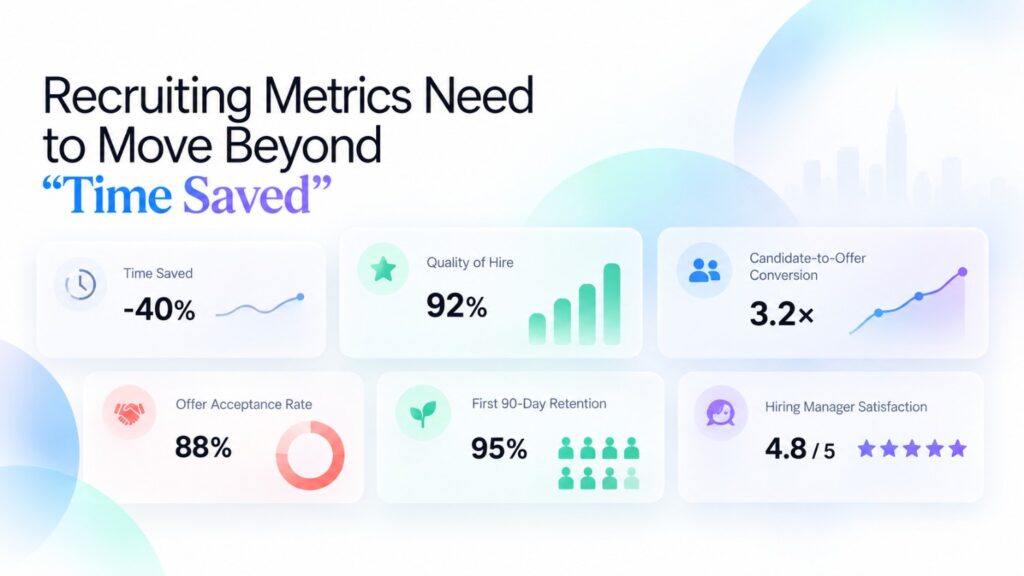
An employee-support agent that closes tickets by giving wrong answers is definitely not successful.
HR Agent KPI Dashboard
| Workflow | Speed metric | Quality metric | Experience metric | Risk metric |
| Recruiting | Time to schedule | Interview completion accuracy | Candidate satisfaction | Decision overrides / errors |
| Onboarding | Time to complete setup | Day-one readiness | New-hire experience | Access mistakes |
| Employee support | Time to resolution | Correct-resolution rate | Employee satisfaction | Incorrect policy answers |
| HR operations | Manual touches per case | First-time-right rate | Internal HR satisfaction | Unauthorized actions |
Companies should also measure human escalation quality.
How often does the agent escalate?
How often should it have escalated but did not?
How often does a person need to redo the agent’s work?
These numbers are more useful than simply measuring the number of conversations handled by AI.
A Better Metric: Resolved Work
The most important HR-agent KPI may be resolved work without avoidable human effort.
Imagine that an employee asks about updating beneficiaries.
The agent responds correctly but tells the employee to call HR.
Technically, the answer rate is 100%.
Operationally, very little was automated.
Now imagine the agent explains the rule, opens the correct workflow, validates the required fields and confirms completion.
That is resolved work.
As HR systems become agentic, businesses should move from measuring how many questions AI answered toward measuring how many valid workflows reached the right outcome.
A Practical 90-Day HR Agent Plan for New York Companies
Companies do not need a two-year transformation program to begin.
A disciplined 90-day pilot is enough to discover whether agentic HR creates real value.
Days 1–15: Choose One Workflow
Do not begin by buying “AI for HR.”
Pick a problem.
Interview scheduling is one option.
Employee policy questions are another.
Onboarding coordination may be stronger for companies hiring frequently.
Measure the current process before automation.
How many cases occur each month?
How many minutes does HR spend on each?
How long does completion take?
Where do errors happen?
How often does the employee need to follow up?
Without that baseline, the company will later have no credible way to prove value.
Days 16–30: Define the Agent’s Boundaries
Write down exactly what the agent can do.
Then write down what it cannot do.
For example, an onboarding agent may create routine task requests but may not give itself broader system permissions.
A recruiting agent may schedule candidates but may not reject them.
A support agent may explain published leave policy but must escalate individual disputes.
These boundaries should become actual technical controls rather than a slide in a governance meeting.
Days 31–45: Connect Trusted Data
The agent should not start with the whole internet or every internal file.
Connect a small number of authoritative sources.
For employee support, that might include the employee handbook, benefits guides and approved HR policies.
For onboarding, it might include role profiles, required training and access rules.
Give each source an owner and review date.
Days 46–60: Run in Shadow Mode
Before letting the system act freely, let it recommend actions while humans remain in control.
Compare the agent’s recommendation with what HR professionals actually do.
Where do they disagree?
Why?
This stage is especially valuable because it reveals missing policies.
Sometimes AI exposes a technology problem.
Often it exposes the fact that humans themselves are following five different versions of the same process.
Days 61–75: Give the Agent Limited Execution Rights
Once the basic workflow performs reliably, allow safe reversible actions.
Send reminders.
Schedule meetings.
Open approved tickets.
Prepare forms.
Update low-risk fields after confirmation.
Keep high-impact decisions behind approvals.
Days 76–90: Measure the Business Result
Return to the original baseline.
Did completion time fall?
Did manual HR touches decline?
Did accuracy change?
Did employee satisfaction improve?
Were escalations appropriate?
Did any privacy or compliance issues appear?
Only then should the company decide whether to scale.
The Economics Should Be Calculated Per Workflow
Executives often ask:
“How much can AI save our HR department?”
That is too broad to answer well.
Calculate the economics workflow by workflow.
Suppose a recruiting team coordinates 2,000 interview scheduling events each month.
If each consumes an average of eight minutes of recruiter time, that represents about 267 hours a month.
If an agent removes 80% of the administrative handling, roughly 214 hours become available for other work.
The company can multiply those hours by its fully loaded internal cost.
Now the ROI case is measurable.
Repeat the calculation for onboarding follow-ups, policy questions or document collection.
Small improvements across several high-volume processes can add up quickly.
New York Financial Services Companies Have a Different Opportunity
New York financial institutions often combine high labor costs with heavy controls.
That makes unrestricted HR automation unattractive.
It also makes controlled agents extremely useful.
A bank might deploy an onboarding agent to coordinate mandatory training, background-process milestones, system access and required acknowledgments.
An internal support agent might answer policy questions from approved documents while preserving an audit trail.
Recruiting agents could coordinate complex interview panels without receiving authority over final candidate selection.
The winning design will probably look less autonomous than the flashiest Silicon Valley demos.
That is not a weakness.
Controlled execution is often more valuable than uncontrolled intelligence.
Healthcare Organizations Need to Focus on Workforce Operations
Hospitals and healthcare organizations operate large, complicated workforces with credentialing, training, shift requirements and role-specific access.
The opportunity for agents is therefore broad.
An onboarding agent might help coordinate required documentation across HR, IT, security and training systems.
An employee-support agent could direct staff toward approved policies without requiring an HR specialist to answer every routine question.
But sensitive health, accommodation and employee-relations information requires stricter handling.
Healthcare HR teams should resist the temptation to place every question inside one general-purpose model.
Retail and Hospitality Could Benefit From Scale
New York retailers, restaurants and hospitality companies often manage large numbers of frontline workers.
The employee experience is very different from a desk worker using Slack all day.
An HR agent therefore needs mobile-first access and very simple language.
Useful workflows might include shift-policy questions, onboarding documents, pay information, benefits guidance and internal job opportunities.
Speed matters greatly.
When employees cannot get a basic answer without finding an HR email address, the real problem is often process design rather than lack of HR staff.
Professional Services Firms Can Automate Coordination Without Automating Judgment
Law firms, accounting firms, consultancies and agencies involve complex project staffing, professional development and promotion processes.
Agents can help organize information around those decisions.
They should not quietly make the decisions themselves.
An agent could gather required promotion feedback, identify missing reviews and prepare structured summaries.
A committee still makes the judgment.
That pattern—agent prepares, human decides—will likely become common across high-skill New York industries.
Startups Should Resist Over-Automating Too Early
A 40-person New York startup probably does not need a collection of seven specialized HR agents.
Its HR volume may be too low.
It may receive more value from connecting existing systems and improving basic processes.
The economics change as the company grows.
Once recruiters repeatedly schedule interviews, new hires move through similar onboarding processes and HR begins answering the same questions every week, agentic workflows become much easier to justify.
The correct question is not:
“Are we innovative enough to use HR agents?”
It is:
“Do we have enough repeatable work for an agent to produce measurable value?”
Build or Buy?
Most companies should not build an HR language model.
That does not mean every company should buy a complete off-the-shelf agent.
The real decision is which layer to own.
Organizations may use an external model, an enterprise agent platform and their existing HR software while building company-specific workflows on top.
The differentiating knowledge often lives in policy, permissions, workflow design and integrations rather than the model itself.
Buy When the Workflow Is Standard
Scheduling is standard.
Basic HR service delivery is largely standard.
Common onboarding processes are standard enough that mature platforms can provide much of the required functionality.
Buying can accelerate deployment.
Build More When the Workflow Is Part of Your Operating Advantage
A large financial institution may have unusual compliance processes.
A hospital system may have complex credentialing.
A fast-growing company may use a highly customized internal mobility process.
Those organizations may need more control over orchestration.
Even then, “build” does not necessarily mean building AI from scratch.
It may mean owning the workflow layer while using external models and systems underneath.
How to Evaluate an HR Agent Vendor
The most impressive demonstration is not necessarily the most important part of a vendor review.
Ask the vendor to show what happens when the agent is uncertain.
Ask which systems it can change.
Ask whether each action is logged.
Ask whether permissions can be limited by role.
Ask whether administrators can prevent specific classes of actions.
Ask which data the vendor stores and whether customer data is used to train models.
For recruiting products, determine whether the tool scores, ranks, recommends or filters applicants.
That question matters much more than whether the marketing page calls the product an “assistant,” “copilot” or “agent.”
Legal obligations depend on what the tool actually does.
Vendor Evaluation Table
| Area | Question that matters |
| Accuracy | Can responses be traced to approved sources? |
| Permissions | Can each agent receive narrowly scoped access? |
| Human control | Can high-impact actions require approval? |
| Auditability | Is every important action logged? |
| Privacy | What data is stored, where and for how long? |
| Recruiting | Does the system score, rank or filter applicants? |
| Bias testing | What testing and audit support is available? |
| Accessibility | How are accommodation needs handled? |
| Integration | Can it safely connect to existing HR systems? |
| Failure handling | What happens when the model is uncertain? |
Human Approval Should Be Designed Into the Workflow
Some companies treat human review as a safety statement.
“We always have a human in the loop.”
That phrase means very little unless the system explains what the human is actually reviewing.
If the agent produces 500 recommendations and one recruiter must approve all of them in ten minutes, the person is not providing meaningful oversight.
Approval needs context.
A reviewer should see the relevant information, understand what the agent did and have enough time and authority to disagree.
The system should record that disagreement.
Over time, those overrides become useful evaluation data.
If humans repeatedly change the same recommendation, the workflow probably needs redesign.
AI Agents Will Change HR Jobs Before They Replace HR Departments
The strongest near-term case for HR agents is not eliminating HR professionals.
It is changing the mix of work they perform.
Recruiters may spend less time coordinating calendars and more time assessing candidates and advising managers.
HR operations teams may spend less time answering routine questions and more time solving exceptions.
HR business partners may spend less time searching for information and more time working with leaders.
Learning teams may spend less time chasing course completion and more time improving development programs.
This is exactly why our New York payroll analysis matters.
The opportunity is not merely cost removal.
It is redeploying expensive expertise.
The Biggest Risk Is Automating a Bad Process Faster
AI does not fix unclear policy.
It can make unclear policy scale.
If different HR teams interpret a rule differently today, connecting an agent may simply spread one interpretation faster.
If the onboarding process has unnecessary approvals, an agent may automate the unnecessary approvals.
If managers are not completing interview scorecards because the form is badly designed, sending more automated reminders will not solve the root problem.
Before automation, simplify.
Ask what the process would look like if the company were designing it today.
Then give the agent that process.
The Most Successful HR Agent Programs Will Be Boring
This is a useful prediction.
The HR agent deployments producing the best returns may not look impressive on stage.
They will quietly schedule thousands of interviews.
They will quietly resolve policy questions.
They will quietly make sure laptops arrive before start dates.
They will quietly chase missing onboarding tasks.
They will quietly move information between systems without somebody copying and pasting it.
That is how enterprise technology creates durable value.
Not every useful AI system needs to feel futuristic.
Five Predictions for HR Agents in New York
1. Scheduling Agents Will Become Nearly Invisible
Interview coordination is structured, repetitive and low risk.
There is little reason for recruiters to remain the human API between calendars.
Within mature recruiting teams, scheduling will increasingly become background automation, with humans appearing only for unusual cases.
2. Employee Support Will Shift From Search to Resolution
Today’s employee portals are often search engines for company policies.
Tomorrow’s best systems will behave more like service desks.
They will answer the question and, where allowed, complete the required workflow.
3. Companies Will Separate HR Operations AI From Employment-Decision AI
This separation will become increasingly important.
An agent that creates tickets does not need the same governance model as software that ranks job candidates.
Mature companies will reflect that difference in architecture, procurement and compliance processes.
4. Audit Logs Will Become as Important as Model Quality
When HR AI only drafts text, occasional mistakes are inconvenient.
When HR AI performs actions, organizations need to know exactly what happened.
That makes traceability a core product feature.
5. The Winning KPI Will Be Human Attention
The scarce resource inside HR is not information.
It is skilled human attention.
The best agent programs will measure how much expert time has moved from administration toward judgment, coaching, planning and difficult cases.
That is a better measure than simply counting automated conversations.
What New York Business Leaders Should Do Now
The HR-agent opportunity is large, but the smartest strategy is narrow.
Do not begin with the goal of creating an autonomous HR department.
Begin with one expensive, repeatable workflow.
Measure its current cost.
Remove unnecessary steps.
Define exactly where human judgment begins.
Give the agent narrow permissions.
Run it in shadow mode.
Allow safe execution gradually.
Track resolved work rather than chatbot usage.
Then expand.
The companies that follow this approach will learn much faster than companies spending months debating an enterprise-wide AI strategy.
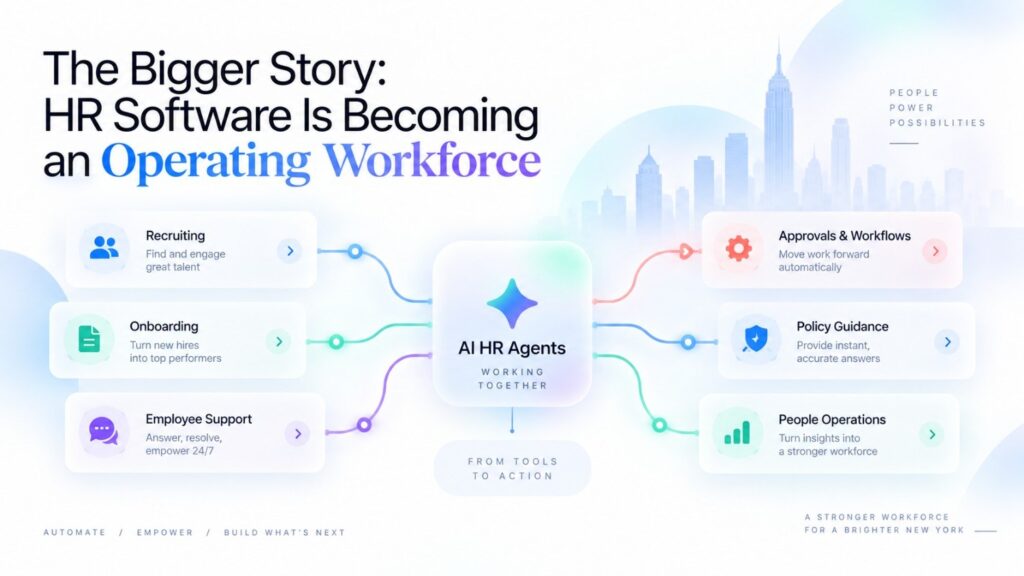
The Bigger Story: HR Software Is Becoming an Operating Workforce
For decades, HR technology mainly stored records.
Then it became self-service software.
Generative AI made it conversational.
Agents add something different: execution.
That shift changes the role of software inside the HR department.
The system no longer waits for a recruiter to click every button.
It can notice that feedback is missing and request it.
It can see that an onboarding task is overdue and follow up.
It can understand an employee’s question, retrieve the correct policy and begin the right workflow.
It can coordinate several applications while maintaining one conversation with the user.
That is why the next HR technology cycle will not be defined by a better chatbot.
It will be defined by the boundary between what software is allowed to do and what people must decide.
New York is likely to be one of the most important places to watch that boundary.
The region combines expensive skilled labor, enormous employers, demanding industries, active hiring markets and unusually visible regulation around automated employment tools.
Our original analysis puts some scale around the opportunity. Just three HR management occupations in the New York metro represent about $4.92 billion in annual payroll. Redirecting only 5% of that time would represent approximately $246 million in salary-equivalent capacity. At 10%, the figure approaches half a billion dollars.
Again, that is not a layoff forecast.
The much more interesting question is what companies can accomplish when recruiters stop managing calendars, HR leaders stop searching for documents, managers stop chasing onboarding tasks and employee-support teams stop manually answering the same questions.
That is the opportunity agents create.
The companies that win will not necessarily deploy the most autonomous AI.
They will understand exactly where autonomy produces value, where judgment must remain human and how to connect the two without making the employee experience worse.
For New York businesses, that may be the real future of AI in HR:
not HR without people, but HR where people spend far less time doing work that never required people in the first place.
Research Methodology and Source Notes
NYC Tech Journal’s quantitative analysis uses the latest detailed BLS Occupational Employment and Wage Statistics available for the New York-Newark-Jersey City metropolitan area, including employment, mean annual wage and location quotient data for human resources managers, compensation and benefits managers, and training and development managers. The implied payroll estimate was calculated as employment multiplied by mean annual wage for each occupation. The capacity scenarios multiply the resulting $4.921 billion aggregate by 2%, 5%, 10% and 15%.
This approach has clear limits. The BLS geography covers the broader New York metropolitan area rather than only New York City. Mean wages are estimates rather than the exact salaries of individual workers, and payroll estimates do not include benefits, payroll taxes or other employment costs. Most importantly, the capacity model measures the salary-equivalent value of time; it does not forecast layoffs, realized savings or productivity.
NYC hiring-volume context comes from Jobs NYC public data maintained through NYC Open Data. Because this dataset represents active city job postings, it should not be interpreted as annual hires or total applications. Weekly snapshots are used only to demonstrate the scale of ongoing hiring workflows.
AI-adoption context comes from SHRM and LinkedIn research. Their methodologies and populations differ, so the percentages are presented independently rather than merged into an artificial index. IBM’s AskHR results are included as a company-reported enterprise case study rather than independent evidence of average market performance.
New York City automated-employment guidance is based on current Department of Consumer and Worker Protection material regarding Local Law 144. Federal disability guidance comes from the U.S. Equal Employment Opportunity Commission. Regulatory requirements can depend on the way a specific tool is configured and used, so companies should obtain appropriate legal review for consequential employment systems.