
Wall Street has spent years using artificial intelligence to predict markets, detect fraud, price risk, find patterns and automate simple tasks. But something much bigger is now starting to happen.
AI is moving from giving financial professionals information to doing parts of financial work for them.
An AI assistant might summarize an earnings call. An AI agent can potentially find the earnings call, pull the numbers into a model, compare them with previous quarters, check the company against peers, update an investment memo, flag unusual changes and send the work to a human analyst for review.
That difference sounds small until it is applied across thousands of employees and millions of financial tasks.
For banks, asset managers, investment firms and wealth managers in New York, this is beginning to change what automation means. Instead of automating one step at a time, firms can increasingly build systems that move through several steps of a workflow.
Research becomes action.
Information becomes execution.
Software becomes something closer to a digital worker.
The shift is still early. Fully autonomous finance is not about to replace Wall Street overnight. In fact, our analysis of major New York financial institutions suggests that the gap between widespread AI use and true autonomous execution remains large.
But the direction is becoming much easier to see.
JPMorganChase is already discussing agents that can take action across the firm. Citi launched an internal platform specifically for building AI agents. BNY says it has 134 “digital employees” made from multi-agent AI systems. Morgan Stanley has moved AI directly into advisor workflows. Goldman Sachs is rebuilding its operating model around AI. BlackRock is adding generative AI across the Aladdin investment platform.
At the same time, New York companies such as Rogo and Hebbia are building AI systems specifically for bankers, investors and other financial professionals.
The result is the beginning of what we can call autonomous finance: financial work in which software does not simply calculate or recommend, but increasingly plans, coordinates and executes parts of a process under defined human controls.
For New York, this matters far beyond productivity.
It could change how investment banks are staffed, how analysts spend their days, how advisors serve clients, how transactions are checked, how research moves through firms, how compliance teams supervise activity and how financial companies design their technology.
This article explains where that change is happening, what our original analysis found and what financial leaders should do about it now.
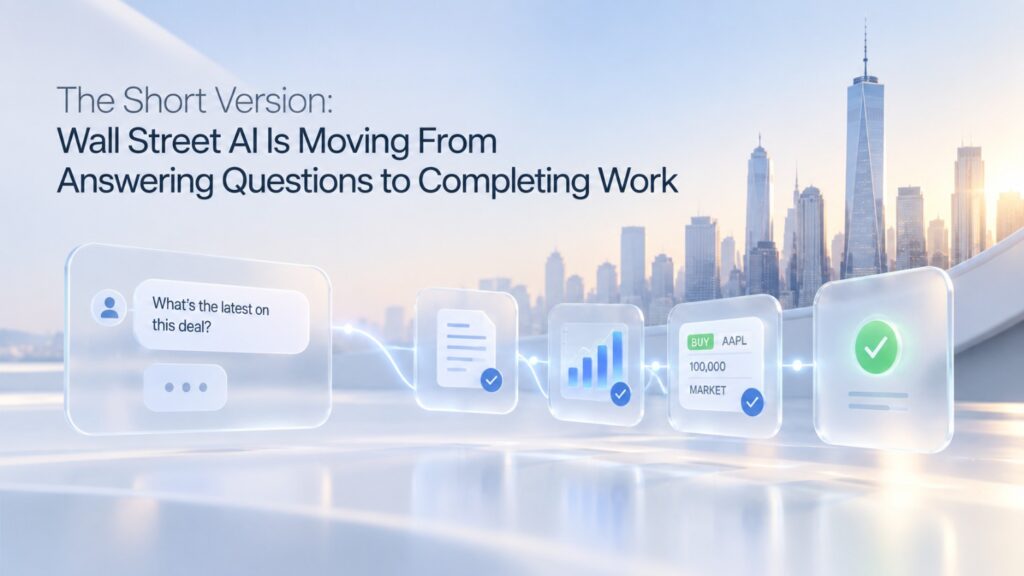
The Short Version: Wall Street AI Is Moving From Answering Questions to Completing Work
The easiest way to understand what is happening is to look at the progression of financial AI.
The first wave was about prediction.
Banks used machine learning for fraud detection, credit decisions, trading models, customer targeting and risk management.
The second wave was about assistance.
Generative AI gave employees tools that could summarize documents, answer questions, draft emails, search research and help write software.
The third wave is now emerging.
AI agents can connect those abilities to tools, data and workflows. Instead of waiting for someone to ask every question, an agent can be given a goal and allowed to complete a controlled sequence of tasks.
FINRA describes AI agents as systems capable of interacting with an environment, planning, making decisions and taking actions toward a goal. FINRA also warns that this creates new concerns around autonomy, authority and auditability.
That distinction is critical for Wall Street.
A chatbot may tell a banker which companies are comparable to a client.
An agent could find the companies, pull their financial information, calculate valuation multiples, update the relevant Excel file and prepare a first draft of the comparison page in a presentation.
A chatbot can summarize a portfolio.
An agent could monitor the portfolio, notice an important change, compare it with the client’s objectives, prepare an advisor briefing and create the next actions that require human approval.
The business value comes from reducing the distance between knowing something and doing something about it.
Our research suggests Wall Street is already crossing that line.
NYC Tech Journal Original Research: Measuring Wall Street’s Move Toward Autonomous Finance
To move beyond anecdotes, NYC Tech Journal created a new dataset for this article.
We reviewed public disclosures available through September 10, 2026 from six major financial institutions with principal executive offices in New York City and significant investment banking, markets, asset management, custody or wealth-management operations:
JPMorganChase, Citigroup, BNY, Morgan Stanley, BlackRock and Goldman Sachs.
The sample was intentionally limited.
This is not meant to rank every American bank. It is designed to answer a narrower question:
How much public evidence currently exists that major New York financial institutions are moving from general AI toward systems that can perform financial work?
Public evidence was taken from annual reports, SEC filings, company technology disclosures and official product announcements. The New York headquarters of firms in the sample can also be verified through their SEC filings.
Our Seven-Factor Autonomous Finance Deployment Score
Each firm received one point for publicly meeting each of seven conditions.
| Factor | What counted as evidence |
| Enterprise AI foundation | A major internal or client-facing generative AI platform is disclosed |
| Scaled access or adoption | The company reports broad access, adoption or usage across a major population |
| Explicit AI agents | The company specifically discloses agents rather than only assistants or copilots |
| Action-taking capability | AI is described as performing actions rather than only generating information |
| Financial workflow integration | AI is embedded in a real finance, markets, wealth, research or operational process |
| Quantified business result | The company discloses a numerical productivity, speed, cost or throughput result |
| Agent-specific controls | Governance, monitoring, auditing or security controls are specifically connected to agentic systems |
A firm received a point only when we found clear public support. We did not award points because a company was large, technically advanced or probably capable of something.
That rule matters.
An absence of disclosure does not mean a firm lacks a capability. Therefore, this should be read as a public deployment-evidence index, not a definitive technical ranking.
Chart 1: NYC Tech Journal Autonomous Finance Deployment Evidence Score
JPMorganChase 7/7 ███████
Citi 7/7 ███████
BNY 6/7 ██████░
Morgan Stanley 4/7 ████░░░
BlackRock 3/7 ███░░░░
Goldman Sachs 2/7 ██░░░░░
The six companies collectively received 29 of 42 possible points, equal to roughly 69% of the maximum public-evidence score.
That number alone is less important than the shape of the results.
Enterprise AI is becoming normal.
Full agentic execution is not.
Original Finding #1: AI Platforms Are Widespread, but Explicit Agents Are Not
Every firm in our sample has moved beyond simply experimenting with AI.
JPMorganChase has LLM Suite and many specialized AI applications. Citi has enterprise AI tools and its new Arc agent platform. BNY operates Eliza. Morgan Stanley has deployed several internal AI products. Goldman Sachs has GS AI and is using AI as part of its One Goldman Sachs 3.0 operating model. BlackRock has Aladdin Copilot and other AI-enabled investment tools.
Yet only half of our sample clearly disclosed AI agents at the level required by our methodology.
That gap is one of the strongest findings in the dataset.
Chart 2: How Far Down the Autonomy Ladder Has Public Disclosure Reached?
AI assistant / GenAI platform 6 of 6 ██████ 100%
Embedded financial workflow 6 of 6 ██████ 100%
Action-taking automation 4 of 6 ████░░ 67%
Explicit AI agents 3 of 6 ███░░░ 50%
Explicit autonomous multi-agents 1 of 6 █░░░░░ 17%
The pattern suggests that Wall Street’s AI transformation is not happening in one jump.
It is moving through layers.
First firms give employees controlled access to AI.
Then they connect AI with internal knowledge.
Next they place AI inside existing workflows.
After that, software begins taking controlled actions.
Only then do true agentic and multi-agent systems emerge.
This is important for financial executives because companies should probably not try to skip those stages.
Autonomy built on poor data and weak controls is not advanced automation. It is simply faster operational risk.
Original Finding #2: The Biggest Wall Street AI Gap Is Not Technology. It Is Measured Execution.
Our seven dimensions show another important pattern.
Chart 3: Percentage of Sample Meeting Each Evidence Standard
Enterprise AI foundation 100% ██████████
Financial workflow use 100% ██████████
Scaled access/adoption 83% ████████░░
Action-taking capability 67% ███████░░░
Explicit agents 50% █████░░░░░
Agent-specific controls 50% █████░░░░░
Quantified business result 33% ███░░░░░░░
Only two of the six firms met our strict standard for clearly disclosed, numerical business results connected to AI deployment.
This does not mean the other four are receiving no value.
It means the public conversation is still far richer in statements about capabilities than in directly comparable measurements of financial returns.
For corporate leaders, this may be the most important lesson in the entire analysis.
The next stage of Wall Street AI will not be won by the firm that creates the most agents.
It will be won by firms that can prove that an agent removes real work, improves quality, reduces risk or produces more revenue.
What the Leading Firms Are Actually Doing
The details behind the scores reveal how quickly the market is changing.
| Firm | Important public signal | What it tells us |
| JPMorganChase | Large internal GenAI deployment, specialized agents and measurable automation outcomes | AI is moving across research, operations, wealth and markets |
| Citi | Arc platform for building agents, widespread internal AI adoption and controlled execution | Citi is creating a formal agent layer inside the bank |
| BNY | 134 digital employees and 160 AI solutions in production | Multi-agent systems are already being described as workers |
| Morgan Stanley | 98% adoption among Financial Advisor teams for its Assistant; Debrief can move meeting information into CRM systems | AI is becoming part of the advisor workflow |
| BlackRock | Aladdin Copilot is available across Aladdin clients | Investment platforms are becoming conversational and AI-enabled |
| Goldman Sachs | One Goldman Sachs 3.0 is explicitly described as an operating model propelled by AI | AI is becoming an operating-model question, not just a product feature |
The evidence is especially strong at three institutions.
JPMorganChase Is Turning AI Into a Large Operating Layer
JPMorganChase provides one of the clearest examples of AI moving into the everyday machinery of a large financial institution.
The bank says more than 65,000 employees in its Commercial & Investment Bank actively use LLM Suite. It has also described AI as creating measurable efficiency in areas such as transaction screening, where AI enabled the bank to process more than twice the volume while cutting manual operator checks roughly in half.
Its broader AI reach is even larger.
JPMorgan disclosed more than 200,000 LLM Suite users and about 100 generative AI solutions in production in its 2025 Investor Day materials.
But the more interesting change is the move toward agents.
The company has rolled out an Employee Assistant described as a personalized AI-powered agent that can help employees find information and take action.
Within asset and wealth management, Connect Coach serves about 12,000 users and incorporates 25 specialized AI agents. JPMorgan says the system pushes personalized opportunities to front-office users instead of waiting for each advisor to search manually.
That is a meaningful change in interface.
Traditional software waits.
Agentic software can notice.
From Search to Continuous Financial Intelligence
JPMorgan’s SpectrumIQ example shows where this can lead.
The company says the system covers around 90,000 securities and 22 million documents and ingests about 7,000 broker research reports per day. It says Smart Monitor can reduce the time from manual research to insight by 80%.
The same disclosure says about 75% of equity trading and almost 85% of foreign exchange trading in the relevant system have been automated, with estimated trading-cost savings for clients of roughly $4 billion since inception.
Those systems should not automatically be called autonomous agents.
But they show why agentic AI has so much leverage on Wall Street.
The data, automation and digital workflows are already there.
Agents can become the orchestration layer connecting them.
Citi Is Building an Internal Factory for AI Agents
Citi’s approach may be even more direct.
In April 2026, Citi announced Arc, a platform that allows developers to build and scale AI agents across the company.
Citi says these agents will handle activities including research, synthesis, preparation and execution. It also says every agent will be monitored, auditable and governed.
That last sentence may matter more than the word “agent.”
Banks cannot simply allow a model to perform arbitrary actions across systems holding money, client information or regulated records.
They need to know what the software did, what authority it had, which systems it accessed and why an action occurred.
Arc suggests Citi is treating governance as part of the agent infrastructure rather than something added after deployment.
Citi Already Has the Adoption Base
The company says more than 80% of approximately 180,000 employees who have access to Citi AI tools use them regularly.
That implies at least roughly 144,000 regular users within the population Citi described, although this should not be interpreted as a percentage of Citi’s entire workforce.
The bank also disclosed that AI-assisted development was creating approximately 100,000 hours of capacity every week.
Outside software engineering, Citi says it is using AI to automate trade confirmations in Markets, improve KYC and onboarding workflows, support wholesale lending and help wealth advisors prepare information.
This combination is what makes the development important.
Citi is not introducing agents into an organization that has never used generative AI.
It is placing agents on top of an adoption base that already exists.
BNY Offers the Clearest Public Example of the “Digital Employee”
BNY stands out in our dataset for one reason.
It is already using unusually direct language about autonomous AI workers.
BNY says all employees have access to its Eliza enterprise AI platform. It reported 171,000 AI learning hours during 2025 and says nearly half of employees are building AI agents.
Most importantly, BNY reported 160 enterprise AI solutions in production and 134 “digital employees.”
The company defines those digital employees as multi-agent AI solutions that can operate autonomously alongside human employees.
That is a notable public disclosure from a systemically important financial institution.
Why BNY Is an Interesting Test Case
BNY sits deep inside financial infrastructure.
Its work includes areas such as asset servicing, custody, payments, trade processing and investment operations. These businesses contain huge volumes of structured processes, data checks and operational handoffs.
BNY says its platform operating model is already producing more automation and fewer handoffs in activities including net asset value calculations and trade settlement.
That is exactly the type of environment in which agents may become valuable.
An agent does not need to predict the stock market to create enormous economic value.
If it can reliably investigate exceptions, gather supporting information, route work, prepare reconciliations, update systems and escalate the small number of cases requiring human judgment, it can reshape a major operational function.
That may be one of the most realistic paths toward autonomous finance.
Morgan Stanley Shows How AI Becomes Part of the Advisor Workflow
Morgan Stanley’s public deployment story has focused heavily on wealth management.
Its AI @ Morgan Stanley Assistant was built to let Financial Advisors search and use the firm’s large internal knowledge base.
Morgan Stanley has said 98% of Financial Advisor teams adopted the Assistant.
The next product, AI @ Morgan Stanley Debrief, moves farther into workflow automation.
Debrief can take meeting notes, summarize discussions, draft follow-up emails and import call information into client CRM profiles.
That last step is important.
When AI moves information into another system, it has crossed from pure content generation toward action.
The Advisor Does Not Disappear
The likely effect is not an AI system replacing the entire relationship between a wealthy client and an advisor.
It is removing the administrative shell around that relationship.
Consider how much advisor time can disappear into preparing for meetings, finding investment information, entering notes, updating CRM records, drafting follow-ups and deciding whom to contact.
AI can increasingly handle the low-judgment steps around those activities.
The advisor then becomes more focused on interpretation, trust, persuasion and decisions.
That same pattern is likely to spread across Wall Street.
The human role moves toward the parts of finance where responsibility and judgment matter most.
Goldman Sachs Is Treating AI as an Operating-Model Change
Goldman Sachs provides another important signal.
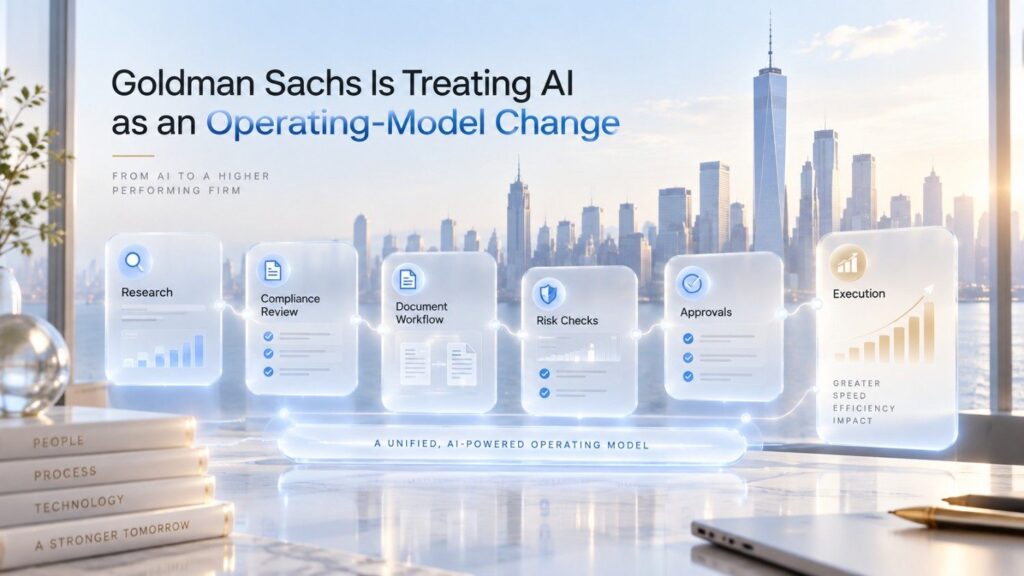
Its 2025 annual report describes One Goldman Sachs 3.0 as a new operating model propelled by AI.
The company says the objective is to create a more modern, digital and automated firm and argues that taking full advantage of AI requires a front-to-back rethink of how people, decisions, data and processes are organized.
That framing is useful.
Many financial companies still approach AI as a tool-purchasing exercise.
Buy a chatbot.
Buy a coding assistant.
Give employees access.
Measure logins.
Goldman’s language suggests the harder question:
If AI can perform a meaningful part of the process, why was the process designed around humans moving information between software systems in the first place?
That is where agentic AI can produce much greater value.
Instead of adding AI to every old step, companies can redesign the workflow.
Goldman previously disclosed a natural-language GS AI assistant, developer tools and AI use cases being developed across its Global Banking & Markets and Asset & Wealth Management businesses.
Its public disclosures provide less detail on internal autonomous agents than those of JPMorgan, Citi or BNY, which is why its score in our methodology is lower.
Again, this is a disclosure finding rather than a judgment about Goldman’s internal technical capability.
BlackRock Shows How Investment Platforms Could Become Agentic
BlackRock approaches the AI shift from a different position.
Aladdin already sits inside investment workflows at many institutions around the world.
BlackRock says Aladdin Copilot is available to all Aladdin clients and can provide answers and insights through a generative AI interface. It also places boundaries around the system, including restrictions intended to prevent the Copilot from giving investment advice outside its designed scope.
This is still more “copilot” than “autonomous agent.”
But the strategic position is powerful.
AI agents become far more useful when they are connected to rich data, portfolio analytics, risk systems and real workflows.
Aladdin already has those ingredients.
Larry Fink’s 2026 shareholder letter says BlackRock expects Aladdin to be a major beneficiary of AI as clients work across larger datasets and increasingly connected public and private investment workflows.
BlackRock is also recruiting engineers to build agentic solutions inside Aladdin investment and trading technology, including compliance-related workflows.
The likely direction is clear.
Today users ask an investment platform for information.
Tomorrow an agent may continuously observe the portfolio workflow, prepare actions and route approved steps through the system.
New York’s AI Finance Startups Are Accelerating the Shift
The change is not being driven by large banks alone.
A second layer of the market is emerging in New York: AI companies specifically built around high-value financial work.
Two companies illustrate the trend particularly well.
Rogo Is Building AI Around the Work of Bankers and Investors
New York-based Rogo describes its mission as building an AI analyst for Wall Street.
Its platform is designed around financial research and workflow tasks rather than generic workplace chat. The company says its software is now used by more than 50,000 bankers and investors across more than 350 institutions, generating more than 150,000 daily queries.
In April 2026, Rogo announced a $160 million Series D round to expand its financial AI platform. The company’s earlier disclosures had already said it was investing in financial reasoning models and autonomous agents.
This matters because investment banking is filled with expensive knowledge work.
Analysts and associates spend large amounts of time collecting information, updating slides, rebuilding tables, checking transaction data, maintaining financial models and preparing materials.
Those tasks are difficult enough to require skilled employees but repetitive enough to contain large opportunities for automation.
That combination is perfect for specialized agents.
Hebbia Is Attacking Document-Heavy Financial Work
Hebbia is another New York AI company working deeply inside finance.
The company says organizations representing about $30 trillion in assets under management use its technology. It reports roughly 200,000 prompts per day and more than 1.5 billion pages processed.
Its Matrix product is designed for complex document analysis across investment and transaction workflows.
Hebbia has also described a future of proactive financial agents in which changes to a deal, portfolio company, fund or client can automatically trigger updates to models, memos and dashboards.
The important word is proactive.
Most enterprise AI today is reactive.
Someone must open a tool and ask something.
The agentic model changes that relationship.
The system watches a defined environment.
Something changes.
The software decides that work is required.
It begins the approved process.
That is a much larger transformation than adding a chatbot to a desktop.
Original Analysis: The NYC Financial AI Market Is Developing Two Separate Agent Layers
Looking across the public evidence, we believe New York’s financial agent market is splitting into two layers.
Layer One: Institution-Owned Agents
Large banks are building internal platforms such as Citi Arc, BNY Eliza and JPMorgan’s enterprise AI infrastructure.
These systems have a major advantage.
They can be connected to internal permissions, internal data, employee identity systems, proprietary models, compliance controls and existing financial infrastructure.
They are likely to dominate processes that are highly specific to one institution.
Examples include internal approvals, transaction processing, risk reviews, employee support and internal operational systems.
Layer Two: Specialist Financial Agent Platforms
Companies such as Rogo and Hebbia are building systems that can be sold across many financial institutions.
Their advantage is specialization.
They can spend their entire product roadmap understanding how analysts search data rooms, how bankers build presentations, how investors perform due diligence and how financial teams work across thousands of documents.
This creates an interesting market structure.
Banks do not have to choose between “build” and “buy.”
The more likely future is build and buy.
A bank may own the agent governance layer while allowing specialist financial tools to operate inside approved boundaries.
That is how many other enterprise technology markets evolved.
Where AI Agents Will Change Wall Street First
Not every financial workflow is equally suitable for autonomy.
The best early targets share several characteristics.
The work happens frequently.
The inputs are digital.
The process can be observed.
The required output is clear.
Mistakes can be checked.
The financial or legal impact of an incorrect step can be limited through permissions.
That makes several Wall Street functions especially attractive.
Investment Banking: The Analyst Workflow Is About to Be Rebuilt
Investment banking may be one of the clearest opportunities.
Junior bankers often perform complex but highly structured work.
They research companies.
They maintain comparable-company tables.
They update transaction databases.
They create company profiles.
They collect information from filings.
They update financial models.
They change presentations after comments.
They prepare meeting materials.
Traditional generative AI can help with individual pieces.
Agents can connect the pieces.
A Future M&A Agent Workflow
Imagine an investment bank is preparing to pitch a software company.
The agent receives a defined task.
First it retrieves the latest financial information for the target and peer companies.
It identifies recent acquisitions in the sector.
It checks valuation multiples.
It reviews earnings calls for changes in management commentary.
It updates the relevant model.
It generates the first draft of selected presentation pages.
It records every source.
It then alerts the analyst that the material is ready for review.
The analyst is still responsible for the conclusion.
But hours of information movement can disappear.
The New Skill Will Be Reviewing Machine Work
This creates an important change for junior bankers.
Historically, one way analysts learned finance was by building things manually.
If software performs more of that work, banks will need a new training model.
Junior employees will have to learn how to inspect AI-generated work, spot weak assumptions, understand source quality and challenge outputs.
The danger is not only job loss.
It is skill loss.
A firm that automates junior work without redesigning junior training could eventually produce senior bankers who never developed the deep financial instincts that came from doing the work themselves.
Equity Research: Agents Could Monitor Instead of Search
Research analysts face another repetitive problem.
The world generates far more information than a human can monitor.
An analyst may cover a group of companies while tracking earnings calls, filings, industry news, management changes, competitors, macroeconomic data and thousands of pieces of market information.
The traditional model forces analysts to decide what to read.
Agents can change that.
Instead of asking, “What happened?”
the analyst can define what matters.
For example:
Monitor these 25 companies.
Flag any change in gross margin guidance greater than a certain amount.
Compare management language with the previous four quarters.
Check whether competitors made similar comments.
Update the relevant section of the research workspace.
Show the analyst the evidence.
Now the agent is not replacing the research judgment.
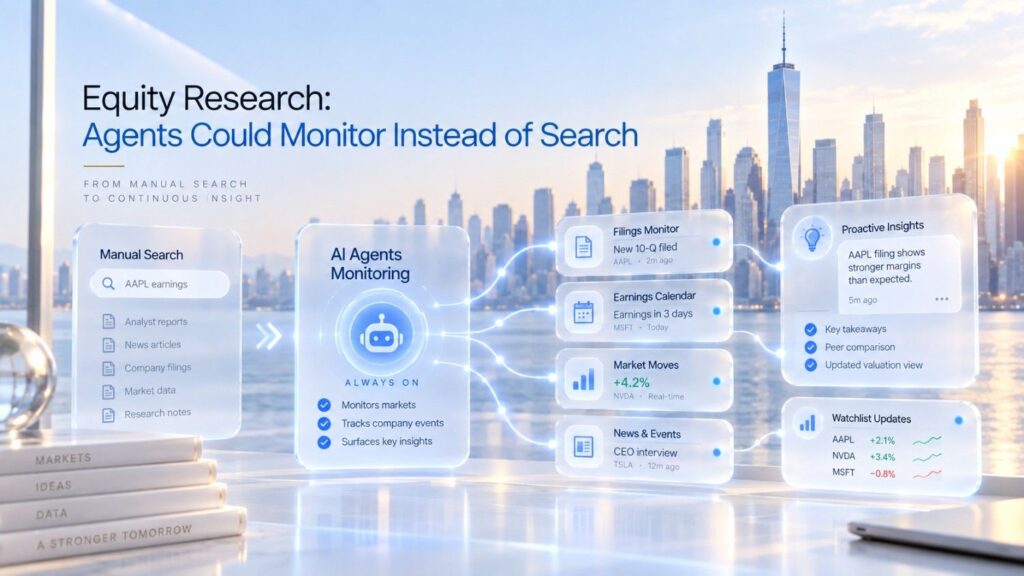
It is expanding the analyst’s observation capacity.
That distinction will matter enormously.
Trading: Autonomy Requires Much Tighter Boundaries
Trading creates larger opportunities but also far greater risk.
Financial markets already use automated systems extensively.
Agentic AI adds a different form of flexibility because language models and related systems can reason across less structured information.
But the cost of a mistake can be immediate.
An agent that drafts a research summary can be reviewed.
An agent with uncontrolled trading authority could create losses before anyone has time to read an explanation.
That means the best agentic applications in trading may first sit around execution rather than independently deciding what to buy and sell.
They can monitor positions.
Investigate breaks.
Prepare explanations.
Find unusual events.
Route exceptions.
Support trade confirmation.
Gather information for risk teams.
JPMorgan’s public comments about securing agents are instructive. The company argues that controls must operate at execution time and that higher-capability agents require stronger safeguards and complete runtime records.
That principle should become standard across finance.
The more authority an agent receives, the stronger its control system must become.
Wealth Management: AI Can Give Every Advisor a Bigger Support Team
Wealth management may become one of the largest areas of agent deployment because the work mixes relationships with a huge amount of preparation.
A financial advisor may need to understand:
client portfolios,
market changes,
tax events,
upcoming meetings,
products,
research,
client communication,
CRM information,
prospecting opportunities,
compliance rules.
An agent can continuously connect these areas.
Citi, JPMorgan and Morgan Stanley are all publicly moving AI deeper into advisor workflows. Citi has also introduced Citi Sky, an AI-powered wealth capability designed to provide market information and eventually work alongside advisors in client experiences.
The strategic opportunity is personalization at scale.
Historically, the best advisors could provide very high-touch service to a limited number of clients because preparation required human time.
Agents can reduce the preparation cost.
The advisor still owns the relationship.
The software expands the advisor’s ability to know what matters for every client.
KYC, Compliance and Financial Crime Could Become Major Agent Markets
Know Your Customer reviews are a classic candidate for agentic automation.
The work often requires collecting information from multiple sources, comparing details, checking documents, identifying gaps, recording findings and escalating unusual cases.
That is exactly the type of multi-step process agents are designed to handle.
Citi has already said it is applying AI to KYC and onboarding in order to automate manual work and shorten cycle times.
The same logic applies to compliance investigations.
An agent can gather evidence.
It can reconstruct a sequence of events.
It can compare a transaction with policy.
It can prepare an investigation file.
But high-risk decisions should remain controlled.
The safest design is often:
agent investigates → agent explains → human approves.
Not:
agent decides → company discovers later.
Treasury and Payments Could Become Machine-Driven
Corporate treasury is another major area to watch.
JPMorgan has described a future in which treasury becomes a real-time control system that can sense changes, predict needs, make decisions, execute actions and create records.
Citi is discussing similar changes around agentic commerce and payments.
The company argues that machine-driven transactions will require payment systems capable of operating at software speed while maintaining control over liquidity, risk and authority.
This may lead to a much broader financial change.
Today humans tell software when money should move.
In an agentic system, software may identify that money should move based on predefined policies.
The authorization architecture therefore becomes as important as the intelligence.
The Biggest Opportunity May Actually Be the Back Office
Wall Street tends to attract attention through trading floors and investment bankers.
Yet the largest agent opportunity may sit in operations.
Financial institutions contain enormous numbers of repetitive exceptions.
Something does not reconcile.
A document is missing.
A trade cannot settle.
An account requires review.
A payment triggers a control.
A record does not match.
Historically, people investigate these cases by opening several systems and moving information between them.
Agents are well suited to investigation.
They can read the exception.
Search approved systems.
Collect evidence.
Determine which known rule applies.
Prepare the resolution.
Complete low-risk actions where permission exists.
Escalate everything else.
This is less glamorous than predicting stock prices.
It may also generate more reliable ROI.
Wall Street Should Stop Measuring AI by Login Counts
One reason many enterprise AI programs struggle to show value is that adoption becomes the goal.
How many people have access?
How many opened the application?
How many prompts were submitted?
Those numbers are useful, but they do not answer the business question.
The important metric is what disappeared from the workflow.
A Better Agent ROI Equation
For a financial process, a simple starting formula is:
Annual Agent Value = Labor Capacity Created + Error Cost Avoided + Cycle-Time Value + Incremental Revenue – Total AI Cost – Control Cost
Every part should be measured.
Suppose 500 analysts each spend four hours a week updating recurring information.
That equals:
500 × 4 × 50 working weeks = 100,000 hours per year.
If an agent cuts the work by 60%, the company creates 60,000 hours of capacity.
But that is still not financial value unless the company knows what happens to those hours.
Do bankers handle more clients?
Does the firm need fewer contractors?
Do deals move faster?
Do employees spend more time on revenue-producing work?
Does turnover decline?
That is the measurement discipline Wall Street needs.
Table: The Agent KPI Dashboard Every Financial Institution Should Build
| KPI | What it answers |
| Human minutes per completed case | Is the agent removing real work? |
| End-to-end cycle time | Is the workflow becoming faster? |
| Straight-through completion rate | How many tasks finish without manual intervention? |
| Human escalation rate | How often does the agent require help? |
| Correction rate | How often does a person have to repair the output? |
| Cost per completed workflow | Is automation actually cheaper? |
| Agent actions per task | Is unnecessary tool use increasing cost? |
| Source-verification rate | Can the result be traced to reliable evidence? |
| Unauthorized-action attempts | Is the agent respecting permissions? |
| Financial impact per error | How costly are failures? |
| Revenue capacity created | Does saved time support more business? |
| Employee time returned | How much low-value work disappeared? |
The dashboard should be tracked before and after deployment.
Without a baseline, almost every AI ROI claim becomes guesswork.
The Biggest Mistake Would Be Automating Entire Jobs Instead of Workflows
Financial executives often ask whether AI will replace analysts, traders, advisors or operations employees.
That question is too broad.
Jobs are bundles of tasks.
Some tasks are predictable.
Some require judgment.
Some involve communication.
Some require personal accountability.
Some are legally sensitive.
Some require creative thinking.
Agent deployment should start by separating them.
Table: A Simple Wall Street Automation Matrix
| Task type | Recommended AI role |
| Repetitive + low risk | Automate aggressively |
| Repetitive + high financial impact | Automate with approval gates |
| Research-heavy + reviewable | Use agents for first-pass completion |
| Judgment-heavy | Use AI as decision support |
| Client-sensitive | Human-led with AI preparation |
| Legally consequential | Human approval required |
| Irreversible transaction | Strict authorization and limits |
| Novel strategic decision | Keep human-led |
This is a much safer way to build autonomous finance.
Start with bounded work.
Earn trust.
Then expand authority.
Human Approval Should Be Designed Into the Workflow
Many firms say they will keep “a human in the loop.”
That phrase is too vague to be useful.
Where is the human?
What exactly must the human approve?
What information will the person see?
Can the reviewer understand what the agent already did?
Can the human reverse the action?
What happens if the reviewer does nothing?
These questions need specific answers.
Three Levels of Approval
Level One: Review the Output
The agent creates a document or analysis.
A human checks it before use.
This works well for research, presentations and meeting preparation.
Level Two: Approve the Action
The agent prepares a transaction or system update.
A person approves before execution.
This is suitable for more sensitive workflows.
Level Three: Supervise by Exception
The agent performs predefined actions within strict limits.
Humans review unusual cases and monitor performance.
This is where the largest operational productivity gains can appear.
It is also where governance becomes much more important.
Agent Identity Will Become a Major Wall Street Control
Traditional financial systems are designed around human and software identities.
A person logs in.
An application has credentials.
Permissions determine what each can do.
Agents create a new problem.
An agent may operate across several systems on behalf of a user while making its own intermediate decisions.
What identity should it have?
What permissions?
How long should those permissions last?
Can it create another agent?
Can it approve its own work?
Morgan Stanley Research recently highlighted this issue, arguing that agentic AI could more than double the identity-security market as organizations need to control why an agent wants access, how long it should have that access and what actions it can perform.
For Wall Street, this is not an abstract cybersecurity issue.
It will become part of financial control design.
Every meaningful agent should have a clear identity, clear owner and clear authority boundary.
Regulators Are Already Paying Attention
Financial companies should not assume regulation will begin after agent adoption.
It has already begun adapting.
FINRA’s 2026 regulatory materials specifically discuss AI agents and identify autonomy, scope, authority, transparency and auditability as important risks.
New York regulators are also actively building AI oversight.
The New York State Department of Financial Services says regulated entities should adapt their risk frameworks for AI. DFS has issued guidance covering AI-related cybersecurity risk, third-party providers and AI use in insurance, and has also begun using an internal AI policy to learn directly from deployment.
This creates a practical rule for New York financial companies.
Do not separate the AI team from the risk team.
Agent design is risk design.
A Practical Agent Control Architecture for Wall Street
Every production financial agent should answer seven questions.
1. Who Owns It?
Every agent needs a named business owner.
Not only an engineering team.
Someone must be accountable for whether the workflow works.
2. What Is It Allowed to See?
Data access should follow the minimum required permission.
An agent preparing a client briefing does not need unrestricted access to the entire company.
3. What Is It Allowed to Do?
Reading and writing should be treated differently.
An agent may be allowed to inspect an account without being permitted to transfer money.
4. How Much Can It Do?
Transaction size, frequency and volume limits can reduce the damage from errors.
5. When Must It Escalate?
Uncertainty thresholds should be defined in advance.
The system needs a clear route for handing the task to a person.
6. Can Every Important Action Be Reconstructed?
Logs should record inputs, sources, tool calls, approvals and final actions.
7. How Is the Agent Stopped?
Every high-impact agent needs an emergency shutdown mechanism.
Autonomy without revocation is not responsible automation.
What a 90-Day Wall Street Agent Pilot Should Look Like
Financial companies do not need to begin with an enterprise-wide agent transformation.
A tightly designed 90-day pilot can answer most of the important questions.
Days 1–15: Find the Workflow
Choose one workflow with enough volume to matter.
Measure the current process.
Record:
average completion time,
number of systems touched,
manual steps,
error rate,
escalations,
cost,
waiting time.
Do this before introducing AI.
Days 16–30: Define the Agent Boundary
Decide exactly what the agent can read, create and change.
Identify actions that always need approval.
Define prohibited actions.
Set escalation rules.
Build the audit trail.
Days 31–60: Run in Shadow Mode
This is one of the safest ways to test financial agents.
Let the agent perform the task without allowing its actions to affect production.
Compare what the agent would have done with what employees actually did.
Record every disagreement.
The goal is not to celebrate correct answers.
The goal is to study failures.
Days 61–75: Allow Low-Risk Execution
Give the agent permission to complete a small set of reversible actions.
Keep high-impact actions behind human approval.
Measure whether the number of escalations begins falling.
Days 76–90: Calculate Real ROI
Now compare the pilot against the baseline.
Did human time decline?
Did quality improve?
Was the process faster?
How much did inference cost?
How much engineering work was required?
How expensive was supervision?
Would the economics still work at ten times the volume?
Only then should the company expand deployment.
Table: A Model 90-Day Agent Scorecard
| Metric | Before pilot | Pilot target |
| Average completion time | 45 min | Under 20 min |
| Human handling time | 35 min | Under 12 min |
| Error rate | 3.0% | Below 1.5% |
| Cases requiring escalation | 100% | Below 35% |
| Automatically completed low-risk steps | 0% | Above 60% |
| Untraceable outputs | N/A | 0% |
| Unauthorized production actions | 0 | 0 |
| Cost per task | Baseline | 25%+ reduction |
The numbers will differ by workflow.
The structure should not.
The Cost Problem Cannot Be Ignored
Agents can use far more computing power than simple chat interactions.
Why?
Because an agent may perform many model calls to complete one task.
It may search.
Reason.
Use a tool.
Read a result.
Reconsider.
Call another model.
Check the result.
Rewrite the answer.
A single business request can therefore become dozens of AI operations.
Goldman Sachs Research expects agentic AI to drive a major rise in model usage and has estimated that token consumption associated with agents could rise dramatically through 2030.
This creates an important financial-management problem.
Companies cannot measure agent cost by monthly software seats alone.
They need cost per completed workflow.
An agent that costs $3 to finish a task that previously required $100 of employee time can be extremely valuable.
An agent that spends $20 automating a $5 task is not.
Autonomy must have unit economics.
Jobs on Wall Street Will Change Before They Disappear
Predictions about AI employment usually become too dramatic in both directions.
One side says AI will replace huge numbers of workers immediately.
The other says it will simply help everyone become more productive.
Reality is likely to be more complicated.
Some work will disappear.
Some roles will shrink.
Some companies will avoid hiring people they previously would have needed.
Other teams will produce more with the same number of employees.
New roles will appear around agent engineering, financial data, AI controls, model risk, evaluation and workflow design.
Morgan Stanley Research has estimated that AI could improve banking productivity by roughly 20% to 50% over the next five to ten years.
Even the lower end would be economically significant.
The Junior Analyst Role Faces the Most Immediate Redesign
Junior financial work contains many tasks AI handles increasingly well.
Finding data.
Reading filings.
Drafting summaries.
Formatting information.
Preparing first versions of documents.
Updating recurring materials.
The analyst who only moves information from one place to another will become less valuable.
The analyst who understands finance deeply enough to direct, test and improve agent work will become more valuable.
Senior Judgment Becomes More Leveraged
A managing director can only directly supervise a limited amount of work.
Agentic systems could expand that leverage.
Instead of a senior banker manually telling several junior people how to research an issue, the bank could encode parts of the process into reusable agents.
The value of senior knowledge can then spread across far more work.
This may eventually change the traditional Wall Street pyramid.
Fewer layers may be needed to move information upward.
But more technical and control expertise may be required around the system itself.
New York Has Unusually Strong Conditions for Autonomous Finance
There is a reason this shift matters especially in New York.
New York combines several things that agent companies need.
It has large financial institutions.
It has investment banks.
It has hedge funds.
It has private equity firms.
It has asset managers.
It has wealth-management businesses.
It has exchanges, fintech companies, legal firms, accounting firms and enterprise technology companies.
Most importantly, it has dense concentrations of expensive knowledge work.
That makes New York an ideal laboratory.
An AI agent does not need to replace thousands of people to create a valuable company.
If it saves a highly paid financial professional several hours per week, the economics can already be attractive.
That is why companies such as Rogo and Hebbia can build meaningful products around workflows that might appear too specialized for general enterprise software.
Wall Street’s complexity becomes the startup opportunity.
Our Most Important Finding: The End State Is Not an AI Bank
After reviewing the current evidence, we do not believe the most useful way to imagine autonomous finance is a bank with no employees.
That is too simple.
The more realistic model is a financial institution made of human judgment surrounded by machine execution.
Humans decide objectives.
Agents prepare.
Humans set policies.
Agents monitor.
Humans handle unusual decisions.
Agents process routine ones.
Humans manage relationships.
Agents maintain the information around those relationships.
Humans accept responsibility.
Agents expand their capacity.
This is why the strongest financial AI systems may not look like independent robot bankers.
They will look like invisible layers embedded across the organization.
What New York Financial Leaders Should Do Now
The window for experimentation is still open, but basic access to AI will soon stop being a competitive advantage.
Most major firms will have strong models.
Many will have similar vendors.
Employees will increasingly expect AI tools.
The advantage will shift toward execution.
Stop Asking Which Model Is Best
Models are improving too quickly for a long-term strategy to depend on one leaderboard.
Focus on the workflow.
What information does the agent need?
What systems must it use?
Which actions are allowed?
How will success be measured?
How can the company switch models later?
BNY’s Eliza strategy, for example, is intentionally model-agnostic and can integrate models from multiple providers.
That flexibility is likely to become increasingly valuable.
Map the Work Before Buying More AI
Most companies know their org chart better than their workflow map.
That has to change.
For each major operation, document:
what starts the process,
who touches it,
which systems they use,
where information waits,
where humans make decisions,
where errors happen,
what can be reversed,
what cannot.
This becomes the blueprint for agent deployment.
Build the Agent Governance Layer Early
Do not wait until hundreds of internal agents exist.
Create standards for identity, authorization, logging, evaluation, ownership and shutdown while deployments are still manageable.
Measure Economics From the First Pilot
Every project should begin with a baseline.
Without it, success becomes a story rather than a result.
Train Employees to Supervise AI, Not Only Prompt It
Prompt writing is not the most important long-term skill.
Employees need to know how to define tasks, inspect sources, detect errors, understand permissions, evaluate quality and decide when an AI system should not be trusted.
That is a much deeper form of AI literacy.
Five Predictions for Wall Street’s Agentic Era

1. Internal Agent Marketplaces Will Become Common
Large financial institutions will eventually maintain libraries of approved agents.
An employee will not need to build every workflow from scratch.
They will choose approved agents for research, preparation, operations, development, compliance and other tasks.
BNY’s disclosure that nearly half of employees are already building agents provides an early signal of this direction.
2. AI Will Move From Employee Tool to Organizational Infrastructure
The first generation of enterprise AI lived inside chat windows.
The next generation will live inside workflows.
Employees may not always know which model completed each step.
AI will increasingly become part of the process itself.
3. Agent Governance Will Become a Major Financial Technology Category
Identity, authorization, monitoring, audit records, evaluation and runtime security will become essential infrastructure.
The company that knows how to build agents but not control them will not be ready for autonomous finance.
4. Junior Financial Roles Will Become More Technical
Bankers do not all need to become software engineers.
But knowing how to design and supervise automated workflows will become increasingly valuable.
The strongest analysts may work almost like managers of a small digital team.
5. The Best Firms Will Measure Work Completed, Not AI Used
Prompt volume will lose importance.
The strategic questions will be:
How many workflows completed?
How much human time disappeared?
How many errors were prevented?
How much faster did the client receive an answer?
How much additional business could each employee manage?
That is where AI moves from technology story to financial result.
Final Thoughts
Wall Street has been automated for decades.
Electronic trading replaced phone calls.
Algorithms changed market making.
Software transformed risk management.
Digital platforms changed banking.
Machine learning changed fraud detection, credit and trading.
AI agents are different because they attack another layer of the financial system: the coordination of knowledge work itself.
The early evidence from New York is already meaningful.
In NYC Tech Journal’s six-firm analysis, all six major institutions showed evidence of substantial AI foundations and financial workflow use. Five showed clear evidence of scaled access or adoption. Four showed action-taking capabilities. Three explicitly disclosed AI agents. Only one, BNY, publicly described autonomous multi-agent digital employees strongly enough to reach the final level of our autonomy ladder.
That pattern tells us where Wall Street stands in 2026.
The industry is no longer asking whether generative AI belongs inside finance.
That question has largely been answered.
The harder question is how much authority companies are prepared to give it.
For now, the sensible answer is not unlimited autonomy.
It is controlled autonomy.
Give agents narrow goals.
Give them the information they need.
Limit their permissions.
Measure every important action.
Keep humans where judgment and accountability matter.
Then expand the boundary when the evidence supports it.
The financial institution of the future may still employ bankers, analysts, traders, advisors, engineers and risk professionals.
But each of those people could be surrounded by software that researches, monitors, prepares, coordinates and executes work continuously.
That would fundamentally change the economics of Wall Street.
And based on what New York’s largest financial institutions are already building, that change is no longer theoretical.
It has started.