


Artificial intelligence is moving into a very different phase in New York.
The first big wave of generative AI was mostly about getting an answer. You typed a question into a box, and software wrote something back. It could summarize a document, draft an email, search through information, or help create content.
AI agents are changing that model.
Instead of only answering a question, an AI agent can be given a job. It can gather information, decide what needs to happen next, use software tools, update business systems, communicate with people, create documents, follow rules, and continue working through several steps until the task is finished.
That difference sounds small. Economically, it could be enormous.
It is also a particularly important shift for New York City because New York has exactly the kind of industries where agentic AI can become valuable quickly. Investment banks have analysts building models and presentations. Accounting firms have teams completing reconciliations and tax work. Law firms review thousands of documents. Healthcare companies manage endless calls, referrals, scheduling requests, and insurance paperwork. Real estate operators handle leasing, maintenance, and resident communication every day.
These are not simple chatbot problems. They are expensive workflow problems.
Our research suggests that this is becoming the central story behind New York’s AI agent market.
For this article, NYC Tech Journal built an original database of 20 New York AI companies that are already developing software capable of performing multi-step business work. We examined public company disclosures, funding announcements, product pages, government data, regulatory filings, customer information, hiring activity, and other publicly available sources through September 8, 2026.
The result is a picture of an AI market that looks very different from the popular idea of one general-purpose digital employee doing everything.
New York is becoming a city of specialist AI agents.
They understand accounting. They understand investment research. They understand patents. They understand procurement. They understand healthcare scheduling. They understand financial regulation. They understand property management.
And increasingly, they do not simply tell humans what to do next.
They do part of the work themselves.
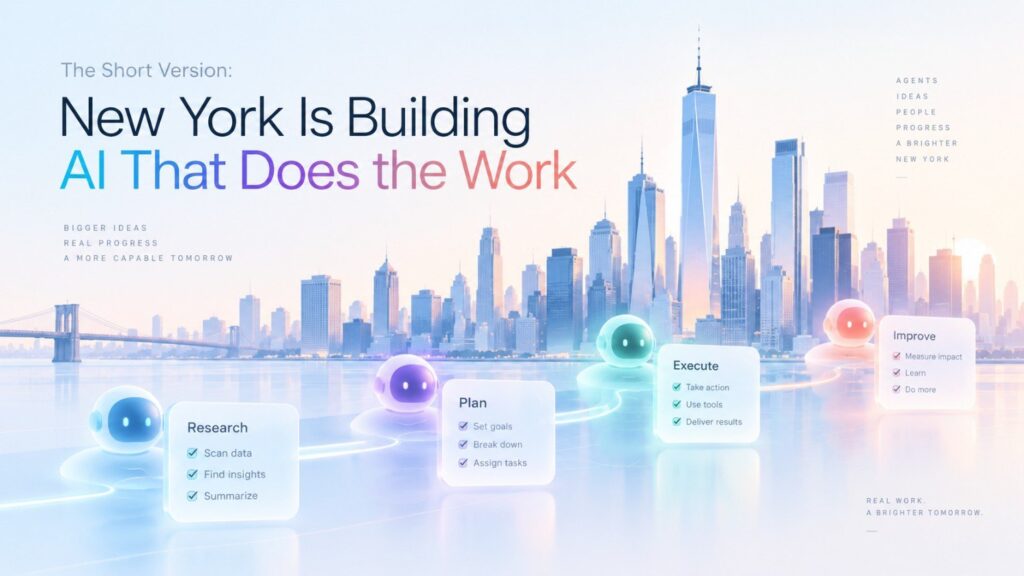
The Short Version: New York Is Building AI That Does the Work
The most important finding from our research is simple: New York’s strongest AI agent companies are being built around valuable business workflows rather than consumer novelty.
All 20 companies in our dataset primarily sell to businesses or institutions. Most are focused on a specific function or industry, and many serve areas where mistakes are expensive, rules matter, and customers already spend large amounts of money on human labor.
That fits New York unusually well.
NYCEDC says New York City already has more than 25,000 tech-enabled startups, more than 2,000 AI startups, over 1,200 active venture capital firms, and roughly 40,000 workers in the metro area with AI-related skills. Its applied-AI strategy specifically highlights the advantage created by New York’s concentration of industries such as finance, healthcare, real estate, media, fashion, and professional services.
Capital is also available at a scale few cities can match. The New York State Comptroller reported that the NYC metropolitan area attracted $28.5 billion in venture capital in 2024, equal to 13.3% of the national total. Software and technology services represented 52.4% of NYC-area investment that year, while AI was helping drive larger venture deals nationally.
But there is an important twist.
AI adoption across New York businesses is not yet universally ahead of the country. Census data cited by the NYC Comptroller put New York State business AI adoption at 16.8% in early April 2026, compared with 19.8% nationally. That creates a large gap between New York’s ability to build AI and the number of businesses that have fully worked AI into normal operations.
AI agents could help close that gap because they give businesses something easier to measure than another general AI subscription.
The question changes from “Are employees using AI?” to “Can this system complete 40% of our referral workflow?” or “Can an agent reduce the time required to prepare a first draft of an investment memo?”
That is a much more useful business conversation.
What We Mean by an AI Agent Startup
The phrase “AI agent” has become so widely used that it can mean almost anything. A normal chatbot with a new homepage can suddenly be described as agentic.
We used a stricter definition.
To qualify for this research, the company’s product needed to do more than generate text or answer questions. It needed public evidence that its software could execute, coordinate, or meaningfully advance a multi-step workflow on the user’s behalf.
That might mean updating a CRM after a sales call. It might mean gathering accounting data, reconciling transactions, and preparing work for review. It might involve researching an investment and generating an Excel model. It could mean talking with a patient, checking a scheduling system, booking an appointment, and writing information back into software.
The important word is action.
An assistant mainly helps a person perform the work. An agent increasingly receives the work, executes part of it, and returns an outcome.
The line is not always perfect, which is why our analysis looked at actual product behavior rather than whether the company happened to use the word “agent” in its marketing.
Original Research: How NYC Tech Journal Built the 2026 AI Agent Index
This list is not simply a collection of startups that appear in search results.
We created an eligibility framework and then compared the companies across five areas.
Our Four Eligibility Tests
First, the company needed a clear New York City headquarters, substantial New York operating base, or strong evidence that New York is a central location for the company.
Second, it needed an actual agent product. Basic content generation, search, analytics, or a chatbot alone was not enough.
Third, the business needed to be active as of our September 8, 2026 research cutoff.
Fourth, we looked for evidence beyond a product announcement. This could include customers, significant usage, funding, hiring, revenue, production deployment, or continued product development.
How We Ranked the Companies
After establishing eligibility, we scored companies using five factors.
| Factor | Weight | What We Looked For |
| Agent depth | 30% | Can the product complete multi-step work and take actions rather than simply answer questions? |
| Commercial proof | 25% | Customers, production usage, revenue, expansion, transaction volume, or other evidence that businesses use the product |
| Capital momentum | 20% | Size and recency of completed primary funding rounds |
| New York depth | 15% | NYC headquarters, employees, office expansion, hiring, or other local commitments |
| Defensibility | 10% | Specialized data, integrations, workflow knowledge, compliance controls, evaluations, auditability, or other barriers to copying |
This ranking is an editorial research framework rather than an investment recommendation. A young company can therefore rank below a large company even when its technology is interesting simply because there is less commercial evidence available.
We also separated completed primary financing from secondary transactions, tender offers, and financing that had merely been reported as under discussion.
That distinction matters. For example, Clay completed a $100 million Series C in August 2025 and later ran a January 2026 tender offer that valued the company at $5 billion. The tender provided employee liquidity, but it was not treated as a new primary venture round in our funding analysis.
The 20-Company NYC AI Agent Dataset
| Rank | Company | Main Agent Market | Latest Named Primary Round* |
| 1 | Rogo | Finance | $160M Series D |
| 2 | EliseAI | Housing and healthcare | $250M Series E |
| 3 | Clay | Go-to-market and sales | $100M Series C |
| 4 | Norm AI | Law and compliance | $120M Series C |
| 5 | Basis | Accounting | $100M Series B |
| 6 | Tennr | Healthcare operations | $101M Series C |
| 7 | Notch | Regulated enterprises | $30M Series A |
| 8 | Hadrius | Financial compliance | $22M Series A |
| 9 | Lio | Procurement | $30M Series A |
| 10 | Hebbia | Finance and professional services | $130M Series B |
| 11 | Regal | Customer service and sales | $40M financing |
| 12 | Attention | Revenue operations | $30M Series B |
| 13 | Patlytics | Patent work | $40M Series B |
| 14 | Uniti AI | Real estate | $12M Series A |
| 15 | Harmony | Internal enterprise services | $34M seed |
| 16 | Clarion | Healthcare communication | $5.4M+ publicly disclosed funding |
| 17 | Maximor | Accounting and finance operations | $9M seed |
| 18 | Hatz AI | AI infrastructure for MSPs | $2.77M sold in 2025 Form D offering |
| 19 | AgentSmyth | Capital markets | $8.7M seed |
| 20 | Atlog | Regulated voice AI | Pre-seed / YC-backed |
*Latest named primary round means the most recent completed financing amount that we could compare from public sources. Clarion and Atlog are excluded from our latest-round statistical calculations because public disclosures do not provide a directly comparable named completed round. Hatz’s figure comes from its February 2025 SEC Form D, which reported $2.77 million sold in an offering of up to roughly $3 million.
Original Analysis: What the Numbers Tell Us About New York’s AI Agent Market
The individual startups are interesting. The structure of the market may be even more useful.
When we grouped the 20 companies by buyer, funding stage, and product design, several patterns appeared.
Finding #1: New York’s AI Agent Market Is Already a Billion-Dollar Venture Category
For the 18 companies where we could identify a reasonably comparable named completed primary financing amount, the latest rounds alone add up to approximately $1.22 billion.
This is not the amount these companies have raised in total. It is also not an estimate of total AI-agent funding in New York. It is simply the sum of the latest comparable primary financing amounts in our 18-company financing subset.
The median latest round was $37 million, while the average was about $67.7 million.
That large difference between the median and average tells us something important: funding is heavily concentrated among a small number of mature companies.
Chart: Latest Completed Primary Round, Selected Companies
EliseAI $250M | █████████████████████████
Rogo $160M | ████████████████
Hebbia $130M | █████████████
Norm AI $120M | ████████████
Tennr $101M | ██████████
Clay $100M | ██████████
Basis $100M | ██████████
Regal $40M | ████
Patlytics $40M | ████
Harmony $34M | ███
EliseAI, Rogo, and Hebbia alone account for roughly 44.3% of the latest-round dollars in the comparable sample. The seven largest latest rounds account for almost 79%.
That means New York has both a large group of emerging agent startups and a smaller set of companies moving into much larger institutional scale.
This is exactly what we would expect in a market beginning to mature.
Finding #2: At Least $578 Million of Our Sample’s Capital Was Announced in 2026 Alone
Ten companies in the dataset announced qualifying funding rounds between January 1 and September 8, 2026.
Together, those rounds were worth $578 million.
Chart: 2026 Completed Funding in Our Sample
Q1 2026 $160M | ████████████████
Q2 2026 $230M | ███████████████████████
Q3 through Sep 8 $188M | ███████████████████
The Q1 total comes from Basis, Notch, and Lio. Q2 includes Rogo, Patlytics, and Attention. Q3 through September 8 includes Norm AI, Hadrius, Uniti AI, and Harmony.
This is a useful signal because it shows that New York’s agent market is not being carried only by old AI funding rounds from the 2023 generative-AI boom. Investors continued writing large checks during 2026 for companies showing that agents can work inside real business processes.
Rogo raised $160 million in April 2026. Norm AI raised $120 million in July. Basis raised $100 million early in the year. Those are large growth rounds for businesses centered on financial work, law, and accounting rather than mass consumer AI.
Finding #3: The Market Is Surprisingly Balanced by Startup Stage
New York does not have only giant late-stage agent companies.
Our 20-company sample includes companies ranging from tiny YC-backed teams to businesses valued above $1 billion.
Chart: Stage Distribution of the 20 Companies
Seed / Pre-seed 6 | ██████
Series A 4 | ████
Series B 5 | █████
Series C 3 | ███
Series D 1 | █
Series E 1 | █
That matters because healthy technology clusters generally need both mature companies and new company formation.
The late-stage firms prove that customers will pay for the category. The early-stage firms then attack narrower problems that become possible as models improve.
Finding #4: Sales Agents Are Only a Small Part of the Story
The public discussion around agents often focuses on sales development representatives, customer support bots, and voice agents.
Those markets matter, but they do not dominate our NYC sample.
We assigned every company to one primary buyer or workflow, even when its software spans multiple areas.
Chart: Primary Market in the NYC Tech Journal Sample
GTM / customer experience 4 | ████ 20%
Legal / compliance / IP 4 | ████ 20%
Finance / capital markets 3 | ███ 15%
Accounting / finance operations 2 | ██ 10%
Healthcare 2 | ██ 10%
Real estate / housing 2 | ██ 10%
Procurement / employee services 2 | ██ 10%
MSP / agent infrastructure 1 | █ 5%
This is probably the most important chart in the entire article.
New York is not developing one agent market. It is developing many vertical agent markets at the same time.
And that is likely an advantage.
A startup in San Francisco can hire great AI engineers. New York can also hire strong technical talent, but it adds something else: immediate access to thousands of potential users working in finance, accounting, insurance, healthcare, law, property management, media, advertising, and other large industries.
The city’s customers can become part of its product-development advantage.
1. Rogo — Building an AI Coworker for Wall Street
Rogo sits at the top of our list because almost every important signal is moving in the same direction.
The New York company builds AI specifically for financial professionals. Its agent, Felix, can take on work that extends beyond question answering, including research, financial analysis, presentation creation, Excel work, dashboards, and other tasks. Rogo also lets financial firms create custom agents around their own workflows, data, and institutional knowledge.
The company raised a $160 million Series D in April 2026, bringing total funding above $300 million. At that point, Rogo said it served more than 250 investment banks and investment firms.
Its New York commitment is just as important as its funding. Empire State Development said in June 2026 that Rogo planned to create 422 full-time jobs, invest nearly $14 million in its NYC headquarters, and undertake more than $40 million in research and development. The state also said more than 35,000 professionals across 250-plus financial institutions were using the technology.
Why Rogo Matters
Rogo shows where high-end professional software could be heading.
The valuable product may no longer be a search box where an investment banker asks a question. It may be an agent that receives a project, searches trusted data, produces a model, creates slides, monitors changes, and gives the banker something close to a first complete work product.
That shifts AI from information retrieval into labor substitution and labor amplification.
For New York, few opportunities could be larger.
2. EliseAI — Turning Housing Operations Into an Agentic System
EliseAI is one of New York’s most commercially advanced vertical AI companies.
The company originally became known for automating conversations and workflows in multifamily housing. It has since expanded into healthcare, while continuing to deepen its agentic products for property operators.
EliseAI raised a $250 million Series E in August 2025. At the time, it said it had surpassed $100 million in annual recurring revenue and supported more than 600 housing owners and operators.
By June 2026, the company said annual recurring revenue had reached $200 million after five consecutive years of 100% year-over-year growth. As with any private-company revenue disclosure, that figure comes from the company, but it gives a useful indication of the scale EliseAI claims to have reached.
Its new Apollo product shows where the platform is going next. Apollo can take actions inside EliseCRM, including sending messages, updating information, changing settings, reassigning tasks and tours, and generating dashboards while inheriting the user’s existing permissions. EliseAI says it has tested Apollo across 7,000 evaluations.
Why EliseAI Matters
EliseAI demonstrates what happens when an AI company goes deep into an industry rather than stopping at conversation.
Property management contains leasing, maintenance, scheduling, marketing, reporting, resident service, and countless small administrative processes. Once an AI provider becomes connected to those systems, the opportunity becomes much larger than answering renter questions.
The agent can begin operating the property software itself.
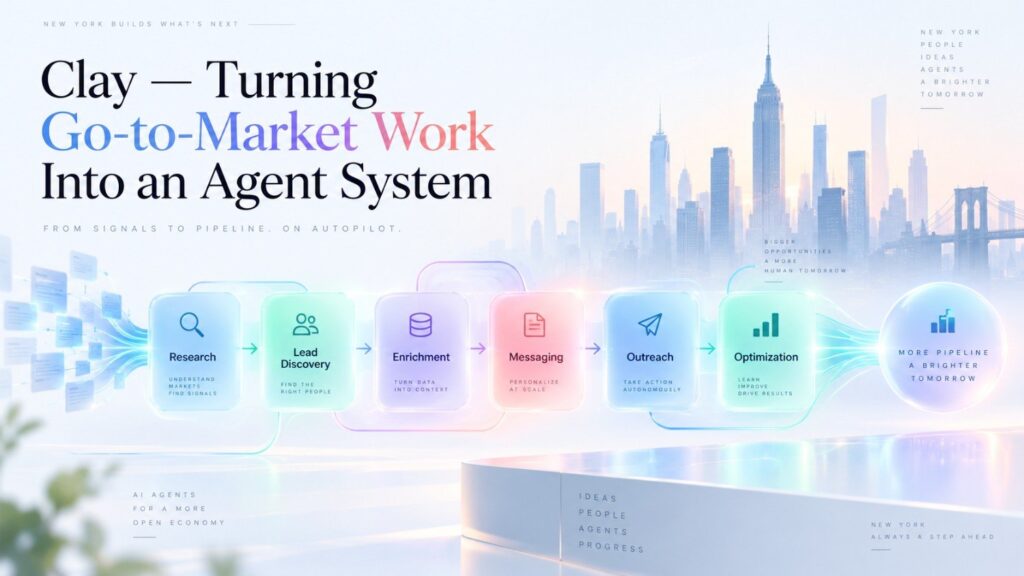
3. Clay — Turning Go-to-Market Work Into an Agent System
Clay has become one of New York’s highest-profile AI software companies.
Its platform helps sales and go-to-market teams combine data, signals, research, enrichment, and automation. Clay’s AI research agent, Claygent, became an important part of that system, while newer agent products move toward continuously watching accounts, making decisions, and triggering actions.
Clay raised a $100 million Series C in August 2025 at a $3.1 billion valuation. In January 2026, an employee tender offer valued the company at $5 billion; Clay said at that time it had approximately 14,000 customers and enterprise net revenue retention above 200%.
Its NYC commitment is also unusually large. In April 2026, New York State announced that Clay would lease more than 163,000 square feet at 11 Madison Avenue and commit to creating 498 new full-time jobs over five years while investing $50 million in New York R&D.
Why Clay Matters
Clay is important because it points toward a different way of building a sales organization.
Companies used to buy separate software for prospect data, enrichment, outbound messages, lead scoring, intent signals, and workflow automation. An agentic system can increasingly connect those pieces and decide what research or action should happen next.
That does not make salespeople unnecessary.
It makes the software surrounding them far more active.
4. Norm AI — Building Agents That Understand Law
Norm AI may be working on one of the hardest agent problems in New York: allowing AI to perform work where being wrong can create legal consequences.
The company describes its approach as “agentic law.” Its technology converts laws, regulations, policies, and legal reasoning into agents that can perform legal and compliance tasks.
In July 2026, Norm AI announced a $120 million Series C at a $1.2 billion valuation, taking its total funding above $260 million. The company also operates alongside Norm Law, a New York-based AI-native law firm where attorneys supervise AI agents performing legal work.
Norm says institutions managing more than $35 trillion in combined assets use its technology. It is also developing supervisory AI designed to check other agents operating in regulated environments.
Why Norm AI Matters
Most discussions of enterprise agents eventually reach the same problem: who checks what the agent did?
That issue becomes more serious as agents move from drafting text to executing work.
Norm is attacking that control layer from the legal side. If businesses eventually operate thousands of agents, systems that monitor whether those agents are following rules may become just as important as the agents themselves.
5. Basis — AI Agents That Actually Do Accounting Work
Basis is a strong example of why we used a strict agent definition.
The company does not simply market an accounting chatbot. Its agents are designed to work for hours, complete end-to-end tasks, and operate across accounting workflows.
Basis raised $100 million in Series B funding in early 2026 at a reported $1.15 billion valuation. The company says its agents are being deployed with major accounting firms and can work on reconciliations, journal entries, tax, audit, and other processes.
OpenAI published a case study describing Basis’s multi-agent system in 2025. According to that case study, a supervising agent coordinates work across specialized sub-agents, while accounting firms using Basis reported average time savings of around 30%. The number is company/customer-reported rather than an independent industry benchmark, but it provides evidence that the system is being measured against actual accounting labor.
Why Basis Matters
Accounting is almost perfectly designed for vertical agents.
The work is structured enough to automate, but complicated enough that generic AI struggles with edge cases, documentation, accounting rules, and reliability.
The winner in this market therefore may not be the company with the most impressive chatbot.
It may be the company that can complete a close task at 2 a.m., leave a clear audit trail, flag the uncertain items, and give the accountant something safe to review in the morning.
6. Tennr — Agents for the Administrative Work Behind Healthcare
Tennr is attacking a healthcare problem that receives much less attention than medical diagnosis: getting patients through administrative systems.
Its software works across referral intake, insurance information, documentation, triage, communications, and related patient-flow tasks. Tennr explicitly describes its product as using agentic workflow automation and agentic communications, with an Autopilot mode that can complete high-confidence work while retaining quality controls.
The company announced a $101 million Series C in 2025. Its current careers material says Tennr processed more than 10 million patients during 2025 and lists its office at 345 Hudson Street in Manhattan.
Why Tennr Matters
Some of the biggest opportunities in healthcare AI have nothing to do with discovering drugs or diagnosing disease.
Healthcare businesses spend huge amounts of time moving information between patients, providers, insurers, documents, call centers, and old software.
Those processes contain exactly the repetitive multi-step work that agents are designed to attack.
The economic opportunity is therefore not only “AI for doctors.”
It is AI for everything that needs to happen before and after the doctor sees the patient.
7. Notch — An AI Operating System for Regulated Industries
Notch is building agents for businesses where automation cannot simply move fast and hope errors are corrected later.
The company’s early focus includes insurance, finance, banking, and telecommunications. It describes its product as an AI operating system for regulated industries.
Notch announced a $30 million Series A in March 2026, taking total funding to $45 million. Its official company information lists its headquarters at 261 Madison Avenue in Manhattan.
The company has also developed an architecture designed to connect agents, human workers, workflows, and business systems rather than leaving an agent isolated inside a chat interface.
Why Notch Matters
The regulated-enterprise market could become one of New York’s strongest agent categories.
Large insurers and financial institutions do not only need an AI model capable of reasoning.
They need permissions. They need controls. They need records. They need humans to intervene. They need to know what happened after the agent clicked a button.
That surrounding operating layer may become a major business in its own right.
8. Hadrius — Automating Financial Compliance Without Removing Human Judgment
Hadrius has taken a particularly clear approach to agentic compliance.
The company builds software for SEC- and FINRA-regulated financial firms. Its platform covers areas such as communications monitoring, marketing review, employee oversight, trading surveillance, testing, and compliance documentation.
Hadrius announced a $22 million Series A in July 2026, bringing combined seed and Series A funding to $27 million. At the time, it said more than 500 financial firms were using the system.
The company’s design is worth noting. Hadrius says agents analyze information and surface possible violations, while human compliance professionals retain judgment over important decisions. Its current website says customers collectively represent more than $5 trillion in assets under management.
Why Hadrius Matters
Hadrius illustrates what responsible enterprise agents may actually look like.
“Autonomous” does not need to mean “no human is involved.”
A better model for high-risk work may be to automate the search, monitoring, evidence gathering, classification, and repetitive review while reserving ambiguous decisions for people.
That is less dramatic than an unsupervised digital worker.
It is also much easier for a regulated business to buy.
9. Lio — Building a Multi-Agent Procurement Team
Procurement is an enormous business function hiding behind a simple word.
Large companies need to collect requests, find vendors, gather information, compare bids, negotiate, manage approvals, follow policies, coordinate contracts, and keep internal stakeholders updated.
Lio is building agents around that process.
The company announced a $30 million Series A led by Andreessen Horowitz in March 2026, bringing disclosed funding to $33 million. Lio describes its platform as a multi-agent system designed to execute procurement work end to end.
The company has also been expanding its U.S. operation from New York, including hiring a former Walmart procurement transformation executive to lead U.S. growth.
Why Lio Matters
Procurement shows why agent design can be more valuable than simply adding AI to an existing dashboard.
The work crosses many systems and departments. A request might begin in Slack, require supplier research, trigger risk checks, move through approvals, involve negotiation, and end inside procurement software.
That is a chain of work.
Agents are built for chains.
10. Hebbia — Moving From AI Research to Proactive Financial Agents
Hebbia became known for Matrix, its system for letting professional users analyze large amounts of structured and unstructured information.
The company has become particularly strong in finance, where users need to reason across filings, research, diligence material, internal documents, and financial data.
Hebbia raised a $130 million Series B in 2024. Its current website says institutions using Hebbia represent approximately $30 trillion in assets under management and that the platform processes around 200,000 prompts per day.
The company’s direction is increasingly agentic. At its January 2026 Future of Finance Forum in Soho, Hebbia described a world of proactive financial agents that can update models, memos, and dashboards when something changes rather than waiting for an employee to ask.
Why Hebbia Matters
This may be one of the clearest examples of the difference between AI search and AI work.
A search tool waits.
An agent watches.
If a portfolio company publishes new financial information, the agentic version of software can eventually identify the change, update the relevant analysis, recalculate a model, and tell the investment team what changed.
That is much closer to a junior knowledge worker than a search engine.
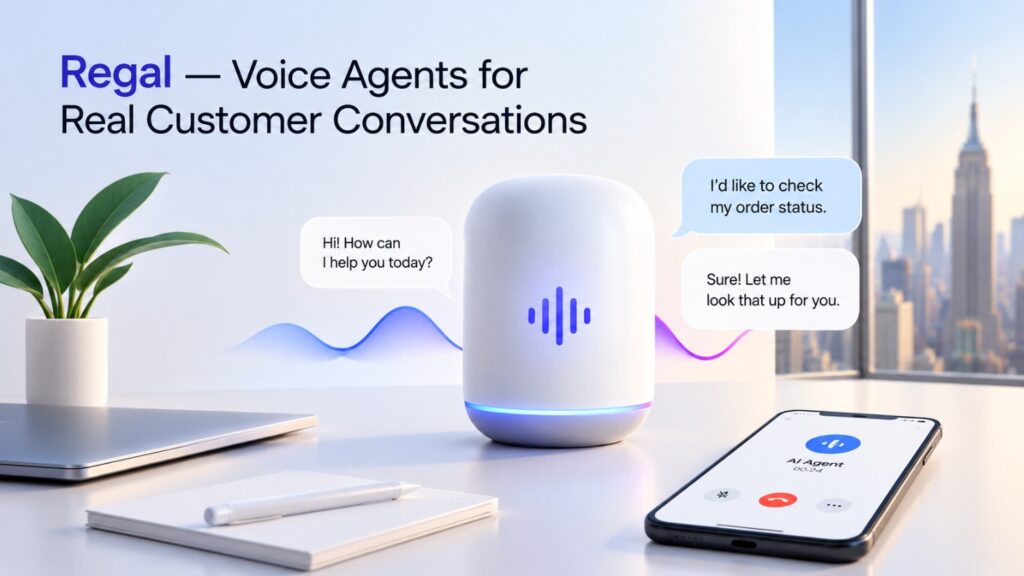
11. Regal — Voice Agents for Real Customer Conversations
Regal is focused on one of the largest pools of repetitive business work: conversations between companies and customers.
The NYC-built company lets enterprises deploy voice and other AI agents across customer service, sales, operations, and retention. These agents can access customer data, communicate, complete multi-step conversations, update internal systems, send follow-up messages, and transfer work to humans when necessary.
Regal says its technology has now been used across hundreds of millions of calls and that it powers more than 10 million customer interactions per month. Those figures are company-reported, but the scale makes Regal one of the more mature voice-agent platforms in the New York ecosystem.
In 2026, Regal also introduced Copilot, an agent that helps businesses create and improve other Regal agents.
Why Regal Matters
Voice exposes agents to something much harder than clean software demos: real people.
Customers interrupt. They change their minds. They become angry. They ask unexpected questions. Their information is incomplete.
If agent platforms can operate reliably in that environment, voice could become one of the fastest areas where businesses replace traditional software-driven call flows with goal-driven AI.
12. Attention — Moving Sales AI From Recording Calls to Doing the Follow-Up
The first generation of sales AI became very good at recording meetings.
It transcribed calls, wrote summaries, highlighted objections, and suggested next steps.
Attention is trying to move beyond that.
The New York company says its agentic system can draft and send follow-up communication, update CRM records, and execute the next sales action instead of simply documenting what occurred.
Attention raised a $30 million Series B in June 2026. The company specifically said the money would be used to expand its agentic product and move further into large enterprise revenue teams.
Why Attention Matters
Sales may become one of the clearest examples of software changing from a database into an operator.
Traditional CRM software asks the salesperson to keep the system updated.
Agentic CRM software can increasingly watch the work, understand what happened, update itself, generate the follow-up, and initiate the next action.
The human can spend more time selling.
The software handles more of the administrative loop surrounding the sale.
13. Patlytics — A Specialist AI Agent for Patent Work
Patent work combines several characteristics that make it attractive for specialist AI.
It involves huge amounts of data. Language matters enormously. Research is expensive. Decisions need sources. And the user base is highly specialized.
Patlytics has built its product around those requirements.
The company raised a $40 million Series B in 2026, bringing total disclosed funding to roughly $65 million. Its new Agent product is grounded in a dataset the company says includes 145 million patents and more than 40 million legal cases, with more than 200 specialized skills for patent work.
Patlytics formally showcased the Agent product in New York in August 2026. The software is designed to let users bring patents, filings, claim sets, legal records, and other material into repeatable AI workflows.
Why Patlytics Matters
General models are becoming cheaper and more capable.
That does not necessarily destroy vertical AI companies.
It can make domain data and workflow design more important.
A patent professional does not simply want good prose. The professional wants the correct patent universe, case law, citations, claim context, repeatable analysis, and output that fits how patent work is actually performed.
That is where specialization becomes a moat.
14. Uniti AI — Agentic AI for Real Estate Operators
Uniti is part of a rapidly growing New York proptech category built around AI labor.
The Manhattan-based startup provides AI agents for property operators across voice, email, SMS, WhatsApp, and web chat. Its agents can answer inquiries, qualify prospects, communicate instantly, handle escalation rules, and work inside existing real estate processes.
Uniti raised a $12 million Series A in July 2026. Commercial Observer reported that the company was already working across several property categories, with customers including coworking, self-storage, and multifamily operators.
Why Uniti Matters
Real estate businesses often operate with large numbers of repetitive customer interactions spread across hundreds or thousands of physical locations.
That makes labor difficult to scale.
An AI agent does not need to be physically located at a building to respond instantly, qualify demand, book the next action, and move a prospect through a process.
For large portfolios, the economics can become compelling very quickly.
15. Harmony — Agents Inside Slack and Microsoft Teams
Not every AI agent needs to replace an external-facing workflow.
Harmony is building agents for the internal work employees deal with every day.
The company launched with $34 million in seed funding in July 2026. Its agents operate inside workplace tools such as Slack and Microsoft Teams and are designed to resolve requests spanning IT, HR, finance, procurement, and legal functions.
This is a potentially important category because employees often do not know which internal system contains the answer to a question. They simply know what they need: access to software, a replacement laptop, an explanation of a benefit, an invoice fixed, or a procurement request approved.
Why Harmony Matters
Enterprise software has spent decades making employees learn the software.
Agents could reverse that relationship.
Instead of opening several portals and finding the correct workflow, an employee can state the goal.
The agent then needs to understand the request, locate the policy, connect to the right system, collect approval where needed, and complete the task.
That may eventually change how employees interact with large parts of the enterprise software stack.
16. Clarion — AI Agents Handling Healthcare Calls and Messages
Clarion is one of the smaller companies on our list, but it attacks a very large problem.
The New York-based company builds communication agents for healthcare. Its agents can handle calls and messages related to scheduling, billing, prescription refills, and other patient-facing administrative workflows.
Y Combinator currently says Clarion serves tens of thousands of patients per month across healthcare organizations and has disclosed approximately $5.4 million in funding from investors including Accel and Y Combinator. Some newer job materials provide slightly different funding totals, so we used the more conservative figure published on its primary YC company profile.
Why Clarion Matters
Healthcare voice AI can look simple until the agent has to do something.
Answering “What time are you open?” is easy.
Changing an appointment, understanding why a patient is calling, checking availability, dealing with a prescription request, identifying an urgent issue, following privacy rules, and updating the correct system is much harder.
That is where a voice bot becomes an operational agent.
17. Maximor — Giving Finance Teams AI Workers Without Replacing the ERP
Maximor is building agentic automation for internal accounting and finance teams.
The company raised a $9 million seed round in 2025. Its agents connect to software such as ERPs, CRMs, billing platforms, payroll systems, banks, and other finance tools to help perform reconciliations, journal entries, revenue work, close procedures, and reporting.
One smart part of the pitch is that customers do not need to replace their accounting system first.
That matters because large finance teams rarely want a risky ERP migration simply to gain access to AI.
Why Maximor Matters
The most successful enterprise agents may not replace systems of record.
They may sit above them.
An accounting agent can read from several systems, perform work across them, and leave the ERP intact underneath.
This is a practical deployment model because it lowers the amount of organizational change required before a company can test the technology.
18. Hatz AI — Giving IT Service Providers an Agent Platform
Hatz AI is different from most of the companies on this list.
Instead of primarily selling one specialist agent directly to an enterprise, Hatz provides technology that managed service providers can use to deliver AI products and agents to their own customers.
The New York company launched publicly in 2024 with a $2.5 million seed financing. Its platform includes AI applications, agents, model access, and multi-tenant management designed for MSPs.
An SEC Form D filed in February 2025 shows Hatz AI had sold approximately $2.77 million of a planned roughly $3 million equity offering. The filing also lists its principal business address in New York.
Why Hatz AI Matters
Thousands of small and midsize companies may not build AI-agent infrastructure internally.
They already rely on outside IT providers.
If MSPs become a major distribution channel for enterprise AI, companies such as Hatz can sit one layer below the visible agent market and provide the infrastructure those service providers need.
That could make distribution, not only model quality, a competitive advantage.
19. AgentSmyth — A Team of AI Agents for Capital Markets
AgentSmyth is taking the multi-agent concept directly into professional trading and investment.
The New York company has built specialist agents focused on areas such as macroeconomic analysis, market sentiment, quantitative signals, options, and earnings. Those agents can work together to produce one investment-oriented answer rather than requiring the user to run several separate research tasks.
AgentSmyth raised an $8.7 million seed round in 2025, bringing total funding at that point to $11.2 million. The company said it had been deployed by 48 institutional customers in less than a year.
Why AgentSmyth Matters
Finance is naturally a multi-agent problem.
A trader rarely cares about only one data source.
The useful answer may require macro conditions, company news, analyst sentiment, options activity, earnings history, and quantitative signals at the same time.
AgentSmyth’s approach points toward digital teams of specialized agents rather than one giant model pretending to be an expert at everything.
20. Atlog — Compliance-First Voice Agents for Regulated Outreach
Atlog is the smallest and earliest company in our top 20, which is exactly why it is worth watching.
The YC-backed New York startup builds voice and text agents with compliance controls aimed at outbound communications. Its current focus includes businesses operating under rules such as the Telephone Consumer Protection Act and other requirements affecting financial services, collections, automotive businesses, and related regulated communication.
Atlog’s team remains tiny compared with most companies in this article. That means there is far less commercial evidence, which is why it ranks twentieth rather than higher.
But the underlying idea is important.
Why Atlog Matters
Voice AI is becoming easier to build.
Compliant voice AI is not.
As the basic speech and reasoning technology becomes widely available, specialized controls around consent, call timing, record keeping, escalation, and industry rules can become a larger part of the value.
Atlog is an early bet that safety and compliance will become part of the product itself rather than something customers bolt on afterward.
What Businesses Should Learn From New York’s AI Agent Startups
The value of this market map is not simply knowing which companies raised money.
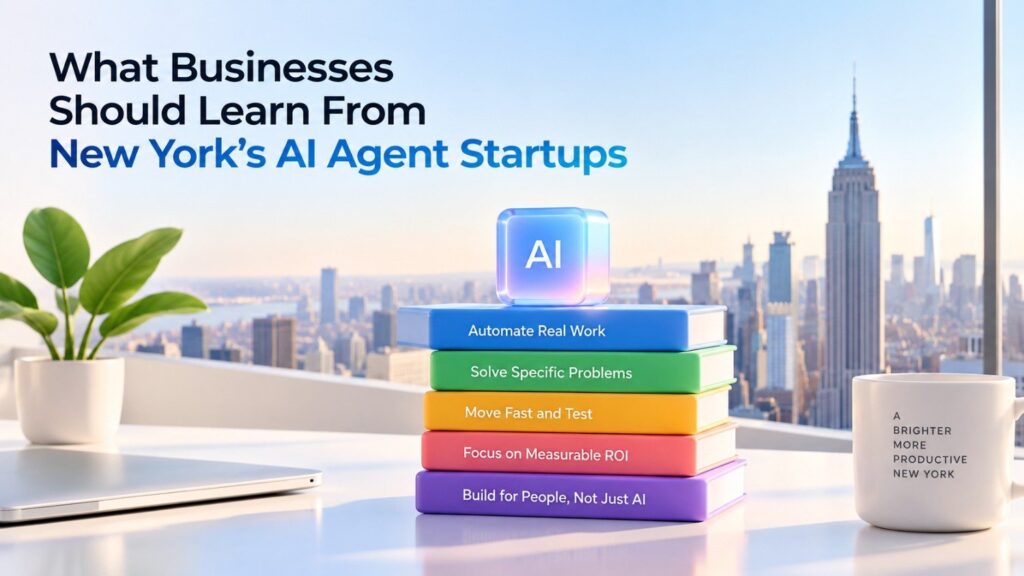
The companies reveal how businesses should think about deploying agents inside their own organizations.
Start With Work, Not With AI
The strongest startups in our dataset are rarely selling “AI” in the abstract.
Basis sells a new way to perform accounting work.
Tennr sells a faster healthcare administrative workflow.
Hadrius sells easier compliance.
Rogo sells faster financial execution.
EliseAI sells operating capacity for housing and healthcare.
This is a useful lesson for every company trying to develop an AI strategy.
Do not begin by asking, “Where can we use an agent?”
Begin with a different question:
Where does important work repeatedly get stuck?
Look for a process where employees spend hours moving information between systems, waiting for someone to answer, checking rules, creating the same document, updating databases, or following the same sequence of steps.
That is where an agent pilot becomes measurable.
The Best Agent Opportunities Have an Expensive Loop
Businesses often become excited by tasks because they look impressive in a demo.
That is the wrong filter.
A task becomes strategically interesting when it repeats often enough that improving it changes economics.
Imagine a workflow that takes 20 minutes and occurs 30,000 times each year. That is 10,000 hours of work.
Reducing the workload by 60% creates a very different business case from saving five minutes on an activity that happens twice per month.
The right unit of analysis is therefore not “How smart is the agent?”
It is:
Frequency × labor × delay × error cost × business value.
The biggest number usually tells you where to begin.
Integration Is Becoming More Important Than the Chat Interface
Several of the companies on this list reveal another important shift.
The agent needs access to the systems where work happens.
Rogo connects into financial data and productivity tools.
Basis needs accounting systems.
Regal connects with customer information and communication infrastructure.
Uniti works with property workflows.
Maximor connects into finance systems.
Apollo operates inside EliseAI’s own property-management environment.
An agent that cannot read or write to business systems remains largely an adviser.
An agent connected to trusted data, permissions, applications, and actions can become an operator.
That difference should shape vendor evaluation.
Human Review Is a Product Feature, Not a Failure of Automation
Businesses should be suspicious of vendors that describe human involvement as something that always needs to disappear.
Different work deserves different levels of autonomy.
A low-risk agent might automatically classify incoming requests or send an appointment reminder.
A higher-risk agent might prepare an accounting entry but require a controller to approve it.
A compliance system may collect evidence and identify possible violations while letting a qualified compliance officer make the final decision.
The goal is not maximum autonomy.
The goal is the highest safe autonomy that creates a better economic result.
That is a more useful standard.
How to Evaluate an AI Agent Vendor in 2026
Buying agent software requires a different process from buying normal SaaS.
With traditional software, the employee usually remains the operator. If the software is awkward, productivity falls.
With an agent, the software may actually execute the task.
That raises the cost of failure.
Use This Buyer Scorecard
| Question | Good Sign | Warning Sign |
| What actions can the agent actually take? | Vendor can demonstrate complete workflows | Demo stops after generating an answer |
| How does it know when it is uncertain? | Clear confidence rules and escalation | Agent always produces an answer |
| Can humans approve high-risk actions? | Permission and review controls | All-or-nothing autonomy |
| Can every important action be traced? | Logs, sources, history, audit trail | Black-box output |
| How is performance evaluated? | Workflow-specific test sets and production metrics | Only generic model benchmarks |
| What happens when an integration fails? | Defined fallback and recovery process | Undefined |
| Can access vary by employee role? | Fine-grained permissions | Agent receives excessive access |
| Does it learn from company context safely? | Clear data controls and retention rules | Vague security claims |
| What business KPI changes? | Vendor agrees on an operational baseline | ROI is described only as “productivity” |
| Can the pilot start narrow? | One workflow with defined boundaries | Requires company-wide rollout |
The most important part of this scorecard is the first row.
Ask the vendor to show you what happens after the AI has finished thinking.
Does it create the ticket?
Does it send the message?
Does it update the CRM?
Does it write into the accounting system?
Does it schedule the appointment?
Does it build the model?
Does it escalate the uncertain case?
That is where the difference between an AI demo and an AI agent becomes visible.
A Better 90-Day AI Agent Pilot
A business does not need to redesign its entire operating model to begin using agents.
A disciplined 90-day pilot can produce much better information.
Days 1–30: Measure the Existing Workflow
Choose one painful process.
Do not automate it immediately.
First measure how it currently works.
How many tasks arrive each week? How long does each take? How often is information missing? How frequently do employees need to correct work? How much time is spent waiting? Which systems are involved? Which decisions require expert judgment?
Without those numbers, you will not know whether the agent improved anything.
Days 31–60: Let the Agent Work With Tight Boundaries
Give the system a narrow job.
Define exactly what it can read, what it can change, when it needs approval, and what should trigger escalation.
For high-risk workflows, run the agent in parallel with the human process before allowing it to act independently.
Measure more than speed.
Measure completion rate, exception rate, accuracy, human review time, rework, customer response time, cost per completed workflow, and the percentage of tasks the agent can finish without intervention.
Days 61–90: Increase Autonomy Only Where the Data Supports It
After several weeks, divide tasks into groups.
Some will be predictable enough for full automation.
Others will work well with quick human approval.
A third group will be too unusual or risky and should remain primarily human.
That is not a failed pilot.
It is exactly the information the company needs.
The goal of a pilot should not be to prove the agent works.
The goal should be to discover where the agent works well enough to change the economics of the process.
Why New York Could Become the Capital of Applied AI Agents
Silicon Valley retains major advantages in foundation models, technical infrastructure, venture capital, and AI research.
New York does not need to copy Silicon Valley to win a large part of the agent market.
It can play a different game.
New York City’s economy gives startups immediate access to high-value workflows. Finance, law, advertising, media, real estate, insurance, healthcare, accounting, fashion, and professional services all exist at enormous scale within a relatively small geographic area.
NYCEDC’s broader AI strategy is explicitly based on this applied-AI advantage. The city says it has more than 2,000 AI startups and a technology ecosystem supported by over 1,200 venture investors and more than 40,000 workers with AI-related skills.
The city’s AI companies are also becoming meaningful physical employers.
Clay has committed to a large Madison Avenue expansion and nearly 500 new jobs. Rogo plans more than 400 additional jobs. Companies such as Basis, Tennr, Regal, Notch, Clarion, and others continue to operate or hire from New York offices.
That creates a potentially powerful feedback loop.
Industry experts leave established companies and join startups.
Startups sell back into established industries.
Customers teach startups where existing workflows break.
Startups build better vertical systems.
Successful companies hire more domain experts.
Those employees eventually create the next generation of companies.
That is how an ecosystem becomes difficult to copy.
The Bigger Shift: Software Is Moving From Tools to Labor
For decades, companies bought software that employees operated.
A CRM stored the customer’s information.
An ERP stored financial transactions.
A property management platform stored leasing data.
A research terminal displayed information.
A ticketing system stored requests.
The employee remained responsible for moving work through the system.
AI agents change that relationship.
The future CRM may not simply tell a salesperson which leads exist. It may research the account, prepare outreach, update the database, schedule follow-up, and alert the salesperson only when human judgment becomes useful.
The future accounting platform may not simply display transactions. Agents may reconcile them, find exceptions, prepare entries, assemble documentation, and place the unusual cases in front of an accountant.
The future compliance platform may not simply store policies. It may continuously watch activity, gather evidence, test behavior against rules, and escalate possible problems.
The future real estate system may not wait for a leasing employee to log in. It may communicate with prospects and residents continuously while updating the operating system underneath.
That is not merely another software feature.
It changes what companies are buying.
Traditional SaaS sold employees a better tool.
Agentic software increasingly sells the business a portion of the completed work.
That could create entirely different pricing models, competitive advantages, and expectations for enterprise technology.
New York’s Biggest Agent Opportunity May Be the Work Nobody Wants to Talk About
It is tempting to imagine agents taking over glamorous work.
Investment recommendations attract attention.
AI lawyers make headlines.
Digital salespeople are easy to demonstrate.
But the biggest economic opportunity may sit in far less exciting processes.
A missing insurance document.
A CRM record that needs updating.
A supplier waiting for approval.
A reconciliation that has to be checked.
A property prospect who needs another follow-up.
A prescription refill request.
An employee who needs software access.
A compliance officer reviewing another communication.
A patent attorney searching another group of documents.
Businesses contain millions of these small pieces of administrative work.
Each one looks insignificant by itself.
Together, they consume an enormous amount of labor.
That is why the strongest signal in our 20-company dataset is not any individual funding round.
It is the breadth of workflows being attacked.
New York founders are building agents for finance, law, accounting, healthcare, property management, procurement, employee services, patents, sales, customer support, compliance, and IT distribution at the same time.
The agent economy is becoming less about building one artificial employee.
It is becoming about rebuilding thousands of business processes.
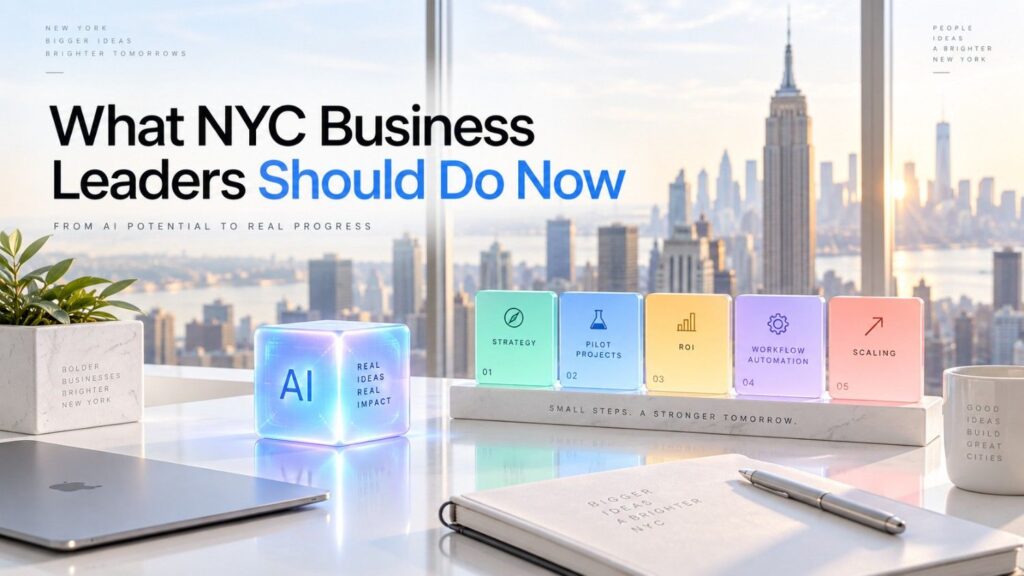
What NYC Business Leaders Should Do Now
The mistake in 2026 would be waiting for a perfect universal AI agent.
Businesses do not need one.
The more practical opportunity is to identify three to five workflows where people are already spending large amounts of time on structured, repetitive, computer-based work.
Rank those workflows by economic impact.
Then determine which can be delegated safely.
The winning company may not be the business with the largest AI budget. It may be the business that learns fastest where agents belong, where humans belong, and how the two should work together.
That requires operational discipline more than hype.
It also means the people closest to the process should be involved.
An accounting agent should be tested with accountants.
A healthcare agent should be tested with healthcare operations staff.
A compliance agent should be evaluated with compliance professionals.
A sales agent should be measured against real revenue workflows.
AI expertise matters.
Domain expertise matters just as much.
Final Takeaway
New York City’s AI agent market is becoming one of the clearest examples of what the next stage of artificial intelligence may look like.
The city is not mainly producing agents that exist for entertainment or novelty. Its strongest startups are embedding AI into the work of finance, law, accounting, healthcare, real estate, procurement, compliance, sales, and other major industries.
Our 20-company study found companies at every stage from tiny pre-seed teams to billion-dollar businesses. Ten companies in the sample announced a combined $578 million in qualifying financing during the first eight months of 2026 alone, while the latest comparable primary rounds across 18 companies total roughly $1.22 billion.
More important than the money is what those companies are building.
Rogo is pushing agents deeper into financial work. Basis is giving accounting firms agents that can work for hours. Norm AI is applying agents to law and compliance. Tennr is attacking healthcare administration. EliseAI is turning property operations into an agentic system. Lio is building a digital procurement workforce. Hadrius is adding agents to financial compliance. Patlytics is building specialized agents around patents.
These companies are different, but the direction is consistent.
Software is beginning to move from helping people do work to taking responsibility for part of the work itself.
For a city built around valuable, complicated, information-heavy industries, that shift could be especially important.
New York does not need to build every foundation model to become one of the world’s most important AI cities.
It needs to become the place where artificial intelligence learns how real businesses actually work.
The first generation of New York AI startups proved that AI could understand business information.
The companies on this list are trying to prove something much bigger.
They want AI to do the job.