

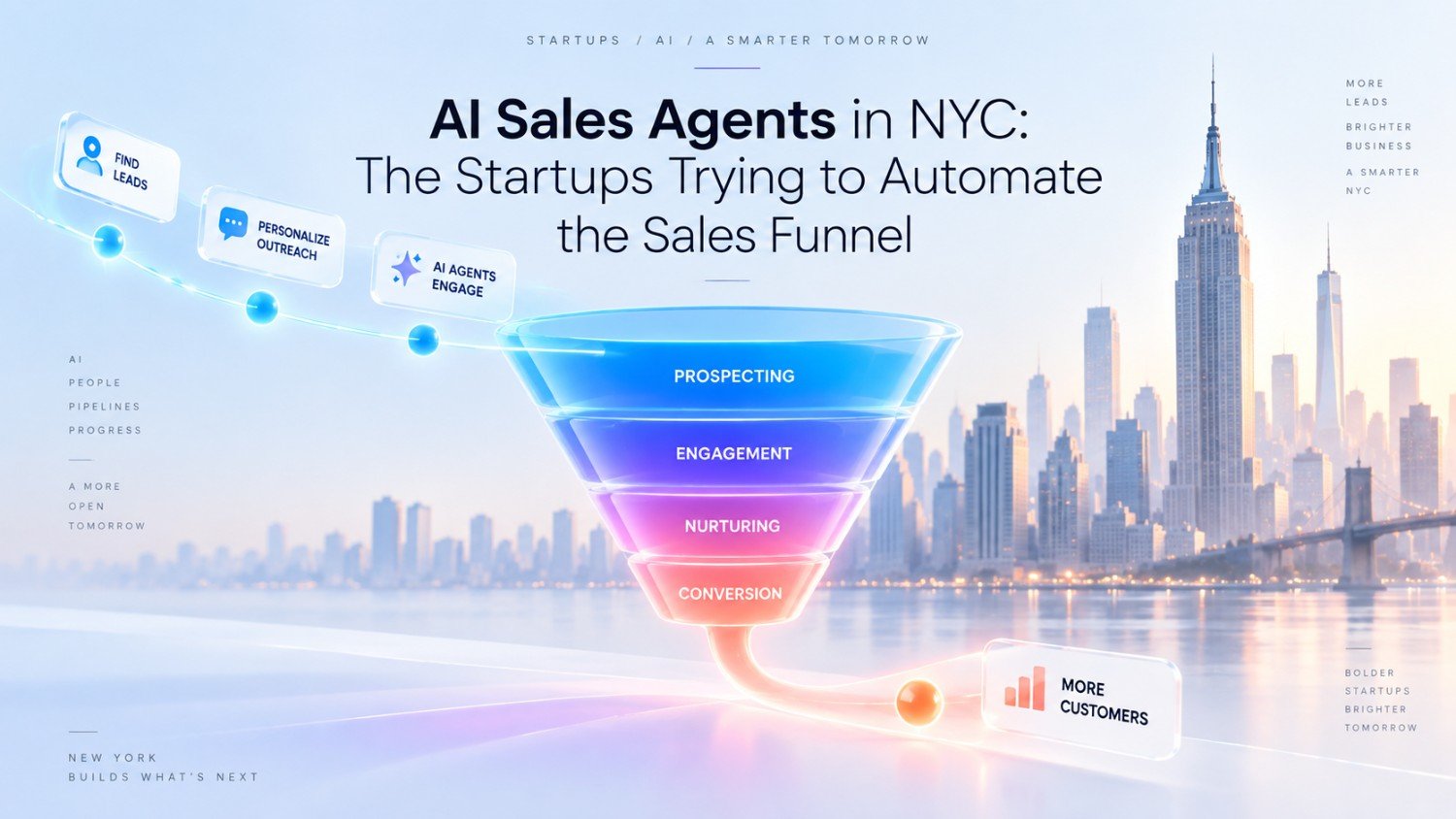
Sales software used to help salespeople keep records.
Then it started helping them write emails, find leads, record calls, update customer relationship management systems, and prepare for meetings.
Now a much bigger change is happening.
A new group of AI companies wants software to actually do parts of the sales job.
Instead of giving a salesperson a list of leads, an AI agent can research those accounts. Instead of telling a rep that a prospect changed jobs, it can decide whether that change matters. Instead of reminding someone to send a follow-up, it can draft the message, update Salesforce, schedule the next action, and sometimes send the message itself.
New York has quietly become one of the most important places to watch this change.
Companies including Clay, Actively, Attention, Regal, Siro, Lavender, and Airspeed are attacking different parts of the sales funnel. Some are building agents for prospecting. Others work after a sales call. Some are focused on face-to-face selling. Regal is going even further by putting AI directly into customer phone conversations.
The category is also attracting serious money.
Clay raised another $115 million on September 9, 2026, at a $7.1 billion valuation. The company says more than 17,000 businesses now use its platform. It is increasingly describing its future not simply as sales software, but as an engine that can help companies grow through autonomous AI-driven work.
But the biggest story is not that New York startups are building robotic salespeople.
Our analysis suggests something more interesting.
The strongest companies are building different autonomous layers around the salesperson. AI researches accounts before the rep arrives. It watches signals while the rep is busy. It prepares outreach. It captures calls. It updates the CRM. It recommends what should happen next.
The human increasingly becomes the person who manages the exceptions, makes judgment calls, builds trust, and handles the parts of a deal where relationships matter most.
That could change how New York companies structure sales teams far more than simply replacing a few SDRs.
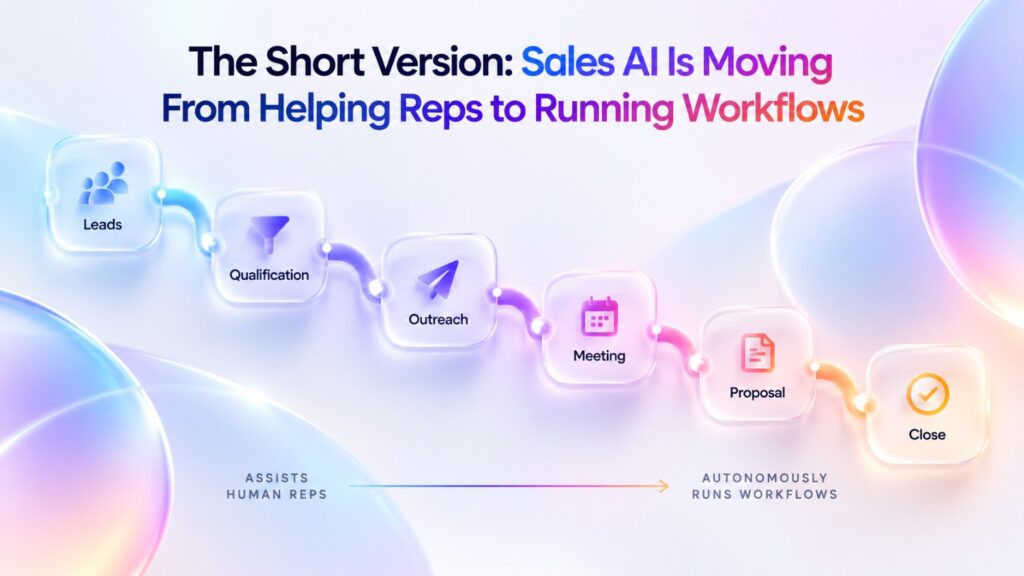
The Short Version: Sales AI Is Moving From Helping Reps to Running Workflows
NYC Tech Journal analyzed seven important companies with a meaningful New York presence whose products automate parts of revenue or sales work:
| Company | Main Sales Problem | Agent Role | Publicly Disclosed Funding Used in Our Analysis |
| Clay | Prospecting, data, GTM workflows | Researches accounts, decides actions, runs workflows | ~$319M primary funding |
| Regal | Customer conversations | Autonomous voice agents | $82.1M |
| Siro | In-person selling | Records, coaches, follows up, updates systems | $75M |
| Actively | Account coverage | Persistent agent for each account | $68M |
| Attention | Post-call execution | Follow-up, CRM, next actions | $47.1M |
| Airspeed | Revenue execution | Pipeline, CRM, forecasting and coaching agents | $25M+ |
| Lavender | Sales email | Researches, writes and sends outreach | $13.2M |
NYC Tech Journal calculation: at least $629.4 million in disclosed funding across this seven-company sample.
That number should be treated as a lower-bound estimate rather than a perfect accounting figure. Funding databases handle secondary transactions differently. Clay is the clearest example: one company funding page reports $392 million, while another public funding tracker reports about $319 million in primary capital. For our analysis, we use approximately $319 million because we are trying to measure capital invested into the business rather than employee tender transactions.
That methodology matters because Clay alone represents roughly half of the capital in our sample.
Chart: Share of Disclosed Funding in Our NYC Sales-AI Sample
Clay █████████████████████████ 50.7%
Regal ██████ 13.0%
Siro ██████ 11.9%
Actively █████ 10.8%
Attention ████ 7.5%
Airspeed ██ 4.0%+
Lavender █ 2.1%
The top four companies in the dataset account for about 86% of the capital.
That tells us something important.
Investors are not spreading money evenly across dozens of simple AI email generators. Capital is concentrating around companies trying to own a larger part of the revenue workflow.
Original Research: How NYC Tech Journal Built the Sales Agent Market Map
The term “AI sales agent” has become so broad that almost any sales product can use it.
We wanted a stricter definition.
To enter our core dataset, a company needed to meet three tests.
First, it needed a meaningful New York connection. That could mean headquarters in New York, being explicitly described as built in NYC, or operating significant New York and another-city teams, as Airspeed does with London and New York.
Second, the product had to automate meaningful sales work rather than simply provide a chatbot.
Third, we needed public evidence describing what the system actually does.
We reviewed company product pages, funding announcements, recent company updates, public job descriptions, press coverage, and product documentation available through September 12, 2026.
This is not meant to be a complete database of every tiny AI sales startup operating in New York. Very early companies often disclose little information, and new products appear constantly.
Instead, the goal was to identify the companies that best show where the market is moving.
The Five-Part Autonomy Test
We also created an original Sales Agent Autonomy Score.
Each company was evaluated across five parts of the sales workflow:
| Dimension | What We Asked |
| Research and qualification | Can the AI research, prioritize or qualify an account? |
| Outreach | Can it prepare or execute sales communication? |
| Conversation | Can it participate in or materially assist live selling? |
| CRM and administration | Can it update systems without manual data entry? |
| Next action | Can it decide or recommend what should happen next? |
Each dimension was scored:
0 = little or no evidence of that capability
1 = AI assists or recommends
2 = AI can execute meaningful work
The score measures product scope, not product quality. A company receiving 9/10 is not necessarily better than one receiving 5/10. It simply attempts to automate more layers of the workflow.
NYC Tech Journal Sales Agent Autonomy Score
| Company | Research | Outreach | Conversation | CRM/Admin | Next Action | Scope Score |
| Regal | 1 | 2 | 2 | 2 | 2 | 9/10 |
| Clay | 2 | 2 | 0 | 2 | 2 | 8/10 |
| Attention | 1 | 2 | 1 | 2 | 2 | 8/10 |
| Airspeed | 1 | 1 | 1 | 2 | 2 | 7/10 |
| Actively | 2 | 1 | 0 | 1 | 2 | 6/10 |
| Lavender | 2 | 2 | 0 | 1 | 1 | 6/10 |
| Siro | 0 | 1 | 1 | 2 | 1 | 5/10 |
These ratings are based on documented features, not vendor performance claims.
That distinction is essential.
A system being capable of sending an email does not mean businesses should allow every email to be sent without approval. A voice agent being technically capable of handling calls does not mean it should handle every customer or every situation.
The most interesting question is therefore not:
Can AI perform this task?
The better question is:
At what level of risk should AI be allowed to perform this task without a human?
That is where sales automation becomes a management problem rather than a software problem.
Original Finding #1: More Than $600 Million Is Chasing the Sales Execution Layer
Our sample contains at least $629 million in disclosed capital.
That alone is meaningful.
But the distribution is even more revealing.
Clay accounts for about 51% of the total. Regal, Siro, and Actively add another 36%. Together, the four largest companies represent roughly 86% of funding across the companies we analyzed.
The market is becoming concentrated around companies with more ambitious products.
Clay is building infrastructure for the top of the funnel and increasingly for account-level actions. Regal is trying to automate actual customer conversations. Actively wants an agent continuously watching each account. Siro brings AI into physical sales conversations.
This is a very different market from the first wave of generative sales software, where dozens of products competed to write slightly better cold emails.
Capital Concentration in the Sample
Top 1 company ██████████████████████████ 50.7%
Top 3 companies ██████████████████████████████████████ 75.6%
Top 4 companies ███████████████████████████████████████████ 86.4%
All others ███████ 13.6%
The implication for buyers is simple.
Do not evaluate sales AI based only on which model writes the best email today.
Large language models will continue improving. Basic text generation is becoming easier to copy.
The deeper value is moving toward the infrastructure surrounding the model: account history, proprietary data, integrations, workflow logic, permissions, feedback loops, memory, and the ability to connect an AI decision to a real business action.
That is much harder to copy.
Original Finding #2: NYC Is Automating the Work Around the Conversation Faster Than the Conversation Itself
When we mapped the seven companies against the sales funnel, another pattern appeared.
The crowded areas are research, outreach preparation, CRM work, and next-step decisions.
The least automated part is still the most human part: a complex live conversation.
NYC Sales-Agent Funnel Coverage
| Sales Stage | Strong Examples in Our Sample | Relative Activity |
| Market and account discovery | Clay, Actively | High |
| Account research | Clay, Actively, Lavender | Very high |
| Lead prioritization | Clay, Actively, Lavender | High |
| Email outreach | Clay, Lavender, Actively | Very high |
| Phone conversations | Regal | Emerging |
| In-person selling | Siro | Emerging |
| Meeting intelligence | Attention, Airspeed, Siro | High |
| CRM updates | Attention, Airspeed, Siro, Clay | Very high |
| Follow-up execution | Attention, Siro, Lavender | High |
| Deal risk and next action | Actively, Attention, Airspeed, Clay | Very high |
| Fully autonomous closing | Very limited evidence | Low |
This creates an important picture of where sales automation is going.
The first major wave may not be an AI salesperson that independently takes a prospect from “never heard of us” to signed enterprise contract.
Instead, automation is eating the sales process from both sides of the human conversation.
Before the conversation, agents gather information, rank accounts, find contacts, research companies, and prepare messages.
After the conversation, agents summarize information, update systems, prepare follow-ups, identify risk, and decide what needs attention.
The human remains in the center.
That center may get smaller over time, but it is still strategically important.
Original Finding #3: Human Approval Is Becoming a Product Feature, Not a Failure of Automation
One of the easiest mistakes companies can make is assuming the most autonomous sales system must be the most advanced.
The products we studied suggest the opposite.
Several leading companies are deliberately creating approval layers.
Actively describes a process where agents research an account and prepare outreach, while the salesperson reviews and sends it.
Attention is building an action engine that ranks high-impact moves and executes the actions a rep approves.
Airspeed says agents can work across sales conversations, CRM activity, forecasts, coaching, and pipeline actions, while customer-facing outputs can still require approval.
Lavender’s Ora gives teams both choices. A company can review messages before launch or use a more autonomous mode in which Ora researches prospects and sends emails itself.
Clay’s Account Agents choose from actions the company has already allowed, creating another form of controlled autonomy.
This is not a weakness.
It may be one of the most important enterprise design choices in the entire category.
The best sales process will probably not use one autonomy setting everywhere.
A low-risk CRM field update might happen automatically.
A routine follow-up after a demo may need only light review.
An email to the CEO of a $20 billion target account may require approval.
A pricing concession definitely should.
An AI agent therefore needs something similar to spending authority inside a company.
The greater the financial, reputational, legal, or relationship risk, the higher the approval requirement should be.
Why New York Is a Logical Home for Sales Automation
New York has one major economic characteristic that makes this category particularly interesting: human commercial talent is expensive.
The Bureau of Labor Statistics reported that sales and related jobs in the New York metro area paid an average of $36.03 an hour in May 2025, compared with $26.43 nationally. Sales managers in the New York metro had an average annual wage of $233,770.
That does not mean companies should replace expensive workers with cheap agents.
It means the value of removing low-value work from expensive workers can be unusually high.
If an enterprise account executive is spending hours searching the internet, copying notes into Salesforce, checking whether a champion changed jobs, and formatting follow-up emails, the company is using expensive human judgment on tasks that often require very little human judgment.
AI changes that equation.
The best economic use of an agent may therefore be less about removing the salesperson and more about increasing the percentage of the salesperson’s day spent on things worthy of an expensive salesperson.

That is especially relevant in New York, where companies sell complex financial products, enterprise software, healthcare technology, advertising, professional services, real estate, and other products that often require trust and judgment.
Clay — Turning the Top of the Funnel Into Infrastructure
Clay is difficult to describe as a simple AI sales agent.
That is exactly why it matters.
The company started by helping go-to-market teams combine data from many providers, research prospects, enrich records, and build workflows.
It is increasingly turning those pieces into an agentic system.
Clay’s Account Agents can reason over information about an account, decide what should happen next, remember previous conclusions, and trigger permitted actions. Its system can update a CRM, notify an account owner, and run another workflow.
Clay also combines data from more than 200 providers with AI research, lead scoring, enrichment, outbound personalization, and CRM updates.
Why Clay Matters
Most sales agents have the same underlying problem.
They need context.
An AI cannot intelligently decide whether a company is a good prospect if it knows almost nothing about the company.
It cannot personalize an email correctly if the data is wrong.
It cannot decide whether to contact someone if it does not know that another salesperson spoke to that person yesterday.
Clay is attacking this data and orchestration layer.
Its Account Research Agents can combine CRM information, warehouse data, call transcripts, email activity, third-party signals, and other context.
That makes Clay less like “an AI SDR” and more like infrastructure on which a company can build many different sales motions.
Clay’s Own Sales Organization Creates an Interesting Counterexample
The company also provides a useful warning against simplistic job-replacement predictions.
Clay says that around a year before September 2026, it had roughly 16 sales reps and no SDR organization. By September 2026, it described a much larger organization, including 33 “ClayDRs” and 82 GTM engineers, while sales-led revenue had become a much bigger part of its business.
That does not prove AI creates sales jobs.
Clay is growing quickly, so many factors are involved.
But it demonstrates something important.
A company can automate large amounts of prospecting and sales work while simultaneously building a larger human commercial organization.
The jobs simply change.
Actively — One AI Agent for Every Account
Actively attacks a different problem.
Most sales teams have far more accounts than their people can deeply understand.
A rep may technically “own” 200 accounts. In reality, only a small portion receive serious attention during any given week.
Actively’s answer is a persistent agent attached to each account.
The agent monitors what is happening, maintains context, identifies opportunities, prepares work, and tells the human what deserves attention.
The company calls this the Per-Account Agent.
Its public product material says agents operate continuously across the customer lifecycle, helping teams research accounts, identify changes, prepare outreach, spot risks, and suggest next actions.
The Big Idea Is Coverage
This is a different philosophy from an AI SDR blasting 5,000 emails.
Actively is betting that the bottleneck is not how quickly a salesperson can type.
The bottleneck is the number of accounts a person can seriously understand at once.
This matters because enterprise sales often contains small signals.
A champion changes companies.
A new executive starts.
A target business announces a product launch.
A previous deal went quiet six months ago but suddenly becomes relevant again.
A competitor gets mentioned during a call.
Individually, none of these signals is difficult to understand.
The difficulty is watching thousands of accounts continuously.
That is the job Actively wants to give to machines.
The company raised a $45 million Series B in April 2026, bringing total funding to $68 million.
The strategic lesson is significant.
Sales automation may move from task automation toward account automation.
Instead of asking an AI to “research Acme Corporation,” companies may assign Acme Corporation permanently to an agent that never stops watching.
Attention — Automating What Happens After the Call
Salespeople have been using call recorders and transcription tools for years.
The obvious next question is:
What happens after the software understands the call?
Attention is trying to answer that.
The New York-headquartered company says its agents can draft and send follow-ups, update systems of record, and run the next play instead of simply recording what happened. It reported more than 500 customers when it announced its $30 million Series B in June 2026.
That follows a $14 million Series A announced in 2024 and earlier seed capital, bringing publicly reported total funding to roughly $47.1 million.
Why the Post-Call Layer Matters
Consider what normally happens after a good discovery call.
Someone needs to write notes.
The opportunity needs to be updated.
Qualification fields may need changing.
An email needs to go out.
The next meeting needs to be scheduled.
A technical question may need routing to another employee.
A manager may need to know the deal changed.
None of these tasks is individually difficult.
Together, they create a large amount of operational drag.
Attention’s thesis is that software should not stop after saying, “Here is your call summary.”
The system should act.
That distinction between a system of insight and a system of action is appearing across the NYC sales-AI ecosystem.
Regal — The Agent Actually Talks to the Customer
Regal moves automation closer to the most sensitive part of selling: the actual customer conversation.
The Manhattan-based company builds voice AI agents for sales, service, and other customer interactions.
Regal says its platform connects agents with customer data, existing contact-center software, CRM systems, monitoring tools, safety controls, and orchestration. The company advertises capabilities including real-time personalization, automated customer conversations, monitoring, testing, and escalation.
Public job postings say Regal has raised about $82 million and operates from its New York headquarters.
Voice Changes the Risk Model
An email can be reviewed before it leaves.
A CRM update can be reversed.
A live phone conversation happens immediately.
That makes voice agents a more difficult engineering and management problem.
An agent may need to understand interruptions, accents, pricing questions, unusual requests, complaints, regulatory requirements, emotional customers, and situations that need escalation.
This explains why Regal’s platform emphasizes monitoring, safety layers, business context, orchestration, and human escalation rather than simply the language model itself.
This is an important signal for buyers.
The closer an AI system gets to the customer, the less useful it becomes to judge the vendor on a polished demo alone.
The real questions become:
How does the agent fail?
How quickly does it know that it is confused?
Can a human take over?
Are calls evaluated?
Can the company see exactly why an action happened?
Can the workflow be tested before it reaches thousands of customers?
Those are operating questions, not model questions.
Siro — Bringing AI Into Face-to-Face Selling
Most sales technology assumes that selling happens inside Gmail, Salesforce, Zoom, or a telephone system.
Siro is interesting because it focuses on a huge part of sales that happens away from a desk.
Its system is designed for in-person sales teams.
A salesperson can record a conversation through the mobile app. Siro can capture the discussion, provide coaching, prepare follow-up work, update the CRM, and identify parts of the conversation that helped or hurt the deal.

The company raised a $50 million Series B in May 2025, bringing total funding to $75 million.
Why Field Sales Is an Underrated AI Market
A Zoom-based software salesperson already leaves a huge digital trail.
The calendar knows when the call happened.
The meeting platform can record it.
Email captures communication.
Salesforce stores the deal.
Field selling can be much less visible.
A rep may drive to someone’s home, a dealership, showroom, worksite, or business location. Managers often know much less about what was actually said.
Siro turns those conversations into structured information.
That does more than automate note-taking.
It creates data that previously did not exist in a usable form.
This could eventually allow businesses to study hundreds of thousands of physical sales conversations the same way digital companies study clicks.
Lavender — From Email Coach to Email Agent
Lavender began with a more focused problem: helping salespeople write better emails.
Its AI email coach analyzes sales messages and provides guidance on clarity, personalization, length, and other factors.
The New York-headquartered company announced $13.2 million in seed and Series A funding in 2023.
Its newer product, Ora, pushes the company deeper into agentic selling.
Ora can research prospects, companies, and markets, reason over that information, write personalized emails, and send them. The product can connect with Salesforce, while teams can choose between human approval and more autonomous campaign execution.
Lavender Shows Why More Emails Is Not Necessarily the Goal
This point matters.
Generative AI made it incredibly cheap to create outbound messages.
That also created a new problem.
If every salesperson can generate 1,000 personalized-looking emails, inboxes become full of personalized-looking emails.
The marginal value of another generated message drops.
Lavender’s positioning increasingly reflects this problem. Its approach emphasizes research, relevance, timing, and controlled volumes rather than simply sending as many messages as possible.
That may be where the broader market goes.
As message creation becomes almost free, attention becomes more expensive.
The winners will need to decide who should receive a message, why now, and what is worth saying.
Airspeed — Building the Revenue Execution Layer
Airspeed, previously called Glyphic, operates in both London and New York.
The company raised a $20 million Series A in June 2026. Public reports put total funding above $25 million.
Airspeed describes itself as a commercial brain for revenue organizations.
Its agents can work across customer conversations, pipeline management, CRM updates, forecasting, coaching, and marketing. The company says its CRM agent can automatically write information into Salesforce or HubSpot, while other agents analyze pipeline and revenue signals.
Why This Category Is Expanding Beyond Sales
This is another important trend.
Traditional software categories have clear walls.
Sales software is for sales.
Marketing software is for marketing.
Customer-success software is for customer success.
Account-level AI has a harder time respecting those boundaries.
The same customer may move from marketing lead to prospect to opportunity to customer to expansion account.
If the agent maintains memory through that entire journey, the old software boundaries become less useful.
That is why companies such as Actively and Airspeed talk about the broader revenue lifecycle rather than only prospecting.
The unit of software may eventually become the account, not the department.
The Sales Funnel Is Becoming a Set of Machine-Executable Jobs
The easiest way for a business leader to understand this shift is to stop thinking about “AI sales reps.”
Break the funnel into jobs.
Stage 1: Find the Right Companies
Old process:
A salesperson searches LinkedIn, uses a data vendor, reads websites, builds lists, and decides whether a company looks relevant.
Agentic process:
Software continuously searches company data, hiring information, funding announcements, web signals, product usage, previous interactions, and other information.
Clay is especially strong here.
Actively takes a more persistent approach by keeping agents attached to accounts.
Stage 2: Find the Right Person
The company is only half the problem.
An enterprise deal can involve executives, department leaders, users, finance, procurement, security, and legal teams.
AI can identify possible stakeholders, monitor job changes, enrich contact details, and help determine which person is worth contacting.
The value is not merely saving ten minutes of research.
The bigger opportunity is maintaining an account map that stays current automatically.
Stage 3: Decide Who Deserves Attention Today
This may become one of the highest-value jobs for AI.
Most salespeople begin their day deciding what to work on.
That decision is often based on memory, recent emails, what appears in Salesforce, and whatever deal feels urgent.
Agents can evaluate much larger amounts of information.
The goal is to move from:
“What should I do today?”
to:
“Here are the five things that need your judgment today. Everything else is already moving.”
Stage 4: Prepare the Outreach
This is already highly automated.
The danger is that writing became automated before strategy did.
A system can create a grammatically perfect message for the wrong prospect.
That still produces a bad sales process.
Research and prioritization therefore need to happen before generation.
Stage 5: Send or Execute the Outreach
At this point, risk rises.
The organization needs rules.
Low-value outreach may be automated.
Strategic accounts may require review.
Existing customers should have different controls from cold prospects.
Regulated industries may require even more oversight.
A single “AI on/off” switch is not enough.
Stage 6: Conduct the Conversation
This is where Regal and Siro become especially interesting.
Regal is working toward autonomous customer conversations.
Siro helps humans perform better during physical conversations.
These represent two different futures.
One replaces some conversations.
The other augments the human inside the conversation.
Both models will probably survive.
Stage 7: Capture What Happened
This work is becoming highly automatable.
Salespeople should rarely need to spend ten minutes manually typing basic notes into a CRM after every meeting.
Attention, Siro, Airspeed, and others are attacking this administrative layer.
Stage 8: Decide What Happens Next
This may become the most important layer of all.
The AI already knows:
who attended,
what was discussed,
what the prospect cares about,
which questions remain unanswered,
where the deal is in the process,
and what has worked in similar situations.
The logical next step is not only to summarize the meeting.
It is to recommend the next move.
Then the next step is to perform the low-risk parts of that move.
That is the progression from assistant to agent.
Which Sales Workflows Should New York Companies Automate First?
Companies should not begin with the most impressive demo.
Start with workflows that combine three qualities:
high volume,
low strategic risk,
and measurable output.
NYC Tech Journal Sales-Automation Priority Matrix
| Workflow | Automation Potential | Risk if Wrong | Recommended Priority |
| Account research | Very high | Low | Start now |
| Contact enrichment | Very high | Low | Start now |
| Meeting preparation | Very high | Low | Start now |
| CRM data entry | Very high | Low | Start now |
| Call summaries | Very high | Low | Start now |
| Routine follow-up drafts | High | Medium | Start with approval |
| Lead prioritization | High | Medium | Start with monitoring |
| Cold outbound sending | High | Medium/high | Test carefully |
| Forecast recommendations | High | Medium | Use as decision support first |
| Pricing discussion | Medium | High | Keep human-controlled |
| Negotiation | Medium | Very high | Human-led |
| Strategic enterprise outreach | Medium | Very high | Human approval required |
| Contract commitments | Low | Extreme | Do not delegate casually |
This framework protects companies from a common mistake.
Do not automate based on technical possibility.
Automate based on the cost of being wrong.
A Practical 90-Day AI Sales Agent Plan
A business does not need to redesign its entire sales organization in one quarter.

It should prove value inside a controlled workflow first.
Days 1–15: Measure the Current Funnel
Before buying another platform, understand where time disappears.
Measure how much time reps spend on research, CRM work, meeting preparation, note-taking, follow-up, internal pipeline updates, and actual customer conversations.
Also measure baseline funnel performance.
You need numbers for reply rate, meeting rate, qualified opportunity rate, sales-cycle length, conversion rate, pipeline per rep, CRM completeness, and time from meeting to follow-up.
Without a baseline, almost any AI pilot can look successful.
Days 16–30: Choose One Painful Workflow
Do not choose “automate sales.”
Choose something narrow.
For example:
“Reduce average account research from 25 minutes to five minutes without reducing research quality.”
Or:
“Update required CRM fields automatically after discovery calls with 95% field accuracy.”
Or:
“Send approved follow-up within ten minutes of every qualified demo.”
Now the project can be measured.
Days 31–45: Build the Control Group
Do not deploy the product across the whole team immediately.
Use a group of reps, territories, or accounts.
Keep another comparable group on the existing workflow when possible.
This gives management a better answer than asking users whether they “like the AI.”
Compare business outcomes.
Days 46–60: Measure Quality, Not Activity
AI can make bad activity explode.
An agent that sends 10 times more emails is not automatically improving sales.
Measure downstream outcomes.
Did positive replies rise?
Did qualified meetings rise?
Did opportunities improve?
Did unsubscribe rates increase?
Did deliverability fall?
Did more meetings happen but fewer become real opportunities?
An AI system should be judged by business movement, not generated output.
Days 61–75: Increase Autonomy One Step
If quality remains strong, remove one approval point.
Do not remove all of them.
For example, allow the agent to update routine CRM fields automatically while keeping customer emails under review.
Or allow autonomous follow-up for low-value inbound leads while requiring approval for named enterprise accounts.
This gradual approach helps the company discover where the technology actually fails.
Days 76–90: Decide Whether to Scale
At the end of 90 days, management should answer four questions.
Did revenue outcomes improve?
Did human time move toward more valuable work?
Did risk remain acceptable?
Did the system create enough economic value to justify its full cost?
If the answer is yes, scale.
If the only improvement was “reps generated more stuff,” stop.
The KPI Dashboard Every AI-Native Sales Team Should Build
The old dashboard is not enough.
AI changes the economics of activity.
When software can create almost unlimited emails, call summaries, account research, and tasks, volume stops being a useful sign of productivity.
Human Productivity
| KPI | What It Shows |
| Selling hours per rep | Whether AI actually frees selling time |
| Accounts actively covered | Whether territory coverage expands |
| Research time per opportunity | Efficiency before meetings |
| CRM admin time | Administrative reduction |
| Follow-up delay | How quickly actions occur |
Funnel Quality
| KPI | Why It Matters |
| Positive reply rate | Better than measuring emails sent |
| Meeting-to-opportunity rate | Tests lead quality |
| Opportunity-to-win rate | Tests whether pipeline is real |
| Average sales cycle | Measures execution speed |
| Pipeline per rep | Measures commercial leverage |
| Revenue per rep | Measures final productivity |
Agent Quality
| KPI | Why It Matters |
| Agent action acceptance rate | Are humans trusting recommendations? |
| Agent correction rate | How often is output wrong? |
| CRM field accuracy | Are automated updates reliable? |
| Escalation rate | How often does the AI need help? |
| Customer complaint rate | Is automation damaging experience? |
| Human override rate | Are controls calibrated correctly? |
The Most Important Metric: Revenue per Human Hour
The long-term metric may not be emails sent per salesperson.
It may be revenue generated per hour of human commercial attention.
That captures what agents are really supposed to change.
If software handles research, preparation, administration, and routine follow-up, every remaining human hour should become more valuable.
Where AI Sales Agent Projects Go Wrong
The technology can be impressive while the implementation fails.
Several mistakes are especially dangerous.
Automating a Bad Sales Process
AI scales whatever process already exists.
If the company’s targeting is poor, automation finds more bad prospects.
If its messaging is weak, automation creates more weak messages.
If CRM rules are inconsistent, automation may simply write inconsistent information faster.
Fix the process before scaling it.
Confusing Personalization With Relevance
Including someone’s university or recent LinkedIn post does not automatically make outreach relevant.
The message still needs a business reason to exist.
AI should answer:
Why this account?
Why this person?
Why now?
What problem might matter?
What evidence supports that belief?
If the system cannot answer those questions, it probably should not send the message.
Measuring Volume
AI sales software can create enormous amounts of activity.
That makes activity metrics dangerous.
A team can proudly report a 400% increase in outbound while damaging its domain reputation and generating almost no additional revenue.
Track outcomes.
Giving the Agent Too Much Authority Too Soon
Every agent should begin with a limited permission set.
A prospecting agent may be allowed to research accounts.
Then it might draft messages.
Later, it may send certain messages.
Eventually, it might execute workflows for specific segments.
Autonomy should be earned through measured accuracy.
Ignoring Data Quality
An advanced model working from bad account data remains a bad system.
This is one reason companies such as Clay are becoming so important.
The model is only one layer.
Identity, account history, previous communication, data freshness, and system permissions determine whether an agent understands reality.
AI Could Change Sales Jobs Without Removing the Sales Organization
The biggest organizational change may be a move from people doing repetitive sales tasks to people supervising revenue systems.
A traditional SDR spends much of the day building lists, researching accounts, drafting outreach, following up, updating systems, and trying to figure out what deserves attention.
An AI-native SDR may work differently.
The agent researches hundreds of accounts overnight.
It identifies the twenty that changed.
It prepares context.
It drafts outreach.
The human examines the highest-value opportunities, makes adjustments, communicates with prospects, and teaches the system what worked.
That is a different job.
Sales Operations Could Move Closer to Engineering
Clay has helped popularize the term “GTM engineer.”
The role sits somewhere between sales operations, marketing operations, automation, data, and engineering.
That structure makes sense in an agentic sales organization.
Someone needs to design workflows.
Someone needs to define permissions.
Someone needs to connect data.
Someone needs to test whether agents are making good decisions.
Someone needs to inspect failures.
Someone needs to improve prompts, routing rules, enrichment, context, and measurement.
As sales becomes more executable through software, revenue operations becomes more technical.
The Bigger Battle May Be Over the Sales System of Record
Salesforce and other CRMs became powerful because companies needed one place to store customer information.
But agents introduce a new question.
What if the most important system is not the one that stores the record?
What if it is the system deciding what to do with the record?
That is why so many startups increasingly describe themselves as an execution layer, intelligence layer, action layer, or commercial brain.
They are not necessarily trying to delete the CRM tomorrow.
They are trying to become the place where decisions happen.
The CRM might remain the database.
The agent becomes the worker.
That creates a strategic battle over where salespeople actually spend their time.
If a rep begins the morning inside an agent inbox that already knows which accounts matter, what happened yesterday, which deals are slipping, and what actions should happen next, the CRM becomes infrastructure behind the interface.
That could be one of the most important changes in enterprise software over the next several years.
Five Predictions for NYC’s AI Sales Agent Market
1. The Standalone AI SDR Category Will Get Harder
Writing outbound messages is becoming easy.
Data, context, deliverability, account memory, integration, workflow control, and proprietary learning are much harder.
Companies whose only advantage is “we generate cold email with AI” will face enormous pressure.
2. Account Memory Will Become a Major Moat
The agent that understands three years of customer history should make better decisions than an agent receiving a fresh prompt every morning.
Persistent account intelligence may therefore become one of the most valuable parts of the stack.
Actively and Clay are already pushing heavily in this direction.
3. Voice Will Become a Bigger Part of the Market
Email was easy to automate because it is asynchronous.
Voice is harder.
But voice has one huge advantage: a customer can explain what they actually want.
As latency, reasoning, evaluation, and safety systems improve, more sales and qualification conversations will move to AI voice agents.
Regal gives New York a strong position in that market.
4. AI Agents Will Create More Specialized Human Roles
AI will remove tasks.
That does not automatically mean commercial teams disappear.
Companies may hire fewer people for repetitive list-building while hiring more GTM engineers, agent managers, enterprise sellers, customer strategists, data operators, and technical salespeople.
Clay’s own sales expansion provides one early example of how automation and commercial hiring can happen at the same time.
5. Sales Leaders Will Manage Fleets of Agents
A sales manager today manages people, pipeline, territories, forecasts, and process.
The future role may include another responsibility:
managing machines.
Which agents can send messages?
Which can edit Salesforce?
Which can contact customers?
Which need approval?
Where are error rates rising?
Which workflows are actually increasing revenue?
The sales manager becomes partly an operating-system manager.
What New York Business Leaders Should Do Now
The most dangerous response to the rise of AI sales agents is either extreme.
One extreme is to dismiss the category because humans remain better at important parts of selling.
The other is to assume the entire funnel should immediately become autonomous.
Neither approach makes sense.
Begin by identifying all the work around your salesperson that does not truly require a salesperson.
Research is a good candidate.
CRM administration is a good candidate.
Meeting preparation is a good candidate.
Basic follow-up is a good candidate.
Monitoring thousands of accounts for changes is an excellent candidate.
Then identify the work where human judgment creates real economic value.
Important conversations.
Negotiation.
Pricing.
Complex discovery.
Trust building.
Internal politics.
Executive relationships.
Creative deal strategy.
Keep humans focused there.
The best agentic sales organization will probably not be the company with the fewest salespeople.
It may be the company where human salespeople spend the smallest possible amount of time doing work that a human never needed to do.
The Bigger Story: The Sales Funnel Is Becoming Executable
For twenty years, businesses digitized sales.
They put contacts into databases.
They moved communication into email.
They recorded calls.
They built dashboards.
They measured activity.
But humans still connected most of those systems manually.
Someone noticed the signal.
Someone researched the account.
Someone decided what mattered.
Someone wrote the message.
Someone updated the record.
Someone remembered to follow up.
AI agents are starting to connect those steps.
Clay can turn account information into workflows and actions.
Actively can keep an agent running against an account even when the salesperson is doing something else.
Attention can turn conversations into follow-up work.
Siro can capture and structure what happens in a physical sales conversation.
Lavender can research and execute email outreach.
Airspeed can move conversation data into CRM, pipeline, coaching, and forecast workflows.
Regal can put the agent directly into the conversation.
These companies are not simply building smarter buttons inside old sales software.
They are trying to make larger parts of revenue work executable by machines.
The companies that benefit most will not be those that automate everything first.
They will be the companies that understand exactly where machines create leverage, exactly where humans create value, and exactly where the boundary between the two should sit.

That boundary is becoming one of the most important operating decisions in modern sales.
And New York is becoming one of the most interesting places to watch it move.