
Healthcare has spent years buying software that helps people do work. The next wave of healthcare software is starting to do parts of that work itself.
That difference sounds small, but it changes almost everything.
A traditional healthcare software product might show a patient’s insurance information, summarize a chart, answer a question, or display open appointment slots. An AI agent can potentially go several steps further. It can read an incoming referral, check what information is missing, contact the referring office, verify eligibility, update the record, schedule the patient, send a reminder, and alert a human when something unusual happens.
The same shift is appearing in billing, prior authorization, patient calls, clinical documentation, care navigation, credentialing, and even parts of clinical decision support.
New York has quietly become one of the most interesting places to watch this transition.
Digital Health New York reported that 126 companies in the New York healthcare ecosystem raised about $4.8 billion during 2025. In Q2 2026 alone, 40 companies raised another $1.2 billion. DHNY’s 2026 report describes AI as moving from potential toward practical applications that improve operations, clinical decisions, and measurable outcomes.
The national numbers point in the same direction. U.S. digital health startups raised $14.2 billion in 2025, according to Rock Health. AI-enabled companies captured 54% of that capital, while clinical and non-clinical workflow companies together received 39% of total funding.
The important story, however, is not that healthcare companies are adding AI.
Almost everyone is doing that.
The much more important story is that a growing group of New York companies are designing AI around completed healthcare work.
NYC Tech Journal analyzed 18 New York-based healthcare AI companies whose products go beyond simple question answering. The results show a market that is moving toward execution surprisingly quickly, but also one that remains cautious around the highest-risk clinical decisions.
Our main finding is simple:
Healthcare agents are becoming operational before they become fully clinical.
That is probably exactly how the market should develop.
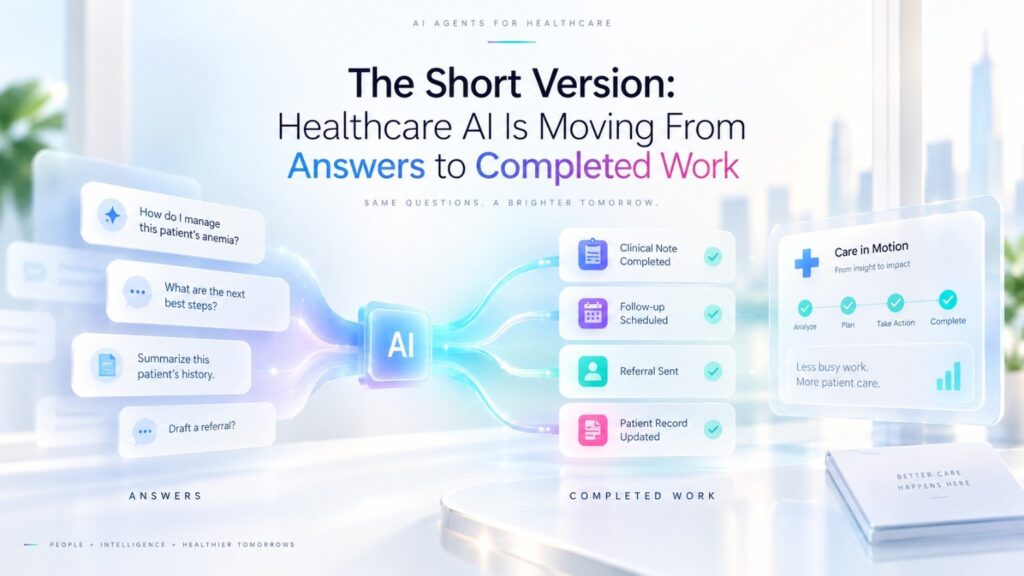
The Short Version: Healthcare AI Is Moving From Answers to Completed Work
The first generation of generative AI in healthcare was largely about information.
Summarize this note.
Draft this message.
Answer this medical question.
Extract these fields.
Write this appeal.
Those tools can save meaningful time, but someone usually still has to take the next action.
Agentic systems change the unit of value.
Instead of asking, “Did the AI generate a useful answer?” healthcare organizations can increasingly ask, “Did the work get completed correctly?”
That distinction is visible across New York’s startup ecosystem.
Tennr is automating complicated referral workflows. Cedar is building AI agents around patient financial engagement. Hyro is automating healthcare communications and patient-access workflows. Anterior is applying AI inside health-plan clinical and administrative operations. EliseAI is automating scheduling, calls, billing conversations, and other non-clinical work. Avo is pushing AI deeper into the EHR. Newer companies such as Elite, Clarion, Locata, Prosper, Trapeze, Pledge Health, Arctic Health, and Evergrove are attacking even narrower operational problems.
That pattern matters.
Healthcare does not need another hundred chat windows.
It needs fewer unresolved referrals, fewer abandoned calls, fewer unpaid claims, fewer missing authorizations, fewer hours spent searching payer portals, and fewer clinicians staying late to finish documentation.
The companies that turn AI into measurable completed work are likely to create much more durable value than companies that simply attach an assistant to an existing screen.
Why New York Is Such an Important Test Market for Healthcare Agents
New York combines three things that AI healthcare companies need: an enormous healthcare economy, difficult operating environments, and deep technology talent.
Healthcare and social assistance is now New York City’s largest employment sector. NYCEDC reported approximately 1.08 million jobs in the sector as of August 2025. It accounted for about 7.1% of the city’s GDP, and the sector had added more than 253,000 jobs compared with its pre-pandemic level.
That is not a small market sitting beside New York’s technology industry.
Healthcare is one of the city’s central industries.
NYC Health + Hospitals alone serves more than one million New Yorkers each year across more than 70 locations, while operating 11 acute-care hospitals as part of the country’s largest municipal healthcare system.
Then there are major systems such as Northwell Health, NYU Langone, NewYork-Presbyterian, Mount Sinai, Montefiore, Memorial Sloan Kettering, and dozens of specialty and independent provider organizations.
These organizations operate under conditions that make workflow automation unusually valuable.
Patient volumes are large. Payer rules are complicated. Labor is expensive. Call centers handle enormous volumes. Clinical systems rarely talk to one another perfectly. Administrative processes still involve phone calls, portals, documents, and faxes.
An AI product that can survive that environment has a stronger chance of surviving elsewhere.
Healthcare Is Also Under Pressure to Do More Without Simply Adding People
The economic backdrop makes automation more important.
Hospitals and medical groups cannot solve every workflow problem by adding another employee. Staffing is expensive, clinical workers remain scarce in important areas, reimbursement pressure continues, and administrative work keeps expanding.
This does not mean AI should simply replace healthcare workers.
It means a growing amount of staff time should be moved away from repetitive coordination and toward work where human judgment actually matters.
An employee should not have to spend twenty minutes navigating an insurance portal merely to discover whether a patient’s plan requires a particular authorization.
A nurse should not have to search multiple documents to determine what information is missing from a referral.
A patient should not spend forty minutes on hold to move an appointment from Tuesday to Thursday.
These are exactly the kinds of workflows that agent companies are targeting.
Original Research: How NYC Tech Journal Built the New York Healthcare Agent Map
To understand where agentic healthcare is actually developing, NYC Tech Journal created a structured dataset of 18 New York-based companies.
This is not intended to represent every healthcare AI company in New York. It is a focused sample designed specifically to study AI systems that execute or materially advance real healthcare work.
Our research snapshot was completed on September 16, 2026.
We reviewed current company product pages, public funding announcements, the Digital Health New York ecosystem, and Y Combinator’s New York healthcare directory. YC’s directory alone lists 85 healthcare startups headquartered in New York and reveals a particularly dense new cohort of AI companies working on calls, referrals, billing, credentialing, insurance verification, and related operations.
Our Inclusion Rules
A company entered the analysis when it met three conditions.
First, it had to be headquartered in New York or clearly identify New York as its base.
Second, AI had to be a core part of the healthcare product rather than simply an internal productivity tool.
Third, the product had to execute, automate, or materially move forward a real healthcare workflow.
That final requirement excluded many companies that use AI mainly for analytics, wellness recommendations, biotech research, or information retrieval.
How the Agent Execution Score Works
We scored each company from zero to eight across four dimensions.
Action depth measures whether the system merely recommends an action or can actually complete a task.
Systems integration measures whether the system can interact with EHRs, payer portals, scheduling systems, billing infrastructure, communications systems, or other operational software.
Workflow span measures whether the product performs one narrow step or coordinates several connected steps.
Production evidence measures public evidence of real-world deployment or meaningful operational scale.
Each dimension receives zero, one, or two points.
This score should not be interpreted as a ranking of company quality. Younger companies naturally receive lower production scores even when their technology appears highly agentic. The framework simply helps us compare how close different products appear to be to autonomous workflow execution based on publicly available evidence.
NYC Tech Journal’s 2026 Healthcare Agent Dataset
| Company | Primary Workflow | Main Agent Role | Execution Score |
| Tennr | Referrals and pre-visit operations | Reads, qualifies and moves referrals through workflows | 8/8 |
| Cedar | Patient financial operations | Resolves billing and payment workflows through AI agents | 8/8 |
| Hyro | Patient access | Handles conversations and completes connected access workflows | 8/8 |
| EliseAI Health | Practice administration | Calls, scheduling, reminders, payments and patient communication | 8/8 |
| Anterior | Prior authorization and payer operations | Researches cases, applies policy and prepares clinical workflows | 7/8 |
| K Health | Virtual clinical workflow | AI intake and clinical support integrated with health systems | 7/8 |
| Prosper | Healthcare phone operations | Automates calls including scheduling and insurance workflows | 7/8 |
| Avo | Clinical workflow | EHR-integrated clinical reasoning, documentation and task support | 6/8 |
| Pearl Health | Value-based care | Prioritizes patients and recommends or automates next actions | 6/8 |
| Elite | Practice front office | Voice agents complete scheduling, intake, eligibility and other tasks | 6/8 |
| Clarion | Patient communication | Voice and messaging agents complete routine practice workflows | 6/8 |
| Locata | Referrals | Coordinates referrals, authorizations and patient follow-up | 6/8 |
| Trapeze | Scheduling | Voice agents manage patient scheduling and intake | 6/8 |
| Pledge Health | Insurance operations | Browser agent handles payer portal workflows | 6/8 |
| Sohar Health | Insurance verification | Automates eligibility and benefits verification | 6/8 |
| Evergrove | Care coordination | Voice agents coordinate workers’ compensation care | 5/8 |
| Arctic Health | Credentialing | Automates payer enrollment, contracting and monitoring | 5/8 |
| Rovi Health | Care navigation | Analyzes needs and coordinates provider selection and booking | 5/8 |
The public evidence behind the newer companies is particularly revealing. YC’s New York healthcare directory describes Elite as writing back into more than 19 EHRs, Locata as automating referral work from prior authorization through patient follow-up, Clarion as handling scheduling, billing and refill communication, Pledge Health as operating across payer portals, and Arctic Health as using browser automation to submit and monitor credentialing across payer systems.
That is very different from a chatbot.
These products increasingly touch the actual systems where healthcare work happens.
Original Finding #1: Two-Thirds of the Companies We Studied Are Primarily Automating Administrative Work
The strongest result from our dataset is where autonomy is appearing first.
Chart 1: Primary Orientation of NYC Healthcare Agent Companies
| Workflow Orientation | Companies | Share |
| Administrative | 12 | 67% |
| Mixed clinical + administrative | 4 | 22% |
| Primarily clinical | 2 | 11% |
Administrative
████████████████████ 67%
Mixed
███████ 22%
Clinical
████ 11%
This tells us something important about how healthcare AI is likely to spread.
AI agents do not need to diagnose cancer to create enormous economic value.
They can start with the work surrounding care.
That includes receiving documents, finding missing information, checking coverage, calling patients, booking appointments, following up on referrals, checking claim status, verifying benefits, submitting information to insurers, monitoring credentialing, and answering common financial questions.
Many of these processes have three attractive properties for automation.
They happen frequently. They are expensive when performed manually. And mistakes can often be detected or reversed before clinical harm occurs.
That combination creates a much easier starting point than autonomous diagnosis or treatment.
Original Finding #2: Patient Access Has Become New York’s Biggest Visible Agent Wedge
When we grouped each company by its primary workflow, patient communication and access formed the largest category.
Chart 2: Primary Workflow in Our 18-Company Sample
| Workflow | Companies | Share |
| Patient access and communications | 7 | 39% |
| Referral, insurance and authorization operations | 6 | 33% |
| Clinical workflow and care navigation | 4 | 22% |
| Patient financial engagement | 1 | 6% |
This is not surprising when you look at how healthcare still operates.
Patients call clinics.
Clinics call insurers.
Insurers call providers.
Providers chase referring offices.
Billing staff call payers.
People leave voicemails.
Someone listens to the voicemail.
Someone types information from the voicemail into another system.
Someone makes another call.
Healthcare remains unusually dependent on human communication as middleware between computer systems.
Voice AI therefore has a much larger opportunity in healthcare than the simple phrase “AI receptionist” suggests.
The winning systems will not merely answer phones. They will turn conversations into completed workflows.
Hyro — Turning Patient Conversations Into Operational Actions
Hyro is one of the clearest examples.
The New York company has moved from conversational AI toward what it describes as an agentic care communications platform. Its agents can operate across voice and digital channels, connect with healthcare systems, and support workflows such as scheduling, prescription management, patient navigation and triage. A 2026 partnership with ServiceNow expands that approach into broader healthcare workflow automation.
The scale is notable.
Hyro says its platform is live across more than 50 health systems, has engaged more than 30 million patients, and automates more than 85% of routine interactions across those deployments. The company raised a $45 million growth round in October 2025, bringing total funding to roughly $95 million.
That points to an important product lesson.
The value of voice AI increases dramatically when the agent can complete an action after understanding what the patient wants.
Answering “What time does the clinic close?” is useful.
Changing an appointment, confirming the change inside the scheduling system, updating the patient, and escalating an unusual case is economically much more valuable.
EliseAI Health Is Following a Similar Logic
EliseAI began in housing but expanded into healthcare in 2023.
Its healthcare platform now handles patient conversations across voice, email, text, and chat while supporting appointment scheduling, billing communication, follow-ups, insurance intake and other administrative work. The company says its system can automate routine patient communication while synchronizing actions with healthcare systems.
The broader company passed $200 million in annual recurring revenue in June 2026 across housing and healthcare, according to EliseAI.
Again, the important part is not conversational intelligence by itself.
It is the connection between conversation and operational execution.
A New Generation of Smaller New York Voice-Agent Companies Is Arriving
The more interesting signal may be underneath the well-funded leaders.
New York now has several very young healthcare companies that were designed as agent companies from day one.
Elite says its agents answer patient calls and then perform scheduling, referrals, refills, eligibility, intake, billing, and other work inside practice systems. Its YC profile says the product writes back to more than 19 EHRs.
Clarion says its agents handle scheduling, billing questions, prescription refill requests, and other communication workflows while serving tens of thousands of patients per month.
Trapeze is targeting scheduling. Its voice agents combine practice-specific scheduling rules with insurance verification, intake, EHR integration, and appointment booking.
Prosper describes AI phone agents that automate scheduling, balance reminders, claim-status checks, benefit verification, and prior authorization while integrating with dozens of EHR systems.
Evergrove is focusing on workers’ compensation care coordination. Its YC profile says its voice agents make more than 500,000 calls annually for customers and are being used to speed care coordination.
Individually, some of these companies are extremely early.
Together, they show where founders believe demand exists.
Healthcare’s phone-and-fax layer is becoming a major AI market.
Original Finding #3: Referrals and Prior Authorization May Be the Highest-Value Agent Opportunity
Patient access gets attention because voice AI is easy to understand.
Referral and authorization workflows may ultimately create even greater economic value.
These processes are complicated because they involve documents, payer policies, clinical information, multiple organizations, unpredictable exceptions, and frequent follow-up.
That makes them terrible workflows for simple rules-based automation.
It also makes them attractive for modern AI.
Tennr — Automating the Referral Infrastructure Nobody Sees
Tennr is one of New York’s strongest examples.
The company’s platform processes referral documents arriving through channels such as fax, email, portals, and electronic prescribing systems. It extracts information, determines what is missing, checks requirements, supports eligibility and benefits workflows, and keeps patients moving through the referral process. Tennr says its systems now process more than 10 million documents per month.
The market has rewarded that approach.
Tennr raised a $101 million Series C in June 2025 at a reported $605 million valuation. Its revenue had more than tripled after its previous round.
This is an important case study because Tennr does not sell “AI” as the final outcome.
Its outcome is getting a patient successfully from referral to service.
That is a better way for healthcare executives to think about agentic AI.
Do not measure whether the model generated impressive text.
Measure whether the patient moved forward.
Locata Is Attacking the Same Problem From Primary Care
Locata is younger, but its architecture points in the same direction.
The company says its agents automate referral work from submitting prior authorizations through sending updates and following up with patients. Its YC description reports that an early customer saved more than 100 hours of work during the first month of deployment.
The significance is larger than that one result.
Referral workflows often cross organizational boundaries.
Primary-care teams, specialists, patients, insurers, scheduling departments, and medical records systems can all become part of the same process.
That makes referral automation a natural test of whether an AI system is truly agentic.
If the software merely reads a referral, it is document AI.
If it understands the referral, identifies missing information, obtains that information, checks requirements, communicates with the patient, schedules the next step, updates systems, monitors completion, and escalates exceptions, it is much closer to an operating agent.
Anterior — Prior Authorization Is Moving Toward AI-Assisted Clinical Operations
Prior authorization sits even closer to the boundary between administrative work and clinical judgment.
That makes it a strategically important market.
Anterior, founded in 2022, develops AI for health plans. Its technology assists clinical teams with case research, documentation, policy application, and authorization workflows. The company says its platform is now trusted by health plans representing more than 50 million covered lives.
Anterior raised $40 million in February 2026, bringing total funding to $64 million.
The opportunity is enormous because prior authorization remains one of healthcare’s most painful workflows.
The AMA’s 2025 physician survey found that practices completed an average of 40 prior authorizations per physician each week, consuming roughly 13 hours of physician and staff time. Ninety-five percent of surveyed physicians said authorization requirements delayed access to care.
This is exactly the type of workflow where AI could create major value if implemented carefully.
But the word carefully matters.
Using AI to collect documentation is very different from allowing AI to deny medically necessary care.
Healthcare organizations must separate workflow automation from final clinical authority.
The 2027 Prior Authorization API Deadline Could Accelerate Agent Adoption
Technology changes become much more powerful when infrastructure changes at the same time.
That is happening in prior authorization.
CMS requires impacted payers to implement several interoperability APIs, including a Prior Authorization API, with major API requirements generally beginning January 1, 2027. Those APIs are intended to expose authorization requirements and support electronic requests and responses.
This could reduce one of the biggest barriers healthcare agents face.
Agents work best when they can interact with structured systems.
Today, many administrative agents still need to navigate websites, documents, faxes, portals, and telephone calls because healthcare infrastructure is fragmented.
As more workflows become accessible through standardized APIs, the cost of reliable automation should fall.
This could eventually transform prior authorization from a document-chasing process into something closer to a structured machine-to-machine workflow, with humans reviewing the cases that genuinely require judgment.
Pledge Health Shows Why Browser Agents Matter Before APIs Arrive
Healthcare cannot wait for perfect interoperability.
That creates an opportunity for another class of agent: software that operates existing interfaces.
Pledge Health, for example, describes an AI browser assistant that works across payer portals to verify benefits, submit prior authorizations, check claim status, and perform related insurance tasks directly from the clinic’s workflow.
Arctic Health applies a related model to payer credentialing and contracting. It says its browser automations submit and monitor work across hundreds of payer portals.
This may become an important transition architecture.
In the long term, healthcare should rely more heavily on structured APIs.
In the near term, agents that can safely operate the messy systems already in place can produce value much sooner.
Cedar — Patient Billing Is Becoming Agentic
The revenue cycle is another obvious target because the tasks are frequent, measurable, and expensive.
Cedar’s August 2026 Kora Platform announcement provides one of the clearest signals that mature healthcare software companies are redesigning products around agents.
Kora is described as a set of specialized AI agents designed to recover patient revenue, reduce collection costs, communicate through voice and two-way text, and operate alongside existing EHR, telephony, and call-center systems.
Cedar is especially interesting because it shows how an established workflow platform can evolve.
The company was founded in 2016 around patient payments and financial engagement. It is now adding agentic execution on top of years of billing and patient-interaction data.
That pattern may repeat across healthcare.
Startups have one advantage: they can build agent-first systems from scratch.
Incumbents have another: they already have customer relationships, integrations, historical workflow data, and transaction volume.
The agent market will likely include both.
Original Finding #4: Integration Is Becoming More Important Than Model Intelligence
The average execution score across our 18-company sample was 6.4 out of 8.
The distribution was also revealing.
Chart 3: Agent Execution Scores
| Execution Score | Companies | Share |
| 8/8 | 4 | 22% |
| 7/8 | 3 | 17% |
| 6/8 | 8 | 44% |
| 5/8 | 3 | 17% |
More than 80% of the sample scored at least six.
That does not mean these systems operate without people.
It means the competitive frontier has already moved past basic text generation.
The strongest healthcare-agent products increasingly need four layers.
They need intelligence to understand messy information.
They need workflow logic to know what should happen next.
They need integrations or browser capabilities to take action.
And they need governance systems that know when the AI should stop and ask a human.
The model may actually become the easiest part to copy.
The difficult part is everything around it.
EHR Write-Back Is a Major Line of Separation
Consider two scheduling agents.
The first agent answers a patient, recommends three available appointment times, and sends the conversation to a receptionist.
The second checks the patient’s identity, reads the practice’s scheduling rules, verifies appointment type, confirms eligibility if necessary, books the appointment in the EHR, sends confirmation, places the patient on the appropriate reminder workflow, and escalates unusual cases.
Both can be described as AI.
Only one removes most of the work.
Healthcare buyers should therefore ask vendors less about benchmark scores and more about action architecture.
What can the system read?
What can it write?
Which actions happen automatically?
Which actions require approval?
What happens when an integration fails?
How is every action logged?
How easily can a human reverse an incorrect action?
Those questions reveal much more about operational value than a polished AI demonstration.
Clinical Agents Are Advancing More Carefully
The administrative side of healthcare may automate quickly.
Clinical work will move differently.
That is already visible in New York.
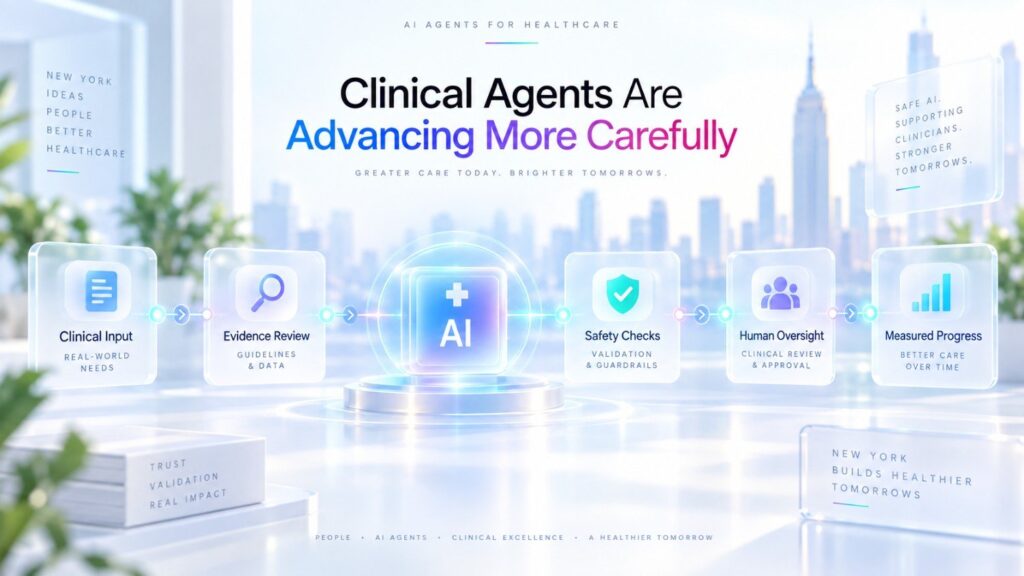
Only two companies in our sample were classified as primarily clinical, with another four operating across the boundary between clinical and administrative workflows.
That does not mean clinical AI is moving slowly.
It means clinical autonomy is being structured around stronger human oversight.
Avo — Turning the EHR Into a System of Action
Avo is one of the clearest examples of AI moving deeper into the clinician workflow.
The New York company raised a $10 million Series A in March 2026. Its platform brings patient information, medical knowledge, clinical guidance, documentation, and workflow support into the EHR. It can synthesize data, propose diagnoses and care plans, assist with orders, produce documentation, and surface evidence.
Avo’s September 2026 expansion with MEDITECH is particularly important because the product is being positioned around clinical decisions inside the EHR rather than as a separate AI application.
That points to where clinical agents may evolve.
The first successful clinical agents may not independently practice medicine.
They may instead assemble the information needed for a decision, identify relevant evidence, prepare orders, draft documentation, check compliance requirements, and execute approved actions once a clinician confirms them.
That still removes a huge amount of work.
K Health Shows What AI-Native Primary Care Could Look Like
K Health is another useful case because it combines AI with actual clinical delivery.
The Manhattan-based company has partnered with major health systems including Northwell Health, Mass General Brigham, Cedars-Sinai, Mayo Clinic, Hartford HealthCare, Hackensack Meridian Health, Penn Medicine, and others.
Its Northwell collaboration illustrates the model.
Patients interact with AI before seeing a physician. The system gathers symptoms and patient information, combines that information with medical record data, and prepares the case for a clinician. The clinician remains responsible for care.
This human-plus-agent structure may prove much more important than the idea of an autonomous “AI doctor.”
Healthcare is full of work that surrounds the final clinical decision.
Preparing that work intelligently can dramatically increase physician capacity without removing physician responsibility.
Pearl Health — The Agent Opportunity May Extend Into Population Management
Pearl Health is attacking a different problem.
Instead of focusing on a single encounter, Pearl’s value-based care platform helps providers identify higher-risk patients, prioritize opportunities, suggest next actions, and automate administrative steps around care management. The company says it works with thousands of providers across more than 40 states.
Pearl raised $110 million in new capital in July 2026, including equity and debt. The company said it had reached profitability in 2025 and expected its patient base to triple between 2024 and the end of 2026.
This hints at another major agent category.
An agent does not always need to wait for someone to ask it a question.
In population health, the more powerful system could continuously identify which patients need attention, determine the appropriate next workflow, complete administrative steps, and bring only high-value decisions to the care team.
That moves AI from reactive assistance toward continuous healthcare operations.
The Bigger Opportunity Is Not One Giant Healthcare Agent
There is a temptation to imagine one universal agent eventually running everything.
Healthcare is unlikely to develop that way.
The workflows are too specialized, the regulatory consequences are too different, and the cost of mistakes varies dramatically.
Scheduling a dermatology appointment and recommending a chemotherapy regimen cannot share the same approval model.
The more realistic architecture is a network of specialized agents.
A referral agent handles incoming documentation.
An eligibility agent checks insurance.
An authorization agent assembles payer requirements.
A scheduling agent finds an appropriate appointment.
A patient-access agent manages communication.
A billing agent resolves financial questions.
A documentation agent prepares the clinician’s note.
A clinical support agent surfaces evidence.
A human remains responsible wherever the cost of an incorrect action becomes unacceptable.
This architecture is less exciting than the idea of one autonomous AI doctor.
It is also much more likely to work.
Original Analysis: Administrative Reversibility Explains Why Adoption Is Happening There First
Our dataset suggests another useful framework for understanding adoption.
The best early agent workflow has two characteristics:
High workload and high reversibility.
If an AI schedules the wrong routine appointment, the mistake can usually be corrected.
If it sends the wrong reminder, the message can be fixed.
If it incorrectly identifies missing referral information, a staff member can review the case.
Now compare that with an AI independently changing a chemotherapy dosage.
The potential harm is far greater, and reversal may come too late.
This gives healthcare organizations a practical automation map.
| Impact of Error | Easy to Reverse | Hard to Reverse |
| Low clinical impact | Strong automation candidate | Automate with controls |
| Moderate clinical impact | Agent + human review | Human approval required |
| High clinical impact | Human approval required | Keep final authority human |
This framework is more useful than asking whether healthcare is “ready for AI agents.”
Some workflows clearly are.
Others are not.
The real question is where autonomy should stop.
Regulation Will Push Clinical AI Toward Explainable Human Oversight
The FDA’s January 2026 final guidance on Clinical Decision Support Software reinforces this distinction.
The guidance explains how certain clinical decision support functions may fall outside the medical-device definition while other software remains regulated as a device. The treatment depends partly on what the software does and how professionals can evaluate the basis for its recommendations.
This matters for agent design.
A healthcare AI product becomes much more sensitive when it moves from retrieving information toward making or executing medical decisions.
New York is also becoming more active around healthcare AI policy. Governor Kathy Hochul’s 2026 healthcare agenda called for a healthcare AI consortium focused on sharing knowledge and supporting safe, effective and equitable deployment, while also proposing AI-related efforts inside safety-net hospitals and state healthcare programs.
The direction is clear.
Healthcare organizations will be encouraged to use AI.
They will not be excused from responsibility for what the AI does.
Healthcare Leaders Should Measure Resolved Work, Not AI Usage
One of the biggest mistakes companies make during AI adoption is measuring activity instead of outcomes.
“Employees generated 40,000 AI messages” does not tell a CEO very much.
Neither does “75% of employees tried the assistant.”
Healthcare agents make better metrics possible.
If an agent handles patient access, measure the percentage of patient requests completely resolved without unnecessary staff intervention.
If it handles referrals, measure the percentage of complete referrals reaching scheduling.
If it works in billing, measure collected dollars, cost per resolved account, time to resolution, and escalation rate.
If it handles authorizations, measure submission cycle time, clean submission rate, missing-information rate, decision turnaround, and overturned denials.
The shift from software usage to completed work may become one of agentic AI’s biggest management effects.
A Practical Healthcare Agent KPI Dashboard
Healthcare organizations should track performance at the workflow level.
| Metric | What It Measures | Why It Matters |
| Resolved-work rate | Workflows completed without unnecessary human intervention | Measures real automation |
| Escalation rate | Cases handed to staff | Shows limits of autonomy |
| Correct escalation rate | Whether the right cases reached humans | Tests safety |
| Write-back accuracy | Accuracy of changes made to operational systems | Measures execution reliability |
| Exception rate | Percentage of cases agents cannot process normally | Reveals workflow weakness |
| Human minutes per completed case | Staff effort that remains | Measures actual productivity |
| Cycle time | Time from request to completion | Measures patient and operational improvement |
| Rework rate | Completed workflows later corrected by humans | Detects hidden AI errors |
| Patient abandonment | Patients who fail to complete the process | Links operations to access |
| Cost per resolved workflow | Total cost divided by successfully completed work | Connects AI with financial ROI |
A company should not deploy an agent because the demo feels intelligent.
It should deploy the agent because these numbers improve.
Start With the Workflow, Not the Model
Healthcare leaders evaluating agentic AI should resist a common technology habit.
Do not begin by asking which model is best.
Begin with the broken process.
Take one workflow and map it from start to finish.
Suppose the problem is specialty referrals.
Where does the referral arrive?
Who opens it?
What information must be present?
How does the team identify missing information?
Which payer rules matter?
Who contacts the referring physician?
Who checks eligibility?
When can an appointment be booked?
What causes the case to stop?
How does someone know that the patient never responded?
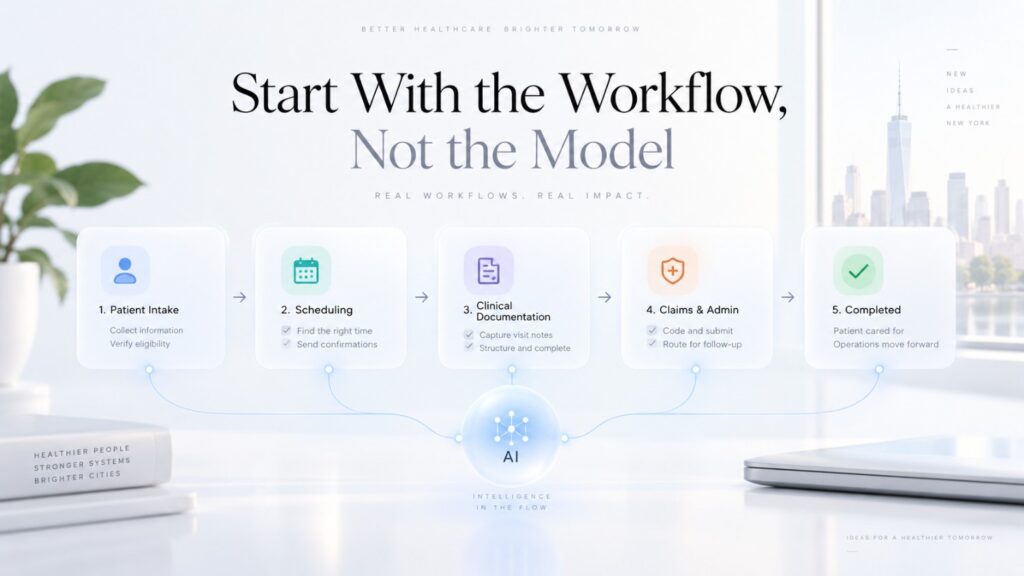
Only after mapping those steps should an organization decide where AI belongs.
The model is one component.
The workflow is the product.
A 90-Day Healthcare Agent Pilot Should Be Extremely Narrow
Hospitals sometimes make AI adoption unnecessarily difficult by beginning with enterprise-wide transformation programs.
A better starting point is one measurable workflow.
Days 1–30: Measure the Existing Process
Do not automate anything yet.
Measure how many cases enter the workflow, how long they take, how much staff time they consume, where they fail, how frequently rework happens, and how often patients drop out.
Without this baseline, the organization will never know whether the AI created value.
Days 31–60: Run the Agent With Limited Authority
Introduce the agent while maintaining strong human oversight.
At first, the system may prepare actions without executing them.
A human can review the recommendation and approve it.
The organization should record exactly where humans change the AI’s proposed action.
Those corrections are more valuable than generic user feedback because they reveal where the workflow model is incomplete.
Days 61–90: Expand Autonomy Only Where Performance Supports It
Once the organization understands the error patterns, selected low-risk actions can become automatic.
Routine scheduling changes might execute automatically.
An unusual clinical request might still require human review.
The right objective is not maximum automation.
It is maximum safe completed work.
Human Approval Should Be Designed Into the Workflow
Many AI products treat human review as a button added after the product has already been built.
Healthcare requires something more thoughtful.
The system should know which events always require review.
It should know which confidence thresholds trigger escalation.
It should preserve the source information used for the recommendation.
It should record every action.
It should allow staff to see what happened without reconstructing the agent’s entire conversation.
And it should fail safely when an external system behaves unexpectedly.
The best agent is not the one that avoids humans completely.
It is the one that uses human attention only where human judgment adds meaningful value.
New York’s Healthcare Agent Market Is Becoming More Competitive
Capital is already following several of the companies building these systems.
| Company | Recent Public Capital or Scale Marker |
| Tennr | $101M Series C in 2025 |
| Pearl Health | $110M capital raise in July 2026 |
| Hyro | $45M growth round; about $95M total funding |
| Anterior | $40M 2026 round; $64M total |
| Avo | $10M Series A in March 2026 |
| EliseAI | Company reported $200M ARR across housing and healthcare in June 2026 |
Sources: company announcements and reported funding data.
The broader New York market has momentum too.
New York healthcare startups raised $4.8 billion during 2025, and funding continued strongly into 2026. Meanwhile, national digital health funding has become increasingly concentrated around AI companies and workflow infrastructure.
Investors appear to understand something healthcare operators should understand as well.
Administrative workflow is not a boring side market.
It is one of healthcare’s largest technology opportunities.
The Companies With the Best Models Will Not Necessarily Win
AI models are improving quickly.
That means raw intelligence may become less durable as a competitive advantage.
The deeper moat could come from five places.
The first is integration.
A healthcare agent connected deeply into Epic, MEDITECH, athenahealth, payer portals, call-center infrastructure, and scheduling tools is much more useful than one operating in isolation.
The second is workflow data.
Every resolved referral or successful insurance verification can teach the company more about the edge cases that actually occur.
The third is trust.
Hospitals are unlikely to hand meaningful operational authority to a vendor they cannot audit.
The fourth is distribution.
Companies already embedded inside major health systems can add new agents much more easily than an unknown vendor starting from scratch.
The fifth is measurable outcomes.
A beautiful AI interface is not a moat.
A product that reliably reduces referral leakage, authorization delays, call abandonment, or collection costs can become one.
The Next Battle Will Be the Healthcare Agent Control Layer
As hospitals deploy more specialized agents, another problem appears.
Who manages them?
A large health system could eventually have separate agents for patient access, revenue cycle, referrals, clinical documentation, pharmacy communication, prior authorization, care management, supply chain, IT support, and employee operations.
Those systems cannot operate as isolated black boxes.
Healthcare organizations will need a control layer.
That layer should define permissions.
It should identify which systems each agent can access.
It should maintain logs.
It should enforce approval rules.
It should monitor performance.
It should identify failures.
And it should allow an organization to stop an agent immediately when something goes wrong.
Healthcare CIOs therefore need to think beyond selecting individual AI applications.
They should begin designing an agent governance architecture.
The Biggest Opportunity May Be Between Existing Systems
For decades, healthcare tried to solve fragmentation by replacing old systems.
That is expensive and slow.
Agents create another possibility.
Instead of replacing every system, AI can increasingly operate between them.
An agent can read a fax.
Query an EHR.
Open a payer portal.
Make a phone call.
Send a patient a message.
Update the scheduling system.
Record the result.
That ability could turn AI into an interoperability layer of a different kind.
Traditional interoperability tries to make systems exchange structured data directly.
Agentic interoperability can sometimes complete work across systems even when the underlying software was never designed to work together.
This should not become an excuse to avoid better APIs.
But it could dramatically improve operations during the long transition toward better healthcare infrastructure.
What New York Healthcare Leaders Should Automate First
The best starting workflows are not necessarily the ones receiving the most AI hype.
Healthcare organizations should prioritize work with four characteristics: high volume, clear rules, expensive manual effort, and relatively reversible mistakes.
That usually points toward patient scheduling, routine patient communication, referral intake, eligibility checks, benefits verification, claim follow-up, documentation preparation, credentialing, and portions of prior authorization.
Higher-risk clinical tasks should follow a different path.
AI can gather information, organize evidence, identify options, prepare documentation, and recommend next actions.
The final clinical decision should remain with qualified professionals when patient safety depends on that judgment.
Five Predictions for New York’s Healthcare Agent Market
The next stage of this market will probably look less like another chatbot boom and more like a gradual redesign of healthcare operations.
Administrative Agents Will Become Normal Infrastructure
Within a few years, manually answering every routine scheduling call may feel as strange as manually processing every credit-card transaction.
Patients will still need humans.
But human teams will increasingly handle exceptions rather than every interaction.
Agent Pricing Will Move Toward Completed Work
The software industry traditionally charges per user.
Agent companies may increasingly charge per resolved workflow.
A vendor could charge per completed call, processed referral, successful verification, recovered claim, or booked appointment.
Elite already describes resolved patient interactions as its charging unit.
That aligns vendor economics more closely with customer outcomes.
EHR Integration Will Become a Competitive Requirement
A healthcare agent that cannot safely act inside core systems will eventually look incomplete.
The market will move from “AI connected to healthcare” toward “AI operating inside healthcare.”
Clinical Agents Will Become More Powerful Without Becoming Fully Autonomous
The biggest clinical gains may come from removing everything around physician judgment.
AI will gather the history.
AI will summarize the chart.
AI will locate evidence.
AI will prepare documentation.
AI will draft the order.
AI will monitor follow-up.
The physician will spend a larger percentage of time on the actual decision.
The Definition of Healthcare Productivity Will Change
Healthcare organizations historically measured productivity in employees, visits, calls, claims, or appointments.
Agentic systems create another unit:
resolved work per human hour.
That metric could become extremely important.
A hospital does not necessarily need fewer people.
It needs more of its people doing work that requires people.
What NYC Tech Journal Will Be Watching Next
The New York market is moving quickly enough that several questions now matter more than whether AI agents are “real.”
They clearly are.
The more useful questions concern performance.
Can referral agents reduce patient leakage rather than merely process documents faster?
Can voice agents improve patient access without trapping people inside another frustrating automated system?
Can prior authorization AI accelerate legitimate approvals without increasing inappropriate denials?
Can clinical agents remain grounded in trustworthy evidence?
Can health systems monitor dozens of agents across different departments?
Can vendors prove ROI after the initial pilot excitement disappears?
And most importantly, can automation make healthcare easier for patients rather than simply cheaper for institutions?
Those are much harder questions than whether a large language model can hold a conversation.
They are also the questions that will determine which companies become infrastructure.
The Bigger Story: Healthcare Software Is Starting to Do the Work
For most of the software era, healthcare technology was designed around humans operating systems.
People entered information.
People moved data.
People clicked through forms.
People switched between systems.
People called another organization when the software could not communicate with it.
AI agents begin to change that relationship.
The software is gradually becoming an active participant in the workflow.
New York’s healthcare startup ecosystem provides a clear picture of what that transition looks like in practice.
It does not begin with autonomous hospitals.
It begins with a missed call that gets answered.
A referral that gets processed.
A patient who gets scheduled.
An authorization packet that gets assembled.
An insurance plan that gets verified.
A bill that gets explained.
A medical record that gets summarized.
A clinician who receives the right information before making the decision.
The original NYC Tech Journal analysis in this article found that two-thirds of the 18 New York companies we studied are still primarily focused on administrative work. Only 11% were classified as primarily clinical.
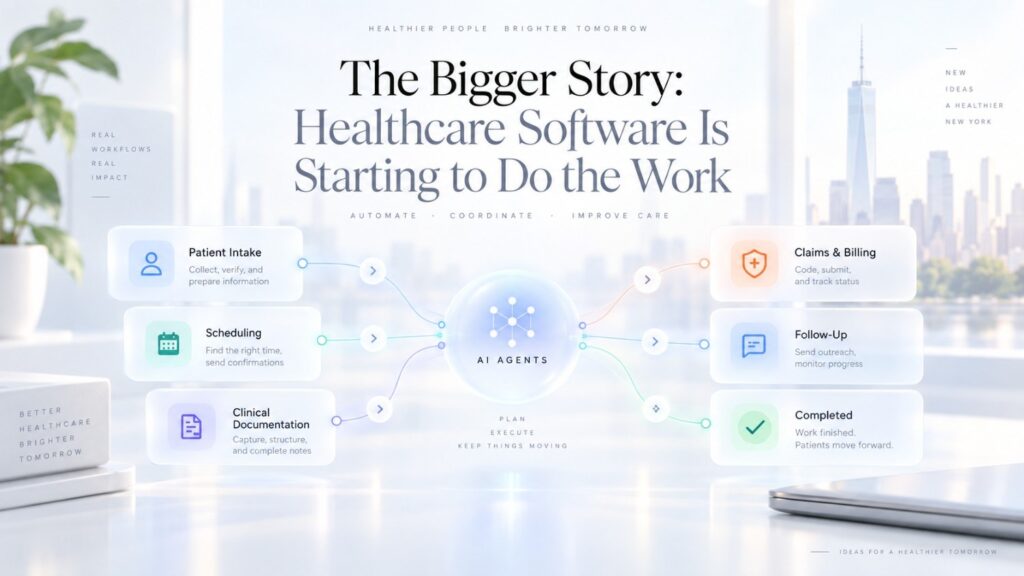
That is not evidence that healthcare AI agents are less advanced than the hype suggests.
It may be evidence that the market is maturing in a rational order.
Automate high-volume, reversible work first.
Build integrations.
Learn the edge cases.
Measure outcomes.
Create strong escalation systems.
Then carefully expand autonomy toward more consequential decisions.
New York is unusually well positioned for that experiment.
It has enormous healthcare systems, difficult operating environments, sophisticated payers, deep technology talent, major investors, and a rapidly growing group of startups building around real healthcare workflows.
The companies that matter most may not be the ones that build the AI that sounds most intelligent.
They will be the ones that quietly make healthcare work.
And the most important metric will not be how many questions their AI can answer.
It will be how many healthcare problems it can safely resolve.