

Investment banking analysts have always done work that sits in an unusual place.
Some of it requires real financial judgment. Analysts need to understand companies, question assumptions, spot strange numbers, think through a transaction, and help senior bankers prepare advice for clients.
But a large part of the job is also built around repeatable digital work. Analysts collect company data. They update comparable-company tables. They change financial models. They search filings. They build slides. They check numbers across presentations. They organize diligence requests. They draft transaction materials. They make one more change to a pitch book at 1:30 in the morning because somebody moved a logo six pixels to the left.
AI agents could change this mix much more than the first generation of AI assistants did.
The important word is agents.
An AI assistant usually waits for a person to ask a question. An AI agent can be given a goal, gather information, use approved systems, complete several steps, check its work, and return a finished or nearly finished result.
That difference matters on Wall Street because investment banking is made of workflows rather than isolated questions.
An analyst rarely needs only one number. The analyst may need to find a company’s latest results, update a model, refresh valuation multiples, identify recent transactions, update eight slides, check whether the conclusions changed, and prepare the files for review.
An agent can potentially work across that chain.
That does not mean investment banks are about to remove analysts from deal teams. Our analysis suggests something more interesting. The most repeatable parts of junior banking work are becoming highly exposed to automation at the same time that judgment, accountability, client understanding, and transaction experience are becoming more valuable.
The analyst job may therefore survive while the analyst workflow changes dramatically.
For New York, that could be a very big story.
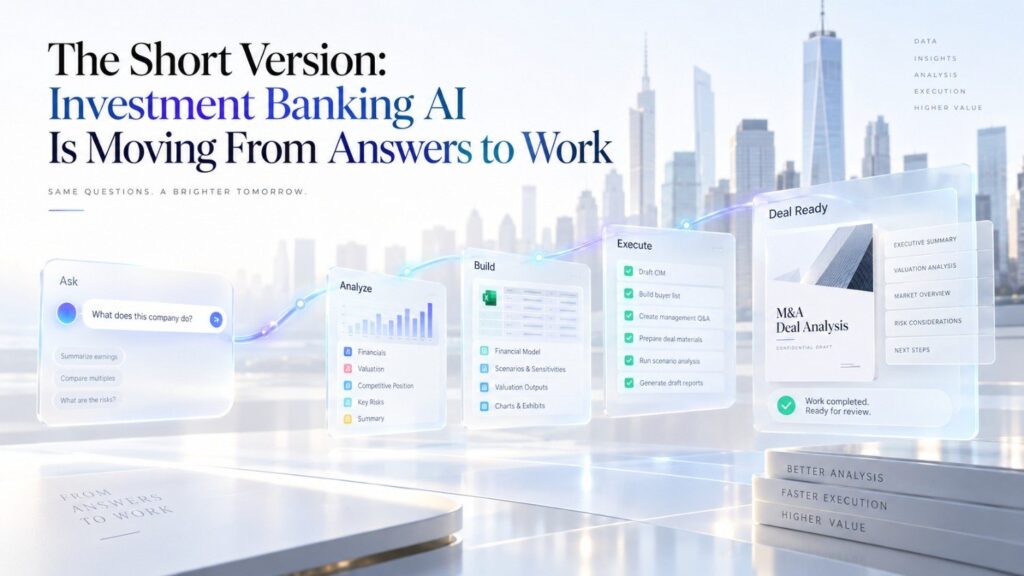
The Short Version: Investment Banking AI Is Moving From Answers to Work
Wall Street’s first major wave of generative AI was largely about helping employees find information, summarize documents, draft text, and answer questions.
The next phase is different.
JPMorgan Chase said more than 65,000 colleagues in its Commercial & Investment Bank were actively using its internal LLM Suite, while the firm described employees moving beyond basic brainstorming and summarization toward integrating generative AI into daily workflows.
Bank of America’s second-quarter 2026 investor materials provide an even more direct signal for investment banking. The bank said roughly 4,000 Corporate & Investment Banking professionals were already using AI for research and presentation preparation. It also reported more than 300 approved AI or machine-learning use cases, including 114 live generative-AI use cases.
Citi moved one step closer to the agent model in April 2026 when it introduced Arc, a platform designed to let the bank build and scale AI agents. Citi specifically described agents as tools that could take on research, synthesis, preparation, and execution work.
Goldman Sachs has gone even broader at the operating-model level. Its 2025 annual report, published in March 2026, described One Goldman Sachs 3.0 as a new operating model “propelled by AI” and connected AI adoption with changes in processes, decision-making, productivity, and the way work is organized.
These are not signs that every analyst task has already been automated. They show something more useful: large financial institutions are building the infrastructure required to move AI from a separate chatbot into the actual operating system of the bank.
That is exactly where investment banking starts getting interesting.
Why New York Is the Most Important Market to Watch
New York does not simply have a lot of bankers. It has a dense network of banks, advisory firms, private equity funds, hedge funds, law firms, accounting firms, public companies, financial-data providers, exchanges, regulators, and financial technology businesses.
That density matters because an investment banking deal touches many of these organizations at once.
It also means even a modest change in analyst productivity could affect a large amount of high-value work.
Wall Street Is Entering This AI Shift From a Position of Strength
The latest New York City data make the timing especially important.
The NYC Comptroller reported approximately 212,580 securities-industry jobs in June 2026, up from about 206,430 in June 2025. That is growth of roughly 3.0% in one year. Overall financial-activities employment increased from about 513,790 to 521,870 over the same period, or around 1.6%.
Our calculation produces another useful finding.
Securities accounted for about 40.7% of financial-activities employment in June 2026 but generated roughly 76% of the sector’s year-over-year net employment growth.
Chart 1: NYC Securities Employment Is Still Growing
| Measure | June 2025 | June 2026 | Change |
| NYC securities employment | 206,430 | 212,580 | +2.98% |
| NYC financial activities employment | 513,790 | 521,870 | +1.57% |
| Securities share of financial activities employment | — | 40.7% | — |
| Securities contribution to financial-activities job growth | — | 76.1% | — |
NYC Tech Journal calculation using NYC Comptroller employment data.
This is important because it challenges the simplest AI story.
The evidence does not currently show a Wall Street labor market in which AI adoption automatically means broad job destruction. New York securities employment was growing while the largest banks were simultaneously expanding their use of AI.
The State Comptroller separately estimated that NYC securities employment stood at 198,200 during 2025 on preliminary annual data and reported an average 2024 securities-industry salary, including bonuses, of $505,677. It also noted that New York City continued to have a larger share of U.S. securities jobs than any state.
AI is therefore entering one of America’s most valuable labor markets.
Investment Banking Activity Is Growing Faster Than Headcount
There is another reason banks want automation now: activity is strong.
The NYC Comptroller reported that investment banking pretax earnings among five large banks it tracks were 35.7% higher in the first half of 2026 than a year earlier. Investment banking fees were up 45.9% year over year to $12.7 billion during the second quarter, helped by stronger M&A and underwriting activity.
Goldman Sachs separately reported that global M&A volume increased 48% year over year during the first half of 2026, while mega-deal volume climbed 125%.
Chart 2: Workload Signals Are Moving Faster Than NYC Securities Hiring
| 2026 indicator | Year-over-year change |
| Investment banking fees at five major banks tracked by NYC Comptroller | +45.9% |
| H1 investment banking pretax earnings | +35.7% |
| Global M&A volume | +48% |
| NYC securities employment, June | +3.0% |
These numbers should not be treated as directly comparable productivity measures because they cover different populations and periods. But together they highlight the economic problem banks are trying to solve: transaction activity and revenue can move far faster than staffing.
Adding people is one solution.
Getting more useful output from each deal team is another.
AI agents make the second option much more realistic.
Original Research: What New York Investment Banking Analysts Are Actually Being Hired to Do
To understand where agents could matter, NYC Tech Journal analyzed publicly accessible job descriptions for eight New York investment-banking analyst roles.
The sample included roles or analyst programs from JPMorgan, Jefferies, TD Securities, Guggenheim Securities, CBRE, Santander, BMO Capital Markets, and KeyBanc Capital Markets.
Rather than counting every word in each advertisement, we manually coded the responsibilities into common work families.
The question was simple:
Which tasks keep appearing across real New York analyst jobs?
Our Methodology
The analysis used publicly accessible job descriptions available during September 2026. A task received a score of one for a bank when the responsibility was clearly stated in the description and zero when it was not.
Similar language was grouped together. “Build financial models,” “maintain detailed financial models,” and “develop valuation analysis,” for example, were placed in the financial modeling and valuation family.
We then calculated the percentage of the eight roles in which each task family appeared.
This is deliberately a role-description study rather than an hours-worked study. A task appearing in every job description does not mean analysts spend the same amount of time on it. Job postings also differ in detail, which creates unavoidable measurement limits.
The value of the analysis is different: it shows which capabilities banks consistently consider part of the analyst role.
The underlying roles repeatedly mention modeling, valuation, company and industry research, presentations, transaction execution, diligence, documentation, client work, and financial analysis.
Finding #1: Modeling and Research Are the Universal Analyst Tasks
Our sample produced a striking result.
Financial modeling and valuation appeared in eight out of eight roles.
Company or industry research also appeared in eight out of eight.
Pitch or client-material preparation appeared in seven. Transaction-execution work appeared in seven. Due diligence appeared in six.
Chart 3: Tasks Mentioned Across Eight NYC Analyst Roles
| Analyst task family | Roles mentioning task | Share |
| Financial modeling and valuation | 8 of 8 | 100% |
| Company and industry research | 8 of 8 | 100% |
| Pitch books and client materials | 7 of 8 | 87.5% |
| Deal execution support | 7 of 8 | 87.5% |
| Client interaction or coverage | 7 of 8 | 87.5% |
| Due diligence | 6 of 8 | 75% |
| Transaction documents and memos | 6 of 8 | 75% |
| Explicit strategic interpretation | 3 of 8 | 37.5% |
| Explicit final accuracy or quality responsibility | 2 of 8 | 25% |
NYC Tech Journal original coding of public analyst-role descriptions.
Jefferies, for example, tells analyst candidates to expect valuation work, financial modeling, pitch books, live-deal materials, industry research, analysis of corporate financial information, and participation in financings and M&A transactions.
Santander’s August 2026 New York analyst posting similarly includes company and industry research, pitch books, financial models, live-transaction execution, due diligence, documentation, client communications, and responsibility for the accuracy of client deliverables.
KeyBanc’s New York analyst role asks candidates to build financial models, research companies and industries, prepare pitch books and information memoranda, analyze financial statements, support diligence, coordinate transaction execution, and participate in client presentations and strategy sessions.
That is almost an instruction manual for where banking agents will be tested.
Original Analysis: The Investment Banking Agent Exposure Index
Frequency alone is not enough.
A job may perform a task often while that task remains very difficult to automate. Client advice is a good example. It can appear throughout a banker’s week, but frequency does not make relationship judgment easy to hand to software.
We therefore created a second measure: the NYC Tech Journal Investment Banking Agent Exposure Index.
This is not a forecast of layoffs. It measures how attractive each work family looks for agent-based automation.
How the Index Works
Each task received an “agentability” score from one to five based on five questions.
How digital and structured are the inputs? How repeatable is the process? How easily can the result be checked? How much judgment does the task require? How dangerous would it be for software to complete the task without human approval?
Higher scores mean the work is easier to delegate safely to an agent.
We then multiplied that score by the percentage of sampled analyst roles containing the task.
A task therefore scores highly only when it is both common and relatively suitable for automation.
Chart 4: Agent Exposure Across the Analyst Job
| Task | Posting prevalence | Agentability | Exposure Index /100 |
| Company and industry research | 100% | 4.4/5 | 88 |
| Financial modeling and valuation | 100% | 4.0/5 | 80 |
| Pitch and client materials | 87.5% | 4.4/5 | 77 |
| Transaction documents and memos | 75% | 4.0/5 | 60 |
| Due diligence | 75% | 3.8/5 | 57 |
| Deal execution support | 87.5% | 2.8/5 | 49 |
| Client interaction and coverage | 87.5% | 2.0/5 | 35 |
| Strategic interpretation | 37.5% | 2.4/5 | 18 |
| Final quality responsibility | 25% | 2.6/5 | 13 |
The result helps explain why analyst work is likely to change without disappearing.
The highest-exposure activities are not “being an investment banker.” They are specific production tasks inside investment banking.
Research is highly exposed.
Presentation production is highly exposed.
Model maintenance is highly exposed.
Document preparation is highly exposed.
Human responsibility for the final answer is not.
Client trust is not.
Strategic judgment is not.
The dividing line is becoming clearer.
Research Could Become an Always-On Process
Consider how analysts conduct company research today.
A banker preparing for a meeting may ask an analyst for recent earnings, consensus changes, relevant M&A transactions, shareholder information, management commentary, valuation movement, industry news, financing activity, and a summary of what competitors are saying.
Today, that request often starts a chain of searches.
An agent could turn it into a monitored workflow.
The Research Agent
A properly controlled research agent could watch approved databases, SEC filings, company disclosures, internal research, market feeds, previous pitch books, and transaction databases.
It could then compare new information with the team’s existing view.
That changes the analyst’s starting point.
Instead of beginning with a blank page, the analyst might begin with a package stating:
The company’s revenue estimate changed 3%.
Three peers reported results.
Two recent transactions changed the sector’s valuation range.
Management changed its language around capital spending.
The client’s share price moved relative to peers.
Four slides in the existing pitch book may now need to be refreshed.
The analyst would still need to ask whether these facts matter.
But the search work gets compressed.
That distinction between finding information and understanding information may become one of the most important changes in banking.
Comparable Company Analysis Could Become Continuous
Comparable-company analysis is one of the clearest agent opportunities.
Today, analysts repeatedly update share prices, enterprise values, revenue estimates, EBITDA estimates, earnings multiples, leverage information, and other inputs.
The analytical idea behind a comp table matters.
The mechanical refreshing of the table matters less.
From Spreadsheet Update to Exception Review
An agent could monitor the approved set of peers and automatically identify which numbers changed.
It could update market values.
It could refresh estimates from approved sources.
It could calculate the new multiples.
It could flag outliers.
It could identify the specific reason a company’s valuation moved.
It could even compare the table against the last client presentation and tell the analyst which conclusions are no longer supported.
The analyst then spends more time deciding whether the peer set is still correct.
That is a much better use of junior banking talent.
A model that calculates perfectly using the wrong comparable companies is still a bad model.
Human judgment moves up one level.
Pitch Books May Shift From Building Slides to Directing Arguments
Presentation work is another large opportunity.
Bank of America’s disclosure that roughly 4,000 Corporate & Investment Banking professionals are already using AI for research and presentation preparation suggests that this transition has moved beyond a theoretical experiment.
An agent should eventually be able to do much more than generate text for a slide.
Imagine the Pitch-Book Agent
A banker could start with:
“Update the strategic alternatives deck for Client X. Use the latest close, current consensus, Q2 results, transactions announced since our previous meeting, and the new capital structure. Preserve the approved template. Do not change the valuation methodology. Flag anything requiring judgment.”
The agent could retrieve the existing deck.
It could identify data-linked slides.
It could update charts.
It could refresh tables.
It could draft new text.
It could create a change report.
It could check that the same revenue figure appears consistently across the deck.
It could return a list of questions requiring an analyst.
The analyst’s role changes from PowerPoint production worker to editor, financial checker, and argument builder.
That is not a small improvement.
It changes what the analyst learns.
Financial Modeling Is More Complicated Than the AI Hype Suggests
It is tempting to say agents will simply build investment banking models.
That claim needs more care.
Models contain formulas, but they also contain assumptions.
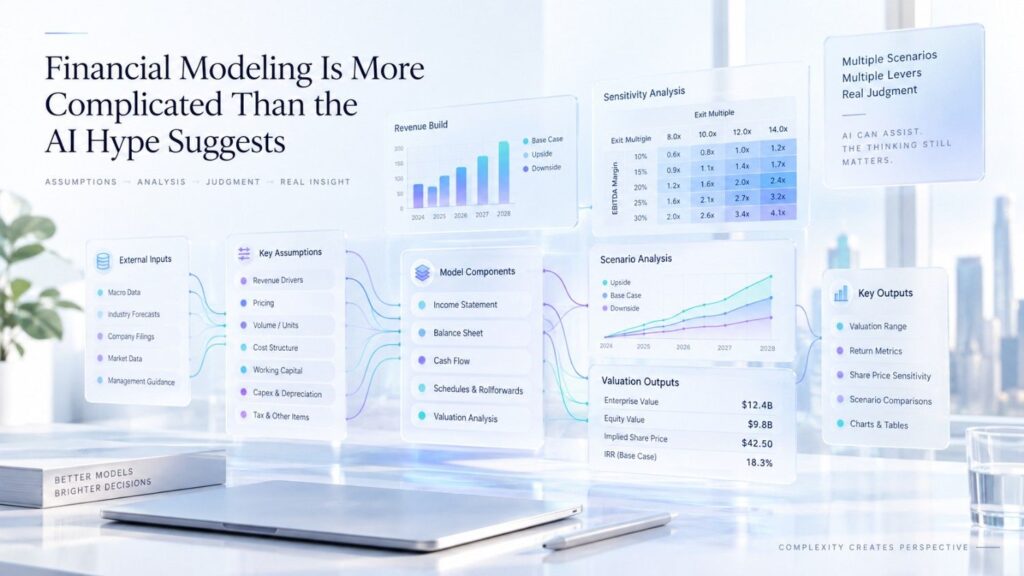
An agent can be excellent at updating historical numbers while still being dangerous when it decides how a business should be forecast.
There Are Really Several Modeling Jobs
A financial model contains data collection, formula construction, accounting relationships, assumptions, scenario design, valuation logic, output formatting, and error checking.
Those parts do not have equal AI exposure.
Table: Where Agents Fit Inside Financial Modeling
| Modeling activity | Agent potential | Human role |
| Pulling historical financial data | Very high | Validate source and mapping |
| Updating market data | Very high | Confirm date and security |
| Refreshing comparable-company multiples | Very high | Approve peer group |
| Formula-error checking | Very high | Review flagged exceptions |
| Updating an existing operating model | High | Approve assumptions |
| Creating standard valuation outputs | High | Interpret valuation |
| Building a new model from a clear template | Medium-high | Review structure |
| Forecasting a new business model | Medium | Set assumptions |
| Selecting scenarios | Medium-low | Exercise judgment |
| Deciding what the model means for a client | Low | Banker-led |
The real breakthrough may therefore be model maintenance rather than model replacement.
A good agent could reduce the hours spent moving information through models while increasing the time analysts spend understanding the drivers.
That would be a healthy change if banks redesign training accordingly.
Due Diligence Could Move From Document Hunting to Exception Hunting
Live M&A deals generate enormous amounts of information.
There may be financial statements, customer information, contracts, legal files, tax material, insurance documents, operating metrics, management presentations, market reports, and hundreds of diligence questions.
Junior bankers spend significant time keeping this process organized.
Our job-posting analysis found diligence responsibilities in six of the eight roles studied. TD, Guggenheim, CBRE, Santander, BMO, and KeyBanc all explicitly referenced diligence work.
Agents Could Build the Diligence Map
An agent working inside an approved data room could classify new documents.
It could connect files with open questions.
It could extract requested information.
It could identify missing periods.
It could compare management statements with data.
It could maintain the request list.
It could detect contradictions.
It could prepare a morning summary showing which issues changed overnight.
The critical word is could.
An agent should not decide that a major diligence problem is immaterial.
That judgment belongs with bankers, lawyers, accountants, clients, and other specialists.
But software may become extremely good at making sure those people see the problem quickly.
Deal Execution Is Where Agent Autonomy Becomes More Dangerous
Research can often be checked before anybody outside the firm sees it.
Transaction execution is different.
An incorrectly updated slide is inconvenient.
An incorrectly sent client communication, data-room permission, filing, instruction, or transaction document can create much larger consequences.
This is why the idea of “fully autonomous investment banking” is misleading.
The closer AI gets to an external action, the tighter permissions should become.
The Execution Ladder
A useful way to design banking agents is to divide work by authority.
| Level | Example | Suggested control |
| 1 | Search approved sources | Agent can act |
| 2 | Summarize information | Agent acts, human reviews output |
| 3 | Draft slides or documents | Agent drafts, analyst approves |
| 4 | Modify financial models | Agent changes, analyst validates |
| 5 | Prepare client communication | Agent drafts, banker sends |
| 6 | Change transaction workflow | Explicit authorized approval |
| 7 | Make strategic recommendation | Human decision |
| 8 | Commit firm or client | Human authority only |
This is where investment banks need to resist a common technology mistake.
The goal should not be to maximize autonomy.
The goal should be to maximize safe useful work.
What the Banks Are Already Telling Us
The largest banks are approaching AI differently, but their public disclosures show a common direction.
JPMorgan: AI Is Entering Daily Workflow
JPMorgan says more than 65,000 Commercial & Investment Bank employees actively use LLM Suite. The bank has also described users moving from basic summarization into business applications and daily workflow integrations.
That evolution matters.
The first stage of enterprise AI is usually access.
The second is workflow.
The third is delegated action.
Investment banking becomes much more affected during stages two and three.
Bank of America: Research and Presentation Preparation Are Already Real Use Cases
Bank of America’s Q2 2026 materials may be the clearest public evidence for junior-banker-style workflows.
Around 4,000 Corporate & Investment Banking professionals were using AI for research and presentation preparation. The bank also reported roughly 200,000 active users of general-purpose AI productivity tools producing more than 400,000 prompts per day.
That suggests the adoption challenge is moving beyond whether employees will use AI.
The harder question is how deeply AI should enter the workflow.
Citi: Agents Become an Enterprise Platform
Citi’s Arc announcement is particularly important because it explicitly shifts from generative AI toward agents.
Citi says agents can help with research, synthesis, preparation, and execution while operating within the bank’s risk framework.
Those four words describe a meaningful part of analyst work.
Research.
Synthesis.
Preparation.
Execution.
Goldman Sachs: AI Becomes an Operating-Model Question
Goldman’s One Goldman Sachs 3.0 initiative moves the discussion beyond tools.
The firm says AI productivity gains require changes in processes, data, organization, decision-making, and operating structure.
That may ultimately be the more important lesson for investment banking.
You cannot insert agents into a workflow designed around humans passing Excel and PowerPoint files back and forth and expect the full benefit.
The process itself has to change.
Morgan Stanley: Augment Judgment Rather Than Pretend It Does Not Matter
Morgan Stanley’s 2026 shareholder letter says AI adoption is being embedded across the enterprise while describing the technology as something that augments professional judgment and advice.
That is a sensible model for investment banking.
The machine can increase the amount of information a banker can process.
It should not become an excuse to remove accountability.
Table: Wall Street’s AI Direction in 2026
| Institution | Public AI signal | What it suggests for banking |
| JPMorgan Chase | 65,000+ CIB users of LLM Suite | AI has reached large-scale daily use |
| Bank of America | ~4,000 CIB staff using AI for research and presentation preparation | Junior-workflow use is already practical |
| Citi | Arc enterprise AI agent platform | Banks are moving from assistance toward delegated workflows |
| Goldman Sachs | One Goldman Sachs 3.0 operating model propelled by AI | AI may reshape organization, not just software |
| Morgan Stanley | Enterprise AI positioned as productivity plus human judgment | Human advice remains central |
The Analyst Day Could Be Rebuilt Around Exceptions
The largest change may not be any single automated task.
It may be the order in which analysts work.
Today, analysts often start with production.
Tomorrow, they may start with exceptions.
A Simplified Before-and-After Workflow
| Traditional workflow | Agent-supported workflow |
| Search filings and databases | Review agent’s sourced research package |
| Pull numbers manually | Check exceptions and source mappings |
| Update comp tables | Approve peer-set changes |
| Update model | Review changed assumptions and errors |
| Build first draft of slides | Edit agent-generated draft |
| Compare pages manually | Review automated consistency report |
| Track diligence requests | Investigate unresolved diligence flags |
| Prepare meeting notes | Challenge conclusions and build questions |
| Make comments | Make higher-level comments |
| Repeat production cycle | Re-run controlled workflow |
The best outcome is not simply that the analyst works faster.
It is that the analyst moves earlier into the thinking process.
But There Is a Big Training Problem
Traditional analyst work is inefficient.
It is also educational.
An analyst who updates dozens of models starts to understand how financial statements connect.
An analyst who builds hundreds of valuation pages begins to notice what causes multiples to move.
An analyst who works through a long diligence process learns where transactions break.
Remove all the mechanical work and you risk removing part of the apprenticeship.
Goldman Sachs still emphasizes apprenticeship in its description of investment banking careers, noting the importance of junior employees working closely with experienced professionals.
Jefferies similarly highlights valuation, accounting, financial modeling, relationship building, client exposure, and case-based learning in its analyst-development approach.
Banks therefore need a new training model.
Analysts Cannot Become Reviewers of Work They Never Learned to Produce
Imagine an analyst who has never built a three-statement model manually.
An agent gives that person a finished model.
The workbook looks professional.
Every sheet balances.
One assumption is economically absurd.
Will the analyst notice?
Maybe not.
That is why training must remain deeper than tool use.
Banks may need controlled “manual practice” in the same way pilots train for situations that computers usually handle.
The analyst should know how to do the task.
The agent should reduce how often the analyst has to do the entire task from scratch.
The New Analyst Advantage Will Be Knowing What to Question
When information becomes easier to produce, skepticism becomes more valuable.
A future analyst might receive twenty pages of agent-generated research in minutes.
The challenge will not be obtaining twenty pages.
The challenge will be identifying the two paragraphs that are wrong and the three facts that change the deal.
That favors a different type of junior banker.
Technical Skill Will Still Matter
Excel knowledge does not become useless because an AI can manipulate spreadsheets.
It becomes useful for a different reason.
Analysts need to understand the logic well enough to supervise automated changes.
The same applies to accounting.
The same applies to valuation.
The same applies to finance.
The analyst who understands only how to prompt an AI may be less useful than the analyst who understands finance deeply and knows when the AI is wrong.
Client Skills Could Arrive Earlier in the Analyst Career
One of the more positive possibilities is that analysts gain earlier exposure to clients.
If a bank can reduce the amount of time spent manually updating slides and pulling data, deal teams gain a choice.
They can cut capacity.
Or they can move junior bankers into more useful work.
The better firms may choose some of both.
An analyst could spend more time preparing questions for management.
They could join more client calls.
They could understand the transaction rationale.
They could follow negotiation issues.
They could learn why the managing director changed the argument.
They could spend more time with associates and vice presidents discussing the deal rather than formatting the deck.
That would make analyst work more demanding intellectually, not less.
The Investment Banking Pyramid Could Become Narrower but More Productive
There is still a staffing consequence.
Investment banking has traditionally used leverage.
A senior banker creates relationships and originates business. Vice presidents and associates run execution. Analysts perform a significant share of the production work underneath them.
If production becomes cheaper, some teams may need fewer junior hours for the same transaction.
That does not automatically mean analyst classes disappear.
There are several competing forces.
Deal volume can grow.
Banks can cover more clients.
Senior bankers can request more analysis.
Smaller transactions can become economically attractive.
Teams can produce more scenarios.
The quality bar can rise.
New AI-related financing activity itself can generate banking work.
Morgan Stanley, for example, argued in March 2026 that the AI investment cycle is creating financing and deal opportunities for banks while also improving industry efficiency.
The likely result is therefore not a simple one-for-one substitution between an agent and an analyst.
It is a change in the economics of deal-team capacity.
Bankers May Produce More Work Because AI Makes Work Cheaper
There is an old pattern in technology.
When the cost of an activity falls, people sometimes consume more of it.
That could happen in investment banking.
Suppose preparing a detailed strategic alternatives analysis currently takes several days.
If an agent reduces the production time dramatically, bankers may not simply save the time.
They may run more alternatives.
They may analyze more acquisition targets.
They may prepare a wider buyer universe.
They may update client materials more often.
They may cover more companies.
They may prepare customized analysis before every senior-client conversation.
AI can therefore increase the amount of analysis produced even while reducing the cost of producing each analysis.
This is one reason job predictions based only on individual-task automation often fail.
Work itself changes.
The Biggest Constraint Will Not Be Intelligence
Many demonstrations of AI agents focus on whether the software is smart enough.
Inside an investment bank, intelligence is only part of the challenge.
An agent also needs permission.
It needs trusted data.
It needs identity.
It needs an audit trail.
It needs version control.
It needs source tracking.
It needs to know what it is not allowed to do.
It needs a clear human owner.
This becomes especially important because financial firms operate under extensive regulatory and supervisory obligations.
FINRA’s 2026 Regulatory Oversight Report specifically discusses AI agents. It warns about autonomy, agents operating beyond their intended authority, auditability, sensitive data, domain knowledge, and the continuing risks of errors, privacy problems, and hallucinations. FINRA also highlights controls such as monitoring system access, human oversight, tracking agent actions, and mechanisms that restrict agent behavior.
FINRA has repeatedly made the broader point that existing securities laws and FINRA rules still apply when firms use generative AI.
In other words, “the AI did it” is not a control framework.
Human Approval Has to Be Designed Into the Workflow
Many businesses talk about keeping a human “in the loop.”
That phrase is too vague for investment banking.
The better question is:
Which human must approve which action at which stage?
A first-year analyst may be able to approve a formatting update.
They should not independently approve a change in transaction strategy.
An associate may approve model assumptions within an established framework.
A senior banker may need to approve a client recommendation.
Legal or compliance teams may need to approve other actions.
The control should match the authority of the task.
A Practical Agent Control Matrix
| Risk | Example failure | Control |
| Wrong source | Agent uses stale financial data | Approved-source whitelist and timestamp |
| Hallucinated fact | Fake transaction or company statement | Mandatory source citation |
| Model error | Formula or mapping changes incorrectly | Formula-diff and reconciliation checks |
| Permission failure | Agent enters restricted data | Role-based access |
| Data leakage | Confidential deal information leaves environment | Private controlled infrastructure |
| Scope creep | Agent performs an action it was not asked to perform | Narrow permissions and action boundaries |
| Bad communication | Incorrect client email drafted or sent | Human-send requirement |
| Weak audit trail | Nobody knows what the agent changed | Immutable activity log |
| Prompt injection | Malicious document changes agent behavior | Treat retrieved content as data, not instructions |
| Strategic error | Agent makes unsupported recommendation | Human ownership of final judgment |
This is not simply a compliance requirement.
It can make the technology better.
A tightly scoped agent often performs more reliably because the system has fewer ways to go wrong.
Agent Identity Could Become a Major Banking Control
Investment banks already spend enormous effort controlling who can access which information.
Agents create a new version of that problem.
An agent should not have “bank-wide access” merely because an employee using it has broad access.
It should operate with the minimum authority needed for the specific workflow.
A research agent may need SEC filings, approved research, market data, and past client materials.
It probably does not need permission to send email.
A diligence agent may need access to a specific data room.
It should not automatically gain access to another transaction.
A presentation agent may edit a working deck.
It should not be able to publish or distribute it externally.
This concept of agent identity will become increasingly important as financial institutions move from chatbots toward systems that can act.
Every Number Should Carry Its Provenance
Investment banking agents should be designed around a simple rule:
A number without a source is an unfinished number.
Suppose an agent inserts “$483 million” into a pitch book.
The reviewer should be able to click it and see:
where the number came from,
when it was retrieved,
whether it was reported or estimated,
what unit it used,
whether the agent transformed it,
which model cell uses it,
and where else it appears.
This makes AI output easier to trust.
It also makes review faster.
Without provenance, AI may create more checking work than it removes.
AI Should Reduce Reconciliation Work
Investment banking contains a surprising amount of reconciliation.
Does the enterprise value on page 12 match page 27?
Does the revenue number in PowerPoint match Excel?
Did the footnote update?
Is the market-data date consistent?
Did the new case flow through the accretion/dilution analysis?
Does the management presentation use the same adjusted EBITDA definition as the model?
Humans are not especially well suited to repeatedly checking hundreds of small relationships.
Machines are.
This may ultimately become one of the highest-return uses of AI agents in banking.
The agent does not need to decide what the transaction means.
It needs to notice that page 43 says 12.6x while page 61 says 12.4x.
That is boring work.
It is also important work.
A Bank Should Not Start With “Build Us an Investment Banking Agent”
That scope is far too wide.
The better starting point is one repeatable workflow with clean inputs and measurable output.
For many banks, comparable-company updates or presentation refreshes would make more sense than autonomous deal execution.
A Practical 90-Day Pilot
Days 1–30: Map the Workflow
Choose one high-frequency task.
Document every input, source, transformation, approval, output, and exception.
Measure the current baseline.
How many analyst hours does it require?
How long does the workflow take?
How many comments come back?
How often do errors occur?
How many systems does the analyst touch?
Without the baseline, the bank cannot know whether AI improved anything.
Days 31–60: Run the Agent in Shadow Mode
Let the agent perform the workflow without replacing the human process.
Compare the two outputs.
Do not grade only whether the final slide “looks good.”
Measure data accuracy.
Measure formula accuracy.
Measure source accuracy.
Measure the number of human corrections.
Measure whether important issues were missed.
The purpose of shadow mode is to discover failure patterns before the system receives more authority.
Days 61–90: Introduce Controlled Production
If the evidence is strong, allow the agent to complete low-risk production steps.
Keep explicit human approval for changes involving judgment or external communication.
Continue logging every action.
The goal at day 90 is not full automation.
It is a proven workflow that saves time without lowering the bank’s quality standard.
The KPI Dashboard Every Investment Bank Should Build
AI projects often fail because teams celebrate usage rather than value.
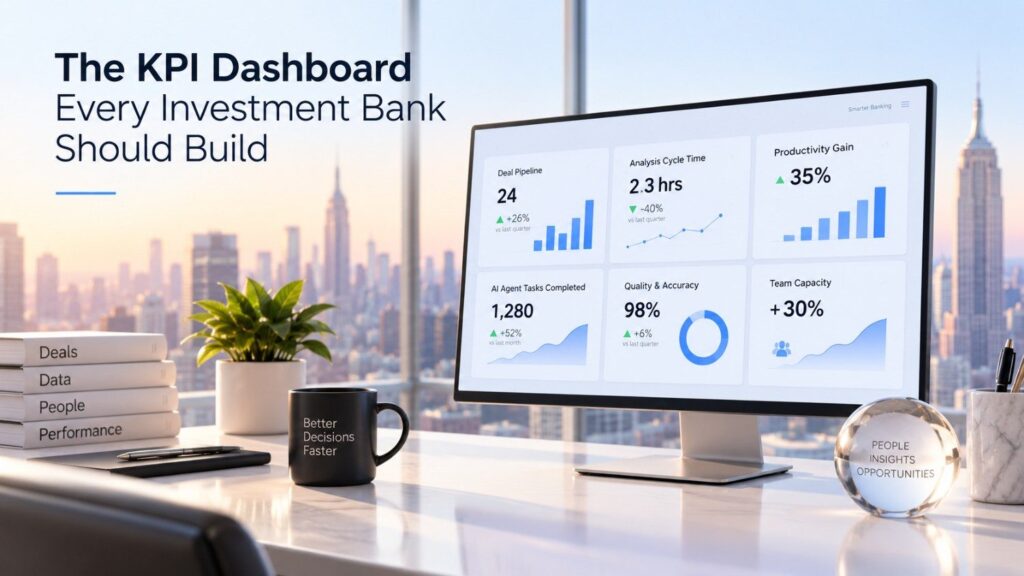
“Ten thousand prompts” is not a business result.
Investment banks should measure the workflow.
Table: Agent KPI Scorecard
| KPI | What it measures |
| Analyst minutes saved per workflow | Real capacity created |
| End-to-end cycle-time reduction | Speed |
| First-pass accuracy | Quality before human correction |
| Human corrections per output | Review burden |
| Source-verification failure rate | Research reliability |
| Model reconciliation failure rate | Financial accuracy |
| Material errors reaching senior review | Operational risk |
| Percentage of tasks requiring escalation | Agent boundaries |
| Rework after VP/MD review | Usefulness |
| Client-facing errors | Critical quality measure |
| Cost per completed workflow | Economics |
| Analyst time moved to judgment/client work | Whether job quality improves |
The last measure deserves more attention.
A bank could automate 20% of an analyst’s workload and still waste the benefit if the saved time gets filled with more formatting.
The real strategic goal should be to move human effort upward.
The New Investment Banking Analyst Skill Stack
The analyst of the agent era will still need finance.
But the mix changes.
Accounting Becomes More Important, Not Less
When software can generate a model quickly, people who can test the accounting logic become more valuable.
Analysts must understand cash flow.
They must understand working capital.
They must understand debt.
They must understand how transactions move through financial statements.
Otherwise they cannot supervise the machine.
Source Judgment Becomes a Core Skill
Analysts will need to distinguish an authoritative source from an easy source.
That sounds basic.
It is not.
An agent can retrieve thousands of documents.
The analyst still needs to know which evidence should drive a client recommendation.
Asking Good Questions Becomes Valuable
Prompting alone is not a durable professional skill.
Problem definition is.
The future analyst needs to translate a vague request from a senior banker into a structured analytical problem.
That ability already separates strong analysts from weak ones.
Agents may amplify the difference.
Communication Matters Earlier
If AI reduces production work, analysts may spend more time explaining conclusions.
That means writing clearly.
Speaking clearly.
Understanding the client’s objectives.
Knowing when to ask a question.
Knowing when not to speak.
Technology does not eliminate these skills.
It exposes people who never developed them.
What Happens to Investment Banking Hours?
One of the most common hopes is that AI will finally reduce the extreme hours associated with junior banking.
It might.
But technology alone will not do it.
If a task that took three hours now takes thirty minutes, the organization can use the remaining two and a half hours in several ways.
It can give the analyst time back.
It can add more work.
It can increase the number of analyses.
It can reduce staffing.
It can increase client coverage.
Most banks will probably use a mixture.
This means the effect of agents on analyst hours will be an organizational decision, not simply a technical outcome.
The firms that treat every productivity gain as unused capacity may discover that analysts are just as busy as before.
They will simply produce more.
The Best Banks May Use AI to Improve the Analyst Experience
There is a competitive talent angle here.
Investment banking still competes with private equity, hedge funds, technology firms, startups, consulting, and other careers for strong graduates.
If one bank uses AI mainly to increase monitoring and workload while another uses it to remove low-value work and accelerate learning, the second firm may have a recruiting advantage.
Imagine telling a candidate:
“Our analysts still learn modeling, accounting, valuation, and transaction execution. But our systems automate a large part of repetitive data gathering and deck maintenance, so you spend more time on the actual deal.”
That is a strong talent message.
It also aligns with what analysts often hoped investment banking would be before they discovered how much time can disappear into production work.
Smaller Advisory Firms Could Gain Disproportionately
Large banks have more data and larger technology budgets.
Boutiques have another advantage.
They can sometimes change workflows faster.
A smaller advisory firm with a strong data architecture and carefully controlled agents might allow a five-person team to perform work that once required a much larger production effort.
That could matter in middle-market M&A, private capital advisory, restructuring, sector boutiques, and other areas where senior expertise is valuable but production capacity is expensive.
The competitive question may become:
How much senior judgment can a firm put behind each dollar of junior production cost?
Agents could change that ratio.
More Automation Could Also Raise the Minimum Quality Bar
AI does not necessarily make mediocre banking competitive.
It may do the opposite.
If every firm can produce a reasonable market overview, a basic DCF, a buyer list, and a professional-looking pitch book quickly, those outputs stop being meaningful points of differentiation.
Clients may care even more about the parts machines cannot easily commoditize.
Which acquisition should we actually make?
Should we sell now?
Which buyer is serious?
How should we structure the negotiation?
Which risk matters?
How will the board react?
What does the market not understand?
What will the other side do next?
AI makes generic analysis cheaper.
That can make non-generic judgment more valuable.
The Analyst Class May Get Smaller in Some Teams but Broader in Responsibility
It would be unrealistic to argue that AI will never affect junior hiring.
If agents reliably eliminate thousands of production hours, some groups will eventually test whether they can run with fewer analysts.
But that will not occur uniformly.
Product groups differ.
Coverage teams differ.
Live-deal intensity differs.
Banks differ.
The likely pattern is uneven.
Some teams may keep similar analyst numbers and produce much more work.
Some may grow more slowly.
Some may use smaller classes.
Some may shift work from centralized production teams.
Others may create new AI-supervision roles.
What seems less likely is that investment banking stops requiring a junior talent pipeline.
Senior bankers do not appear automatically.
They are developed.
Today’s analyst can become tomorrow’s associate, vice president, managing director, group head, or client executive.
Removing the entire entry layer to save short-term cost would create a long-term talent problem.
Five Predictions for Wall Street’s Agentic Analyst Era
Prediction #1: Research Updates Become Continuous
By the end of this transition, asking an analyst to “update the company” may sound strange.
The agent will already have updated it.
The analyst will instead be asked to explain what changed and why it matters.
Prediction #2: Pitch Books Become Dynamic Objects
The traditional deck is a static file.
Future presentations may behave more like controlled outputs from connected data.
Change an assumption and related pages update automatically.
Add a transaction and sector pages refresh.
Move the valuation date and charts re-run.
PowerPoint will still exist.
The process behind it becomes less manual.
Prediction #3: Model Review Becomes More Important Than Model Entry
The ability to enter formulas quickly becomes less valuable.
The ability to detect a bad assumption becomes more valuable.
This will push analysts toward financial reasoning earlier.
Prediction #4: Agent Permissions Become Part of Deal Governance
Banks will eventually think about AI-agent access in the same disciplined way they think about human access.
Who can see the deal?
What can they change?
What can they send?
What actions require approval?
Every important agent will need an answer to the same questions.
FINRA’s 2026 attention to agent authority, human validation, auditability, and data access makes this direction increasingly difficult for financial institutions to ignore.
Prediction #5: The Best Analysts Become More Valuable
When basic output gets cheaper, people who know what good output looks like become valuable.
A great analyst will use agents to cover more ground.
They will test more assumptions.
They will identify errors faster.
They will understand the client better.
They will arrive at senior discussions better prepared.
AI may therefore widen the gap between analysts who merely produce work and analysts who understand the work.
What New York Investment Banks Should Do Now
The strongest starting point is not an enterprise promise about “autonomous banking.”
It is workflow redesign.
Take one analyst process.
Measure it.
Separate mechanical work from judgment.
Identify approved data.
Define agent permissions.
Create verification rules.
Run it in shadow mode.
Measure corrections.
Introduce human approval.
Then expand.
The firms that succeed will probably be the ones that remain disciplined enough to automate boring work before attempting glamorous work.
There is huge value in automatically updating a comparable-company table accurately.
There is huge value in finding mismatched numbers across eighty pages.
There is huge value in organizing a diligence room.
There is huge value in creating a sourced first draft overnight.
None of these demonstrations will look as exciting as an AI announcing that it has autonomously advised on a $20 billion merger.
They are far more likely to create real economic value.
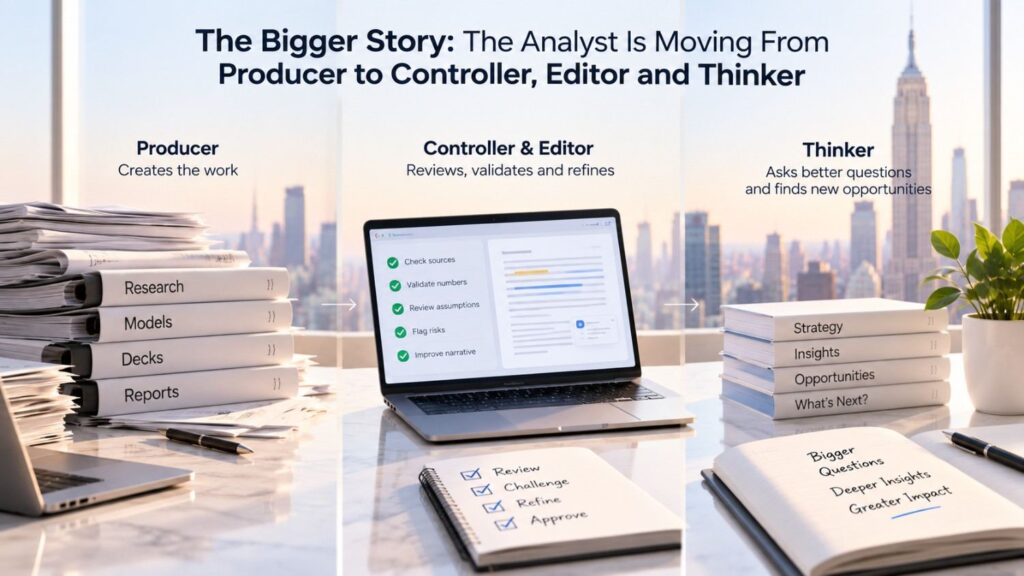
The Bigger Story: The Analyst Is Moving From Producer to Controller, Editor and Thinker
Investment banking analysts are not disappearing into a chatbot.
But a large part of the production system around them is becoming programmable.
Our analysis of eight New York analyst roles found financial modeling and research in every role. Pitch materials and transaction execution appeared in seven of eight. Due diligence appeared in six.
Those same activities contain some of the clearest opportunities for agent-based automation.
Our Agent Exposure Index placed company and industry research at 88 out of 100, modeling and valuation at 80, pitch materials at 77, transaction-document preparation at 60, and diligence at 57.
That does not mean 88% of research jobs disappear.
It means research presents an unusually strong combination of high analyst relevance and high technical suitability for agents.
At the same time, New York securities employment was still growing by roughly 3% year over year as of June 2026, while major financial institutions were rapidly expanding AI deployment. Securities represented around 41% of NYC financial-activities employment but produced about three-quarters of that sector’s year-over-year job growth.
That combination matters.
The near-term Wall Street story may not be humans versus AI.
It may be AI-enabled teams versus teams still operating manually.
An analyst who spends ten hours gathering, copying, formatting, and reconciling information cannot compete forever with an analyst who receives the same information in minutes and spends the remaining time understanding the deal.
That is the real opportunity.
Investment banking has spent decades using technology to make calculations faster.
AI agents could attack something much bigger: the workflow connecting those calculations.
When that happens, analysts will still build careers by knowing companies, understanding finance, earning trust, working under pressure, and developing sound judgment.
They may simply spend much less of their career moving numbers from one place to another.
And on Wall Street, that would represent a genuine change in how the work gets done.
NYC Tech Journal Original Research Methodology
| Element | Method |
| Research question | Which common investment-banking analyst responsibilities are most exposed to AI-agent automation? |
| Geography | New York City / New York analyst roles |
| Role sample | Eight publicly accessible investment-banking analyst descriptions |
| Institutions represented | JPMorgan, Jefferies, TD Securities, Guggenheim Securities, CBRE, Santander, BMO Capital Markets, KeyBanc Capital Markets |
| Coding method | Manual binary coding of clearly stated responsibilities into nine work families |
| Posting prevalence | Number of roles mentioning task divided by eight |
| Agentability assessment | 1–5 analytical score based on digital inputs, repeatability, verifiability, judgment burden and action risk |
| Exposure calculation | Posting prevalence × agentability / 5 |
| Employment analysis | NYC Comptroller/BLS-linked securities and financial-activities employment data |
| Key limitation | Job descriptions show required capabilities, not actual analyst time allocation; the sample is purposive rather than statistically random |
| Interpretation | Exposure measures suitability for workflow automation, not predicted job losses |
Key Sources
| Source | Evidence used |
| NYC Comptroller, August 2026 economic outlook | NYC securities and financial-activities employment; Wall Street profitability |
| NYC Comptroller, July 2026 economic outlook | Major-bank investment banking earnings and fee growth |
| New York State Comptroller | Securities employment, compensation and national position of NYC finance |
| JPMorgan Chase 2025 Annual Report materials | LLM Suite use across Commercial & Investment Bank |
| Bank of America Q2 2026 investor materials | CIB AI adoption and enterprise GenAI scale |
| Citi | Arc AI agent platform and agent workflow description |
| Goldman Sachs 2025 Annual Report | One Goldman Sachs 3.0 and AI operating-model strategy |
| Morgan Stanley 2026 shareholder letter | Enterprise AI adoption and human-judgment position |
| FINRA 2026 Regulatory Oversight Report | AI-agent risks, supervision and controls |
| Public NYC analyst job descriptions | Original analyst-task dataset |