
For more than a century, New York advertising has reinvented itself whenever the way people discover products changes.
Radio changed the business. Television changed it again. Cable created more places to buy attention. Search advertising turned keywords into an auction. Social media turned feeds into storefronts. Programmatic advertising turned millions of individual ad placements into software transactions.
Agentic AI may create an even deeper change.
The important difference is that an AI agent does not simply help someone write a headline, summarize a report, or make an image. A properly connected agent can receive a goal, gather information, decide what to do next, use software, create assets, monitor results, and take another action.
That means advertising software is starting to move from helping people do advertising work toward doing parts of the advertising workflow itself.
Google has announced agentic capabilities that can help advertisers create campaigns, recommend keywords and creative, implement changes, analyze results, and troubleshoot problems. Adobe is putting agents into content-production workflows. WPP describes WPP Open as an agentic marketing platform that connects strategy, creative, media, and production. Dentsu says its latest dentsu.Connect system uses agents across the marketing lifecycle. Omnicom’s Omni platform now emphasizes agent orchestration, personalized production, predictive intelligence, activation, and optimization.
This is happening while advertisers themselves are becoming much more serious about the technology. IAB’s 2026 Outlook study, based on more than 200 brand and agency buyers, found that five of the six biggest areas receiving increased buyer attention involved AI. Two-thirds of buyers were focused specifically on agentic AI for ad buying and campaign execution, while 96% were aware of the concept.
For Madison Avenue, this is not simply another software upgrade.
It could change what an agency sells, how many steps sit between a client brief and a live campaign, how media budgets are managed, what junior employees spend their days doing, how agencies charge clients, and ultimately where the most valuable advertising expertise lives.
The agency of the future may still produce campaigns.
But increasingly, it may also design, train, supervise, and improve the systems that produce them.
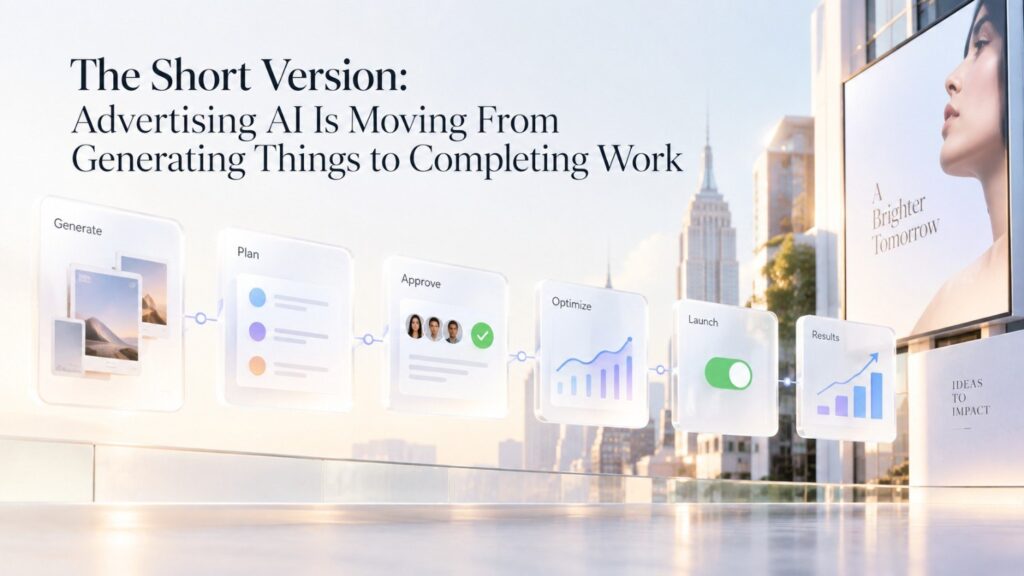
The Short Version: Advertising AI Is Moving From Generating Things to Completing Work
The first wave of generative AI in advertising was easy to understand.
Give the model a prompt. Get something back.
A headline.
An image.
A storyboard.
A summary.
A set of audience ideas.
That was useful, but the human remained the operating system. Someone still had to take the output, move it into another application, check the data, ask for approval, upload the campaign, watch performance, prepare the report, and decide what happened next.
Agentic AI starts to join those steps.
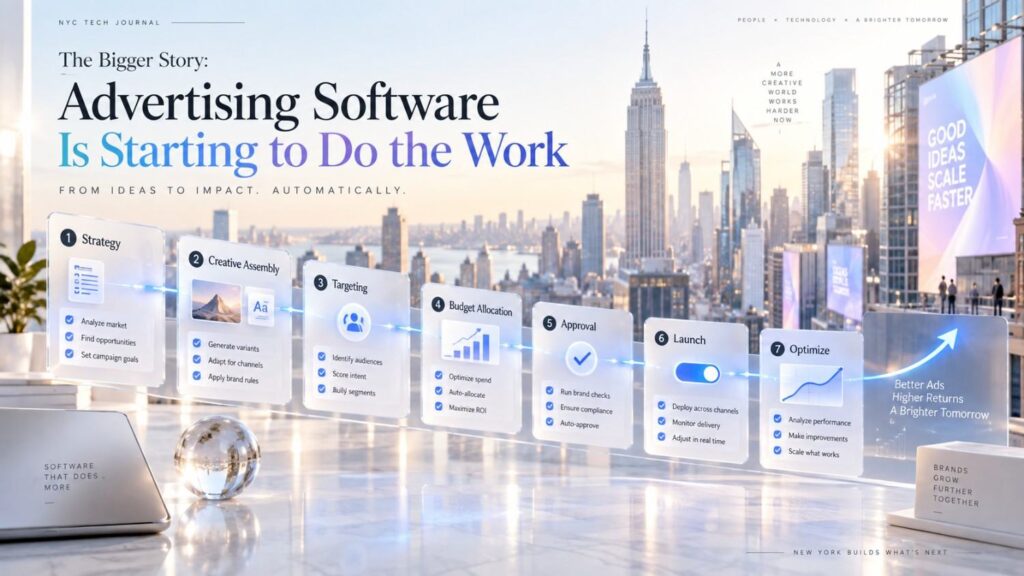
An advertising agent could receive a brief for a new sneaker launch, examine past campaign data, identify promising audience segments, prepare channel recommendations, generate dozens of creative versions, send selected versions into an approval queue, build campaign structures inside advertising platforms, monitor performance, detect an underperforming ad, create another variation, and recommend moving budget.
The human would still set the objective, boundaries, budget, brand standards, approval requirements, and risk limits.
But much more of the work between those decisions could become executable by software.
That difference matters enormously.
The old model was human-led software
Traditional ad technology normally waits for commands.
A planner opens a platform.
A buyer selects an audience.
A strategist downloads data.
A designer makes versions.
An account manager requests changes.
An analyst prepares a report.
Even highly automated advertising platforms usually automate a defined action inside a system.
The agent model connects actions
Agentic systems are more useful when they can decide what action should happen next within a controlled workflow.
Google’s announced advertising agents illustrate this change. Its agentic expert can provide personalized campaign recommendations and, under advertiser guidance, implement them. Google has said the system can suggest keywords, creative, and even multiple tailored ad groups with related assets. Google Analytics is also gaining agentic capabilities for finding insights, exploring data, and troubleshooting campaign issues.
That is a bigger change than adding another text-generation box.
The software is moving closer to the workflow.
Why Madison Avenue Is an Ideal Test Market for Agentic Advertising
“Madison Avenue” has long been shorthand for the American advertising business, even though New York’s advertising industry is now spread across neighborhoods, boroughs, platforms, consultancies, production companies, media organizations, and technology firms.
The phrase still works because New York remains an unusually dense market for advertising expertise.
The latest BLS metropolitan data provide a useful signal. In May 2025, the New York-Newark-Jersey City area had an estimated 3,630 advertising and promotions managers and 54,730 marketing managers. Advertising and promotions managers were employed at 2.77 times the national concentration, while marketing managers were at 2.27 times the national concentration. Their mean annual wages were roughly $202,940 and $207,770 respectively.
That concentration matters for AI adoption.
New York has agencies.
It has major advertisers.
It has publishers.
It has television.
It has finance.
It has fashion.
It has retail.
It has sports.
It has entertainment.
It has healthcare.
It has technology companies.
It also has some of the industry’s largest agency networks and thousands of businesses that buy advertising.
A technology that connects audience intelligence, creative development, media buying, commerce, measurement, and business data therefore has an unusually large number of workflows to attack in this market.
New York’s office market gives another clue. NYC’s February 2026 financial plan cited Colliers data showing that more than one-third of Manhattan office leasing activity during the fourth quarter of 2025 came from the combined technology, advertising, media, and information-services sector.
The geographic center of advertising may be less literal than it once was.
The economic network is still here.
NYC Tech Journal Original Research: How We Studied the Agentic Advertising Shift
To move beyond AI predictions, NYC Tech Journal analyzed several groups of publicly available information current through September 2026.
The first dataset is employment information from the U.S. Bureau of Labor Statistics Occupational Employment and Wage Statistics program. We compared New York metropolitan employment in advertising management, marketing management, public relations management, and advertising sales.
The second dataset combines IAB studies released in 2025 and 2026. We compared AI integration, agentic-AI interest, reported AI incidents, governance investment, and buyer priorities.
The third part is a manual capability analysis of publicly documented advertising systems from Google, Adobe, WPP, Dentsu, and Omnicom. Instead of scoring marketing claims about which product is “best,” we examined which parts of the advertising workflow each company publicly says its technology can address.
Finally, we built two models of our own. One estimates the economic value of time returned to New York advertising teams. The other ranks common advertising workflows by their suitability for controlled agent automation.
These are not forecasts of job losses, agency revenue, or investment returns. They are structured analyses designed to reveal where the operating model is changing fastest.
That distinction is important.
Original Finding #1: New York’s Advertising Workforce Is Already Changing Shape
One of the easiest mistakes in the AI debate is to assume that advertising employment will simply move down as automation moves up.
New York’s labor data tell a more interesting story.
Consider three management occupations.
Chart 1: Change in Selected New York Metro Management Roles
| Occupation | 2021 employment | 2025 employment | Calculated change |
| Advertising and promotions managers | 7,380 | 3,630 | -50.8% |
| Marketing managers | 29,690 | 54,730 | +84.3% |
| Public relations managers | 5,980 | 7,940 | +32.8% |
2021 values come from BLS metropolitan OEWS data, while 2025 values come from the latest BLS New York metropolitan release.
The numbers should be interpreted carefully. OEWS estimates are survey estimates, metropolitan definitions and occupational classification practices can change, and these occupations appear across many industries. They should not be read as a direct count of agency hiring and firing.
Even with those limitations, the pattern is worth studying.
The narrow occupation called “advertising and promotions manager” has become much smaller while broader marketing management has expanded sharply.
That fits a larger change in the work.
Advertising used to be easier to separate from marketing. Creative was created. Media was purchased. Campaigns ran. Results arrived later.
Digital systems have blurred those borders.
The same marketing leader may now deal with customer data, ecommerce, performance marketing, product feeds, creators, search, email, loyalty, attribution, AI discovery, websites, and paid media.
Agentic AI pushes that convergence further.
The job may expand even when individual tasks disappear
Suppose an agent eliminates hours spent building repetitive reports.
That does not necessarily eliminate the marketing manager.
It may allow that manager to oversee more campaigns, study more customer segments, test more ideas, or spend more time making business decisions.
The important unit of analysis is therefore not always the job.
It is the task inside the job.
That is one reason businesses should be cautious about building AI strategies around simple headcount reduction.
The better question is:
Which parts of expensive New York knowledge work can become faster without removing the judgment that creates value?
Original Finding #2: Advertising Has a Governance Gap, Not Just an Adoption Gap
Another striking pattern appears when different IAB studies are viewed together.
IAB reported in 2025 that only 30% of agencies, brands, and publishers had fully integrated AI across the media campaign lifecycle. About half of organizations still lacked a strategic AI roadmap. Data quality, data protection, and fragmented tools were among the main barriers.
Yet adoption continued moving rapidly.
In another 2025 IAB study, more than half of marketers were already using generative AI for creative content and audience targeting. More than 70% of surveyed executives said they had encountered an AI-related advertising incident, such as hallucinated information, bias, or off-brand content. Fewer than 35% planned to increase spending on AI governance or brand-integrity oversight over the following year.
Put those numbers together.
Chart 2: The Advertising AI Governance Mismatch
| Indicator | Reported level |
| Organizations fully integrating AI across media lifecycle in 2025 | 30% |
| Industry participants lacking an AI roadmap | About 50% |
| Executives reporting an AI-related advertising incident | More than 70% |
| Executives planning increased governance or brand-integrity investment | Less than 35% |
| 2026 buyers aware of agentic ad buying | 96% |
| 2026 buyers focused on agentic AI for buying/execution | About two-thirds |
Sources: IAB State of Data 2025, IAB/Aymara AI research, and IAB 2026 Outlook.
The original calculation is simple but revealing.
If more than 70% have encountered an AI problem while fewer than 35% expect to increase governance investment, the reported incident rate is more than twice the share planning to increase governance spending.
There is also a gap of more than 35 percentage points between the two measures.
These surveys examine different questions, so this is not a causal relationship. It does, however, show why agency AI strategy cannot focus only on speed.
When AI generates one headline, a person can easily review it.
When an autonomous workflow produces 2,000 pieces of creative, changes bids, moves money, creates audiences, and publishes assets, governance becomes an operating requirement.
The faster the machine moves, the more valuable control becomes.
Agentic AI Could Turn the Advertising Workflow Into a Software System
A modern campaign still contains many handoffs.
The strategist interprets the brief.
The research team gathers information.
The media planner develops a plan.
The creative team develops concepts.
Production makes versions.
Legal reviews claims.
The account team gets approval.
The media team builds campaigns.
Operations checks everything.
The campaign launches.
Analysts watch results.
Reports are built.
Changes are requested.
Each handoff creates time, cost, and the possibility of information getting lost.
Agents attack the handoffs.
Research can become continuous
Traditional research often produces a presentation.
Agentic research can become an active input.
Imagine a retail client asking an agency to understand why one product category suddenly slowed in Brooklyn and Queens.
A research agent could examine approved sales data, search trends, campaign performance, customer reviews, competitor messaging, weather, local events, pricing, and inventory.
It could then prepare several hypotheses.
The strategist does not disappear.
The strategist begins with a much richer first draft.
WPP’s Agent Hub gives a glimpse of this direction. Its initial agents include a Brand Analytics Agent built around roughly 30 years of Brand Asset Valuator data, a Behavioural Science Agent, an Analogies Agent, and Creative Brain. WPP said in January 2026 that the platform was already used by more than 75,000 people across the company and more than 90% of client-facing staff.
Institutional knowledge that once lived mostly in experienced employees can increasingly be made available through software.
That has major implications for large agencies.
Strategy Could Become Faster Without Becoming Automatic
Strategy is often described as something AI will either replace or never touch.
Both positions are too simple.
Much of strategic work contains tasks that machines can help perform extremely well: gathering evidence, organizing information, identifying patterns, comparing segments, finding contradictions, and generating possible explanations.
But deciding what a brand should stand for is different.
That choice involves taste, competitive judgment, business context, organizational politics, risk, and often an understanding of culture that is difficult to reduce to data.
The likely model is therefore not autonomous strategy.
It is machine-expanded strategy.
A strategist may be able to examine twenty scenarios rather than three.
An agent may challenge assumptions before a meeting.
The human still decides what matters.
That could actually increase the value of strong strategists because more teams will gain access to roughly competent analysis.
When information becomes cheap, judgment becomes more visible.
Creative Production Is Likely to Change Faster Than Big Creative Ideas
Creative production is one of the clearest areas for automation because modern advertising demands an enormous number of assets.
A single campaign may need multiple aspect ratios, languages, product versions, calls to action, headlines, backgrounds, video lengths, placements, and audience variations.
That work consumes enormous production capacity.
IAB’s 2025 digital video study found that half of advertisers were already using generative AI to build video advertising. A total of 86% were using or planning to use it, and buyers expected generative-AI creative to represent 40% of ads by 2026.
Adobe is building directly for this environment. GenStudio for Performance Marketing can create variants for paid media and other channels, manage brand rules, support review and approval, and analyze performance. Adobe’s Content Production Agent can interpret a marketing brief and create channel-specific content while following campaign objectives and brand guidelines.
This changes the production bottleneck.
One concept could produce hundreds of executions
Consider a campaign with one strong creative platform.
Historically, creating 300 high-quality variations could become expensive enough that the advertiser simply would not make them.
Agents change the economics.
One approved concept could be transformed into versions for different products, audiences, placements, locations, languages, and stages of the customer journey.
The expensive part becomes less about manually producing each asset.
The expensive part becomes deciding which variation should exist, which parts may change, which elements must remain locked, and what the system must never generate.
That is a very different creative operating model.
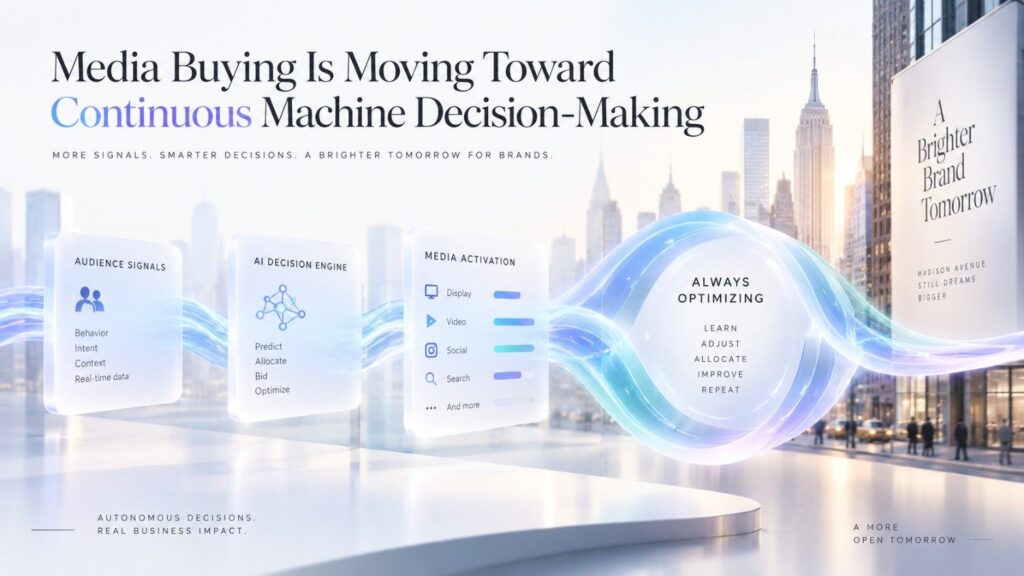
Media Buying Is Moving Toward Continuous Machine Decision-Making
Media was already highly automated before generative AI arrived.
Real-time bidding, algorithmic optimization, automated targeting, and campaign bidding systems have existed for years.
Agentic AI adds another layer.
Instead of optimizing only inside a campaign using a fixed objective, an agent can potentially reason across the surrounding workflow.
Google has said its agents can help with campaign onboarding, creation, optimization, reporting, and troubleshooting. The advertising agent can recommend keywords and creative and take implementation actions under advertiser guidance.
This suggests a future in which the media buyer increasingly manages policy rather than every individual action.
The buyer may define:
Spend no more than this amount.
Never exceed this acquisition cost without approval.
Do not advertise these products in these locations.
Do not move more than 10% of budget between channels automatically.
Pause if tracking quality drops.
Escalate unusual results.
Protect brand-search coverage.
Then the agent operates within those boundaries.
The important skill becomes writing better operating rules.
Original Finding #3: Major Advertising Platforms Are Converging on the Same Workflow
We reviewed public descriptions of five major advertising and marketing systems as of September 2026.
The purpose was not to decide which system is superior.
Instead, we coded the parts of the workflow each company publicly emphasizes.
Chart 3: Publicly Documented AI Workflow Coverage
| Platform | Research / intelligence | Creative | Media / activation | Optimization | Measurement / insights | Workflow orchestration |
| Google Ads + Analytics agents | Yes | Yes | Yes | Yes | Yes | Partial |
| Adobe GenStudio | Yes | Yes | Yes | Yes | Yes | Yes |
| WPP Open | Yes | Yes | Yes | Yes | Yes | Yes |
| dentsu.Connect | Yes | Yes | Yes | Yes | Yes | Yes |
| Omnicom Omni | Yes | Yes | Yes | Yes | Yes | Yes |
This coding is based on capabilities publicly described by Google, Adobe, WPP, Dentsu, and Omnicom and does not test actual product performance.
The interesting finding is not that every company uses the word AI.
It is that the product boundaries are disappearing.
Creative technology wants to understand media.
Media technology wants to generate creative.
Analytics technology wants to recommend actions.
Agency operating systems want to connect everything.
Data platforms want to become decision engines.
The strategic battle may therefore move away from individual AI features.
The moat could become orchestration
If every major platform can eventually create an image, draft copy, analyze a report, and propose an audience, those functions will become less differentiating.
The harder problem is connecting them safely.
Which customer data can an agent read?
Which campaign can it edit?
Which asset library contains approved product images?
Which claims require legal review?
Who can approve a $100,000 budget movement?
What happens when conversion tracking fails?
How does a creative agent know that a product is out of stock?
Which learning belongs to the advertiser and which belongs to the agency?
The company that controls this orchestration layer can become deeply embedded in how marketing operates.
That may be one reason major agency groups are investing so heavily in connected AI infrastructure rather than isolated tools.
WPP describes Open as a single environment spanning strategy, creative, media, production, and commerce. Dentsu describes its latest system as an operating layer connecting creative, production, media, and experience. Omnicom describes Omni around central orchestration, predictive intelligence, production, activation, and localized optimization. Publicis and Microsoft announced an expanded partnership in April 2026 to connect legacy systems, AI agents, and identity-based data across marketing workflows.
Madison Avenue is becoming a software architecture problem.
Agencies May Stop Selling Hours and Start Selling Operating Systems
The agency business has traditionally been built around people.
More work generally required more people or more hours.
AI puts pressure on that relationship.
If a team once needed three days to perform work an agent-assisted team can finish in three hours, charging for the original number of hours becomes increasingly difficult to defend.
This does not automatically mean agencies earn less.
It means they may need to sell something different.
WPP explicitly connects its agent strategy with commercial models based more on business outcomes rather than only time and materials.
That direction makes sense.
A client does not really want 300 agency hours.
The client wants more customers, better creative, stronger demand, lower acquisition costs, useful research, safer execution, or faster growth.
AI could force agency pricing to become more closely connected to those outcomes.
Retainers could become platform-plus-expertise models
A future agency contract might combine several things.
The client pays for access to an agency’s AI infrastructure.
It pays for proprietary intelligence and data.
It pays for senior strategic talent.
It pays for creative leadership.
It pays for governance and operational oversight.
And part of compensation may depend on defined business results.
That is closer to managed software and consulting than traditional advertising labor.
For agencies that execute well, the economics could be attractive.
Software can serve one additional campaign much more cheaply than adding another full team.
Original Finding #4: The Value of Agentic AI May Come From Capacity Before Headcount
Vendor productivity claims need to be treated carefully.
They are useful signals, but they are not the same as independent academic studies.
With that caution, WPP reports that across a sample of 20 WPP Open client pilots, a four-person team gained about 14 hours of capacity per week. WPP says that translates to roughly 90 days of additional team capacity each year.
We combined that claim with New York wage data to estimate what the time could represent economically.
The latest BLS data put the mean hourly wage for New York metro marketing managers at $99.89.
Fourteen hours per week multiplied by 52 weeks equals 728 hours annually.
At $99.89 per hour, that equals approximately $72,720 in annual wage-equivalent capacity for one four-person team.
Again, that is not guaranteed cash savings. It excludes benefits, overhead, utilization, implementation expense, software cost, and many other factors.
It tells us something else:
Small productivity gains become economically meaningful when repeated across an expensive New York workforce.
Chart 4: Modeled Annual Capacity Value
| Number of four-person teams | Hours returned per year | Wage-equivalent capacity at $99.89/hour |
| 1 | 728 | $72,720 |
| 10 | 7,280 | $727,199 |
| 25 | 18,200 | $1.82 million |
| 50 | 36,400 | $3.64 million |
| 100 | 72,800 | $7.27 million |
This NYC Tech Journal scenario combines WPP’s vendor-reported 14-hour weekly figure with BLS New York metro marketing-manager mean wages. It measures potential capacity, not realized savings or profit.
There is another useful way to look at the number.
Fourteen hours divided across four people equals 3.5 hours each week.
That is 8.75% of a 40-hour week.
An agency does not have to automate half of a job to change its economics.
Removing less than one-tenth of repetitive weekly work across hundreds of expensive employees can already matter.
What Should New York Agencies Automate First?
The right starting point is not “Where can we use AI?”
That question is too broad.
A better question is:
Which workflow is frequent, structured, measurable, reversible, and relatively safe?
NYC Tech Journal created a simple Agent Automation Suitability Index to make that decision more concrete.
Each task was rated from 0 to 5 across five equally weighted factors: repetition, structure of available data, reversibility of mistakes, measurability of the outcome, and the ability to operate without high-risk human judgment.
The maximum score is 100.
The model is a decision framework, not a performance prediction.
Original Agent Automation Suitability Index
| Advertising workflow | Score / 100 | Suggested operating model |
| Routine reporting and data pulls | 100 | High automation |
| Creative resizing and controlled versioning | 92 | High automation |
| Campaign trafficking and metadata QA | 92 | High automation with checks |
| Budget pacing inside strict limits | 88 | Automated within guardrails |
| Keyword and ad-group setup | 84 | Agent executes, buyer supervises |
| Audience and competitor research | 80 | Agent researches, strategist interprets |
| First-draft media planning | 76 | Agent drafts, planner decides |
| First-draft copy and concepts | 68 | Machine expands options |
| Large budget reallocation | 64 | Human approval required |
| Brand positioning | 52 | Human-led with AI support |
| Regulated claims and final legal approval | 48 | Human decision required |
The score reveals an important pattern.
The best early automation targets are not necessarily the most glamorous parts of advertising.
They are the repetitive middle.
Pulling reports.
Checking names.
Building versions.
Moving information.
Monitoring thresholds.
Creating predictable structures.
These activities consume time without always creating differentiation.
Removing them gives people more room for the work clients actually notice.
Start With the Workflow, Not the Model
Many AI pilots fail before they start because businesses choose the technology first.
Someone buys an enterprise AI product.
Then the organization looks for things to do with it.
The process should run in the opposite direction.
Choose one expensive workflow.
Map every step.
Measure the current cycle time.
Record the systems used.
Identify every human approval.
Find the errors that commonly occur.

Calculate the business value of improving the process.
Only then decide where an agent belongs.
A media reporting example
Imagine that an agency team spends every Monday morning downloading results from Google, Meta, TikTok, a retail-media network, an ad server, and the client’s ecommerce platform.
Analysts clean the data.
Someone updates a presentation.
Someone checks anomalies.
Someone writes commentary.
Someone emails the deck.
The agent opportunity is not “use AI to make reports.”
It is much more specific.
The agent can collect approved data, standardize it, compare results with campaign targets, identify unusual changes, draft explanations, prepare visualizations, and flag uncertain conclusions for an analyst.
The analyst now starts with the exception.
That is a much better use of expensive human time.
Advertising Agents Need Permission Architecture
Autonomy sounds impressive in a demo.
In business, unlimited autonomy is dangerous.
The more powerful an agent becomes, the more clearly its permissions should be defined.
A research agent may only need read access.
A production agent may create assets but not publish them.
A media agent may change bids within a narrow range.
A finance-connected agent may need separate approval before changing a large budget.
A legal-review agent should identify possible problems but should not necessarily become the final authority on regulated claims.
This suggests that advertising teams need an agent permission map.
A practical control table
| Action | Agent permission | Human requirement |
| Read campaign performance | Automatic | None |
| Draft report | Automatic | Analyst reviews major conclusions |
| Generate asset variations | Automatic inside approved templates | Creative reviews representative output |
| Launch low-risk test | Limited | Pre-approved conditions |
| Shift small budget inside campaign | Threshold based | Logged automatically |
| Shift budget across channels | Restricted | Buyer approval |
| Create factual product claim | Draft only | Evidence verification |
| Publish regulated claim | None | Legal/compliance approval |
| Use synthetic human performer | Controlled | Disclosure and legal checks |
| Change total client budget | None | Authorized human approval |
The point is not to slow down AI.
It is to let low-risk work move quickly while putting friction exactly where it is valuable.
New York Agencies Now Have a Local AI Advertising Compliance Issue
This part of the story is especially important for New York firms.
New York enacted legislation in December 2025 requiring conspicuous disclosure when certain advertisements use a “synthetic performer.” The law provides civil penalties of $1,000 for a first violation and $5,000 for subsequent violations. It was signed on December 11, 2025 and was written to take effect 180 days later, placing its effective date in June 2026.
The law includes definitions, conditions, and exceptions, so individual campaigns should be reviewed against the actual statute rather than relying on a short summary.
But the operational message is clear.
AI disclosure is becoming something advertising systems need to track.
If an agent creates thousands of assets, the workflow should know which assets contain synthetic performers, which disclosure requirement applies, whether that disclosure survives resizing and distribution, and who verified compliance.
That metadata should travel with the creative.
Federal advertising rules still matter too
The FTC’s basic advertising standard has not changed because AI exists.
Advertising claims must be truthful, non-deceptive, and supported by appropriate evidence.
The FTC’s rule covering consumer reviews and testimonials also prohibits specified fake or false reviews, including certain AI-generated fake reviews.
An AI agent can create content extremely quickly.
It cannot make an unsupported claim true.
For New York agencies, compliance therefore needs to become part of the system architecture rather than a final document passed to legal five minutes before launch.
The New Creative Brief May Become Machine-Readable
Advertising briefs were designed for humans.
They often contain loose language such as:
“Make the brand feel modern.”
“Speak to younger consumers.”
“Keep it premium.”
“Do not feel corporate.”
Humans can debate what those instructions mean.
Agents need more structure.
An agent-ready brief may include explicit brand rules, approved claims, banned claims, audience definitions, product information, tone boundaries, visual restrictions, geographic restrictions, campaign goals, budget limits, measurement rules, legal disclosures, approved sources, and escalation conditions.
That does not make the creative process less creative.
It makes operational expectations more precise.
The strongest agencies may become extremely good at translating fuzzy business goals into systems that both humans and machines can execute.
The Agency’s Proprietary Data Becomes More Important
If everyone has access to strong foundation models, having an AI model is not much of a moat.
The advantage comes from what surrounds the model.
Proprietary research.
Historic campaign performance.
Customer data.
Brand rules.
Commerce information.
Media relationships.
Creative archives.
Experiment results.
Industry knowledge.
Human expertise.
This is visible in agency strategy already.
WPP’s Open platform emphasizes proprietary intelligence and decades of brand data. Omnicom describes Omni as a unified intelligence backbone connecting data, creativity, media, and AI. Publicis is connecting agents with identity-based data. Dentsu emphasizes proprietary data, models, and agents inside its operating system.
The lesson for independent New York agencies is important.
They do not need to train a frontier model.
They need to own valuable context.
A 70-person agency with ten years of specialized healthcare campaign knowledge could potentially build a much more useful healthcare advertising agent than a generic system with no understanding of its clients, approval processes, category rules, and past performance.
The moat is not simply AI.
The moat is AI plus memory plus permission plus expertise.
Advertising Will Have to Work for Consumer Agents Too
There is another side of agentic advertising that may eventually become even more important.
Brands will not be the only organizations with agents.
Consumers will have them too.
A shopper may ask an AI assistant to find the best running shoe under $150 for wide feet.
A business traveler may ask an assistant to identify a hotel near a meeting with flexible cancellation.
A procurement manager may ask an agent to compare five software products.
A household assistant may automatically reorder routine products.
When that happens, some advertising will no longer be designed only to persuade a human being.
Brands will also need to become understandable to machines.
IAB’s 2026 research found that 73% of marketers were prioritizing content optimized for AI-generated answers.
That is an early signal of a larger change.
Advertising becomes partly about machine visibility
Traditional search asked:
Can Google find my page?
The emerging question is broader:
Can an AI system correctly understand my product?
Does it know the price?
Can it confirm availability?
Can it identify the difference between models?
Can it find credible evidence for performance claims?
Does it understand who the product is for?
Is structured information consistent across the web?
Advertising agencies may therefore move deeper into product data, knowledge architecture, reputation signals, structured content, ecommerce feeds, and AI discovery.
That is far beyond making banners.
What Happens to Junior Advertising Jobs?
This is where the conversation becomes uncomfortable.
Many entry-level advertising roles have historically involved exactly the work agents are improving at fastest.
Gather research.
Build first drafts.
Resize content.
Prepare reports.
Summarize meetings.
Create campaign structures.
Check spreadsheets.
Tag assets.
Build presentations.
If AI performs more of those tasks, agencies cannot assume the old apprenticeship model will continue unchanged.
BLS now projects U.S. employment of advertising and promotions managers to decline 4% between 2025 and 2035, while marketing manager employment is projected to increase 7%. BLS specifically notes that improving technology, including AI, is expected to let advertising staff generate, test, and modify digital advertising more quickly.
Advertising sales roles face pressure as well. BLS projects employment of advertising sales agents to decline 7% nationally from 2025 through 2035, noting automation of digital ad placement as one factor affecting demand.
That does not tell us exactly what will happen in Manhattan.
But agencies need to solve a real talent problem.
Agencies still need a way to create senior people
Today’s creative director was once a junior creative.
Today’s strategist once did basic research.
Today’s media leader once built campaign reports.
If agents take over the beginner work, agencies need a new path for learning.
Junior employees may need responsibility earlier.
Instead of spending two years moving information between spreadsheets, they may spend those years supervising systems, studying customers, evaluating creative, designing experiments, learning business economics, and presenting decisions.
The entry-level role becomes harder intellectually but potentially more valuable.
The Most Valuable Human Skills Could Become More Human
AI is unusually good at producing competent averages.
That changes what stands out.
Taste matters more.
Originality matters more.
Humor matters more.
Cultural judgment matters more.
Client trust matters more.
Negotiation matters more.
Knowing when the data are misleading matters more.
Understanding what the client is afraid to say in the meeting matters more.
Recognizing that a technically correct campaign idea will feel offensive or ridiculous in the real world matters more.

This is why the likely future of Madison Avenue is not an empty office full of servers.
The interesting future is a smaller amount of mechanical work wrapped around a much larger amount of machine capability.
People become the editors, architects, decision makers, negotiators, storytellers, and risk owners.
The New Advertising KPI Should Be Completed Work, Not AI Usage
Many companies are measuring AI adoption badly.
They track logins.
Prompts.
Seats.
Generated images.
Training sessions.
None of those measurements proves business value.
A company can generate 100,000 AI images and make no additional money.
Agentic systems should instead be evaluated against completed work.
A practical agentic advertising scorecard
| Area | Weak metric | Better metric |
| Creative | Images generated | Approved assets shipped |
| Media | Recommendations produced | Profitable actions implemented |
| Reporting | Reports drafted | Analyst hours removed |
| Research | Queries completed | Decisions supported |
| Production | Number of variants | Cost per approved usable asset |
| Optimization | Agent interventions | Incremental business outcome |
| Operations | AI users | Campaign cycle-time reduction |
| Governance | Number of rules | Prevented or detected failures |
| Client service | AI activity | Time from request to resolution |
| Strategy | Ideas generated | Experiments that change decisions |
One number is especially valuable:
time from decision to execution.
If a client approves a change at 10 a.m., how long does it take for that decision to appear in the market?
Three days?
Three hours?
Three minutes?
Agentic advertising could compress that distance dramatically.
A Practical 90-Day Agentic AI Plan for a New York Agency
Agencies do not need to rebuild the company in one quarter.
They need to prove one workflow.
Days 1-30: Measure the current process
Pick a workflow that happens frequently.
Reporting is a strong option.
Creative adaptation is another.
Campaign QA, competitive intelligence, and budget pacing can also work.
Document the current process from beginning to end.
Measure hours.
Measure errors.
Measure delays.
Record how many people touch the work.
Record which systems contain required information.
Identify every decision that requires human judgment.
Most importantly, define what success means before introducing AI.
If the agency cannot describe today’s process numerically, it will have trouble proving that the new one is better.
Days 31-60: Build a constrained agent
Give the agent the smallest useful set of permissions.
Connect only approved data.
Define the source of truth.
Require citations or links for factual conclusions where practical.
Log every meaningful action.
Set limits.
Build escalation rules.
Create a human approval point for anything that affects money, legal exposure, brand reputation, or customer-facing factual claims.
Run the agent beside the existing process rather than immediately replacing it.
Now compare them.
Days 61-90: Run controlled production tests
Measure cycle time.
Measure accuracy.
Measure correction rate.
Measure human hours.
Measure output volume.
Measure business performance if the workflow influences a live campaign.
Also track failures.
A failed agent run is useful information if the business records why it failed.
At the end of 90 days, the agency should be able to answer a simple question:
Did this workflow become measurably better?
If not, do not scale it simply because AI is fashionable.
Madison Avenue’s Biggest AI Advantage May Be Speed of Learning
The obvious benefit of automation is lower cost.
The deeper benefit may be faster learning.
Advertising improves through experiments.
Which message works?
Which audience responds?
Which product benefit matters?
Which creator changes behavior?
Which channel adds incremental sales?
Which offer increases conversion without destroying margin?
Historically, every experiment had a cost.
Someone had to plan it.
Someone had to make the creative.
Someone had to build the campaign.
Someone had to analyze it.
If agents reduce those costs, brands can run more valid experiments.
That creates a compounding effect.
More experiments create more data.
More data can improve future decisions.
Better decisions produce better experiments.
The winning advertising system may therefore not be the one that generates the most content.
It may be the one that learns the fastest.
But More Creative Is Not Automatically Better Creative
There is a dangerous assumption hidden inside many AI marketing plans.
If making an asset becomes almost free, companies may assume they should make far more assets.
Technically, they can.
Strategically, that can create a mess.
Ten thousand mediocre variations do not automatically create a strong brand.
If every campaign reacts instantly to performance signals, brands can also begin optimizing toward short-term clicks while slowly losing a recognizable identity.
The role of creative direction may therefore become more important.
Someone must define what remains constant while the machine changes everything else.
The logo may be fixed.
The product truth may be fixed.
The visual world may have limits.
The brand voice may have limits.
The core idea may remain untouched.
Agents then explore inside the box.
Good automation needs good constraints.
Agencies Should Own the Experiment Design, Not Just the Execution
If platforms increasingly automate execution themselves, agencies need to ask where their durable value sits.
Simply knowing how to click the buttons in an advertising platform becomes less defensible when the platform’s own agent can operate those buttons.
Experiment design is much harder to automate completely.
Should a company optimize for revenue or margin?
Should acquisition be measured over seven days or six months?
Is the new creative actually incremental, or is it taking credit for customers who would have purchased anyway?
Should the advertiser spend more money, or is demand already saturated?
Which customer group is worth retaining?
Should a campaign prioritize short-term sales or long-term brand growth?
Those are business questions.
The agency that can connect marketing decisions with business economics has a stronger position than an agency built mainly around execution labor.
The Governance Layer Could Become a New Agency Service
AI governance sounds like an internal IT topic.
For advertising agencies, it could become a commercial product.
Large brands are going to operate many models, vendors, agencies, asset systems, data sources, and AI agents.
Someone needs to define how they work together.
Which models are approved?
Which client data can enter them?
Which content can be used for training?
Which outputs need disclosure?
Which actions need human approval?
How long should prompts and outputs be stored?
Who owns generated assets?
What happens when an agent publishes incorrect information?
Which system records the decision trail?
The IAB has already moved toward formal infrastructure here. In January 2026 it released an AI Transparency and Disclosure Framework based on a risk- and materiality-oriented approach rather than universal labeling of every AI use.
For New York agencies serving regulated sectors such as finance, health, insurance, and legal services, governance expertise could become particularly valuable.
AI creates risk.
Clients will pay people who know how to control it.
The Agency Pitch Could Change Completely
Traditional pitches often showcase people, past work, strategy, category experience, and creative ideas.
Future pitches may need another layer.
A client may ask:
How does your agent architecture work?
What can your agents access?
Which parts of our workflow can be automated?
How is our proprietary data isolated?
Can we take our accumulated learning with us?
Can your systems connect with our CRM?
Can agents publish directly?
What requires human approval?
How do you audit actions?
How do you measure AI-created value?
What happens when a model changes?
Which intellectual property belongs to us?
This turns technology architecture into part of agency selection.
The chief technology officer becomes more relevant to the pitch.
So does the data leader.
So does legal.
So does procurement.
The advertising relationship starts looking much more like a long-term enterprise operating partnership.
The Battle Will Be Over Who Owns Marketing Intelligence
This may ultimately become the most important issue.
Imagine a brand spends five years running campaigns through an agency’s agent system.
The system learns which audiences respond.
It learns which claims work.
It learns which creative structures fail.
It learns seasonal patterns.
It learns approval preferences.
It learns the client’s tolerance for risk.
It learns how customer behavior changes after promotions.
It learns which media combinations generate incremental sales.
Who owns that intelligence?
The client?
The agency?
The technology provider?
The underlying model company?
All of them in different ways?
Dentsu has already publicly raised the question of where operational intelligence and learning live as agentic marketing systems spread.
This issue deserves far more attention.
In the old agency world, a client could change agencies and take its files.
In an agentic world, the most valuable asset may not be a file.
It may be accumulated machine-readable knowledge about how the business grows.
Contracts will need to catch up.
Five Changes New York Advertising Leaders Should Prepare For
Campaign cycles will become dramatically shorter
Briefing, research, production, trafficking, analysis, and optimization contain many steps that can be compressed.
Waiting will become harder to justify.
Clients accustomed to a one-week turnaround may begin expecting the first useful version tomorrow.
That will create pressure on agencies whose processes remain highly manual.
Creative volume will stop being the main constraint
Producing variations will become easier.
Choosing the right variation will become harder.
The scarce resource shifts from output capacity toward judgment, customer understanding, distribution, attention, and brand distinctiveness.
Media and creative will become harder to separate
When performance data automatically influences the next creative version, the wall between creative production and media optimization weakens.
Organizations built around separate departments may need new workflows.
Agents do not care about historical org charts.
Agency economics will move toward outcomes and intellectual property
Clients will resist paying premium rates for work they believe software can perform quickly.
Agencies will respond by selling proprietary systems, data, specialized expertise, technology, governance, and measurable outcomes.
The strongest intellectual property may be encoded expertise rather than a presentation methodology.
Advertising will become a human-machine management discipline
Managers will oversee both people and agents.
They will need to decide what a machine can do, what it can see, how far it can act, and when it must stop.
That becomes a new management skill.
What New York Business Leaders Should Do Now
The mistake would be to wait for one perfect “AI advertising platform.”
That platform may never exist.
The market is moving toward interconnected systems.
Google is putting agents inside advertising and analytics.
Adobe is putting them inside content operations.
Large agency networks are building their own orchestration layers.
Advertisers are building internal AI systems.
Commerce companies are building AI.
CRM vendors are building AI.
Consumers are adopting AI assistants.
The practical response is to make the company’s marketing infrastructure ready for this environment.
Clean the product data.
Organize the asset library.
Define brand rules.
Document claims.
Fix campaign naming.
Improve first-party measurement.
Decide which data is authoritative.
Create clear approval thresholds.
Track experimentation.
Build APIs where important information remains trapped in isolated systems.
Then automate one valuable workflow.
Do not chase an impressive demo.
Build an operating capability.
The Bigger Story: Advertising Software Is Starting to Do the Work
Madison Avenue has survived every previous technological shift because advertising is not ultimately about the tools used to make an ad.
It is about influencing real human behavior in a competitive market.
That remains difficult.
Agentic AI does not remove the need for an original idea.
It does not eliminate taste.
It does not guarantee a good strategy.
It cannot make a weak product strong.
It cannot turn a false claim into a true one.
It cannot automatically understand every cultural moment.
What it can do is remove enormous amounts of friction surrounding the work.
Research can arrive faster.
Variations can be produced faster.
Campaigns can be built faster.
Performance can be watched continuously.
Routine actions can happen automatically.
Insights can feed directly into the next experiment.
That creates a very different advertising company.
The traditional agency assembled people around projects.
The emerging agency may assemble people, data, models, agents, permissions, workflows, and proprietary intelligence around business outcomes.
That is why agentic AI could be more important to Madison Avenue than generative AI alone.
Generative AI made advertising assets cheaper to create.
Agentic AI could make parts of the advertising organization executable.
For New York agencies, the opportunity is not to replace creativity with machines.
It is to remove the mechanical work surrounding creativity, make learning dramatically faster, and build an operating model in which human judgment can control far more capability than before.
The agencies that understand that distinction may not simply use AI better.
They may redefine what an advertising agency is.