

Online shopping has spent the last two decades removing friction. Stores became faster. Payments became easier. Delivery became more predictable. Product catalogs became larger. Yet the basic job of shopping has stayed surprisingly manual.
A person looking for a new jacket still has to search, filter, compare, read reviews, check sizing, decide whether the price is fair, confirm delivery dates, add the item to a cart and complete the purchase. On the other side of the transaction, the retailer still has people managing product feeds, campaigns, customer questions, returns, promotions and dozens of small operational tasks.
AI agents are starting to change both sides of that system.
Instead of simply answering a question, an AI agent can understand what someone wants, gather information, make a decision within set rules and then perform an action. For a shopper, that could mean finding three suitable products and preparing the purchase. For a retailer, it could mean selecting products for a campaign, answering customer questions, issuing an approved return, fixing a shipping problem or deciding which offer should appear during checkout.
New York has quietly become one of the most interesting places to watch this transition.
Companies including Wizard, Bluecore, Rokt, Attentive, Cartful, Nudge, FindMine, Siena AI, Kustomer and Pango are attacking different parts of the commerce workflow. Some are building agents for shoppers. Others are building agents for merchants. Some focus on the moment before a purchase. Others are trying to automate what happens after the order arrives.
The important story is therefore bigger than the arrival of another shopping chatbot.
E-commerce software is beginning to move from software people operate toward software that can complete parts of the work itself.
That could change how retailers acquire customers, how products get discovered, how stores are designed and even what an e-commerce team spends its day doing.
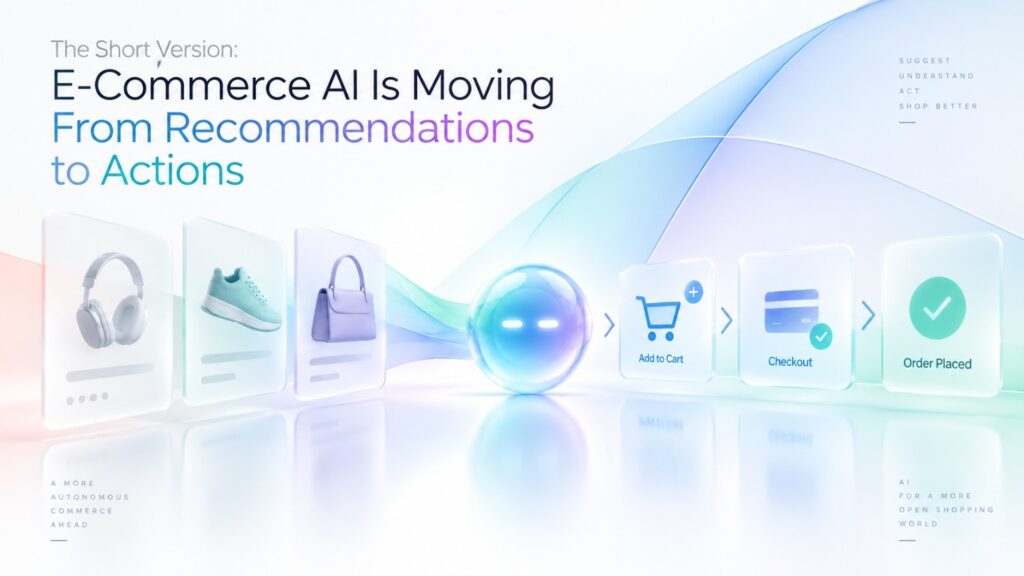
The Short Version: E-Commerce AI Is Moving From Recommendations to Actions
For years, retail AI mostly predicted things.
It predicted what product a shopper might like. It predicted whether someone would click an ad. It predicted which customer might buy again. It predicted which email subject line might perform better.
Agentic commerce adds another step.
The system can increasingly act on those predictions.
An AI marketing system can decide when to contact a customer and generate the message. A service agent can look up an order, apply a policy and issue a refund. A shopping agent can compare products, build a cart and move toward checkout. A post-purchase agent can process a return or handle a delivery exception.
That difference sounds small. Operationally, it is enormous.
The old system looked like this:
Data → prediction → dashboard → human decision → human action
The emerging system looks more like this:
Data → reasoning → decision → approved action → measurement
Humans do not disappear from the process. Instead, the human increasingly decides the rules, limits and goals while software handles more of the repeated work inside those boundaries.
That is what makes AI agents strategically different from ordinary generative AI.
What Does an AI Agent Actually Mean in E-Commerce?
The word “agent” is being used very loosely, so businesses need a simple definition.
A useful e-commerce agent has four basic abilities.
It can understand a goal. It can collect the information needed to pursue that goal. It can decide what to do next. Most importantly, it can perform an approved action through another system.
That final part matters.
A chatbot that tells a customer how to return an item is helpful.
An agent that checks the order, verifies whether the item is eligible, creates the return, generates the shipping label, updates the order system and sends confirmation has completed work.
Assistants Explain
An assistant might answer:
“Your package normally arrives within three to five business days.”
The human still completes the workflow.
Agents Execute
An agent might notice that the package has missed its delivery promise, check carrier information, apply the retailer’s late-delivery policy and offer the customer an approved replacement or refund.
The software has moved from information to execution.
That is the central shift happening across e-commerce.
Original Research: Online Commerce Is Already Large Enough for Small Automation Gains to Matter
Before looking at New York startups, it helps to understand the size of the system they are trying to automate.
NYC Tech Journal reviewed U.S. Census Bureau quarterly e-commerce releases for the second quarters of 2019, 2020, 2023 and 2026. We used seasonally adjusted retail e-commerce sales because this provides a more useful comparison between periods.
The results show why even narrow improvements in commerce automation can become economically meaningful.
U.S. Retail E-Commerce Has More Than Doubled Since 2019
| Period | Quarterly U.S. e-commerce sales | Share of total retail |
| Q2 2019 | $146.2B | 10.7% |
| Q2 2020 | $211.5B | 16.1% |
| Q2 2023 | $277.6B | 15.4% |
| Q2 2026 | $340.2B | 17.1% |
Census data shows seasonally adjusted U.S. e-commerce sales reached $340.2 billion in Q2 2026, up 12.2% from Q2 2025. Online commerce represented 17.1% of total retail sales during the quarter.
The comparable Q2 2019 number was $146.2 billion, when e-commerce represented 10.7% of retail.
Our calculation shows quarterly e-commerce sales grew at roughly 12.8% per year compounded between Q2 2019 and Q2 2026.
The online share of retail also increased by 6.4 percentage points, or roughly 60% relative to its 2019 level.
Chart: Growth in Quarterly E-Commerce Sales
| Year | Sales | Relative scale vs. Q2 2019 |
| 2019 | $146B | █████████████ |
| 2020 | $212B | ███████████████████ |
| 2023 | $278B | █████████████████████████ |
| 2026 | $340B | ███████████████████████████████ |
The 2020 jump was unusual because the pandemic rapidly moved purchasing online. But the important finding is that e-commerce did not return to its old size afterward. By Q2 2023, seasonally adjusted online sales were already $277.6 billion, and by Q2 2026 they had climbed to $340.2 billion.
Why This Matters for AI Agents
At this scale, an agent does not need to transform the entire customer journey to create value.
A retailer processing one million orders does not necessarily need a fully autonomous store. Automating 20% of support cases, improving conversion slightly on high-intent sessions or reducing the manual work required for thousands of returns can already matter.
This leads to one of the most important rules for e-commerce leaders evaluating AI:
Do not begin by asking how much of the company AI can automate. Start by identifying one high-volume decision that employees or shoppers repeatedly make.
That is where agent economics become much easier to prove.
Why New York Is an Important Test Market
New York combines several industries that agentic commerce needs.
The city has retailers, direct-to-consumer brands, fashion businesses, advertising agencies, payment companies, commerce software firms and a large technical workforce. That means startups can build close to both the merchants buying the software and the industries whose workflows they are trying to understand.
New York also still has a very large retail workforce.
The New York City Comptroller reported roughly 290,600 retail trade jobs in December 2025, compared with approximately 296,780 one year earlier. That was a decline of about 6,190 jobs, or 2.1%.
That does not mean AI caused the decline. The data does not establish that.
It does show something strategically important: retailers are already operating in an environment where productivity, labor allocation and operating efficiency matter. Agentic tools are arriving while businesses are under pressure to do more with existing teams.
That can accelerate interest in systems that automate repeated work.
Original Research: AI Is Becoming Visible Across New York’s E-Commerce Startup Base
To test whether agentic commerce is simply a story created by a few large AI companies, NYC Tech Journal examined another public dataset.
We reviewed Y Combinator’s September 2026 directory of e-commerce startups headquartered in New York.
The directory contained 25 New York e-commerce companies. Seven were listed as acquired, leaving 18 active companies in the sample.
We manually coded the 18 active company profiles using a conservative method.
A company counted as “AI-related” only when its YC description or category tags explicitly referred to AI, artificial intelligence or an AI assistant.
A company counted as “agentic/workflow AI” only when the public description explicitly discussed agents or AI performing operational work, rather than merely generating content or providing analytics.
Results of the NYC Tech Journal YC E-Commerce Analysis
| Category | Active companies | Share of active sample |
| Active NY e-commerce companies reviewed | 18 | 100% |
| Explicit AI signal in YC profile | 7 | 39% |
| Explicit agent/workflow automation signal | 4 | 22% |
At least seven of the 18 active companies—about 39%—had an explicit AI signal in their YC profiles.
Four—roughly 22%—went further and described agentic or workflow-oriented systems.
Those four included companies working on product data for shopping agents, commerce operations, back-office workflows and revenue recovery.
For example, Pango describes an agentic operating system that can automate delivery and returns. Channel3 is building product data infrastructure that developers can use to give agents shopping abilities. Glimpse describes agents that retrieve deduction data, validate charges and dispute invalid claims for consumer brands.
This Is a Small Sample, but the Direction Is Important
This analysis should not be treated as a measure of the entire New York e-commerce industry. YC companies are a specific startup population, and company descriptions are written by the companies themselves.
But the finding is still useful.
Agentic commerce is not limited to checkout buttons and consumer shopping assistants. New York founders are also applying agent-style automation to logistics, finance, merchandising and product infrastructure.
That tells businesses where this market may be heading.
The autonomous store will probably not arrive as one giant AI system.
It is more likely to emerge as several specialized agents gradually taking control of individual workflows.
Original Research: Mapping New York’s Emerging Autonomous Commerce Stack
NYC Tech Journal also reviewed public product descriptions from a sample of 12 New York commerce technology companies.
The goal was not to rank them.
Instead, we wanted to understand where agentic development is concentrated inside the commerce journey.
For each company, we counted a workflow only when its public materials described a current AI capability relevant to that area. Features described as “coming soon” were not treated as active.
The NYC Autonomous Commerce Map
| Company | Main agentic commerce role |
| Wizard | Shopping discovery, comparison and checkout |
| Nudge | AI shopping visibility, product data and AI-originated conversion |
| Cartful | Product guidance and merchant knowledge for AI shoppers |
| Bluecore | Shopping assistance and retail marketing operations |
| FindMine | Automated merchandising, styling and contextual recommendations |
| Rokt | Real-time transaction decisions, product offers and catalog expansion |
| Attentive | Autonomous lifecycle marketing and message decisions |
| Siena AI | Customer-service resolution and commerce conversations |
| Kustomer | Customer-service actions, order workflows and returns |
| Pango | Returns, shipping and post-purchase automation |
| Channel3 | Product intelligence infrastructure for shopping applications and agents |
| Glimpse | Back-office CPG finance and revenue-recovery agents |
The underlying company evidence shows how broad this system is becoming. Wizard publicly launched a New York-based AI shopping agent that handles discovery, recommendations and native checkout. Nudge describes its New York Agentic Commerce Platform as infrastructure for improving visibility, product information and conversion when shopping begins inside AI systems.
Cartful, founded and based in New York City, publishes approved merchant product guidance into feeds and pages AI agents can read. Bluecore’s New York operation now includes both an AI shopping agent and a Marketing Agent designed to move retail teams from analysis toward execution.
FindMine uses AI to create product combinations and contextual shopping experiences at scale, while its product positioning explicitly acknowledges that AI shopping agents increasingly need structured outcomes rather than simple product grids.
Rokt, headquartered in New York City, applies AI decisioning inside cart, payment and post-purchase environments, while its Catalog product uses AI to automate much of product onboarding and data mapping.
Attentive is applying agentic systems to lifecycle marketing decisions such as timing, targeting and message generation. Siena AI describes autonomous commerce-focused customer-resolution agents, while Kustomer allows configured agents to use tools, update information and complete e-commerce workflows.
Pango is attacking the post-checkout layer directly, with agents for shipments, returns, refunds and claims.
Where the New York Market Is Concentrated
Using the 12-company sample above, we coded seven broad workflow areas.
This is publicly documented product coverage, not company quality, adoption or market share.
| Workflow | Companies with explicit capability | Share of 12-company sample |
| Discovery and recommendation | 7 | 58% |
| Product/catalog intelligence | 5 | 42% |
| Customer service/resolution | 3 | 25% |
| Marketing/lifecycle automation | 2 | 17% |
| Checkout/transaction execution | 2 | 17% |
| Returns/logistics | 2 | 17% |
| Back-office operations | 1 | 8% |
Chart: Publicly Documented Workflow Coverage
Discovery / recommendation
█████████████████████████████ 58%
Product/catalog intelligence
█████████████████████ 42%
Service / resolution
█████████████ 25%
Marketing / lifecycle
█████████ 17%
Checkout / transaction
█████████ 17%
Returns / logistics
█████████ 17%
Back-office operations
████ 8%
Original Finding #1: Discovery Is Ahead of Full Execution
The clearest pattern is that shopping discovery is developing faster than end-to-end transaction automation.
That makes sense.
Recommending a product has lower risk than moving money. Producing a personalized product list is easier to govern than authorizing a refund or placing an order.
This means companies should expect the agentic transition to happen unevenly.
AI may become very good at deciding what someone should buy before businesses are comfortable allowing it to independently decide when money should move.
Original Finding #2: Product Data Is Becoming Infrastructure
Five companies in our sample were working directly on product or catalog intelligence.
That is not an accident.
Traditional stores are designed for humans. Humans can interpret product photography, marketing language, collection names and visual layouts.
Agents require something more structured.
They need to understand:
- what the product actually is,
- who it is suitable for,
- important restrictions,
- current price,
- live inventory,
- product relationships,
- compatibility,
- shipping information,
- returns rules,
- sizing or fit,
- and the context in which the product should be recommended.
A beautifully designed product page can still be a poor data source for an AI agent.
For the next generation of commerce, a retailer’s product information may become as important as its storefront design.
Wizard Is Trying to Turn Product Search Into Delegated Shopping
Wizard represents the consumer side of the shift.
Instead of asking shoppers to type keywords and inspect hundreds of products, Wizard’s shopping agent is designed to interpret a more natural request, compare products and lead the shopper toward checkout.
The company publicly launched the product in February 2026 after operating in private beta. Wizard says the agent analyzes product attributes, reviews and editorial information and can support native checkout with participating retailers.
The strategic change is simple.

The shopper no longer begins with the retailer’s navigation.
They begin with a desired outcome.
“Find a carry-on suitcase under $250 that fits international airline limits and is durable enough for weekly travel” is a very different input from clicking Luggage → Carry-On → Sort by Price.
For retailers, this means product discoverability will increasingly depend on whether machines can understand what their products are good for.
Nudge Is Building for the Traffic That Arrives From AI
Nudge is attacking another part of the same problem.
Being mentioned inside an AI answer is useful, but a recommendation does not automatically create a sale.
A shopper might discover a brand through ChatGPT, Gemini or another assistant and then land on a generic product page that knows nothing about the conversation that brought them there.
Nudge’s New York-based platform is being designed around that gap. The company describes tools for measuring brand visibility inside AI systems, improving product information for agent discovery and turning the original shopping intent into a more relevant conversion experience.
This points toward an important future change.
Retail websites may eventually need to respond differently when traffic arrives from an AI shopping conversation.
A person arriving after asking an agent for “a winter moisturizer for very sensitive skin under $40” should not necessarily land on the same generic page as someone who searched the brand name directly.
The intent is different.
The landing experience should be too.
Cartful Is Working on a Problem Most Retailers Have Not Yet Considered
Cartful’s approach may look less dramatic than a shopping bot, but it addresses a foundational problem.
How does an AI know why a merchant recommends one product instead of another?
Merchandisers carry large amounts of knowledge that may never appear in structured product feeds.
They know that one shoe is better for wide feet. They know a certain skincare product is too strong for some users. They know which coffee machine is best for someone who values convenience over control.
Cartful turns this type of merchandising judgment into structured guidance that can be used across quizzes, recommendation surfaces and AI systems. Its Agentic Training product publishes brand-approved guidance into sources that shopping agents can read.
This may become a major competitive issue.
Brands that fail to explain their products clearly to machines risk having their products represented by whatever incomplete information an agent can find elsewhere.
Bluecore Shows Why Retail Agents Will Not Only Face Customers
Bluecore provides a useful example of the second major category of commerce agent.
Some agents will shop.
Others will operate the retail business.
Bluecore launched its Marketing Agent in February 2026. The company describes it as both an analyst and operator that can examine marketing performance, explain what is happening and provide prioritized actions. Bluecore also operates alby, an AI shopping assistant that works with retailer catalogs and shopper questions.
That combination is worth watching.
One agent understands what shoppers are asking.
Another system can help the retailer decide what to do about those signals.
Over time, the distance between those two loops may shrink.
A retailer could eventually detect a new pattern in shopper questions, identify a missing merchandising explanation, update guidance and adjust campaigns without waiting for several teams to manually connect the dots.
That is much closer to an operating system than a chatbot.
FindMine Shows How Merchandising Could Become Continuous
Merchandising has traditionally required people to decide which products belong together.
A fashion retailer creates complete looks. A beauty company groups products into routines. A home retailer shows pieces inside a finished room.
Doing this manually across thousands of SKUs is difficult.
FindMine uses AI to scale those relationships. Its system can combine products while taking brand rules, trends, inventory and performance into account.
The deeper implication is that merchandising can become much more dynamic.
Instead of creating one fixed “complete the look” recommendation for thousands of shoppers, a system can increasingly adjust the context based on the person, inventory and moment.
That becomes even more important when AI agents are shopping.
A human may browse individual products for inspiration.
An agent is more likely to search for a completed outcome.
Rokt Is Focused on the Moment When Intent Turns Into Money
Much of e-commerce technology has focused on getting people onto a website.
Rokt is focused on what happens when those people are already in a transaction.
Its New York-headquartered platform uses AI to determine relevant offers, products and actions during cart, payment and post-purchase experiences. The company says its Rokt Brain uses first-party and contextual information to determine the most relevant next action during the transaction.
That becomes interesting in an agentic world because the buyer reaching checkout may eventually be software acting on behalf of a person.
Traditional merchandising assumes human attention.
Agent-driven commerce creates another audience: machines evaluating structured choices very quickly.
That changes what checkout optimization may mean.
Instead of simply asking, “What offer will make this human click?”, the retailer may increasingly ask, “What product, price, delivery promise or bundle best satisfies the goal the shopper delegated to the agent?”
Attentive Shows What Autonomous Lifecycle Marketing Could Look Like
Marketing automation is not new.
Most marketing automation, however, still begins with humans designing a series of rules.
If someone abandons a cart, send message A after one hour. If they do not purchase, send message B tomorrow. If they purchased before, put them into another segment.
Agentic systems allow more of those decisions to become dynamic.
Attentive’s AI Journeys can use customer behavior to decide message timing, frequency, content and product selection. The company says the system learns from shopper engagement over time.
Attentive has also described its 2026 direction as a move from static campaigns toward more autonomous orchestration based on purchase intent, behavior and channel preferences.
The marketing team therefore moves up a level.
Instead of manually deciding every branch inside a journey, the team increasingly defines goals, brand rules, prohibited actions and measurement standards.
The system handles more of the smaller decisions.
Siena and Kustomer Are Turning Customer Service Into Resolution
Customer service may be one of the fastest places where businesses can understand the difference between an AI assistant and an AI agent.
A customer rarely contacts support because they want information for its own sake.
They want something completed.
They want a shipping address corrected. A return approved. A subscription changed. A refund processed. A package located.
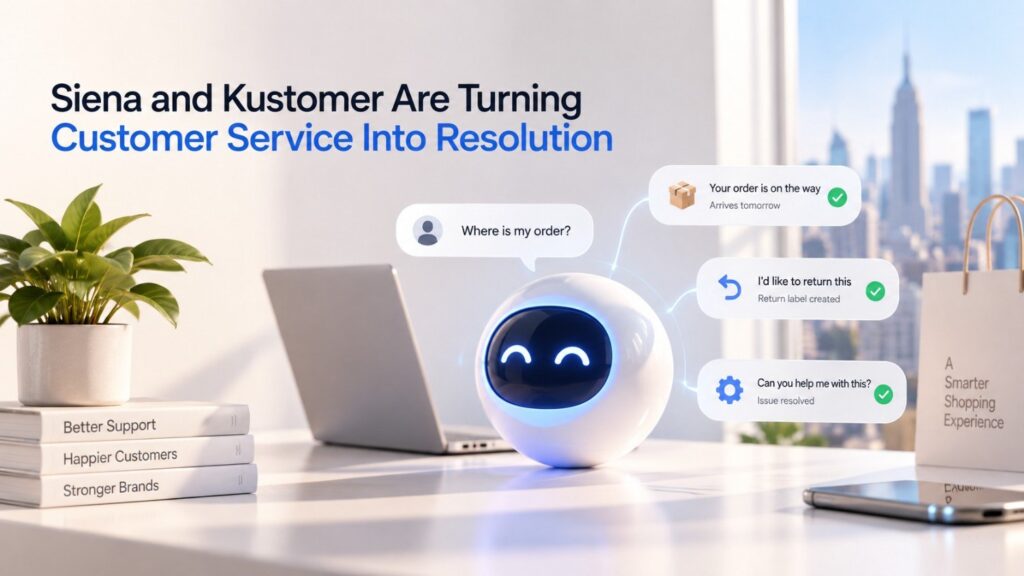
Siena says its agents can provide autonomous end-to-end customer resolutions across connected commerce systems.
Kustomer takes a similar action-oriented approach. Its AI agent tools can retrieve information, use configured tools, update records, work with external systems and escalate when required. Kustomer’s e-commerce documentation includes workflows around orders and returns.
That changes the core service KPI.
Businesses should care less about how many messages the bot answered.
They should measure how many customer problems were actually resolved correctly.
Pango Shows Why Post-Purchase May Be an Ideal Agent Market
Some of the least glamorous parts of e-commerce are also some of the most repetitive.
Where is my order?
Can I return this?
Can I exchange the size?
Where is my return label?
Has my refund been approved?
Pango, a 2026 Y Combinator company located in New York City, describes an agentic operating system for these post-purchase workflows. Its system connects with a merchant’s commerce stack and can automate delivery, returns, refunds, claims and related customer-service processes.
This category has strong agent economics because the tasks can be both high volume and rule driven.
A return often has a clear policy.
If an item is within the return window, belongs to an eligible category and meets the required conditions, much of the workflow can potentially be automated.
Exceptions can still go to people.
That is a good model for responsible commerce automation.
The Bigger Change: Shopping Is Becoming an API Problem
For most of internet history, businesses optimized websites for people.
Then they optimized pages for search engines.
Now they also need to think about AI agents.
That requires a new layer of infrastructure.
Several major technology companies are already building standards intended to allow AI systems and merchants to communicate during a transaction.
OpenAI and Stripe introduced the Agentic Commerce Protocol in 2025. OpenAI uses the protocol to connect shopping experiences with merchants while leaving payments, fulfillment and the merchant relationship under merchant control.
OpenAI expanded the protocol’s role in product discovery in March 2026, helping support richer and more current product information inside ChatGPT shopping experiences.
Google and Shopify have been developing another open standard, the Universal Commerce Protocol. Google says UCP is intended to connect agents and retailers across discovery, decision and purchase.
Shopify opened more of its agentic commerce infrastructure to developers in 2026, including tools that allow developers to build agent-driven product search and checkout experiences.
Google has also developed its Agent Payments Protocol, while payment networks such as Visa and Mastercard are building systems for trusted AI-initiated transactions.
The Website Will Not Disappear
Retailers should not interpret this as the death of the website.
People will still browse.
Brand storytelling will still matter.
Photography, design, community and physical retail will remain important.
But another sales surface is being added.
The traditional storefront is built for eyes and fingers.
The next storefront must also be understandable by software.
The Agent-Ready Commerce Stack
Businesses preparing for this shift need more than an AI model.
They need infrastructure around the model.
Product Truth Layer
The agent needs reliable information about products.
That includes names, descriptions, specifications, price, availability, variants, sizing, shipping limits, return rules and compatibility.
The data should be structured enough that a machine does not have to guess.
Customer Context Layer
The system may also need approved information about the customer.
Previous purchases, loyalty level, preferences and current order history can improve decisions.
Access should follow clear privacy rules.
An agent does not need every piece of customer data simply because the company has it.
Decision Layer
The system needs instructions for making choices.
Which products should be prioritized?
When is a discount allowed?
Which returns can be approved automatically?
When should a customer be transferred to a person?
This is where business policy becomes machine-readable.
Action Layer
Agents become useful when they can securely interact with other software.
That might include Shopify, an order-management platform, customer-service software, a warehouse system, an email platform or a payment provider.
An agent with no access to tools can only talk.
Approval Layer
High-risk actions should still require stronger controls.
A business might allow an agent to automatically issue credits below $20 while requiring a person to approve larger refunds.
Autonomy does not have to be all or nothing.
Observability Layer
Every action needs to be visible.
Companies should know what the agent decided, why the action was allowed, what information it used and what happened afterward.
Without observability, businesses cannot safely improve the system.
A Practical Autonomy Ladder for Retailers
Companies do not need to jump from manual operations to autonomous operations overnight.
A safer path is to increase autonomy in levels.
| Level | What AI does | Example |
| 0 | No AI | Human handles return manually |
| 1 | Suggests | AI recommends return decision |
| 2 | Prepares | AI gathers order data and prepares action |
| 3 | Acts with approval | Human clicks approve |
| 4 | Acts within limits | AI processes eligible low-risk returns |
| 5 | Manages workflow | AI resolves the full standard case and escalates exceptions |
This framework is useful because risk changes by workflow.
Letting an AI recommend products is different from allowing it to issue a $1,500 refund.
Autonomy should be designed around the consequence of being wrong.
Where New York Retailers Should Deploy Agents First
The best first workflow is usually not the most exciting one.
It is the one with clear rules, high frequency, measurable cost and low downside when handled correctly.
Start With Repetitive Customer-Service Actions
Order status, delivery questions, basic changes and return eligibility are strong candidates.
The important requirement is tool access.
If the agent simply tells customers to contact another department, little work has actually been removed.
Automate Merchandising at Scale
Businesses with thousands of SKUs can use AI to generate product relationships, bundles and contextual recommendations.
Humans can create the merchandising rules.
The AI can apply those rules repeatedly.
Automate Lifecycle Decisions
Instead of manually building dozens of customer segments, agents can respond to live behavior.
A customer repeatedly browsing winter coats should not necessarily receive the same message as someone who just bought one.
Use Agents for Operations Nobody Enjoys Doing
Reconciliation, deduction management, reporting, return processing and exception investigation are often better targets than creative brand work.
That is also what some of the New York YC companies in our research are building around.
A Practical 90-Day Agentic Commerce Plan
Businesses do not need a three-year AI transformation program before testing agents.
A tightly controlled 90-day deployment can produce much better information.
| Period | Main objective | What to do |
| Days 1–15 | Select workflow | Find one high-volume, rule-driven task |
| Days 16–30 | Map process | Document inputs, rules, exceptions and systems |
| Days 31–45 | Build controlled agent | Give AI limited tools and clear instructions |
| Days 46–60 | Shadow mode | Let agent recommend actions without executing |
| Days 61–75 | Limited execution | Allow low-risk actions inside set boundaries |
| Days 76–90 | Measure economics | Compare quality, speed, cost and customer outcomes |
Days 1–15: Follow the Work
Do not start with the model.
Start with employees.
Watch how the task is completed today.
Document every screen, spreadsheet, approval and exception.
Many businesses discover that the hardest part is not AI.
The real problem is that nobody has written down the operating process clearly enough for another system to follow.
Days 16–30: Define the Boundaries
Write down what the agent may do.
Then write down what it may never do.
For example:
A return agent may approve unopened items returned within 30 days.
It may not approve final-sale products.
It may not issue cash refunds over $100 without human approval.
It must escalate when the order data is incomplete.
These constraints are part of the product.
Days 31–45: Connect Only the Tools It Needs
Do not give the agent unrestricted access to the entire company.
Follow least-access principles.
A returns agent may need order history, shipping status, product eligibility and refund tools.
It probably does not need payroll records or the marketing database.
Days 46–60: Run in Shadow Mode
This is one of the most useful steps companies skip.
Let the agent process real cases but prevent execution.
Compare what it would have done with what employees actually did.
You can now measure error patterns before money or customer relationships are affected.
Days 61–75: Allow Low-Risk Actions
Begin with a narrow permission set.
Let the agent execute only where confidence and policy are clear.
Everything else goes to a person.
Days 76–90: Measure Business Outcomes
Do not ask employees whether the demo looked impressive.
Measure the workflow.
That is how you learn whether the agent is creating value.
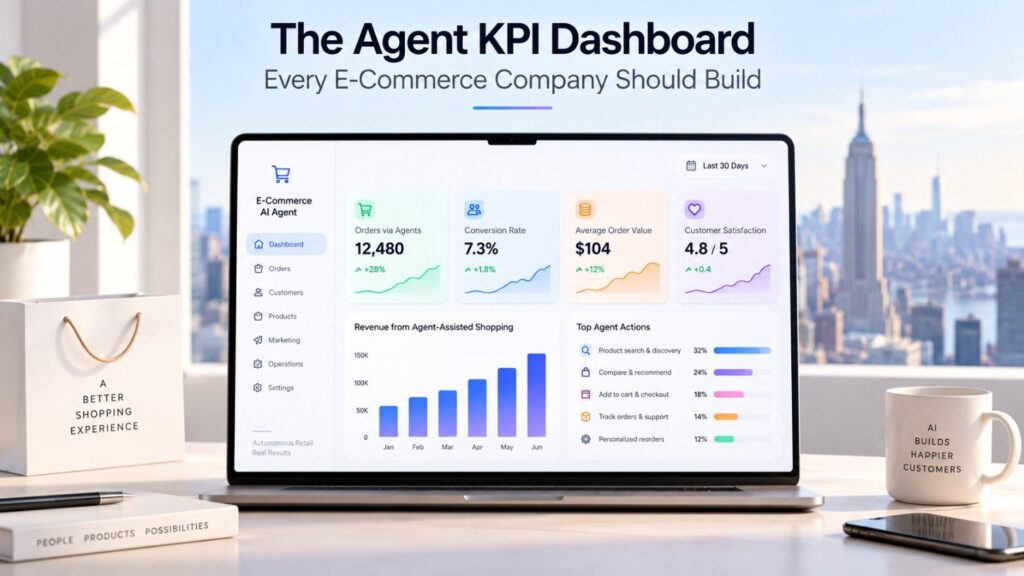
The Agent KPI Dashboard Every E-Commerce Company Should Build
Traditional AI metrics often focus on model behavior.
Retail leaders need business metrics.
| Area | KPI |
| Customer service | Correct resolution rate |
| Customer service | Escalation rate |
| Customer service | Reopened-case rate |
| Commerce | Conversion rate from agent sessions |
| Commerce | Revenue per agent-assisted session |
| Merchandising | Attach rate |
| Merchandising | Average order value |
| Returns | Cost per completed return |
| Operations | Human minutes per completed workflow |
| Reliability | Incorrect-action rate |
| Governance | Policy violation rate |
| Finance | Incremental gross profit after AI cost |
Measure Completed Work, Not Conversations
An AI system saying “hello” to 100,000 customers is not success.
A system correctly resolving 40,000 customer problems might be.
The unit of measurement should move from AI interactions toward work completed correctly.
Measure Exceptions Separately
Suppose an agent correctly resolves 80% of cases and sends the remaining 20% to people.
That may be far safer than a system claiming 95% automation while making costly mistakes.
Escalation is not automatically failure.
Good escalation is part of intelligent automation.
How to Build the Business Case
Companies should model agent economics at the workflow level.
Consider a hypothetical retailer processing 100,000 orders each month.
Assume 15% of orders generate a customer-service interaction.
That produces 15,000 contacts.
If 35% of those contacts are simple enough for an agent to resolve and the fully loaded manual cost is $5 per interaction, then the addressable monthly operating cost is:
15,000 × 35% × $5 = $26,250 per month
That equals $315,000 per year before AI platform costs, implementation expense and quality adjustments.
This example is illustrative rather than market research.
But it shows how businesses should think.
Do not ask:
“What is the ROI of AI?”
Ask:
“What is the current cost of this workflow, how much of it can safely be automated, what will the agent cost and what new errors might it create?”
That question is much easier to answer.
Product Data Could Become a Competitive Moat
Retail leaders spend large amounts of money on photography, paid acquisition and conversion optimization.
They should now give similar attention to product data.
Write for Questions, Not Only Keywords
Traditional SEO often focused on keywords.
AI shopping is more conversational.
Shoppers ask questions like:
“What office chair is best for a small apartment if I am six foot three?”
An agent needs enough structured information to determine which product actually meets those constraints.
Make Important Differences Explicit
If one version is waterproof and another is water-resistant, say so clearly.
If a product requires another component, document it.
If sizing runs small, make that information available.
Machines perform better when important facts are not hidden inside vague marketing language.
Keep Information Current
A recommendation for an out-of-stock product has little value.
Agent-ready commerce requires accurate inventory, price and fulfillment information.
Freshness becomes part of discoverability.
Connect Product Relationships
Retailers should define what products work together.
Agents will increasingly shop for outcomes rather than isolated SKUs.
A shopper may ask for a complete skincare routine, a business-travel wardrobe or everything needed to start making espresso.
Brands that structure those relationships can make their catalogs easier for agents to understand.
Checkout Is Where Agentic Commerce Gets More Serious
Product recommendations are relatively easy.
Moving money is harder.
The system needs to know that the shopper actually authorized the transaction.
It needs spending limits.
It needs merchant identity.
It needs payment security.
It needs a way to prove what the agent was allowed to do.
This is why so much agentic commerce infrastructure is being developed around payments and authorization.
Google’s Agent Payments Protocol work includes support for stronger records of user intent and autonomous payments within approved conditions. Visa’s Intelligent Commerce initiative is focused on credentials, authentication and controls for AI-initiated purchases. Mastercard has also been building Agent Pay systems for machine-driven commerce.
The Best Commerce Agent May Sometimes Refuse to Buy
Autonomy does not mean buying everything automatically.
A trustworthy shopping agent should sometimes stop.
The product might be out of budget.
The delivery date might not work.
The return policy might be poor.
The seller might not meet the shopper’s requirements.
Good agentic commerce depends on restraint as much as action.
The Biggest Risk Is Giving Bad Decisions Tools
Generative AI can make mistakes.
A normal chatbot mistake may produce a strange answer.
An agent mistake can create an operational event.
It can cancel an order.
Issue a credit.
Send the wrong promotion.
Change customer information.
Approve a return.
That is why businesses cannot treat agent deployment like chatbot deployment.
Separate Reasoning From Permission
An agent can be allowed to think broadly while acting narrowly.
It can consider many options.
It should only have permission to execute approved actions.
Put Dollar Limits on Autonomous Decisions
Refund permissions should have thresholds.
Discounts should have limits.
Purchases should have spending controls.
These constraints dramatically reduce downside.
Build an Escalation Path Before Launch
Do not wait for unusual cases to appear.
Decide in advance what should trigger human review.
Low confidence, missing data, unusually high transaction values and policy conflicts are obvious candidates.
Keep a Record of Actions
Businesses should be able to answer:
What did the agent do?
What information did it use?
Which policy allowed the action?
What happened afterward?
If those questions cannot be answered, the system is not ready for significant autonomy.
Agentic Commerce Will Change E-Commerce Teams More Than It Eliminates Them
The first impact of agentic software may be a change in what employees spend time on.
A merchandiser may create rules and review exceptions instead of manually assembling hundreds of product combinations.
A customer-service manager may spend less time staffing repetitive queues and more time improving policies and reviewing unusual cases.
A lifecycle marketer may define goals and boundaries while an agent handles more timing and targeting decisions.
An operations employee may investigate the cases an agent cannot reconcile rather than manually reviewing every transaction.
That changes the skills businesses need.
Knowing how the company actually works becomes extremely valuable.
The employee who understands the edge cases, policies and customer expectations may be the person best positioned to design and supervise agent workflows.
Five Questions New York E-Commerce Leaders Should Ask Now
What Work Happens Hundreds of Times Per Week?
Frequency creates the economic case.
A brilliant agent solving something that occurs twice per year is unlikely to matter.
Does the Work Have Clear Rules?
Agents are easiest to control when businesses already know what a correct decision looks like.
Messy policy creates messy automation.
Can We Measure the Outcome?
If success cannot be measured, the business will struggle to know whether the agent improved anything.
What Happens When the Agent Is Wrong?
This determines how much autonomy is appropriate.
A bad product recommendation and a $5,000 incorrect refund should not receive the same permissions.
Can a Human Take Over Cleanly?
Every production agent needs a path back to a person.
The handoff should include the context already gathered so customers do not have to begin again.
What NYC Tech Journal Will Be Watching Next
The next stage of e-commerce agents will probably be less visible than the first.
The first wave gets attention because shoppers can see it.
An AI asks questions. It recommends products. It builds a cart.
The deeper transformation may happen behind the scenes.
Agent-to-Agent Commerce
A consumer’s shopping agent may eventually communicate directly with a merchant’s commerce agent.
One side knows the shopper’s needs.
The other knows inventory, price, policies and fulfillment options.
The interface between them may increasingly become software rather than webpages.
Negotiation Within Boundaries
Retail systems may eventually have authority to create limited offers when certain conditions are met.
A shopper’s agent could ask whether a merchant can provide free expedited shipping.
The merchant agent could evaluate margin, inventory and customer value before responding.
That model is still emerging, but commerce protocols and agent payment systems are creating some of the infrastructure it would require.
Continuous Merchandising
Instead of merchandising being updated through periodic campaigns, systems could continuously adjust product combinations based on inventory, trend changes, margins and shopper intent.
The store becomes more adaptive.
Autonomous Exception Handling
Most operations software handles the standard path well.
Human labor is consumed by exceptions.
Agents capable of investigating those exceptions across several systems could therefore be especially valuable.
Commerce Software Will Be Judged by Work Completed
The traditional software pitch was:
“Here is a tool your employees can use.”
The next pitch may increasingly become:
“Tell the system what outcome you need.”
That is a much more significant change than adding another AI button to a dashboard.
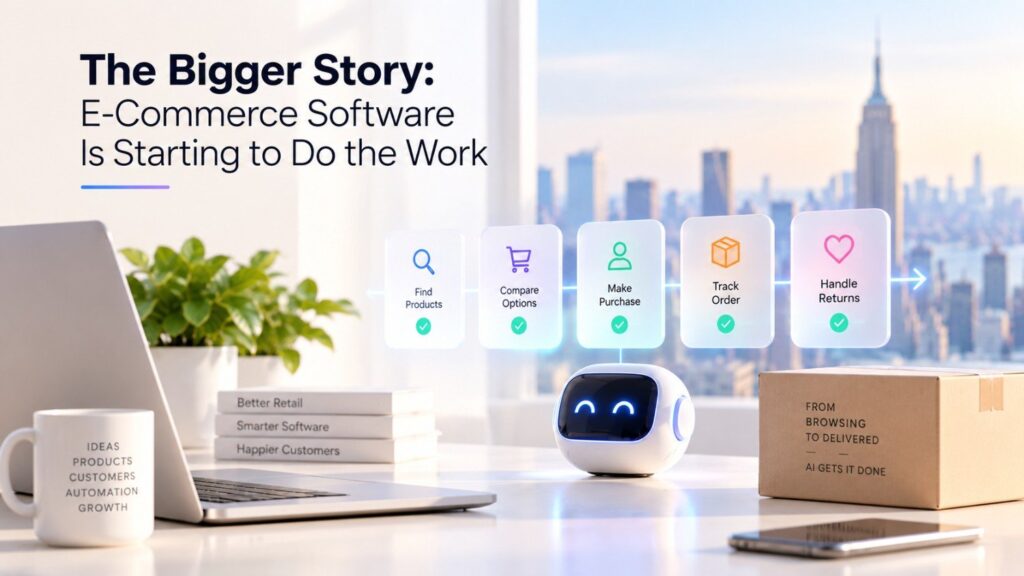
The Bigger Story: E-Commerce Software Is Starting to Do the Work
The most important thing about AI agents for e-commerce is not the word “agent.”
It is the change in responsibility.
For years, software stored information, displayed dashboards and gave employees better tools.
Then machine learning helped businesses predict behavior.
Generative AI helped people create and understand information faster.
Agentic AI introduces another stage.
Software can begin completing parts of the workflow itself.
New York’s commerce technology market already provides a useful view of how that future may be assembled.
Wizard is working on delegated shopping.
Nudge is building around AI-originated discovery and conversion.
Cartful is making merchandising knowledge understandable to machines.
Bluecore combines shopping assistance with retail marketing intelligence.
FindMine is automating contextual merchandising.
Rokt is applying AI to transaction decisions.
Attentive is moving lifecycle marketing toward more autonomous decisions.
Siena and Kustomer are turning service conversations into completed actions.
Pango is attacking returns and delivery operations.
Channel3 is working on product infrastructure.
Glimpse is applying agents to back-office financial work.
No single company represents the autonomous store.
Together, however, they reveal what the architecture may look like.
The front of the store gets an agent.
The marketing team gets agents.
The service team gets agents.
The returns operation gets agents.
The back office gets agents.
The systems begin connecting.
For New York retailers, the right response is not to automate everything as quickly as possible. It is to identify the workflows where autonomy produces a clear customer or financial benefit, build strong data underneath them, limit permissions carefully and measure the work that actually gets completed.
The businesses that do that well will not merely have more AI.
They will operate differently.
And that is when agentic commerce becomes much more than another technology trend.