
New York is not usually the first city people think about when they hear the words logistics technology. The image that comes to mind is more likely to be a warehouse filled with robots, a line of trucks outside a distribution center, or containers stacked beside a large port.
That picture misses an important change taking place in New York City.
A growing group of New York startups is building the software that decides how goods move rather than the physical machines that move them. These companies are using artificial intelligence to map global supplier networks, improve trucking decisions, automate procurement, predict freight needs, monitor international trade risk, analyze logistics data, manage import operations, and help companies respond faster when something goes wrong.
Some of these businesses are already large. Altana became a unicorn after raising a $200 million Series C. Optimal Dynamics has raised $95 million while developing advanced decision software for trucking networks. Transfix has shifted from running a technology-led freight brokerage toward building AI-powered transportation software. Nuvocargo is evolving from digital freight forwarding into an AI-native freight execution platform.
A newer group is emerging underneath them. Didero is applying AI agents to procurement. Nauta is creating an operational intelligence layer for importers. Atomic is rebuilding supply chain planning around AI. Catena is making fragmented fleet data easier for software systems to use. Desteia is applying AI to disruption and cross-border logistics.
Taken together, these companies reveal something much larger than a collection of isolated startups.
New York is starting to look less like a warehouse robotics hub and more like a control center for global trade. The city’s strongest supply chain companies are increasingly focused on the intelligence layer that sits above trucks, ports, warehouses, factories, suppliers, and buyers.
That may become one of the most valuable parts of the logistics economy.
The Short Version: New York Is Building the Brain of the Supply Chain
The Port of New York and New Jersey handled close to 8.9 million twenty-foot equivalent units, or TEUs, in 2025. That was up from about 5.29 million TEUs in 2010, meaning container volume increased by roughly 68% over 15 years.
While the physical trade network around New York has grown, a parallel software economy has started developing inside the city.
Altana is building intelligence around global value chains and compliance. Optimal Dynamics is improving trucking network decisions. Transfix is bringing AI into transportation management and freight brokerage workflows. Nuvocargo is deploying AI agents across freight execution. Didero is automating procurement work. Sourcemap is helping large businesses understand supplier networks. Nauta is organizing import operations. Atomic is applying AI to inventory and supply planning.
The common thread is not simply that these companies use artificial intelligence.
The more important point is that they are using AI to make, support, or execute decisions.
Our analysis of 12 logistics and supply chain technology companies with strong New York City ties found that at least $764 million in publicly disclosed or independently reported funding has gone into 11 of them. Tarmac was excluded from the funding calculation because we could not establish a reliable public figure.
Even more striking, nearly 95% of the known funding in our sample has gone into companies working primarily on trade intelligence, compliance, transportation execution, or freight decision-making.
That concentration suggests New York may be developing a very specific advantage.
Rather than competing to build the machines inside warehouses, New York companies are increasingly building the software that tells the broader logistics system what to do.
How NYC Tech Journal Conducted This Analysis
We did not create this list by searching for logistics companies that happen to mention AI on their homepages. The term artificial intelligence has become so broad that using company marketing language alone would produce a weak and misleading ranking.
Instead, we applied three basic filters.
A company needed a meaningful New York City connection through its headquarters, primary operating base, founding story, or substantial local presence. Its product also needed to solve an important problem involving freight, transportation, procurement, inventory, global trade, supply chain planning, supplier management, or logistics operations.
Most importantly, AI, machine learning, advanced optimization, autonomous agents, predictive models, or another intelligent system had to play a meaningful role in the product itself.
We then reviewed company websites, funding announcements, industry reporting, government trade data, Port Authority statistics, employment information, and other public sources.
The result is not meant to be a complete directory of every logistics startup operating in New York. It is a focused analysis of companies where we could verify both a strong New York connection and a meaningful role for AI or advanced decision software.
The 12 Companies in Our Core NYC Sample
| Company | Main problem being solved | Role of AI | Public funding used in our analysis |
| Altana | Global trade intelligence and compliance | Core AI network | $322M |
| Transfix | Freight brokerage and transportation management | AI embedded across workflows | $118.5M |
| Optimal Dynamics | Trucking decisions and network optimization | Core decision intelligence | $95M |
| Nuvocargo | North American freight execution | AI-native agents | $75.6M |
| Leaf Logistics | Freight planning and contracting | Machine learning and prediction | $58.2M |
| Didero | Procurement operations | AI agents | $37M |
| Sourcemap | Supply chain mapping and due diligence | AI risk monitoring | $31.2M |
| Desteia | Supply chain disruption and cross-border operations | AI and graph-based analysis | $11.5M |
| Nauta | Import operations and logistics orchestration | AI-native agents | $7M+ |
| Catena | Fleet and telematics data infrastructure | AI-enabling data layer | $5M+ |
| Atomic | Inventory and supply planning | Agentic AI | $3M |
| Tarmac | Truckload and route planning | AI assistant | Not included |
The figures should be treated as conservative rather than exhaustive. For example, Nauta announced another strategic financing round in August 2026 without disclosing the amount, while Catena has been assigned higher totals by some funding databases. We used clearly disclosed figures where possible instead of choosing the largest estimate available.
That approach makes the total less dramatic, but it also makes the analysis more useful.
Original Finding #1: At Least $764 Million Has Gone Into This NYC Supply Chain AI Sample
The 11 companies in our sample with reliable public funding information have raised at least $764.02 million.
That number is almost certainly lower than the true amount invested across the group. It excludes Tarmac, does not include the undisclosed portion of Nauta’s most recent strategic financing, and uses conservative funding figures where public databases disagree.
The distribution is also highly uneven.
| Company | Known funding |
| Altana | $322.0M |
| Transfix | $118.5M |
| Optimal Dynamics | $95.0M |
| Nuvocargo | $75.6M |
| Leaf Logistics | $58.2M |
| Didero | $37.0M |
| Sourcemap | $31.2M |
| Desteia | $11.5M |
| Nauta | $7.0M+ |
| Catena | $5.0M+ |
| Atomic | $3.0M |
The five largest companies account for approximately $669 million, which represents close to 88% of known funding in the sample.
That tells us two things.
First, New York already has a meaningful group of established logistics technology companies that have survived several funding cycles and built deeper enterprise products. Second, a much younger generation of AI-native companies is now forming around them.
That combination is important because enterprise logistics software is difficult to build.
Customers do not simply need an impressive AI demonstration. They need software that integrates with old systems, understands complex business rules, handles messy data, works reliably, protects sensitive information, and can be trusted when a mistake could affect a shipment, payment, customs process, or customer relationship.
Capital gives companies more time to solve those harder problems.
Original Finding #2: Nearly 95% of Known Capital Is Going Into Trade and Transportation Decisions
We also grouped the companies according to the main layer of the supply chain they address.
The result was unusually concentrated.
| Product layer | Companies included | Known capital | Share |
| Freight execution and transportation intelligence | Transfix, Optimal Dynamics, Nuvocargo, Leaf, Desteia, Nauta, Catena | $370.82M | 48.5% |
| Trade intelligence, visibility and compliance | Altana, Sourcemap | $353.20M | 46.2% |
| Procurement and supply planning | Didero, Atomic | $40.00M | 5.2% |
Tarmac is not included in the funding percentages because we did not have a dependable public funding figure.
The striking part is not simply where the capital went. It is where it did not go.
Most of the money in this sample is not funding warehouse robots, automated forklifts, delivery drones, robotic picking arms, or new physical distribution infrastructure.
About 94.8% of known funding sits in companies focused on understanding trade or making transportation decisions.
That makes New York’s logistics technology ecosystem look very different from many other logistics hubs.
New York Is Becoming a Control Layer Rather Than a Hardware Hub
This specialization fits the city remarkably well.
New York has large numbers of people who understand finance, risk, enterprise software, legal compliance, complex transactions, data, procurement, investment, retail, insurance, and multinational business operations.
Those skills transfer naturally into supply chain technology.
Many of the city’s largest companies may never own a truck, ship, warehouse, or freight terminal. They still depend heavily on products being imported, sourced, classified, purchased, insured, transported, stored, and delivered correctly.
That creates a large local market for software that improves those decisions.
Instead of trying to recreate the physical logistics infrastructure found in other regions, New York can build technology that sits above it.
Original Finding #3: New York’s Port Has Grown by Roughly 68% Since 2010
The software opportunity is developing beside a physical trade system that has also become much larger.
Port Authority data shows how quickly container traffic has expanded.
| Year | Container volume |
| 2010 | 5.29M TEUs |
| 2015 | 6.37M TEUs |
| 2020 | 7.59M TEUs |
| 2021 | 8.99M TEUs |
| 2022 | 9.49M TEUs |
| 2023 | 7.81M TEUs |
| 2024 | 8.70M TEUs |
| 2025 | 8.90M TEUs |
Container volume increased from about 5.29 million TEUs in 2010 to about 8.90 million in 2025.
That represents approximately 68.1% total growth over the period. On a compound basis, it works out to roughly 3.5% growth per year.
The port ended 2025 as one of the largest container gateways in the United States, and much of the freight handled there remains within the wider Northeast region.
This matters because it creates an unusual relationship between software and infrastructure.
A founder can build an enterprise AI company in Manhattan while remaining only a short distance from one of America’s largest port, warehouse, air cargo, trucking, and distribution systems.
The physical assets may be concentrated in New Jersey and the surrounding metro area, but the decision-making companies can still be built in New York City.
Original Finding #4: NYC Has a Multibillion-Dollar Supply Chain Decision Workforce
AI discussions often focus too quickly on whether a technology can replace employees.
That framing is especially weak in logistics.
A better question is how much expensive human decision-making is currently required to keep the supply chain functioning.
Bureau of Labor Statistics data for the New York-Newark-Jersey City metropolitan area estimated around 10,410 transportation, storage, and distribution managers in May 2025. Their mean annual wage was approximately $148,430.
The same regional data included roughly 7,370 purchasing managers, with a mean annual wage of approximately $189,490.
Together, those two occupational groups represent about 17,780 managerial jobs.
Multiplying employment by the reported mean wage produces an estimated annual wage base of roughly $2.94 billion across those two categories alone.
That number is our calculation rather than an official BLS payroll measure, so it should not be interpreted as labor that AI can simply remove.
Its value is different.
The figure shows that New York has billions of dollars of highly skilled human work devoted to purchasing, logistics, transportation, and supply chain decisions.
Software does not need to replace those managers to create enormous economic value.
If a purchasing manager can analyze five times as many suppliers, a transportation manager can identify network problems earlier, or an operations team can investigate exceptions in minutes instead of hours, productivity can improve substantially even while humans remain in control.
That is one reason the market for supply chain AI is becoming so attractive.
The Top Logistics and Supply Chain AI Startups in NYC
1. Altana — Building an Intelligence Network for Global Trade
Altana may be the clearest example of New York producing a major AI company built specifically around global trade.
The company uses artificial intelligence to connect information about suppliers, manufacturers, products, shipments, importers, logistics providers, corporate ownership, and other pieces of international commerce.
The problem it solves becomes clearer when we look at how supply chains actually work.
A large company may know exactly which supplier it pays directly. It may know far less about the factories, subcontractors, raw material providers, ownership relationships, and upstream suppliers several levels below that direct relationship.
Those hidden layers matter more than they used to.
Companies increasingly need to understand sanctions exposure, forced labor risk, export controls, country-of-origin rules, tariff exposure, supplier concentration, ownership links, and other issues that can stop goods from moving.
Altana is attempting to map those relationships into a usable intelligence network.
The company raised a $200 million Series C in 2024 at a valuation of about $1 billion, bringing reported total funding to around $322 million.
Altana Is Moving From Visibility Toward Execution
The company’s strategic direction became even more interesting during 2026.
Altana achieved FedRAMP High authorization, strengthening its ability to work with U.S. government agencies handling sensitive information.
It then acquired New York startup Cervo AI in July 2026.
Cervo had been developing software to automate customs-entry preparation. By combining that capability with Altana’s global trade data, Altana can move closer to automating larger parts of customs and compliance workflows.
This is a major shift.
A platform that only shows trade risk is useful. A platform that understands the product, identifies risk, analyzes origin, helps classify the shipment, prepares information, and supports customs clearance becomes much more deeply embedded in how trade operates.
That is how a software product begins moving toward infrastructure.
2. Optimal Dynamics — Automating the Decisions Behind Trucking Networks
Trucking looks simple only from a distance.
A shipper has freight, a carrier has a truck, and a dispatcher connects them.
The real operation is much harder.
Every trucking decision affects another decision. Accepting one load may place a driver in a poor market for the next job. Rejecting a load may reduce today’s revenue but improve tomorrow’s network. A route that looks profitable on its own may create too many empty miles later.
Optimal Dynamics is trying to automate that type of thinking.
The New York company grew out of decades of transportation research connected with Princeton University. Its software applies advanced optimization and what the company calls Artificial Decision Intelligence to trucking networks.
In 2025, Optimal Dynamics raised a $40 million Series C, taking total capital raised to approximately $95 million.
The company also reported strong recurring revenue growth going into 2026.
From Optimization Software to Agentic Freight Decisions
The company pushed further into autonomous software in March 2026 with the launch of Scale.
Instead of requiring a human operator to run a planning process manually, Scale is designed to examine network conditions continuously and use autonomous agents to help carriers secure the freight they are likely to need.
That is a meaningful evolution.
Traditional analytics helps an operator understand what happened.
Optimization suggests what should happen.
Agentic systems try to help make it happen.
The opportunity is large because trucking networks contain thousands of connected decisions every day.
The risk is also much higher than it is in many other AI markets.
A weak recommendation does not simply produce an awkward answer on a screen. It can create empty miles, reduce fleet utilization, anger a customer, hurt driver satisfaction, or lower margins.
That is why specialized transportation decision models may prove more valuable than generic AI assistants.
3. Transfix — Turning Freight Brokerage Experience Into AI Software
Transfix has been part of New York’s freight technology ecosystem for more than a decade, but the company operating today is different from the business many people first knew.
Transfix originally built a technology-driven freight brokerage.
In 2024, NFI acquired its brokerage operation. Transfix then shifted its focus toward the software and data products that supported freight brokers, carriers, and shippers.
That transition now looks increasingly important.
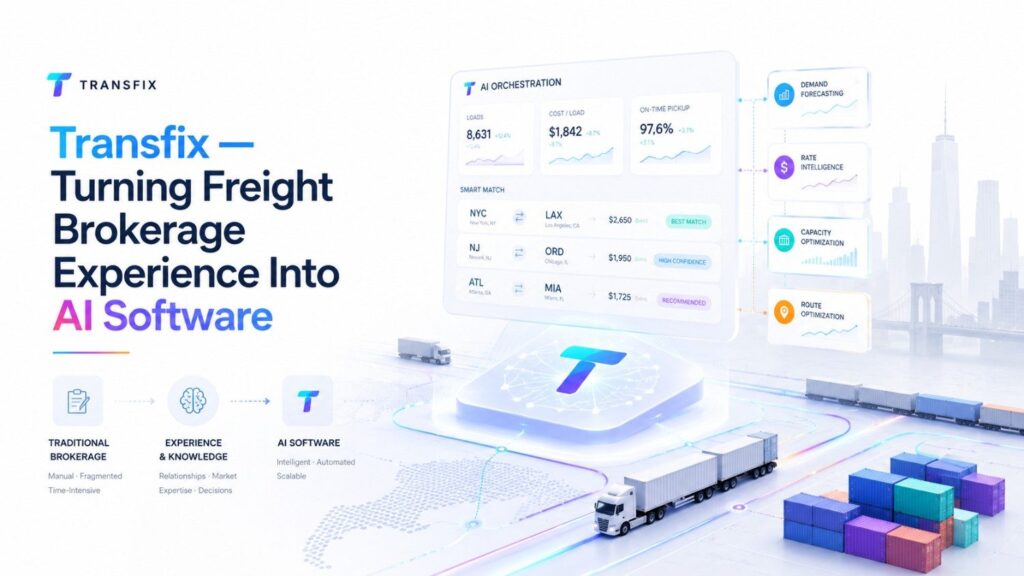
The company launched a Transportation Management System in late 2025 and continued adding AI features across freight workflows throughout 2026.
AI Is Moving Into Small but Expensive Freight Tasks
One of Transfix’s newer tools focuses on shipment troubleshooting.
Instead of requiring a broker to search through systems, emails, updates, and notes manually, the platform can turn a shipment ID into a structured case file, identify unusual events, and allow the operator to investigate through natural language.
The company says tasks that previously took 15 to 30 minutes can sometimes be reduced to seconds.
Transfix has also introduced AI-powered rate recommendations.
Those tools combine information about lanes, costs, market conditions, previous awards, and margins to help brokers make faster pricing decisions.
Another product analyzes large freight requests for proposals and summarizes network patterns, pricing considerations, lane concentration, and other information that pricing teams would normally pull from large spreadsheets.
Individually, each feature may appear small.
Together, they point toward a much larger change.
Freight brokerage contains thousands of repeated judgment tasks. Employees investigate problems, compare rates, examine lanes, price loads, read bids, contact carriers, update systems, and decide which exception needs attention first.
AI does not need to automate the entire brokerage overnight.
It can automate or accelerate those decisions one at a time.
That may be the more practical path toward real freight automation.
4. Nuvocargo — Using AI Agents to Run North American Freight
Nuvocargo began with one of North America’s most complicated logistics problems: moving freight between the United States and Mexico.
That corridor is enormous.
U.S. goods exports to Mexico reached approximately $337.3 billion in 2025, while imports from Mexico were around $534.3 billion.
That produced total bilateral goods trade of roughly $871.6 billion.
Every shipment moving through that system can involve transportation, customs, documentation, payments, pricing, communication, insurance, tracking, and coordination between companies operating across different systems.
Nuvocargo built its original business around making that freight process easier.
The company has raised roughly $75 million according to widely reported private-market data.
Nuvocargo Is Shifting From Freight Forwarding Toward AI Infrastructure
The company’s direction changed meaningfully after it acquired Mentum, a Y Combinator-backed startup that was building AI agents for procurement and supply chain workflows.
That acquisition strengthened Nuvocargo’s internal AI capabilities and helped prepare the company for a larger move.
In March 2026, it launched Nuvo AI, an AI-native freight execution engine aimed at North American shippers.
The system uses more than a dozen specialized agents to support different parts of truckload freight operations while keeping humans involved when necessary.
That shift matters because it changes Nuvocargo’s potential market.
A digital freight forwarder mainly earns money by helping customers move freight.
An AI freight execution platform can potentially sit inside the operations of many shippers and influence much larger amounts of transportation spending.
The company is no longer only trying to move freight more efficiently.
It is trying to become part of the software layer through which freight decisions are made.
5. Leaf Logistics — Planning Freight Before Problems Appear
Many freight systems react after demand has already become urgent.
Leaf Logistics has spent years working on a different idea.
The company uses data and machine learning to help shippers, carriers, and brokers plan transportation capacity earlier.
Its technology analyzes freight patterns across networks and looks for opportunities to coordinate demand, reduce empty miles, improve carrier planning, and create more predictable transportation arrangements.
Leaf Adapt, for example, uses machine learning to examine shipper transportation needs and identify ways to improve cost and network efficiency.
The company has raised approximately $58.2 million according to private-market reporting.
Why Leaf Still Matters in the Age of AI Agents
Leaf was building predictive transportation systems before the current wave of agentic AI became popular.
Its underlying idea remains highly relevant.
The biggest supply chain improvement does not always come from solving a problem faster after it appears.
Sometimes the larger opportunity is preventing that problem from appearing in the first place.
Consider two transportation strategies.
In one, AI waits until a load becomes urgent and then tries to find a cheaper truck.
In another, software identifies repeated freight patterns weeks earlier and helps restructure the network so fewer urgent loads appear at all.
The second approach can create a deeper economic advantage.
That is why predictive planning remains important even as newer startups focus more heavily on autonomous agents.
6. Didero — Building AI Agents for Procurement Teams
Procurement rarely receives as much attention as trucking or warehouse robotics.
It may become one of the most important areas for enterprise AI.
Procurement teams spend enormous amounts of time exchanging emails with suppliers, requesting quotes, tracking orders, comparing documents, updating systems, resolving missing information, checking purchase orders, and following up on delays.
Much of this work is repetitive but still requires business context.
Didero wants AI agents to handle a larger share of it.
The New York company raised $7 million in seed funding in 2024 and followed that with a $30 million Series A in February 2026, bringing disclosed funding to approximately $37 million.
Its agents work with the systems and communication channels procurement teams already use.
They can support supplier communication, purchase-order tracking, exception handling, document work, and other routine processes.
Procurement Is an Ideal Test for Specialized AI Agents
Procurement contains many of the features that make an AI workflow difficult but valuable.
Information arrives through email.
Important details sit inside PDFs.
Order history lives inside enterprise systems.
Suppliers respond in different formats.
Policies vary between companies.
Some decisions can be automated, while others require clear human approval.
That means a strong procurement AI product needs much more than a good chatbot.
It needs permissions, structured data, supplier context, company rules, ERP integrations, audit trails, and reliable escalation when the system is uncertain.
Didero is attempting to build that deeper operating layer.
If it works, procurement could become one of the clearest examples of AI improving white-collar supply chain productivity.
7. Sourcemap — Mapping the Suppliers Companies Cannot See
Modern supply chains can extend far beyond the companies a business deals with directly.
A finished product may contain dozens or hundreds of components. Those components may depend on factories, processors, farms, mines, chemical suppliers, logistics providers, and subcontractors spread across several countries.
A company can therefore know its direct supplier very well and still have limited knowledge of what exists deeper inside the network.
Sourcemap has spent years trying to solve that visibility problem.
The New York company provides software for supply chain mapping, traceability, due diligence, and supplier monitoring.
It raised a $10 million Series A in 2022 and a $20 million Series B in 2023, taking reported total funding to roughly $31 million.
Its platform also incorporates AI-powered monitoring designed to surface supplier watchlist issues, reputational risks, and supply disruptions.
Supply Chain Mapping Is Becoming Operational Infrastructure
Mapping used to be treated mainly as a sustainability exercise.
That is changing quickly.
Companies now need deeper supplier visibility for tariffs, sanctions, forced labor rules, country-of-origin questions, deforestation regulations, critical materials exposure, and disruption management.
As those requirements grow, supply chain mapping becomes more important to everyday operations.
One well-maintained supplier network can potentially support procurement teams, compliance teams, sustainability teams, finance departments, risk teams, and senior management.
That makes the underlying data more valuable.
AI can help companies understand and act on that information faster, but the quality of the supplier map remains the foundation.
8. Nauta — Building an Operational Brain for Importers
Nauta is younger than many of the companies above it, but that makes the startup especially useful for understanding where the market is heading.
The company began with a simple observation.
Import operations often run across a messy combination of emails, spreadsheets, documents, ERPs, carrier systems, customs information, warehouse platforms, and tracking tools.
People spend large amounts of time collecting information from those systems before they can decide what to do next.
Nauta wants to bring that information together into a single operational layer.
The New York-based company raised a $7 million seed round in 2025 led by Construct Capital.
In August 2026, it announced an additional strategic investment involving BMW i Ventures, Bosch Ventures, Hitachi Ventures, and Yamaha Motor Ventures. The amount was not disclosed.
Nauta Shows How Visibility Software Is Turning Into Execution Software
The company’s pitch has moved beyond simply showing users where shipments are.
Its platform connects data from systems such as ERP, TMS, WMS, tracking sources, documents, and email so AI agents can understand a larger operational picture.
That creates an important progression.
Traditional visibility software tells the operator what is happening.
Operational intelligence software helps explain what should happen next.
Agentic software attempts to perform some of those next steps safely.
That progression may define the next generation of logistics platforms.
The value does not come from another dashboard.
It comes from reducing the number of times a human needs to jump between five systems just to understand one shipment problem.
9. Desteia — Applying AI to Disruption and Cross-Border Operations
Supply chains produce huge amounts of unstructured information every day.
Important updates arrive through emails.
Shipment details sit inside PDFs.
Instructions are exchanged through messaging tools.
Operational decisions are spread across transportation systems, procurement platforms, spreadsheets, customer portals, and employee inboxes.
Desteia uses AI and graph-based analysis to extract and connect that information.
The New York-based company announced an $8 million seed round in February 2025, bringing reported funding to approximately $11.5 million.
It has focused heavily on cross-border logistics and supply chain disruption.
Trade Software Is Becoming Less Dependent on Physical Geography
Desteia highlights a broader shift in logistics technology.
A company no longer needs to be located beside a border crossing, warehouse, or shipping terminal to become important infrastructure for global trade.
Software can manage a truck in Texas, a supplier in Mexico, a container in New Jersey, a customs process in California, and a purchasing team in Chicago from one platform.
That separation between logistics software and logistics geography creates a major opportunity for New York.
The city can house the engineers, product teams, investors, enterprise sellers, and decision systems even when the physical goods move somewhere else.
10. Atomic — Rebuilding Supply Chain Planning With Agentic AI
Supply chain planning still relies heavily on spreadsheets.
That may seem surprising given how much software companies have purchased over the past two decades.
The reason is flexibility.
Planners need to think about demand, inventory, lead times, production, purchasing, cash, customer service, supplier risk, and countless company-specific rules.
Spreadsheets are often inefficient, but they allow people to change assumptions quickly.
Atomic is trying to combine that flexibility with modern AI and simulation.
The New York company was founded by former Tesla supply chain leaders and announced a $3 million seed round in April 2025.
Its platform models supply and demand at a detailed transaction level while using AI to simplify onboarding, scenario analysis, and planning workflows.
Planning Could Become One of the Biggest Agentic AI Markets
The financial opportunity is easy to underestimate.
An AI writing tool may save a few minutes on an email.
A better planning decision can release millions of dollars of inventory.
Improved forecasting can reduce emergency freight.
A better purchasing plan can lower stockouts.
Faster scenario analysis can help a company respond to tariffs, supplier failures, demand changes, or port disruptions before competitors do.
That means planning AI does not simply improve administrative productivity.
It can directly affect working capital, margins, revenue, and service levels.
That gives companies such as Atomic a potentially large market even if the software itself appears less dramatic than autonomous robots.
11. Catena — Building the Data Layer AI Logistics Systems Need
Most discussions about AI begin with the model.
In logistics, that can be a mistake.
The quality of the underlying data often matters more.
Catena is attacking that problem.
The New York startup is building a universal interface for fleet and telematics data. It announced a $5 million seed round in September 2025.
Its software is designed to normalize information coming from different electronic logging devices, telematics platforms, and fleet systems so other software companies can use the data more easily.
That information can support transportation systems, freight brokers, insurers, fintech platforms, tracking tools, fraud systems, and AI agents.
Logistics AI Needs Better Plumbing
This part of the market may become more valuable than it first appears.
An AI system cannot respond accurately to a delayed truck if it cannot reliably determine where the truck is.
It cannot predict driver availability if hours-of-service data is fragmented.
It cannot automate payments safely if shipment status cannot be trusted.
It cannot give a shipper an accurate delivery estimate if the underlying telematics data is inconsistent.
Catena therefore does not need to own the visible AI assistant to benefit from the growth of AI.
It can become infrastructure underneath the agents.
In many enterprise technology markets, the company that solves the data plumbing problem becomes just as important as the company that builds the interface.
12. Tarmac — Creating a Conversational AI Dispatcher for Trucking
Tarmac is one of the smaller companies in this analysis, but its product illustrates another important part of the market.
The New York startup is building an AI assistant for trucking carriers.
Users can ask the system to find loads, examine rates, plan routes, and support booking decisions using real-time information.
The idea sounds simple because the interface is conversational.
The underlying decision is not.
Dispatching requires a system to understand driver preferences, route timing, freight availability, prices, hours-of-service constraints, destination markets, and what a particular load means for the truck’s next move.
A recommendation that looks profitable in isolation can turn out to be poor once those wider effects are considered.
That makes trucking assistants a strong example of why logistics AI needs specialized context.
The companies that succeed will probably not be those that simply put a chat interface over public information.
They will need transportation data, optimization logic, business rules, and a deep understanding of the economics of operating trucks.
NYC’s Logistics AI Market Is Splitting Into Four Layers
Looking across the companies reveals a useful structure.
| Layer | NYC examples | Main problem being solved |
| Trade intelligence | Altana, Sourcemap | What exists inside the supply chain, and where is the risk? |
| Freight execution | Nuvocargo, Transfix, Optimal Dynamics, Leaf, Desteia, Tarmac | How should goods move? |
| Procurement and planning | Didero, Atomic | What should companies buy, when, and from whom? |
| Data and orchestration | Nauta, Catena | What information should systems use, and how should workflows connect? |
These categories will probably become less distinct over time.
Trade intelligence companies can expand into customs execution.
Transportation systems can add procurement functionality.
Data companies can launch their own agents.
Freight businesses can become software platforms.
This overlap is already happening.
Altana’s purchase of Cervo pushed it closer to customs execution. Transfix moved away from operating a brokerage and toward selling the software behind freight operations. Nuvocargo expanded from digital freight forwarding into an AI-native freight platform.
The boundaries between categories are beginning to disappear because customers do not experience supply chains as separate software markets.
They experience one continuous flow of decisions.
The Biggest Shift: Logistics Software Is Moving From Systems of Record to Systems of Action
Traditional enterprise systems were mainly designed to store information.
An ERP records purchases and orders.
A transportation management system records shipments.
A warehouse management system tracks inventory movements.
A procurement system stores supplier activity.
A visibility platform shows where freight is located.
These tools remain essential, but they usually leave the next decision to a person.
That is the part AI is beginning to change.
Stage One: Software Shows the Operator What Happened
This is the traditional analytics model.
The system tells an employee that a shipment is late, inventory is low, a supplier missed a date, or transportation costs increased.
The employee then decides what to do.
Stage Two: Software Recommends the Next Decision
Machine learning and optimization move one step further.
The system may recommend a carrier, suggest another route, propose a price, identify the highest-risk supplier, adjust inventory targets, or prioritize the exceptions that deserve attention first.
The employee still controls execution, but the software does more of the thinking.
Stage Three: Software Takes Approved Action
Agentic systems push beyond recommendation.
They can contact a supplier, prepare a response, update shipment information, request quotes, classify documents, create a draft order, investigate a delay, or take another clearly defined operational step.
Humans supervise the workflow rather than manually performing every action.
Many New York startups are moving toward this third stage.
That is why the current logistics AI cycle feels different from the analytics tools that came before it.
Why New York Could Have an Advantage in Supply Chain AI
New York does not need to lead every part of logistics technology.
Its strongest advantages sit in a few specific areas.
New York Understands Financial Risk
Supply chains are financial systems as much as physical systems.
Inventory consumes cash.
Late deliveries hurt revenue.
Poor purchasing decisions reduce margins.
Tariffs change product economics.
Freight prices move.
Suppliers create credit and operational exposure.
Delayed shipments can create penalties, overtime, emergency freight, and lost sales.
New York already has deep expertise in pricing, financial risk, data systems, complex transactions, enterprise technology, and regulated markets.
Those capabilities transfer well into modern supply chain software.
A company building AI for transportation or trade compliance often needs exactly the type of analytical, financial, and enterprise talent already concentrated in the city.
The City Sits Beside One of America’s Largest Trade Gateways
The Port of New York and New Jersey handled close to 8.9 million TEUs in 2025.
Newark Liberty International Airport adds another major logistics node.
Northern and central New Jersey contain one of the country’s largest concentrations of warehouses and distribution facilities.
Major highways connect the region with some of the most densely populated consumer markets in the United States.
This creates an unusual combination.
A startup can build enterprise software in Manhattan while staying close to real transportation, port, warehouse, import, retail, and distribution problems.
That proximity matters because the best logistics products usually begin with a detailed understanding of how operations fail in the real world.
New York Has the Customers
Strong enterprise software ecosystems often develop close to buyers.
New York has no shortage of them.
The region contains retailers, fashion brands, financial companies, pharmaceutical businesses, consumer goods companies, importers, healthcare systems, construction businesses, food companies, manufacturers, investment firms, and multinational corporate headquarters.
Almost all of them operate some form of supply chain.
That creates opportunities for founders to watch expensive workflows closely and identify problems before turning those problems into software products.
What Businesses Should Actually Learn From These Startups
The wrong lesson from this article would be that every company needs to deploy AI agents immediately.

The better lesson is that the strongest supply chain AI projects begin with expensive, repetitive decisions.
Start With Exceptions Rather Than Chatbots
Businesses should begin by asking where employees repeatedly spend time fixing operational problems.
Perhaps teams investigate delayed shipments every morning.
Maybe buyers spend hours chasing supplier responses.
Maybe logistics employees repeatedly copy the same information from PDFs into systems.
Perhaps planners combine ten spreadsheets before making one inventory decision.
Maybe brokers spend too much time pricing similar lanes manually.
These are useful starting points because the pain already exists and the current cost can be measured.
AI should enter the workflow only after the business understands the problem clearly.
Measure the Decision Before Automating It
Suppose a company wants to automate shipment exception handling.
Before implementing anything, it should understand the existing process.
How long does an average investigation take?
How many exceptions can one employee handle each day?
How quickly are customers informed?
How much does detention cost?
How often does an issue require management involvement?
How many problems could have been resolved earlier?
Once these measurements exist, the company can evaluate AI based on real business outcomes.
Without them, teams often measure the wrong things.
The number of AI queries is not a business result.
The number of employees who log into an AI tool is not a business result.
Reducing freight expense, lowering detention charges, shortening procurement cycle times, improving service levels, or releasing inventory cash are business results.
Do Not Ignore the Data Layer
Companies such as Catena and Nauta highlight a difficult truth.
AI cannot fully solve broken operational data.
If one supplier appears under four different names, shipment status is missing, product codes conflict across systems, and important information remains trapped in employee inboxes, the AI starts from a weak foundation.
Businesses should therefore treat data integration as part of the AI project rather than as something that can be cleaned up later.
The companies that create the strongest operational context may eventually have a larger advantage than competitors with better-looking demos.
A Practical 90-Day Supply Chain AI Plan
Companies do not need to redesign the entire supply chain before learning whether AI can create value.
A narrow 90-day project is usually more useful.
Days 1–30: Find One High-Friction Workflow
The first month should focus on one repeatable problem.
Do not begin with the question, “Where can we use AI?”
Ask where employees repeatedly collect information, make similar decisions, or fix the same type of exception.
Shipment investigations are one example.
Supplier follow-up is another.
Freight invoice review, document extraction, purchasing requests, inventory exceptions, carrier communication, and customs preparation can also be strong candidates.
The company should document exactly how the workflow works today and measure the time, cost, delays, errors, and escalation rates involved.
That becomes the baseline.
Days 31–60: Put AI Beside the Employee
The second phase should focus on assistance rather than full autonomy.
Let the AI collect information, summarize the situation, identify likely causes, and recommend what should happen next.
Employees can approve or reject the recommendation.
Every rejection becomes useful information.
The company can begin identifying where the system performs well, which company-specific rules are missing, and which decisions should remain under human control.
This phase creates something more valuable than a simple productivity estimate.
It creates a real error dataset.
Days 61–90: Automate Low-Risk Actions
Once the company understands accuracy, it can allow the system to take a narrow group of approved actions.
The AI might send a standard status request.
It could classify a document.
It might update a shipment field.
It could route a problem to the correct team.
It may prepare a draft purchase order instead of approving one automatically.
Expensive, unusual, legal, safety-sensitive, or strategically important decisions should remain under human control until the system has demonstrated strong reliability.
This gradual approach is less dramatic than announcing a fully autonomous supply chain.
It is also far more likely to create lasting value.
The Next Major Opportunity Is Closed-Loop Execution
Supply chain software has been making predictions for years.
Demand forecasting systems predict sales.
Visibility platforms predict arrival times.
Transportation tools predict freight rates.
Risk systems predict supplier problems.
Those predictions are useful, but a prediction creates value only when it changes what happens next.
Imagine that a visibility platform predicts a late container.
An employee may still need to discover the alert, understand the reason, search through documents, contact a carrier, email a customer, update the ERP, adjust inventory expectations, and escalate the issue.
The prediction solved only one small part of the workflow.
The next generation of logistics software is trying to close that gap.
The system can detect the problem, understand the context, recommend a response, take approved actions, watch what happens, and escalate only when needed.
That is why agentic AI is appearing so quickly in logistics.
The opportunity is not simply to predict the future more accurately.
It is to reduce the amount of manual work required after the prediction arrives.
New York’s Most Interesting Supply Chain AI Opportunity May Be Global Trade Compliance
Freight optimization receives more attention because trucks and containers are visible.
Trade compliance may become an equally important AI market.
Global trade rules are becoming harder to manage.
Products have complex origins.
Manufacturing chains stretch across countries.
Tariffs can change quickly.
Sanctions require screening.
Export controls affect who can buy certain goods.
Forced labor rules require deeper supply chain visibility.
Governments increasingly want companies to understand where goods came from rather than simply who sold the finished product.
Humans currently manage much of this complexity by reviewing documents, databases, classifications, supplier information, regulations, and email.
That environment is well suited to specialized AI.
Altana’s growth and acquisition of Cervo are therefore especially important.
The company is moving from explaining global trade toward helping execute parts of the process required to move goods across borders legally.
If that strategy succeeds, customs and trade compliance could become one of the first large global trade functions where AI handles a meaningful share of routine operational work.
The Real Competitive Advantage Will Be Proprietary Logistics Context
Large language models will continue becoming better and cheaper.
That does not mean every logistics AI product will become interchangeable.
The strongest advantages are likely to come from the information and decision context around the model.
A trucking platform may understand years of lane behavior, carrier performance, driver restrictions, fleet economics, rates, and network patterns.
A procurement system may understand suppliers, contracts, past negotiations, item specifications, internal approvals, and purchasing history.
A trade platform may understand products, corporate ownership, shipments, customs classifications, sanctions, supplier relationships, and country-of-origin data.
A planning platform may understand demand, inventory, lead times, production capacity, customer service goals, and cash constraints.
That context is hard to copy.
The language model may eventually become a common input.
The operational understanding of the customer’s business will remain much harder to reproduce.
Original Finding #5: NYC Is Developing a Decision Stack for Global Trade
When the companies in our sample are organized according to what happens before, during, and after goods move, a broader structure becomes visible.
| Supply chain stage | NYC companies | Primary function |
| Supplier and trade intelligence | Didero, Sourcemap, Altana | Procurement, supplier visibility, trade risk |
| Planning | Atomic, Leaf Logistics | Inventory, supply, freight planning |
| Transportation execution | Optimal Dynamics, Nuvocargo, Transfix, Tarmac, Desteia | Dispatch, freight execution, brokerage, disruption response |
| Data and orchestration | Catena, Nauta | Fleet data, systems integration, operational context |
This is not one single software market.
It looks more like a New York supply chain decision stack.
Different companies are building intelligence for different moments in the movement of goods.
Some help companies understand suppliers before a purchase happens.
Others help planners decide how much inventory to hold.
Some influence how trucks and freight move.
Others connect the data AI needs to understand the operation.
If these companies continue expanding, New York could build an important logistics technology ecosystem without becoming the country’s biggest logistics hardware center.
The city can own parts of the software brain instead.
What Could Go Wrong?
Supply chain AI has unusually high consequences when software makes mistakes.
A weak marketing sentence can be rewritten.
A wrong customs classification can cost a company money.
A poor trucking decision can delay freight.
A bad purchasing recommendation can create excess inventory or a stockout.
A false supplier-risk alert can damage an important commercial relationship.
An incorrect automated negotiation can commit a company to unfavorable terms.
That means logistics AI companies need stronger controls than many consumer AI products.
Important decisions should have clear audit trails.
Humans need access to approval steps.
Systems should identify uncertainty rather than pretending to know more than they do.
Permissions need to be carefully designed.
Companies should test common failure cases before giving software more autonomy.
The goal should not be maximum automation at any cost.
The better goal is maximum useful automation at an acceptable level of operational risk.
What Happens to Logistics Jobs?
The simplest version of the AI debate asks whether software will remove supply chain jobs.
The more useful question is how the work itself changes.
The New York metropolitan area has tens of thousands of managers working in purchasing, transportation, storage, and distribution.
Those jobs exist because physical supply chains constantly produce exceptions.
A supplier is late.
A truck breaks down.
Demand changes unexpectedly.
A customer moves an order.
A document is missing.
A port closes.
A price changes.
A tariff appears.
AI can probably absorb a growing share of the routine work surrounding these events.
It can gather information, summarize the situation, prepare options, update systems, and handle standard follow-up.
That does not remove the need for judgment.
Complex supply chains will continue creating unusual situations where relationships, strategy, commercial trade-offs, legal requirements, and experience matter.
Human work may therefore move upward.
Experienced employees may spend less time collecting information and more time managing exceptions, negotiating with suppliers, designing networks, setting policies, reviewing AI decisions, and improving the system itself.
The value of judgment can rise even while the amount of manual coordination falls.
What Investors Should Watch in NYC Supply Chain AI
The most promising company will not always be the one using the newest AI language.
Several signals are more important.
The first is whether the software sits inside a workflow that happens frequently and costs real money.
The second is whether customers give the product proprietary operational data that helps it become more useful over time.
The third is whether recommendations can turn into real actions rather than ending as another dashboard.
Integration depth also matters.
A product connected deeply to a customer’s ERP, transportation systems, warehouse systems, supplier data, and financial workflows becomes harder to replace.
Most importantly, investors should watch whether customers can measure financial results.
Supply chain buyers tend to care less about novelty than buyers in many other technology markets.
They want lower freight costs, less inventory, fewer empty miles, faster purchasing cycles, better service, lower detention fees, stronger margins, fewer errors, and reduced operational risk.
Companies that can repeatedly prove those outcomes are more likely to build durable businesses.
Why New York Could Become a Major Global Trade AI Hub
New York has several AI ecosystems developing at the same time.
Financial AI is growing quickly.
Legal AI is becoming a major startup category.
Healthcare AI is expanding.
Media, advertising, and marketing companies are adopting generative systems.
Supply chain AI is different because it connects software directly to the physical economy.
Every container exists because somebody bought something.
Every truck moves because a business decision happened earlier.
Every warehouse reflects assumptions about demand and inventory.
Every customs filing represents rules being applied to a real product.
Every supplier relationship connects capital, manufacturing, materials, transportation, and risk.
New York already has deep expertise in the industries surrounding those decisions.
Now local startups are building the intelligence systems that connect them.
The regional trade base is also large enough to matter.
The Port of New York and New Jersey handled close to 8.9 million TEUs in 2025. U.S.-Mexico goods trade was worth roughly $872 billion in the same year. The wider New York metropolitan area contains one of America’s largest transportation, warehouse, corporate, retail, and financial ecosystems.
Those figures are not startup projections.
They are evidence of the scale of economic activity these technologies can influence.
The Bigger Story: AI Is Turning Global Trade Into Software
Global trade will always involve physical assets.
Factories still need to manufacture products.
Trucks still need to collect them.
Ships still need to cross oceans.
Cranes still need to lift containers.
Warehouses still need to receive inventory.
AI does not remove that physical reality.
What it changes is the growing layer of decisions surrounding those assets.
AI can influence what companies buy, which suppliers they choose, how much inventory they hold, how freight is priced, which truck should carry a shipment, whether a supplier creates risk, how customs documents are prepared, which shipment exception should receive attention, and what employees should do when the original plan fails.
That is where many New York startups are concentrating their efforts.
Our analysis suggests investors are following the same pattern.
At least $764 million in known funding has gone into the 11 companies in our core sample for which reliable figures could be established.
Nearly 95% of that capital sits in transportation execution or trade intelligence and compliance.
That is not the profile of an ecosystem built around better dashboards.
It is the profile of an ecosystem moving toward automated decision infrastructure.
Conclusion
New York is unlikely to become the world’s largest center for autonomous forklifts, warehouse robots, or logistics hardware.
It may not need to.
Companies such as Altana, Optimal Dynamics, Transfix, Nuvocargo, Leaf Logistics, Didero, Sourcemap, Nauta, Desteia, Atomic, Catena, and Tarmac are attacking a different layer of the logistics economy.
They are building technology around the decisions that determine how goods move.
The first generation of logistics software digitized information. The next generation used data to improve predictions. The companies emerging now are trying to determine what should happen next and, in some cases, carry out part of that decision automatically.
If that transition continues, New York’s role in global trade could become much larger than its physical location suggests.
The city will not simply finance, insure, buy, sell, and consume products moving around the world.
It may increasingly build the artificial intelligence that decides how those products move in the first place.