
Artificial intelligence is already changing Wall Street, but not in the way many people expected.
The popular picture of AI in finance is an all-knowing trading machine watching markets, making investment calls, and replacing armies of bankers. That makes for an exciting headline. It is also a poor description of where much of the real work is happening.
Inside New York’s largest financial firms, AI is increasingly being used to search huge libraries of research, write software, review documents, prepare advisors for meetings, improve fraud detection, speed up compliance checks, automate trade paperwork, help employees find internal information, and remove thousands of small manual steps from everyday work.
JPMorgan Chase says more than 200,000 employees were given access to its LLM Suite, while more than 500 AI use cases had reached production by 2025. Citi has made proprietary AI tools available to more than 175,000 colleagues. BNY says every employee now has access to its Eliza AI platform, with 160 enterprise AI solutions in production and 134 “digital employees.” Morgan Stanley has pushed AI deeply into financial-advisor and research workflows. Goldman Sachs has made AI central to a new operating model. BlackRock is putting generative AI into Aladdin, the technology platform used by investment institutions around the world.
This matters far beyond the firms themselves.
New York City already has more than 2,000 AI startups, more than 40,000 workers with AI-related skills in the metro area, more than 1,200 active venture capital firms, and an enormous base of companies that can buy AI software. Roughly one-third of the venture funding raised by New York City startups in 2023 went to AI companies, according to NYCEDC.
Wall Street may therefore become one of the most important testing grounds for applied AI in the world.
And the biggest opportunity may not be replacing the person deciding which company to buy or sell.
It may be rebuilding almost everything that happens around that decision.
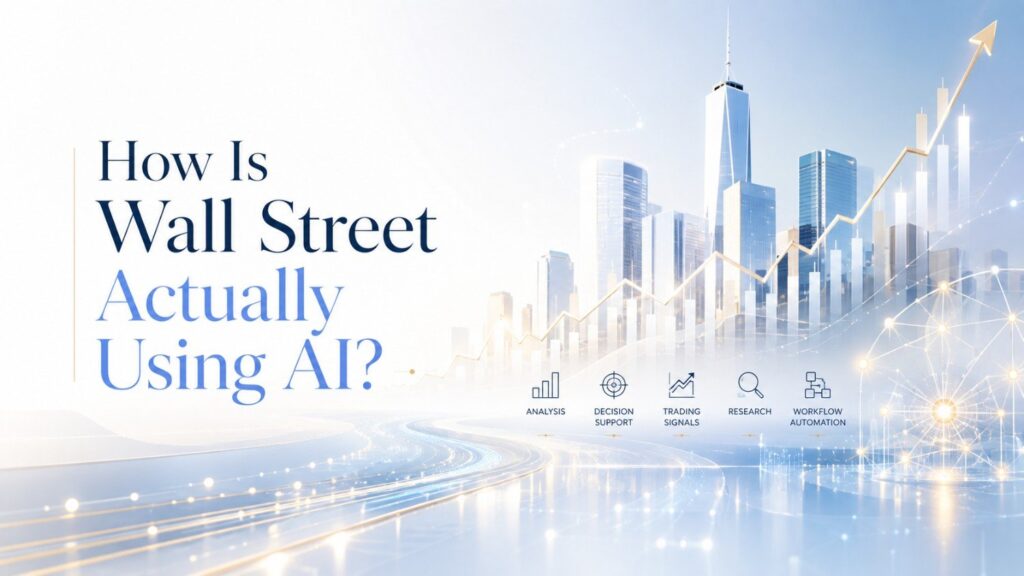
The Short Answer: How Is Wall Street Actually Using AI?
The clearest way to understand the AI boom on Wall Street is to stop thinking about “AI in banking” as one thing.
A large bank contains thousands of different workflows. There are developers writing code, bankers preparing client materials, compliance teams reviewing customers, advisors reading research, operations teams fixing failed processes, risk teams examining transactions, and investment professionals searching through mountains of information.
AI can be inserted into each of these workflows in a different way.
Based on NYC Tech Journal’s review of official disclosures from JPMorgan Chase, Citi, Goldman Sachs, Morgan Stanley, BNY and BlackRock, six areas stand out.
| Wall Street AI use | What AI is doing |
| Internal knowledge | Finding answers across research, policies, documents and company data |
| Software development | Writing, reviewing and improving code |
| Client and advisor work | Preparing meetings, summarizing conversations and suggesting relevant information |
| Risk and compliance | Supporting KYC, fraud detection, transaction screening and regulatory work |
| Operations | Processing documents, validating payments and automating repetitive tasks |
| Markets and investing | Analyzing research, securities data, earnings calls, portfolios and market workflows |
The important point is that these are not distant experiments.
Many are already being used at significant scale.
That is where the Wall Street AI story becomes much more interesting.
Original Research: NYC Tech Journal Analyzed How Six Wall Street Giants Are Deploying AI
There is a problem with comparing AI adoption across banks.
Companies disclose AI activity in very different ways. JPMorgan may report hundreds of production use cases. Another company may announce three important products without stating the number of smaller internal systems it operates.
Simply counting press releases would therefore produce a bad dataset.
NYC Tech Journal used a different method.
Our Methodology
We reviewed publicly available corporate disclosures published between January 1, 2023 and August 30, 2026 for six major financial firms headquartered in New York:
JPMorgan Chase, Citi, Goldman Sachs, Morgan Stanley, BNY and BlackRock.
We prioritized annual reports, shareholder letters, official product pages, company technology pages and corporate press releases.
We then coded public evidence into six broad functions:
- Internal knowledge and search
- Software engineering
- Client and advisor service
- Risk, compliance and controls
- Operations and document-heavy workflows
- Markets, investing and investment research
A category received a positive score only where we found a specific public deployment signal.
General statements such as “AI will transform our industry” did not count.
We also did not assume that an activity was absent simply because a firm had not publicly discussed it. A blank in this research means not clearly documented in the public material reviewed, not “the company does not do this.”
This gives us a conservative view of publicly visible adoption rather than an exaggerated estimate.
Chart 1: AI Deployment Breadth Across Six Major NYC Financial Firms
Number of six functions with a clearly documented AI deployment signal
JPMorgan Chase 6/6 ██████
Citi 6/6 ██████
Goldman Sachs 5/6 █████
Morgan Stanley 4/6 ████
BNY 4/6 ████
BlackRock 4/6 ████
Across the full dataset, we found a deployment signal in 29 of 36 possible firm-function combinations, or about 81%.
That is an unusually broad footprint for a technology that only entered the mainstream generative-AI era after late 2022.
The bigger finding, however, comes from looking at which functions appear most often.
Chart 2: Where Wall Street AI Deployment Is Most Visible
Operations / document workflows 6 of 6 ██████
Internal knowledge / search 6 of 6 ██████
Client / advisor workflows 5 of 6 █████
Markets / investing / research 5 of 6 █████
Risk / compliance / controls 4 of 6 ████
Software engineering 3 of 6 ███
Source: NYC Tech Journal original coding of official company disclosures, 2023-August 2026.
The result challenges the popular view of financial AI.
The two areas with the widest public evidence were not autonomous investing or algorithmic trading.
They were operations and knowledge work.
That tells us something important about how AI is entering finance.
Banks appear to be attacking information friction first.
The AI Boom on Wall Street Is Really a Workflow Boom
Large financial firms have a strange advantage in AI.
They also have a strange problem.
These businesses have accumulated huge amounts of proprietary information over decades. They have research reports, market data, contracts, transaction histories, customer records, compliance procedures, risk models, internal policies and thousands of software systems.
That information is valuable.
But finding the right piece of it at the right moment can be extremely difficult.
Traditional software usually asks workers to learn where the information lives.
Generative AI can reverse that relationship.
Instead of an employee opening five systems and searching manually, the employee can increasingly ask a question in normal language and allow an approved AI system to search the right information.
Morgan Stanley provides a clear example.
Its AskResearchGPT system was created for investment banking, sales and trading, and research employees. The assistant can search and summarize information from Morgan Stanley Research, which publishes more than 70,000 reports each year.
Imagine the old workflow.
A banker wants the firm’s latest views about a sector before speaking with a client. The banker searches reports, opens PDFs, reads documents, copies important sections and turns those findings into a useful summary.
Now imagine being able to ask a controlled internal system to find that information immediately, while preserving links to the source material.
That does not eliminate the banker.
It changes where the banker spends time.
That pattern appears repeatedly across Wall Street.
JPMorgan Chase May Be the Clearest Example of AI at Industrial Scale
JPMorgan’s public disclosures give us one of the best views into what AI adoption looks like when a financial institution moves beyond small pilots.
In 2024, the company launched LLM Suite to more than 200,000 employees. The system provides generative AI capabilities inside a controlled environment designed to protect company and customer data. By 2025, JPMorgan said it had more than 500 AI use cases in production.
But the scale number is only part of the story.
What matters more is where those tools are being inserted.
AI Is Changing Software Development
More than 90% of JPMorgan’s engineers were using AI coding assistants according to its 2025 disclosures. In the previous year’s report, the company said software engineers were seeing productivity improvements of roughly 10% to 20% in parts of the software-development lifecycle.
That is important because JPMorgan is not merely a bank with an IT department.
It employs tens of thousands of technologists and operates thousands of applications.
A modest improvement in developer productivity can therefore matter at enormous scale.
If an AI tool saves a few minutes for one developer, the impact is small.
If similar improvements appear across tens of thousands of engineers working throughout the year, the economics change dramatically.
AI Is Moving Into Compliance and Transaction Screening
JPMorgan says AI has allowed its corporate and investment bank to review more than twice the transaction-screening volume while cutting manual operator checks roughly in half. The company has also reported that AI and machine learning helped produce a nearly 40% reduction in unit costs for certain KYC processes in the CIB.
This may be one of the most important areas to watch.
Compliance is necessary, expensive and full of repetitive work.
Financial firms must identify customers, examine documents, look for suspicious activity, understand ownership structures and keep records updated.
AI does not remove those obligations.
It can change the cost of completing them.
AI Is Entering Asset and Wealth Management
JPMorgan has also disclosed several unusually specific investment and advisor applications.
SpectrumIQ brings research, data and risk information together across roughly 90,000 securities and 22 million documents. JPMorgan said the system produced an 80% reduction in the time required to move from manual research to insight in the use case it described.
Its Connect Coach system uses 25 specialized AI agents to generate personalized outreach ideas for advisors. JPMorgan reported delivering one million custom AI-driven insights to 5,000 Global Private Bank users.
This is a useful picture of where financial AI is heading.
The model does not have to replace the advisor.
It can continuously prepare the advisor.
Citi Is Turning AI Into an Enterprise Layer
Citi provides another valuable case because its disclosures show AI moving from general employee tools into specific financial workflows.
By September 2025, Citi said its proprietary AI tools had reached more than 175,000 colleagues across 80 countries and jurisdictions. Those tools include systems such as Citi Stylus for working with documents and Citi Assist for finding information.
The latest disclosures go much further.
Citi’s 2025 annual report says developers using AI-assisted coding tools were creating approximately 100,000 hours of capacity every week.
That number deserves attention.
One hundred thousand hours each week equals more than five million hours over a full 52-week period if the pace were sustained.
That does not mean Citi has eliminated five million hours of jobs. “Capacity created” is not the same as headcount reduction. It means Citi believes developers can redirect a very large amount of time from certain coding work into other activities.
AI Is Moving Into Markets Operations
Citi says its Markets business is using AI to automate trade confirmations.
Trade confirmation may sound boring compared with predicting stock prices.
But boring workflows can contain enormous value.
Financial markets create huge numbers of documents, messages, approvals, reconciliations and exceptions. Each manual handoff creates a chance for delay or error.
That makes operations one of the most practical areas for AI.
Citi Is Applying AI to KYC and Lending
Citi says it is upgrading Know Your Customer and client-onboarding processes with AI to automate manual work and reduce cycle times.
It is also using AI in wholesale lending to streamline underwriting and credit review.
This is much closer to core banking activity.
The important distinction is that AI can help gather information, analyze documents and support the review process without necessarily receiving final authority over a lending decision.
That model—AI does more preparation while a human keeps responsibility—is likely to remain common in regulated financial work.
Wealth Management Is Becoming Another Important AI Test
Citi has introduced Advisor Insights and AskWealth.
AskWealth gives wealth employees a conversational system for finding information and research. Advisor Insights is designed to surface useful client information and engagement opportunities.
Citi says these tools are intended to save time for advisors, bankers and service teams while preserving the high-touch nature of wealth management.
Again, this is augmentation rather than simple replacement.
The advisor still owns the relationship.
AI changes the information available before the conversation.
BNY Is Pushing Toward “Digital Employees”
BNY may be one of the most interesting institutions in our dataset because it is openly discussing a move beyond simple chatbots.
Its enterprise platform is called Eliza.

According to BNY’s 2025 annual report, every employee has access to Eliza. The firm delivered 171,000 hours of AI learning during 2025, nearly half of employees were building AI agents, 160 enterprise AI solutions were in production, and BNY had 134 “digital employees.”
That last number changes the conversation.
What Does BNY Mean by a Digital Employee?
BNY describes these as multi-agent AI systems that can perform work alongside human colleagues.
The company has disclosed examples including digital employees that help payment teams validate transactions that cannot move through normal straight-through processing.
It has also discussed AI for client onboarding, contract review, continuous transaction monitoring and risk analysis.
This is a more advanced stage than giving workers access to a chatbot.
A chatbot waits for a person to ask a question.
An agent can potentially receive a goal, use tools, complete several steps and return a result.
That transition—from answering to doing—could be one of the biggest changes in financial services between 2026 and the end of the decade.
Settlement Is a Strong AI Use Case
BNY’s Predictive Trade Analytics uses AI to examine trade patterns and identify transactions at higher risk of settlement failure.
That allows teams to intervene before a problem becomes a failed settlement.
This shows why AI has such a strong fit with financial infrastructure.
There are enormous numbers of transactions.
Most are normal.
Human attention is most valuable on the exceptions.
AI can help identify those exceptions earlier.
Morgan Stanley Shows Why Wealth Management Was an Early AI Winner
Morgan Stanley took a different path.
Rather than beginning with a generic firmwide story, some of its most visible generative-AI products have focused directly on advisors.
The AI @ Morgan Stanley Assistant gives financial-advisor teams access to the firm’s internal intellectual capital through a conversational interface.
By June 2024, Morgan Stanley said 98% of financial-advisor teams had adopted the Assistant.
That is a remarkable adoption figure for a new enterprise tool.
The reason makes sense.
Financial advisors spend a large amount of time searching for information, preparing for meetings, recording notes and following up.
Those activities are important.
They are also highly suited to language models.
AI @ Morgan Stanley Debrief Attacks the Meeting Workflow
Debrief can, with client consent, create meeting notes, identify action items, produce a draft follow-up email and save notes into Salesforce.
Morgan Stanley later rolled the system out across its financial-advisor base.
Think about what happened there.
The bank did not try to automate “wealth management.”
It selected a narrow workflow.
Listen to a meeting.
Create the notes.
Find the next steps.
Prepare a draft.
Update the system.
That is the pattern executives outside finance should study.
Successful enterprise AI often begins with a painful chain of small tasks rather than one enormous promise.
Goldman Sachs Is Redesigning the Operating Model Around AI
Goldman Sachs has moved from experimenting with employee AI tools to discussing AI as part of the way the firm itself should operate.
The company’s 2024 annual report described a developer coding assistant, its natural-language GS AI Assistant and other generative-AI applications.
Its 2025 report went much further.
Goldman introduced One Goldman Sachs 3.0, describing it as a new operating model propelled by AI.
The initial work is focused on six areas:
| Goldman Sachs OneGS 3.0 workstream | Why AI fits |
| Client onboarding / KYC | Large amounts of documents and verification |
| Vendor management | Contracts, reviews, information gathering |
| Regulatory reporting | Data collection, validation and reporting |
| Lending | Document analysis and decision support |
| Enterprise risk management | Faster access to risk information |
| Sales enablement | Better preparation and client insights |
Goldman’s stated goals include reducing friction in onboarding, automating error-prone workflows, improving data capture and retrieval, creating faster risk insights and reducing routine work.
This could be more important than launching another chatbot.
It suggests that the AI question inside large financial firms is shifting.
The first question was:
Which AI tools should employees receive?
The next question is becoming:
How would we design this entire process if AI had existed when the process was created?
That is a much bigger transformation.
BlackRock Is Bringing AI Into the Investment Technology Stack
BlackRock is particularly important because it sits at the intersection of asset management and financial technology.
Its Aladdin platform is deeply embedded in the investment operations of institutions around the world.
BlackRock has now introduced Aladdin Copilot, which uses generative AI to help users interact with information inside Aladdin. The system includes permission-based access and controls intended to keep responses within the platform’s boundaries.
The control design is worth noticing.
BlackRock explicitly says Aladdin Copilot will not provide investment advice and includes measures intended to reduce hallucination, misinformation and inappropriate output.
That tells us something about enterprise AI in finance.
A successful financial AI system is not simply the most powerful model.
It is a powerful model inside carefully designed boundaries.
AI Is Also Moving Into Investment Research
BlackRock has publicly described the use of generative AI to interpret information from earnings calls and help investment teams analyze index changes and corporate actions.
Its systematic investment teams have used AI and machine learning techniques for much longer than the recent generative-AI boom.
In his 2026 chairman’s letter, Larry Fink argued that Aladdin should become a major beneficiary of AI because the technology can help clients work across increasingly large datasets and scale investment analysis.
This may become one of the largest commercial opportunities created by Wall Street’s AI boom.
Financial technology platforms can sell AI-enabled workflows to thousands of other institutions.
Original Research Finding #1: Information Retrieval Is Becoming a Core Wall Street Interface
Across our six-firm sample, internal knowledge and information search was one of only two categories with clear deployment evidence at every institution.
That is not an accident.
Financial companies produce enormous amounts of text.
A traditional software interface makes a user navigate menus, folders, search fields and applications.
AI offers another interface:
Ask the system what you need.
This could eventually change how financial employees interact with software itself.
Morgan Stanley has already described a future in which AI works as an interaction layer between employees and applications such as CRM systems, reporting tools, order-entry systems and risk tools.
That idea is much bigger than ChatGPT inside a bank.
Imagine an employee saying:
“Show me the client’s recent activity, summarize our last two meetings, identify outstanding compliance items, pull the latest house research related to their portfolio and prepare my meeting brief.”
Today, accomplishing that may involve several systems.
An AI layer could increasingly coordinate them.
The competitive advantage may therefore move from having the most applications to having the best system for connecting them.
Original Research Finding #2: The Back Office May Capture AI Value Before the Trading Desk
Our coding found public evidence of operations-related AI across all six companies.
That was stronger than software engineering, risk and several supposedly more glamorous AI categories.
This makes economic sense.
The financial back office contains exactly the features AI needs:
large transaction volumes, repeated processes, structured rules, documents, exceptions and expensive human review.
Why Exception Management Matters
Many financial processes do not need AI to handle the normal case.
Traditional automation can already process clean transactions.
The difficult part is everything that breaks.
A payment is missing information.
A trade may fail settlement.
A document does not match the expected format.
A customer’s ownership structure is complicated.
A contract contains unusual language.
A transaction looks suspicious.
Humans spend enormous amounts of time investigating these exceptions.
AI can potentially help gather the evidence, summarize the problem and recommend what needs attention.
That can create value without handing the model uncontrolled decision-making power.
BNY’s payment-validation and settlement-prediction work, JPMorgan’s transaction screening, Citi’s trade-confirmation automation and Goldman’s focus on onboarding and regulatory reporting all fit this pattern.
Original Research Finding #3: AI Adoption Is Moving Through a Clear Maturity Curve
We also classified the six institutions by the strongest stage visible in their public disclosures.
Chart 3: The Wall Street AI Maturity Funnel
Broad AI access or AI product available 6 firms ██████
Specific workflows publicly deployed 6 firms ██████
Numeric adoption/productivity result disclosed 4 firms ████
Agentic/autonomous workflow publicly disclosed 2 firms ██
Unsupervised material financial authority 0 firms
Source: NYC Tech Journal original analysis. “0 firms” means no clear example found in the reviewed public material, not proof that no such system exists anywhere inside these organizations.
This chart may be the most useful result in our research.
Wall Street has largely passed the “should employees have AI?” stage.
The major firms are now embedding it into workflows.
A smaller group can publicly demonstrate large adoption or measurable operating results.
The frontier is moving toward agents.
But there remains a major boundary around handing AI unsupervised authority over material financial decisions.
That boundary is important.
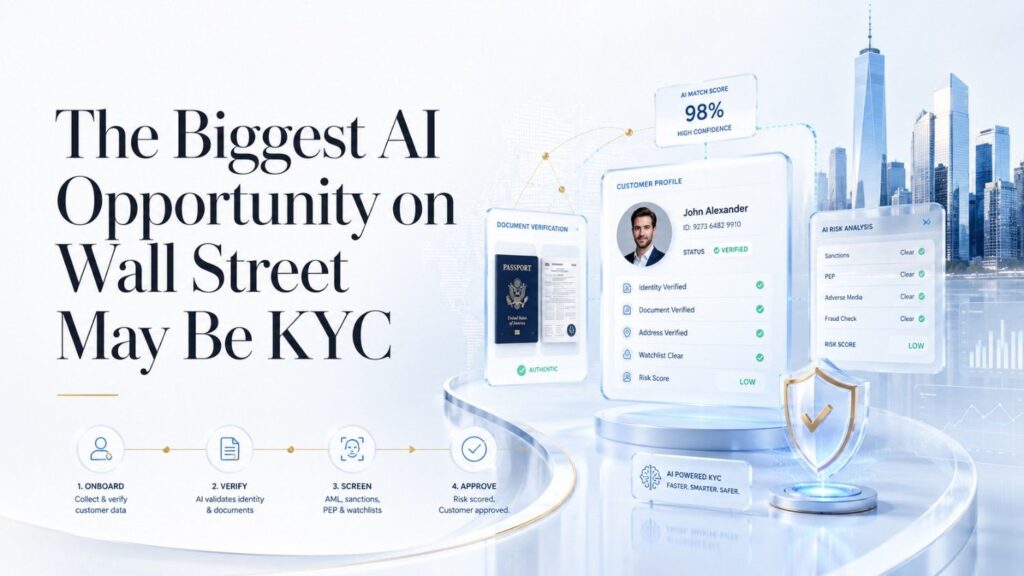
The Biggest AI Opportunity on Wall Street May Be KYC
Know Your Customer is rarely discussed outside financial services.
Inside financial services, it is unavoidable.
Before banks can serve clients, they often need to understand who those clients are, where money comes from, who ultimately owns an entity and whether the relationship creates regulatory or financial-crime risks.
That can require reviewing large numbers of documents.
It is slow.
It is expensive.
And mistakes are serious.
This is almost a textbook AI workflow.
AI can help extract information from documents, compare records, identify missing fields, summarize ownership relationships and bring unusual cases to a human reviewer.
JPMorgan has reported significant reductions in CIB KYC unit costs. Citi is applying AI to client onboarding. Goldman has chosen onboarding and KYC as one of the six initial OneGS 3.0 workstreams.
For AI startups selling to Wall Street, this should be a lesson.
Do not look only for jobs that sound futuristic.
Look for work that is expensive because highly paid people spend too much time assembling information.
Software Engineering Could Produce Some of the Fastest Returns
Coding is another powerful use case because financial institutions are enormous software organizations.
JPMorgan operates thousands of applications.
Citi has spent heavily modernizing technology.
Goldman has long built important parts of its own systems.
These companies do not need AI coding assistants to replace entire engineering teams for the economics to work.
Suppose an assistant saves a developer even 10% of time.
At a company with thousands of developers, that becomes large.
JPMorgan has disclosed 10% to 20% productivity improvements in parts of software development and says more than 90% of engineers use coding assistants. Citi now reports roughly 100,000 hours of developer capacity created each week. Goldman has deployed a developer copilot.
These are among the strongest hard productivity signals in our research.
They also explain why AI may alter technology spending without necessarily reducing technology’s importance.
If developers become more productive, firms may simply build more.
What Wall Street Is Not Publicly Showing Us Yet
There is also value in studying what is missing.
Public corporate material is full of examples of AI summarizing, searching, coding, checking, preparing, extracting and assisting.
It contains far fewer examples of a generative-AI agent receiving unsupervised power to make large trades, approve major loans or take material risk with firm capital.
That does not mean advanced models are absent from trading.
Machine learning and quantitative systems have existed in markets for years.
The distinction is about authority.
Why Financial Firms Are Careful
If an AI model drafts a summary incorrectly, an employee can catch the mistake.
If an autonomous system sends a large trade incorrectly, the consequences are very different.
Finance therefore creates what we might call an AI risk ladder.
| AI task | Typical risk level |
| Search internal documents | Lower |
| Summarize a meeting | Lower |
| Draft an email | Lower |
| Suggest research | Moderate |
| Flag suspicious activity | Moderate |
| Recommend a credit action | Higher |
| Execute material trades autonomously | Very high |
The higher AI moves on this ladder, the more important validation, permissions, human review, model monitoring and audit trails become.
That is why controlled systems may win over flashy systems.
New York’s Regulation Could Actually Strengthen Its AI Advantage
New York creates a difficult environment for financial AI.
That may become an advantage.
The New York State Department of Financial Services has already issued guidance on cybersecurity risks created by artificial intelligence. It has specifically highlighted concerns such as AI-powered social engineering, stronger cyberattacks, exposure of non-public information and third-party risks.
In 2026, DFS said it had also adopted an internal AI-use policy and continued to develop expectations around responsible AI use by regulated institutions.
FINRA has similarly reminded broker-dealers that existing regulatory obligations continue to apply when generative AI is used.
This could slow irresponsible deployment.
It could also produce better financial AI companies.
A startup that can satisfy the security, governance and audit requirements of a major New York bank has built something very different from a simple consumer chatbot.
That capability can be sold elsewhere.
Why New York Is Unusually Well Positioned for Applied Financial AI
There is a reason so much financial AI activity is appearing in New York.
New York combines four things that rarely exist at this scale in one city.
New York Has the Buyers
Finance and insurance remain enormous parts of the city’s economy.
As of September 2024, the sector accounted for roughly 370,100 New York City jobs, according to city data.
More importantly, New York contains major banks, hedge funds, private-equity firms, insurers, asset managers, fintech companies, accounting firms, law firms and data companies.
An AI founder building for financial work can meet potential customers without leaving the city.
New York Has the AI Startup Base
NYCEDC reported more than 2,000 AI startups in the city and more than 40,000 workers with AI skills in the broader metro area.
It also reported more than 25,000 tech startups and more than 1,200 active venture capital firms.
This creates a powerful loop.
Wall Street creates problems.
Founders build tools for those problems.
Investors fund the founders.
Financial firms buy the software.
Experienced employees leave companies and create the next generation of startups.
The ecosystem compounds.
New York Has a Huge Talent Engine
NYCEDC says Columbia, Cornell Tech, CUNY and NYU collectively produced more than 87,000 “AI-ready” degree holders between 2018 and 2023.
That matters because financial AI does not require only machine-learning researchers.
It requires people who understand engineering, finance, regulation, operations, cybersecurity, data and product design.
New York has unusual depth across those fields.
Chart 4: The Scale of New York’s AI-Finance Flywheel
| NYC ecosystem factor | Publicly reported scale |
| AI startups | 2,000+ |
| AI-skilled metro workers | 40,000+ |
| Active VC firms | 1,200+ |
| Tech-enabled startups | 25,000+ |
| AI-ready graduates, 2018-2023 | 87,000+ |
| NYC finance and insurance jobs, Sept. 2024 | ~370,100 |
Sources: NYCEDC and City of New York.
The numbers explain why “applied AI” may be a better way to understand New York than simply comparing the city with Silicon Valley on foundation-model research.
New York has huge existing industries waiting to be rebuilt.
Finance may simply be the first major proving ground.
The Next Phase Is Agentic AI
The industry’s first generative-AI wave gave employees chat boxes.
The next wave will give software goals.
That is the core idea behind agentic AI.
A normal chatbot may answer:
“Here are the documents required for this onboarding case.”
An agent could eventually do something closer to:
“Collect the available documents, extract the required fields, compare them with our records, identify what is missing, prepare the case and route the exception to the correct reviewer.”
The second system removes far more work.
BNY is already talking openly about digital employees. Citi introduced an agentic version of Citi Stylus Workspaces. Nasdaq Verafin, outside our six-company core sample, has launched an Agentic AI Workforce for financial-crime compliance after its generative-AI Entity Research copilot was adopted by more than 1,300 clients.
This is where AI economics could become much larger.
Chatbots save minutes.
Agents can potentially redesign processes.
But Agents Make Governance Much Harder
The more work an AI system can perform, the more ways it can make a mistake.
An AI assistant that cannot access customer records has limited power.
An agent that can open systems, change data, communicate with clients and initiate workflows has far more.
Companies will therefore need to think about AI access in the same way they think about employee access.
Which information can the agent see?
Which tools can it use?
Which actions can it take?
How much money can it influence?
What requires human approval?
Can every action be reconstructed later?
What happens when the system behaves unexpectedly?
BNY’s language around distinct personas, credentials and supervisors for digital employees points toward where enterprise design is heading.
An AI agent may eventually need something that looks a lot like a job description.
Original Research Finding #4: The Best AI Metrics Are Moving From Usage to Business Outcomes
Companies often celebrate the number of workers who have access to AI.
That is useful during the first stage of rollout.
It becomes less useful later.
If 200,000 employees can open an AI tool but few use it for important work, access is not transformation.
The stronger Wall Street disclosures increasingly measure outcomes.
Table: Some of the Strongest Public AI Metrics We Found
| Firm | Publicly disclosed AI metric |
| JPMorgan | 200,000+ employees given LLM Suite access |
| JPMorgan | 500+ AI use cases in production by 2025 |
| JPMorgan | 90%+ of engineers using AI coding assistants |
| JPMorgan CIB | Nearly 40% lower unit cost in certain KYC processes |
| JPMorgan | Transaction-screening volume more than doubled while manual checks were roughly halved |
| Citi | 175,000+ colleagues reached by proprietary AI tools |
| Citi | About 100,000 hours of developer capacity created per week |
| BNY | 100% employee access to Eliza |
| BNY | 160 enterprise AI solutions in production |
| BNY | 134 digital employees |
| BNY | 171,000 AI learning hours delivered in 2025 |
| Morgan Stanley | 98% of financial-advisor teams adopted its AI Assistant |
| Morgan Stanley | AskResearchGPT can search a research library producing 70,000+ reports annually |
Sources: official company reports and releases.
The next generation of metrics should become even more practical.
Minutes saved per case.
Cost per onboarding.
Settlement failures prevented.
False positives reduced.
Client-response time.
Research time saved.
Revenue supported per advisor.
Developer cycle time.
Compliance exceptions per thousand transactions.
That is how AI moves from an innovation story to an operating system.
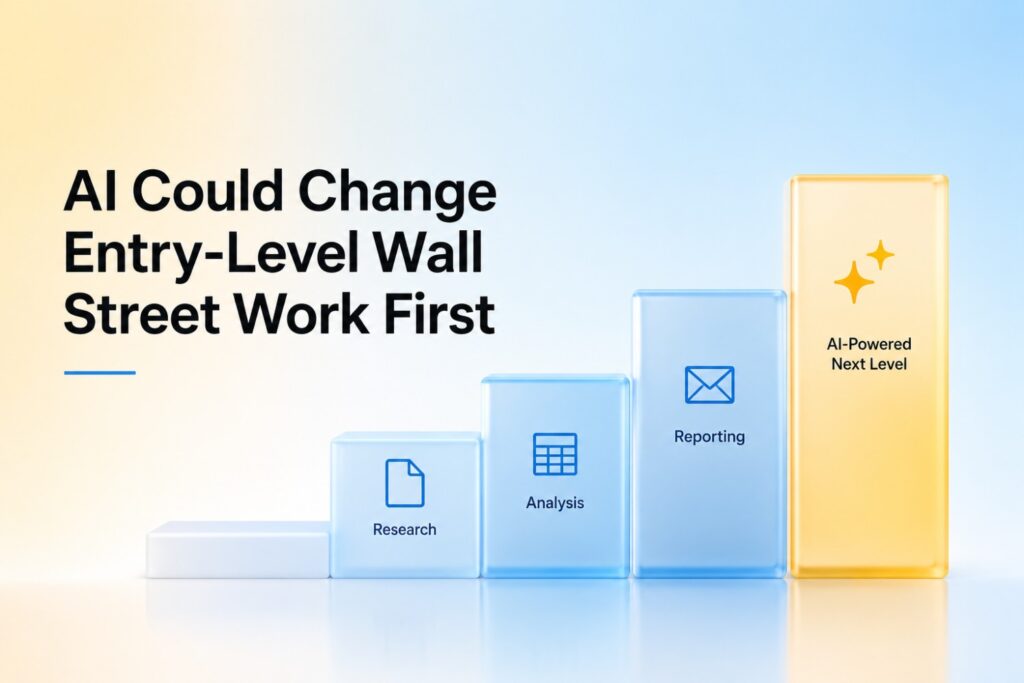
AI Could Change Entry-Level Wall Street Work First
The labor question cannot be ignored.
Many junior financial jobs contain exactly the tasks generative AI handles well.
Search.
Summarize.
Compare.
Format.
Prepare.
Draft.
Check.
That does not mean analysts disappear tomorrow.
It does mean the job can change.
A first-year banker may spend less time manually building basic summaries and more time checking AI output, interpreting information and working with clients.
A junior compliance professional may review exceptions rather than every routine document.
A software engineer may spend less time writing basic code and more time reviewing architecture and solving harder problems.
New York City’s Comptroller has warned that AI exposure is especially important for the city’s office-based economy. Its 2026 analysis found adoption particularly strong in finance, information and professional services. The report also noted that measurable productivity gains were beginning to appear in high-skill services and finance.
That creates both opportunity and risk.
If entry-level workers no longer learn by completing basic tasks, companies will need new ways to teach judgment.
You cannot simply remove the bottom steps of the career ladder and assume everyone will somehow arrive at the top.
What Financial Firms Should Learn From the Current Leaders
The six institutions in our research follow different strategies, but several common lessons are becoming visible.
Start With Expensive Friction
The best AI project is rarely the one with the coolest demonstration.
It is often the workflow everyone hates.
Look for employees spending hours searching documents, copying information between systems, preparing repetitive reports, reviewing normal cases or recreating the same analysis.
That is where measurable returns can appear quickly.
Build a Secure Enterprise Layer
JPMorgan’s LLM Suite, BNY’s Eliza and Citi’s internal AI platforms show another pattern.
Large companies do not want employees casually sending sensitive information into random public AI services.
They are building controlled environments.
That allows firms to choose approved models, manage permissions, connect internal data and monitor use.
The model itself may become a commodity.
The secure enterprise layer around the model can become the strategic asset.
Fix the Data Before Expecting Magic
Goldman’s OneGS 3.0 plan repeatedly connects AI with better data architecture.
That is not accidental.
An AI agent cannot reliably answer questions if customer information is split across conflicting systems.
It cannot automate a workflow if the underlying process is undocumented.
It cannot make good recommendations from bad data.
AI often exposes old technology problems rather than eliminating them.
Keep Humans Where Judgment Matters
The strongest deployments do not blindly automate every decision.
They give professionals more information and remove routine preparation.
That model is particularly useful in regulated businesses.
The objective should not be maximum automation.
It should be maximum useful automation within an acceptable level of risk.
What AI Startups Selling to Wall Street Should Understand
New York’s financial AI boom creates a huge startup opportunity.
It also creates a brutal sales environment.
A bank does not care that a demo looks impressive if the product cannot pass security review.
Solve One Expensive Problem Extremely Well
A startup should be able to explain the value in plain numbers.
“We help compliance teams” is weak.
“We cut the time required to prepare this case from 90 minutes to 20 minutes while preserving human approval” is much stronger.
The closer the product is to a measurable workflow, the easier the business case becomes.
Integrate With Existing Systems
Banks already have enormous technology stacks.
A new AI product that requires employees to copy data into another standalone tool creates more work.
The winners will increasingly operate inside the systems employees already use.
Morgan Stanley’s Debrief writing into Salesforce is a simple example of why integration matters.
Governance Is Part of the Product
For financial AI, audit logs are not boring.
Permissions are not boring.
Source citations are not boring.
Data isolation is not boring.
Human approval controls are not boring.
They are product features.
Companies that understand this may have an advantage over startups built primarily for consumer AI.
Why Wall Street Could Become One of the World’s Biggest Markets for Vertical AI
The first phase of generative AI was horizontal.
One chatbot could answer questions about almost anything.
The next phase is increasingly vertical.
A financial AI system can know the language of banking, connect to financial data, follow firm policies and understand specific workflows.
This is where New York has a major advantage.
Wall Street contains thousands of specialized tasks that generic software has never fully solved.
Private markets are still full of PDFs and spreadsheets.
Investment research is enormous.
Compliance keeps becoming more complex.
Financial advisors face information overload.
Companies process huge numbers of contracts.
Banks operate old technology systems alongside new ones.
Each problem creates room for specialized AI.
New York does not need to defeat Silicon Valley at building the world’s largest foundation model to become one of the most important AI cities.
It can become the place where models are turned into businesses.
What NYC Tech Journal Will Be Watching Next
Several signals will tell us whether Wall Street’s current AI boom becomes a deeper transformation.
The first is the move from access to measurable ROI.
We expect firms to disclose fewer “employees with access” numbers and more figures around cycle time, capacity, cost, revenue and risk.
The second is agent adoption.
BNY and Citi already provide early signals. The important question is how quickly other firms move from assistants that answer questions to agents that complete controlled workflows.
The third is customer-facing AI.
Most firms have been careful here. As model reliability improves, AI may move more directly into client service, portfolio explanation, treasury support and personalized financial experiences.
The fourth is organizational change.
Goldman’s OneGS 3.0 may prove particularly important if AI begins changing the structure of teams and processes rather than merely helping individual employees work faster.
The fifth is the entry-level labor market.
If AI removes large amounts of routine analysis, companies will need to redesign how junior employees learn.
And the sixth is New York’s startup ecosystem.
The city already has the ingredients required for a major vertical-AI cluster: thousands of AI companies, capital, technical talent and some of the world’s largest buyers of financial technology.
The Bigger Picture: Wall Street Is Becoming an AI Laboratory
For decades, financial institutions spent heavily on software because tiny improvements could become valuable when multiplied across enormous transaction volumes.
AI follows the same logic.
A few seconds saved on one task does not matter.
A few seconds saved across millions of tasks does.
A better research search may not sound revolutionary.
Multiply it across thousands of investment professionals.
A faster KYC review may sound boring.
Multiply it across a global client base.
An AI coding assistant may look like a convenience.
Put it in the hands of tens of thousands of technologists.
That is how Wall Street’s AI transformation should be measured.
Not by how futuristic the technology looks.
By how many points of friction disappear.
Chart 5: NYC Tech Journal’s View of the Wall Street AI Value Stack
┌─────────────────────────────┐
│ Autonomous financial work │
│ Still highly controlled │
└──────────────▲──────────────┘
│
┌──────────────┴──────────────┐
│ AI agents │
│ Multi-step workflow action │
└──────────────▲──────────────┘
│
┌──────────────┴──────────────┐
│ Embedded workflow AI │
│ KYC, research, operations │
└──────────────▲──────────────┘
│
┌──────────────┴──────────────┐
│ Enterprise copilots │
│ Search, draft, summarize │
└──────────────▲──────────────┘
│
┌──────────────┴──────────────┐
│ Data + permissions + APIs │
│ The foundation underneath │
└─────────────────────────────┘
The biggest mistake companies can make is trying to jump straight to the top.
Strong financial AI usually starts at the bottom.
Good data.
Clear permissions.
Reliable systems.
Controlled models.
Useful workflows.
Then automation.
New York’s AI Boom Is Becoming a Wall Street Operating Story
There is still enormous hype around artificial intelligence.
Some AI projects will fail.
Some productivity forecasts will prove too optimistic.
Some companies will discover that expensive models do not fix broken processes.
Financial firms will also have to manage hallucinations, privacy risks, cyber threats, bias, third-party dependencies and increasingly complicated regulation.
But the evidence coming from Wall Street is becoming difficult to dismiss.
JPMorgan has AI running across hundreds of production use cases. Citi is reporting millions of hours of potential annualized developer capacity at its current weekly rate. BNY is deploying AI agents as digital employees. Morgan Stanley has achieved near-universal adoption of an advisor assistant. Goldman Sachs is redesigning major operating workflows around AI. BlackRock is embedding generative AI into one of institutional investing’s most important technology platforms.
The artificial-intelligence boom on Wall Street is therefore no longer mainly a story about what AI might someday do.
It is becoming a story about what financial firms can rebuild now.
And that distinction could be extremely important for New York.
The city’s greatest AI advantage may not simply be the number of models, startups or researchers it can produce.
It may be the concentration of industries with difficult, valuable problems that AI is finally becoming capable of solving.
Wall Street is one of the largest of those industries.
If the current pace continues, New York will not merely be a city where financial companies use artificial intelligence.
It could become one of the places where the operating model for AI-powered finance is invented.
Research Note and Limitations
NYC Tech Journal’s original analysis in this article is based on publicly available information from official company annual reports, investor materials, press releases and corporate product pages available through August 30, 2026. The six-company comparison focuses on JPMorgan Chase, Citi, Goldman Sachs, Morgan Stanley, BNY and BlackRock because all are headquartered in New York and represent different major parts of financial services.
The coding intentionally uses broad functional categories rather than attempting to estimate every AI system operating inside each company. Financial institutions disclose technology differently, and many internal projects are never announced publicly. Therefore, a category marked as not publicly documented should never be interpreted as proof that a company has no activity in that area.
The analysis is designed to answer a narrower and more defensible question: What does the publicly verifiable evidence tell us about where large New York financial institutions are actually deploying AI?
The answer is increasingly clear.
Wall Street’s most important AI revolution is happening inside the workflow.