

Artificial intelligence is moving quickly into New York restaurants, but the change is far less dramatic than the popular image of robots taking over kitchens. In most restaurants, AI is appearing quietly inside the systems that already run the business. It is answering phone calls, predicting customer demand, helping managers plan labor, improving online ordering, analyzing guest feedback, forecasting food preparation, adjusting delivery times, and helping operators understand which parts of the business need attention.
This matters because running a restaurant in New York is unusually difficult. Operators face high wages, expensive rent, rising food costs, intense competition, delivery fees, changing customer habits, and very little room for operational mistakes. A restaurant can be packed on Friday evening and slow on Tuesday afternoon, while a single staffing mistake, poorly planned prep cycle, or missed rush can reduce the profit from an otherwise strong week.
NYC Health says the city has roughly 27,000 restaurants and food-service establishments under its inspection system. New York’s restaurant and bar industry supported nearly 280,000 jobs in 2024, generated more than $11.4 billion in wages, and produced roughly $28 billion in economic activity. Restaurant taxable sales in New York City also reached approximately $28.54 billion during the 12 months ending August 2025.
Those numbers show that New York has an enormous restaurant economy, but size does not make the business easy. Restaurant sales have risen strongly in dollar terms, yet inflation, wages, ingredients, rent, insurance, delivery commissions, technology fees, and other operating expenses continue to absorb much of that growth. For many operators, raising prices again is becoming harder because customers are already sensitive to the cost of dining out.
This is exactly the kind of environment in which useful automation starts to become valuable.
The strongest restaurant AI tools are not valuable because they appear futuristic. They are valuable because they remove small, repeated inefficiencies that happen hundreds or thousands of times every month. Saving 20 minutes of manager time, answering several additional reservation calls, preparing slightly less excess food, improving order-ready estimates, or scheduling one shift more accurately can each look small in isolation. Across an entire year, however, those improvements can become meaningful.
For this article, NYC Tech Journal analyzed publicly available restaurant, wage, labor, sales, storefront, and technology data to understand where AI is likely to create the greatest value for New York restaurant operators. There is no reliable public dataset that identifies exactly which New York restaurants currently use artificial intelligence, so it would be misleading to invent an AI adoption rate.
Instead, the analysis focuses on something more useful. It examines the operating conditions that make automation attractive, measures where restaurant activity is growing, studies real AI products already serving the restaurant industry, and estimates what small productivity improvements can be worth in a city where every labor hour and every wasted ingredient matters.
The Short Version: AI Is Becoming the Restaurant’s Decision Layer
The first major wave of restaurant technology was mostly about digitizing transactions. Point-of-sale systems replaced traditional cash registers, online ordering moved takeout to websites and apps, reservation platforms made tables easier to book, delivery services connected restaurants to drivers, and loyalty systems created digital records of customer behavior.
AI represents a different stage because it does more than simply record what happened.
A traditional POS system can tell a manager that the restaurant sold 85 burgers yesterday. An AI forecasting system can use that history, along with weather, day of the week, seasonality, events, and recent sales patterns, to estimate how many burgers the kitchen is likely to sell tomorrow.
A reservation platform can record that a guest visited three times. An AI-powered customer system can recognize that the guest usually books on Friday evenings, frequently orders vegetarian food, and has not returned for several weeks.
A restaurant phone can ring during a busy dinner service. A voice AI system can answer basic questions, handle a reservation request, explain opening hours, and pass unusual questions to an employee when necessary.
The difference is important because traditional restaurant software mainly stores information and follows instructions, while AI increasingly interprets information and suggests what should happen next.
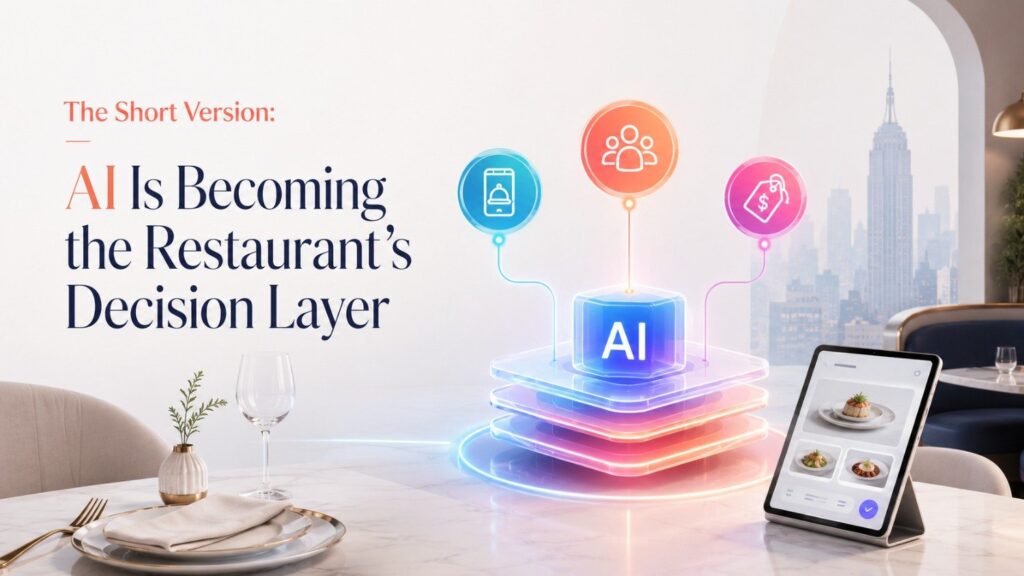
That is why the most important restaurant AI companies may eventually become less like separate tools and more like decision systems that help operators manage the entire business.
NYC Tech Journal Original Research: Measuring the Restaurant AI Opportunity
Understanding restaurant automation in New York starts with understanding the structure of the city’s restaurant economy. That requires some care because public datasets often measure different parts of the industry in different ways.
Why Inspection Records Cannot Simply Be Counted as Restaurants
The NYC Department of Health and Mental Hygiene publishes restaurant inspection information through NYC Open Data. The dataset contains hundreds of thousands of records, but each record does not represent a separate restaurant.
A single restaurant can appear many times because inspections may produce several violation records, and establishments are inspected repeatedly over time. The city identifies individual establishments using a unique CAMIS identification number.
For that reason, counting every inspection row would dramatically overstate the number of restaurants operating in New York.
For market scale, the more useful figure is NYC Health’s estimate that approximately 27,000 food-service establishments fall within its inspection system.
That number is not perfect for every type of restaurant analysis, but it provides a reasonable estimate of the size of the city’s food-service base.
How the Data Was Combined
Our analysis draws from several public sources, including NYC Health, NYC Planning, the New York City Comptroller, the New York State Comptroller, the New York State Department of Labor, and the U.S. Bureau of Labor Statistics.
Each source measures something slightly different. A dataset describing “restaurants and bars” is not exactly the same as one describing “food-service establishments.” Similarly, “food and drink storefronts” is not identical to restaurant employment.
That means calculations combining these sources should be treated as directional operating estimates rather than precise audited averages for an individual restaurant.
The purpose is not to create artificial precision. It is to understand the economic environment in which restaurant AI is being adopted and to identify where relatively small improvements could create meaningful value.
Original Finding #1: New York’s Restaurant Economy Is Huge, but the Margin for Error Is Small
Several public measurements help show the scale of New York’s restaurant industry.
| Measure | Latest public figure used |
| Approximate NYC food-service establishments | 27,000 |
| Restaurant and bar jobs, 2024 | Nearly 280,000 |
| Restaurant and bar wages, 2024 | More than $11.4 billion |
| Estimated restaurant and bar economic activity | About $28 billion |
| Restaurant taxable sales, Sep. 2024-Aug. 2025 | $28.544 billion |
| NYC minimum wage, 2026 | $17 per hour |
| Mean metro food-preparation and serving wage, May 2025 | $22.22 per hour |
Using approximately 27,000 establishments as a rough denominator helps put these numbers into perspective.
Citywide taxable restaurant sales of approximately $28.54 billion work out to slightly more than $1 million per food-service establishment when spread evenly across the estimated establishment base. That is not the same as saying the average restaurant makes $1 million in revenue because the datasets use different definitions, and real restaurant sales vary enormously.
Still, the figure is useful for understanding scale.
The same logic can be applied to employment. Nearly 280,000 restaurant and bar jobs spread across approximately 27,000 establishments works out to roughly 10 jobs per establishment. More than $11.4 billion in industry wages also translates into hundreds of thousands of dollars in annual labor expense for an establishment when viewed as a citywide proxy.
Those numbers explain why restaurant operators pay close attention to productivity.
A very small improvement in labor efficiency, order accuracy, food waste, guest retention, or digital conversion can matter because the operating base is already large.
Sales Have Grown Faster in Dollars Than in Real Purchasing Power
New York restaurant sales have recovered strongly from the pandemic, but the headline numbers can be misleading if inflation is ignored.
| 12-month period | Taxable restaurant sales, current dollars | Inflation-adjusted sales, 2019 dollars |
| Sep. 2018-Aug. 2019 | $22.333B | $23.020B |
| Sep. 2019-Aug. 2020 | $15.643B | $15.715B |
| Sep. 2020-Aug. 2021 | $14.514B | $13.846B |
| Sep. 2021-Aug. 2022 | $22.218B | $19.854B |
| Sep. 2022-Aug. 2023 | $25.901B | $21.699B |
| Sep. 2023-Aug. 2024 | $27.145B | $21.731B |
| Sep. 2024-Aug. 2025 | $28.544B | $22.182B |
In current dollars, restaurant taxable sales during the latest period were approximately 28% higher than during the 2018-2019 period. Once inflation is considered, however, the picture is far less dramatic.
Inflation-adjusted sales remained slightly below the earlier level.
That difference helps explain why many operators can look busy while still feeling financially squeezed.
More dollars are moving through the restaurant, but those dollars also have to cover higher wages, food costs, rent, insurance, equipment, utilities, delivery commissions, software subscriptions, and other expenses.
This makes productivity more important than headline revenue growth.
Original Finding #2: Saving One Hour of Repetitive Work Can Be Worth Thousands of Dollars
New York City’s minimum wage reached $17 per hour in 2026. At the same time, the mean wage for food-preparation and serving occupations across the wider New York metropolitan area was $22.22 per hour in May 2025.
These numbers create a useful way to understand the economics of restaurant automation.
Suppose a software system does not replace an employee but simply removes repetitive work. A host might spend less time answering basic phone questions. A manager might spend less time building a weekly forecast. Kitchen employees might spend less time correcting poor prep estimates. A marketing employee might spend less time manually reading and sorting reviews.
For a restaurant operating 365 days a year, even a small amount of saved time can become meaningful.
| Repetitive labor saved | At $17/hour | At $22.22/hour |
| 30 minutes per day | $3,103/year | $4,055/year |
| 1 hour per day | $6,205/year | $8,110/year |
| 2 hours per day | $12,410/year | $16,221/year |
| 4 hours per day | $24,820/year | $32,441/year |
These figures only reflect direct wage value. They do not include payroll taxes, benefits, overtime, manager distraction, turnover, missed orders, or revenue gained when employees can spend more time serving guests.
That is why restaurant AI should not always be discussed as a job replacement tool.
In many cases, the better use of automation is to move employee time away from repetitive tasks and toward work that has more value.
A host who spends less time answering questions about opening hours can greet guests faster. A manager who spends less time creating spreadsheets can coach employees. A kitchen team that receives a more accurate prep forecast can concentrate on food quality rather than reacting to shortages.
The more useful question is therefore not how many employees AI can eliminate.
The better question is how many low-value tasks can be removed from each shift.
Original Finding #3: The Next Restaurant Technology Market Is Not Only Manhattan
One of the most important restaurant trends in New York is happening outside the traditional Manhattan core.
NYC Planning studied storefront activity between the first quarter of 2020 and the third quarter of 2024. During that period, the city recorded net growth in food-and-drink storefronts across all five boroughs.
| Borough | Net food-and-drink storefront growth |
| Brooklyn | +501 |
| Queens | +420 |
| Bronx | +117 |
| Manhattan | +97 |
| Staten Island | +92 |
| Total | +1,227 |
Brooklyn and Queens alone accounted for approximately 75% of the city’s net food-and-drink storefront growth during the period. The four boroughs outside Manhattan together represented roughly 92% of the net gain.
That is a meaningful shift.
For years, restaurant technology companies could reasonably focus heavily on Manhattan because it contained many of the city’s best-known hospitality groups, high-volume restaurants, corporate offices, tourists, and expensive dining districts.
The opportunity is becoming much broader.
Restaurants in Williamsburg, Astoria, Long Island City, Flushing, Downtown Brooklyn, Bushwick, the Bronx, and many other neighborhood markets increasingly face the same operating complexity as businesses in Manhattan.
Some also operate with smaller management teams, which makes software that can turn restaurant data into simple operational decisions especially valuable.
Consumer Spending Is Also Becoming More Distributed
Broader consumer spending data points in a similar direction.
Compared with 2019, inflation-adjusted consumer spending during the 12 months ending March 2024 was 32% higher in Queens, 9% higher on Staten Island, 7% higher in the Bronx, and 2% higher in Brooklyn. Manhattan remained the largest consumer market but had not returned to its earlier spending level on an inflation-adjusted basis.
This is not restaurant-specific spending data, so it should not be treated as direct restaurant revenue.
However, it strengthens the wider argument that economic activity is becoming more distributed across the city.
For restaurant technology companies, New York’s future market may therefore be far more geographically diverse than many assume.
AI Is Starting With One of the Oldest Restaurant Problems: The Phone
The restaurant telephone looks almost outdated compared with mobile apps, online ordering platforms, and digital reservation systems, yet it remains one of the most important customer channels in hospitality.
That creates an unusual problem.
A restaurant may have modern software everywhere else while still relying on a host or manager to answer a physical phone during the busiest part of service.
When that phone rings during dinner, an employee often has to choose between helping the guest standing in front of them and answering the person calling.
Voice AI is beginning to remove that trade-off.
Voice AI Can Handle Real Restaurant Conversations
New York-based Slang AI has built voice AI specifically for restaurants and hospitality businesses.
The technology can answer inbound calls, respond to common questions, help with reservation requests, route important calls, and connect with restaurant systems such as OpenTable and SevenRooms.
This is very different from an old automated phone menu that tells customers to press one for reservations and press two for opening hours.
Modern voice AI can interpret normal conversational questions.
A guest might ask whether there is outdoor seating, whether the restaurant has vegan dishes, whether the kitchen is still serving, whether a booking can be changed from four people to six, or whether a table is available later that evening.
The system can answer routine questions and transfer more difficult situations to a person.
The Missed-Call Opportunity Could Be Significant
Restaurant industry research from DoorDash and SevenRooms reported that 64% of diners still call restaurants when making reservations, while 40% of those calls may go unanswered. The same research found that many diners are open to AI handling reservations.
These are national findings rather than NYC-only numbers, so they should not be presented as direct measures of New York behavior.
However, they help show the scale of the problem.
If 100 diners were used as a simple example and 64 called a restaurant, a 40% missed-call rate would leave roughly 26 potentially unanswered callers.
Not every unanswered call becomes lost revenue. Some customers call again, some book online, and others may only be asking a question.
Even so, the funnel is large enough to explain why restaurants are interested in voice AI.
The technology does not have to change the menu or the dining experience. It simply captures demand that may already be trying to reach the restaurant.
AI Ordering Is Moving Beyond Digital Menus
Digital restaurant ordering has existed for years, but the newest systems are becoming more intelligent.
The next generation of restaurant ordering technology is not only about allowing a customer to click a button and submit an order. It is increasingly about helping predict what the customer may want, when the order should be ready, and how the kitchen should respond.

New York-based Olo has become one of the largest restaurant technology platforms in this space. Its products cover ordering, payments, delivery, guest engagement, and other parts of restaurant commerce across tens of thousands of locations.
AI Can Personalize the Ordering Experience
Traditional restaurant websites often show every guest the same menu in the same order.
That approach is beginning to change.
AI-powered ordering systems can use customer behavior to make recommendations that are more relevant to each person. Someone who repeatedly orders vegetarian meals may see vegetarian options sooner. A customer who regularly buys lunch around noon may receive different recommendations from someone placing a large evening order.
The idea is familiar from ecommerce.
Amazon does not present every customer with the same homepage, and streaming services do not recommend the same programs to every viewer.
Restaurants are beginning to move in the same direction.
The goal should not be to manipulate customers into buying unnecessary items. The stronger use case is reducing friction by helping guests find relevant options faster.
AI Can Improve Order-Ready Estimates
Another important area is preparation-time prediction.
Restaurants have always struggled with estimated pickup times because the kitchen does not operate at a constant speed. Ten orders arriving within three minutes can completely change the time required to prepare the next order.
AI can use previous order history, current volume, time of day, location performance, and other patterns to generate better estimates.
Olo’s OrderReady AI is one example. In a case study involving P.F. Chang’s, the company reported improved quote accuracy, higher order conversion, and fewer manual changes to estimated lead times.
Those numbers belong to one company and should not be assumed to apply everywhere.
The more important lesson is that accurate preparation estimates affect several parts of restaurant operations at the same time.
Better estimates can reduce customer frustration, shorten delivery-driver waiting, decrease calls asking where an order is, and improve the chances that customers complete a digital purchase instead of abandoning it.
That makes order-timing AI more valuable than it may initially appear.
Restaurant Discovery Is Also Becoming an AI Problem
For many years, restaurant marketing focused heavily on Google Search, Maps, Yelp, Instagram, delivery marketplaces, and reservation platforms.
AI assistants are creating another discovery channel.
Consumers can now ask a system where to eat instead of searching manually through pages of listings.
A customer might ask for a quiet Italian restaurant near Union Square, a casual vegetarian lunch near Bryant Park, or a family-friendly restaurant in Brooklyn that has a reservation at 7 p.m.
The AI system may compare restaurant information, menus, reviews, location details, availability, pricing, and other information before returning a recommendation.
That changes what restaurant search optimization means.
Restaurants increasingly need accurate structured information that machines can understand.
Opening hours should be correct. Menus should be current. Dietary information should be clear. Reservation availability should be connected. Location details should be consistent. Customer reviews should be monitored.
The restaurant website may no longer be the first place where the buying decision happens.
The decision may begin inside an AI assistant.
AI Staffing Should Predict Demand Without Treating Employees Like Numbers
Labor planning is another obvious area where restaurant AI can create value.
Restaurants almost never know tomorrow’s demand perfectly.
Weather changes customer traffic. Concerts and sporting events create rushes. Office districts become quiet during holidays. Rain can increase delivery orders while reducing outdoor dining. A viral social-media video can suddenly create demand that the manager never planned for.
Traditional scheduling usually relies on historical averages combined with manager experience.
AI can analyze far more variables at once.
Forecasting Can Connect Sales With Staffing
Platforms such as ClearCOGS use restaurant sales and operational information to forecast demand and generate recommendations related to food preparation, purchasing, and labor.
The basic idea is straightforward.
A manager should ideally know how much revenue is expected during each part of the day, how many transactions may occur, what items customers are likely to order, and how much production the kitchen will need before deciding how many people should work.
The purpose is not simply to reduce staffing.
Understaffing can easily cost more than overstaffing.
A restaurant may save $100 in labor but lose several hundred dollars in revenue because customers wait too long, the kitchen becomes overwhelmed, delivery orders are delayed, or employees cannot keep up.
Good staffing AI therefore needs to understand both labor expense and service capacity.
The cheapest schedule is not always the most profitable schedule.
New York Scheduling AI Must Understand Local Labor Rules
This issue is especially important in New York City because restaurant scheduling does not happen in a legal vacuum.
Fast-food employers covered by NYC’s Fair Workweek Law must follow rules related to scheduling notice, schedule changes, available shifts, clopenings, and other employee protections.
That creates an important difference between forecasting demand and automatically changing employee schedules.
AI might correctly predict that next Tuesday will be slower than expected.
That does not necessarily mean an employer can cancel a scheduled shift at the last minute without consequences.
The prediction still has to operate inside labor law.
Restaurant groups buying AI scheduling systems should therefore ask whether the software understands the rules in the markets where they operate.
An algorithmically efficient schedule can still be legally or operationally wrong.
This is one reason restaurant AI will increasingly need local compliance logic built directly into its systems.
AI Hiring Creates Another Compliance Challenge
Scheduling is not the only employment area affected by AI.
Restaurant groups may increasingly use automated systems to screen applicants, rank candidates, analyze interviews, or recommend who should move to the next stage of hiring.
New York City already regulates certain automated employment decision tools.
Under Local Law 144, qualifying systems used in employment decisions can be subject to requirements that include independent bias audits and public disclosure.
Not every AI hiring feature automatically falls under the law, and operators should seek proper legal guidance when necessary.
Still, the broader lesson is clear.
Restaurant automation cannot stop at operational efficiency.
Employment systems also need governance.
An operator cannot simply assume that a recommendation is fair or compliant because software produced it.
AI Is Changing Restaurant Pricing, but Operators Need to Be Careful
Pricing is one of the most powerful and controversial uses of AI in restaurants.
Restaurants already change prices in many normal ways.
Lunch and dinner can have different menus. Happy hour may offer lower prices. Delivery prices may differ from dine-in prices. Promotions can run on quiet days. Catering orders can include different fees.
AI can help operators make these decisions using better information.
It can analyze food cost, demand, contribution margin, daypart performance, delivery commissions, menu popularity, and other variables.
That can make menu engineering much more intelligent.
The concern begins when pricing becomes individualized.
Personalized Pricing Is Very Different From Menu Optimization
There is a major difference between deciding that a burger should cost $18 during dinner and deciding that one customer should pay $18 while another should pay $20 because their personal data suggests they are willing to spend more.
New York’s Algorithmic Pricing Disclosure Act took effect in November 2025 and regulates certain situations where personal data is used to determine individualized algorithmic prices.
This matters for restaurants because customer data is becoming more detailed.
Reservation histories, loyalty programs, ordering behavior, location data, browsing activity, and purchasing patterns can all create rich customer profiles.
Operators should be extremely careful about how those profiles are used for pricing.
Using AI to understand menu economics can be useful.
Using hidden personal information to determine what an individual customer should pay creates much larger legal and trust concerns.
Dynamic Restaurant Pricing Is Also Receiving Political Attention
New York City lawmakers have also considered restaurant-specific restrictions on certain types of dynamic pricing.
As of September 2026, a proposal before the City Council sought to restrict food-service businesses from raising menu prices based on real-time demand that considered how many people were physically present in the establishment.
The proposal had not become law at that point, so restaurants should not treat it as an enacted prohibition.
However, the debate itself matters.
It shows that policymakers are paying close attention to how algorithmic pricing could affect restaurant customers.
The most sustainable restaurant pricing AI will probably focus on cost analysis, menu engineering, planned promotions, and transparent revenue management rather than hidden surveillance-based pricing.
AI Can Tell the Kitchen What to Prepare Before Orders Arrive
Some of the most valuable restaurant AI will never speak to a customer.
Food preparation is a good example.
Every restaurant has to estimate demand before much of that demand actually happens.
Preparing too much creates waste.
Preparing too little creates stockouts and lost sales.
The challenge becomes more serious when food requires significant preparation time.
A bakery cannot wait until the morning rush begins before deciding how much bread to make. A pizza restaurant needs enough dough prepared in advance. A barbecue restaurant cannot begin cooking every product after the order arrives.
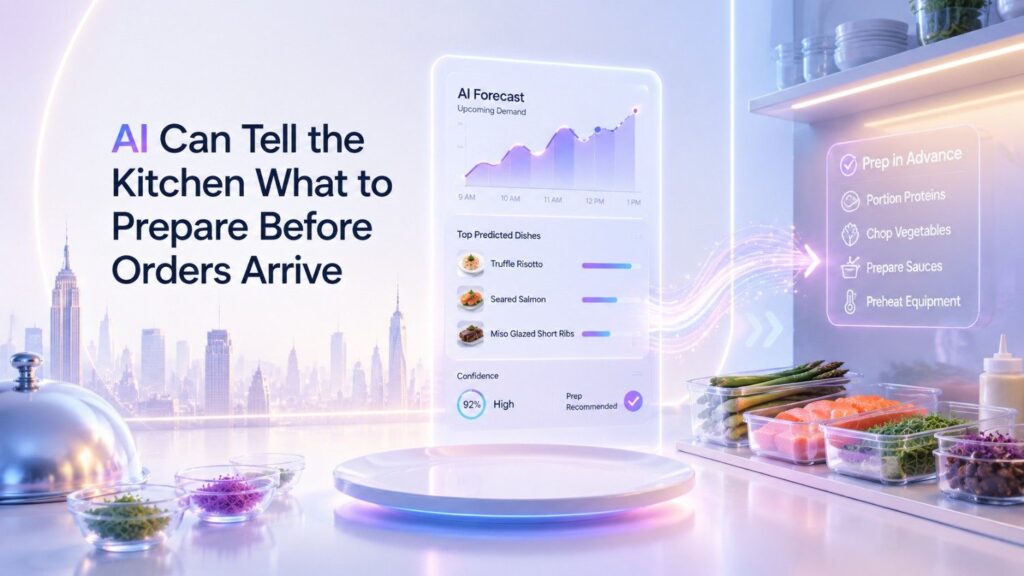
Demand forecasting helps restaurants make those decisions earlier and with better information.
AI systems can combine historical sales, weekdays, weather, seasons, events, recent demand, and menu mix to estimate what the kitchen should prepare.
The restaurant already owns much of the data required.
It sits inside the POS, ordering system, inventory platform, and reservation system.
AI simply makes that data more useful for tomorrow’s decisions.
The Best AI Forecast Should Be Easy to Act On
Restaurant operators should avoid a common technology mistake.
A sophisticated forecast is not valuable if nobody can understand or use it during service.
Managers do not need another complicated dashboard filled with charts that require 20 minutes of interpretation.
The most useful output may be extremely simple.
A kitchen manager might receive a recommendation to prepare 80 portions instead of 105.
A general manager might receive a warning that delivery demand is expected to be unusually high between 6 p.m. and 8 p.m.
A purchasing manager might be told that one fewer case should be ordered this week.
The calculation behind that recommendation may involve thousands of data points.
The action itself should remain easy to understand.
That is where restaurant AI becomes useful rather than impressive.
AI Is Turning Restaurant Guest Data Into Institutional Memory
Hospitality has always depended on memory.
A great host remembers a regular customer’s preferred table. A bartender remembers a favorite drink. A server knows that one guest has an allergy. A manager recognizes a couple who returns every year for an anniversary.
The difficulty is that human memory does not scale easily across multiple shifts or locations.
Customer relationship software solved part of this problem by creating digital guest profiles.
AI can make those profiles far more useful.
SevenRooms, a New York restaurant technology company, has introduced AI features that help restaurants summarize customer feedback, improve guest notes, and respond to reviews.
The real value is not simply generating text faster.
A restaurant group may receive thousands of reviews, reservation notes, customer messages, and feedback entries.
No executive can read all of them carefully.
AI can identify patterns inside that information.
Perhaps complaints about waiting times are increasing at one location. Maybe several guests mention that a room feels too noisy. Perhaps one employee repeatedly receives positive comments. Maybe frequent customers have suddenly stopped returning.
AI can compress all of that information into a smaller number of patterns that managers can investigate.
That is far more useful than another pile of reports.
Restaurant Marketing Is Becoming More Selective
AI may also improve restaurant marketing by helping operators decide when not to send promotions.
Traditional restaurant marketing often follows a simple process.
The restaurant collects email addresses, sends a large campaign, offers a discount, and hopes customers return.
That approach treats every customer almost the same.
AI can make segmentation more precise.
A high-value guest who already visits every two weeks should not receive the same offer as a first-time visitor who never came back.
A lunch customer should not necessarily receive the same campaign as someone who usually books dinner.
A delivery-only customer may respond differently from a dine-in regular.
The important opportunity is not generating more marketing messages.
It is reducing irrelevant marketing.
Discounting customers who would have returned anyway destroys margin.
Sending constant offers can also make the restaurant feel cheap or repetitive.
Good AI should help restaurants communicate less often and with more relevance.
AI Can Reduce Friction Between Delivery Drivers and Kitchens
Delivery created another operational challenge for restaurants because orders can now arrive from several different channels at the same time.
A restaurant may receive orders from its own website, multiple delivery marketplaces, catering systems, telephone orders, and walk-in customers.
Each channel can have different economics and different timing expectations.
Technology companies have already built systems that aggregate and route these orders.
The next step is making fulfillment more intelligent.
If software can predict when an order will actually be ready and also estimate when a delivery driver will arrive, the two processes can be coordinated more closely.
The goal is simple.
The driver should arrive when the food is ready.
When drivers arrive too early, they crowd the restaurant and spend time waiting.
When they arrive too late, food sits and loses quality.
Better coordination improves several outcomes at once, including food temperature, customer satisfaction, kitchen flow, employee workload, and delivery efficiency.
The Restaurant Technology Stack Is Starting to Converge
For years, restaurants solved operational problems by buying another piece of software.
One platform handled POS.
Another managed reservations.
Another handled delivery.
Another tracked loyalty.
Another handled scheduling.
Another managed inventory.
Another supported marketing.
Another helped with accounting.
The result was often a restaurant with many systems that each understood only one small part of the business.
AI makes this fragmentation more painful.
An AI system is only as useful as the information it can access.
A labor forecast becomes stronger when it can see expected sales.
A sales forecast becomes stronger when it knows reservations, weather, and previous demand.
A preparation forecast becomes stronger when it understands expected menu mix.
A marketing system becomes stronger when it understands visits, purchases, reservations, and customer history.
The competitive battle in restaurant technology is therefore moving toward the data layer.
The most powerful platforms will be the ones that can connect information from different parts of the restaurant and turn it into clear decisions.
This helps explain why companies that originally focused on a single restaurant function are expanding into broader operating platforms.
The larger opportunity is not owning one feature.
It is becoming the place where restaurant decisions happen.
What an Automated Restaurant Will Actually Look Like
The automated restaurant of the future will probably look surprisingly normal to the customer.
There may be no robot walking through the dining room and no machine replacing the chef.
Most automation will happen behind the scenes.
A customer might begin by asking an AI assistant where to eat.
The restaurant appears because its menu, location, opening hours, reviews, and reservation data are accurate and easy for machines to understand.
The guest makes a reservation.
The restaurant’s customer system recognizes that this person has visited before and knows that a dietary preference has been recorded.
Demand forecasting software sees that reservations are unusually strong and that a nearby concert is likely to increase walk-in traffic.
The kitchen receives a higher preparation recommendation.
The manager receives staffing guidance.
The online ordering system automatically adjusts expected pickup times as demand increases.
Voice AI answers routine phone questions so the host can focus on people arriving at the door.
Delivery software coordinates driver arrival with kitchen timing.
After service, AI summarizes reviews, customer feedback, order delays, and unusual operating problems.
The next morning, managers receive a short list of issues worth investigating.
That restaurant would be heavily automated even though the customer might never see a robot.
A Practical Automation Maturity Model for NYC Restaurants
Restaurants should not try to automate every process at once.
The more sensible approach is to move through clear stages.
| Stage | How the restaurant operates | Strong opportunities |
| 1. Digitized | Transactions are captured digitally | POS, ordering, reservations |
| 2. Connected | Systems exchange useful information | Delivery aggregation, CRM, integrations |
| 3. Predictive | Software estimates future demand | Sales, prep, labor, inventory forecasting |
| 4. Assisted | AI recommends actions | Guest targeting, menu analysis, staffing guidance |
| 5. Automated | Approved actions happen automatically | Phone reservations, review replies, routing |
| 6. Adaptive | Systems continuously coordinate | Demand, labor, prep, ordering and marketing |
Many independent restaurants do not need to move immediately to the highest level.
A restaurant with poor data, disconnected ordering tablets, and unreliable menu information will usually create more value by fixing basic integration first.
AI becomes more powerful after the restaurant’s digital foundation is organized.
Automation cannot compensate for bad data indefinitely.
Different Restaurant Formats Should Automate Different Problems
The best first AI project depends heavily on the type of restaurant.
| Restaurant format | Good first AI use cases |
| Full-service restaurant | Phone automation, reservations, guest CRM, review analysis |
| Fast casual | Demand forecasting, ordering, labor planning |
| Pizza restaurant | Prep forecasting, delivery timing, ingredient planning |
| Cafe | Daypart forecasting, staffing, inventory, loyalty |
| Fine dining | Guest intelligence, reservation management, personalization |
| Delivery-heavy restaurant | Order aggregation, prep-time prediction, dispatch |
| Multi-location group | Central forecasting, marketing, reporting |
| High-volume QSR | Ordering automation, throughput analysis, labor forecasting |
A fine-dining restaurant and a delivery-focused pizza shop should not have identical AI strategies.
The technology should follow the operating problem.
Operators should therefore avoid buying AI simply because the product sounds modern.
The better approach is to identify a measurable business problem first and then choose the technology that addresses it.
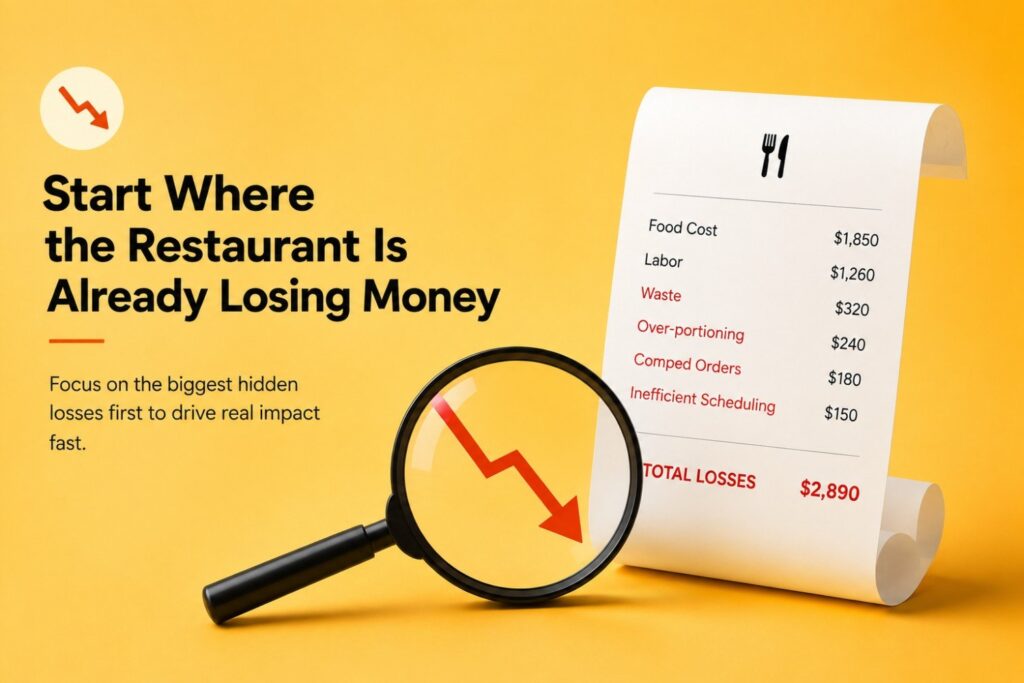
Start Where the Restaurant Is Already Losing Money
The strongest automation opportunity is usually attached to an existing operational leak.
Restaurants should look closely at unanswered phone calls, refunds, excessive prep, food waste, overtime, delivery-driver waiting, abandoned digital orders, repetitive administrative work, stockouts, inaccurate schedules, and marketing discounts that do not produce incremental sales.
Once a problem is identified, the restaurant should calculate what that problem costs.
If missed calls are the issue, estimate how many calls are lost and how many might have become reservations.
If food waste is the issue, measure the monthly dollar value of discarded ingredients.
If labor planning is weak, measure overtime, early clock-outs, understaffed periods, and sales per labor hour.
This creates a rational starting point.
The restaurant is no longer asking whether it should “use AI.”
It is asking whether a specific technology can fix a problem that currently costs a measurable amount of money.
A Practical 90-Day AI Plan for a New York Restaurant
Restaurants do not need a long digital transformation program to begin using AI responsibly.
They need a focused experiment.
Days 1-30: Measure the Current Process
The first month should establish a baseline.
If the restaurant wants to test phone AI, it should count total calls, missed calls, reservation calls, basic information requests, and the amount of staff time spent answering.
If the goal is better kitchen forecasting, the operator should track food waste, stockouts, prep variance, and manager forecasting time.
If staffing is the target, the restaurant should record sales per labor hour, overtime, schedule changes, service delays, and periods of understaffing.
The point is to understand the current performance before software changes anything.
Without a baseline, nearly any new technology can appear successful.
Days 31-60: Automate One Narrow Workflow
The second stage should focus on one clearly defined process.
A full-service restaurant might automate after-hours reservation calls.
A pizza business might test dough forecasting.
A restaurant group might use AI to summarize reviews across several locations.
A fast-casual operator might test better order-ready estimates.
Keeping the experiment narrow makes it easier to understand whether the technology actually produced value.
Human review should remain in place when AI affects sensitive areas such as allergies, food safety, employment decisions, or pricing.
Days 61-90: Compare Results With the Baseline
After enough operating data has been collected, the restaurant can compare the test period with the original baseline.
The evaluation should focus on business outcomes.
Did more phone calls get answered?
Did managers save time?
Did food waste fall?
Did forecast accuracy improve?
Did online conversion increase?
Did overtime decrease?
Did customer complaints rise or fall?
Did employees frequently override the AI recommendation?
If the improvement is measurable and consistent, the restaurant can expand the system.
If the results are weak, the operator should stop or redesign the experiment.
AI pilots should be allowed to fail without becoming expensive long-term commitments.
The Restaurant AI Scorecard Should Stay Simple
AI performance should be measured using a small number of operating metrics rather than a large dashboard that nobody checks.
| Area | Metric | What it reveals |
| Ordering | Digital conversion rate | Whether browsing becomes revenue |
| Phone | Answered-call rate | Whether demand is being captured |
| Reservations | Booking conversion | Whether inquiries become bookings |
| Kitchen | Prep forecast error | How accurate forecasting is |
| Waste | Waste as % of purchases | Whether prep decisions are improving |
| Labor | Sales per labor hour | Whether staffing is productive |
| Service | Ticket time | Whether throughput is improving |
| Delivery | Driver wait time | Whether kitchen and delivery timing match |
| Guest | Repeat visit rate | Whether loyalty is improving |
| Marketing | Incremental revenue per campaign | Whether promotions create new revenue |
| AI | Human override rate | Whether recommendations are actually trusted |
The final measure is particularly useful.
If managers constantly correct an AI system, the software is not really reducing work.
It may simply be creating another thing employees have to manage.
Four Areas Where Restaurants Need Strong AI Guardrails
Restaurant AI can create value quickly, but not every decision should be automated in the same way.
Allergies and Food Safety Cannot Depend on Guessing
Generative AI should never invent information about allergens, ingredients, or food safety.
Customer answers should come from verified restaurant information.
If the AI does not know whether a dish contains a specific ingredient, it should escalate the question to an employee rather than generating a likely-sounding response.
A restaurant can tolerate an imperfect marketing sentence.
It cannot safely tolerate invented allergy information.
Pricing Requires Transparency
Restaurant operators should clearly define what data pricing systems are allowed to use.
Menu prices, promotions, customer segmentation, and individualized offers should not become a hidden experiment that customers would find unfair if they understood how it worked.
Legal compliance matters, but customer trust matters as well.
A pricing strategy can be mathematically clever and still damage the brand.
Staffing AI Cannot Override Worker Rights
Demand forecasting can help managers create better schedules, but employment rules still apply.
AI should inform the manager rather than become an excuse for ignoring local labor requirements.
Human review remains especially important when software influences schedules, hiring, disciplinary decisions, or other employment actions.
Guest Data Should Improve Hospitality, Not Become Surveillance
Restaurants increasingly know a great deal about customers.
Used carefully, that information can make service better.
Used aggressively, it can feel invasive.
Remembering that a regular customer prefers a quiet table is hospitality.
Building a hidden profile that uses every available personal signal to manipulate pricing or behavior is something very different.
Restaurants should decide where that line sits before software makes the decision for them.
The Real Goal Is Not a Restaurant With Fewer People
Restaurant AI is frequently described as a labor replacement technology, but that framing misses much of its potential.
Some repetitive tasks will clearly require fewer employee hours.
Phone answering, report creation, review analysis, and routine administrative work are obvious examples.
The more interesting outcome is what happens to the time that is saved.
A customer does not care that software reconciled three ordering channels automatically.
The customer cares that an employee is available when help is needed.
A diner does not care that an algorithm built tomorrow’s prep forecast.
The diner cares that the desired menu item is available and properly prepared.
A guest does not care that AI analyzed their previous visits.
The guest cares that the restaurant remembers something useful and makes the experience feel more personal.
This creates an important paradox.
The more invisible work software can manage, the more human attention restaurants can potentially direct toward hospitality.
Original Finding #4: Small Gains Become Large Across New York
The size of New York’s restaurant economy means that even tiny improvements become significant when viewed citywide.
Using approximately $28.54 billion in annual taxable restaurant sales as the base, relatively small percentages represent large dollar amounts.
| Percentage of citywide restaurant sales | Dollar equivalent |
| 0.1% | $28.5 million |
| 0.25% | $71.4 million |
| 0.5% | $142.7 million |
| 1.0% | $285.4 million |
These figures are not forecasts of how much money AI will create.
They simply demonstrate the scale of the operating environment.
A technology does not need to transform every restaurant transaction to create substantial economic value.
Minor gains in food waste, conversion, labor productivity, order timing, or retention can matter when those gains are repeated across thousands of establishments and millions of customer interactions.
That is one reason New York is such an important restaurant AI market.
The city combines enormous transaction volume with unusually expensive mistakes.
The Biggest AI Opportunity May Be Better Management Decisions
The most important restaurant AI opportunity may eventually have little to do with robots, automated ordering, or flashy customer experiences.
It may be management decision-making.
Restaurant managers make a constant stream of decisions.
They need to know how many people should work, how much food should be prepared, whether another large order can be accepted, why labor costs rose, which menu item is losing money, whether a promotion is working, which customers are becoming less active, how much inventory should be ordered, and whether pickup times should be increased.
Historically, these decisions have depended heavily on experience, spreadsheets, reports, and intuition.
Experience will remain important because restaurants are complicated human businesses.
AI can improve the information available before the manager makes the decision.
The strongest future systems may function like operating assistants.
They will know what happened yesterday, understand what is happening today, predict what may happen tomorrow, and show the manager a short list of actions worth considering.
That is much more powerful than simply creating another analytics dashboard.
New York Has the Ingredients to Become a Restaurant AI Hub
New York already has a strong restaurant technology ecosystem.
Olo has expanded from online ordering into a much broader restaurant commerce, customer data, payments, delivery, and AI platform.
SevenRooms has grown from reservations and guest management into a wider hospitality operating system that increasingly uses AI.
Slang AI is building restaurant-specific voice automation from New York.
Lunchbox has also developed ordering, loyalty, catering, CRM, and restaurant commerce tools for major food brands.
There is a strategic reason these companies can grow from New York.
The city provides an unusually diverse customer base.
Within a relatively small geographic area, restaurant technology companies can work with independent cafes, neighborhood restaurants, fast-casual concepts, pizza shops, fine-dining operators, delivery-heavy businesses, bars, and large hospitality groups.
New York also creates demanding operating conditions.
High wages make inefficiency expensive.
Large order volumes reveal software weaknesses quickly.
Customers expect speed and convenience.
Complex employment rules make compliance important.
Intense competition makes customer retention difficult.
Technology that can survive these conditions may be well suited to other major restaurant markets.
The Bigger Story: Restaurants Are Becoming Software-Managed Systems
Restaurant technology used to digitize individual jobs.
AI is beginning to connect those jobs.
Reservations can influence demand forecasts.
Demand forecasts can influence food preparation.
Sales forecasts can influence staffing.
Staffing levels can influence throughput.
Throughput can influence pickup-time predictions.
Pickup-time predictions can influence delivery-driver dispatch.
Transactions can update customer profiles.
Customer behavior can influence marketing.
Reviews and feedback can change operating priorities.
As these systems become more connected, the restaurant starts to behave less like a collection of separate tools and more like one coordinated operating network.
That is the real meaning of the automated restaurant.
It does not require removing chefs, bartenders, servers, or hosts.
It means information can move through the business without managers manually copying numbers between systems.
It means software can detect patterns that would otherwise take employees hours to find.
It means repetitive decisions can happen automatically while unusual or sensitive decisions remain with people.
Most importantly, it means human attention can become more valuable because less of that attention is consumed by repetitive administrative work.
What New York Restaurant Operators Should Do Now
Restaurant operators should resist the temptation to automate everything at once.
The strongest strategy begins with one operating problem that can be clearly measured.
For a busy Manhattan restaurant, that might be unanswered reservation calls.
For a growing Brooklyn restaurant group, it might be demand forecasting across several locations.
For a Queens delivery business, it may be better coordination between order preparation and drivers.
For a fast-food operator, it could be creating more accurate labor forecasts while staying compliant with local scheduling laws.
For a fine-dining restaurant, it may be using guest information more intelligently.
For a neighborhood cafe, it might be predicting daily production more accurately so fewer products are discarded at closing.
The process should stay simple.
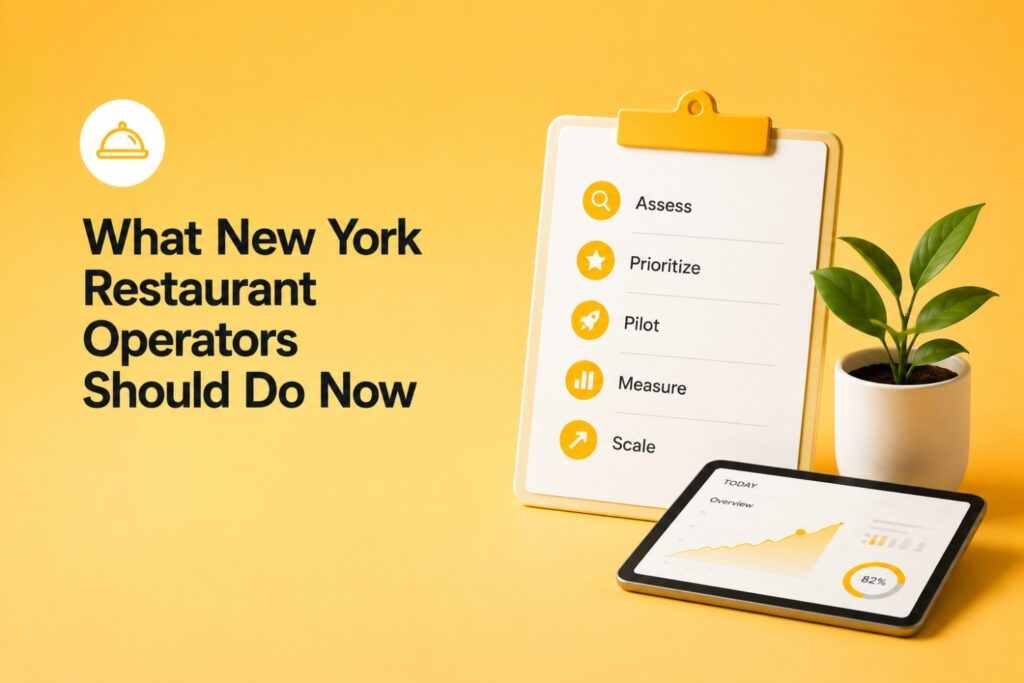
Find the leak, calculate what it costs, test one system, measure the results, and expand only when the economics are clear.
That approach is far more reliable than buying an AI product first and searching for a reason to use it afterward.
Conclusion: AI Will Change How New York Restaurants Are Run
The restaurant of the future will still need excellent food, strong service, careful management, good locations, disciplined operations, and customers who want to return.
AI does not remove any of those requirements.
What it can change is the operating system underneath them.
New York restaurants are already using intelligent software for ordering, demand forecasting, phone calls, customer data, delivery coordination, staffing, marketing, and pricing analysis. As those systems become more connected, restaurants will increasingly be able to predict what should be prepared, how busy a shift may become, when an order will be ready, which customers are becoming less active, and where employee time is being wasted.
The most successful operators will not necessarily be the restaurants using the greatest number of AI tools.
They will be the ones that understand where automation creates real value and where human judgment still matters most.
That is the real promise of the automated restaurant.
It is not hospitality without people. It is a restaurant where software handles more of the repetitive work so people can spend more time doing the work customers actually notice.