
Insurance has used software for decades. Yet much of the actual work inside an insurance company still depends on people reading documents, moving information between systems, checking rules, reviewing claims, asking for missing data, and deciding what should happen next.
AI agents are starting to change that operating model.
The important change is not that insurance companies can now use a chatbot. It is that AI systems are beginning to complete parts of an insurance workflow. They can open a submission, read dozens of documents, extract risk details, compare those details with underwriting rules, recommend the next action, update another system, route a claim, check coverage, summarize medical records, or prepare a case for human approval.
New York is becoming one of the best places to watch this shift.
AIG is using AI in underwriting and claims from its New York headquarters. Lemonade has already automated large parts of policy sales and claims handling. New York companies such as Sixfold and Kalepa are building AI around underwriting, while EvolutionIQ and Five Sigma are pushing deeper into claims. Bevaya, CoverGo, Neutrinos and a new group of smaller companies are trying to connect several steps into agent-driven workflows rather than selling one isolated AI feature.
There is also another reason New York matters. The state has one of the clearest insurance-specific approaches to AI oversight in the country. New York State Department of Financial Services Insurance Circular Letter No. 7 sets expectations around AI used in underwriting and pricing, including governance, discrimination testing, documentation, management oversight and responsibility for third-party vendors.
That combination makes New York unusually useful as a test market.
Companies can build advanced insurance AI here. Large carriers can deploy it here. Regulators are already asking how it is controlled. And there is enough public information to begin measuring where the market is actually moving.
This article does exactly that.
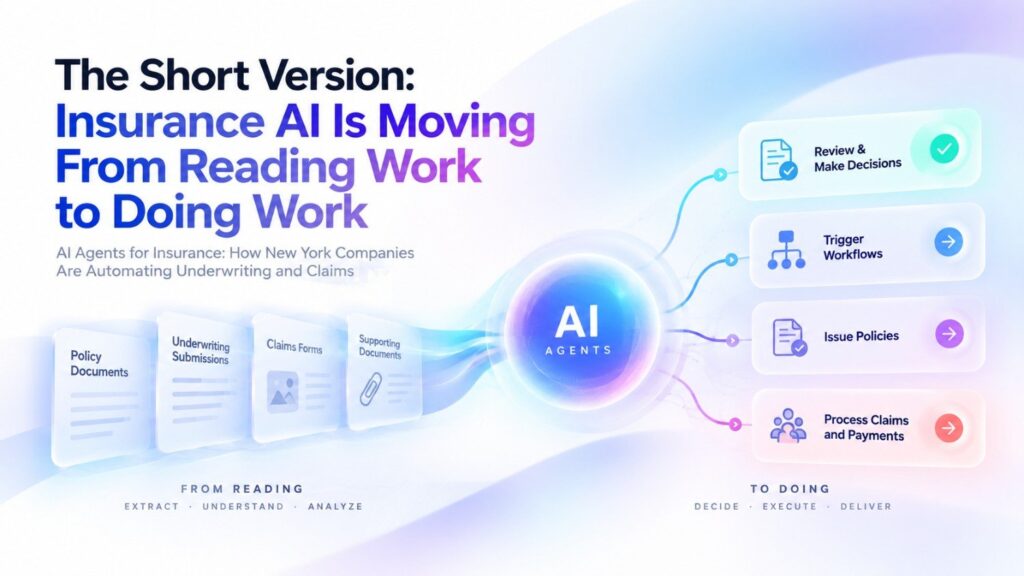
The Short Version: Insurance AI Is Moving From Reading Work to Doing Work
The first generation of insurance AI mostly helped people find information.
A system might summarize a submission, predict whether a claim looked unusual, extract fields from a PDF, or suggest which application deserved attention. That was valuable, but a person still had to move the workflow forward.
Agentic AI changes the question.
Instead of asking, “What does this document say?” the system can increasingly be asked, “What needs to happen next?”
That difference sounds small. Operationally, it is enormous.
Sixfold’s current property and casualty product, for example, describes an AI Underwriter that can extract submission data, bring in outside research, compare a risk with carrier appetite, recommend the next action and, where authority has been granted, take actions itself. The underwriter remains accountable for the final decision.
Five Sigma takes a similar idea into claims. Its Clive platform separates claims work into specialized agents for intake, triage, coverage, liability, documents, planning, communications, fraud and other tasks. Some agents recommend actions, while other workflow functions can execute routine steps.
AIG is building an orchestration layer designed to determine when agents should activate, which information they can access, how tasks should be sequenced and where people need to intervene. Its 2025 annual report makes an important point: the company is not treating AI as another interface sitting on top of insurance. It is rebuilding parts of underwriting and claims around it.
This is the real shift.
Insurance AI is moving from information retrieval to workflow participation, and from workflow participation toward controlled execution.
The word “controlled” is important.
Underwriting involves committing capital to risk. Claims may involve determining coverage and paying money. An agent that summarizes a file is very different from an agent allowed to bind a policy or settle a claim.
That is why the companies that succeed will not simply have the smartest model.
They will have the best control system around the model.
NYC Tech Journal Original Research: Mapping the Insurance AI Workflow in New York
To understand how far this market has actually moved, NYC Tech Journal analyzed public information from ten insurance companies and insurance technology providers with headquarters, offices or a documented operating presence in New York.
The sample included AIG, Lemonade, Kalepa, Sixfold, Bevaya, CoverGo, Five Sigma, EvolutionIQ, Hesper AI and Neutrinos.
This is not meant to rank the companies. It answers a different question:
Which parts of underwriting and claims already have public evidence of AI-enabled execution or decision support?
Our Methodology
We divided underwriting and claims into ten operating stages.
For underwriting, we examined submission intake, risk analysis, underwriting decision support and execution such as quoting or binding.
For claims, we examined intake, document analysis, triage, claim decision support, next-best-action guidance and workflow execution.
Each company received one point for a stage only when current public material clearly described that capability. We did not give credit because a feature seemed technically possible. We also avoided counting general statements such as “AI-powered platform” unless a specific workflow could be identified.
That produced 100 company-workflow observations: ten companies across ten workflow stages.
A zero therefore does not mean the company lacks the capability. It means we did not find enough public evidence to count it under this conservative method.
Chart 1: Public Evidence of AI Across the Insurance Workflow
| Workflow stage | Companies with public evidence | Share of 10-company sample |
| Underwriting intake | 7 | 70% |
| Underwriting risk analysis | 7 | 70% |
| Underwriting decision support | 7 | 70% |
| Underwriting execution | 4 | 40% |
| Claims intake | 5 | 50% |
| Claims document/evidence analysis | 7 | 70% |
| Claims triage | 6 | 60% |
| Claims decision support | 7 | 70% |
| Claims next-best-action | 5 | 50% |
| Claims execution | 2 | 20% |
Visual view
Underwriting intake ███████░░░ 70%
Risk analysis ███████░░░ 70%
UW decision support ███████░░░ 70%
UW execution ████░░░░░░ 40%
Claims intake █████░░░░░ 50%
Claims analysis ███████░░░ 70%
Claims triage ██████░░░░ 60%
Claims decision support ███████░░░ 70%
Claims next action █████░░░░░ 50%
Claims execution ██░░░░░░░░ 20%
Sources used in the coding included company product pages, public filings and deployment announcements from AIG, Lemonade, Sixfold, Kalepa, Bevaya, CoverGo, Five Sigma, EvolutionIQ, Hesper AI and Neutrinos.
Finding #1: Analysis Is Becoming Common. Execution Is Still the Bottleneck
The strongest result is not where AI exists.
It is where AI stops.
Seventy percent of our sample showed public evidence of AI being used to analyze underwriting risk. Seventy percent also showed claims-analysis capability.
But only 40% showed evidence covering underwriting execution, while only 20% reached our conservative threshold for claims execution.
Across the seven stages we classified mainly as intake, analysis or decision support, average public workflow coverage was about 66%. Across the two clearest execution stages, underwriting execution and claims execution, average coverage fell to 30%.
That is a 36-percentage-point gap.
This tells insurance leaders something important.
The next competitive fight is unlikely to be about whether AI can read an insurance document. That problem is rapidly becoming standard.
The difficult part is allowing the system to safely act.
Finding #2: Underwriting Agents Are Slightly Further Along Than Claims Agents
Average workflow coverage across the four underwriting stages was 62.5%.
Across the six claims stages, it was about 53.3%.
The gap is not enormous, but the reason matters.
Underwriting can often be broken into a cleaner sequence: receive submission, extract information, assess appetite, analyze risk, request missing information, recommend a decision and prepare the quote.
Claims develop over time.
New evidence arrives. Medical records change. Lawyers become involved. Coverage can be disputed. Fraud indicators may appear. Reserve assumptions change. Communications with policyholders, vendors and experts become part of the file.
Claims therefore require agents to maintain state over a longer period.
That makes claims one of the most valuable agentic opportunities in insurance, but also one of the hardest.
New York Already Has the Ecosystem to Build This Market
The agentic insurance trend is not happening in a small technology niche.
InsurTech NY’s July 2026 startup map tracks 142 insurance technology companies, of which 124 have NYC executives, with $7.8 billion in reported capital raised across the map.
NYC Tech Journal calculates that 124 out of 142 equals about 87.3%.
That percentage matters more than it may first appear.
Capital can come from anywhere. Software engineers can work remotely. But enterprise insurance is still a relationship-heavy market where product teams need direct access to underwriters, claims leaders, brokers, compliance teams and executives.
Having decision-makers physically concentrated in New York helps shorten that learning loop.
At the same time, DFS reported that its Insurance Division supervised 1,962 companies in its 2024 annual report. That gives insurance AI companies operating in New York access to a market that is technologically active but also closely supervised.
New York therefore has both sides of the equation: companies trying to move faster and regulators asking them to prove that speed does not create unfair outcomes.
What an AI Insurance Agent Actually Does
It helps to remove some of the hype around the word “agent.”
An AI agent does not need to run an entire insurance company by itself.
In practical insurance operations, an agent can be a system given a specific goal, access to approved information, a set of permitted actions and a rule for when human approval is required.
A Traditional AI Tool Gives You an Answer
Imagine an underwriter receives an 80-page commercial submission.
A traditional document AI system could extract revenue, address, industry, loss history and coverage information.
That is useful.
But the underwriter still decides which systems to open next, which checks to perform, what information is missing and what to send to the broker.
An Agent Works the Case
An underwriting agent can take the same submission and continue.
It can identify missing information, review underwriting rules, research an exposure, compare the opportunity with appetite, prepare a recommendation, create a broker follow-up and update the underwriting workbench.
Sixfold describes this movement directly. Its AI Underwriter evaluates submission data alongside broker history, carrier appetite and portfolio context, then recommends the next action.
Kalepa is pursuing a similar model for commercial and specialty insurance. Its public material describes agentic AI across submission intake, document ingestion, exposure analysis, pricing guidance and portfolio steering.
The difference is workflow continuity.
A useful agent does not simply answer another question every time someone prompts it.
It remembers where the work is, understands what has already happened and helps move the case toward a defined outcome.
Underwriting Is Becoming an Exception-Management System
For years, insurance leaders have talked about making underwriters more productive.
Agentic AI may finally force companies to define what that actually means.
The wrong objective is to make an underwriter click through the same process 30% faster.
The better objective is to decide which parts of the process require an underwriter at all.
Submission Intake Should Become Mostly Machine Work
Commercial submissions often arrive as emails, spreadsheets, PDFs, loss runs, schedules and attachments.
There is little strategic value in paying an experienced underwriter to re-enter information already sitting inside those files.
That is why submission intake appears so frequently across the New York companies we analyzed.
Sixfold extracts information from complex documents such as schedules of values and loss runs. Kalepa describes automation around submission intake and document ingestion. CoverGo’s intelligent document processing agent turns unstructured insurance material into structured data used by underwriting and claims workflows.
This should be the first automation layer for many carriers.
The business case is relatively simple, the action is easy to measure and the human remains available for exceptions.
Appetite Matching Is More Valuable Than Summarization
The second step is more interesting.
Knowing what a submission says is not enough. The insurer needs to know whether it wants the risk.
That means comparing the submission with appetite, underwriting manuals, previous decisions, portfolio concentration and sometimes external data.
Sixfold explicitly combines submission information with carrier appetite and portfolio fit. Kalepa positions its platform around risk selection, triage and portfolio decisions rather than document summarization alone.
This is where AI begins affecting economics instead of only administrative cost.
A carrier does not create most of its underwriting value by reading files faster.
It creates value by selecting better risk and allocating underwriting capacity toward opportunities worth pursuing.
AIG Shows What Enterprise-Scale Agentic Underwriting Could Look Like
AIG gives the market one of the strongest public examples because it has published operating data rather than only describing a pilot.
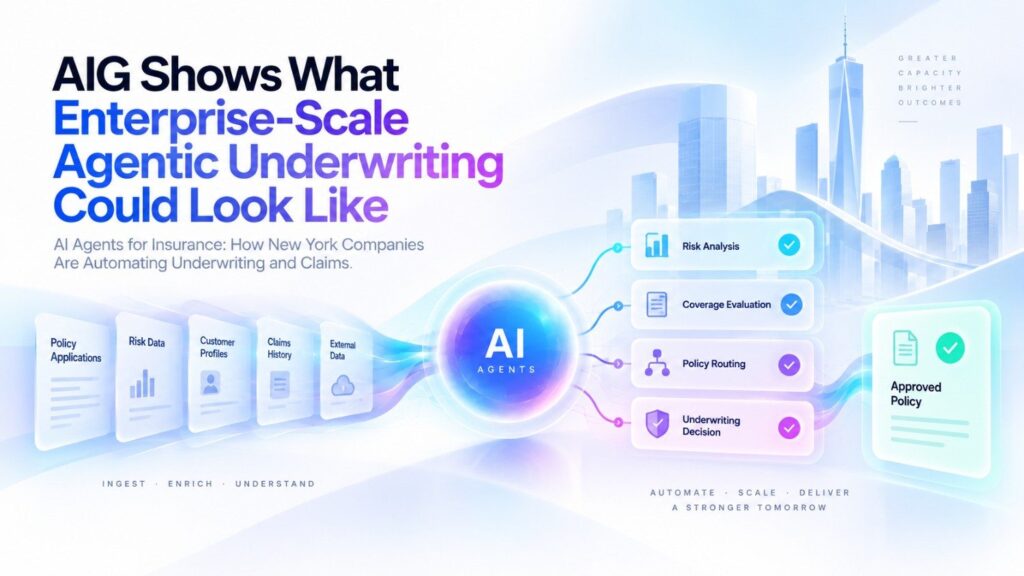
The company said in its 2025 annual report that it scaled Underwriting by AIG Assist during the year and was building AI infrastructure across underwriting and claims. AIG also described plans for an orchestration layer controlling when agents operate, what they can access, how work is sequenced and where humans remain involved.
Chart 2: AIG’s Lexington New-Business Submission Growth
| Year | New-business submissions |
| 2018 | 30,000 |
| 2024 | 300,000 |
| 2025 | 370,000+ |
| 2030 target | 500,000 |
2018 30K █
2024 300K ██████████████████
2025 370K+ ██████████████████████
2030 goal 500K ██████████████████████████████
AIG reports that Lexington exceeded 370,000 submissions in 2025 and that its submit-to-bind ratio improved 35% after the rollout of Underwriting by AIG Assist in Lexington Middle Market Property. The company has set an ambition of reaching 500,000 submissions by 2030.
Our calculation adds another useful perspective.
Moving from roughly 30,000 submissions in 2018 to at least 370,000 in 2025 represents more than a 12-fold increase. Using the rounded numbers published by AIG, that is equivalent to about 43% compound annual growth across seven years.
AI did not cause that entire increase, and AIG does not claim that it did. The important point is that the company is deploying AI inside an underwriting operation that is already handling vastly greater submission volume.
That is the enterprise use case.
The goal is not merely reducing the time needed for one submission.
It is creating an underwriting architecture capable of handling a much larger opportunity set without expanding manual work at the same rate.
Sixfold Is Turning the Underwriting Assistant Into an AI Underwriter
Sixfold is one of the clearest examples of the shift from copilots to agents.
The company is based in New York and says its technology has processed more than 1.5 million submissions across more than 50 business lines. Its current website reports average adoption rates of 90% or higher among users.
Its newer AI Underwriter goes beyond summarization.
For property and casualty insurance, the product can extract submission data, retrieve outside information, evaluate carrier appetite, consider portfolio context and recommend the next action. Sixfold says it can also take an action when the carrier has granted it authority, while the human underwriter remains accountable for the underwriting decision.
That last point is likely to become a standard insurance design pattern.
The AI receives operating authority.
The human retains decision accountability.
Those two concepts should not be confused.
The Better Model Is Delegated Authority, Not Unlimited Autonomy
Insurance companies already understand delegated authority.
People have underwriting limits. Junior underwriters escalate certain cases. MGAs operate within agreed rules. Claims professionals have settlement authority.
AI can be designed the same way.
Instead of asking whether an insurer should allow “autonomous AI,” the useful question becomes:
Exactly what authority can this agent exercise under exactly what conditions?
That makes deployment far easier to govern.
Kalepa Is Building Around Commercial Underwriting Economics
Kalepa, headquartered in New York, approaches the market from another useful angle.
Its platform focuses on commercial and specialty underwriting and describes AI supporting submission intake, exposure analysis, pricing guidance, risk selection and portfolio steering.
That matters because commercial underwriting is not simply a document-processing problem.
The insurer is trying to decide where it can earn attractive returns.
An agent that only reduces reading time creates an expense advantage. An agent that helps an insurer identify attractive submissions sooner may create a growth advantage as well.
Kalepa’s public material around its Church Mutual deployment, for example, makes a deliberate distinction between operational work such as submission intake and higher-judgment activities such as risk selection and portfolio decisions. The AI handles work that can be performed consistently at scale while people remain responsible for judgment where it matters most.
That division of labor is probably more realistic than the idea of removing underwriters.
Lemonade Shows How Deep Automation Can Go
Lemonade provides a useful comparison because it was designed around digital insurance rather than adding AI to an older operating model.
Its 2025 Form 10-K says AI Maya and its APIs sell 98% of policies. The company also reports that AI Jim takes the first notice of loss without human intervention 96% of the time and that roughly 55% of claims were automated from start to finish as of December 31, 2025.
Lemonade’s corporate headquarters remains in New York City.
Chart 3: Lemonade’s Public Automation Funnel
Policies sold by AI/API 98% ████████████████████
FNOL taken by AI Jim 96% ███████████████████
Claims automated end-to-end 55% ███████████
This creates one of the most revealing data points in the article.
The difference between AI handling first notice of loss and claims being automated from beginning to end is 41 percentage points.
In other words, Lemonade can automate the beginning of a claim at very high rates, but complete claim resolution remains much harder.
That matches our broader 10-company analysis.
Intake is becoming easier.
Execution is the hard part.
The 55% Number May Be More Important Than the 96% Number
A 96% automated intake rate makes a good headline.
The 55% end-to-end figure tells operations leaders more.
It shows that there is a large middle section of claims work where complexity requires additional decisions, information, controls or human judgment.
This is exactly where the next generation of insurance agents will compete.
Claims May Become the Bigger Agentic AI Market
Underwriting receives much of the attention because pricing and risk selection sit close to insurance economics.
Claims, however, contain enormous amounts of repetitive coordination.
An adjuster may need to read incoming documents, review coverage, request information, check medical records, update notes, decide priority, contact specialists, monitor deadlines and determine what should happen next.
That work creates a natural multi-agent environment.
Five Sigma Is Breaking the Claim Into Specialized Agents
Five Sigma’s Clive illustrates what that architecture can look like.
Its publicly described agents cover intake, triage, coverage, liability, document handling, planning, communications, risk and fraud signals, compliance and portfolio analysis. The platform can sit above an existing claims management system rather than requiring every insurer to replace its core technology first.
Its Intake agent can turn unstructured information into a structured FNOL. Its Coverage agent can compare an incident with policy information. Its Planning agent can generate and update a claim plan, while its Risk agent can identify suspicious inconsistencies.
Five Sigma announced in January 2026 that Starr selected its claims platform and Clive for specialty and P&C claims transformation. In July 2026, New York-based real estate company L+M Development Partners went live with the platform for self-insured claims involving areas such as general liability, construction liability and workers’ compensation.
This is a useful sign of where the market is heading.
Agentic insurance software is moving outside clean personal-lines claims and into messier commercial cases.
EvolutionIQ Shows Why “Next Best Action” Matters
EvolutionIQ built its business around a different claims problem.
Instead of trying to settle every claim automatically, it helps claims teams identify which files need attention and what action may create the greatest impact.
The company has its New York office at 250 Hudson Street and describes its focus as AI-powered claims guidance. Its public site reports millions of claims guided and more than 30 deployments.
EvolutionIQ’s Medical Summarization product turns complex medical information into structured claims insight. Its claims guidance technology uses AI to surface high-impact claims and recommend next actions.
CCC Intelligent Solutions completed its acquisition of EvolutionIQ in January 2025. CCC said the acquisition added capabilities including medical summarization and next-best-action technology to its wider insurance platform.
This model highlights an important point.
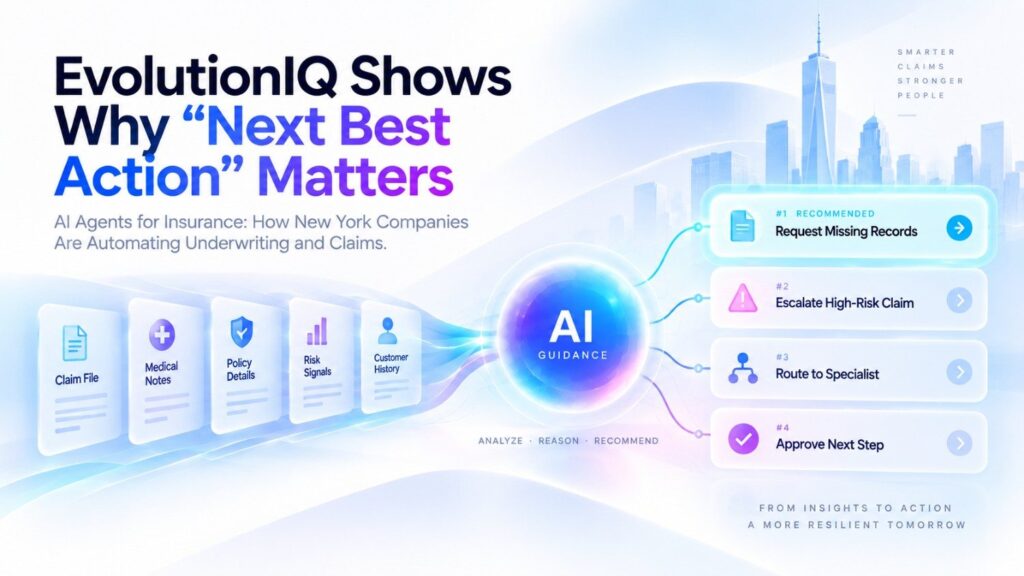
An AI agent does not have to make the final settlement decision to create major economic value.
If it helps an adjuster intervene three weeks earlier on the claims most likely to become expensive, the value can be much greater than saving a few minutes of administrative work.
A New Wave of New York Claims Companies Is Going Even Further
The market is still creating new companies around narrow pieces of claims work.
Hesper AI, a 2026 Y Combinator company based in New York City, describes agents that investigate property and casualty claims. Its agents read claim files, identify potentially altered documents, verify information, check coverage, flag inconsistencies and produce audit-ready case files.
That is a useful example of specialization.
Rather than building a generic claims assistant, Hesper is targeting the investigation layer.
This approach may become common because insurance contains dozens of workflows that need different evidence, controls and models.
A fraud investigation agent should not have the same authority as an FNOL agent.
A medical-summary agent should not have the same permission set as a settlement agent.
The future insurance architecture may therefore contain many narrow agents coordinated by a central control layer.
CoverGo, Bevaya and Neutrinos Are Moving Toward Multi-Workflow Platforms
Some New York-linked vendors are taking the opposite approach and building broad execution layers.
CoverGo has a New York office at 450 Lexington Avenue. In February 2026 it announced insurance AI agents covering document processing and other insurance operations, and its wider platform now describes agents for underwriting, claims, quotation, fraud and distribution.
Bevaya, headquartered in New York, says its platform supports agents across underwriting, claims and policy servicing. It reports more than 120 production deployments and describes capabilities including triage, clearance, rating, coverage analysis and next-step recommendations.
Neutrinos has also announced a library of more than 50 insurance-focused AI agents across claims, underwriting, servicing and distribution. Its life and health claims offering covers intake, triage, adjudication and fraud detection, while a 2026 group medical product applies AI to onboarding and underwriting workflows.
The strategic question for insurers is therefore changing.
It is no longer only whether to buy AI.
It is whether to buy a single specialist agent, buy an orchestration platform, build internal agents, or combine all three.
Original Analysis: New York Has More Than 21,000 Underwriting and Claims Roles in the Metro Economy
The workforce angle is important because AI-agent economics depend heavily on the cost and scarcity of skilled labor.
The most recent May 2025 occupational data cited by O*NET and BLS-based sources puts New York-Newark-Jersey City employment at roughly 6,740 insurance underwriters and 14,840 claims adjusters, examiners and investigators. Median annual wages were approximately $98,410 and $95,980 respectively.
The geography is the wider metro area, not New York City alone, so the figure should not be presented as a city employment count.
Still, it provides a useful measure of scale.
Chart 4: Underwriting and Claims Roles in the New York Metro
Claims adjusters/examiners/investigators 14,840 ██████████████████████
Insurance underwriters 6,740 ██████████
──────
Combined 21,580
NYC Tech Journal calculates a combined workforce of approximately 21,580 people across these two occupational categories.
If each occupation’s employment count is multiplied by its median wage, the resulting illustrative annual wage pool is about $2.09 billion.
This is not an estimate of actual insurance payroll. Median wage multiplied by headcount does not capture individual wage distributions, benefits, part-time work or the exact share working inside insurers.
It is useful for another reason.
It shows the economic value attached to the work that insurance agents are beginning to touch.
AI Does Not Need to Eliminate a Job to Create Large Value
Suppose an insurer saves only 15% of the time spent on document gathering, re-keying information, routine checks and internal coordination.
That does not mean 15% of employees disappear.
The company could instead process more submissions, handle more claims, improve response times, reduce overtime or shift experienced people toward complicated cases.
This is especially relevant because the U.S. Bureau of Labor Statistics already expects automation to influence both occupations.
BLS projects employment of insurance underwriters to decline 4% nationally from 2025 to 2035 and says improved automated underwriting software will allow applications to be processed more quickly. It projects claims adjusters, appraisers, examiners and investigators as a group to decline 6%, noting that improving software and AI can increase worker productivity.
The more useful management question is therefore not, “How many people can AI remove?”
It is, “How much insurance work can the same skilled workforce handle safely?”
New York Regulation Changes How These Agents Must Be Designed
An insurer operating in New York cannot treat underwriting AI as an uncontrolled experiment.
DFS Insurance Circular Letter No. 7, issued July 11, 2024, applies to artificial intelligence systems and external consumer data used in underwriting and pricing. It covers insurers authorized to write insurance in New York and establishes expectations involving fairness, governance, documentation, model risk and transparency.
The guidance is especially important for agentic systems because agents can turn model outputs into workflow actions.
A Black Box Vendor Does Not Transfer Responsibility
DFS makes this unusually clear.
An insurer remains responsible for AI and external data used in its underwriting or pricing process even when the technology comes from a third-party vendor. DFS expects insurers to maintain standards and procedures for third-party systems and, where appropriate, seek contractual audit rights and cooperation with regulatory investigations.
That should affect procurement immediately.
A carrier should not select an underwriting-agent vendor only by comparing model accuracy and user experience.
The legal team needs to know whether the carrier can inspect what happened after a regulator asks about a decision months later.
Boards and Senior Management Cannot Treat AI as an IT Tool
DFS also expects governance to reach senior management and the board.
Its guidance says an insurer’s governance framework should provide oversight of AI use. Senior management is responsible for day-to-day implementation, including policies, competent staffing, model risk management, independent challenge and remedial action.
Policies should be reviewed at least annually, and insurers should maintain comprehensive documentation and an inventory of AI systems.
For AI agents, that inventory needs to be more detailed than a list of models.
The insurer should know what each agent is allowed to do.
Build an Agent Authority Register
A practical insurer should maintain an authority record similar to this:
| Control field | Example |
| Agent | Commercial Submission Agent |
| Business line | Middle-market property |
| Allowed data | Submission, loss runs, approved external sources |
| Allowed actions | Extract, research, classify, request missing information |
| Approval required | Pricing exception, decline, bind |
| Maximum authority | No independent binding authority |
| Human owner | Underwriting operations leader |
| Model/version | Recorded for every case |
| Evidence retained | Inputs, outputs, source documents, actions, overrides |
| Review frequency | Monthly operational review; formal annual policy review |
This converts abstract “human oversight” into an operating rule.
New York Insurers Need to Test Outcomes, Not Just Models
One of the biggest mistakes in AI governance is measuring whether the model produced technically accurate information while ignoring what happened to customers.
DFS focuses directly on this problem.
The regulator expects insurers using AI in underwriting or pricing to assess whether their systems create disproportionate adverse effects for similarly situated people or protected classes. It also expects insurers to be able to explain the relationship between model variables and risk.
That means an insurer’s dashboard cannot stop at accuracy.
The company should examine who gets quoted, declined, referred, delayed and approved.
The Agent KPI Dashboard Every Insurance Company Should Build
| KPI group | Measure | Why it matters |
| Speed | Submission-to-decision time | Measures real workflow improvement |
| Speed | FNOL-to-first-action time | Shows whether claims move faster |
| Productivity | Submissions per underwriter | Measures capacity |
| Productivity | Claims per adjuster | Measures claims capacity |
| Quality | Rework rate | Finds bad automation |
| Quality | Human override rate | Shows where agent judgment fails |
| Quality | Missing-data rate | Tests extraction reliability |
| Economics | Quote-to-bind ratio | Connects underwriting AI with growth |
| Economics | Loss ratio by AI-assisted cohort | Checks risk quality |
| Claims | Leakage indicators | Tests financial claim outcomes |
| Customer | Complaint rate | Finds consumer harm early |
| Governance | Unsupported-action rate | Detects authority violations |
| Governance | Material disparity by tested group | Supports fairness review |
| Governance | Decisions with complete audit trail | Measures explainability readiness |
The strongest AI program will improve several rows at once.
If submission time falls but rework rises sharply, the agent is not working.
If quote volume rises but loss performance deteriorates, the system may be helping the company make bad decisions faster.
If automation rises while customer complaints rise too, leadership needs to understand why.
How Underwriting Teams Should Redesign Work Around Agents
Buying the technology first is usually the wrong order.
Start with the operating model.
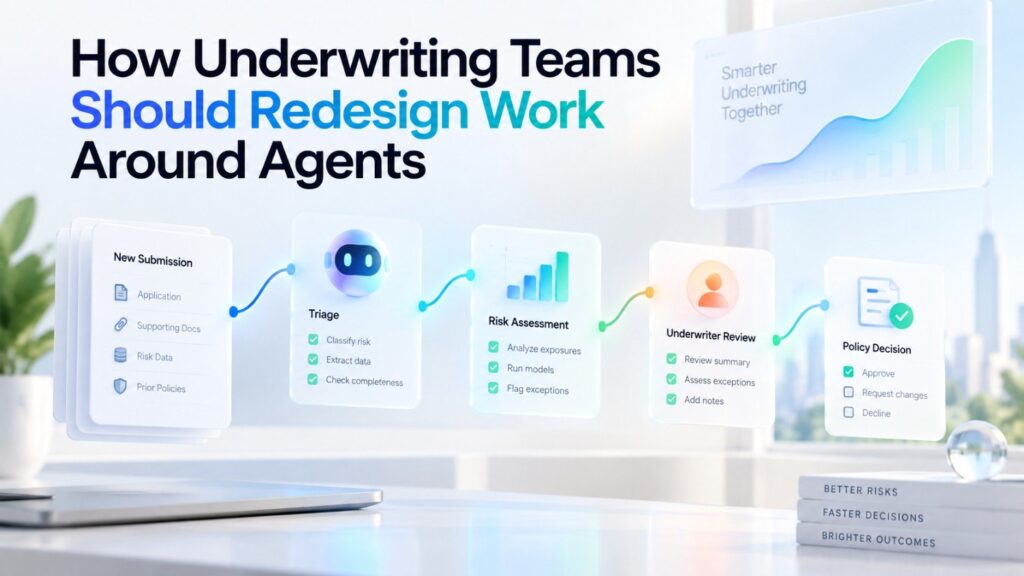
Step One: Measure the Work Before Automating It
Take a real sample of underwriting files.
Measure how much time is spent receiving submissions, entering data, checking completeness, researching risk, interpreting guidelines, preparing quotes, communicating with brokers and documenting decisions.
Most insurers know total turnaround time.
Far fewer know where that time actually goes.
Without that baseline, an AI vendor can demonstrate a dramatic improvement in a task that represents only 3% of the workflow.
Step Two: Automate the Lowest-Judgment Bottleneck
Document intake is often a good starting point.
It has high volume, measurable output and limited authority.
The agent can extract and organize data while the underwriter checks the result.
Once accuracy and controls are established, the insurer can add appetite checks, research, triage and recommendations.
Step Three: Add Action Only After Evidence Is Strong
Execution should be earned.
An agent that has produced reliable recommendations over thousands of cases may later receive permission to perform low-risk actions automatically.
For example, it could request missing documents or update a status without approval.
Binding a complex policy should sit much further along the authority curve.
That is how insurers can move toward autonomy without making a single giant leap.
Claims Teams Should Start With Triage and Coordination
The same principle applies to claims, but the first workflow may be different.
Claims departments usually have large queues and constantly changing priorities.
An agent can create value by helping the team decide what needs attention today.
A Claims Agent Should Know When a File Is Becoming Dangerous
The best claims agent is not necessarily the one that closes simple files instantly.
It may be the one that finds complicated files before they become expensive.
That could mean detecting a coverage issue, an unusual medical development, missing documentation, inconsistent statements or a claim sitting without an expected action.
EvolutionIQ’s focus on next-best-action guidance is useful here. Five Sigma’s approach to dynamic claim planning points toward the same operating model.
The system watches the portfolio.
People handle the exceptions requiring judgment.
Build Versus Buy Is Becoming the Wrong Question
Large insurers often frame AI strategy as a choice between building internally and buying from a vendor.
Agentic systems make that distinction less useful.
AIG can build a large internal architecture and still work with Palantir, Anthropic, AWS and Google. AIG’s public AI strategy describes partnerships across those technologies while developing its own underwriting, claims and orchestration capabilities.
The better strategy is usually layered.
The insurer owns its risk appetite, policies, authority model, customer standards and governance.
Specialist vendors can provide insurance models, workflow tools, orchestration, document technology or infrastructure.
The New Insurance Technology Stack
| Layer | What should live here |
| Core systems | Policies, claims, billing, customer records |
| Data layer | Clean internal and approved external data |
| Knowledge layer | Guidelines, SOPs, coverage language, authority rules |
| Agent layer | Specialized underwriting and claims agents |
| Orchestration | Decides sequence, tools, handoffs and approvals |
| Control layer | Permissions, monitoring, testing and audit logs |
| Human layer | Judgment, exceptions, customer care and accountability |
The orchestration and control layers may become two of the most important areas in insurance technology.
Models will improve.
The hard problem will be deciding which model or agent gets to do what.
A Practical 90-Day Insurance Agent Plan
Insurance companies do not need a three-year transformation program before testing this approach.
A focused 90-day project can produce useful evidence.
| Period | Main work | Required output |
| Days 1-15 | Map one workflow and establish baseline | Current time, cost, errors, handoffs and outcomes |
| Days 16-30 | Select one narrow agent use case | Defined goal, authority boundary and success metrics |
| Days 31-45 | Prepare data and controls | Approved sources, access rules, logs and escalation paths |
| Days 46-60 | Run in shadow mode | AI works cases but humans remain in control |
| Days 61-75 | Compare AI and human outcomes | Accuracy, time saved, disagreement and fairness checks |
| Days 76-90 | Allow limited controlled actions | Production test with clear approval thresholds |
Shadow Mode Is Underrated
An insurer can let an agent analyze real work without allowing it to affect customers.
For example, the agent can independently assess 5,000 submissions while human underwriters continue normal work.
The insurer then compares the two.
Where did they agree?
Where did they disagree?
Which variables drove the disagreement?
Did differences appear across protected groups?
Did the AI find information humans missed?
This creates evidence before authority is transferred.
Measure Overrides as Valuable Data
When a professional rejects an agent recommendation, do not treat it as a failure to hide.
Record the reason.
Perhaps the model misunderstood a document.
Perhaps the underwriting guideline contained an exception.
Perhaps the underwriter used broker information the system could not access.
Overrides teach the company where its operating knowledge is incomplete.
That data may eventually become one of the strongest sources for improving the agent.
The Best Agents Will Understand Institutional Memory
One of the least discussed advantages of insurance agents is memory.
Insurance companies make millions of decisions.
Yet much of the thinking behind those decisions remains trapped in emails, claim notes, individual experience and old files.
An agent can potentially make that history more usable.
Sixfold explicitly talks about institutional memory as part of its newer underwriting approach. The idea is that underwriting decisions should not disappear into separate desks and separate systems.
This matters because good insurance judgment is partly pattern recognition.
A senior underwriter remembers the unusual warehouse fire from six years ago.
A senior claims professional remembers which early details often signal a difficult injury claim.
If those insights can be captured, tested and made available at the correct moment, junior employees gain access to a much deeper operating history.
That may be a bigger long-term advantage than simple automation.
The Human Role Will Move Up the Decision Stack
The strongest evidence does not suggest that experienced insurance professionals suddenly become unnecessary.
It suggests their work changes.
The machine handles more gathering.
The human handles more judgment.
The machine watches more cases.
The human spends more attention on exceptions.
The machine creates a recommendation.
The human challenges the assumptions.
That movement is already visible in how companies describe their products.
Sixfold says underwriters remain responsible for the final call. Kalepa describes AI taking operational work while underwriters focus on higher-judgment decisions. Lemonade’s AI Jim automatically handles many claims but routes cases outside its authority or cases with concerns to claims experts.
That is probably the realistic autonomous enterprise.
Not a company without people.
A company where people no longer need to personally touch every routine step.
Five Predictions for Insurance Agents in New York
Agent Authority Will Become a Formal Governance Discipline
Companies already govern financial authority.
They will increasingly govern machine authority in the same way.
Every important insurance agent will need explicit permissions, escalation rules, owners, monitoring and evidence retention.
Underwriting Workbenches Will Become Systems of Action
The old workbench displayed information.
The new one will increasingly coordinate work.
It will know which submissions need attention, which missing data should be requested, which checks have been completed and what action comes next.
Sixfold, Kalepa and the agentic work described by AIG all point in this direction.
Claims Will Shift Toward Continuous Monitoring
A traditional claim gets reviewed when a person opens the file.
An agent can monitor thousands of files continuously.
That changes claims management from a queue of files into a stream of exceptions.
The most valuable alert will not be “Here is a summary.”
It will be “This claim changed in a way that requires attention now.”
AI Governance Data Will Become Operating Data
Bias testing, overrides, authority violations and audit trails currently sound like compliance concerns.
Soon they will be management metrics.
A company with a 12% override rate needs to know why just as urgently as it needs to understand a bad loss ratio.
The Winning Insurer Will Not Have the Most Agents
It will have the best system for deciding when agents should act.
A hundred disconnected agents could create more work than they remove.
The competitive advantage will come from orchestration.
That means connecting data, rules, authority, workflow, monitoring and people into one operating system.
What New York Insurance Leaders Should Do Now
The evidence from New York suggests that insurance AI has already moved beyond experimentation.
AIG has public operating results from AI-supported underwriting and claims. Lemonade has significant levels of real workflow automation. Sixfold and Kalepa are expanding the role of AI in underwriting. Five Sigma and EvolutionIQ are pushing claims toward continuous guidance and execution. Bevaya, CoverGo and Neutrinos are trying to orchestrate agents across broader parts of the insurance lifecycle.
At the same time, our original workflow analysis suggests the industry still has a major last-mile problem.
AI can increasingly read.
It can analyze.
It can recommend.
It can triage.
But far fewer publicly documented systems have reached broad execution authority.
That gap is where the next several years of insurance technology will be decided.
Executives should therefore stop treating “AI adoption” as the goal.
The goal should be a measurable increase in safe operating capacity.
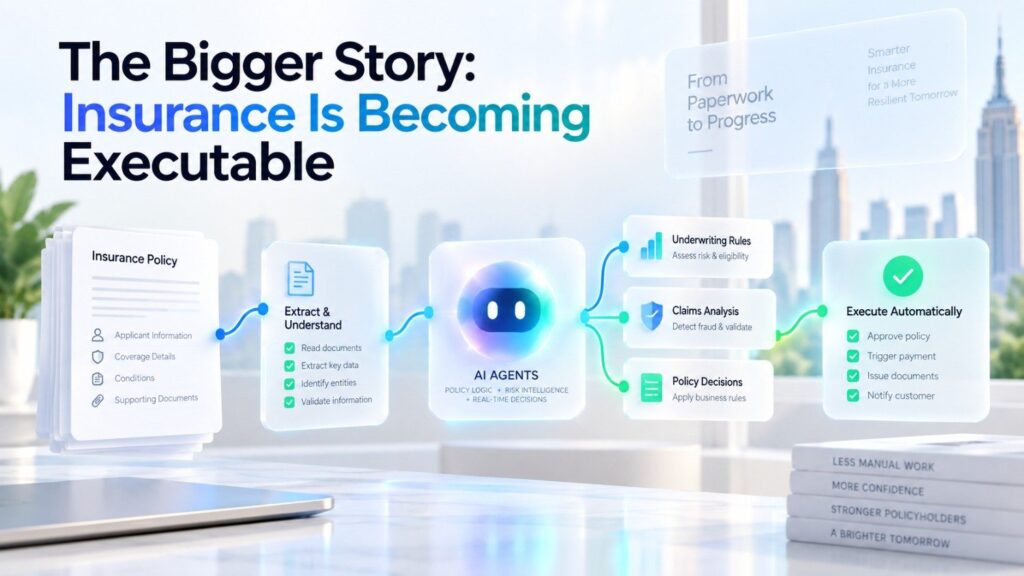
The Bigger Story: Insurance Is Becoming Executable
For decades, the core insurance workflow was built around software records and human execution.
Systems stored the policy.
Systems stored the claim.
Systems stored the rules.
People moved the work.
AI agents introduce a different architecture.
The system can begin participating in the work itself.
That does not mean every underwriting decision should be automated or every claim should be paid by an algorithm. New York’s regulatory approach is a reminder that greater machine capability creates a greater need for governance, documentation, fairness and accountability. DFS has also made clear that insurers remain responsible for third-party AI used in regulated underwriting and pricing.
The companies likely to benefit most will therefore avoid two extremes.
They will not keep AI trapped forever inside a chatbot that can only suggest ideas.
But they will not hand unlimited authority to an unpredictable system either.
They will build controlled autonomy.
An agent reads the submission.
Another checks the risk.
Another reviews the rules.
A workflow engine decides what happens next.
Routine actions happen automatically when the evidence is strong and the authority is clear.
A person enters when judgment, unusual risk, consumer impact or financial exposure crosses a defined threshold.
That operating model is already starting to appear across New York.
And that is why the most important insurance AI question for 2026 is no longer whether artificial intelligence can understand insurance work.
The important question is:
How much of that work should it be allowed to do?
Research Notes and Sources
The NYC Tech Journal workflow analysis was conducted from public information available through September 12, 2026. It covers ten New York-headquartered or New York-linked insurers and insurance technology companies and ten underwriting and claims workflow stages, producing 100 coded company-workflow observations. Public absence was scored as absence of evidence rather than proof that a capability does not exist.
The main regulatory source is New York State Department of Financial Services Insurance Circular Letter No. 7, issued July 11, 2024. The circular applies specifically to AI systems and external consumer data used in underwriting and pricing; DFS explicitly says the circular is not intended to address other phases of the insurance lifecycle.
The New York ecosystem figures come from InsurTech NY’s NYC InsurTech Startup Map, last updated July 10, 2026, which reports 142 tracked companies, 124 with NYC executives and $7.8 billion in reported capital raised.
The nationwide adoption context is also substantial. NAIC reports that among surveyed insurers, 88% of responding private-passenger auto insurers, 70% of homeowners insurers, 58% of life insurers and 92% of health insurers said they use, plan to use or plan to explore AI or machine-learning models. Those figures combine current use with planned or exploratory use, so they should not be interpreted as production adoption rates.
NAIC’s current state map also shows that New York follows its own insurance-specific AI guidance rather than simply adopting the NAIC Model Bulletin. Numerous other states have adopted versions of that model bulletin, making governance increasingly relevant for insurers operating across the country.
Company-specific operating and product evidence was drawn primarily from company filings and first-party product materials, including AIG’s 2025 annual report, Lemonade’s 2025 Form 10-K, Sixfold, Kalepa, Five Sigma, EvolutionIQ, CoverGo, Bevaya and Neutrinos. Vendor-reported performance figures should be treated as company claims unless independently verified.
Employment analysis uses May 2025 occupational data for the New York-Newark-Jersey City metro. The combined 21,580-role figure and approximately $2.09 billion illustrative wage pool are NYC Tech Journal calculations based on published employment and median-wage figures; they are not estimates of job displacement or actual employer payroll.