

For the past few years, most businesses have treated artificial intelligence as a tool that helps people work faster. An employee opens an AI assistant, asks a question, creates a draft, summarizes a document, or researches a customer. The person still sits in the middle of almost every step.
AI agents are beginning to change that model.
An AI agent does not simply answer a question. It can receive a goal, gather information, decide what needs to happen next, use connected software, complete parts of a workflow, check the result, and send difficult cases back to a person. In a carefully designed system, the employee moves from doing every step to supervising the work.
That change could matter more in New York than in almost any other American business market.
New York City has a huge concentration of finance, professional services, media, technology, real estate, advertising, healthcare, law, and other industries where employees spend much of their day moving information between systems. According to Bureau of Labor Statistics data for May 2025, professional and business services, financial activities, and information together accounted for about 1.52 million New York City jobs, or roughly 31.4% of all nonfarm employment in the city.
At the same time, New Yorkers appear unusually willing to use advanced AI tools. The New York City Comptroller reported in February 2026 that, relative to population, New York State used Anthropic’s Claude more heavily than every U.S. state except the District of Columbia. Yet separate business adoption data suggest New York establishments were actually somewhat behind the national average in formally adopting AI.
That apparent contradiction may be one of the most important signals in the New York AI market.
Workers are experimenting quickly. Companies are moving more carefully. AI agents could be the bridge between those two worlds because agents turn scattered personal AI use into controlled business processes.
The autonomous enterprise is therefore not a company without people. It is a company where more routine digital work can happen without a person manually pushing every button.
And New York may be one of the best places to see that transition happen first.
What Does an Autonomous Enterprise Actually Mean?
The phrase “autonomous enterprise” sounds more dramatic than the reality.
It does not mean a company hands its operations to one giant AI system and walks away. That would be both unrealistic and dangerous.
A more useful definition is much simpler.
An autonomous enterprise is a business in which software can independently complete clearly defined portions of work, while people set goals, provide judgment, handle exceptions, and control high-risk decisions.
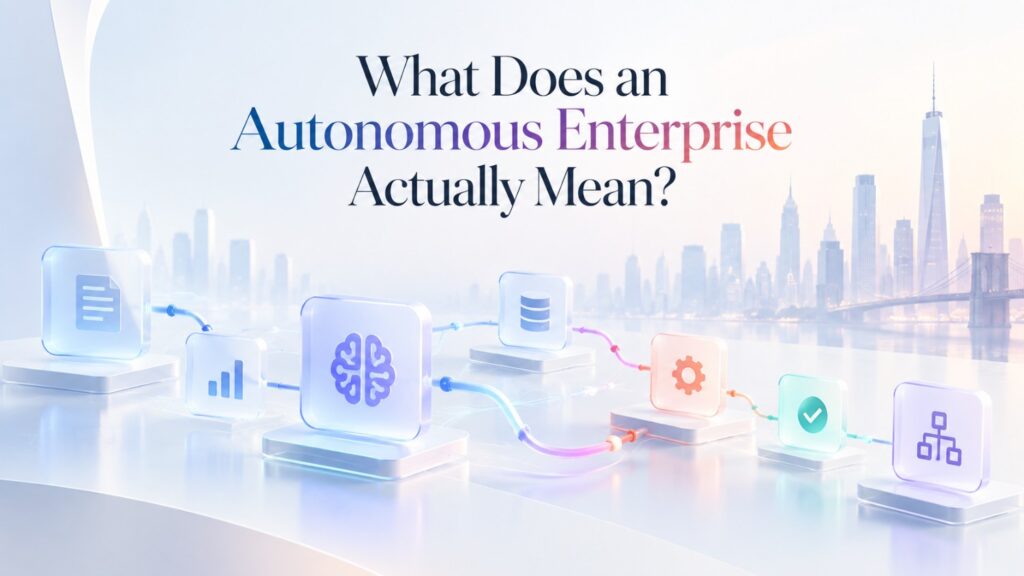
The important word is not autonomous. It is defined.
Useful AI agents need boundaries.
The Difference Between an AI Assistant and an AI Agent
Imagine a private equity analyst preparing for a meeting.
With a traditional AI assistant, the analyst might upload several files and ask for a summary. The AI produces text. The analyst then checks the portfolio company’s latest numbers, searches for market information, opens a CRM, finds earlier meeting notes, prepares questions, and sends a briefing document.
An agent could potentially receive the instruction, “Prepare tomorrow’s portfolio-company meeting brief.”
It could retrieve the approved documents, collect permitted market information, inspect previous meeting notes, compare financial results with the plan, highlight unusual changes, draft questions, create the brief, and route the final document to the analyst for review.
The employee still owns the meeting.
The difference is that the software performs more of the steps between the request and the finished outcome.
Four Levels of Enterprise AI
| Level | What the AI does | Example |
| 1. Answer | Responds to a question | “Explain this contract clause.” |
| 2. Produce | Creates a work product | “Draft a client briefing.” |
| 3. Act | Uses tools to complete steps | “Update the CRM and prepare the follow-up.” |
| 4. Own a bounded workflow | Watches for a trigger, completes permitted actions, checks results and escalates exceptions | “Handle qualified inbound leads until a salesperson is needed.” |
Most businesses are still somewhere between Levels 1 and 2.
The bigger economic change starts when organizations move into Levels 3 and 4.
At that point, AI is no longer only improving the productivity of individual workers. It begins changing how the company itself operates.
Why New York Is Such an Important Test Market
New York has an unusual economic structure for AI agents because expensive knowledge work exists here at enormous scale.
BLS data for the New York-Newark-Jersey City metropolitan area show mean hourly wages of about $94.64 for management occupations, $87.83 for legal occupations, $67.04 for computer and mathematical jobs, $62.24 for healthcare practitioners and technical workers, and $57.35 for business and financial operations occupations as of May 2025.
Saving an hour of repetitive work in a high-wage occupation can therefore create meaningful economic value.
More importantly, many of these jobs revolve around information.
A lawyer compares documents. An investment banker builds analyses from financial information. An advertising team studies performance data. A commercial real estate employee updates property records. An insurance employee gathers material for underwriting. A recruiter reviews applications. A consultant prepares research.
These jobs involve judgment, but they also contain many smaller tasks that can be separated from that judgment.
AI agents are beginning to attack those smaller tasks.
Chart 1: The Size of New York’s Agent-Friendly Business Core
Using BLS employment data for New York City proper, NYC Tech Journal calculated the combined employment of three sectors where digital information work is especially common.
| NYC sector, May 2025 | Employment | Share of all NYC nonfarm jobs |
| Professional and business services | 794,300 | 16.4% |
| Financial activities | 500,900 | 10.3% |
| Information | 228,300 | 4.7% |
| Combined | 1,523,500 | 31.4% |
| All NYC nonfarm employment | 4,847,300 | 100% |
Visual
Professional & business services ████████████████ 794K
Financial activities ██████████ 501K
Information █████ 228K
These broad sectors are not perfectly “AI-agent jobs.” A professional-services business contains many different roles, and an information company still employs people whose work cannot be handled on a screen.
But the scale matters.
Almost one-third of New York City’s nonfarm employment sits inside just these three parts of the economy. The Comptroller has separately found that AI adoption has been especially strong in finance, information, and professional services.
That creates an unusually large market where even modest improvements in workflow productivity can matter.
NYC Tech Journal Original Research: Building the Agent Leverage Index
To understand where AI agents could matter most in the New York economy, NYC Tech Journal combined three public datasets into a new analytical model.
We call it the Agent Leverage Index.
The purpose is not to predict which workers will be replaced. It is to estimate where AI-assisted or AI-operated workflows could have unusually high economic importance because the work is common, expensive, and already contains tasks that current AI systems appear able to perform.
The Methodology
For each major occupation group, we combined three variables.
Local employment share measures how much of the New York metropolitan workforce works in the occupation.
Local mean hourly wage provides a rough measure of the economic value of worker time.
Observed AI task coverage comes from analysis highlighted by the New York City Comptroller using Anthropic Economic Index data matched to the U.S. Department of Labor’s O*NET occupational task database.
That research mapped millions of work-related Claude conversations to ONET tasks. The resulting data showed what percentage of tasks associated with each broad occupation had already appeared in actual Claude usage. The underlying ONET database contained 19,530 work tasks.
We then calculated:
Raw Agent Leverage = Employment Share × Mean Hourly Wage × Observed AI Task Coverage
The occupation with the highest raw result was set to 100, and all other occupations were scaled against it.
No subjective industry weights were added.
That matters because we did not decide in advance that finance should receive more points than healthcare or that technology should receive more points than management. The score comes directly from the three variables.
An Important Limitation
This is a prioritization model, not a forecast of job losses.
The source datasets also cover slightly different geographic and time periods. Employment and wage data refer to the New York metropolitan area in May 2025. The task-use data are based on Claude conversations from late 2024 and early 2025 and reflect national usage patterns. Later state-level Claude data provide another view of current New York usage.
There is currently no public dataset that perfectly measures autonomous-agent activity by occupation inside the five boroughs.
The index therefore answers a narrower question:
Where does the combination of New York employment scale, labor value, and demonstrated AI task use create the largest potential business leverage?
That is a much more defensible question than trying to calculate how many jobs AI will “replace.”
Original Finding #1: Management and Finance May Have More Agent Leverage Than Technology
The results are striking.
Computer and mathematical occupations have the highest observed AI task coverage in the underlying task data, at about 56%. But they do not rank first in our New York leverage model.
Management does.
Chart 2: NYC Tech Journal Agent Leverage Index
| Rank | Occupation group | NYC metro employment share | Mean hourly wage | Tasks observed in Claude use | Agent Leverage Index |
| 1 | Management | 7.5% | $94.64 | 25% | 100.0 |
| 2 | Business & financial operations | 7.6% | $57.35 | 36% | 88.4 |
| 3 | Computer & mathematical | 3.5% | $67.04 | 56% | 74.0 |
| 4 | Education | 6.9% | $39.71 | 40% | 61.8 |
| 5 | Sales | 7.9% | $36.03 | 36% | 57.7 |
| 6 | Office & administrative support | 11.7% | $28.72 | 25% | 47.3 |
| 7 | Healthcare practitioners & technical | 6.4% | $62.24 | 17% | 38.2 |
| 8 | Legal | 1.4% | $87.83 | 27% | 18.7 |
| 9 | Arts, design, entertainment & media | 2.0% | $52.51 | 31% | 18.3 |
| 10 | Food preparation & serving | 7.4% | $22.22 | 12% | 11.1 |
Source data: BLS New York metro occupational employment and wages and NYC Comptroller analysis of Anthropic/O*NET task usage. Calculations and index are NYC Tech Journal’s.
Chart 3: Relative Agent Leverage
Management ████████████████████ 100
Business & finance ██████████████████ 88
Computer & math ███████████████ 74
Education ████████████ 62
Sales ████████████ 58
Office & administration █████████ 47
Healthcare practitioners ████████ 38
Legal ████ 19
Arts & media ████ 18
Food preparation ██ 11
The management result deserves attention.
Only about one-quarter of management tasks in the source data appeared in Claude usage, far below the 56% observed for computer and mathematical work. But management occupations combine a meaningful share of the New York workforce with very high wages.
That makes small productivity improvements economically important.
An agent does not have to “be the manager” to create value in management work. It could prepare operating reviews, collect metrics, summarize team updates, monitor project deadlines, draft follow-ups, compare budget results, prepare meeting material, and identify issues that need human attention.
The manager keeps authority.
The agent absorbs coordination work.
Business and Finance Could Be the Larger Prize
Business and financial operations rank second in our analysis.
That is especially relevant in New York.
These jobs include financial analysts, accountants, auditors, compliance workers, project specialists, business operations employees, and other roles found throughout banking, asset management, insurance, professional services, startups, healthcare organizations, and major corporations.
Many of their workflows contain exactly the mix agents handle best: collecting information, comparing it with rules, transforming it into a structured format, and preparing a recommendation.
The business opportunity is therefore broader than building AI tools for programmers.
Six Occupation Groups Represent an Enormous Opportunity Surface
The six highest-scoring groups—management, business and financial operations, computer and mathematical work, education, sales, and office administration—represent approximately 45.1% of New York metro employment in our analysis.
Using employment share multiplied by average wages as a rough proxy for payroll-weighted economic importance, those same six groups account for roughly 54.9% of the wage-weighted value represented by the major occupation categories.
Their employment-weighted average observed AI task coverage is approximately 33.5%.
The point is not that one-third of these jobs can disappear.
It is almost the opposite.
If an occupation contains many separate tasks and AI can already assist with a meaningful portion of them, the first effect is likely to be a redesign of the job rather than the elimination of the whole role.
Original Finding #2: New York’s Biggest Opportunity May Be Where AI Use Is Still Low
Another pattern appears when we compare our Agent Leverage Index with state-level Claude usage reported by the Comptroller.
Technical workers already use Claude at unusually high rates.
Some of the occupations with the highest economic leverage do not.
Table: Potential Leverage Versus Current New York AI Use
| Occupation | Agent Leverage Index | NY Claude usage relative to occupation size | What the gap suggests |
| Management | 100.0 | 0.18× | Very high leverage, low observed current usage |
| Business & financial operations | 88.4 | 0.15× | Very high leverage, low current usage |
| Computer & mathematical | 74.0 | 13.72× | High leverage and extremely high current usage |
| Education | 61.8 | 1.17× | High leverage, roughly proportional-to-high use |
| Sales | 57.7 | 0.22× | High leverage, low current usage |
| Office & administrative | 47.3 | 0.38× | Large workforce and substantial untapped opportunity |
| Healthcare practitioners | 38.2 | 0.10× | High-value work but limited observed use |
| Legal | 18.7 | 0.05× | High wages, but current usage remains low relative to occupational size |
The “relative usage” figures come from state-level Anthropic data analyzed by the NYC Comptroller. A value greater than 1 means the occupation appears in Claude work use more often than its share of New York employment would predict.
This comparison must be treated carefully because it combines separate datasets.
But the direction is interesting.
Computer and mathematical workers are already deep into AI experimentation. Management, finance, sales, administrative work, healthcare, and legal occupations appear much less represented in current Claude use relative to the size of their workforces.
That creates what we would call latent organizational opportunity.
The next phase of New York enterprise AI may be less about convincing software engineers to use AI. Many already do.
The larger opportunity may be moving AI into the operating workflows surrounding managers, bankers, sales teams, administrators, lawyers, property managers, healthcare operations teams, and other employees who have not yet incorporated it deeply into everyday work.
Original Finding #3: New York Appears to Have a Worker-to-Firm Adoption Gap
Perhaps the most interesting New York signal comes from comparing individual AI activity with formal business adoption.
The Comptroller reported that approximately 16.8% of New York State establishments were using AI in business functions in early April 2026, compared with 19.8% nationally.
New York therefore trailed the U.S. rate by about 3 percentage points, or roughly 15% on a relative basis.
Now look at another dataset.
Anthropic activity analyzed in the same Comptroller research suggested New York generated roughly 9% of national Claude usage despite representing around 6% of U.S. nonfarm employment.
That is roughly 1.5 times New York’s employment share.
Chart 4: Two Different Signals From the New York AI Market
| Indicator | New York | Comparison |
| Formal establishment AI adoption | 16.8% | U.S.: 19.8% |
| Share of U.S. Claude usage | ~9% | NY share of U.S. employment: ~6% |
| Claude-use intensity relative to employment share | ~1.5× | Calculated by NYC Tech Journal |
These numbers should not be combined into a single adoption rate because they measure different things.
But together they point toward a plausible two-speed market.
New York workers seem to be experimenting aggressively with AI while many employers are still working out how to deploy it formally across business systems.
That matters because unmanaged employee AI use is very different from an autonomous enterprise.
An employee can paste information into a chatbot and receive a summary. A company-grade agent needs approved access to internal data, identity controls, permissions, audit records, testing, human escalation rules, security controls, and clear ownership.
Closing that gap could become a major enterprise technology project across New York over the next several years.
The Bigger Shift: AI Is Moving From Helping With Work to Doing Parts of the Work
The technology itself is moving in the same direction.
Anthropic’s June 2026 Economic Index reported that AI sessions are increasingly moving away from simple conversations and toward longer-running work through agent-style coding and workplace tools. The company said models are increasingly able to operate autonomously for extended periods rather than waiting for a person to provide a new instruction after every step.
Its earlier economic research found an even clearer difference between consumer-style chat and business software integration.
About 74% of API usage in the analyzed data was classified as work-related, compared with around 46% of Claude.ai usage. Roughly three-quarters of API interactions were classified as automation, while fewer than half of Claude.ai interactions were.
Why does that matter?
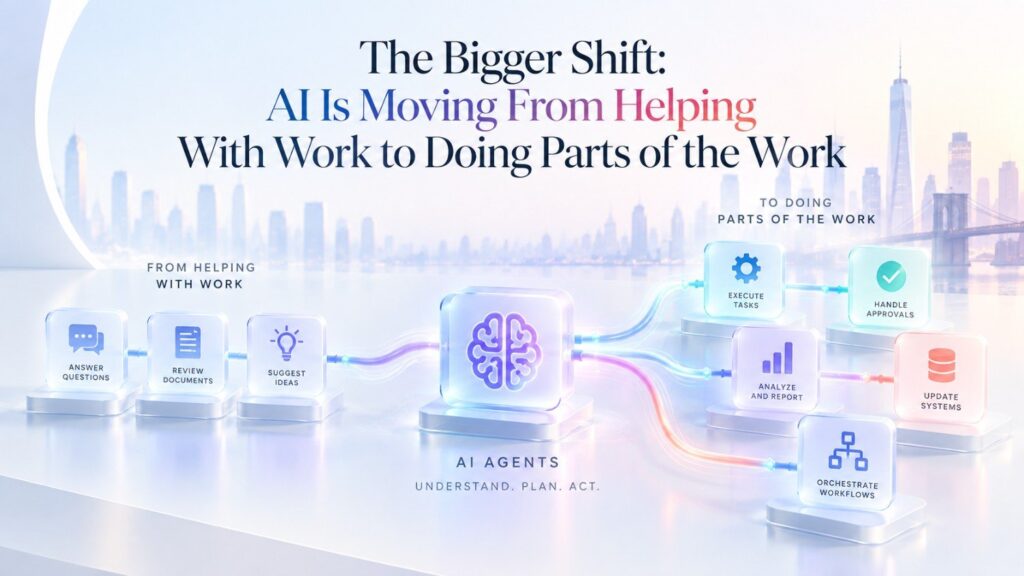
Because API use usually means another piece of software is asking the AI to do something.
The human is no longer necessarily typing each prompt.
That is the foundation of the autonomous enterprise.
The Old Workflow
A salesperson receives a lead.
The salesperson researches the company, opens LinkedIn, reads the website, checks the CRM, looks for earlier conversations, figures out which product might fit, writes an email, schedules a follow-up, updates the CRM, and remembers to return later.
AI might help draft the email.
But the employee still manages the process.
The Agent Workflow
Now imagine that a new lead automatically triggers an agent.
The agent checks the account against company rules, gathers approved information, studies existing CRM records, researches relevant public data, identifies likely needs, prepares a personalized message, recommends the next action, updates the account, and sends the highest-value opportunities to a salesperson.
Low-confidence cases are escalated instead of completed automatically.
The salesperson starts much closer to the moment where human judgment actually matters.
That is a very different productivity model.
New York Companies Are Already Building Pieces of This Future
New York’s AI startup market provides a useful preview of what the autonomous enterprise may look like.
The important change is not that these companies can generate text. ChatGPT and other large AI systems already do that.
The important change is where the software sits in the workflow.
Clay: Turning Revenue Work Into a Coordinated System
Brooklyn-born Clay has been pushing beyond simple sales-data enrichment toward systems that can research accounts and coordinate go-to-market actions.
Clay says its Claygent product, introduced in 2023, had processed more than one billion runs by June 2025 and five billion by August 2026. Its newer products include agents that can research accounts, structure information from signals and transcripts, recommend actions, trigger workflows, and work across connected systems.
The strategic lesson is bigger than Clay itself.
Sales software used to tell employees what happened.
The next generation increasingly tries to decide what should happen next and prepare or perform the action.
Rogo: Bringing Agents Into Wall Street Workflows
New York-based Rogo is applying the same idea to financial work.
The company describes its platform as an AI system for finance that can support workflows across investment banking, private equity, hedge funds, corporate finance, and other parts of financial services. In 2026, Rogo said its technology was being used daily by more than 25,000 financial professionals.
Finance is a natural agent market because employees spend enormous amounts of time gathering, cleaning, comparing, checking, and presenting information.
The final investment decision remains high stakes.
But the work required to reach that decision contains many smaller pieces that software can increasingly prepare.
Hebbia: Agents for Complex Knowledge Work
New York-based Hebbia approaches the problem from another angle.
Its Matrix platform is designed for information-heavy work at financial, legal, consulting, and other large organizations. The company says businesses use the platform to teach AI agents their internal processes and apply them to more than 1,000 production use cases.
Case studies published by Hebbia and OpenAI report significant time savings in areas such as investment-banking deal work, private-equity analysis, and legal agreement review. These are vendor-reported results rather than independent experiments, so businesses should not assume they will receive the same outcome.
Still, the use cases demonstrate the direction of travel.
AI is moving closer to the actual work product.
Regal: Voice Agents Move Into Customer Operations
New York-founded Regal focuses on another large category of business work: customer conversations.
Its AI agents can handle voice interactions and connect those conversations with enterprise systems. Regal markets the technology for inbound service, outbound engagement, lead response, scheduling, and other customer workflows.
This is an important step beyond the traditional phone menu.
A traditional automated system asks the customer to “press 1.”
An agent can potentially listen to the customer’s intent, retrieve approved account information, take an allowed action, explain the result, record the interaction, and transfer complicated cases to an employee.
That transforms call-center economics without requiring every customer conversation to become completely automated.
EliseAI: Agents Move Into Housing and Healthcare Operations
New York-based EliseAI has built AI systems around repetitive communication and operating workflows in housing and healthcare.
The company has expanded rapidly and in early 2026 announced a major expansion of its New York headquarters. Its systems are designed to handle workflows such as resident or patient communication, scheduling, follow-ups, lead management, and operational coordination.
This category is important because it shows AI agents moving beyond technology companies and Wall Street.
Real estate and healthcare contain enormous amounts of repetitive administrative work wrapped around services that remain deeply human.
Norm AI: Regulation Becomes Part of the Workflow
New York’s regulated industries create another opportunity.
Norm AI builds systems that apply AI agents to regulatory and compliance work. The company emphasizes rules-based reasoning and supervisory checks rather than unrestricted AI decision-making.
One particularly relevant New York example is the company’s work with New York Life around reviewing sales and marketing material for compliance requirements.
That points toward a powerful enterprise use case.
The agent does not need the authority to decide what is legally acceptable on its own.
It can perform the first pass, document the reasoning, identify possible problems, and send uncertain or high-risk cases to specialists.
Table: What New York’s Agent Companies Tell Us About the Market
| Company | Workflow area | What agents are moving toward | Business lesson |
| Clay | Revenue and sales | Research, account intelligence, workflow triggers, next actions | Agents can connect research directly to execution |
| Rogo | Finance | Research and finance workflows | High-value information work can be broken into agent tasks |
| Hebbia | Finance, legal, consulting | Complex document and knowledge workflows | Agents become more useful when they understand company processes |
| Regal | Customer operations | Voice conversations and connected actions | AI can move from answering customers to resolving requests |
| EliseAI | Housing and healthcare | Communication, scheduling and operating workflows | Administrative work is becoming a major agent market |
| Norm AI | Compliance | Rule-based review and escalation | Regulated work can use agents when controls are built into the process |
The pattern across these companies is clear.
The market is moving away from “Ask AI something” and toward “Give AI a piece of work.”
The Autonomous Enterprise Changes the Operating Model Before It Changes the Org Chart
Much of the public debate about AI starts with headcount.
That misses the first-order effect.
The near-term change is more likely to be how work moves through an organization.
Research based on a large CFO survey found that most companies investing in AI were primarily trying to improve productivity and efficiency rather than immediately reduce employment. More than 80% of surveyed firms expected to invest in AI in 2026, while the expected near-term employment effects remained relatively modest.
New York City Comptroller analysis reached a similar conclusion. Its 2026 work noted that measured employment effects remained small even as businesses expanded AI use, with much of current activity still focused on writing, analysis, search, and other parts of jobs rather than complete end-to-end job automation.
That means businesses should first look for changes in workflow design.
Managers Become Supervisors of Human and Digital Work
A traditional manager distributes tasks among employees.
In an agent-enabled company, some of that work can go to software.
A marketing manager might supervise employees responsible for strategy and creative judgment while agents collect competitor changes, compile campaign numbers, prepare first-pass reports, tag customer feedback, and create drafts.
The manager’s job becomes more about defining the outcome, checking quality, handling exceptions, and deciding where human judgment is required.
Work Becomes a Collection of Queues
Companies traditionally design software around applications.
Sales work happens in Salesforce. Finance happens in an ERP. Customer support happens in a ticketing system. Documents sit in another system. Communication happens somewhere else.
People connect these systems.
Agents can potentially become a new connection layer.
Instead of an employee opening five tools to complete one job, the employee gives the agent a goal and the agent uses permitted systems on the employee’s behalf.
That means businesses should begin thinking less about “which app contains this work?” and more about “what outcome needs to happen when this event occurs?”
That is a major design shift.
What Should New York Businesses Automate First?
The wrong place to begin is with the question:
Which jobs can AI replace?
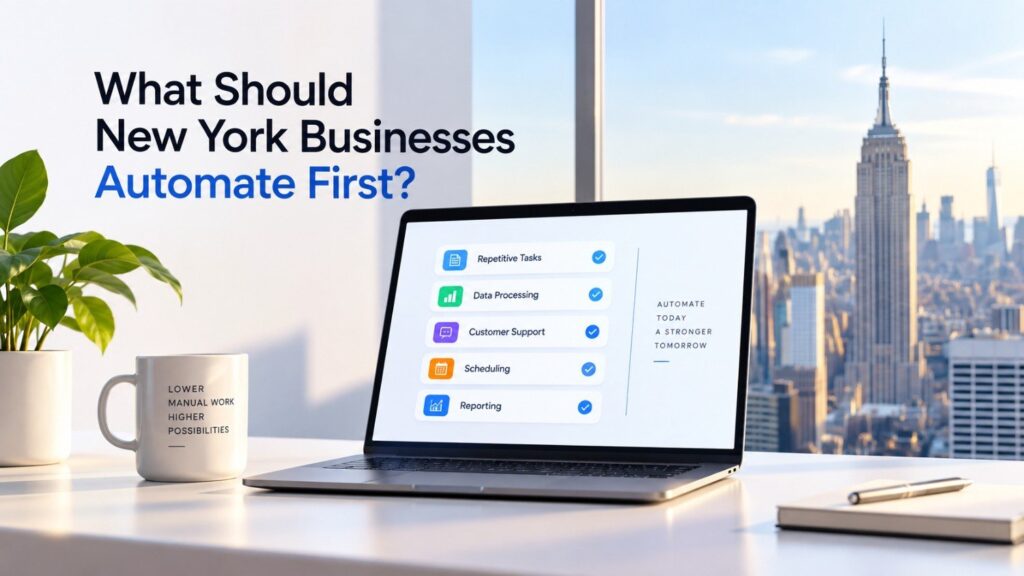
A much better question is:
Which repeated workflow costs us time, moves mostly through digital systems, has a clear successful outcome, and can be safely checked?
That produces very different projects.
Start With Work, Not Job Titles
An accounts-payable employee may perform twenty different tasks.
Perhaps three are highly repeatable. Five require judgment. Four require communication. Several involve gathering documents. One involves approving something with financial consequences.
Trying to automate the “accounts-payable job” is too broad.
Mapping the individual workflows is much more useful.
Table: Agent Opportunity Scorecard
| Question | Low-fit workflow | High-fit workflow |
| Is the work repeated often? | Rare | Daily or hundreds of times monthly |
| Are inputs digital? | Mostly physical or verbal | Already available in approved systems |
| Is the desired output clear? | Highly subjective | Easy to define and check |
| Can errors be detected? | Difficult | Strong rules or comparison data |
| Can actions be reversed? | No | Yes |
| Are exceptions identifiable? | Unclear | Easy to route to a person |
| Is success measurable? | Vague | Time, cost, revenue or quality metric exists |
| Is regulatory risk manageable? | Very high | Low or controlled |
A business should not automatically choose the workflow with the highest labor cost.
The best first workflow usually combines meaningful economic value with low operational danger.
That makes experimentation faster and easier to measure.
A Practical 90-Day AI Agent Plan for a New York Business
Companies do not need a three-year autonomous-enterprise transformation plan before starting.
A carefully chosen 90-day project can reveal much more than months of strategy meetings.
Days 1–15: Map the Work
Pick one department and document how work actually moves.
For each repeated workflow, record what triggers it, what information is required, which applications employees open, what judgment is required, what final output is expected, how often it happens, how long it takes, what happens when something goes wrong, and who owns the outcome.
Do not ask workers only what their official job description says.
Watch the real process.
You may discover that a high-paid employee spends several hours each week copying information between systems, preparing the same type of report, searching for documents, or checking routine conditions.
That is where the leverage hides.
Days 16–30: Pick One Bounded Outcome
Now select one workflow.
“Automate sales” is too broad.
“Research every qualified inbound account and prepare a briefing before a salesperson opens the lead” is specific.
“Use AI for finance” is too broad.
“Collect month-end variance explanations from approved systems and prepare a draft management report” is specific.
A good agent project has a beginning, an end, permitted tools, measurable quality standards, and clear escalation rules.
Days 31–60: Run in Shadow Mode
Before allowing the agent to take consequential actions, let it perform the workflow alongside employees.
The agent prepares the answer, but the person remains responsible for the real action.
Compare its work with the human baseline.
How often is the output correct?
Where does it fail?
Which exceptions does it recognize?
Does it save time after review is included?
What information does it lack?
Shadow mode is one of the most valuable steps because it reveals whether an impressive demonstration survives normal business conditions.
Days 61–90: Allow Controlled Action
If the agent performs reliably, give it limited authority.
Low-risk and reversible actions can be automated first.
The agent might update an internal record, create a draft, categorize an inquiry, schedule a meeting within approved rules, or request missing information.
High-risk actions should continue to require approval.
The objective is not maximum automation.
It is maximum useful automation at an acceptable level of risk.
Chart 5: A 90-Day Path From Idea to Production
| Period | Goal | Human role | Agent role |
| Days 1–15 | Understand workflow | Map work and define success | None |
| Days 16–30 | Design pilot | Set rules and boundaries | Test access and instructions |
| Days 31–60 | Shadow deployment | Perform/approve real work | Complete parallel work |
| Days 61–90 | Controlled production | Review exceptions and high-risk actions | Execute approved low-risk actions |
The company should leave the 90-day project with evidence rather than excitement.
If the workflow works, expand it.
If it fails, understand why before buying more software.
How to Measure AI Agent ROI Without Fooling Yourself
AI pilots often produce impressive demos and weak financial results because companies measure the wrong thing.
“Employees liked it” is useful feedback.
It is not ROI.
“Employees saved time” is also incomplete.
Saved time only has value if the company knows what happens to the time.
Table: The Metrics That Matter
| Metric | What it tells the business |
| Human touch time | How much employee time the workflow still requires |
| End-to-end cycle time | Whether customers or teams receive outcomes faster |
| Completion rate | How often the agent finishes without escalation |
| Exception rate | How frequently a person must intervene |
| Accuracy/rework rate | Whether faster work creates hidden cleanup |
| Cost per completed outcome | Whether economics improve after AI cost is included |
| Revenue or retention impact | Whether the workflow changes business results |
| Employee capacity created | How much time becomes available for other valuable work |
A Simple NYC Professional-Services Example
Imagine a 100-person professional-services company completing 200 research tasks each month.
Suppose each task currently requires 1.5 employee hours.
That equals 300 hours.
Now assume an agent performs the first-pass research and reduces human review time to 0.4 hours per task.
Human work falls to 80 hours.
The company has created 220 hours of monthly capacity.
If the fully loaded value of that employee time is $85 per hour, the theoretical capacity value is:
220 hours × $85 = $18,700 per month.
Suppose the software, integration, monitoring, and support cost $8,000 per month.
The simple capacity-return calculation becomes:
($18,700 − $8,000) ÷ $8,000 = about 134%.
That looks excellent.
But there is an important catch.
The company has not necessarily saved $18,700 in cash.
If employees simply have more free time, the money is still being spent.
The economic benefit becomes real when the business can use those hours for additional clients, faster delivery, better service, more revenue, avoided hiring, or genuinely lower operating cost.
That difference between capacity value and cash savings should appear in every AI business case.
The Largest Barrier May Not Be the AI Model
Once businesses move from chatbots to agents, the hardest problem often moves somewhere else.
The model may already be able to understand the task.
The challenge becomes giving it safe access to the organization.
An agent that can read a customer record is useful.
An agent that can also change the record, email the customer, issue a refund, update a contract, place an order, or modify a financial system is much more useful—and much more dangerous when something goes wrong.
Agent Risk Is Action Risk
Businesses have spent years worrying about AI giving incorrect answers.
Agents add another question:
What can the AI do when it is wrong?
That should shape the entire deployment.
Build a Permission Ladder
| Permission level | Example | Recommended control |
| 1. Read | Search approved documents | Logging and access control |
| 2. Draft | Prepare an email or report | Human reviews output |
| 3. Recommend | Suggest a refund or pricing action | Human approves |
| 4. Execute reversible action | Update CRM, schedule meeting | Rules, monitoring, rollback |
| 5. Execute consequential action | Move money, approve candidate, change contract | Strong human approval and specialized controls |
Most organizations should climb this ladder gradually.
There is little reason to give an agent broad write access when read-only access produces most of the value.
Every Enterprise Agent Needs an Identity
Companies also need to know which agent did what.
If five agents share one administrator account, investigating an error becomes difficult.
A mature autonomous enterprise should treat important agents more like controlled digital workers.
The system should know which agent is acting, what it is permitted to read, what it is permitted to change, who owns it, which version is running, what instructions it received, and what actions it performed.
This creates an audit trail.
It also makes permissions easier to remove if something behaves unexpectedly.
The same principle already exists in cybersecurity: users receive only the access required to do their jobs.
Agents should receive the same treatment.
Human Approval Should Be Designed, Not Added as Decoration
Many companies say they keep a “human in the loop.”
That phrase sounds reassuring, but it can mean almost anything.
If an employee is expected to approve 2,000 agent actions every morning, the human is not providing meaningful oversight.
Approval should be placed where judgment creates actual value.
For example, an agent might automatically research 500 prospects and remove companies that clearly fail basic qualification rules.
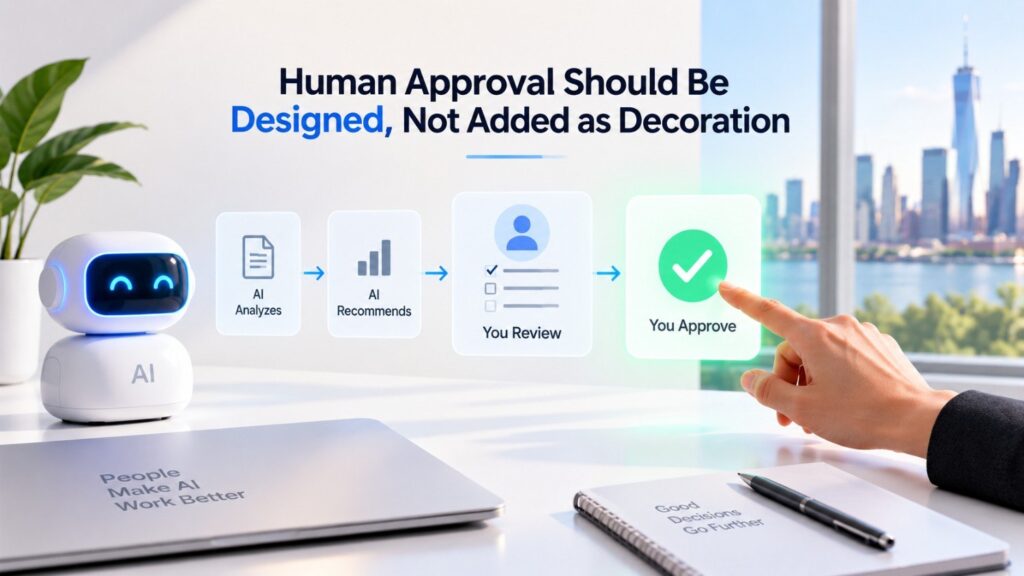
It might prepare outreach for 80 qualified accounts.
A salesperson could then review the 20 highest-value or lowest-confidence cases.
The goal is to use people where uncertainty, risk, relationships, creativity, or judgment are highest.
New York Regulation Makes Governance Especially Important
New York businesses operate in one of the country’s most closely watched environments for automated decision-making.
That does not make AI agents impossible.
It makes controls more important.
Hiring Requires Particular Care
New York City’s Local Law 144 places requirements on covered automated employment decision tools used in certain hiring and promotion decisions. Covered employers or employment agencies can face requirements involving independent bias audits, publication of information, and notices to candidates or employees.
That means a company should not casually connect a general-purpose AI agent to applicant screening and assume it is merely another productivity tool.
Whether a particular system falls under the law depends on how it works and how it is used.
Businesses deploying agents in hiring, promotion, employee evaluation, credit, insurance, healthcare, housing, or other sensitive areas should involve legal and compliance teams early rather than after deployment.
New York City Itself Has Flagged Agent Risks
NYC’s own generative-AI guidance recognizes risks involving accuracy, security, privacy, bias, transparency, accountability, and workforce impact. Newer agent capabilities increase the importance of those concerns because software may be able to act on its output instead of merely displaying it.
A useful rule for businesses is simple:
The greater the consequence of an action, the stronger the control should be.
Finance Could Become New York’s Largest Agent Laboratory
Wall Street is a natural place for AI agents because financial work has three useful characteristics.
The information is often digital.
The labor is expensive.
And many processes are repeated thousands of times across firms.
An investment-banking team may repeatedly collect company information, compare transactions, review filings, update analyses, summarize calls, prepare presentation material, and check numbers.
An agent does not have to decide whether a company should be acquired.
It can handle portions of the work that allow the banker to reach that decision.
Where Finance Teams Should Start
The safer early opportunities tend to sit around decision support rather than uncontrolled decision authority.
Research preparation is a strong example.
An agent can gather approved source material, extract relevant data, organize evidence, identify discrepancies, and prepare questions.
Internal reporting is another.
A system can collect metrics from approved sources, compare actual results with expectations, prepare commentary, and flag numbers that need review.
Compliance teams can also use agents for first-pass review when every final decision remains governed by clear policy.
The objective is to shorten the distance between raw information and human judgment.
Law Firms Could Redesign the Economics of Document Work
Legal services have an especially interesting position in our Agent Leverage Index.
Legal occupations rank only eighth because they represent a smaller share of metropolitan employment than management, finance, sales, or administrative support.
But their average hourly wage is extremely high.
That makes time savings valuable.
Legal teams already spend large amounts of time reviewing agreements, comparing clauses, preparing first drafts, conducting research, checking citations, building timelines, and organizing diligence material.
Agents can increasingly handle parts of that preparation.
The attorney should still own interpretation, strategy, client advice, negotiation, and final legal judgment.
That division could eventually change how law firms price and staff some kinds of work.
Real Estate May Be an Underestimated Agent Market
New York real estate has huge operating complexity.
A building generates leasing questions, maintenance requests, vendor communication, billing issues, inspections, scheduling needs, resident messages, market data, and compliance work.
Many of those activities happen across separate systems.
That creates an ideal environment for agents because much of the value comes from coordination.
A leasing agent could receive an inquiry, answer approved questions, check availability, gather qualification information, schedule a tour, record the interaction, and escalate unusual situations.
A property-operations agent could categorize maintenance requests, ask follow-up questions, create a ticket, notify the appropriate vendor, monitor whether the issue is resolved, and alert a manager when service-level targets are missed.
None of this means the building operates without people.
It means fewer employees have to manually move information from one step to the next.
Advertising and Media Will Use Agents Differently
New York’s media and advertising industries are often discussed through the lens of generative content.
That is only part of the opportunity.
Agents may ultimately be more important in the operational work surrounding content.
A campaign team could use agents to gather performance data from multiple channels, identify unusual changes, prepare testing ideas, generate reporting drafts, maintain campaign documentation, and alert specialists when performance falls outside expected ranges.
A publisher could use agents to prepare research, organize archives, tag content, identify related stories, create internal briefs, and monitor distribution.
Human taste remains difficult to automate.
But the administrative work around creative work is much easier to attack.
That distinction matters.
The best media companies will not necessarily be the ones that publish the most AI-generated content.
They may be the ones that remove the most low-value coordination work from talented human teams.
Healthcare Agents Will Grow First Around Administration
Healthcare presents enormous potential but much higher consequences.
That makes administrative work the more obvious starting point.
Scheduling, patient communication, documentation preparation, insurance information gathering, call-center work, referral coordination, and other back-office processes consume large amounts of staff time.
An agent can help move those processes faster without independently making clinical decisions.
New York’s healthcare sector is enormous. Education and health services employed more than 1.3 million people in New York City in May 2025, making it the city’s largest major employment supersector.
Even modest administrative productivity improvements could therefore have large economic effects.
But healthcare organizations should resist the temptation to move directly from administrative automation into autonomous clinical judgment.
The risk profile is completely different.
What Happens to New York Jobs?
The most tempting AI prediction is also the least useful:
“AI will replace X percent of jobs.”
Jobs are bundles of tasks.
The available evidence shows AI affecting those tasks unevenly.
The Comptroller’s analysis of Claude and O*NET data found that across observed work activity, augmentation remained extremely important. About 65.5% of analyzed tasks involved at least some augmentation, while 57% involved some automation. When tasks were classified by the dominant pattern, roughly 45% were mostly augmentation and only around 19% were mostly automation.
Those categories can overlap at the task level, which is why the broad figures should not be treated as a simple “share of jobs.”
But they reinforce the main point.
The first wave is not simply human or machine.
It is human work being reorganized around machine capability.
Entry-Level Work May Be the Hardest Problem
There is one risk businesses should take especially seriously.
Many junior employees learn through work that looks automatable.
A young investment banker builds basic analyses.
A junior lawyer reviews documents.
A new marketing employee prepares reports.
An entry-level consultant conducts research.
These tasks may not be the highest-value parts of the job, but they help employees develop judgment.
If agents absorb most apprenticeship work, companies will need a new way to train future senior workers.
Deleting junior tasks without redesigning junior learning could produce short-term efficiency and long-term talent problems.
That issue deserves far more executive attention.
Productivity Is More Likely to Show Up Before Large Headcount Cuts
Survey evidence from 2026 supports a productivity-first view.
Research involving hundreds of corporate executives found widespread AI investment but relatively limited expected employment reductions. Businesses reported efficiency and productivity as major motivations, while many still struggled with technology maturity, workforce training, data security, and implementation.
The New York Comptroller similarly reported that among firms using AI, most had implemented it in only a limited number of business functions. Sales and marketing, strategy and business development, and IT were among the most common areas.
That tells business leaders something important.
AI adoption is still early enough that simply installing an enterprise chatbot should not be confused with transformation.
The real gains are likely to come when businesses redesign entire workflows.
The Autonomous Enterprise Needs Better Data Before It Needs More AI
Agents are only as useful as the information they can safely reach.
A company may buy an excellent AI system and still receive poor results because customer information is duplicated, product data is outdated, internal documents lack ownership, permissions are inconsistent, or employees use different definitions for the same metric.
Agents expose these problems quickly.
A human employee knows that a certain spreadsheet is outdated.
An agent may not.
A longtime manager knows which number in the CRM cannot be trusted.
The agent may simply treat it as truth.
That means autonomous-enterprise projects often become data-governance projects.
Companies should see that as a benefit rather than an inconvenience.
AI creates a financial reason to clean systems that should have been cleaned years ago.
The Best Agent Strategy Is Usually Smaller Than Executives Expect
Executives naturally imagine large systems.
The better starting point is often a narrow agent that performs one valuable task extremely well.
One agent could prepare customer-renewal briefs.
Another could check incomplete invoices.
Another could research qualified prospects.
Another could organize compliance evidence.
Another could prepare a daily operations report.
These systems can eventually work together.
But building one dependable workflow is more valuable than building a spectacular general agent that fails unpredictably.
Specialized Agents May Beat One Corporate Super-Agent
Different workflows require different information and authority.
A finance agent should not automatically have access to HR files.
A customer-service agent should not need the ability to modify financial reporting.
A marketing agent should not be able to approve payments.
Specialized agents make those boundaries easier to control.
That suggests the future enterprise may look less like one giant artificial employee and more like a network of specialized digital workers, each operating inside a carefully defined area.
Management Will Need an Agent Operating System
As companies deploy more agents, another problem appears.
Someone has to manage them.
Businesses will need clear answers to basic operating questions.
| Management question | What a mature business should know |
| Who owns the agent? | Named business and technical owner |
| What can it read? | Explicit approved data sources |
| What can it change? | Defined tool permissions |
| When must it stop? | Clear escalation conditions |
| How is quality measured? | Test set and production metrics |
| What happens after an error? | Review, rollback and incident process |
| How are changes approved? | Version and deployment controls |
| How is activity reviewed? | Searchable audit history |
| How is it disabled? | Immediate kill or access-revocation process |
This may sound like IT administration.
It is really operating design.
As agents become responsible for more work, agent governance becomes part of management itself.
What New York CEOs Should Ask Their Teams Right Now
The most useful executive conversation is not “What is our AI strategy?”
That question is too broad.
Ask where the company’s expensive human time is being used to transfer information between systems.
Ask which workflows are repeated hundreds or thousands of times.
Ask which outputs can be measured.
Ask where employees already use AI without a formal company system.
Ask which processes would become dramatically faster if the first 70% of the work arrived already prepared.
Those questions lead to real projects.
A general AI strategy often leads to presentations.
The Autonomous Enterprise Will Not Arrive All at Once
Businesses should not expect a clean moment where they “become autonomous.”
The shift will happen workflow by workflow.
Customer service may move first.
Research may follow.
Then reporting.
Then internal operations.
Then finance preparation.
Then compliance.
Some high-risk decisions may remain human-controlled for a very long time.
That is fine.
The goal is not to maximize the percentage of work done by machines.
The goal is to build a better business.
What NYC Tech Journal Will Be Watching Through 2027
Several signals will tell us whether agents are actually becoming a new operating layer rather than another software trend.
The first is tool access.
When enterprise AI products move from reading information to securely taking actions across CRMs, finance systems, ticketing tools, communications platforms, and internal applications, the economic impact becomes much larger.
The second is usage duration.
Short AI conversations suggest assistance. Long-running jobs that execute several steps suggest delegation. Anthropic’s 2026 data already point toward increased long-running agent activity.
The third is budget ownership.
If AI remains an experimental technology budget, adoption may stay fragmented. When operating teams begin paying for agents because those agents own measurable workflows, the market has moved to another stage.
The fourth is pricing.
Traditional software is often priced per user.
Agent software may increasingly be priced around work performed: a resolved customer issue, a researched account, a processed document, a completed review, or another measurable outcome.
That changes the software business model because customers will compare AI spending directly with the cost and quality of the work.
The fifth is organizational redesign.
The deepest evidence of autonomous-enterprise adoption will not be a company’s press release announcing an AI partnership.
It will be a department changing how responsibilities are divided because an agent now handles part of the operating process.
New York Has the Right Conditions for This Shift
NYCEDC has described New York as a major center for applied AI, supported by thousands of AI startups, a large AI-ready workforce, deep investor networks, and unusually strong customer industries. The city has also been investing in programs intended to increase practical AI adoption among New York businesses.
But New York’s biggest advantage may not be its number of AI startups.
It may be its number of complicated businesses.
AI agents become valuable where workflows are expensive.
New York has investment banks, asset managers, insurers, law firms, real estate operators, healthcare systems, advertising agencies, publishers, retailers, consultancies, large corporate headquarters, and tens of thousands of smaller businesses.
All of them contain work that moves information from one person or application to another.
That is exactly what agents are beginning to attack.
The Final Takeaway
The autonomous enterprise is easy to misunderstand.
It is not a company where robots replace the staff.
It is a company where software can increasingly take responsibility for clearly defined pieces of digital work.
Our original analysis suggests that New York’s largest economic opportunity may not sit only inside technology occupations. Management, business and financial operations, sales, administration, education, healthcare, law, and other large occupational groups contain significant potential leverage because they combine valuable employee time with tasks AI systems can increasingly support.
Even more interesting is the apparent gap between New York’s heavy individual AI usage and its more cautious formal business adoption.
That gap is where the next enterprise opportunity may sit.
New Yorkers have already learned how to ask AI for help.
The next question is whether New York businesses can safely teach AI to do the work.
The companies that succeed will not start by trying to automate everything.
They will find one expensive, repeated, measurable workflow. They will map it carefully. They will give an agent limited access. They will test it beside humans. They will measure real outcomes. They will control high-risk decisions. Then they will expand only after the evidence proves that expansion makes sense.
That process sounds less dramatic than the idea of an autonomous company.
It is also much more likely to work.
And if enough New York businesses follow that path, the result could be a much larger transformation than another generation of productivity software.
It could change the basic unit of enterprise work—from a task a person must complete to an outcome a person can delegate.
Research Methodology and Source Notes
| Source | Data used in this article | Why it matters |
| U.S. Bureau of Labor Statistics, May 2025 NYC metro occupational employment and wage estimates | Employment shares and mean hourly wages | Base data for the Agent Leverage Index |
| U.S. Bureau of Labor Statistics, NYC supersector employment | NYC employment in finance, information and professional/business services | Used to calculate the 1.5235 million-job, 31.4% business-core estimate |
| NYC Comptroller, 2025 analysis of Anthropic Economic Index and O*NET | AI task coverage by occupation and augmentation/automation patterns | Third variable in the Agent Leverage Index |
| NYC Comptroller, February 2026 | New York occupation-level Claude representation | Used to compare current usage with potential leverage |
| NYC Comptroller, 2026 AI fiscal analysis | Business AI adoption, Claude-use share, barriers and current business deployment | Basis of the worker-to-firm adoption-gap analysis |
| Anthropic Economic Index, 2026 | Business/API automation patterns and longer agent sessions | Evidence for movement from assistance toward delegated workflows |
| Federal Reserve Bank of Richmond / Atlanta Fed / Duke CFO Survey | Corporate AI investment, productivity and workforce expectations | Broader business-adoption context |
| NYC Department of Consumer and Worker Protection | Local Law 144 requirements | NYC governance context for covered employment AI systems |
The Agent Leverage Index, the 31.4% NYC business-core calculation, the top-six 45.1% employment calculation, the roughly 54.9% wage-weighted concentration estimate, and the worker-to-firm adoption comparison are original NYC Tech Journal analyses produced by combining the public datasets above. They should be read as analytical indicators rather than forecasts of job displacement or precise measurements of autonomous-agent adoption.