

Accounting software is starting to cross an important line.
For years, finance technology helped accountants work faster. A tool could scan an invoice, suggest a category, match a receipt, pull numbers into a dashboard, or generate a report. The accountant still had to move the work from one step to the next.
AI agents are changing that model.
The new generation of accounting software is being built to receive an assignment, collect information from several systems, make a series of decisions, complete parts of the work, flag unusual cases, document what happened, and hand the result back to a human reviewer.
That is much closer to having another member of the finance team than having another software feature.
New York has quietly become one of the most interesting places to watch this shift. Companies such as Basis, Tabs, Monk, Nominal, Finaloop, Trullion, Vic.ai and uiAgent are attacking different parts of the finance stack. Some are focused on accounting firms. Others are targeting corporate controllers, ecommerce operators, accounts receivable teams or large enterprises.
The approaches are different, but the direction is remarkably similar.
Software is moving from helping finance teams find the answer toward helping them complete the work.
That difference could reshape how accounting departments are staffed, how month-end close works, how companies collect cash, how audits are prepared and how accounting firms increase capacity without simply hiring more people.
The important question is therefore not whether accountants will use AI.
They already are.
The more useful question for New York businesses is this:
Which pieces of accounting work are ready to move from human-operated software to supervised autonomous systems?
This article examines that question using original NYC Tech Journal analysis of publicly available company, funding, employment and product data.
The Short Version: Accounting AI Is Moving From Tools to Workers
The first wave of financial automation was mostly rule based.
“If invoice amount is below X, route it here.”
“If this merchant appears, use this expense code.”
“If the numbers match, mark the transaction as reconciled.”
These rules created useful efficiencies, but they struggled whenever the real world became messy.
And accounting is extremely messy.
Contracts have unusual clauses. Payments arrive without clean references. Customers dispute invoices. Account descriptions change. Companies restructure entities. Auditors ask unexpected questions. Revenue recognition depends on context. Supporting evidence might be hidden inside an email, PDF, spreadsheet or ERP record.
Traditional automation handles the happy path well.
AI agents are being designed for everything surrounding the happy path.
Basis says its agents can work for hours on accounting tasks and perform end-to-end work for accounting firms. The company has demonstrated systems handling activities ranging from journal entries and reconciliations to tax work.
Tabs has taken a similar idea into revenue operations. Its platform handles workflows around contracts, invoicing, collections, payments, revenue recognition and reporting. In 2025, the company launched AI agents specifically for billing and collections.
Finaloop describes specialized agents for transaction processing, bank reconciliation, inventory accounting and lending-related accounting. Importantly, its system explicitly sends complex exceptions to humans rather than pretending every accounting decision can safely be automated.
Nominal is applying agents to close, consolidation, reconciliation and reporting while working with existing enterprise systems.
Monk is attacking accounts receivable. Trullion is applying agentic AI to accounting and audit workflows. uiAgent is building agents around audit, tax and client accounting services. Vic.ai has been pursuing autonomous accounting in accounts payable for years.
The phrase “autonomous finance team” should therefore not be interpreted as a finance department with no people.
The emerging model looks more practical.
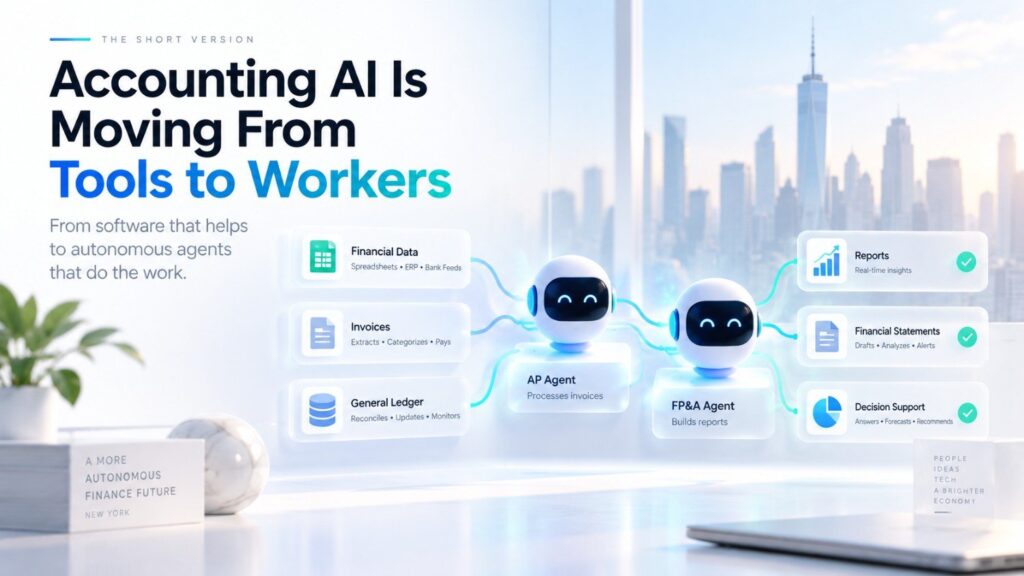
Machines execute increasingly large blocks of routine work. Humans define rules, approve sensitive actions, investigate exceptions, review estimates and remain accountable for the final financial output.
That distinction matters.
Original Research: Building the NYC Accounting Agent Map
To understand what is actually happening in New York, NYC Tech Journal created a working dataset of companies building AI-driven accounting or closely related finance workflows.
The goal was not to produce the longest possible startup list. It was to identify companies with meaningful evidence that software was moving beyond chat or simple suggestions toward the execution of accounting work.
Our Inclusion Method
A company was included in the main landscape when public evidence supported three conditions.
First, the company needed a meaningful New York headquarters or operating base.
Second, accounting, finance operations, audit, receivables, revenue management or a closely related workflow needed to be central to the product.
Third, the product needed to show meaningful automation or agent-like execution rather than simply offering a chatbot over financial information.
This produced a core working set of nine active companies or emerging platforms:
| Company | Primary area examined | New York evidence | Agent or autonomous-work evidence |
| Basis | Accounting firms, tax, audit, CAS | New York office and recruiting | Long-running agents completing accounting work |
| Tabs | Billing, AR, revenue recognition | NYC HQ | AI agents for billing and collections |
| Monk | Accounts receivable | New York office | AI-led contract-to-cash automation |
| Nominal | Close, consolidation, reporting | New York HQ | Agents executing accounting workflows |
| Finaloop | Ecommerce accounting | Brooklyn HQ | Specialized finance and operations agents |
| Trullion | Accounting and audit | New York HQ | Trulli agentic AI assistant |
| Vic.ai | Accounts payable | New York HQ | Autonomous accounting platform |
| uiAgent | Accounting firms | New York HQ | End-to-end accounting agents |
| Exponent | Franchise finance and accounting | New York HQ | AI-powered accounting platform |
Company locations and product descriptions were verified primarily through company websites, careers pages, legal pages and financing announcements.
There are important edge cases.
Rillet is one of the fastest-growing AI-native accounting companies in the market, and a May 2025 funding announcement was issued from New York. However, its August 2026 Series C announcement identified the company from San Francisco. To keep this analysis strict rather than stretching the definition of “New York startup,” Rillet is discussed as a market comparator rather than counted in the core NYC sample.
WiseLayer is another important New York company because it built task-specific AI workers for accruals, payroll accounting, reconciliations and related work. But BlackLine acquired WiseLayer in December 2025, so it is treated as evidence of acquisition demand rather than an independent active startup in the 2026 sample.
Ramp is headquartered in New York and is increasingly agentic across spend, AP, accounting and finance operations. But because it is now a much larger private finance platform rather than an early-stage accounting startup, we use Ramp mainly as a scale benchmark.
That distinction keeps the comparison more useful.
Original Finding #1: At Least $495 Million Has Already Gone Into Eight Comparable NYC Accounting-Automation Companies
We next examined publicly disclosed financing.
For comparability, this calculation uses eight companies for which reasonably clear cumulative venture-funding numbers could be reconstructed from public announcements.
Exponent was excluded from this funding total because its latest announcement combines equity financing with credit facilities. Ramp was excluded because its much larger financing history would overwhelm the startup cohort.
The result is significant.
Verified Minimum Funding in the NYC Sample
| Company | Minimum publicly disclosed funding used in analysis |
| Basis | $137.6M |
| Vic.ai | $115M |
| Tabs | $91M+ |
| Finaloop | $55M |
| Trullion | $34M |
| Nominal | $29.2M |
| Monk | $29M |
| uiAgent | $4.6M |
| Total | At least $495.4M |
Basis raised $3.6 million in 2023, $34 million in 2024 and $100 million in February 2026, producing $137.6 million across those disclosed rounds.
Vic.ai reported $115 million in total capital after its $52 million Series C.
Tabs had raised more than $91 million after its $55 million Series B.
Finaloop reported $55 million in total funding following its $35 million Series A.
Trullion reported $34 million raised through its 2023 financing.
Nominal publicly described $9.2 million of seed financing followed by a $20 million Series A, giving a minimum of $29.2 million in the rounds included here.
Monk’s $25 million Series A took its total financing to $29 million.
uiAgent raised a $4.6 million seed round in September 2025.
Chart: Publicly Verified Funding in the Comparable NYC Cohort
Basis $137.6M | ████████████████████████████
Vic.ai $115.0M | ███████████████████████
Tabs $91.0M | ███████████████████
Finaloop $55.0M | ███████████
Trullion $34.0M | ███████
Nominal $29.2M | ██████
Monk $29.0M | ██████
uiAgent $4.6M | █
The concentration is almost as interesting as the total.
Basis, Vic.ai and Tabs represent about 69% of the $495.4 million tracked in this comparable group.
The top five represent about 87%.
Chart: How Concentrated Is the Capital?
Top 3 companies 69.4% | ████████████████████████████
Remaining 5 30.6% | ████████████
This tells us something about how investors appear to view accounting AI.
Money is not being spread evenly across hundreds of lightweight tools. The larger financing rounds have gone toward platforms that sit close to essential financial processes: the ledger, revenue, accounts payable, tax, audit and the monthly close.
That is logical.
The closer software gets to the financial statement, the more valuable reliability becomes.
It also becomes much harder to build.
Original Finding #2: Close and Reporting Are Becoming the Center of the Accounting-Agent Battle
We manually coded the nine-company active landscape according to publicly described workflow coverage.
This is not a measurement of revenue or market share. A company received credit for a category when a current public product description clearly showed meaningful functionality in that workflow.
NYC Accounting-Agent Workflow Map
| Workflow | Companies in sample with meaningful public product evidence | Share of 9-company sample |
| Close, reconciliation or general-ledger work | 5 | 56% |
| Reporting or forecasting | 5 | 56% |
| Payables or spend workflows | 3 | 33% |
| Audit or compliance workflows | 3 | 33% |
| Receivables or collections | 2 | 22% |
| Billing or revenue recognition | 2 | 22% |
| Tax | 2 | 22% |
| Vertical operating/accounting workflows | 2 | 22% |
The classification is based on the public product capabilities of Basis, Tabs, Monk, Nominal, Finaloop, Trullion, Vic.ai, uiAgent and Exponent.
Chart: Where NYC Accounting Agents Are Concentrating
Close / reconciliation / GL 56% | ██████████████████████
Reporting / forecasting 56% | ██████████████████████
Payables / spend 33% | █████████████
Audit / compliance 33% | █████████████
Receivables / collections 22% | █████████
Billing / revenue recognition 22% | █████████
Tax 22% | █████████
Vertical accounting workflows 22% | █████████
Two conclusions stand out.
First, accounting agents are moving toward the center of the finance process.
Reconciliation, close and reporting are not minor administrative features. They are the machinery that converts raw financial activity into numbers leadership can actually use.
Second, the market is still fragmented enough for specialization to matter.
There is no single New York startup dominating every category.
That may remain true for some time because the knowledge needed to automate a tax return is different from the knowledge needed to collect an overdue invoice or calculate ecommerce inventory costs.
Original Finding #3: New York Has Powerful Economics for Accounting Automation
Why would New York become a major market for this technology?
Labor economics provide part of the answer.
The New York-Newark-Jersey City metro had approximately 127,360 accountants and auditors in May 2023, according to the Bureau of Labor Statistics. Their average annual wage was $119,050. Nationally, accountants and auditors averaged $90,780.
That makes the New York metro mean wage roughly 31% higher than the national average.
The local concentration of accounting jobs was also unusually high. Accountants represented approximately 13.41 jobs per 1,000 workers in the New York metro versus 9.46 nationally, producing a location quotient of 1.42.
New York Accounting Economics
| Measure | New York metro | United States | NYC premium / difference |
| Accountants and auditors, 2023 | 127,360 | 1.44M | — |
| Employment per 1,000 jobs | 13.41 | 9.46 | ~42% higher concentration |
| Mean annual accountant wage | $119,050 | $90,780 | ~31% higher |
| Mean hourly accountant wage | $57.23 | $43.65 | ~31% higher |
Using BLS employment and mean-wage figures, NYC Tech Journal calculates that these 127,360 metro-area accounting and audit jobs represented roughly $15.16 billion in annual wage-equivalent labor.
That is not the same thing as saying businesses spend exactly $15.16 billion on accounting employees. The BLS estimate covers a metro region larger than New York City, does not include every form of compensation, and excludes some workers. But it gives us a useful measure of the scale of professional accounting labor in the region.
The economics become even easier to see at the hourly level.
At the 2023 mean hourly wage, one hour of work across 127,360 accountants represents approximately $7.29 million of labor capacity.
If technology ultimately released even 5% of that annual labor capacity for more valuable work, the wage-equivalent productivity pool would be roughly $758 million per year.
Again, this is not a prediction of layoffs or direct cash savings.
It is a way of showing why companies are willing to invest heavily in systems that remove low-value manual work.
New York’s broader finance economy strengthens the argument. BLS data for May 2025 showed business and financial operations workers in the metro earning an average $57.35 per hour versus $45.78 nationally, a premium of roughly 25%.
High labor costs create strong incentives to automate low-value activity.
But New York also has something equally important: a huge concentration of the people who understand the work.
That gives accounting-AI startups access to potential customers, finance leaders, accountants, auditors and domain experts within the same market.
Basis — Building Long-Horizon Agents for Accounting Firms
Basis represents one of the clearest examples of accounting software becoming labor-like.
Rather than focusing mainly on helping corporate employees search financial data, Basis has concentrated on the accounting profession itself.
The company says its agents can operate for hours and perform end-to-end accounting work. Its publicly described use cases include journal entries, reconciliations, technical accounting memos and increasingly complex tax workflows.
That makes Basis particularly important because accounting firms have a different problem from ordinary software buyers.
Their product is professional labor.
An accounting firm that cannot hire enough qualified people cannot simply sell more seats of software. Its ability to grow depends on how much work each accountant can reliably complete.
Agents potentially change that equation.
Why Basis Could Matter to Accounting Firms
Imagine a firm with 100 accountants.
If every accountant must manually perform every reconciliation, inspect every support document and prepare every first draft, revenue capacity grows roughly with headcount.
Now imagine each accountant supervises several agent-run workflows.
The firm’s constraint starts moving away from the number of available hands and toward the amount of professional judgment available for review.
That is a very different business model.
Basis’ $100 million Series B in February 2026 valued the company at $1.15 billion, following its earlier $3.6 million seed and $34 million Series A.
The valuation is notable, but the product direction matters more.
Basis is betting that accounting agents eventually become a capacity layer underneath accountants.
What Businesses Should Learn From Basis
The biggest lesson is that AI becomes more valuable when it can stay with a task.
A system that answers one question and stops does not remove much process overhead.
A system that can inspect several documents, compare them with prior records, perform calculations, create workpapers and return a review-ready package removes an entire chain of handoffs.
That is where the economics change.
Tabs — Turning Contract-to-Cash Into an Agent Workflow
While Basis starts from the accounting profession, Tabs starts from revenue.
That is a particularly painful part of finance because business models have become more complicated.
One customer might pay a fixed annual subscription. Another has usage-based pricing. Another has milestones. Another has multiple products, discounts or custom contract terms.
Those commercial details eventually need to become invoices, receivables, revenue schedules, forecasts and accounting entries.
Tabs built its platform around that path.
The company says its system handles contract review, invoicing, receivables, payments, revenue recognition, collections, reporting, cash forecasting and other revenue workflows.
In September 2025, Tabs raised a $55 million Series B and announced AI agents for billing and collections. At the time, the company said it served more than 200 customers and was on track to automate more than $1 billion in annual invoice volume.
That is an important marker.
Agentic finance is moving into workflows that communicate directly with customers and control the timing of cash.
Why Revenue Is a Natural Agent Workflow
Accounts receivable often involves many small decisions.
Was the invoice sent?
Did the customer receive it?
Is there a purchase-order mismatch?
Did they raise a dispute?
Has the payment arrived?
Can the payment be matched automatically?
Should somebody follow up again?
Traditional software records these events.
An agent can potentially act between them.
That is the deeper change.
The Strategic Lesson From Tabs
CFOs should look for workflows where employees spend most of their time moving information between systems.
Those workflows often contain more automation value than tasks where the employee is already spending most of the time making high-level judgments.
Contract-to-cash is full of handoffs.
That makes it fertile ground.
Monk — Making Accounts Receivable Autonomous
Monk is focused even more tightly on getting businesses paid.
The company raised a $25 million Series A in April 2026, taking total funding to $29 million. Monk said its platform automates the contract-to-cash lifecycle and reported average customer outcomes including lower days sales outstanding and substantial time savings for AR teams.
Its own 2026 materials describe collections, cash application and forecasting as core parts of the system, with billions of dollars of receivables managed through the platform.
AR is particularly interesting for agents because the work sits at the intersection of accounting and communication.
A collection process cannot simply be “send reminder every seven days.”
Different customers need different treatment.
One customer may have a genuine dispute. Another forgot to send the payment. Another needs the invoice uploaded to a portal. Another paid but used the wrong reference.
This is where language models can add something traditional workflow software struggled to provide.
They can reason over messy communication.
The KPI That Matters Is Not Number of Emails Sent
Businesses evaluating collections agents should avoid measuring automation by activity.
Sending 10,000 automated emails is not necessarily useful.
The better questions are whether days sales outstanding falls, whether aging improves, whether collection rates increase, whether fewer invoices require human handling and whether customer relationships remain healthy.
That principle applies across accounting agents.
Measure financial outcomes rather than machine activity.
Nominal — Building an Intelligence Layer Around Existing ERPs
Some startups want to replace old financial systems.
Nominal has taken another route.
Its product sits around existing ERPs and applies AI agents to accounting operations such as consolidation, reconciliation, intercompany work and reporting.
This matters because enterprise accounting systems are extremely difficult to replace.
A large company may have spent years configuring NetSuite, SAP, Workday or another ERP.
There are integrations, internal controls, historical data and reporting processes wrapped around that environment.
Replacing everything to gain AI capabilities can create more risk than value.
An intelligent layer that works with the existing system may therefore be an easier path to adoption.
Nominal said in May 2026 that its technology had saved finance teams more than 50,000 hours of manual accounting work. The company describes its category as “Agentic Performance Management.”
Why Overlay Systems Could Win Enterprise Buyers
The ERP is usually the system of record.
The agent can become the system of action.
That separation is strategically attractive.
The existing database continues holding the official financial information. The agent works across those records, applies rules, performs calculations and creates outputs.
The company does not need to rebuild its finance infrastructure before testing automation.
For many New York enterprises, that could be the fastest path to value.
Finaloop — What Happens When Agents Understand a Specific Business Model
Finaloop takes a different approach again.
Instead of serving every kind of company, it has built around ecommerce and consumer brands.
Its platform combines accounting, inventory, reporting and operations. Finaloop says its AI continuously categorizes transactions, reconciles financial accounts, monitors inventory and generates financial reports based on live financial data.
The company is headquartered in Brooklyn and raised $35 million in 2024, taking total funding to $55 million.
Finaloop is particularly useful for understanding the possible future of vertical accounting agents.
An ecommerce company does not only need a general ledger.
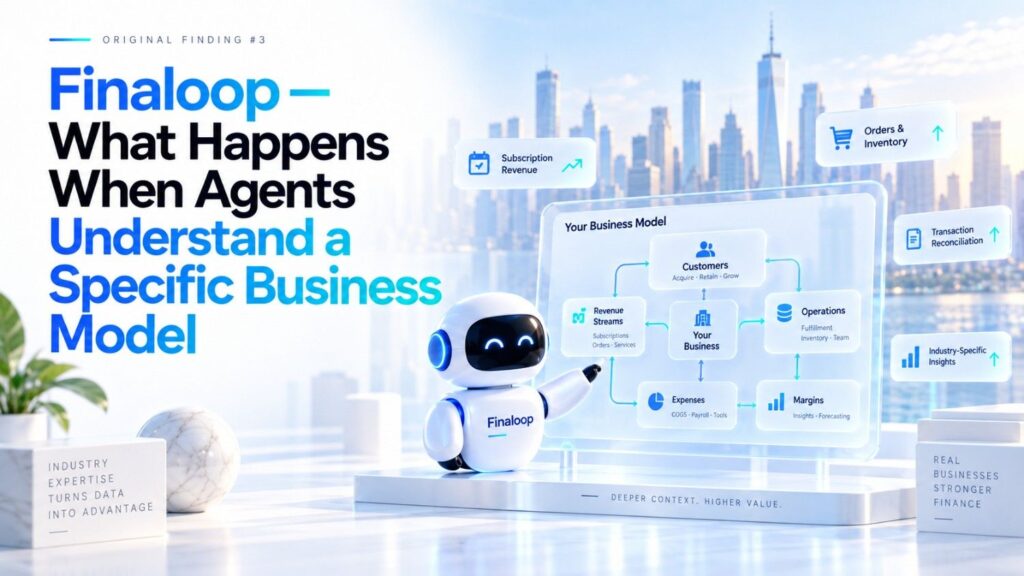
It must connect Amazon, Shopify, payment processors, advertising platforms, warehouses, inventory records, returns, shipping and cost of goods sold.
The accounting system becomes much stronger if it understands that operating context.
Vertical Knowledge May Become a Bigger Moat Than the Model
Large language models are becoming widely available.
Business context is not.
An agent that knows how ecommerce inventory works can make decisions a generic finance assistant cannot safely make.
The same logic applies to construction accounting, healthcare reimbursement, franchise accounting, fund accounting and property management.
That may create a second major startup opportunity.
Instead of one universal AI CFO, we may get dozens of finance systems built around specific industries.
Trullion — Applying Agentic AI to Accounting and Audit Evidence
Trullion was founded in 2019 and is headquartered in New York. Its products have focused on areas including lease accounting, revenue recognition and audit automation.
In May 2025, the company introduced Trulli, an agentic AI assistant designed for accounting professionals.
Trullion says Trulli helps with workflow automation, document analysis and policy interpretation while producing source-backed and auditable results.
That last part deserves attention.
Accounting AI cannot be evaluated in the same way as a consumer chatbot.
A finance system cannot simply provide a convincing answer.
A reviewer often needs to know where the answer came from.
Which contract clause?
Which accounting policy?
Which invoice?
Which transaction?
Which supporting schedule?
Agentic accounting therefore creates demand for something traditional generative AI products do not always prioritize: evidence.
Auditability Could Become a Product Feature, Not Just a Compliance Requirement
The strongest accounting agents may eventually compete on the quality of their evidence trail.
A controller should be able to inspect what the agent looked at, what rule it applied, what calculation it performed, what assumption it made and who approved the final action.
That is not administrative overhead.
It is part of the product.
Trullion said in October 2025 that its products served more than 3,000 companies globally, including major corporations and accounting firms.
The scale suggests accounting AI is already well beyond experimental demos.
Vic.ai — An Earlier Bet on Autonomous Accounts Payable
Vic.ai is important because it entered autonomous accounting before the current agent boom.
The New York-headquartered company raised a $52 million Series C in 2022, bringing total capital raised to $115 million. Its stated goal was to expand an AI platform for autonomous accounting and financial intelligence.
The company’s core territory has been accounts payable.
AP is one of the clearest early targets for finance automation because invoices arrive in large numbers, contain repeatable information and must travel through predictable processes.
But the process still contains judgment.
Is this invoice legitimate?
Which entity owns it?
What GL category should apply?
Does it match the purchase order?
Is the amount unusual?
Who should approve it?
That mix of repetition and judgment is exactly where agentic systems become useful.
AP Shows the Difference Between Automation and Autonomy
Traditional invoice software extracts fields.
Autonomous AP tries to understand the invoice’s place within the broader process.
That distinction can sound small.
Operationally, it is enormous.
Extraction saves keystrokes.
Execution removes steps.
uiAgent — Building Agents Directly for Accounting Firms
uiAgent is another New York company focused on the accounting profession rather than a general corporate finance buyer.
The company raised a $4.6 million seed round in September 2025. It describes its software as an AI-agent automation platform covering Client Accounting Services, tax and audit workflows.
The accounting-firm focus is strategically important.
Public accounting firms have large pools of repeated work across many clients.
The same types of documents, reconciliations, tests and schedules appear again and again.
That repetition gives agents something valuable: patterns.
However, every client also has slightly different facts.
That is where rigid automation breaks down.
An agent can potentially preserve the reusable workflow while adapting to the specific client.
The Accounting Firm Could Become an Agent Management Business
If this model works, accounting-firm management may change.
Partners will still win clients and sign off on important work.
Managers will still apply professional judgment.
But a growing portion of staff activity could shift toward configuring workflows, reviewing agent output, investigating exceptions and deciding when automation should stop.
That requires a different management skill set.
Accounting expertise remains essential.
The way the expertise is applied changes.
Exponent — Vertical AI Accounting for Franchise Operators
Exponent illustrates another emerging branch of the market.
The New York company is building financial infrastructure for multi-location franchise operators. Its platform combines financing, corporate cards and an AI-powered accounting suite.
Its May 2026 financing announcement said the company had raised more than $40 million in combined equity and credit capital. The equity portion of the new Series A was $7.5 million. Exponent said its AI accounting suite was expected to begin piloting with operators around the end of summer 2026.
The interesting idea here is not simply adding AI to bookkeeping.
It is combining financial products with accounting context.
A franchise financial platform can potentially understand individual locations, card transactions, financing obligations, expansion activity and operating data at the same time.
That creates the foundation for much more useful agents.
The agent is no longer looking at a transaction in isolation.
It understands why the transaction exists.
Ramp Shows Where the Market Could Go at Scale
Ramp does not fit neatly into an early-stage startup ranking anymore, but its 2026 strategy offers a useful preview of where larger finance platforms are heading.
Ramp’s current positioning describes agents operating across finance workflows, and its 2026 product releases include Ramp Stack, an AI operating system specifically for accounting firms.
Stack is designed to run reconciliations, schedules and monthly reporting from workbooks to the ledger.
Ramp also launched Applied AI Solutions for enterprises, covering workflows including AP, procurement, close, accounts receivable and expense management.
Perhaps even more interesting is Ramp’s work around financial controls for software agents.
Ramp describes giving agents their own identities, owners, budgets, permissions, payment capabilities and audit trails.
That points toward a problem finance leaders will face soon.
AI agents will not merely prepare accounting records.
Some will spend money.
At that point, businesses will need financial controls for machines just as they need controls for employees.
Three Product Architectures Are Emerging
Across the NYC companies examined, three broad architectures appear.
| Model | How it works | Representative NYC examples |
| Agent layer | Works over existing finance/accounting systems | Basis, Nominal, uiAgent |
| Workflow system | Owns a major operational finance process | Tabs, Monk, Vic.ai, Trullion |
| Vertical financial operating system | Combines accounting with industry-specific operational data | Finaloop, Exponent |
None is automatically better.
The right architecture depends on the customer.
Agent Layers Reduce Replacement Risk
A large enterprise probably does not want to replace its entire ERP merely to use AI.
An agent layer can deliver automation while preserving the existing system of record.
The challenge is integration quality.
If an agent cannot reliably access the correct data and write back clean information, its intelligence does not matter.
Workflow Systems Can Go Deeper
A company that owns the complete AR or AP process has more context.
It sees what happened before the current task and what needs to happen afterward.
That gives agents a better environment for execution.
Vertical Systems Can Understand Why the Numbers Exist
The biggest advantage of a vertical platform is context.
An ecommerce accounting system knows about inventory and fulfillment.
A franchise finance platform knows about locations and unit economics.
Domain context makes agent decisions more accurate and more useful.
The Biggest Opportunity Is Not Replacing Accountants
Much of the public discussion around accounting AI focuses on job replacement.
That is probably the wrong starting point for business leaders.
The immediate problem inside many finance departments is not that there are too many accountants.
It is that experienced accountants spend too much time on low-value process work.
The profession has also faced talent-pipeline pressure. AICPA data showed accounting degrees awarded fell 6.6% in the 2023–2024 academic year, although more recent enrollment trends have improved. Four-year undergraduate accounting enrollment rose 8.9% year over year in spring 2026.
That means companies should not build an AI strategy around the assumption that humans disappear.
A better strategy is to redesign the division of labor.
Agents handle high-volume execution.
Junior employees learn by reviewing well-documented work rather than spending every hour copying information.
Experienced accountants investigate exceptions.
Controllers own policy.
CFOs use faster and cleaner information to make decisions.
That is a much more realistic version of autonomous finance.
Which Accounting Workflows Should New York Companies Automate First?
The safest place to start is not the workflow that looks most impressive in a demo.
Start with work that is frequent, expensive and measurable.
A good accounting-agent workflow usually has five characteristics.
Inputs are available digitally. The workflow happens often. There is a reasonably clear definition of correct output. Humans currently spend meaningful time moving information around. Errors can be detected before they create irreversible damage.
Reconciliations are a strong example.
So are invoice processing, standard accruals, collections follow-up, reporting package preparation and some revenue workflows.
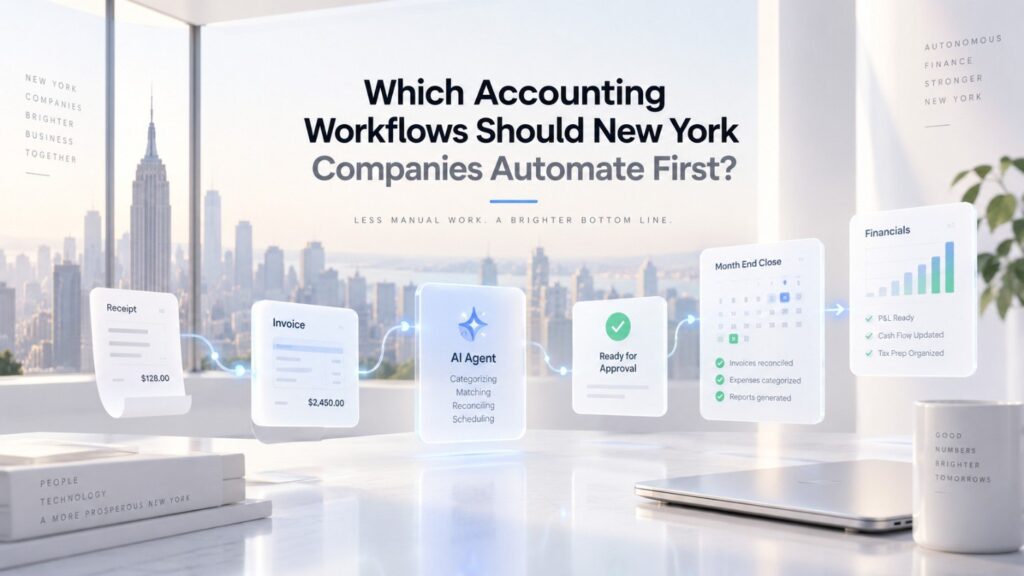
A complicated acquisition accounting judgment is a much worse first project.
A Practical Workflow Selection Table
| Workflow | Automation potential | Risk if wrong | Good first agent project? |
| Bank reconciliation | High | Medium | Yes |
| Invoice coding | High | Medium | Yes |
| Collections follow-up | High | Medium | Yes |
| Standard accrual preparation | High | Medium | Yes |
| Monthly reporting package | High | Medium | Yes |
| Revenue recognition | Medium-high | High | With controls |
| Tax-return preparation | Medium-high | High | With expert review |
| Audit evidence collection | High | Medium-high | Yes |
| Complex accounting policy judgment | Lower | Very high | Usually no |
| Final external reporting sign-off | Low | Very high | No |
The goal is not maximum autonomy on day one.
The goal is maximum reliable value.
A Practical 90-Day Accounting-Agent Plan
Companies do not need to spend a year creating an AI strategy document.
They need to select one painful workflow and measure whether an agent improves it.
Days 1–30: Measure the Work Before Automating It
Choose one workflow.
Map every step.
Measure how many transactions enter the process, how many employee hours are used, how often humans need to correct something, how long the workflow takes and which systems contain the necessary information.
Without this baseline, AI ROI becomes marketing.
Suppose a reconciliation process consumes 150 hours every month.
If an agent reduces that to 40 hours while maintaining accuracy, the improvement is obvious.
If nobody recorded the original 150 hours, the company will struggle to prove anything changed.
Days 31–60: Run the Agent Beside the Existing Process
Do not immediately remove the existing control structure.
Run the new system in parallel.
Let the agent produce its result while employees complete the normal workflow.
Compare the two outputs.
The most useful measure at this stage is not simply accuracy.
Track the kinds of errors.
A system that makes one predictable mistake can often be controlled.
A system that makes unpredictable mistakes across many areas is much harder to trust.
Days 61–90: Move Humans to Exception Review
Once reliability is established, change the operating model.
Employees should stop touching every transaction.
Instead, define the conditions that require review.
An invoice over a certain amount may require approval.
An unusual vendor needs investigation.
A reconciliation difference above a threshold needs an accountant.
A revenue contract with unfamiliar language goes to technical accounting.
Everything else moves automatically.
This is where genuine productivity appears.
Human Approval Should Be Designed Into the System
“Human in the loop” has become an easy phrase to use.
The details matter more than the phrase.
A finance leader should know precisely where the human sits.
Does the agent ask for approval before posting an entry?
Does the employee review every transaction?
Only high-value transactions?
Only low-confidence cases?
Can the agent move money?
Can it communicate with customers?
Can it create a journal entry but not post it?
Can it post within one subsidiary but not another?
Those are product-design questions and accounting-control questions at the same time.
Finaloop, for example, publicly describes a system where AI handles routine activity while complex exceptions are escalated for human review.
Ramp’s agent infrastructure similarly emphasizes ownership, spending permissions and audit trails.
That is the direction finance teams should demand.
The KPI Dashboard Every Finance Team Should Build
Most companies will make a mistake if they judge accounting AI by hours saved alone.
Speed matters.
But accounting is also about reliability.
A useful dashboard needs both.
| KPI | What it tells you |
| Automation rate | Share of transactions completed without human touch |
| Exception rate | Share requiring human investigation |
| Human correction rate | How often completed agent work is changed |
| Material error rate | Whether errors could affect meaningful financial outcomes |
| Average handling time | Human minutes still required per item |
| Cycle time | Time from workflow start to completion |
| Close duration | Number of days required to close |
| Reconciliation backlog | Unfinished reconciliation volume |
| DSO | Effectiveness of receivables automation |
| Aging distribution | Whether overdue receivables are improving |
| Evidence completeness | Whether each action has supporting records |
| Cost per transaction | Total operating cost of the workflow |
| Escalation quality | Whether genuinely difficult cases reach the right humans |
The most important metric may eventually become exception rate.
Why?
Because autonomous finance becomes economically powerful when humans no longer need to review the routine majority.
If an agent “automates” 90% of data entry but employees still need to inspect every result, the workflow has not really become autonomous.
Accounting Agents Need an Audit Trail of Their Own
Traditional accounting controls answer questions such as who approved a payment or who posted a journal entry.
Agentic systems add new questions.
Which model made the recommendation?
Which source records did it use?
Which instructions governed its decision?
What confidence threshold was applied?
Did the system change after the transaction was processed?
Was a human required to approve the action?
Could the agent access anything outside its authorized scope?
These questions will matter to controllers, auditors and security teams.
They should be considered before deployment, not after the first incident.
The strongest accounting-agent platforms will therefore need to combine intelligence with governance.
A brilliant system without controls is difficult to deploy.
A controlled system with mediocre performance is not valuable either.
The winner needs both.
Agents Will Change the Monthly Close More Than the Dashboard
Many early AI finance tools focused on asking questions about financial data.
“What happened to marketing spend?”
“Why did gross margin fall?”
“Show me our biggest vendors.”
Those features are useful.
But they sit after the hard accounting work has already happened.
The bigger opportunity lies before the dashboard.
Imagine a close where reconciliations happen continuously.
Invoices are classified while they arrive.
Accrual schedules update automatically.
Missing evidence is requested before month-end.
Intercompany mismatches are identified immediately.
Revenue schedules are refreshed when contract events occur.
Unusual balances are escalated during the month instead of discovered on day six of the close.
At that point, month-end becomes less of an event.
It becomes the final review of accounting work that has been happening continuously.
That may be one of the most important long-term consequences of agents.
The Finance Team Could Move From Production to Supervision
Today, a large portion of accounting labor is production work.
Prepare the schedule.
Reconcile the balance.
Find the invoice.
Update the workbook.
Send the reminder.
Check the report.
Create the entry.
Agents reduce the need for people to manually produce each artifact.
The human role moves toward supervision.
Was the policy correct?
Did the agent identify the right exception?
Is the estimate reasonable?
Does the transaction make business sense?
Has a control failed?
What should management do about the result?
This should increase the value of judgment.
It could also make accounting careers more interesting.
The profession has historically trained people through repetitive work. Businesses will need new ways to make sure younger accountants still develop deep understanding if machines perform more of the basic preparation.
That is an organizational challenge, not just a technical one.
Five Predictions for New York’s Accounting-Agent Market
Accounting Firms Will Become One of the Biggest Battlegrounds
Basis, uiAgent and Ramp Stack all point toward the same market.
Accounting firms need leverage.
The winners will not simply create better chatbots for CPAs.
They will allow professionals to supervise larger volumes of reliable work.
The General Ledger Will Become More Competitive
Accounting AI currently sits in several layers around the ERP.
Over time, some agent companies will want to own the ledger itself.
Others will argue that replacing the ERP is unnecessary.
This could become one of the defining product battles in finance software.
Vertical Accounting Agents Will Multiply
Finaloop and Exponent show why vertical knowledge matters.
A generic model knows accounting concepts.
A vertical system knows how the customer’s business actually works.
Expect more systems designed specifically for industries where accounting is especially messy.
AR and AP Agents Will Gain More Authority
Today, many systems recommend actions or prepare work.
The next step is permissioned execution.
Agents will increasingly send messages, update records, route approvals and possibly initiate financial actions within carefully defined limits.
That makes identity and authorization critical.
The Best AI Finance Companies Will Sell Trust
Model intelligence will keep improving.
Raw intelligence alone will therefore become less differentiated.
Finance buyers will increasingly compare vendors on accuracy, controls, evidence, implementation, security and the ability to handle exceptions.
The product that can explain and prove what it did may beat a more impressive model that cannot.
What New York CFOs Should Do Now
The worst response to agentic accounting would be to either ignore it or attempt to automate the entire finance function immediately.
Both approaches miss the opportunity.
Start small enough to control the risk but large enough to measure the economic result.
Find one recurring workflow consuming hundreds of hours.
Document the existing process.
Choose a vendor that can access the necessary data.
Set clear boundaries around what the system can change.
Measure performance against the current team.
Track exceptions.
Require evidence.
Expand only after the system proves reliable.
Most importantly, do not buy AI because the product contains the word “agent.”
Ask what the agent actually does.
What task can it finish?
How long can it operate?
What systems can it use?
What happens when it gets confused?
Where does a human intervene?
How is every action documented?
Can the finance team reverse what it did?
Those answers tell you whether you are buying autonomous workflow technology or merely a chatbot with new branding.
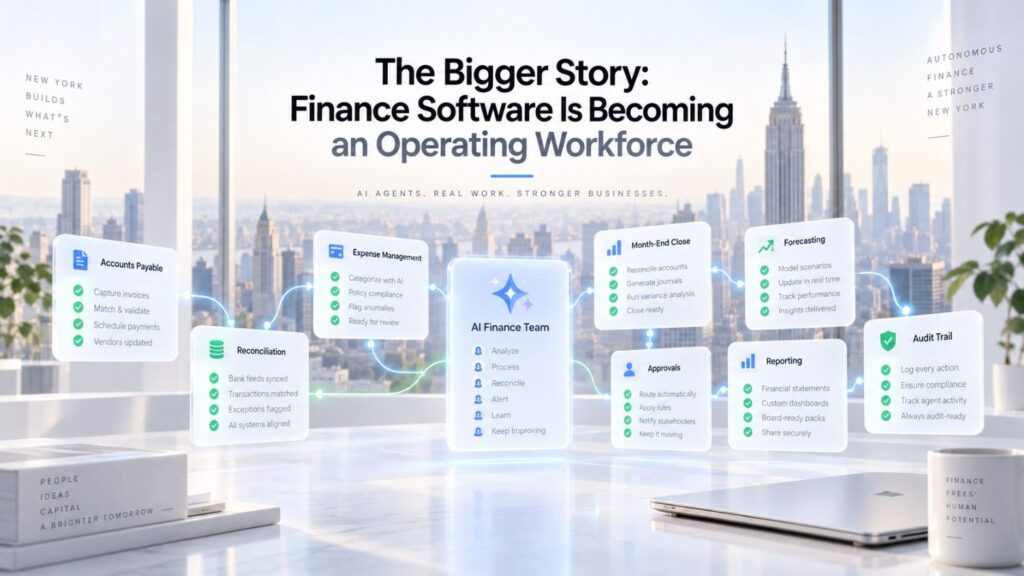
The Bigger Story: Finance Software Is Becoming an Operating Workforce
New York’s accounting-agent ecosystem remains young.
But the direction is becoming much clearer.
Basis is building long-running workers for accounting firms.
Tabs and Monk are moving through revenue and receivables.
Nominal is putting agents around the enterprise accounting stack.
Finaloop is combining agents with ecommerce operating data.
Trullion is connecting agentic workflows with accounting evidence and auditability.
Vic.ai continues pushing autonomous AP.
uiAgent is building agent libraries for professional accounting firms.
Exponent is applying the idea to franchises.
And Ramp shows what happens when the same philosophy reaches a much larger financial platform.
These companies are not simply adding better search to financial software.
They are gradually changing who—or what—performs the process.
The shift will not make finance fully autonomous overnight.
Nor should it.
Financial statements, tax returns, audits, payments and accounting judgments carry too much consequence for uncontrolled automation.
But that does not mean the operating model stays the same.
The likely future is a finance department where software performs a growing percentage of routine execution while people own judgment, policy, exception handling and accountability.
That is a much more important change than putting a chatbot inside an ERP.
It changes the basic unit of productivity in finance.
For decades, scaling an accounting team generally meant adding people or outsourcing work.
The emerging model adds another option.
Give the work to a supervised digital worker.
For New York businesses, accounting firms and investors, that transition is no longer theoretical.
The infrastructure is already being built.
Research Notes and Limitations
The company dataset in this article was built from public information available through September 12, 2026. Company websites and primary announcements were preferred where possible.
Funding totals represent publicly disclosed amounts that could be reasonably verified. They should be treated as minimum known amounts rather than a complete reconstruction of every company’s capitalization because private financing information can be incomplete.
The $495.4 million funding calculation excludes Ramp because of its substantially larger scale and excludes Exponent because its latest announced financing mixes equity and credit capital.
Workflow counts are NYC Tech Journal classifications based on public product descriptions. A workflow appearing in the table means the company publicly describes meaningful functionality in that area. It does not mean every feature is equally mature or generates equal revenue.
The detailed accountant employment analysis uses May 2023 BLS data because that dataset provides clear occupation-level figures for the New York-Newark-Jersey City metro. The geographic area includes surrounding parts of New Jersey and Pennsylvania and should therefore not be interpreted as New York City proper. More recent May 2025 BLS data was used for broader business and financial operations wage comparisons.
Company performance statistics quoted from startup websites or funding announcements should be treated as company-reported figures unless independently verified.
Sources
| Source | Main information used |
| U.S. Bureau of Labor Statistics | NYC metro accounting employment, wages and national comparisons |
| AICPA & CIMA | Accounting education and talent-pipeline trends |
| Basis | Agent capabilities and financing rounds |
| Tabs | Revenue automation, agents and funding |
| Monk | AR automation and financing |
| Nominal | Agentic accounting platform and funding history |
| Finaloop | Ecommerce accounting agents, company location and funding |
| Trullion | Accounting AI products, Trulli and company scale |
| Vic.ai | Autonomous AP and funding |
| uiAgent | Accounting-firm agents and seed funding |
| Exponent | Franchise-focused accounting platform and financing |
| Ramp | Accounting-firm operating system and finance-agent controls |
| BlackLine | WiseLayer acquisition, used as ecosystem evidence |
| Rillet | Market comparator and current location treatment |