

Wall Street spent the first part of the generative AI boom learning how to ask machines better questions. The next phase is very different. Financial firms are starting to give AI actual work.
That does not mean an AI system is suddenly running an investment bank on its own. The more important shift is smaller and far more practical. AI agents are beginning to research companies, prepare deal materials, monitor portfolios, review compliance documents, reconcile financial records, open wealth management accounts, investigate fraud, find prospects and complete other multi-step jobs that once moved between analysts, associates, operations teams and spreadsheets.
New York is becoming one of the most interesting places to watch this transition because the companies building these systems sit close to the people who understand the problems. Investment bankers, private equity investors, hedge funds, asset managers, wealth advisers, compliance teams and fintech operators can all become design partners, customers and talent sources.
The result is not one giant race to build an artificial Wall Street employee. It is a collection of startups attacking individual pieces of financial work.
That is the central finding of our research.
Wall Street is becoming agentic one workflow at a time.
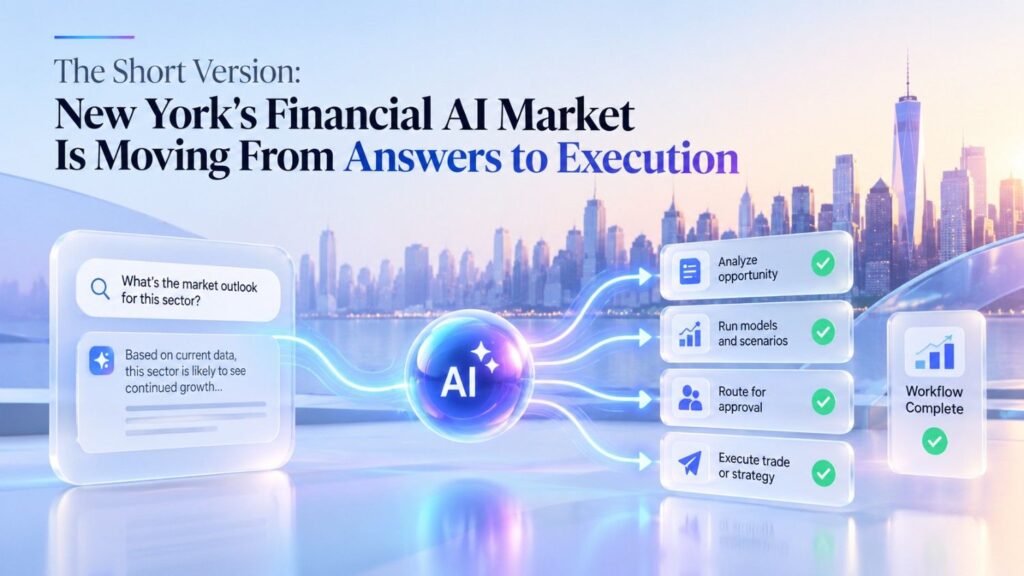
The Short Version: New York’s Financial AI Market Is Moving From Answers to Execution
For several years, financial AI mostly helped professionals find information, summarize documents or draft text. Those tools could save time, but the user remained responsible for moving the work forward.
The latest generation of New York companies is pushing further. Rogo wants an AI system to operate more like a financial teammate. Farsight can generate full deal materials. LinqAlpha builds research agents around an investment team’s own thinking. Ellis is putting agents across private-credit reconciliation and reporting. Zeplyn can move from meeting data into actual wealth-management account-opening workflows. Hadrius is moving compliance toward continuous AI execution rather than isolated document review.
The shift is happening at the same time financial institutions are struggling to move AI from experimentation into production. An ACA Group survey of more than 200 U.S. financial-services firms found that 84% reported using AI somewhere in their organizations, yet average deployment across specific compliance functions remained below 20%. Operations adoption was only around 5%. Fewer than 5% of respondents qualified as advanced practitioners using AI embedded directly into operating workflows.
That gap explains much of the opportunity.
Wall Street does not need another chatbot. It needs systems that can safely connect to existing data, follow firm rules, complete work, show their sources and send difficult decisions to people.
Our analysis of 15 New York financial AI companies suggests the market is already moving in that direction.
NYC Tech Journal Original Research: How We Built the Financial AI Agent Ranking
Most AI startup lists mix together chatbots, data platforms, old automation software and companies that simply added the word “agent” to their marketing.
We wanted a tighter method.
We built a working universe using public company materials, financing announcements, Y Combinator’s New York finance company directory, the 2026 FinTech Innovation Lab New York cohort, company case studies, product documentation and independent reporting. The FinTech Innovation Lab itself offers an important signal: its 2026 class included several New York companies focused directly on multi-agent finance workflows, fraud, compliance and wealth technology. The program says its graduates since 2010 have created more than 3,000 jobs and raised more than $3 billion.
We then applied five filters.
A company needed a clear New York headquarters, New York operating base or meaningful New York financial-services presence. It needed an AI product doing financial work rather than a general-purpose AI tool that happened to have banking customers. There also needed to be public evidence of multi-step automation, autonomous work, proactive analysis or execution.
We favored current independent companies. That is why WorkFusion and WiseLayer are discussed later as important exits instead of being ranked as startups.
Finally, we did not simply rank companies by money raised. Funding is useful evidence of market confidence, but a $100 million round does not automatically make an agent more useful than a $5 million company solving a painful workflow extremely well.
Our Five-Part Agent Score
Each company received a score from zero to five across five areas. The weighted result was converted into a 100-point score.
| Factor | Weight | What We Asked |
| Agent execution depth | 30% | Does the system simply answer questions, or can it execute a multi-step job? |
| Financial specialization | 20% | How deeply is the product built around finance-specific work? |
| Production evidence | 20% | Is there meaningful evidence of real customers, integrations or deployments? |
| Control and audit readiness | 15% | Can users trace work, enforce permissions, review outputs and maintain oversight? |
| Workflow breadth | 15% | Can the agent handle one small task or own a meaningful end-to-end workflow? |
This is an editorial evidence score, not a technical benchmark. We did not independently penetration-test systems, audit customer claims or run identical workloads across each platform.
A high score therefore means that a company’s public evidence strongly supports the idea that it is building serious financial agents. It does not mean investors should buy the company, customers should skip due diligence or one product will perform better than another in every environment.
Chart 1: NYC Financial AI Agent Leaders by Public-Evidence Score
| Rank | Company | Score / 100 | Main Workflow |
| 1 | Rogo | 98.5 | Investment banking and institutional finance |
| 2 | Hadrius | 98.5 | Financial compliance |
| 3 | Concourse | 94.0 | Corporate finance and FP&A |
| 4 | Artian | 94.0 | Financial operations automation |
| 5 | Basis | 93.5 | Accounting |
| 6 | Alloy | 91.0 | Identity, fraud and risk |
| 7 | Farsight | 90.0 | Banking and deal materials |
| 8 | Zeplyn | 89.5 | Wealth-management operations |
| 9 | FINNY | 88.5 | Wealth-adviser growth |
| 10 | LinqAlpha | 86.0 | Public-markets research |
| 11 | Ellis | 86.0 | Private-credit operations |
| 12 | Keye | 85.5 | Private-equity due diligence |
| 13 | Kobalt Labs | 82.5 | Third-party risk and compliance |
| 14 | Charm Security | 82.5 | Scam and fraud prevention |
| 15 | Affiniti | 73.5 | SMB finance and AI CFO work |
The order becomes more useful when we look beyond individual companies.
Several larger patterns appear.
Original Finding #1: Two-Thirds of the Companies Are Already Moving Beyond the Copilot Model
We gave an execution score of 4.5 or higher to 10 of the 15 companies in our sample. That means roughly 67% showed public evidence of systems that could perform substantial multi-step work instead of merely helping a person think.
That distinction matters.
A copilot waits.
An agent works.
A copilot might explain why an account balance moved. An agent might retrieve the required data, reconcile the accounts, investigate the difference, prepare supporting evidence and send exceptions to the controller.
A copilot might summarize a company. An agent might review a data room, calculate customer retention, identify unusual patterns, produce a structured diligence pack and keep analyzing new documents as they arrive.
That is a fundamentally different product.
Chart 2: Agent Execution Depth in Our NYC Sample
| Execution Level | Number of Companies | Share |
| Strong multi-step/autonomous execution | 10 | 67% |
| Meaningful workflow automation with greater human direction | 3 | 20% |
| Earlier-stage or narrower agent execution | 2 | 13% |
The important story is therefore not that Wall Street suddenly trusts AI to make every decision.
It does not.
The story is that financial firms are becoming comfortable delegating larger pieces of preparation and execution while keeping judgment, approvals and important decisions with people.
Original Finding #2: Controls Are Becoming Part of the Product, Not an Afterthought
Another number stood out.
Twelve of the 15 companies received at least 4.5 out of five in our control and audit-readiness category.
That is unusually important in finance.
When AI was mostly generating marketing copy or brainstorming ideas, an incorrect answer was annoying. When AI starts reconciling financial records, reviewing regulated communications, examining customer identity information or preparing investment work, errors can become expensive.
Financial agents therefore need more than intelligence.
They need evidence.
They need permissions.
They need logs.
They need predictable calculation methods.
They need human escalation.
They need clear rules describing which actions the system is allowed to take.
That is visible across the market. Concourse says calculations are executed deterministically in code and outputs can be traced to source data. Keye emphasizes calculation-backed, audit-ready diligence and source attribution. Ellis says numbers are tied back to their underlying source and material actions remain under human review.
The competitive question in financial AI is therefore shifting.
It is no longer just:
Which model produces the smartest answer?
It is increasingly:
Which system can be trusted with the largest amount of real work?
Original Finding #3: There Is No Single Financial Agent Market
Our 15-company dataset covers at least six distinct workflow clusters.
Chart 3: Where NYC Financial Agents Are Concentrating
| Workflow Cluster | Companies | Share of Sample |
| Investment research, banking and deal work | 4 | 27% |
| Compliance, fraud and risk | 4 | 27% |
| Corporate finance and accounting | 3 | 20% |
| Wealth management | 2 | 13% |
| Private-credit operations | 1 | 7% |
| Agent infrastructure for financial operations | 1 | 7% |
This fragmentation is healthy.
Finance is simply too complicated for one agent to understand every process equally well.
The workflows of an investment banking analyst have little in common with sanctions investigations. Private-credit portfolio monitoring is different from RIA prospecting. Accounting close work requires a different data model from equity research.
The strongest New York companies are therefore starting with narrow domain knowledge.
That is exactly how vertical AI can become defensible.
The Top Financial AI Agent Startups in NYC
1. Rogo — Building an AI Teammate for High Finance
Rogo is the clearest example of how quickly financial AI has moved from search toward execution.
The New York company was founded specifically around institutional finance and says its platform is used across more than 250 investment banks and investment firms. In April 2026, Rogo announced a $160 million Series D led by Kleiner Perkins, bringing total funding at that time to more than $300 million.
The company is now putting much of its agent strategy around Felix.
Why Felix Matters
Rogo describes the older AI model in finance quite well: ask a question and receive an answer.
Felix is designed around delegation instead. A user can give the system more involved financial work and interact with it more like a teammate completing a project.
That direction fits investment banking especially well.
Junior bankers can spend large amounts of time gathering data, rebuilding comparable-company analyses, updating models, formatting slides and preparing materials. Much of that work requires care but does not require the relationship skills or final judgment that make senior bankers valuable.
An agent capable of owning more of the preparation layer could significantly change team economics.
Rogo’s momentum also continues to expand. On September 10, 2026, The Wall Street Journal reported that the company was moving further into wealth management and had recently secured roughly $30 million in additional strategic funding from major financial institutions and other investors.
What Financial Firms Should Learn From Rogo
The lesson is not simply that bankers want AI.
The more useful lesson is that domain depth matters.
A finance agent needs to understand how analysts structure work, what senior reviewers care about, which sources can be trusted and what a deliverable is supposed to look like.
The winners in financial AI may therefore feel less like general chat products and more like software versions of specialized teams.
2. Hadrius — Turning Compliance Into an Agentic Operating Function
Hadrius attacks a very different part of finance.
The company is building agentic compliance infrastructure for SEC- and FINRA-regulated firms. Hadrius says more than 500 financial institutions and investment firms use its platform and that its customers collectively represent more than $5 trillion in assets under management.
In July 2026, Hadrius announced $27 million in combined seed and Series A funding, including a $22 million Series A led by CRV.
Compliance Is Almost Designed for Vertical Agents
Compliance teams deal with repetitive work, huge amounts of information and high costs when something is missed.
Marketing review is a good example.
A human might need to read material, identify claims, compare the language with internal policies and regulations, flag issues, request changes, record the decision and retain evidence for future examination.
Traditional automation struggles when every document is slightly different.
A well-designed agent can potentially handle much more of that variation.
Hadrius is trying to consolidate communications supervision, marketing review, account surveillance, employee oversight and testing into a connected system rather than a collection of isolated tools.
That makes compliance one of the best examples of why agentic AI could matter.
The Strategic Advantage
The biggest compliance products of the AI era may not be the ones that simply catch more issues.
They may be the ones that run the compliance process.
That means identifying what needs review, performing the first analysis, collecting evidence, routing exceptions, documenting decisions and maintaining an audit trail.
Compliance then becomes less like a queue of tasks and more like a continuously running system.
3. Concourse — Giving Finance Teams Agents That Own Workflows
Concourse started in the corporate finance world rather than traditional Wall Street, but it is highly relevant to the larger autonomous-finance trend.
The New York YC company says it has raised $20 million and is building production-ready agents that own end-to-end finance workflows.
Its platform covers close, forecasting, accounts receivable, collections, treasury, variance analysis and recurring business reviews.
Why Concourse Scores So Highly
The interesting part is not that finance teams can ask questions in natural language.
That is becoming common.
Concourse is designed so agents can connect to financial systems, encode company-specific logic, perform calculations in code, run on triggers and deliver work without waiting for someone to start every step manually. The company also says it has deployed more than 1,000 agents.
That makes the architecture closer to a system of action than a chatbot.
Consider variance analysis.
The old process may involve pulling general-ledger data, comparing results with budget, identifying unusual movements, asking department owners for explanations and preparing commentary.
An agent can potentially begin before the analyst arrives in the morning.
It can identify the change, calculate its size, gather supporting detail and prepare a first explanation. The analyst starts from the exception rather than from a blank spreadsheet.
What Wall Street Can Learn
Concourse illustrates a principle financial institutions should copy even when they build their own agents.
Do not automate the conversation. Automate the process behind the conversation.
The value is not asking an AI, “Why did revenue change?”
The value is having the answer, evidence and follow-up analysis ready before someone has to ask.
4. Artian — Building an Agent Factory for Financial Operations
Artian approaches the market from an infrastructure angle.
The New York company raised $8 million by May 2025, including a $6 million seed round led by Work-Bench, and its initial focus is financial services.
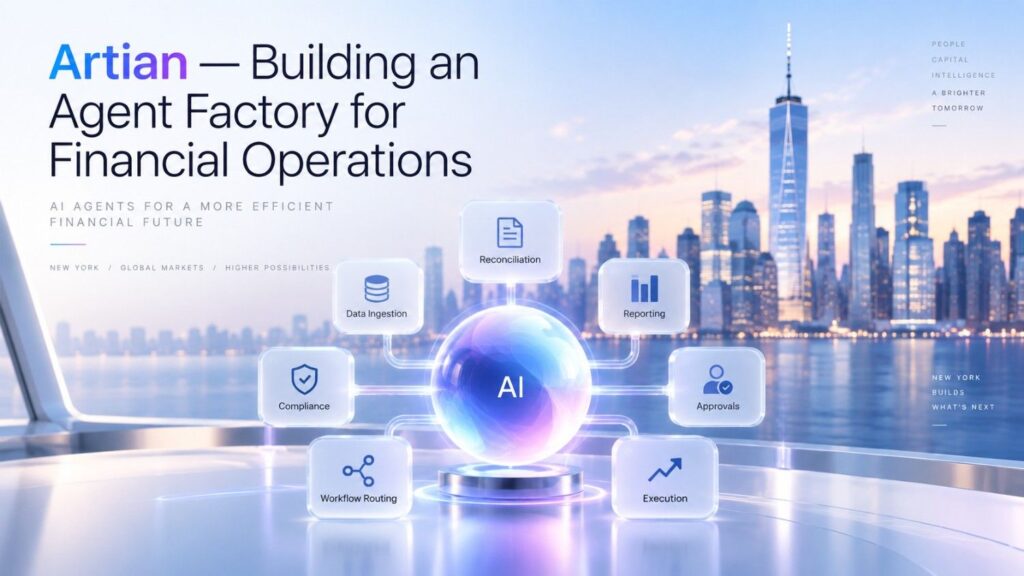
Artian is designed around multi-agent workflows for complex operations where old automation systems break.
The Exception Problem
Financial institutions already automate many predictable processes.
The difficulty appears when something unusual happens.
A transaction fails.
A field is missing.
Data does not match.
A collateral record breaks.
Approval rules conflict.
Traditional software can push the exception to a person, but the person must then investigate the situation across several systems.
Artian wants agents to continue the work.
Its platform can gather context, coordinate across systems, remediate problems and escalate when human involvement is required. The company specifically highlights transaction and collateral breaks and risk adjustments with multi-level approvals.
Why This Could Become a Big Category
Agentic finance is not only about creating smarter front-office employees.
There may be an equally large opportunity in the invisible work that keeps financial institutions functioning.
Operations departments contain thousands of exception-driven processes that were too messy for traditional automation but too repetitive to justify endless human work.
That is fertile ground for agents.
5. Basis — Long-Running Agents for Accounting Work
Basis has become one of New York’s most important examples of long-horizon agents.
The company builds AI agents specifically for accounting firms. In February 2026 it raised a $100 million Series B at a reported $1.15 billion valuation.
Basis says its agents can work for hours at a time on end-to-end accounting tasks. Its New York operation is based at 20 West 22nd Street.
Accounting Is a Serious Test of Agent Reliability
Accounting work exposes a weakness of simple generative AI.
A good paragraph that is 95% correct may be useful.
A financial reconciliation that is 95% correct may be unacceptable.
Basis therefore has to solve a harder problem than generating language. Agents need to follow procedures, maintain context over long jobs, make many intermediate decisions and produce work that an accountant can inspect.
An OpenAI case study reported that Basis agents were being used for reconciliations, journal entries and financial summaries, with customers seeing time savings of up to 30%.
Why Basis Matters to Wall Street
Accounting may sit outside the glamorous part of finance, but it teaches the broader market an important lesson.
The next agent breakthrough is not necessarily a better answer.
It is reliable persistence.
If an agent can work for three hours without drifting from company policy, losing track of earlier decisions or creating unverifiable numbers, entirely new workflows become possible.
6. Alloy — Moving Risk Decisions Toward Agentic Execution
Alloy is larger and older than most companies on this list, but it remains privately held and is an important New York financial AI player.
The company provides identity, fraud and risk infrastructure. In February 2026 it launched an agentic AI Assistant that can analyze data and recommend risk decisions, which customers can either send to a human or configure for automatic acceptance.
By July 2026, Alloy said more than 900 fintechs and financial institutions were using its platform.
Why Risk Is Moving Toward Agents
Risk teams face a difficult balance.
Reject too many customers and growth slows.
Approve too easily and fraud losses rise.
Manual review can improve decisions but creates delay and cost.
Agentic systems have an opportunity to sit between rigid rules and fully manual investigation.
They can gather signals, understand the broader customer context and send difficult cases to analysts while allowing clear cases to move quickly.
What Makes Alloy Strategically Interesting
Alloy already sits inside important financial decision infrastructure.
That matters because agent adoption often depends less on having the smartest language model and more on having trusted access to the right data and workflow.
Companies that already own the decision layer may have a powerful path into agents.
7. Farsight — Automating the Deliverables That Run Deals
Farsight is one of the most direct competitors in the race to automate analyst and associate work.
The New York company raised $16 million across seed and Series A financing by June 2025, according to Axios.
Its product is built around financial deliverables rather than simple chat.
From Blank Slide to Finished Deal Material
In May 2026, Farsight launched Freeform, an agent designed to create full client-ready financial documents from a prompt. The company says it can produce complex outputs including 60-plus-page confidential information memoranda rather than isolated paragraphs or slides.
That is an important jump.
Deal teams do not get paid for producing one good paragraph.
They need complete materials with a coherent argument, consistent formatting, correct financial analysis and firm-specific standards.
Farsight says it automates full pieces of work including decks, models and memos.
Its position became even more interesting in July 2026 when S&P Global Market Intelligence announced a partnership and minority investment that will bring Farsight-powered financial workflow capabilities into Capital IQ Pro.
The Bigger Implication
The future investment banking analyst may spend less time creating the first version of a deliverable.
Instead, the analyst may become the reviewer, challenger and editor of work produced by agents.
That raises the value of judgment while reducing the value of mechanical production.
8. Zeplyn — Moving Wealth AI From Meeting Notes Into Execution
Wealth technology provides another clear example of the assistant-to-agent transition.
Zeplyn began with AI tools for financial-adviser meetings. The New York company announced a $3 million seed round in November 2024 and said its meeting product could save advisers 10 to 12 hours per week.
By late 2025, however, Zeplyn was moving beyond note-taking.
Its Agent Nexus system was designed to connect data and translate analysis into executed actions.
The Account-Opening Breakthrough
The most interesting example came in August 2026.
Zeplyn announced an integration with Schwab Advisor Center that allows its agents to complete Schwab digital account-opening workflows while using holdings and transaction information to improve meeting preparation.
That is exactly the sort of change businesses should watch.
Meeting notes are helpful.
Opening the account is work.
Once an AI product can move from understanding a conversation to completing the next operational step, its economic value changes sharply.
9. FINNY — An AI Growth Agent for Financial Advisers
FINNY attacks the revenue side of wealth management.
The company started by helping advisers identify and prioritize prospective customers. It then added automated personalized outreach, follow-ups and meeting scheduling.
FINNY raised a $4.3 million seed round in 2024 and followed it with a $17 million Series A led by Venrock in December 2025.
Hunter Shows Where the Product Is Going
In April 2026, FINNY announced Hunter, an agent intended to work more like a chief growth officer.
Hunter is designed not just to suggest marketing ideas but to create content, manage targeting and run campaigns for advisers.
This matters because business-development work contains many small steps.
Find the right prospect.
Understand why the person may need advice.
Choose the right message.
Select a channel.
Follow up.
Schedule the meeting.
Learn from the response.
When an agent can own that sequence rather than supporting each task separately, the entire cost structure of adviser growth can change.
10. LinqAlpha — Building Research Agents Around an Investor’s Own Thinking
LinqAlpha focuses on the public markets.
The New York-headquartered company announced a $22 million Series A in July 2026 and said more than 70 financial institutions were using its platform. Its disclosed buy-side users collectively manage more than $5 trillion in assets.
The product uses multiple specialized agents to analyze information across global markets.
The Real Opportunity Is Institutional Memory
Many investment AI products can summarize earnings calls or retrieve financial data.
That is becoming a commodity.
LinqAlpha is trying to make an investment team’s own research history part of the intelligence layer.
That means an agent does not simply ask, “What does the market think about this company?”
It can potentially ask, “How does this new event change the thesis our team has been building for six months?”
That is far more valuable.
The firm’s history of investment decisions, rejected ideas, assumptions and research becomes part of the context used by the agent.
The Moat May Be the Feedback Loop
Models will continue getting better.
Data access will also spread.
The harder asset to copy may be a system that continuously learns how a specific investment team thinks.
If that happens, the agent becomes less like an outside research service and more like institutional memory that can reason.
11. Ellis — Bringing Agents Into Private-Credit Operations
Ellis may be one of the most important new companies to watch because it attacks a part of private markets that still relies heavily on spreadsheets and fragmented systems.
The New York startup was founded by Cadre founder Ryan Williams and emerged from stealth in July 2026 with more than $10 million in seed financing.
Its target is private credit.
The Problem Ellis Is Solving
Private-credit managers may receive information from administrators, banks, loan accounting systems, borrower financial statements, compliance certificates and internal spreadsheets.
Those numbers do not always line up neatly.
Teams therefore spend substantial time reconciling the information before they can even analyze it.
Ellis builds a governed operating layer over those existing systems. Its site says the company is already working alongside private-credit managers representing more than $50 billion in assets under management.
Agents can then work across reconciliation, close, reporting, cash forecasting and portfolio monitoring.
The human team retains control of material decisions.
Why Private Credit Could Be a Huge Agent Market
Private credit combines three conditions that agent startups like.
The market is large.
The operational infrastructure is fragmented.
And the cost of incorrect information is high.
That creates demand for software that can do more than chat.
A reliable agent that continuously reconciles portfolio information and identifies problems before reporting deadlines could become part of a firm’s operating infrastructure.
12. Keye — Making Private-Equity Diligence More Deterministic
Keye is building AI specifically for private-equity due diligence.
The New York YC company emerged from stealth with $5 million in seed financing in July 2025.
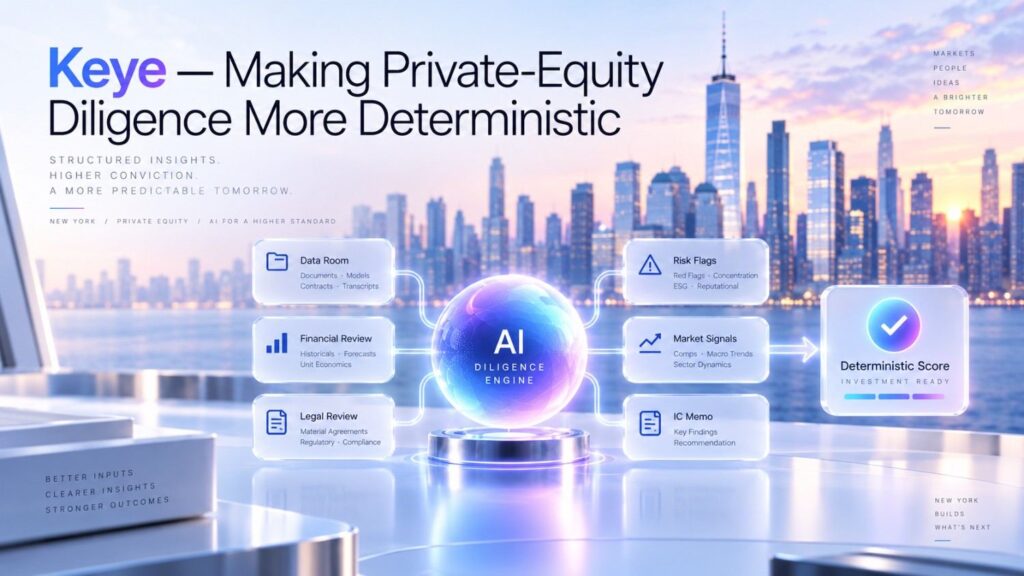
Its platform turns raw deal-room data into structured analyses such as customer cohorts, retention views and financial models.
Why Keye Takes a Different Approach
The company emphasizes deterministic analysis.
That means it can use AI to understand what the investor wants while performing important calculations using auditable code and formulas rather than asking a language model to guess the answer.
Keye’s Odin system can also continuously analyze incoming information and surface unusual patterns or risks without waiting for every question to come from a user.
The company says funds representing more than $1.4 trillion in assets use its platform and claims users can save multiple days of work per deal.
What PE Firms Should Learn
Diligence is a perfect example of where finance needs both generative AI and deterministic systems.
AI is useful for understanding messy documents and interpreting questions.
Code remains better for calculations that must be exact.
The strongest financial agents will combine both.
13. Kobalt Labs — Automating Third-Party Risk Reviews
Kobalt Labs targets one of the least glamorous but most important jobs inside financial institutions: evaluating third-party risk.
The New York company has raised $12.7 million according to reporting published in February 2026.
Its system can ingest policies, contracts, security documents and other materials, compare them with regulations and internal standards, identify gaps and prepare follow-up reports.
The ROI Can Be Very Concrete
Kobalt’s published Core Bank case study provides a useful example.
The bank reported that due-diligence document review fell from roughly 10–16 hours to 1–3 hours, while risk-assessment work dropped from around eight hours to 2–3 hours.
Another Kobalt case study reported an 87% reduction in document-review time at Payscout.
These are company-published customer claims, so they should not be treated as independent benchmarking.
But they demonstrate something businesses should understand.
The easiest AI projects to justify are often not the flashiest.
If a bank can identify a repetitive review process, measure exactly how many hours it consumes and automate most of the preparation, the business case can become very easy to calculate.
14. Charm Security — Using Agents to Fight Human-Centered Fraud
Charm Security is using agents for scam and fraud defense.
The New York company launched from stealth in 2025 with an $8 million seed round led by Team8.
Its approach is unusual because many scams exploit human behavior rather than purely technical weaknesses.
Agents Across the Fraud Lifecycle
Charm has developed different agent roles.
One investigates cases and connects signals. Another works with customer-facing teams during potentially fraudulent interactions. Another gathers intelligence about scam infrastructure and attacker patterns.
That means the product aims to move beyond detecting suspicious activity after the event.
The agent can potentially help teams understand what is happening while an attack is unfolding and recommend or execute appropriate next steps.
Why Fraud Agents Could Become Essential
Generative AI is making it cheaper to create convincing messages, voices and identities.
Banks therefore face an asymmetric problem.
Attackers can automate deception.
Defenders will need to automate investigation and response.
Human fraud experts will still matter, but agents can help them cover far more activity than manual investigation alone.
15. Affiniti — Testing the AI CFO Model for Smaller Businesses
Affiniti sits farther from traditional Wall Street than most companies in this ranking, but it represents an important direction for autonomous finance.
The New York fintech raised an $11 million seed round and then a $17 million Series A in 2025.
Its original product centered on financial services and expense tools for smaller businesses, but the company has described a broader vision of AI agents functioning more like CFOs.
Why the AI CFO Idea Matters
Many small businesses do not have full finance departments.
They still need to understand cash flow, manage bills, use credit intelligently, compare spending and decide where money should go.
That creates room for a financial agent that has both data access and permission to carry out routine work.
Affiniti remains earlier in this agent journey than the companies at the top of our ranking. That is why its evidence score is lower.
The long-term opportunity, however, could be enormous.
Autonomous finance will not only change banks.
It could make sophisticated financial operations available to businesses that could never afford a large finance team.
Table: What Each NYC Financial Agent Is Actually Trying to Replace
| Company | Primary Human Work Being Reduced | What the Agent Adds |
| Rogo | Analyst research and deliverable preparation | Financial analysis and delegated execution |
| Hadrius | Manual compliance administration | Continuous compliance execution |
| Concourse | FP&A and recurring finance work | Triggered end-to-end finance workflows |
| Artian | Exception handling | Cross-system remediation |
| Basis | Repetitive accounting work | Long-running accounting agents |
| Alloy | Risk review | Context-aware decision automation |
| Farsight | Deal-material preparation | Complete financial deliverables |
| Zeplyn | Adviser administration | Research plus account execution |
| FINNY | Adviser prospecting | Targeting, outreach and scheduling |
| LinqAlpha | Investment research synthesis | Thesis-aware research agents |
| Ellis | Private-credit reconciliation | Continuous operating-book intelligence |
| Keye | PE diligence analysis | Deterministic diligence automation |
| Kobalt Labs | Compliance document review | Automated third-party risk analysis |
| Charm Security | Fraud investigation | Real-time fraud agent workforce |
| Affiniti | Small-business finance administration | AI CFO-style assistance and execution |
The table makes the broader pattern very clear.
Most companies are not replacing a full job.
They are replacing bundles of tasks inside a job.
That distinction is crucial for business leaders thinking about AI strategy.
Original Finding #4: The Agent Market Is Starting With Workflows That Have Clear Inputs and Clear Proof
The strongest workflows in our dataset share several features.
There is something concrete for the agent to start with: financial statements, CRM records, data-room documents, accounting transactions, compliance policies, customer identity information or portfolio data.
There is also a concrete output.
A reconciled account.
A completed review.
A diligence model.
A client-ready deck.
An opened account.
A scheduled meeting.
A compliance report.
This matters because AI ROI becomes much easier to measure when the workflow has a visible beginning and end.
A company cannot easily calculate the value of “making employees smarter.”
It can calculate the value of reducing a 12-hour process to three hours.
It can calculate how many accounts an adviser can open.
It can calculate how many compliance documents an analyst reviews per month.
It can calculate the cost of preparing a pitch book.
It can calculate the time required to close the books.
That is why narrow agents may create more value than broad assistants.
Original Finding #5: New York Is Becoming a Lab for Regulated Agentic AI
New York’s advantage is not only the size of its technology scene.
It is proximity to difficult customers.
Financial institutions have high security standards, complicated approval structures, old software, strict regulatory obligations and low tolerance for unexplained errors.
That makes them difficult buyers.
It also makes them excellent training grounds for enterprise AI companies.
The 2026 FinTech Innovation Lab New York class reflects this trend. Its participants included Artian, Beam AI, Charm Security, Kobalt Labs, LinqAlpha and Zeplyn, among others working on agentic or AI-heavy financial workflows.
When a startup learns how to deploy safely inside a bank, investment firm or regulated adviser, the resulting technology can become much stronger.
That may be one of New York’s most important AI advantages.
Silicon Valley can build frontier models.
New York can become one of the places where those models learn how to do serious financial work.
The Acquisition Signal: Large Software Companies Are Already Buying Financial Agent Technology
Two companies that would have appeared prominently in an earlier version of this ranking are no longer independent.
That is meaningful.
WiseLayer Was Acquired by BlackLine
WiseLayer built specialized AI workers for accounting tasks including accruals, payroll accounting and reconciliations.
BlackLine acquired the New York company in December 2025 to expand its agentic finance capabilities.
A later regulatory filing disclosed purchase consideration of approximately $23.6 million.
WorkFusion Was Acquired by UiPath
WorkFusion built agents for financial-crime compliance, including sanctions screening and other investigation work.
UiPath acquired the company in February 2026.
UiPath’s September 2026 filing disclosed acquisition consideration of approximately $189.5 million.
These acquisitions provide useful market evidence.
Large automation and finance-software companies are not treating agents as a temporary interface trend.
They are buying the technology.
What Should Wall Street Automate First?
The worst way to start an AI-agent program is to ask:
Where can we use AI?
That question is too broad.
A better question is:
Where are highly paid employees repeatedly moving information between systems, applying known rules and producing predictable outputs?
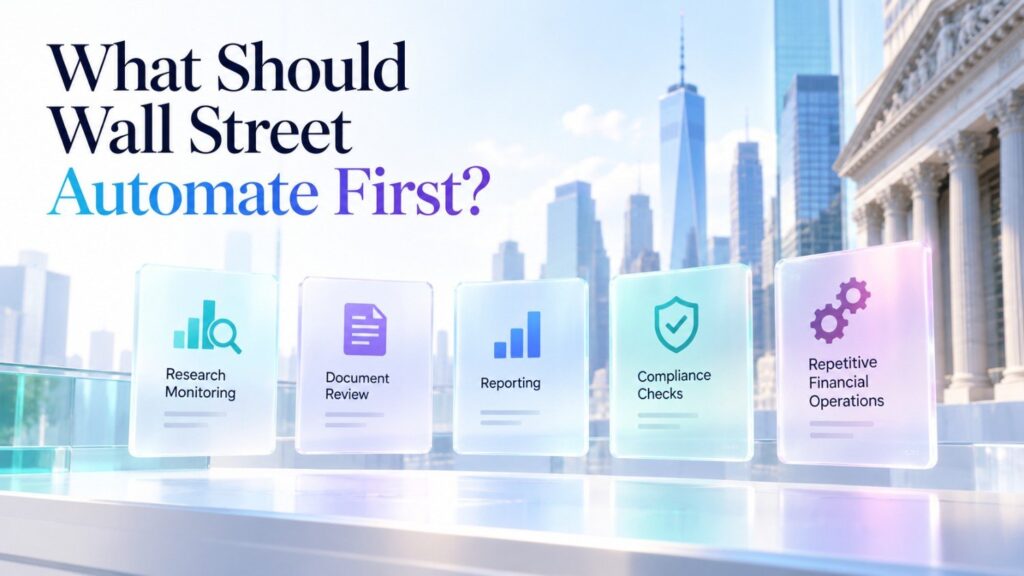
That is where financial firms should look first.
Our Financial Agent Opportunity Matrix
| Workflow | Repetition | Judgment Required | Error Cost | Agent Opportunity |
| Research gathering | High | Medium | Medium | Very high |
| Pitch-book updates | High | Medium | Medium | Very high |
| Portfolio monitoring | High | Medium-high | High | High |
| Account reconciliation | Very high | Medium | High | Very high |
| Compliance document review | Very high | Medium-high | Very high | Very high |
| Data-room diligence | High | High | High | High |
| Adviser meeting preparation | High | Medium | Medium | Very high |
| Client account opening | High | Medium | High | High |
| Fraud investigation preparation | Very high | High | Very high | High |
| Investment decision | Low | Very high | Very high | Low for full autonomy |
The final row is important.
The fact that AI can automate analysis does not mean it should automatically make the investment decision.
The closer a task gets to irreversible capital allocation, regulatory responsibility or major client consequences, the stronger human approval should become.
A Better Way to Decide What an AI Agent Should Own
Financial companies should break a workflow into four layers.
Layer 1: Gather
The agent collects the information needed to perform the job.
This is usually the safest place to begin because the system is not yet making a major decision.
Layer 2: Analyze
The agent organizes the evidence, calculates values, identifies inconsistencies and develops recommendations.
This is where source attribution becomes critical.
Layer 3: Prepare
The system produces the output a person normally would have created.
That could be a report, model, review, email, presentation, case file or account-opening package.
Layer 4: Execute
The agent takes an external action.
Execution may mean sending a message, updating a system, opening an account, approving a low-risk case or triggering another workflow.
The key mistake is jumping directly to Layer 4.
Financial institutions should earn their way toward execution by proving accuracy at the first three layers.
A Practical 90-Day Financial Agent Pilot
Most firms should not begin with a company-wide agent program.
Start with one workflow.
Days 1–15: Measure the Current Process
Document how the work happens today.
Do not rely on the official operating manual alone.
Watch the people who actually perform the process.
Measure the number of steps, applications opened, files handled, approvals required, average completion time and percentage of cases that become exceptions.
That becomes your baseline.
Days 16–30: Define the Agent Boundary
Decide exactly what the agent is allowed to do.
An example might be:
The agent can collect financial information, reconcile records, prepare an exception report and suggest adjustments. It cannot post a material journal entry without controller approval.
That is far more useful than saying the company wants “an accounting agent.”
Days 31–45: Build an Evaluation Set
Create historical examples.
Include normal cases, difficult cases, unusual formats, incomplete data and known errors.
Then test whether the agent produces the right result repeatedly.
Do not judge the system based on an impressive demo.
Judge it based on hundreds of realistic cases.
Days 46–60: Run in Shadow Mode
Allow the agent to perform the work without changing the production process.
Humans complete the workflow normally.
The team then compares the agent’s result with the human result.
This reveals where the system fails without putting customers or the firm at unnecessary risk.
Days 61–75: Introduce Human-Approved Execution
Allow the agent to prepare actions.
A person reviews and approves them.
Measure how often the person changes the agent’s recommendation.
If humans are correcting the system frequently, autonomy should not expand.
Days 76–90: Automate the Low-Risk Majority
Once performance is stable, allow the agent to execute the safest categories automatically.
Difficult or high-value cases should continue moving to people.
The result should not be “full autonomy.”
The result should be maximum safe autonomy.
The Agent KPI Dashboard Every Financial Firm Should Build
Companies often evaluate AI by measuring how many employees use it.
That is almost useless.
Usage does not tell management whether the system is producing economic value.
Agents need operational KPIs.
| KPI | What It Measures | Why It Matters |
| Straight-through completion rate | Work completed without human help | Measures true autonomy |
| Human correction rate | Outputs changed by reviewers | Measures reliability |
| Exception rate | Cases escalated to people | Shows workflow difficulty |
| Cycle-time reduction | Before-versus-after completion time | Measures speed |
| Cost per completed workflow | Total system cost divided by completed jobs | Measures economics |
| Source-verification rate | Outputs backed by traceable evidence | Measures auditability |
| Rework rate | Jobs reopened after completion | Detects hidden quality problems |
| Severe error rate | Material errors reaching production | Measures operational risk |
| Human hours recovered | Labor time saved | Shows capacity impact |
| Business outcome | Revenue, loss reduction or throughput | Connects AI to enterprise value |
One metric deserves special attention.
Measure the Cost Per Successful Workflow
Agent economics can become misleading when companies focus only on model prices.
A cheap model that requires repeated retries and heavy human correction may be more expensive than a stronger model that completes the work correctly.
The correct denominator is not tokens.
It is successful work.
A bank should ask what it costs to complete one investigation correctly.
An investment bank should calculate the cost of creating one approved deliverable.
A controller should calculate the cost of one fully reconciled account.
That is the economic unit that matters.
Human Approval Should Shrink With Risk, Not Disappear Everywhere
There is a popular idea that a successful agent eventually removes the person.
Finance will probably work differently.
Human involvement is likely to become concentrated around risk.
An agent may handle 90% of routine cases with almost no intervention while sending the difficult 10% to skilled employees.
That can be more valuable than pursuing 100% automation.
Consider fraud.
A clear low-risk case might move automatically.
A suspicious transaction involving an important customer may require a human investigator.
Consider investment banking.
An agent may build much of the pitch deck, but the managing director should still decide what advice goes to the CEO.
Consider private equity.
AI may complete most of the analytical preparation while the investment committee makes the final capital decision.
The future financial employee is therefore not simply competing against an agent.
The employee increasingly becomes the person responsible for the agent’s hardest exceptions.
What Financial Firms Should Ask Vendors Before Buying an Agent
A polished demonstration can hide important weaknesses.
The first question should be about sources.
Can every important financial fact be traced back to its origin?
Then ask how calculations are performed.
If the system is calculating leverage, retention or cash flow, does it use deterministic code or generate the number probabilistically?
Ask what happens when information conflicts.
Ask whether the system can recognize that it does not have enough evidence.
Ask how permissions work.
Ask which actions require approval.
Ask whether administrators can create different limits for different users and workflows.
Ask how every action is logged.
Ask whether models train on customer data.
Ask how the product behaves when an underlying model is unavailable.
Ask how accuracy is evaluated after model updates.
The vendor with the most impressive chatbot may not be the vendor you should trust with production finance.
Why Financial Agents Could Change Entry-Level Work First
The most obvious workforce impact is likely to appear at the bottom of the traditional pyramid.
Investment banks, accounting firms, asset managers, private-equity firms and other financial businesses have long depended on junior professionals to perform large amounts of preparation work.
That model has two purposes.
It produces the work.
It also trains future senior employees.
Agents challenge the first purpose.
If AI can research companies, update models, prepare slides, reconcile data and create first drafts, firms may need fewer junior hours to produce the same amount of output.
But that creates a new problem.
How Do You Train a Senior Investor Without Junior Work?
A junior banker learns partly by spending hundreds of hours inside transactions.
A private-equity associate develops judgment by examining company after company.
An accountant learns what can go wrong by repeatedly doing the work.
If agents remove much of that repetition, financial firms will need a deliberate replacement for apprenticeship.
The answer should not be keeping useless manual work simply because it trains employees.
Instead, firms should redesign training around review.
Junior employees can examine agent work, identify mistakes, compare competing assumptions and explain why one answer is better.
Training moves from production toward judgment.
That may actually create stronger professionals if firms design it correctly.
Original Finding #6: Institutional Knowledge May Become the Real Moat
Another pattern connects companies such as Rogo, Farsight, LinqAlpha, Metal and other private-market AI platforms.
They increasingly want access not only to external data but to the firm’s own history.
Past investment memos.
Previous deals.
Old models.
Research notes.
Portfolio commentary.
Rejected investments.
Client materials.
Senior-partner edits.
Compliance decisions.
That data shows how the organization thinks.
Once an agent can use it safely, the firm’s past work can improve its future work.
This creates a powerful compounding loop.
Each project teaches the system something.
Each decision creates more context.
Each correction becomes another signal about how the company wants work performed.
The biggest AI advantage on Wall Street may therefore not come from access to a model that everyone else can buy.
It may come from turning decades of scattered institutional knowledge into machine-usable context.
Where the Biggest Opportunities Still Exist
The current market is impressive, but much of financial work remains untouched.
Agentic Private Credit
Ellis is an early sign of what may become a much larger category.
Private credit has rapidly expanded while operating systems remain fragmented.
Expect more companies to attack covenant monitoring, borrower reporting, portfolio valuation, lender communication and fund operations.
Agentic Wealth Operations
Wealth AI has initially focused heavily on meetings and prospecting.
Zeplyn’s move into account opening suggests the next phase will connect the entire adviser workflow.
Future agents could prepare reviews, monitor client changes, identify service opportunities, update CRMs and coordinate routine operations while the adviser focuses on the relationship.
Agentic Financial Crime
WorkFusion’s acquisition and the rise of Hadrius, Alloy and Charm demonstrate strong demand around regulated workflows.
Banks face huge volumes of alerts and reviews.
AI does not need to replace the final investigator to create value.
Simply reducing the amount of low-value investigation preparation could have major economic impact.
Agentic Investment Banking
This is likely to remain one of New York’s most competitive categories.
Rogo and Farsight are already pushing from research into complete deliverables.
The next battle is likely to be around deeper model creation, transaction execution, workflow coordination and institutional memory.
Agentic Finance Infrastructure
The ultimate opportunity may sit below all these applications.
Financial institutions could eventually operate internal networks of agents that work across systems under a shared permission and governance layer.
At that point, companies will need infrastructure that determines which agent can access what data, what it is allowed to do, when it must escalate and how every action is audited.
That could become the operating system beneath autonomous finance.
What NYC Business Leaders Should Do Now
The market has moved far enough that waiting for “AI to mature” is no longer a strategy.
At the same time, deploying autonomous agents everywhere would be reckless.
Businesses need a middle path.
Start with real work.
Choose one costly workflow.
Measure it carefully.
Create a controlled agent boundary.
Require evidence.
Keep humans in the loop for high-risk decisions.
Track corrections.
Expand autonomy only after the data supports it.
Most importantly, stop measuring AI success by the number of licenses purchased.
Measure work completed.
If an agent cannot reliably finish a useful job, it is still an assistant.
If it can take a clearly defined outcome, navigate the steps required, use trusted company data, create the deliverable, request approval where necessary and leave a complete record of what happened, the business has moved into something different.
That is where New York’s financial AI market is heading.
The Bigger Story: Wall Street Is Not Being Automated All at Once
The popular image of autonomous finance is dramatic.
An AI investment banker negotiates a deal.
An AI portfolio manager trades billions of dollars.
An AI CFO controls a company’s finances.
The actual transformation is likely to be less cinematic and far more important.
One workflow gets delegated.
Then another.
Research becomes agentic.
Diligence becomes agentic.
Compliance review becomes agentic.
Reconciliation becomes agentic.
Portfolio monitoring becomes agentic.
Client onboarding becomes agentic.
Reporting becomes agentic.
Eventually, enough connected workflows change that the operating model of the financial institution itself begins to look different.
That is why the current generation of New York startups matters.
Rogo is not automating all of Wall Street.
Hadrius is not automating an entire compliance department.
Ellis is not replacing a private-credit firm.
Zeplyn is not replacing the financial adviser.
They are doing something more realistic.
They are finding specific pieces of financial work where AI can move beyond suggestions and begin carrying responsibility.

One workflow at a time, those pieces are getting larger.
And when enough of them connect, the autonomous financial firm stops looking like science fiction.
It starts looking like the next software architecture of Wall Street.