

New York is not trying to become Silicon Valley.
That may be exactly why it has a chance to become one of the most important places in the world for enterprise AI agents.
The Bay Area still has a huge lead in frontier AI research, model companies, infrastructure, and venture funding. But enterprise AI agents are a different market. The winners do not simply need better models. They need to understand how companies actually work.
They need to understand insurance claims, investment research, compliance reviews, procurement requests, sales pipelines, property operations, legal rules, internal approvals, customer conversations, and thousands of other messy processes that happen inside large businesses every day.
New York happens to be packed with those businesses.
It has Wall Street. It has major insurance companies. It has global law firms. It has advertising agencies, commercial real estate owners, media companies, healthcare systems, consulting firms, retailers, logistics businesses, and some of the largest corporate offices in the world.
That creates a powerful advantage.
AI agent startups can build near the people who have the problems, test their systems inside real companies, learn where automation fails, and improve the product around workflows that businesses will actually pay to automate.
The numbers are beginning to support that story.
Tech:NYC reported that New York City-based AI companies raised $15.84 billion during 2025, up 50% from the previous year. The organization also counted more than 2,000 AI startups, over 40,000 AI professionals, and more than 203,000 technology jobs across the city. AI companies leased more than 486,000 square feet of Manhattan office space during 2025.
At the same time, enterprise AI adoption is moving quickly. A Tech:NYC and Accenture study of 500 New York City executives found that reported AI adoption increased from 55% to 78% in one year, while 99% of respondents planned to increase recruitment for AI-related roles.
The more interesting shift, however, is happening one level deeper.
New York is moving from AI that helps employees produce an answer toward AI that can take responsibility for part of a workflow.
That is the enterprise-agent opportunity.
The Short Version: New York Has the Customers Agent Companies Need
An AI assistant waits for someone to ask a question.
An enterprise AI agent can be given a goal, collect information, reason through a process, use business systems, complete steps, escalate exceptions, and return a finished result.
That difference sounds small until you look at what companies spend money on.
Businesses rarely spend millions of dollars simply because employees can write emails faster. They spend serious money when technology can help them close more deals, process more claims, review more contracts, handle more accounts, reduce compliance work, shorten reporting cycles, or operate without adding the same amount of headcount.
That is why New York matters.
The city is unusually dense with expensive business workflows.
An investment bank might have analysts reading documents.
An insurer might have teams processing policy changes.
A law firm might have associates checking contracts.
A property manager might have employees answering tenant requests.
A finance department might spend days reconciling data.
A sales organization might have representatives researching thousands of accounts.
These jobs are different, but they share an important feature: much of the work involves moving information between systems, checking rules, making repeatable judgments, writing outputs, and deciding what should happen next.
Those are increasingly agent-friendly tasks.
Our research suggests New York’s emerging agent ecosystem is already forming around them.
NYC Tech Journal Original Research: Building the New York Enterprise AI Agent Map
We wanted to test a simple question.
Is New York actually developing a meaningful enterprise-agent ecosystem, or are a few well-funded startups creating that impression?
To answer it, NYC Tech Journal built a dataset of New York-based companies that publicly announced institutional funding and clearly described AI agents, agentic workflows, or autonomous business execution as an important part of their product.
Our Methodology
The research window covered January 1 through September 8, 2026.
A company had to satisfy three conditions.
First, public sources had to describe it as New York-based or headquartered in New York.
Second, the product needed to serve enterprises or professional business users.
Third, the company needed to publicly describe its technology as using AI agents, agentic workflows, autonomous execution, or a closely related system that carries out business work instead of simply generating content.
We identified 20 companies with sufficiently clear public funding and product information.
To make the capital comparison consistent, we recorded one major disclosed primary financing round per company during 2026. We excluded secondary transactions, debt, undisclosed rounds, and older financing. Where a company raised more than once during the year, we used the larger or most recent primary round rather than adding both rounds.
That means the figures below should not be interpreted as total New York agent funding. They are a conservative, comparable sample designed to show where capital is moving.
The 20-Company NYC Enterprise Agent Cohort
| Company | Main workflow | 2026 round used | Stage |
| Norm AI | Legal and regulatory work | $120M | Series C |
| Nimble | Real-time web data for enterprise agents | $47M | Series B |
| Pace | Insurance operations | $46M | Series B |
| Actively AI | Enterprise sales | $45M | Series B |
| Harmony | Internal employee support | $34M | Seed |
| Didero | Procurement | $30M | Series A |
| Encore AI | Customer conversations | $30M | Series A |
| Avantos | Financial-services workflows | $25M | Series A |
| Daytona | Agent computing infrastructure | $24M | Series A |
| Jedify | Enterprise context infrastructure | $24M | Series A |
| Visitt | Commercial real estate operations | $22M | Series B |
| LinqAlpha | Institutional investment research | $22M | Series A |
| Novella | Wholesale insurance | $21M | Series A |
| Axle | Insurance operations | $17.5M | Series A |
| Rebar | Commercial HVAC workflow automation | $14M | Series A |
| Concourse | Finance teams | $12M | Series A |
| Haast | Enterprise compliance | $12M | Series A |
| Uniti | Real estate operations | $12M | Series A |
| Pinegap | Institutional equity research | $8M | Series A |
| GenerativeX | Enterprise AI deployment | $4M | Series A |
Total capital represented by these rounds: approximately $569.5 million.
The underlying announcements include Norm AI’s $120 million Series C, Actively AI’s $45 million Series B, Pace’s $46 million Series B, Didero’s $30 million Series A, Harmony’s $34 million seed financing, and multiple specialized agent companies across insurance, finance, real estate and infrastructure.
The broader cohort also includes New York-based companies such as Jedify, Concourse, Haast, Visitt, Uniti, Avantos, Axle, Rebar and others whose public announcements explicitly connect AI agents with enterprise workflows.
Original Finding #1: This Is Already a $569.5 Million Funding Cohort
The first important finding is scale.
The 20 financing rounds in our sample add up to approximately $569.5 million.
That does not include Clay’s $100 million Series C from 2025. It does not include Hebbia’s $130 million Series B from 2024. It does not include every New York company experimenting with agents, and it excludes companies without clearly disclosed financing.
In other words, this is not a measure designed to produce the biggest possible number.
It is a deliberately narrow view.
Even with that restriction, more than half a billion dollars of primary financing is represented.
Chart: Capital Represented in Our 2026 NYC Agent Cohort
20 qualifying companies
Total round value $569.5M
Average round $28.5M
Median round $23.0M
$0M $150M $300M $450M $600M
|————|———–|———–|———–|
███████████████████████████████████████████████ $569.5M
The median is especially useful.
At $23 million, the middle company in the sample is not a tiny experimental project raising a few hundred thousand dollars. Investors are funding many of these businesses at amounts large enough to hire meaningful engineering, sales, implementation, security, and domain teams.
That is what starts turning a trend into an ecosystem.
Original Finding #2: Seventy Percent of the Cohort Is Series A
The second finding may be even more important.
Fourteen of our 20 companies were classified as Series A companies based on the financing used in the analysis.
That equals 70% of the sample.
Chart: Companies by Financing Stage
Series A ████████████████████████████ 14 companies — 70%
Series B ████████ 4 companies — 20%
Series C ██ 1 company — 5%
Seed ██ 1 company — 5%
Funding by Stage
| Stage | Companies | Capital represented | Share of cohort capital |
| Seed | 1 | $34M | 6.0% |
| Series A | 14 | $255.5M | 44.9% |
| Series B | 4 | $160M | 28.1% |
| Series C | 1 | $120M | 21.1% |
| Total | 20 | $569.5M | 100% |
This creates an interesting picture.
The market is early by company count but already producing larger businesses.
Seed and Series A companies account for 75% of the cohort. Yet Series B and Series C companies, only one quarter of the sample, account for almost half of the capital represented.
That suggests New York has two things happening at once.
A large new generation of agent companies is being formed, while a smaller group is already moving into serious scaling mode.
That is healthier than an ecosystem built around one famous startup.
Original Finding #3: Enterprise Applications Dominate Infrastructure
We also classified each company according to whether it primarily sells an enterprise workflow application or infrastructure that other agents can use.
The distinction is important.
A company like Daytona is building computing infrastructure that agents can use.
Jedify is building a context layer designed to help agents understand a company’s data, permissions, language, and internal relationships.
Nimble gives enterprise AI systems structured access to current web information.
Those are infrastructure businesses.
Most of the cohort, however, is much closer to the actual worker.
Pace handles insurance operations. Didero handles procurement. Concourse works with finance teams. Uniti works with real estate operators. Actively works with revenue teams. Norm AI works around law and compliance.
Chart: Where NYC Agent Capital Is Going
Workflow applications █████████████████████████████████ 17 companies
Agent infrastructure ██████ 3 companies
| Layer | Companies | Capital | Share of capital |
| Enterprise workflow applications | 17 | $474.5M | 83.3% |
| Agent infrastructure and data | 3 | $95M | 16.7% |
This may be the clearest explanation for New York’s role in the agent economy.
New York is becoming an application-layer AI city.
Its advantage is less about building the biggest foundation model and more about taking powerful models and connecting them to valuable business work.
That fits the city’s economic structure unusually well.
Original Finding #4: Almost Half the Capital Is Going Into Regulated, Financial Work
When we grouped the cohort by business problem, another pattern appeared.
NYC Enterprise-Agent Funding by Workflow Cluster
| Workflow cluster | Companies | Capital represented | Share |
| Financial services, insurance and investing | 7 | $151.5M | 26.6% |
| Legal and compliance | 2 | $132M | 23.2% |
| Agent infrastructure and data | 3 | $95M | 16.7% |
| Revenue and customer workflows | 2 | $75M | 13.2% |
| Real estate and industrial operations | 3 | $48M | 8.4% |
| Employee support | 1 | $34M | 6.0% |
| Procurement and supply chain | 1 | $30M | 5.3% |
| Broad enterprise deployment | 1 | $4M | 0.7% |
Now combine the first two categories.
Financial services, insurance, investing, legal, and compliance represent about $283.5 million, or 49.8% of all capital in the cohort.
Chart: New York’s Regulated-Work Advantage
Finance + insurance + investing ██████████████████████ 26.6%
Legal + compliance ███████████████████ 23.2%
Infrastructure + data █████████████ 16.7%
Revenue + customer ██████████ 13.2%
Real estate + industrial ███████ 8.4%
Other █████████ 11.9%
That concentration is unlikely to be random.
It reflects New York itself.
Why New York’s Economy Is Almost Designed for Enterprise Agents
Enterprise agents become valuable where human labor is expensive, information is fragmented, decisions happen repeatedly, and the cost of doing something incorrectly is high.
New York has enormous concentrations of exactly that kind of work.
Think about the basic unit of output on Wall Street.
It is often information transformed into a decision.
An analyst studies documents, spreadsheets, filings and transcripts. A banker builds an analysis. An investor compares opportunities. A compliance professional checks activity against rules. A lawyer interprets an agreement.
These tasks are difficult to automate with old-fashioned software because every case contains differences.
AI changes that.
Language models can understand documents and unstructured information. Agents add the ability to break down a goal, gather inputs, use tools and continue working through multiple steps.
That combination makes previously resistant workflows much easier to attack.
New York Has a Huge Supply of Agent-Friendly Work
The New York City Comptroller published occupational data showing that office and administrative support represents 11.3% of city employment. Business and financial operations account for another 9.4%, sales 8.1%, management 7.5%, computer and mathematical occupations 3.9%, and legal occupations 1.7%.
We combined those six categories to create a simple NYC Agent-Addressable Office Work Proxy.
This is not an estimate of how many jobs can be automated. It should not be interpreted that way.
It simply measures the share of NYC workers who sit in broad occupational groups where information handling, business processes, sales activity, decision support, administration, software and legal work are important parts of the job.
NYC Tech Journal Agent-Addressable Office Work Proxy
| Occupational group | Share of NYC employment |
| Office and administrative support | 11.3% |
| Business and financial operations | 9.4% |
| Sales | 8.1% |
| Management | 7.5% |
| Computer and mathematical | 3.9% |
| Legal | 1.7% |
| Combined proxy | 41.9% |
That means these six broad occupational groups together represent 41.9% of New York City employment.
Again, 41.9% does not mean 41.9% of jobs will disappear. Many jobs contain physical, social, strategic, managerial and relationship work that an agent cannot simply replace.
The point is different.
New York contains a huge amount of work that enterprise-agent companies can potentially improve one task at a time.
The Comptroller’s analysis also found that several occupations with heavier current AI use are overrepresented in New York. It specifically highlighted computer, media, business and financial, education and management work, while noting that legal work could become a significant future AI use case because of its reliance on document analysis and writing.
That gives agent startups a very large local laboratory.
The Real Advantage Is Customer Density
Software founders used to be told they should move to Silicon Valley because that was where the technical talent and venture investors were.
Agent founders face a different equation.
Talent and capital still matter.
But domain access matters more than it did during the previous SaaS era.
An Agent Cannot Learn a Workflow From a Product Requirement Document
Consider an insurance agent.
It is easy to make a demo where AI reads a policy.
It is much harder to create a system that reliably handles thousands of real policy-service requests, recognizes exceptions, follows insurer-specific rules, works across legacy systems and knows when a human needs to become involved.
The same is true in investment banking.
Building a chatbot that summarizes an earnings report is simple.
Building a product that investment professionals trust for live deals is much harder.
The startup needs to understand how analysts research companies, how senior bankers review output, how data moves between systems, which numbers need citations, what requires approval, what errors are unacceptable and what happens when information conflicts.
That knowledge is difficult to acquire from the internet.
It comes from customers.
New York puts the customers a few subway stops away.
Finance May Be New York’s Most Important Agent Incubator
Financial services appears repeatedly in the cohort because the economics are unusually attractive.
The work is expensive.
The output is digital.
The workflows depend heavily on information.
The customers can pay.
And saving one hour of a highly paid professional’s time can be worth far more than saving one hour in a lower-margin industry.
That makes finance an attractive starting market for agent companies.
Hebbia Shows the Pattern
Hebbia is one of the clearest examples.
The New York company raised a $130 million Series B in 2024. Its product is designed to let knowledge workers use AI across large sets of documents and complex research tasks.
Hebbia says its systems are used across investing, banking, legal work and corporate strategy. The company now says firms using its platform collectively manage around $30 trillion in assets.
The important part is not the funding number.
It is the workflow.
An investment professional does not merely need an answer.
They need evidence.
They need comparisons.
They need to know where a number came from.
They need to inspect the source before putting information in front of an investment committee.
That pushes AI companies toward enterprise-grade products rather than generic chat interfaces.
Pinegap and LinqAlpha Go Even More Specialized
Pinegap is targeting institutional equity research.
LinqAlpha is also building around public-market research, using AI agents to help institutional investors surface signals from their own research.
LinqAlpha announced a $22 million Series A in July 2026 and said it was serving more than 70 financial institutions.
This is a classic vertical-agent pattern.
Instead of asking, “How do we build AI for everyone?” the company asks, “What does one expensive professional do repeatedly, and which parts can software now perform?”
That is likely to produce stronger enterprise businesses.
Insurance Is Emerging as Another NYC Agent Cluster
Insurance may be an even better agent market than finance.
The industry contains huge volumes of structured rules mixed with unstructured documents, emails, forms and exceptions.
It is also full of workflows.
Policy servicing. Underwriting. Claims. Renewals. Broker submissions. Compliance. Customer acquisition. Document review.
Pace is one of the most direct examples. The New York company describes its product as an agentic workforce for insurance operations and announced a $46 million Series B in May 2026.
The company said its agents had already autonomously completed more than a quarter-million insurance workflows.
Novella is taking a different approach.

Rather than simply selling software to brokers, it is building an AI-powered wholesale brokerage where agents perform parts of the insurance-placement workflow. Its system reviews submissions, summarizes risks, recommends markets and assists with policy review while human brokers remain involved in the transaction.
Axle is attacking insurance infrastructure, using agents to automate policy verification and monitoring across industries including automotive, real estate and lending.
Avantos is working across financial services and insurance systems, connecting agents with custodians, CRMs, underwriting platforms, portfolio systems and policy-administration software. It raised a $25 million Series A in February 2026.
One startup does not create a cluster.
Several companies solving different layers of the same industry begin to look much more interesting.
Legal and Compliance AI Could Become a Defining New York Category
Legal work has long looked automatable from the outside.
The reality is more difficult.
Law depends on interpretation, evidence, context, accountability and judgment. A model producing a plausible answer is not enough.
Enterprise agents change the opportunity because they can be designed around controlled processes.
Norm AI is one of New York’s largest examples.
The company raised a $120 million Series C at a $1.2 billion valuation in July 2026, bringing total capital raised since 2023 to more than $260 million. Norm says its platform is used by clients representing more than $30 trillion in assets under management.
Its approach is revealing.
Rather than presenting AI as a generic lawyer, Norm focuses on embedding legal and regulatory rules into agents that perform specific tasks.
Its affiliated Norm Law structure pushes the idea further by combining agents with human attorneys supervising their work.
Haast is approaching compliance from another direction.
Its agents are designed to put company policies, risk rules and approval logic directly into operating workflows, helping enterprises review content and decisions without sending everything through a manual compliance queue.
The opportunity grows as AI itself increases the volume of work.
If marketing teams can create 20 times more content with AI, compliance teams cannot manually review 20 times more material.
Eventually, AI must help supervise AI.
That creates an entirely new enterprise software layer.
Sales Agents Are Becoming More Than Automated Email Tools
Sales was one of the first enterprise functions flooded with generative AI products.
Many early products focused on writing emails.
That is useful, but it is not a major transformation.
The deeper opportunity is deciding which company should be contacted, what information matters, when a salesperson should act, which message should be sent and what should happen after the customer responds.
That is moving from content generation into decision-making.
Actively AI Is a Good Example
New York-based Actively AI raised a $45 million Series B at a $250 million valuation in April 2026.
Its system creates AI agents around individual accounts. Those agents can research the account, draft outreach, help prepare materials and recommend next steps using the customer’s own historical information.
The company says customer Ramp attributed tens of millions of dollars of incremental revenue to the system, while Verkada reported higher sales productivity. Those are company and customer claims rather than independently audited results, but they show how enterprise buyers increasingly judge agents: not by how impressive the demo looks, but by business output.
Clay provides another important New York example.
The company confirmed a $100 million Series C at a $3.1 billion valuation in August 2025, bringing its total funding at that point to $204 million. It subsequently reported a $5 billion valuation through a 2026 employee tender.
Clay combines external data, integrations and AI agents to create automated go-to-market workflows.
Its significance is larger than sales automation.
It shows how an enterprise agent can become valuable when it connects information, reasoning and action inside one repeatable system.
New York Is Also Building the Infrastructure Agents Need
Application companies get most of the attention because the business case is easier to explain.
But agents need a new infrastructure layer.
They need data.
They need context.
They need secure computers.
They need permissions.
They need ways to execute actions safely.
Several New York companies in our dataset are moving directly into these problems.
Jedify Is Building the Context Layer
Jedify raised a $24 million Series A in June 2026.
Its argument is straightforward: a generic model does not understand how your company works.
It may not know what your organization means by “revenue.” It may not know which employee can access which file. It may not understand the relationship between a dashboard, a sales account and an internal policy.
Jedify connects enterprise information sources and creates a context graph intended to give agents that missing business knowledge.
This problem could become enormous.
The smarter general models become, the more the bottleneck shifts toward company-specific context.
Daytona Gives Agents Their Own Computers
Daytona raised a $24 million Series A in February 2026.
The company’s thesis is that agents require secure, programmable computing environments where they can run software, write files, access networks, pause work and resume later.
That sounds technical, but the business importance is simple.
An agent that only talks is limited.
An agent that can safely operate software becomes a worker inside a digital environment.
Nimble Focuses on Current External Data
Nimble raised a $47 million Series B in February 2026.
Its platform sends agents across the web, validates information and turns that information into structured datasets that enterprises can use.
This solves another fundamental problem.
Enterprise agents often need information that does not live inside the company’s database.
An investment agent needs market information.
A retail agent may need competitor pricing.
A procurement system may need supplier information.
A sales agent may need company research.
Agents that cannot reliably access fresh external data will always have a limited view of the world.
Procurement Shows Why Agents Can Replace Process, Not Just Software
Didero may represent one of the most important shifts in enterprise AI.
The New York company raised a $30 million Series A in February 2026 to expand AI agents for procurement.
The product is designed to carry out operational procurement work rather than simply advise procurement employees.
That distinction matters.
Traditional business software gives an employee a screen.
The employee still performs the process.
Agent software increasingly performs parts of the process and gives the employee exceptions.
This creates a different economic model.
The question stops being:
“How many seats can we sell?”
It becomes:
“How much work can the system complete?”
That change could reshape the enterprise software industry.
Internal Employee Support Could Become a Huge Horizontal Agent Market
Harmony is another useful example because it crosses departments.
The company raised a $34 million seed round in July 2026.
Its agents sit inside Slack and Microsoft Teams and handle employee requests across IT, finance, HR, procurement and legal operations.
Think about how much internal work begins with a basic employee request.
“I need access to this system.”
“How do I change my benefits?”
“Where is this contract?”
“Can I order new equipment?”
“Why was this expense rejected?”
“Who needs to approve this?”
Large organizations created ticket systems to manage those questions.
Agents create the possibility that many requests never become tickets.
The agent could understand the employee, check permissions, retrieve the relevant rule, complete the action and document what happened.
That turns the AI agent into a new interface for the enterprise.
Real Estate Is Another Very New York Agent Opportunity
New York’s real estate industry provides a useful lesson about why agents are not limited to pure knowledge work.
Commercial buildings create endless operating tasks.
Work orders have to be routed.
Tenants need responses.
Vendors need coordination.
Compliance records need updating.
Maintenance requests need prioritization.
Invoices need checking.
Much of that work sits between physical property and digital administration.
Visitt raised a $22 million Series B in January 2026 and said it planned to expand AI agents for commercial real estate operations. The company reported serving more than 150 customers.
Uniti raised a $12 million Series A in July 2026 around agentic software for real estate operations.
New York is one of the world’s largest and most complicated real estate markets.
That makes the city a natural testing ground.
Enterprise AI Adoption in New York Is Creating the Demand Side
Startups alone cannot create a hub.
Customers have to adopt the technology.
That part of the equation is moving too.
A 2025 Tech:NYC and Accenture study surveyed 500 C-level executives across 20 industries in the five boroughs. Reported AI adoption climbed from 55% to 78% in one year. The research also found 99% intended to increase recruitment for AI-related roles.
The New York City Comptroller reported in 2026 that AI adoption was sharpest in finance, information and professional services, which are disproportionately important to the city’s employment, wages and tax base.
The report also noted something important: adoption was still relatively narrow.
Among firms using AI in the cited CFO research, 57% had integrated it into no more than three business functions. Common areas included sales and marketing, strategy and IT.
That is not evidence that AI has failed.
It may show where the next wave begins.
Companies spent 2023 and 2024 experimenting with models.
They spent 2024 and 2025 adding copilots.
The next stage is redesigning workflows.
That is where agents become strategically important.
Why the Shift From Copilots to Agents Matters
The first generation of enterprise generative AI mostly sat beside the employee.
It summarized.
It drafted.
It searched.
It answered.
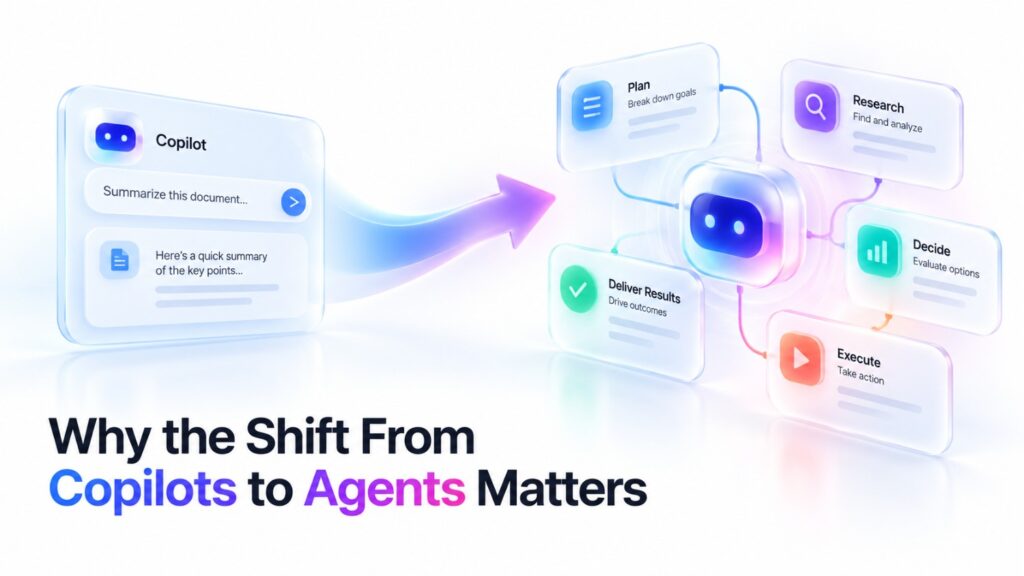
Those tools can save time, but the worker still has to move the process forward.
The agent model changes the unit of automation.
Copilot
Employee opens a document.
AI summarizes the document.
Employee decides what to do.
Employee opens another system.
Employee types information into that system.
Employee sends an email.
Agent
Employee defines the objective.
The agent retrieves the documents.
The agent checks the relevant rules.
The agent determines what needs to happen.
The agent updates the system.
The agent prepares or sends the communication.
The employee reviews exceptions.
That difference can produce much larger economic value.
It is also much harder to build safely.
And that is another reason New York may have an advantage.
Regulated Customers Force Better Products
Selling software to a hedge fund, insurer, bank or law firm is painful.
That can be good for a startup.
These customers ask difficult questions.
Where did the answer come from?
Who can see this information?
Is customer data used for model training?
Can we review what the agent did?
What happens if it makes a mistake?
Can an action require approval?
Can different users have different permissions?
Can the system work within our existing security controls?
Can every important decision be logged?
Consumer products can sometimes grow while solving those issues later.
Enterprise-agent companies often cannot.
New York customers force startups to build trust, permissions, controls, source verification and auditability earlier.
Those features may eventually become part of the competitive moat.
New York Has the Capital to Support the Transition
New York does not need to become the biggest AI funding market in the world to succeed.
It needs enough capital to repeatedly finance companies solving local enterprise problems.
That condition is clearly present.
NYCEDC reported that New York City has more than 1,200 active venture firms and more than 2,000 AI startups. It also said there were more than 40,000 workers with AI skills in the New York metro region.
Tech:NYC reported that NYC technology companies raised more than $28 billion in 2025, while AI companies accounted for $15.84 billion.
The New York State Comptroller has separately described the New York metro as the country’s second-largest venture market and reported that software and technology services accounted for more than half of NYC venture investment across 2020 through 2024.
The capital base matters because enterprise AI is expensive to build.
The startup does not only need machine-learning engineers.
It may need security specialists.
Implementation engineers.
Domain experts.
Enterprise salespeople.
Customer-success staff.
Compliance expertise.
Infrastructure.
Legal support.
That is a more complex company than a simple consumer AI application.
The Talent Advantage Is Becoming Broader Than Engineering
New York’s talent case is also different from the traditional technology-hub argument.
Yes, it has AI engineers.
But an enterprise-agent company often needs another type of employee just as badly.
It needs people who understand the work.
A financial AI company needs people who understand capital markets.
A legal AI company needs lawyers.
An insurance AI company benefits from insurance operators.
A property-management agent company needs people who understand buildings.
A procurement company needs people who understand purchasing and supply chains.
New York’s advantage is the intersection.
The city can put technical and domain talent inside the same startup.
NYCEDC reported that universities including Columbia, Cornell Tech, CUNY and NYU produced more than 87,000 AI-ready degree holders between 2018 and 2023.
That university base sits next to millions of professionals working in the industries those graduates may eventually automate.
That is difficult to reproduce.
New York’s Agent Ecosystem Is Not Just Silicon Valley With Skyscrapers
It is tempting to judge every AI city by asking whether it can beat San Francisco.
That is the wrong framework.
The Bay Area is still dramatically ahead in many parts of AI, particularly frontier models and capital.
New York does not need to win there.
Its more interesting opportunity is specialization.
Silicon Valley’s historic strength
Build the underlying technology.
New York’s emerging strength
Turn the technology into a business system.
This is an oversimplification, of course. San Francisco has major enterprise AI companies and New York has deep AI infrastructure companies.
But the pattern inside our NYC cohort is difficult to ignore.
Seventeen of 20 companies are primarily application businesses.
Nearly half the represented funding is concentrated in financial, insurance, investing, legal and compliance workflows.
Those are areas where New York has exceptional customer density.
That is what a geographic advantage should look like.
The Next Moat Will Be Workflow Knowledge
Large language models are becoming widely available.
That creates a strategic problem for startups.
If everyone can access strong models, simply wrapping a model inside a nice interface may not produce a lasting advantage.
Agent companies need something deeper.
They Need Proprietary Workflow Knowledge
An insurance startup learns which exceptions cause claims or policies to get stuck.
A sales company learns which signals predict action.
A finance product learns how strong analysts structure research.
A compliance company learns how rules map to real business decisions.
A real estate product learns how property managers route operational problems.
That knowledge can be reflected in data structures, integrations, evaluations, agent instructions, permissions, human-review systems and customer-specific configurations.
Over time, the product becomes more than the underlying model.
It becomes an encoded operating process.
This is where New York’s customer access becomes strategically important.
Enterprise Agents Will Probably Be Sold by Outcome
Traditional SaaS pricing was built around seats.
A company had 500 employees using software.
The vendor sold 500 licenses.
Agents complicate that model.
If one agent allows 10 employees to handle the previous workload of 20, charging by employee seat starts to make less sense.
Pricing may increasingly follow usage or business outcomes.
Insurance agents might be priced per workflow.
Legal agents could be priced per contract or matter.
Sales agents could be tied to accounts researched or actions executed.
Finance agents could be tied to analyses.
Procurement agents could be tied to transactions.
That moves software closer to the economics of labor.
It also dramatically increases the potential market.
The vendor is no longer competing only for the software budget.
It may be competing for part of the operating budget.
What New York Businesses Should Actually Do With Agents
The worst way to adopt enterprise agents is to start with the sentence:
“We need an AI agent.”

That starts with technology instead of a business problem.
Start with work.
Find the Workflow Before You Find the Vendor
A useful first agent project usually has four characteristics.
The work happens often.
The inputs are mostly digital.
The outcome can be measured.
And a human can review difficult exceptions.
That could mean reviewing invoices.
Preparing account research.
Triaging support requests.
Checking contracts.
Processing insurance documents.
Monitoring compliance.
Updating CRM records.
Handling property requests.
The exact workflow matters much more than whether the vendor uses the newest model.
Build an Agent ROI Baseline Before the Pilot
Most AI pilots fail to prove value because nobody measured the old process first.
Before deployment, calculate the current economics.
Enterprise Agent Pilot Scorecard
| Metric | Before pilot | During pilot | Target |
| Average completion time | Measure | Measure | Lower |
| Employee minutes per case | Measure | Measure | Lower |
| Cost per completed workflow | Measure | Measure | Lower |
| Error or rework rate | Measure | Measure | No increase |
| Human escalation rate | N/A | Measure | Declining |
| Work completed per employee | Measure | Measure | Higher |
| Customer response time | Measure | Measure | Lower |
| Revenue or savings impact | Measure | Measure | Positive |
The most important metric is rarely “hours saved.”
Hours saved do not automatically become money.
Ask what the company can now do because those hours were saved.
Can the same team process twice as many accounts?
Can deals close faster?
Can the business grow without hiring another operations team?
Can compliance review more content?
Can analysts study more opportunities?
That is where ROI becomes real.
Do Not Begin With the Most Dangerous Workflow
There is a temptation to prove the power of agents by giving them maximum autonomy.
That creates unnecessary risk.
A better rollout is progressive.
Stage One: Observe
The agent watches the workflow and prepares recommendations.
Humans still perform every important action.
Stage Two: Draft
The agent prepares the work.
A person approves it.
Stage Three: Act With Approval
The agent can operate systems, but sensitive actions need human confirmation.
Stage Four: Exception-Based Supervision
The agent independently handles routine cases while humans review unusual situations.
Stage Five: Controlled Autonomy
Only mature, measurable and well-tested tasks should reach this stage.
This sequence creates something most AI projects desperately need: operational evidence.
Measure Escalations, Not Just Accuracy
Teams often ask whether an AI system is 95% accurate.
That number can hide the real risk.
Suppose an agent correctly handles 95% of cases and confidently makes damaging mistakes in the other 5%.
That may be unusable.
A better enterprise agent should understand uncertainty.
It should recognize when it is outside its reliable operating area and escalate.
That makes escalation quality an important metric.
Businesses should track how often the agent escalates, whether it escalates the correct cases, how frequently humans reverse its decisions and whether the same failure patterns repeat.
The best enterprise agent may not be the one that acts most often.
It may be the one that knows when not to act.
The Biggest Agent Opportunity May Be Work Between Systems
Executives often imagine AI replacing one major application.
The larger opportunity may be between applications.
Modern enterprises already own enormous software stacks.
Salesforce stores customer information.
Workday stores employee information.
ServiceNow manages tickets.
SAP manages business processes.
Snowflake stores data.
Slack handles communication.
Google and Microsoft manage documents.
The problem is that humans still connect everything.
An employee reads information in one system, interprets it, opens another system, enters data and tells someone what happened.
Agents can become the connective tissue.
That means the next enterprise platform may not replace every system of record.
It may sit above them.
Actively’s product, for example, can work with existing systems including Salesforce instead of requiring customers to immediately replace the CRM.
Harmony operates through existing collaboration tools.
Jedify connects enterprise knowledge sources.
This pattern may prove much easier to adopt than asking a giant company to rip out software that took years to implement.
What Investors Should Watch Next
The words “AI agent” will become less useful as more companies adopt them.
Investors will need stronger filters.
The best companies will increasingly be separated by evidence of production use.
Watch Workflow Volume
How many real tasks are completed?
Pace’s disclosure that its agents had completed more than a quarter-million workflows is more meaningful than a vague claim about “AI transformation.”
Watch Expansion
Does the customer start with one workflow and add more?
Expansion shows the vendor is moving from a tool toward infrastructure.
Watch Human Escalation Rates
An improving escalation rate can show that agents are becoming more reliable.
Watch Gross Margin After Human Support
Some agent companies use humans behind the scenes to correct outputs.
That can be useful during early deployment.
But investors should understand the full labor required to deliver the result.
Watch Integration Depth
The deeper the product connects to important systems, the harder it may become to replace.
Watch Evidence
In regulated work, citations, logs, permissions and traceability may become more important than raw benchmark scores.
Original Finding #5: The Emerging NYC Agent Stack Has Four Layers
Looking across the cohort, we can describe New York’s developing enterprise-agent ecosystem as a four-layer stack.
| Layer | What it does | NYC examples |
| Data and context | Gives agents usable business information | Nimble, Jedify |
| Execution infrastructure | Gives agents secure environments and tools | Daytona |
| Horizontal workflow agents | Automates functions used across industries | Actively AI, Harmony, Concourse, Didero |
| Vertical industry agents | Handles specialized industry work | Norm AI, Pace, Avantos, Visitt, Uniti, Novella, Pinegap |
The fourth layer may become New York’s strongest.
Vertical agents need domain knowledge.
New York has domain knowledge at enormous scale.
The Main Risk: Companies Confuse Autonomy With Value
The agent market has a language problem.
Vendors are rewarded for describing products as autonomous.
Customers should care about something else.
Useful work.
An agent that independently performs 10 unnecessary steps is worse than a simple model that reliably completes one valuable task.
Businesses should therefore ignore much of the vocabulary.
Do not buy “agentic architecture.”
Buy faster underwriting.
Buy shorter diligence.
Buy fewer unresolved tickets.
Buy quicker approvals.
Buy more sales capacity.
Buy lower operating cost.
If the vendor cannot connect the agent to a measurable business result, the level of autonomy does not matter.
Security Will Become a Major Part of the NYC Agent Economy
Agents create security problems normal SaaS tools do not.
A dashboard reads information.
An agent may act on it.
That means permissions become much more serious.
An agent with access to email, financial systems, company documents and external tools can potentially perform thousands of actions faster than a person.
Enterprise security therefore needs to move from protecting data to controlling machine behavior.
Companies will need to know what an agent can access, which tools it can use, what actions require approval and how to stop unexpected behavior.
This may create another major startup category around agent identity, monitoring, governance, access control and audit systems.
The need will be particularly strong in New York because so much of the city’s agent activity is happening in regulated sectors.
The Job Impact Will Be More Complicated Than “AI Replaces Workers”
New York will also become an important laboratory for understanding what agents do to work.
The city’s occupational structure makes it unusually exposed to both the benefits and disruptions of AI.
The Comptroller’s research already found that AI use is more concentrated in higher-paid analytical occupations, although current usage still tends to augment workers more often than fully automate their work.
Agents may gradually change that balance.
A traditional copilot helps a junior employee finish a task.
An agent can sometimes perform the first version of the task itself.
That will change roles.
But the effect may not simply be fewer jobs.
Companies may process more work.
Employees may manage larger portfolios.
Teams may serve more customers.
New kinds of agent-operations, AI-security, workflow-design and domain-engineering jobs may grow.
The most important question is not whether a particular task can be automated.
It is what companies do with the resulting capacity.
Why 2026 Looks Like an Inflection Point
Our cohort provides one reason to believe 2026 is different.
Seventy percent of the companies are at Series A.
That means a large group of businesses has moved beyond the earliest idea stage and is now receiving capital to build repeatable products and distribution.
At the same time, companies such as Norm AI, Clay, Hebbia, Pace and Actively show that enterprise AI businesses in New York can reach larger financing rounds and significant valuations.
The demand side is also maturing.
Executives have already experimented with generative AI.
They understand the basic technology.
The conversation is moving away from, “Should we use AI?”
It is becoming, “Which processes should AI own?”
That is a much more valuable question.
What Could Make New York the Enterprise Agent Capital
New York does not automatically win.
The ecosystem still has to solve several problems.
Enterprise pilots need to become production systems.
Startups need to show measurable ROI.
Companies need stronger security and governance.
Customers need clean data and usable APIs.
Workers need training.
Agent deployments need clear ownership.
The city also needs to keep attracting technical talent despite competition from the Bay Area and other AI hubs.
But the underlying ingredients are unusually strong.
There are thousands of potential buyers.
There is deep venture capital.
There is a growing AI workforce.
There are world-class universities.
There are specialized industries.
There are expensive workflows.
And there is growing pressure inside corporations to translate AI investment into actual productivity.
That last point may matter most.
The Bigger Story: Enterprise AI Is Moving Toward Doing the Work
The defining enterprise software company of the 2010s helped employees manage work.
The defining enterprise AI company of the late 2020s may actually perform some of it.
New York is well positioned for that transition because the city has never been only a technology market.
It is a market for finance.
Insurance.
Law.
Media.
Advertising.
Real estate.
Healthcare.
Commerce.
Logistics.
Professional services.
Those industries contain the workflows from which enterprise agents learn.
Our 20-company dataset already shows the pattern.
$569.5 million of disclosed primary financing is represented in the 2026 cohort.
Seventy percent of the companies are Series A.
Eighty-five percent are primarily application-layer businesses rather than agent infrastructure companies.
Nearly half of represented capital is concentrated in financial, insurance, investment, legal and compliance workflows.
Those numbers suggest New York is not merely participating in the AI-agent boom.
It is developing a specific type of AI ecosystem.
One built around real work.
The Strategic Takeaway for New York Businesses
Do not wait for a general-purpose digital employee that can run your entire company.
That is not necessary.
The more practical opportunity already exists.
Find one workflow that is expensive, repetitive, measurable and mostly digital.
Measure what it costs today.
Give the agent a narrow operating area.
Require human review where risk is high.
Track completion time, cost, errors, escalations and business output.
Expand only after the numbers work.
Companies that follow that approach may discover something much more valuable than an AI demo.
They may find a new operating model.
The Strategic Takeaway for Founders
New York founders should resist the temptation to build another generic agent platform unless they have a genuine technical advantage.
The city’s stronger opportunity is closer to the customer.
Spend time inside industries.
Watch employees work.
Find processes held together by emails, spreadsheets, PDFs and human memory.
Look for tasks where customers already spend significant money.
Then build an agent around the workflow rather than trying to force a workflow around an agent.
The best New York enterprise AI companies may ultimately look less like chatbot companies and more like technology-powered operators.
The Strategic Takeaway for Investors
Do not count how many times “agentic” appears in the pitch deck.
Measure how much work the software actually performs.
A strong agent company should eventually be able to show how many workflows it completes, what percentage requires human help, how performance changes over time, how deeply the system connects to customer operations and what measurable economic result the buyer receives.
That is where durable enterprise value will be created.
Final Thoughts
New York’s AI story is becoming less about whether the city can copy Silicon Valley and more about what it can build better because it is New York.
Enterprise AI agents may be one of the clearest answers.
The city has the customers, industries, capital, domain expertise and workforce density required to turn general AI technology into specialized systems that perform expensive business work.
The first wave is already visible across finance, insurance, law, compliance, sales, procurement, real estate and enterprise infrastructure.
What comes next will be more important.
The winners will not be the companies with the most futuristic demos.
They will be the companies whose agents quietly enter real workflows, earn trust, handle more work each month and become increasingly difficult for customers to operate without.
That is the market New York appears to be building.