
Patents have always been one of the slowest parts of the technology economy.
A startup may build a new product in months. A software team may release updates every week. An artificial intelligence company may change its entire product strategy before lunch.
Patent work moves differently.
Patent attorneys still need to interview inventors, study technical documents, search huge databases, compare claims against earlier inventions, draft long applications, respond to patent examiners, review competing patents, and decide which parts of a portfolio are worth keeping.
That creates a strange gap.
Some of the most advanced companies in the world still protect their inventions through workflows built around PDFs, Word documents, spreadsheets, database searches, email, and many hours of manual reading.
Artificial intelligence is starting to close that gap.
And New York is becoming one of the most interesting places to watch.
Companies including Patlytics, DeepIP, IP8, PatentPlusAI and the former Garden Intelligence have built major parts of their businesses in New York. Solve Intelligence and Stilta are expanding through New York offices. LexisNexis Legal & Professional, headquartered in Manhattan, is bringing conversational AI into large-scale patent analytics. Upstate, IP.com has spent years building semantic search and is now mixing it with generative AI.
This is not simply a story about lawyers using ChatGPT.
A much bigger shift is taking place.
AI is moving into almost every part of the patent lifecycle: invention harvesting, patentability analysis, prior-art search, application drafting, office-action responses, freedom-to-operate reviews, invalidity analysis, infringement investigations, portfolio management, licensing and patent monetization.
For New York, that creates an unusually interesting opportunity. The city already sits at the intersection of law, finance, enterprise software, life sciences, venture capital and corporate strategy. Patent AI connects all of those markets.
To understand where the industry is going, NYC Tech Journal analyzed the companies building patent-focused AI products with a meaningful New York presence and compared their funding, products, market positioning and workflow coverage.
The results suggest that a real patent-AI cluster is starting to form.
The Short Answer: The Top Patent AI Companies in New York
The New York patent-AI market is still young enough that ranking companies from one to ten can be misleading.
A company automating patent drafting is solving a different problem from one looking for infringement across a portfolio. A platform designed for litigation is different from one helping a chief intellectual property officer decide which patents should be renewed.
Instead, the most useful approach is to look at what each company is trying to own.
| Company | New York connection | Main focus | Public commercial signal |
| Patlytics | Headquartered in New York | Full patent lifecycle, litigation, prosecution, search, portfolio strategy | About $65M total funding |
| DeepIP | New York and Paris; Manhattan address | Patentability, drafting, prosecution, FTO, invalidity and portfolio workflows | $40M total funding |
| Solve Intelligence | New York office | Broad patent workflow platform spanning drafting through litigation analysis | $55M total funding |
| Stilta | New York and Stockholm operations | Agentic patent research, invalidity, infringement and FTO | $10.5M seed round |
| Garden Intelligence / SIM IP | Garden was headquartered in NYC | Patent search, enforcement and monetization intelligence | $6.8M seed; Garden valued at $150M in 2026 merger |
| IP8 | Headquartered in New York | Infringement detection, licensing leads and patent monetization | Funding not publicly disclosed in sources reviewed |
| PatentPlusAI | NYC / tri-state team | Autonomous prior-art and patent searching | Early research supported by NSF grants |
| LexisNexis IP Solutions | LexisNexis Legal & Professional headquartered in NYC | Enterprise patent analytics and AI-assisted patent intelligence | Part of global RELX business |
| IP.com | Fairport, New York | Semantic patent search, innovation intelligence and AI ideation | Established private company |
Sources include company announcements, company product pages, USPTO materials, Y Combinator and RELX. Funding figures are disclosed amounts, not NYC Tech Journal estimates.
The first takeaway is simple: New York is not producing one kind of patent-AI company.
It is producing an ecosystem.
NYC Tech Journal Original Research: How We Analyzed New York’s Patent-AI Market
Before getting into individual companies, it helps to explain how we built this analysis.
This matters because the phrase “patent AI company” has become loose. Many general legal-AI platforms can summarize a patent. That does not make them patent-AI companies.
Our inclusion rules
For the core dataset, NYC Tech Journal looked for companies meeting three tests.
First, the company had to offer technology directly aimed at patent or intellectual property workflows rather than general legal work.
Second, it needed a meaningful New York connection. That could mean a New York headquarters, dual New York headquarters, a formal New York office or, in the case of IP.com, a New York State headquarters.
Third, the product had to be active and publicly verifiable as of August 30, 2026.
We then reviewed public product pages, company funding announcements, customer disclosures, acquisition announcements, USPTO material and other credible sources.
We separated funding from valuations
This is important.
A $40 million investment is not the same thing as a $150 million acquisition valuation. Mixing those numbers would make the market appear more heavily funded than it really is.
For that reason, Garden Intelligence’s $150 million valuation in its February 2026 merger with SIM IP is discussed separately from venture funding. Garden’s previously announced $6.8 million seed financing is the figure included in our startup-capital analysis.
We also separated product breadth from product quality
A platform offering eight workflows is not automatically better than a company offering one.
A specialized prior-art engine might outperform a broad platform on searching. A litigation product might be far more useful during an invalidity dispute than an application-drafting platform.
Our workflow analysis therefore measures breadth, not quality.
That distinction matters throughout this article.
Original Data: At Least $177.3 Million Has Gone Into Five New York-Connected Patent-AI Startups
Here is one of the clearest signs that this market is becoming serious.
NYC Tech Journal identified five comparable venture-backed patent-AI companies with meaningful New York operations and publicly disclosed financing:
Patlytics has reported about $65 million in total funding. Solve Intelligence has reported $55 million. DeepIP has reported $40 million. Stilta announced a $10.5 million seed round. Garden Intelligence announced a $6.8 million seed round before its merger with SIM IP.
Together, those companies account for at least $177.3 million in disclosed startup funding.
Chart: Share of disclosed funding in our comparable startup sample
Patlytics $65.0M ██████████████████ 36.7%
Solve Intelligence $55.0M ███████████████ 31.0%
DeepIP $40.0M ███████████ 22.6%
Stilta $10.5M ███ 5.9%
Garden Intelligence $6.8M ██ 3.8%
——————————————————-
Total $177.3M
The concentration is striking.
Patlytics, Solve Intelligence and DeepIP together represent roughly 90.3% of the disclosed capital in this five-company sample.
That suggests investors are already making large bets on a small group of companies attempting to become major workflow platforms.
But the smaller companies may be just as interesting.
Stilta is attacking high-value patent disputes. IP8 is focusing on monetization. PatentPlusAI is taking an unusually automated approach to prior-art searching. Specialized companies may not need to become full patent operating systems to build valuable businesses.
Patent AI Is Growing Because the Patent Problem Is Getting Bigger
AI is changing patents from two directions at once.
On one side, AI is making patent work faster.
On the other, AI itself is creating an explosion of new inventions that companies want to protect.
WIPO’s 2026 update on generative-AI patent activity makes the scale of the second trend clear. The organization reported that published GenAI patent families rose from roughly 14,000 in 2023 to more than 37,000 in 2025. More than 56,000 GenAI patent families were published during 2024 and 2025 alone, exceeding the entire total from the previous decade.
Chart: Global GenAI patent families
2023 ~14,000 ███████
2025 >37,000 ███████████████████
Two-year increase: roughly 164%
Approximate annualized growth: about 63%
These calculations use WIPO’s rounded public figures, so they should be read as directional rather than exact.
Still, the message is difficult to miss.
The world is producing more AI inventions while AI is simultaneously becoming capable of helping humans analyze those inventions.
That creates a feedback loop.
More patents create more search work. More search work creates demand for better AI. Better AI makes it cheaper to analyze larger patent sets. That makes larger-scale patent strategy possible.
WIPO also reported that large language model patent families reached about 14,100 publications in 2025, compared with roughly 5,200 for generative adversarial networks. GenAI represented 8.7% of all published AI patent families, up from 6.1% in 2023.
Patent intelligence is therefore becoming important not just to patent lawyers, but to technology executives.
Patlytics — New York’s Best-Known Full-Lifecycle Patent-AI Startup
If one company currently represents New York’s patent-AI boom, it is Patlytics.
The company is headquartered in New York and has positioned itself as an AI-native platform covering much of the patent lifecycle. Its product includes infringement analysis, invalidity, freedom-to-operate work, standard-essential patents, portfolio analysis, patent and non-patent-literature search, claim construction, drafting and office-action workflows.
Funding has moved unusually fast
Patlytics first announced a $4.5 million seed round led by Google’s Gradient Ventures. A $14 million Series A followed. In April 2026, the company announced a $40 million Series B led by SignalFire, bringing total capital raised to approximately $65 million.
That is a large amount of capital for a company founded only a few years ago.
The funding is important, but its customer claims may be more interesting.
At the time of its Series B announcement, Patlytics said it served more than 40% of Am Law 100 IP practices. More recent company materials claim still broader adoption. Because those numbers are company-reported and may use different definitions, buyers should confirm customer metrics during diligence rather than treating them as independently audited market-share figures.
Why Patlytics matters
The most ambitious part of Patlytics’ strategy is not any single feature.
It is the attempt to connect the work.
Patent teams traditionally move information between different search tools, drafting systems, spreadsheets, docketing software and litigation systems. Each handoff creates extra labor.
Patlytics is betting that the winning platform will preserve context across those stages.
A prior-art search should help inform drafting. Drafting should feed prosecution. Portfolio data should help identify infringement. Infringement evidence should support licensing or litigation strategy.
That is much more valuable than merely generating paragraphs faster.
The platform is moving toward AI agents
In August 2026, Patlytics launched what it describes as an AI reasoning layer for patent work at an event in New York. That direction is worth watching because it reflects a broader move from simple AI assistance toward systems capable of completing multi-step patent tasks.
The next battle in patent software may therefore not be “Who has the best chatbot?”
It may be “Which system can safely complete the largest piece of a patent matter while keeping the attorney in control?”
DeepIP — Bringing AI Directly Into Drafting and Prosecution
DeepIP is another major New York patent-AI company, operating from New York and Paris. Its legal notice lists a Manhattan address at 1411 Broadway.
The company originally gained attention around AI-assisted patent drafting but has expanded well beyond that starting point.
DeepIP now markets patentability analysis, semantic patent search, drafting, office-action analysis, prosecution support, FTO work, invalidity analysis and portfolio intelligence. Its search product says it covers more than 120 million patents.
DeepIP has raised $40 million
In March 2025, DeepIP announced a $15 million Series A. In March 2026, the company announced a $25 million Series B, bringing total funding to $40 million. The company said at the time that more than 400 law firms and corporate IP teams were using the platform.
That puts DeepIP firmly in the group of well-funded patent-AI platforms trying to own several stages of the workflow.
Its Microsoft Word strategy is important
One of DeepIP’s smarter choices has been to meet patent attorneys where they already work.
Patent lawyers have spent decades drafting in Microsoft Word. Getting a law firm to replace that environment entirely can be harder than adding intelligence inside it.
DeepIP has therefore integrated its AI assistant into Microsoft Word while also offering connections to docketing systems, Outlook and APIs.
That sounds like a product detail.
It is actually a distribution strategy.
Legal technology adoption often fails because software demands too much behavior change. The closer AI can sit to the existing workflow, the easier adoption becomes.
Solve Intelligence — A Major Patent-AI Player Building a New York Base
Solve Intelligence is headquartered in London, but New York has become an important part of its expansion.
The company announced a New York City office as part of its broader U.S. growth and says its patent platform is now used by more than 700 in-house IP teams and law firms. Its current product spans patent application drafting, prosecution, search, invention harvesting, claim charts, invalidity, FTO, infringement detection and portfolio work.
Solve has raised $55 million
Solve announced a $12 million Series A in April 2025 and a $40 million Series B in December 2025, bringing total funding to $55 million. Investors have included 20VC, Visionaries Club, Microsoft’s M12, Thomson Reuters Ventures and Y Combinator.
That puts Solve slightly behind Patlytics but ahead of DeepIP in total disclosed funding among the companies in our sample.
The company is also expanding from creation to enforcement
This is one of the biggest market trends to watch.
Several patent-AI companies started with drafting because large language models are naturally good at working with text.
But drafting alone may not be the largest opportunity.
Solve’s newer products extend into claim charting, freedom-to-operate analysis, infringement and invalidity work. That takes the platform closer to litigation, licensing and business strategy, where the value of a good answer can be far greater than the cost of producing a draft.
The direction looks very similar to Patlytics and DeepIP.
All three appear to be moving toward broader patent operating systems.
Stilta — Agentic AI for High-Stakes Patent Research
Stilta is much younger.
That is exactly why it deserves attention.
Founded in 2026, the company has operations in Stockholm and New York City and is building agentic AI for patent work. It focuses heavily on invalidity, infringement and freedom-to-operate investigations across patents, scientific literature and archived web sources.
Andreessen Horowitz led its $10.5 million seed round
In May 2026, Stilta announced a $10.5 million seed round led by Andreessen Horowitz. Y Combinator also backed the company.
That funding is notable for a startup only months old.
But the more interesting point is what Stilta is trying to automate.
Patent research is becoming agentic
Old patent searching normally starts with a human designing queries, reviewing results, changing the query, checking more documents and slowly narrowing the field.
Agentic systems change that model.
A group of software agents can search different information sources, compare evidence, test new search ideas, return to weak points and then combine the findings.
Stilta says its system is designed to perform this kind of parallel reasoning while keeping practitioners in control. The company reports that its platform can work across patents, journals, file histories and archived web material and produce source-cited analysis.
If this approach works reliably, it could change the economics of invalidity research.
Finding one old document that destroys a patent claim can determine the direction of a dispute worth millions of dollars.
That makes high-recall AI research an unusually valuable problem.
Garden Intelligence and SIM IP — Where Patent AI Meets Patent Finance
Garden Intelligence shows another possible future for patent AI.
Instead of remaining only a software company, Garden moved directly toward patent monetization.
The New York company announced a $6.8 million seed round in August 2024. It developed AI tools for prior-art research, patent analysis and related IP workflows.

Then something bigger happened.
SIM IP and Garden merged in a deal valuing Garden at $150 million
In February 2026, SIM IP and Garden announced a merger that valued Garden Intelligence at $150 million.
The combined strategy joins patent analytics with licensing and IP-focused capital. The companies said the goal was to use AI and proprietary data to identify valuable patents and turn more of those assets into revenue.
This is a very different model from patent drafting.
It treats patents almost like financial assets.
Why this matters especially in New York
New York is unusually well suited to this model because the city understands capital.
A patent portfolio can contain hundreds or thousands of assets, but many corporate teams historically treat the portfolio mostly as a legal cost center.
AI creates a different possibility.
Software can rank assets, map them against products, identify possible infringers, surface licensing targets and estimate which patents deserve closer human review.
That begins to connect patent strategy with investment strategy.
And that connection may become one of New York’s strongest advantages in intellectual-property technology.
IP8 — Using AI to Find Money Hidden Inside Patent Portfolios
IP8 is another New York company focused on the commercial side of patents.
The company’s stated mission is to help IP teams find monetization opportunities by automating infringement detection and licensing-lead generation. It is developed by the team behind patent-intelligence platform PatSeer and lists its headquarters at 108 West 39th Street in Manhattan.
The problem IP8 is solving is simple
Companies own patents they barely use.
Some patents may protect products. Some are defensive. Some exist because an invention mattered ten years ago but no longer supports the company’s current strategy.
Inside a large portfolio, however, there may also be patents that other companies are using.
Traditionally, identifying those opportunities can require large amounts of technical and legal research.
IP8 uses AI and automated product monitoring to reduce that work.
Patent monetization could become much more systematic
The long-term opportunity is larger than sending a company a list of possible infringers.
Imagine a patent portfolio being monitored continuously.
New products launch. Product manuals change. Websites are updated. New standards appear. Competitors release technical documentation.
An AI system could repeatedly compare those public signals against thousands of patent claims and surface promising matches.
Humans would still need to determine whether infringement actually exists and what action makes business sense.
But the search for opportunities could become continuous rather than occasional.
That is a major shift.
PatentPlusAI — Trying to Automate the Prior-Art Search Itself
PatentPlusAI is a smaller company, but its technical focus makes it worth watching.
The company lists New York City as its headquarters and says its employees are based in the tri-state region. Its primary product, AutoPat, is designed to perform autonomous patent searching.
According to the company, AutoPat can search more than 150 million patent documents and 38 million research papers and may review tens of thousands of documents for a single project. PatentPlusAI says development began through research supported by National Science Foundation grants.
Search may be harder to disrupt than drafting
AI-generated writing gets most of the attention because the result is easy to see.
Prior-art search may be the more technically difficult challenge.
A search system cannot merely produce something that sounds correct.
It has to find the document that matters.
Missing one reference can completely change a patentability or invalidity conclusion.
That makes retrieval, recall, query expansion, claim interpretation and citation verification central to the product.
PatentPlusAI’s narrow focus gives it an interesting position against larger platforms.
The question is whether specialized autonomous search engines remain independent categories or eventually become components inside broader patent-AI platforms.
LexisNexis PatentSight+ — The Incumbent Response to Patent AI
Patent AI is not only a startup market.
LexisNexis Legal & Professional is headquartered in New York and has thousands of employees around the world. Its Intellectual Property Solutions group has been adding AI capabilities to established patent-data products.
That matters because incumbents start with something startups have to build: huge structured datasets and existing enterprise relationships.
Protégé brings conversational AI to PatentSight+
In May 2026, LexisNexis announced Protégé inside PatentSight+.
The system allows users to ask patent-intelligence questions in plain language and receive structured answers grounded in large patent datasets and established analytics. LexisNexis says the platform works across tens of millions of harmonized and verified patent records.
The company had already introduced AI-powered TechDiscovery, which allows users to search patent information using words, descriptions, document excerpts and patent numbers rather than relying entirely on complicated database-query syntax.
This changes who can use patent intelligence
Traditional patent analytics often require specialist knowledge.
Users need to understand classifications, Boolean logic, assignee normalization and the odd language patents use.
Natural-language interfaces reduce that barrier.
A strategy executive might eventually be able to ask:
Which competitors are increasing patent activity in battery recycling?
Which companies have the strongest portfolios around a specific technology?
Where is our portfolio weaker than our competitors?
Which patents could become acquisition targets?
AI does not remove the need for good underlying patent data.
It makes that data easier to interrogate.
IP.com — A New York State Patent-AI Company With a Very Different History
Not all New York patent-AI companies were born during the generative-AI boom.
IP.com is based in Fairport, near Rochester, and was founded long before ChatGPT. The company has built patent search, prior-art, semantic-search and innovation-intelligence products for years.
It is now adding generative AI to that foundation.
Semantic search remains valuable in a generative world
IP.com’s approach helps explain an important technical point.
Generative AI and patent retrieval are not the same thing.
A language model can write a convincing explanation without having searched the right evidence.
IP.com continues to emphasize semantic retrieval systems designed to return traceable source material, while products such as CompassAI add generative capabilities around ideation and problem solving.
That hybrid model may become common.
The generative model handles conversation, reasoning and synthesis.
A specialized retrieval engine handles evidence.
For patent work, the evidence layer is critical.
Original Analysis: The New York Patent-AI Market Is Splitting Into Five Layers
When we mapped these companies by problem rather than by brand, a clearer market structure appeared.
Layer 1: Create the patent
This includes invention harvesting, patentability review, drafting and application preparation.
DeepIP, Solve Intelligence and Patlytics are all active here.
Generative AI fits naturally into this layer because much of the work involves understanding technical disclosures and turning them into structured legal documents.
Layer 2: Get the patent allowed
This layer covers office actions, examiner arguments, claim amendments and prosecution strategy.
DeepIP, Solve and Patlytics have all expanded into this area. The goal is moving beyond “write a response” toward understanding what the examiner rejected, why the examiner rejected it and how claim changes may affect future value.
Layer 3: Understand the patent landscape
This includes patentability searching, prior art, FTO, competitive landscapes and portfolio intelligence.
Almost every serious patent-AI vendor touches this layer because search connects the entire patent lifecycle.
Layer 4: Fight over patents
Invalidity, infringement, claim construction, litigation evidence and post-grant strategy live here.
Patlytics, Solve and Stilta are especially important to watch in this market.
The financial value per matter can be extremely high, which may justify much more sophisticated AI infrastructure.
Layer 5: Turn patents into money
This is where New York could develop a particularly strong niche.
Garden/SIM IP and IP8 are pushing directly toward licensing and monetization.
Instead of asking only, “How can AI help us file this patent?” they ask, “How can AI help us discover which patents are worth money?”
That changes the buyer, business model and size of the opportunity.
Original Workflow Comparison: How Broad Are the New AI-Native Platforms?
To make this more concrete, NYC Tech Journal mapped six AI-native companies against eight major patent workflows.
A check means we found a current public product description or company statement clearly supporting that category. A blank does not mean a platform cannot perform the work. It simply means we did not count the capability without enough public evidence.
| Workflow | Patlytics | Solve | DeepIP | Stilta | IP8 | PatentPlusAI |
| Invention intake / harvesting | ✓ | ✓ | ✓ | |||
| Prior-art / patent search | ✓ | ✓ | ✓ | ✓ | ✓ | |
| Patent drafting | ✓ | ✓ | ✓ | |||
| Prosecution / office actions | ✓ | ✓ | ✓ | |||
| FTO / clearance | ✓ | ✓ | ✓ | ✓ | ✓ | |
| Invalidity / infringement | ✓ | ✓ | ✓ | ✓ | ✓ | ✓ |
| Portfolio analysis | ✓ | ✓ | ✓ | ✓ | ✓ | ✓ |
| Licensing / monetization | ✓ | ✓ | ✓ |
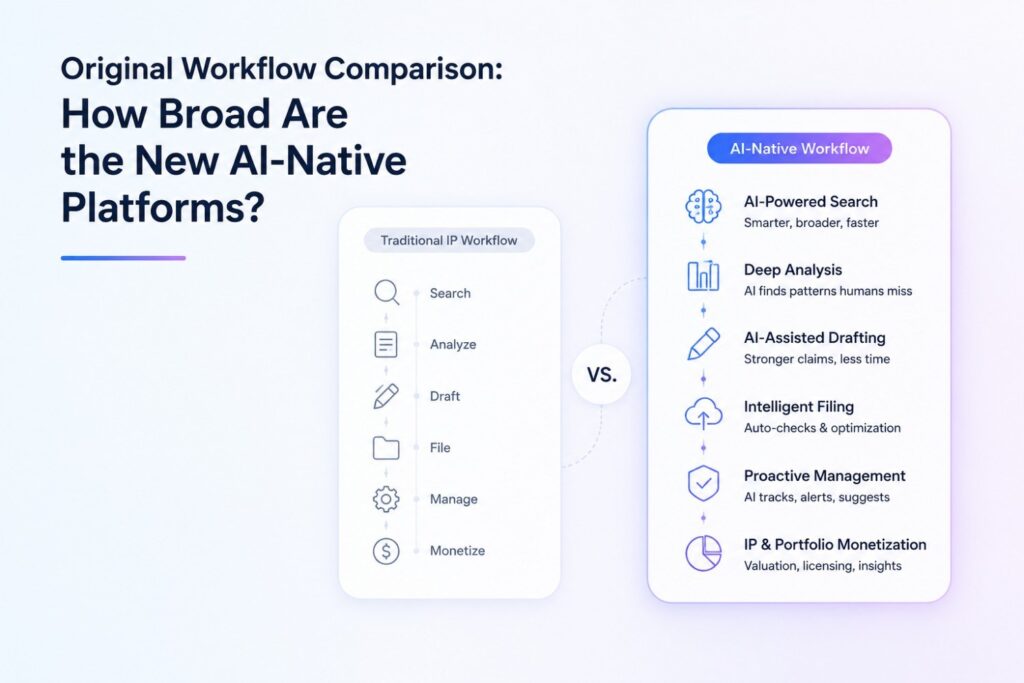
The table is based on publicly marketed functionality rather than independent product testing. Categories are deliberately broad, and the table measures coverage rather than quality.
Chart: Verified workflow breadth in our eight-stage framework
Patlytics 8/8 ████████
Solve Intelligence 7/8 ███████
DeepIP 7/8 ███████
Stilta 5/8 █████
IP8 3/8 ███
PatentPlusAI 4/8 ████
Again, this is not a quality ranking.
What it shows is strategic direction.
The better-funded companies are generally becoming broader.
The smaller companies are often focusing on narrower problems where deep automation may create a strong advantage.
AI Will Change Patent Search More Than Most People Expect
The old patent-search interface asks humans to think like databases.
Choose keywords.
Add Boolean operators.
Find classifications.
Search synonyms.
Review hundreds of results.
Change the query.
Repeat.
AI reverses that interaction.
The software increasingly tries to understand the invention first.
Semantic search reduces dependence on exact words
Patents deliberately use broad and unusual language.
A company may describe a technology differently from the engineer who invented it. Two documents can discuss almost the same technical concept while sharing surprisingly few keywords.
Semantic search attempts to match meaning rather than exact wording.
That idea existed before modern generative AI. What has changed is the ability to combine retrieval with language-model reasoning.
Agentic search goes another step
An agent can begin with a claim, break it into limitations, search different concepts, review references, notice missing elements, change search strategies and try again.
That begins to resemble the way an experienced human searcher works.
The advantage is scale.
A human cannot deeply read 20,000 patents during every search.
Machines can.
The hard part is making sure the system does not confuse quantity with relevance.
AI Will Change Patent Drafting, but Drafting Is Not Just Writing
At first glance, patent drafting looks like a perfect generative-AI task.
Give the system an invention disclosure.
Ask it to write a specification.
Generate claims.
Create an abstract.
Done.
That is the dangerous version of patent AI.
A patent application is not a school essay.
Every sentence can affect claim scope, support, enablement, prosecution and future litigation.
Strong systems need context
Good AI-assisted drafting therefore needs to understand more than the invention description.
It may need prior art.
It needs consistency between claims and the specification.
It needs terminology that stays stable.
It needs different embodiments.
It may need jurisdiction-specific rules.
It needs to avoid inventing technical facts the inventor never provided.
This is why the strongest patent-AI companies increasingly combine drafting with search, review and prosecution.
The value is not merely writing faster.
It is keeping the entire patent record consistent.
Office Actions May Become One of the Most Valuable AI Workflows
Patent prosecution is an especially strong AI use case because office actions are highly structured but require substantial reasoning.
An examiner may reject claims under Section 101, 102, 103 or 112.
The attorney must understand the rejection, inspect cited references, determine whether the examiner’s claim mapping is correct, decide whether to amend or argue and think about how today’s response affects enforcement years later.
DeepIP, Solve and Patlytics are all building here.
The best AI systems will not simply create persuasive language.
They will help attorneys see the structure of the problem faster.
That is much more useful.
Patent Litigation Could Be Where Agentic AI Creates the Most Economic Value
Patent litigation generates huge amounts of research.
Teams may examine patents, prosecution histories, technical manuals, academic papers, product documents, archived websites and prior litigation.
The objective may be finding one piece of evidence.
This is exactly the kind of work autonomous research agents could transform.
AI can parallelize investigation
Instead of one researcher following one search path, several AI agents can explore different possibilities.
One can search patents.
Another can inspect scientific literature.
Another can search archived product material.
Another can analyze prosecution history.
A coordinating layer can then compare what they found.
Stilta is built strongly around this model, while Patlytics and Solve are also moving deeper into high-volume patent analysis.
The financial incentive is obvious.
Reducing an expensive investigation from weeks to hours could be worth far more than reducing the time needed to draft one document.
AI Could Finally Make Patent Portfolios Act More Like Business Assets
Large companies often own thousands of patents.
The problem is that understanding those portfolios is expensive.
Which patents protect important products?
Which overlap?
Which can be abandoned?
Which competitors may be using them?
Which technologies are becoming more important?
Where does the company have gaps?
Which assets could generate licensing revenue?
AI makes it possible to ask those questions more often.
Portfolio monitoring can become continuous
Traditional portfolio reviews happen periodically because humans are expensive.
Machine analysis does not need to wait for an annual review.
Products, competitors, markets and patent filings can be tracked continuously.
That means the chief patent counsel of the future may work from a living intelligence system rather than a static spreadsheet.
For corporate IP departments, that could be one of the biggest changes AI brings.
AI Is Also Changing What Can Be Patented
There is another side to the story.
AI is not only helping people work with patents.
AI is helping people invent.
That raises a difficult question: who is the inventor?
AI still cannot be named as a U.S. inventor
The USPTO revised its guidance on AI-assisted inventions in November 2025.
Its position is straightforward: the traditional legal standard for inventorship still applies, and only natural persons can be named as inventors. AI systems are treated as tools used by humans rather than inventors themselves.
That does not mean inventions developed with AI cannot be patented.
They can.
The key question remains human conception and inventorship under existing law.
This makes documentation more important
Imagine a researcher works with an AI system over hundreds of prompts.
The AI proposes dozens of technical approaches.
The researcher changes parameters, rejects options, combines concepts and eventually reaches a patentable design.
Years later, someone challenges inventorship.
What happened during that AI-assisted process suddenly matters.
Companies may therefore need better records of how human inventors used AI during research.
Ironically, more AI in invention could create demand for better human documentation.
Patent Professionals Cannot Simply Copy Confidential Inventions Into Any AI Tool
Another issue is confidentiality.
Patent work frequently involves inventions that have never been published.
That information may represent years of research and enormous commercial value.
Putting it into an uncontrolled consumer AI system can create unacceptable risk.
The USPTO has already issued guidance reminding practitioners that existing professional rules and obligations continue to apply when AI tools are used in USPTO matters.
That is why enterprise patent-AI companies talk so much about security.
DeepIP advertises SOC 2 Type II and ISO 27001 controls. Stilta describes tenant isolation, data-residency options and restrictions against using client information for model training. IP8 describes private-cloud systems and enterprise model providers. PatentPlusAI says customer information is not used for model training.
For buyers, these are not minor IT questions.
They are part of the legal product.
How New York Law Firms Should Evaluate Patent-AI Software
Buying patent AI should not begin with a companywide rollout.
Start with one workflow.
Choose a painful, measurable task
Prior-art search is one option.
Office-action analysis is another.
Claim charting, first-draft generation or FTO screening can also work.
The important point is that you already understand the existing process well enough to measure it.
If the team does not know how many hours the current task consumes, it will be difficult to know whether AI improved anything.
Measure quality before speed
A system that completes a job 80% faster but introduces serious legal errors is not cheaper.
A good evaluation should compare the AI-assisted result with the firm’s normal work product.
Look at references missed.
Check unsupported statements.
Review claim mappings.
Check technical details.
Look for invented citations.
Measure partner correction time.
Only after quality clears the required threshold should speed matter.
Test difficult matters
Vendor demos often use clean examples.
Real patent work is messy.
Test the system with poor invention disclosures, long claims, unusual technologies, mixed-language references and difficult office actions.
The objective is not seeing how impressive the software looks when everything goes right.
It is discovering what happens when the work becomes difficult.
A Practical Patent-AI Pilot Scorecard
New York firms and corporate IP teams can use a scorecard like this during a 30- to 60-day pilot.
| Measure | Suggested question | Why it matters |
| Accuracy | Were important facts and citations correct? | Patent work cannot tolerate confident fiction |
| Recall | Did the system miss important prior art or evidence? | Missed evidence may be more dangerous than wrong summaries |
| Attorney review time | How long did verification take? | Gross AI speed can hide expensive review |
| End-to-end cycle time | Did the matter finish sooner? | Measures actual workflow improvement |
| Work-product quality | Did senior reviewers make fewer corrections? | Tests whether AI improves more than speed |
| Security | Where is confidential data stored and processed? | Unpublished inventions require strict protection |
| Traceability | Can every important conclusion be checked against a source? | Essential for legal defensibility |
| Integration | Does the system fit Word, docketing and other existing tools? | Poor workflow fit kills adoption |
| Cost per matter | What did the completed task actually cost? | Seat price alone can be misleading |
| User adoption | Did attorneys voluntarily continue using it? | The best software is useless if nobody opens it |
This is where legal-AI buying needs to become more disciplined.
Do not buy a patent AI platform because the demo writes an impressive paragraph.
Buy it because a measured workflow gets better.
How In-House IP Teams Should Think About Patent AI
Corporate buyers have a slightly different problem.
Their goal is not maximizing billable efficiency.
It is improving the economics and strategic value of the entire patent program.
Start before the patent application
One major opportunity is invention harvesting.
Engineers generate ideas continuously, but many never reach legal teams in a structured form.
AI can help summarize technical discussions, structure invention disclosures and identify ideas that may deserve evaluation.
That potentially increases the amount of innovation an IP team can review without increasing headcount at the same rate.
Use AI to decide what not to patent
This may be even more important.
Filing everything is expensive.
An AI-assisted system can help compare an idea against prior art, company strategy, competitors and the existing portfolio before large prosecution costs are incurred.
The result should not be “AI decides whether we patent this.”
The better model is “AI gives humans much better information before they make the decision.”
Connect patents with products
Corporate IP teams should also push vendors beyond legal documents.
A valuable portfolio platform should understand the company’s products, roadmap, competitors and markets.
Otherwise, patent analytics can remain disconnected from business strategy.
The strongest tools will help answer not merely “What patents do we own?”
They will help answer “Why do these patents matter?”
What Startups Should Do Differently
Founders may be the group most tempted to over-automate patent work.
A startup sees a tool that can draft a patent in minutes and naturally wonders why it should pay lawyers thousands of dollars.
The answer is that generating a document and creating a valuable patent position are different things.
Use AI to become a better legal client
Founders can use AI to organize technical information.
Create diagrams.
Build timelines.
Describe alternatives.
List inventors.
Compare possible embodiments.
Gather known prior art.
Prepare questions.
That can reduce the amount of expensive attorney time spent gathering basic information.
Do not optimize for the cheapest filing
A cheap patent that fails to cover the company’s eventual product is expensive.
A poorly drafted application can also create problems that cannot easily be repaired later because new matter generally cannot simply be added after filing.
Startups should therefore think about AI as leverage.
Use it to improve preparation and efficiency.
Do not confuse automation with strategy.
Why New York Has a Real Shot at Becoming a Patent-AI Hub
Silicon Valley has engineers.
Washington has the USPTO ecosystem.
Boston has life sciences.
Why New York?
Because patent AI is not purely a legal technology problem.
It sits where several industries meet.
New York understands enterprise legal software
Many of the world’s largest law firms have major New York operations.
Selling software into sophisticated legal organizations requires trust, security, workflow integration and long buying cycles.
New York startups can build close to those users.
New York understands monetization
Patents are legal rights, but valuable portfolios are also economic assets.
Licensing, litigation finance, acquisitions, venture capital, private equity and corporate finance all matter once companies begin asking what their IP is worth.
The Garden/SIM IP transaction and IP8’s monetization focus show how naturally patent technology can connect with New York’s financial ecosystem.
New York also has many kinds of inventors
Finance, advertising technology, enterprise software, biotech, pharmaceuticals, cybersecurity, media, manufacturing, robotics and AI all have meaningful activity in the wider New York economy.
That diversity matters.
A patent-AI company building in New York is exposed to many different kinds of patent problems.
Original Analysis: 2026 Looks Like the Year Patent AI Became a Platform Race
The funding timeline tells a story.
Chart: Major verified events around New York-connected patent AI
AUG 2024
Garden Intelligence raises $6.8M seed
MAR 2025
DeepIP raises $15M Series A
APR 2025
Solve Intelligence raises $12M Series A
DEC 2025
Solve raises $40M Series B
Total funding reaches $55M
FEB 2026
Garden merges with SIM IP
Garden valued at $150M
MAR 2026
DeepIP raises $25M Series B
Total funding reaches $40M
APR 2026
Patlytics raises $40M Series B
Total funding reaches about $65M
MAY 2026
Stilta raises $10.5M seed
AUG 2026
Patlytics unveils new AI reasoning layer in New York
Sources: company announcements and public reports.
What changed across that period?
The major vendors stopped looking like isolated AI features.
They started looking like platforms.
Drafting companies added prosecution.
Search companies added analysis.
Prosecution platforms added FTO.
Patent analytics moved toward conversational AI.
Litigation tools became agentic.
Portfolio systems moved toward monetization.
That expansion is unlikely to stop.
The Next Battle Will Be Over Patent Data
Large language models are becoming easier to access.
Every vendor can call powerful foundation models.
That means the model itself may not be the long-term advantage.
The bigger moat could be data.
Patent data is messy
Company names change.
Ownership moves.
Patent families spread across countries.
Claims are amended.
Legal status changes.
Documents cite other documents.
Products use different language from claims.
Scientific literature may become important prior art.
Litigation and prosecution histories add another layer.
Cleaning, connecting and understanding this information can be more difficult than generating text.
That gives established platforms such as LexisNexis an advantage.
But startups can build different moats through proprietary workflow data, user feedback, search behavior, validated claim mappings and human-reviewed outputs.
The companies that learn fastest from actual patent work may improve faster than those using the most fashionable base model.
Citation Quality Will Matter More Than Beautiful Writing
Patent attorneys do not primarily need AI that sounds smart.
They need AI that can prove what it says.
That distinction could determine which legal-AI companies survive.
A system may produce a beautiful invalidity explanation.
If the cited document does not actually contain the relevant limitation, the explanation is useless.
The same applies to office actions, infringement reports and FTO analysis.
For high-stakes patent work, the best AI user interface may eventually look less like a chatbot and more like an evidence workspace.
Every conclusion should connect back to documents.
Every claim element should have a source.
Every uncertain point should be visible.
That is where trust comes from.
Patent AI Probably Will Not Replace Patent Attorneys
The strongest products do not make that claim.
There is a reason.
Patent work combines technical understanding, legal judgment, commercial strategy, negotiation and risk.
AI can do increasingly large portions of the research and preparation.
But deciding what a company should protect is a business decision.
Deciding how aggressively to claim an invention is a strategic decision.
Deciding whether to sue a competitor is not a retrieval problem.
Deciding whether a weak patent should be abandoned can involve product plans that no public database understands.
The job is therefore likely to change more than disappear.
Junior patent work may change first
Some of today’s junior work consists of searching, summarizing, comparing documents, preparing first drafts and building charts.
Those are exactly the tasks AI is improving at fastest.
The future junior patent professional may spend less time manually collecting information and more time checking machine-generated analysis.
That requires a different skill.
Knowing how to verify AI may become almost as important as knowing how to produce the first draft manually.
Patent Pricing Could Change
This may be the most uncomfortable part of the shift for law firms.
If AI reduces a twenty-hour task to five hours, the traditional billable-hour model becomes harder to defend.
Clients will know that.
Some firms may simply cut hours.
Others will move toward fixed fees.
Some will use AI productivity to increase margins while keeping prices relatively stable.
The strongest firms may bundle software, attorney judgment and portfolio strategy into higher-value services.
Patent AI therefore creates a business-model problem, not merely a technology problem.
Firms that solve only the software question may still struggle with the economics.
Consolidation Is Almost Inevitable
There are too many patent workflows for every startup to remain independent forever.
A corporate IP department does not want fourteen AI tools.
It wants a trusted system that covers most of its work and connects with the tools it already uses.
That puts pressure on startups to expand.
It also creates opportunities for acquisitions.
Search technology can be bought by drafting platforms.
Litigation products can join portfolio systems.
Patent data businesses can acquire AI interfaces.
Financial firms can buy patent intelligence.
Garden’s combination with SIM IP may be an early example of this pattern rather than an exception.
What NYC Tech Journal Will Be Watching Next
The New York patent-AI market is moving too quickly to judge companies only by today’s feature lists.
Five questions matter more.
Can agents complete full matters reliably?
Generating individual pieces of work is already becoming common.
The harder challenge is completing a multi-step project.
An agent conducting an invalidity investigation must search, review, compare, change direction, gather evidence and explain the final result.
Doing that reliably would be a major step.
Which platform builds the strongest evidence layer?
Patent AI has little value without trustworthy sources.
The winner may be the company that creates the best connection between AI reasoning and verifiable patent evidence.
Will monetization become a major category?
New York may have an edge here.
If AI makes it cheaper to find infringement and licensing opportunities, companies may begin treating dormant patent portfolios much more aggressively.
That could create an entire category connecting AI, patents, licensing and finance.
Will enterprise buyers consolidate vendors?
Today, law firms may test several products.
Over time, security review, training and integration costs create pressure to standardize.
The companies that become systems of record could gain powerful advantages.
Can companies prove better patent outcomes, not just faster work?
This is ultimately the most important question.
Hours saved are useful.
But stronger claims are better.
Fewer unnecessary prosecution rounds are better.
More relevant prior art is better.
Better FTO decisions are better.
Successful licensing opportunities are better.
The next phase of patent AI needs outcome data.
Final Takeaway
Patent AI is becoming one of New York’s most interesting vertical-AI markets.
The city already has a meaningful group of companies attacking different pieces of the problem. Patlytics is building across the full patent lifecycle. DeepIP is connecting patentability, drafting and prosecution with broader intelligence. Solve Intelligence is expanding a broad patent platform through its New York presence. Stilta is bringing agentic systems into high-stakes patent research. IP8 is concentrating on monetization. PatentPlusAI is pushing autonomous patent searching. Garden Intelligence has already moved from startup to a $150 million merger with SIM IP. LexisNexis is bringing AI to established patent analytics, while IP.com represents a longer-standing New York search and innovation technology base.
Our analysis found at least $177.3 million in disclosed funding across five comparable venture-backed patent-AI companies with meaningful New York connections. More important than the number is where the money is going: not into simple writing assistants, but into platforms that search evidence, analyze claims, draft applications, handle prosecution, evaluate risk, investigate infringement and increasingly turn patents into commercial intelligence.
That is the real change.
AI is not simply helping lawyers produce patent documents faster.
It is beginning to change what a patent department can know.
A team that once reviewed a few hundred documents may analyze thousands. A company that reviewed its portfolio once a year may eventually monitor it every day. A patent attorney who spent hours reconstructing an examiner’s rejection may soon begin with a structured map. A licensing team may discover assets that had been sitting untouched for years.
The patent system will still require human judgment.
But the amount of information one human can work with is increasing dramatically.
For New York, that creates a compelling opportunity. The city has lawyers, technologists, investors, global corporations and one of the world’s deepest markets for turning complicated information into business decisions.
Patent AI sits directly in the middle of all of them.
And the companies being built now may determine how some of the world’s most valuable ideas are protected, defended and monetized for decades to come.