


New York City has a climate challenge unlike almost any other major American city. It has millions of people living and working in dense neighborhoods, thousands of older buildings, limited space for new energy infrastructure, expensive electricity, aging heating systems, and one of the most complicated construction environments in the country. At the same time, the city has committed to cutting greenhouse gas emissions while building owners face growing pressure to make their properties more efficient.
This combination is creating an unusually strong market for climate technology.
Artificial intelligence is becoming an important part of that market, but not in the way many people imagine. The most interesting climate AI companies in New York are not simply creating chatbots that write sustainability reports or summarize carbon data. They are using AI, machine learning, sensors, forecasting models, and automated controls to change how physical energy systems operate.
Some systems decide when a boiler should run and when it should shut down. Others determine when a battery should charge, identify which buildings are good candidates for electrification, calculate whether a renewable energy project is likely to work, or help developers find problems before millions of dollars are committed.
These applications are important because New York’s climate problem is increasingly becoming a decision problem. The city already knows that buildings need to use less fossil fuel and electricity needs to become cleaner. The harder question is how millions of individual energy decisions should change every hour, every day, and across thousands of properties.
Our analysis of New York City’s greenhouse gas inventory shows why this shift matters.
NYC Tech Journal examined official city greenhouse gas data for residential and commercial and institutional stationary energy. Between 2005 and 2024, combined emissions from these categories fell from roughly 39.37 million metric tons of carbon dioxide equivalent to approximately 29.13 million metric tons.
That represents a decline of about 26%.
The progress is substantial, but the numbers reveal something even more important. Emissions linked to fuel oil fell dramatically during this period, while emissions linked to natural gas increased. In other words, New York has already solved part of the older heating problem, but the remaining challenge is becoming concentrated around natural gas, electricity, electrification, building controls, and grid management.
That is exactly where many of New York’s most interesting climate and energy AI startups are working.
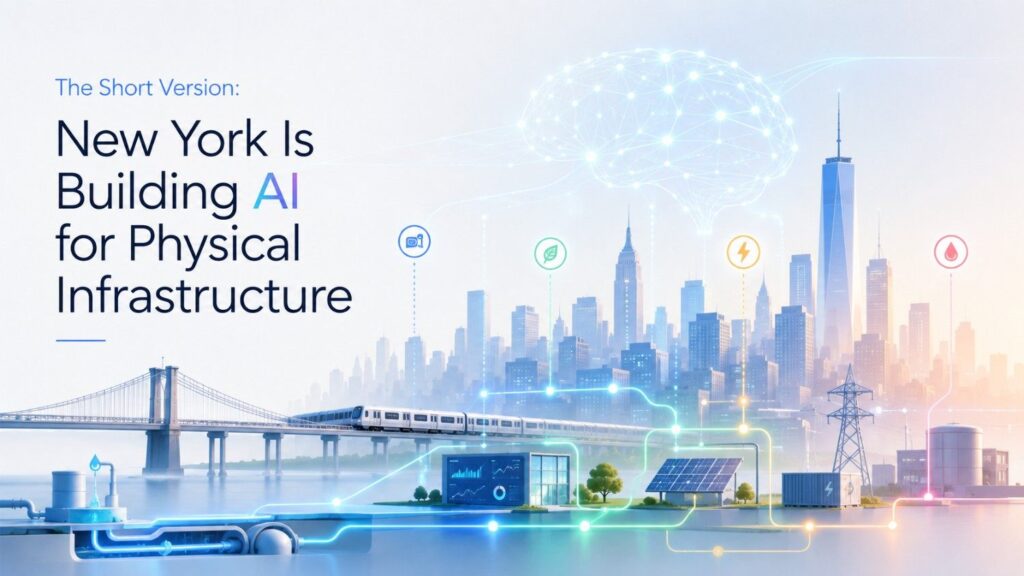
The Short Version: New York Is Building AI for Physical Infrastructure
Climate AI has become an extremely broad term. A startup can now add a generative AI feature to almost any sustainability product and describe itself as a climate AI company, even when the technology has little influence on actual energy use.
For this article, we used a much narrower definition.
We focused on companies with meaningful New York City connections that use AI, machine learning, automated optimization, predictive analytics, or similar intelligent software to address energy, building, infrastructure, or decarbonization problems. Greater weight was given to businesses whose technology can influence what actually happens inside a building, battery, energy project, or grid-connected asset.
The result is a group of companies that reveals where the climate AI market is heading.
| Company | New York connection | What the intelligence layer does | Main problem being solved |
| Runwise | New York headquarters | Continuously optimizes heating and building operations | Boiler, steam, HVAC and energy waste |
| Kelvin | Brooklyn Navy Yard | Coordinates room-level controls, heat pumps and existing heating | Decarbonizing older buildings |
| BlocPower | Brooklyn | Uses building data and modeling to plan electrification and retrofits | Scaling urban building upgrades |
| David Energy | New York | Optimizes batteries and distributed energy assets | Electricity costs and peak demand |
| Paces | Brooklyn | Uses AI agents and energy data to automate project development | Siting, permitting and interconnection |
| GridMarket | New York City | Analyzes distributed-energy project economics | Finding viable solar, storage and microgrid opportunities |
| Convergent Energy + Power | New York | Optimizes battery dispatch using AI and machine learning | Grid peaks and energy-storage economics |
| Euclid Power | New York | Extracts and verifies renewable project information | Slow diligence and project execution |
| Astro | New York City | Models grid congestion and project economics | Renewable energy site selection |
| Guardia | New York-focused | Analyzes building data and Local Law 97 exposure | Carbon compliance and retrofit planning |
This should not be treated as a funding or valuation ranking. It is better understood as a map of the different parts of New York’s climate problem where intelligent software is beginning to make practical decisions.
Original NYC Tech Journal Research: How New York’s Building Emissions Problem Is Changing
New York’s climate challenge cannot be understood by looking only at the total amount of emissions produced each year. It is also necessary to understand which fuels are producing those emissions and how that mix is changing.
That is why we analyzed the city’s published greenhouse gas inventory in more detail.
Our Methodology
NYC Tech Journal compared calendar-year 2005 and calendar-year 2024 greenhouse gas data published by New York City. We isolated stationary energy emissions from residential properties and commercial and institutional properties because these categories are most closely connected with the startups discussed in this article.
Within those categories, we examined emissions connected with electricity, natural gas, steam, No. 2 fuel oil, No. 4 fuel oil, No. 6 fuel oil, and biofuel.
We did not include transportation, waste, manufacturing, construction, or other sectors in these calculations. The goal was not to reproduce New York City’s entire greenhouse gas inventory. Instead, the goal was to understand how the emissions profile of the city’s major building categories has changed and what that means for the climate technology market.
Historical greenhouse gas estimates can also be recalculated as New York improves its methodology and data. For this reason, the calculations below should be understood as NYC Tech Journal analysis based on the currently available city inventory.
Original Finding #1: Building Energy Emissions Have Fallen, but the Harder Problem Remains
Residential and commercial and institutional stationary energy emissions in the categories included in our analysis totaled approximately 39.37 million metric tons of carbon dioxide equivalent in 2005.
By 2024, those emissions had fallen to roughly 29.13 million metric tons.
That is a reduction of approximately 26%.
Residential and Commercial Building Energy Emissions
| Year | Emissions analyzed | Change from 2005 |
| 2005 | 39.37 million tCO₂e | Baseline |
| 2024 | 29.13 million tCO₂e | -26.0% |
The decline shows that New York has already made meaningful progress, particularly through changes in heating fuel and improvements in electricity-related emissions. However, the composition of the remaining emissions suggests that the next phase will be harder.
The city has already removed a large portion of the dirtiest fuel oil from its building energy mix. Future reductions will depend much more heavily on improving natural gas heating, reducing unnecessary energy consumption, electrifying buildings, managing peak electricity demand, and making the grid cleaner.
Those tasks require far more precise control than simply switching away from one fuel.
Original Finding #2: Fuel Oil Emissions Fell by Nearly 72%
One of the clearest changes in New York’s building energy system is the decline of fuel oil.
When we combined No. 2, No. 4, and No. 6 fuel oil across the residential and commercial and institutional categories examined, emissions fell from approximately 5.89 million metric tons in 2005 to around 1.65 million metric tons in 2024.
That represents a decline of approximately 71.9%.
The disappearance of No. 6 fuel oil from the relevant 2024 inventory rows is particularly notable. This does not mean New York has eliminated fossil-fuel heating, because natural gas remains extremely important. What it shows is that a major part of the city’s earlier building emissions problem has already changed.
How Building Energy Emissions Shifted
| Energy source | 2005 emissions | 2024 emissions | Change |
| Electricity | 19.92M tCO₂e | 12.89M tCO₂e | -35.3% |
| Natural gas | 11.99M | 14.08M | +17.5% |
| Combined fuel oil | 5.89M | 1.65M | -71.9% |
| Steam | 1.57M | 0.51M | -67.8% |
| Total analyzed | 39.37M | 29.13M | -26.0% |
The most important number in this table may be the increase in natural gas.
While almost every other major category declined, natural gas emissions rose by approximately 17.5%. This means New York’s building decarbonization challenge is becoming increasingly focused on heating efficiency and electrification.
Original Finding #3: Natural Gas Is Becoming the Center of the Building Challenge
The shift becomes even clearer when we examine each energy source as a percentage of the emissions included in our analysis.
In 2005, electricity represented approximately 50.6% of the analyzed emissions. Natural gas represented only about 30.5%.
By 2024, electricity’s share had fallen to approximately 44.2%, while natural gas had increased to roughly 48.3%.
Fuel oil moved in the opposite direction, falling from about 15% of the analyzed total to roughly 5.7%.
Share of the Building Energy Emissions We Analyzed
| Energy source | 2005 share | 2024 share |
| Natural gas | 30.5% | 48.3% |
| Electricity | 50.6% | 44.2% |
| Fuel oil | 15.0% | 5.7% |
| Steam | 4.0% | 1.7% |
This change has major implications for climate technology.
New York cannot finish decarbonizing its buildings simply by replacing the remaining heavy fuel oil. Owners now need to know when heating is truly required, whether boilers are operating longer than necessary, whether heat pumps can replace part of a building’s gas use, and how electrification can happen without creating expensive electricity peaks.
These are dynamic problems, which makes them well suited to intelligent control systems.
Why Buildings Are Such a Large Climate AI Opportunity in New York
Buildings dominate New York City’s carbon problem.
According to city climate budgeting materials, buildings were responsible for approximately 66% of citywide greenhouse gas emissions in 2022. Transportation represented most of the remaining emissions, while waste accounted for a much smaller share.
That makes buildings one of the most attractive places to apply AI because improvements can produce both financial and environmental benefits.
A building owner does not need to care about artificial intelligence itself. The owner cares about heating bills, electricity charges, equipment failures, tenant complaints, future capital expenses, and possible carbon penalties.
The climate AI companies most likely to succeed are therefore the companies that connect their technology directly to those problems.
Local Law 97 Is Turning Carbon Into a Financial Operating Metric
Local Law 97 has dramatically changed the economics of building energy in New York.
The law applies emissions limits to many large buildings, including individual buildings larger than 25,000 gross square feet and certain groups of buildings that collectively meet the applicable threshold. The exact rules depend on building type and compliance pathway, which means owners need property-specific analysis rather than generic citywide advice.
For many properties covered by the main framework, emissions above the permitted limit can create financial penalties.
The Department of Buildings states that an annual emissions overage can result in a civil penalty calculated by multiplying the number of excess metric tons of carbon dioxide equivalent by $268.
What the $268-per-Ton Penalty Formula Can Mean
| Annual emissions above limit | Potential annual penalty |
| 25 tCO₂e | $6,700 |
| 100 tCO₂e | $26,800 |
| 250 tCO₂e | $67,000 |
| 500 tCO₂e | $134,000 |
| 1,000 tCO₂e | $268,000 |
The mathematics are straightforward, but the operational decisions required to avoid those penalties are not.
An owner needs to know why a building’s emissions are high, which equipment is responsible, whether controls can solve part of the problem, whether electrification is financially practical, which improvements should be completed first, and how every proposed upgrade affects both energy bills and carbon performance.
That creates a powerful market for software that can convert building data into practical decisions.
New York’s Grid Creates a Second Major AI Opportunity
Building electrification solves only part of the climate problem.
Moving heating, vehicles, kitchens, and other equipment from fossil fuels to electricity increases the importance of managing the electrical grid. If thousands of new electric devices all operate during the same peak period, infrastructure costs can increase even when total annual electricity use remains manageable.
Recent NYISO long-term forecasts illustrate this challenge.
Forecast summer peak demand in Zone J, which covers New York City, rises from approximately 11,184 megawatts in 2025 to roughly 11,486 megawatts in 2030.
NYISO Zone J Summer Peak Forecast
| Year | Forecast summer peak |
| 2025 | 11,184 MW |
| 2026 | 11,185 MW |
| 2027 | 11,240 MW |
| 2028 | 11,313 MW |
| 2029 | 11,398 MW |
| 2030 | 11,486 MW |
The increase is about 302 megawatts, or approximately 2.7%, across the period.
The percentage increase may appear manageable, but the economics of electricity depend heavily on when demand occurs. A short period of extremely high demand can be much more expensive than the average level of consumption.
That makes batteries, demand response, forecasting, and automated building controls increasingly important.
1. Runwise — Making Old Building Systems Operate More Intelligently
Runwise is one of the best examples of climate technology designed specifically for the reality of New York buildings.
Instead of assuming that every aging boiler or steam system can immediately be removed, Runwise installs sensors and controls that help existing equipment operate more efficiently.
Its system collects information from inside the building while also considering outdoor temperature and weather conditions. The software can then adjust heating behavior based on what the building actually needs rather than simply following a fixed schedule.
This distinction matters enormously in older multifamily buildings.
Traditional systems can continue producing heat because an outdoor sensor indicates that the weather is cold, even when many apartments are already warm enough. In some buildings, residents respond by opening windows during winter, which means the property is paying to generate heat that immediately escapes outside.
A more intelligent system can use actual apartment conditions to make better heating decisions.
Why Runwise Works Well in New York
Runwise’s approach fits New York because much of the city’s existing building stock will remain in operation for decades.
Full electrification may ultimately be necessary for many properties, but it cannot happen everywhere at once. Owners have financial limits, buildings remain occupied during construction, electrical upgrades can be expensive, and major mechanical work needs careful planning.
That creates a valuable opportunity for technologies that improve existing systems while deeper retrofits are being prepared.
Runwise reports that its technology is used across more than 10,000 buildings and says customers can achieve meaningful reductions in heating, cooling, and water costs. Those savings vary by property and should be evaluated building by building, but the broader lesson is clear.
The fastest climate improvement does not always begin with replacing equipment. Sometimes it begins by making existing equipment stop wasting energy.
2. Kelvin — Bringing Room-Level Intelligence to Steam-Heated Buildings
Kelvin, formerly known as Radiator Labs, started with another classic New York problem: overheated apartments in steam-heated buildings.
Steam systems can be extremely difficult to control at the apartment level. One apartment may become too hot while another remains cold, leading building operators to overheat the entire property in an attempt to satisfy the coldest units.
Kelvin developed a smart radiator enclosure called the Cozy that gives buildings much more precise control over individual radiators.

The company reports average energy savings of roughly 25.5% for the system and references NYSERDA validation of the technology.
However, Kelvin’s larger idea is becoming even more interesting.
Adaptive Electrification Could Make Building Upgrades Less Disruptive
Kelvin is developing what it calls Adaptive Electrification, which allows heat pumps and existing heating infrastructure to operate together.
Instead of removing the boiler immediately, the system can determine when electric heating should be used and when the existing system should provide heat. The software can consider factors such as outdoor conditions, electricity pricing, available equipment, and demand-response opportunities.
This creates a gradual pathway toward electrification.
For many New York buildings, that may be more practical than attempting a complete mechanical replacement in a single project.
A co-op or multifamily owner can begin reducing fossil-fuel consumption while preserving existing equipment as backup. Over time, the building can increase its dependence on electric heating as economics and infrastructure improve.
That type of flexible transition may become especially important in a city where buildings cannot simply shut down while modernization occurs.
3. BlocPower — Using Data to Scale Building Electrification
BlocPower approaches the climate problem at the portfolio level.
The Brooklyn company combines building upgrades, project management, financing, energy efficiency, and electrification. It has worked on more than a thousand buildings and has become one of the best-known New York companies focused on making clean building technology accessible beyond luxury office towers.
The company’s technical approach has included physics-based simulations, building data, artificial intelligence, and machine-learning models that can help identify suitable energy conservation measures.
The important opportunity is not simply modeling energy use.
It is reducing the amount of manual work required before a retrofit can begin.
Why Retrofit Planning Needs Better Automation
Decarbonizing one building is complicated. Decarbonizing thousands of buildings becomes a data problem.
Each property has different heating equipment, electrical capacity, ownership structures, utility costs, financial constraints, building shapes, and retrofit possibilities.
If every property requires months of manual analysis before anyone can decide what work makes sense, the energy transition will move slowly.
AI can help reduce that problem by screening properties more quickly.
A system can combine building characteristics, historical energy data, equipment information, incentives, expected savings, and likely retrofit costs. Engineers can then spend more time examining the buildings where detailed analysis will create the most value.
This does not eliminate the need for engineering expertise. It makes that expertise easier to scale.
4. David Energy — Turning Small Batteries Into Flexible Energy Assets
David Energy is approaching the electricity market from both the software and energy-supply sides.
The New York company has developed technology that manages distributed energy resources including batteries, HVAC systems, and other flexible loads. Machine learning and automated optimization help determine when these assets should operate.
Its recent work with small commercial batteries makes the concept easy to understand.
A battery can charge when electricity is relatively inexpensive and discharge when prices or demand charges are higher. The customer does not need to manually decide when to use the stored electricity because software can make those decisions continuously.
Why Small Commercial Batteries Could Matter
One battery inside a restaurant does not change the New York electricity system.
Thousands of batteries acting together can become much more meaningful.
Restaurants, stores, offices, and other businesses follow relatively predictable energy patterns. If software understands those patterns, it can charge batteries before expensive periods and discharge them during peaks.
When many systems are coordinated, those batteries can begin behaving like a distributed power resource.
This creates a possible pathway toward much larger virtual power plants in which thousands of small devices work together.
The Real Product Is Lower Energy Cost
David Energy also demonstrates an important climate-tech business principle.
Most business owners are not interested in becoming energy-market experts. They want predictable costs and lower bills.
A product becomes easier to adopt when the technology works quietly behind a simple financial result.
That means the AI does not have to be the centerpiece of the sales message. It only needs to make the economics better.
5. Paces — Using AI Agents to Accelerate Energy Development
Paces operates much earlier in the energy project lifecycle.
The Brooklyn startup builds software that helps developers decide where clean-energy and power infrastructure should be built and whether individual projects are likely to work.
Its platform brings together information about sites, grid conditions, permitting requirements, environmental constraints, property data, and other development factors.
The company has also moved toward autonomous AI agents that can perform parts of the development workflow.
Renewable Projects Often Fail Before Construction Starts
Energy development involves much more than buying solar panels or batteries.
Developers must identify suitable sites, understand zoning, investigate grid capacity, estimate costs, secure land rights, evaluate environmental restrictions, apply for interconnection, obtain permits, and arrange financing.
A project that appears attractive at the beginning can become unworkable months later.
By that point, the developer may already have spent significant amounts of money.
This creates a valuable role for AI.
If software can identify a fatal problem early, the company can abandon the project before wasting more capital. If the opportunity looks strong, the development team can move faster and with greater confidence.
AI Agents Could Transform Infrastructure Workflows
The larger opportunity is not limited to finding project sites.
Energy development contains hundreds of repetitive tasks involving maps, forms, databases, engineering documents, deadlines, permits, and applications.
AI agents can potentially perform much of the early research and administrative work while keeping specialists involved whenever engineering or regulatory judgment is required.
That could allow a small development team to evaluate far more opportunities without increasing headcount at the same rate.
6. GridMarket — Finding Energy Projects That Actually Make Financial Sense
GridMarket focuses on a related problem: determining which properties are suitable for distributed energy projects.
The New York City company uses large data sets, predictive analytics, and AI-supported analysis to evaluate potential solar, energy storage, fuel cell, and microgrid opportunities.
This is important because renewable energy economics are highly site-specific.
A solar project that works on one building may make little financial sense on another property nearby. Roof conditions, electricity use, tariffs, available space, resilience needs, local rules, and equipment costs can all change the outcome.
Evaluating every property manually is expensive.
GridMarket attempts to make portfolio-level screening much faster.
Turning Energy Planning Into an Investment Pipeline
Large real estate owners, governments, utilities, and companies may control hundreds or thousands of properties.
Instead of commissioning a complete engineering study for every location, predictive software can identify the most promising opportunities first.
The owner can then direct engineering resources toward the smaller group of sites that deserve detailed examination.
This turns energy planning from a collection of isolated consulting projects into a repeatable investment process.
7. Convergent Energy + Power — Giving Batteries a Better Decision System
Battery storage creates value only when the stored electricity is used intelligently.
A battery that charges during an expensive period or remains full during the most valuable grid event may provide far less value than expected.
Convergent Energy + Power addresses this problem with its PEAK IQ platform.
The New York-headquartered company says the system uses artificial intelligence, machine learning, and advanced analytics to decide when storage systems should charge and discharge.
Its models can consider electricity tariffs, customer demand, wholesale market conditions, weather, and grid peaks.
Energy Storage Is Really a Timing Business
The physical battery is only one part of an energy-storage project.
The software controlling that battery determines how much economic value the hardware can produce.
Electricity prices change throughout the day. Commercial customers may face demand charges. Grid operators may place significant value on reducing load during a small number of peak periods. Renewable generation also varies with weather.
The control software must continuously evaluate all of those conditions.
That makes battery dispatch an ideal optimization problem for AI.
8. Euclid Power — Automating the Paperwork Behind Renewable Projects
Some of the biggest barriers to clean-energy development have nothing to do with power generation itself.
Renewable energy projects create huge amounts of documentation.
Developers and investors need to manage leases, permits, surveys, engineering files, tax documents, contracts, interconnection materials, financing information, and numerous versions of important project data.
Euclid Power is building software to make that process more manageable.
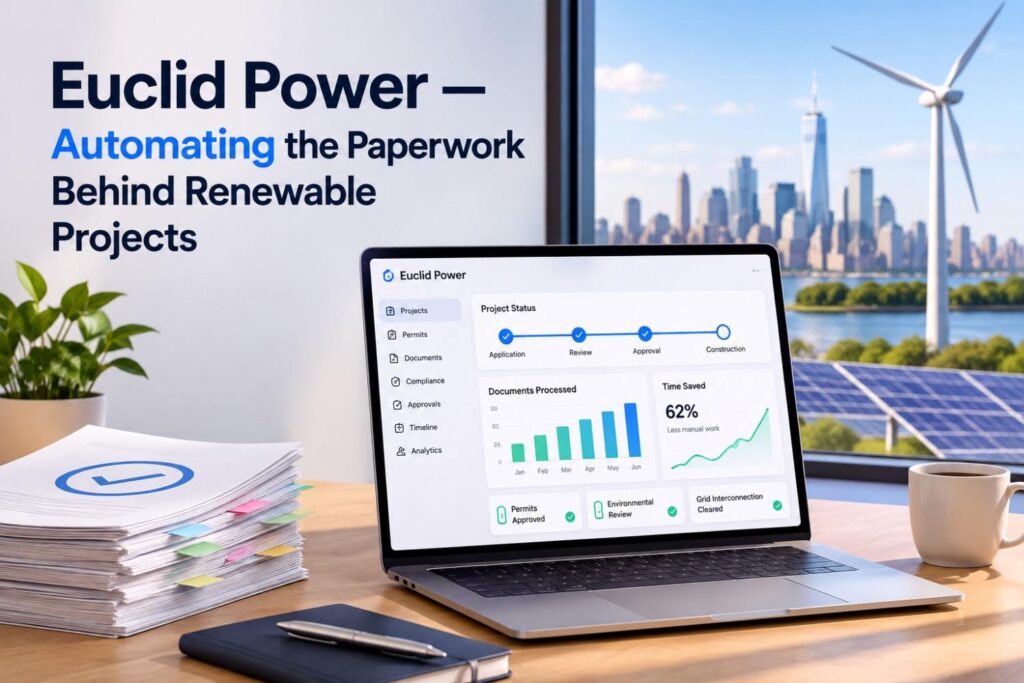
The New York company uses AI to read solar and storage project documents, extract important information, and connect extracted values back to the original source.
That final step is particularly important.
Financial and engineering teams need to know where information came from before relying on it. A system that simply generates an answer without showing the underlying evidence would be difficult to trust in a large infrastructure transaction.
Why Administrative Efficiency Has Climate Value
Document processing may sound less important than building a wind farm or battery project, but delays in administrative work can slow real infrastructure.
A developer may discover late in the process that a permit is missing, a contract contains an important deadline, or different documents contain conflicting numbers.
Better software can surface those problems earlier.
If teams can complete diligence faster and identify project risks sooner, capital can move more quickly toward viable projects.
That makes administrative AI part of the climate infrastructure stack.
9. Astro — Using AI to Find Better Renewable Energy Sites
Astro is much younger than most of the companies in this article, but its model demonstrates where energy AI could move next.
The New York City startup was founded in 2024 and joined Y Combinator’s Winter 2025 batch.
Its software uses AI and quantitative models to search for renewable energy development opportunities, with particular attention to grid congestion and interconnection economics.
That focus is important because attractive land does not automatically make an attractive energy project.
The Grid Can Be More Important Than the Property
A solar or battery project must be able to connect to the electricity system economically.
A location may have excellent physical characteristics but require extremely expensive grid upgrades. If those costs are discovered too late, the entire project can become unprofitable.
Better modeling can help developers understand the grid before committing significant capital.
Astro’s approach is also interesting because its founder previously worked in energy trading. New York’s deep pool of financial and quantitative talent could become an unexpected advantage for climate technology.
Electricity markets contain many of the same types of forecasting, pricing, and risk problems that quantitative finance professionals already understand.
The underlying assets are different, but the analytical mindset transfers surprisingly well.
10. Guardia — Building AI Around Local Law 97
Guardia represents another emerging category: AI built specifically around New York climate regulation.
The NYC-focused platform uses public building information to help owners understand emissions, estimate Local Law 97 exposure, identify possible upgrades, and build phased decarbonization plans.
The product uses sources such as city benchmarking information, permits, violations, building records, and incentive programs.
Its AI layer is intended to explain emissions drivers and organize possible improvements into a clearer plan.
Small Building Owners Need a Better Starting Point
Large institutional property owners may already have sustainability teams, energy engineers, lawyers, consultants, and sophisticated asset-management software.
A small co-op or condo board may have none of those resources.
The board may know that Local Law 97 matters without understanding exactly what needs to happen next.
That creates an opportunity for software that can give owners a useful first assessment before they begin paying for detailed engineering work.
Early-stage products such as Guardia should not replace qualified engineers, especially where certified calculations, filings, or physical design work are required. Their value is more likely to come from reducing the confusion that occurs before professional work begins.
Nantum AI Shows That Intelligent Building Controls Have Strategic Value
Nantum AI also deserves attention even though it is no longer an independent New York startup.
The company, previously called Prescriptive Data, built an AI-powered operating system for commercial buildings. Its software combined real-time building data, machine learning, and automated controls to improve HVAC operation, energy efficiency, and carbon performance.
The company also developed products that directly addressed New York-specific problems, including carbon penalty forecasting and systems for optimizing steam use.
In April 2026, Johnson Controls acquired Nantum AI and announced plans to integrate its technology into the OpenBlue building platform.
The acquisition matters because it shows that intelligent building controls are moving beyond a small climate-tech niche.
Major building technology companies increasingly view AI-based optimization as an important part of the future building operating system.
For New York startups, that creates both competition and validation.
Original Finding #4: The Most Important Climate AI Companies Are Closing the Gap Between Data and Action
When we compare the companies in this article, one pattern stands out.
The strongest products are moving beyond analysis and getting closer to real decisions.
Traditional energy management often follows a slow sequence. Utility data is collected, consultants study it, a report is produced, management reviews the report, capital is approved, and eventually someone changes the equipment.
Every handoff adds time.
Modern climate AI can shorten that cycle.
Runwise can use temperature information to change building heating. Kelvin can decide how different heating systems should work together. David Energy and Convergent can automatically change battery behavior. Paces can automate parts of project development, while Euclid can structure project documents as they arrive.
The software is becoming part of the operating process rather than simply describing what happened afterward.
Where the Intelligence Leads
| AI role | Example companies | Real-world result |
| Physical optimization | Runwise, Kelvin | Heating or cooling changes |
| Energy asset dispatch | David Energy, Convergent | Batteries charge or discharge |
| Retrofit analysis | BlocPower, Guardia | Capital projects are prioritized |
| Development intelligence | Paces, Astro | Projects are advanced or rejected |
| Investment and diligence workflow | GridMarket, Euclid Power | Better projects receive attention faster |
This creates a useful test for evaluating climate AI.
Ask what changes in the physical or financial world because the model made a better decision.
If a boiler runs less, a battery avoids an expensive peak, an unworkable project is rejected early, or a viable project receives financing faster, the value of the AI is relatively easy to understand.
Original Finding #5: New York Climate AI Is Becoming a Retrofit Industry
Another major pattern is that many New York climate startups are designed around existing infrastructure.
Runwise works with boilers and steam systems that are already installed. Kelvin adds intelligence to legacy radiators and combines existing systems with heat pumps. BlocPower plans upgrades for existing properties. Guardia begins with information about buildings that may have been constructed decades ago.
This is not accidental.
New York cannot build its way out of the climate problem entirely through new construction.
Most of the buildings that will exist in the city decades from now are already standing today.
The challenge is therefore to improve existing infrastructure without making buildings financially impossible to operate.
This gives New York climate technology a potentially valuable international advantage.
Older cities such as London, Boston, Philadelphia, Chicago, and many European capitals face similar problems. Technology that can successfully reduce energy use inside a complicated New York building may also work in dense urban markets elsewhere.
Original Finding #6: Climate Regulation Is Creating a New Software Market
Local Law 97 creates demand for more than heat pumps and efficient boilers.
It also creates demand for an entire information system around building carbon.
Owners need to understand current emissions, predict future exposure, identify retrofit opportunities, compare capital projects, find incentives, verify savings, and continuously track performance.
Each of those activities creates a software opportunity.
The Emerging Local Law 97 Technology Stack
| Stage | Owner’s question | Technology opportunity |
| Measure | How much energy are we using? | Sensors, meters and data integration |
| Diagnose | Why are emissions high? | Analytics and AI |
| Forecast | What happens under future limits? | Carbon and penalty modeling |
| Optimize | What can we fix without construction? | Building controls |
| Plan | Which project should happen first? | AI-assisted capital planning |
| Finance | How do we pay for improvements? | Incentive and finance software |
| Verify | Did the project actually save energy? | Measurement and verification |
| Operate | How do we maintain those savings? | Continuous monitoring and controls |
The long-term opportunity is therefore much larger than compliance software.
The real market is everything required to make buildings continuously perform better.
Why Energy Is Such a Natural Problem for AI
Energy systems constantly change.
Weather changes from hour to hour. Buildings fill and empty. Electricity prices move. Solar production rises and falls. Equipment becomes less efficient as it ages. Batteries have different levels of stored energy throughout the day.
Simple operating rules work when conditions are predictable.
Machine learning becomes much more useful when the best decision depends on many changing inputs.
Consider a New York apartment building on a cold winter morning.
A traditional system might begin heating at the same hour every day because the outdoor temperature falls below a fixed threshold.
An intelligent system can look at outdoor temperature, indoor apartment temperatures, weather forecasts, historical heating performance, and how quickly the property normally warms.
The better question is no longer whether the clock says 5 a.m.
The better question is how much heat the building actually requires.
That is the difference between automation and intelligent optimization.
Flexible Electricity Demand Could Become New York’s Next Major Climate AI Market
As New York electrifies heating and transportation, controlling when electricity is consumed will become increasingly important.
Imagine thousands of heat pumps operating during a cold morning while EV chargers, elevators, commercial kitchens, cooling equipment, office computers, and industrial loads are also drawing power.
The city may have enough energy across the entire day while still facing problems during a few difficult hours.
That makes flexibility extremely valuable.
Batteries can charge before peak periods. Buildings can preheat or precool. Electric vehicles can delay charging. Some commercial equipment can reduce consumption temporarily. Thermal systems can store heating or cooling for later use.
No human control room can manually coordinate millions of small decisions.
AI can.
David Energy and Convergent already show what intelligent battery dispatch can look like. Runwise and Kelvin show how buildings themselves can become more responsive.

The next generation of New York energy companies may combine these ideas and operate entire portfolios as flexible grid resources.
Climate AI Could Turn Buildings Into Part of the Power System
Historically, buildings have been passive electricity customers.
Power entered the building, equipment consumed it, and the utility sent a bill.
That relationship is changing.
A modern building can contain solar panels, batteries, heat pumps, smart HVAC equipment, electric vehicles, controllable lighting, and other flexible systems.
Once these assets become connected, the building can do more than consume electricity.
It can change when it consumes electricity.
Some buildings can also store energy and provide support when the grid is stressed.
The intelligence layer becomes the coordinator between the building and the larger power system.
This could become one of the most important climate AI opportunities in New York because the city contains enormous amounts of flexible electricity demand packed into a relatively small geographic area.
The company that controls the coordination layer may not need to manufacture the battery, heat pump, or thermostat.
Its value may come from deciding how all those devices should work together.
AI Agents Could Remove One of Energy Infrastructure’s Biggest Bottlenecks
Generative AI became popular because it can create text and answer questions, but infrastructure may provide an even more valuable use case.
Infrastructure development is filled with workflows.
A battery developer may need to investigate zoning, property ownership, interconnection requirements, permits, environmental restrictions, equipment prices, grid conditions, financing terms, and dozens of other variables before construction begins.
Every project involves documents, databases, deadlines, forms, and repeated checks.
Paces and Euclid already demonstrate two different approaches to improving these workflows.
Paces is pushing AI deeper into project development. Euclid is applying AI to the documents and diligence behind renewable projects.
Future systems could go even further.
An energy development agent could watch a project continuously, identify missing information, update financial assumptions when new data appears, draft paperwork, flag conflicting documents, track deadlines, and escalate unusual issues to specialists.
This would not eliminate engineers, lawyers, developers, or finance professionals.
It would allow them to spend more time making difficult decisions and less time moving information between systems.
Climate AI Needs Human Oversight Because the Decisions Are Real
Climate AI operates in a very different environment from many consumer applications.
Mistakes can affect building comfort, equipment safety, regulatory compliance, financial investments, electrical systems, and infrastructure reliability.
That means the goal should not be maximum automation at any cost.
The better goal is controlled automation with clear human oversight.
The best climate AI products should make it easy to understand where recommendations came from, what information was used, when the system is uncertain, and what a human needs to approve.
This is particularly important when AI is controlling physical equipment.
Building owners should ask vendors how staff can override automated actions, what happens when a sensor fails, how operating changes are recorded, and how cybersecurity is handled.
Trust will become one of the biggest competitive advantages in climate AI.
What New York Building Owners Should Do in the Next 90 Days
Building owners do not need to begin with an enormous AI transformation.
A much better approach is to identify one expensive problem and test whether intelligent software can improve it.
A Practical 90-Day Climate AI Pilot
| Period | Main objective | Expected outcome |
| Days 1–30 | Establish a reliable baseline | Understand current energy, equipment and costs |
| Days 31–60 | Test one controllable problem | Run a focused pilot |
| Days 61–90 | Verify results | Decide whether to scale |
Days 1–30: Understand the Building Before Buying Technology
Start by collecting at least twelve months of utility information and preferably twenty-four months when available.
Separate electricity, natural gas, steam, oil, water, and demand charges.
The goal is not simply to calculate a total bill. Owners need to understand how costs change by season, which fuels dominate the building, and when expensive peaks occur.
The next step is to map the major equipment responsible for those patterns.
A steam building with frequent winter overheating may have an obvious controls opportunity. A commercial property with large summer demand charges may benefit from storage or flexible loads.
The technology should be chosen after the problem is understood, not before.
Days 31–60: Choose One Measurable Decision
The best pilot changes something that can be measured.
Heating controls are useful because owners can compare weather-normalized fuel consumption before and after the system is installed.
Battery dispatch can be measured through avoided peak demand or electricity cost.
AI used in development workflows can be tested by comparing how long teams take to evaluate sites, complete diligence, or prepare applications.
Avoid connecting every system in the property during the first project.
A narrow pilot makes the value easier to prove.
Days 61–90: Verify the Economic Result
At the end of the pilot, the owner should be able to explain exactly what improved.
Energy savings should be compared with a reasonable baseline. Weather, occupancy, production levels, or other major changes should be considered where relevant.
Workflow AI should be measured using factors such as employee hours saved, error rates, review time, and number of projects evaluated.
A percentage printed in a sales presentation is not proof.
The strongest climate technologies are valuable precisely because their results can be measured.
How Businesses Should Evaluate Climate AI Vendors
Companies do not need deep technical knowledge to evaluate climate AI, but they do need to ask practical questions.
| Question | Why it matters |
| What decision does the AI improve? | Reveals whether there is a genuine use case |
| What data does the system need? | Determines integration difficulty |
| Does it recommend actions or automatically control equipment? | Defines operational risk |
| Can important outputs be traced back to source data? | Improves trust |
| How are savings measured? | Tests whether claims are credible |
| What happens when data or sensors fail? | Shows operational resilience |
| Can employees override the system? | Protects physical operations |
| Who owns the building data? | Reduces long-term lock-in risk |
| How is system access protected? | Addresses cybersecurity |
| Does the vendor understand New York regulations? | Local rules can change project economics |
The strongest vendors should answer these questions clearly.
Climate AI should not operate like an unexplained black box. The technology becomes far more valuable when the customer understands how it reaches decisions and how performance will be verified.
Where the Next Major NYC Climate AI Startups Could Emerge
New York already has promising climate AI companies, but the market remains extremely early.
Several large opportunities remain open.
AI for Smaller Multifamily Buildings
Large institutional property owners can hire engineers, consultants, sustainability specialists, and energy managers.
Many smaller buildings cannot.
A future platform could combine city records, benchmarking information, utility data, equipment details, financial incentives, and basic building information to create an affordable decarbonization roadmap.
The software could identify likely problem areas, estimate upgrade pathways, recommend incentives, connect qualified professionals, help arrange financing, and track whether improvements delivered expected savings.
That would turn climate software into a practical operating platform for building owners who currently struggle to know where to begin.
AI for Electrical Capacity Planning
Electrification creates another major challenge.
Buildings may want to install heat pumps or EV chargers without knowing whether existing electrical infrastructure can support the additional demand.
Today, answering that question can require time-consuming engineering work and may result in expensive service upgrades.
Better software could analyze actual electricity consumption, peak loads, equipment schedules, planned new devices, batteries, and flexible demand before assuming that a major electrical upgrade is required.
If AI can reduce the cost of electrification planning, it could accelerate adoption across thousands of buildings.
AI for Permitting and Grid Interconnection
Paces, Astro, Euclid, and GridMarket already demonstrate how much opportunity exists before physical construction begins.
Permitting and interconnection remain major areas where better automation could save time.
A future system could understand local project requirements, watch regulatory changes, identify missing documents, predict delays, track applications, and warn developers when a small problem is likely to become expensive.
The goal would not be to replace professional judgment.
It would be to stop valuable people from spending large amounts of time on repetitive administrative work.
AI for Extreme Heat and Building Resilience
Climate technology also has to help New York adapt to warmer conditions.
Extreme heat creates risks for residents, equipment, and the electrical grid.
AI could help predict which buildings or apartments are most likely to overheat, optimize cooling while avoiding unnecessary electricity peaks, and identify where resilience investments should be prioritized.
Researchers are already using machine learning to study building electricity demand and how warmer conditions may affect the New York power system.
The commercial opportunity is to turn those models into practical tools that property owners, utilities, and city agencies can use every day.
Why New York Could Become a Global Climate AI Test Market
Building climate technology in New York is difficult.
Property is expensive. Construction costs are high. Buildings are old. Space is limited. Permitting can be complicated. Electrical infrastructure cannot always be expanded easily. Owners and tenants may have different financial interests.
Those challenges can also become an advantage.
A product that only works in a brand-new building on cheap land is not very useful to many of the world’s largest cities.
New York forces climate companies to design around existing infrastructure.
The city requires products that can work with old heating systems, occupied apartments, difficult construction conditions, strict regulations, and expensive energy.
If a climate AI company can produce reliable savings under those conditions, the same technology may work in other mature cities around the world.
The Bigger Story: AI Is Turning Urban Energy Into a Software Problem
New York will still need enormous amounts of physical infrastructure.
The city needs heat pumps, cleaner electricity, better transmission, batteries, electrical upgrades, building-envelope improvements, efficient HVAC equipment, charging infrastructure, and many other physical investments.
Artificial intelligence cannot replace those assets.
What AI can do is help every asset make better decisions.
It can determine when a building needs heat instead of simply following a schedule. It can determine when a battery should store electricity and when it should release it. It can identify a bad development site before a company wastes months working on it. It can help a building owner determine which retrofit should happen first.
These improvements may look small individually, but they become extremely important when repeated across thousands of buildings and energy assets.
What Businesses Should Learn From New York’s Climate AI Startups
The first major lesson is that AI becomes most valuable when it is connected to an expensive decision.
Energy contains thousands of those decisions.
A building operator must decide when heating equipment should run. A property owner must decide whether to electrify. A battery operator must decide when electricity should be stored. A developer must decide whether to spend more money on a project. An investor must decide whether a project is financially sound.
Improving those decisions by even a small percentage can create meaningful value.
The second lesson is that data alone is not enough.
New York has had utility bills, weather information, building records, benchmarking data, equipment information, and energy audits for years.
The opportunity comes from turning that information into action.
The third lesson is that useful climate AI does not need to look dramatic.
A system that prevents unnecessary boiler operation across thousands of apartment buildings may have more climate impact than a much more visually impressive AI application.

A platform that rejects weak renewable projects earlier may never receive public attention, but it can help capital move toward better projects.
In infrastructure, scale often matters more than spectacle.
Conclusion
New York’s climate technology market is entering a new phase.
The city’s own greenhouse gas data shows that residential and commercial and institutional stationary energy emissions in the categories analyzed by NYC Tech Journal fell by roughly 26% between 2005 and 2024.
Fuel oil emissions fell by almost 72%, which represents major progress. At the same time, natural gas emissions increased by approximately 17.5% and now represent more than 48% of the emissions included in our selected building energy categories.
That change tells us where the next climate challenge is moving.
New York needs smarter heating systems, practical electrification, better building controls, intelligent batteries, cleaner electricity, faster energy-project development, and more effective management of peak demand.
Companies such as Runwise, Kelvin, BlocPower, David Energy, Paces, GridMarket, Convergent Energy + Power, Euclid Power, Astro, and emerging platforms such as Guardia are attacking different parts of that problem.
What connects them is not simply their use of artificial intelligence.
It is their attempt to make real infrastructure behave differently.
A boiler runs for less time because a system understands indoor temperature. A heat pump takes over when it makes more sense than fossil-fuel heating. A battery charges before an expensive period and discharges when the grid needs help. A developer abandons an unsuitable project before millions of dollars are wasted. A building owner receives a clearer roadmap for reducing emissions.
None of these changes needs to look futuristic.
The most important climate AI may operate quietly in mechanical rooms, energy bills, development platforms, utility systems, batteries, and building control software.
That is what makes New York such an interesting climate AI market.
The city does not simply need better climate predictions. It needs millions of better decisions about energy, buildings, infrastructure, and capital.
Artificial intelligence is beginning to make those decisions easier, faster, and more precise.