


Artificial intelligence is beginning to change almost every part of New York’s media industry, but the biggest shift is easy to misunderstand.
The story is not simply that media companies can now use AI to generate pictures, articles, voices, and videos. Those capabilities matter, but they represent only one part of a much larger transformation taking place across the media business.
New York startups are building AI systems that help studios create video, help publishers control how AI platforms use their work, help brands turn raw footage into finished social content, help creative teams search enormous media libraries, and help publishers turn audience data into revenue.
AI is therefore moving beyond content generation and deeper into the entire media value chain.
That matters more in New York than in most cities because media is already one of the city’s largest industries. The Mayor’s Office of Media and Entertainment says the industries within its scope, including film, television, theater, music, advertising, publishing, and digital content, account for more than 305,000 jobs and about $104 billion in economic output.
At the same time, New York has become one of the largest artificial intelligence ecosystems in the world. NYCEDC has said that the city has more than 2,000 AI startups and tens of thousands of workers with AI-related skills.
Those two powerful industries are beginning to overlap.
Companies such as Runway, Mirage, TollBit, Firsthand, Shade, Bria, ArcSpan, and Bevyl are solving very different problems, yet when we studied them together, a clear pattern began to appear.
New York may not simply be building another cluster of AI content tools.
It may be building the operating layer that connects artificial intelligence with the business of media.
The Short Version: Media AI in New York Is Moving Beyond Content Generation
Generative video receives much of the attention because its output is easy to understand. Runway can create and transform video, while Mirage is trying to reduce the distance between an idea and a finished video. Bria is building visual generation around licensed training data.
However, some of the most interesting New York media AI companies are working on problems that happen before or after content is generated.
Shade is addressing the challenge of finding and managing the enormous amount of media that companies already own. TollBit is building infrastructure between publishers and AI systems that want access to their content. Firsthand is turning publisher and brand knowledge into interactive AI experiences, while ArcSpan is applying artificial intelligence to audience monetization.
That difference matters because the future of media AI will probably not be decided by one question alone.

The industry already knows that AI can generate content.
The more valuable questions are now about whether AI can understand the content a company already owns, find the right asset at the right moment, reuse that asset safely, protect the rights attached to it, distribute it effectively, personalize it for different audiences, and ultimately create more revenue from it.
That is where much of New York’s media AI opportunity appears to be moving.
NYC Tech Journal Original Research: How We Studied New York’s Media AI Market
There is no single public database that neatly identifies every media-focused AI startup operating in New York. Defining the category is also difficult because some AI companies serve many industries, while others use artificial intelligence only for one part of a much larger product.
To avoid creating a vague list, NYC Tech Journal built a focused dataset using publicly available information.
Our Inclusion Rules
For the main quantitative analysis, we looked for privately held companies with a meaningful New York connection and a product where AI directly changes an important media workflow.
That workflow could include content creation, creative production, media asset management, publisher monetization, audience engagement, content rights, or the way AI systems access publisher content.
We excluded large public companies and traditional media businesses that had simply added a few AI features.
We also avoided classifying a company as a New York startup merely because it had a salesperson or a small office in the city. Bria is the main special case because it operates across New York and Tel Aviv, so throughout this analysis we describe the companies as NYC-anchored rather than claiming that every one of them is exclusively headquartered in New York.
The Eight-Company Quantitative Sample
Our core funding sample contains eight companies where enough public financing information was available to support meaningful analysis.
| Company | Main Media AI Layer | Publicly Reported Funding Used in Our Analysis |
| Runway | Generative video and world models | $860M |
| Mirage / Captions | AI video creation and editing | $175M+ |
| Bria | Licensed-data visual generative AI | $65M |
| Firsthand | AI brand and publisher agents | $32.6M |
| TollBit | AI content access and publisher monetization | $31M+ |
| Shade | AI media storage, search and asset management | $20M |
| ArcSpan | AI publisher audience monetization | $11.98M |
| Bevyl | AI short-form video editing | $1.3M |
Runway had raised about $860 million after its $315 million Series E financing in February 2026. Mirage said its March 2026 financing brought total funding above $175 million. Bria reported $65 million in total capital after its Series B.
Firsthand’s $26 million Series A followed a $6.6 million seed round, while TollBit currently says that it has raised more than $31 million. Shade reported approximately $20 million in total funding after its 2026 round. Public funding databases place ArcSpan at roughly $11.98 million, while Bevyl announced a $1.3 million seed round in June 2026.
An Important Limitation
Funding data for private companies is never perfect.
Some financing rounds may not be publicly disclosed, while debt and equity can also be reported differently across sources. Private market databases sometimes disagree about exact totals.
For Mirage and TollBit, we therefore used the published minimums of $175 million and $31 million rather than pretending that a more precise number was available.
Our aggregate should consequently be read as a minimum rather than an exact total.
The individual funding facts come from public sources. The company grouping, workflow classification, calculations, comparisons, and conclusions are original NYC Tech Journal analysis.
Original Finding #1: The Companies in Our Sample Have Raised at Least $1.20 Billion
Adding the publicly disclosed financing in our eight-company sample produces a total of approximately $1.197 billion.
That is a large amount of capital for a relatively narrow part of New York’s artificial intelligence market.
However, the headline number hides a more important insight.
Chart 1: Publicly Disclosed Funding in Our NYC Media AI Sample
| Company | Funding Used | Approx. Share of Sample |
| Runway | $860M | 71.9% |
| Mirage | $175M+ | 14.6%+ |
| Bria | $65M | 5.4% |
| Firsthand | $32.6M | 2.7% |
| TollBit | $31M+ | 2.6%+ |
| Shade | $20M | 1.7% |
| ArcSpan | $11.98M | 1.0% |
| Bevyl | $1.3M | 0.1% |
Runway alone accounts for roughly 72% of all disclosed capital in the sample.
Runway and Mirage together represent approximately 86.5%.
This concentration tells us something important about the current state of New York media AI.
The Market Has Money, but the Money Is Highly Concentrated
A nearly $1.2 billion funding total can make the entire sector appear heavily financed.
Our analysis suggests a different picture.
Most of the money has gone to a very small number of companies solving technically difficult video-generation problems.
The average funding level across the eight-company sample is approximately $149.6 million, while the median is only about $31.8 million.
That means the average is roughly 4.7 times higher than the median.
The gap matters because a few extremely large rounds can make a startup category appear much more heavily funded than the typical company actually is.
For founders, investors, and media executives trying to understand the market, the median gives a more realistic picture of what most companies in the group have raised.
Original Finding #2: Roughly 92% of the Capital Went Toward Creative Generation
We next assigned every company one primary media workflow.
Runway, Mirage, Bria, and Bevyl were placed in the creation and production group because their main products help users generate, edit, or transform creative media.
TollBit, Firsthand, Shade, and ArcSpan were placed in the broader media infrastructure, control, audience, and monetization group.
The result was highly uneven.
Chart 2: Funding by Primary Media AI Layer
| Primary Layer | Companies | Disclosed Funding | Share |
| Creation and creative production | Runway, Mirage, Bria, Bevyl | ~$1.101B | ~92.0% |
| Media infrastructure, rights, audience and monetization | TollBit, Firsthand, Shade, ArcSpan | ~$95.6M | ~8.0% |
Roughly 92% of the funding in our sample has flowed toward companies whose primary job is helping users create or transform media.
Only about 8% has gone toward companies focused mainly on media infrastructure, rights, audience intelligence, and monetization.
This is one of the most useful findings in the entire analysis.
Venture capital has heavily favored the most visible part of media AI: making things.
Yet media companies do far more than create content.
They store enormous libraries, clear rights, search archives, sell advertising, understand audiences, protect intellectual property, license material, reuse old assets, distribute content, and manage thousands or even millions of files.
That creates a potential mismatch between where capital has already concentrated and where future business value may still be underdeveloped.
Original Finding #3: Media Infrastructure May Be the Less Crowded Opportunity
The importance of infrastructure becomes clearer when we think about what happens after AI makes content much cheaper to produce.
A media business that once created 100 useful assets might suddenly be able to create 1,000.
At first, that sounds like a pure advantage. However, every additional asset creates management work.
The company still needs to know what each file contains, which version is approved, who appears in it, what rights apply, where the original footage is located, whether the asset has already been used, whether a client approved it, and whether the company is allowed to train AI on it or distribute it through another platform.
AI-generated abundance can therefore create a second problem: media overload.
Shade is an interesting example of a company positioned around this consequence.
The New York startup combines media storage with AI-powered search, transcription, facial recognition, metadata, preview generation, review tools, and other creative workflow features. Its pitch is not simply that AI should create more media. It is that creative teams should be able to understand and use the media they already own.
That category could become much larger.
As content production becomes easier, organizing, understanding, governing, and reusing content becomes more valuable.
Original Finding #4: New York’s Most Distinctive Media AI Advantage May Be Rights and Monetization
Silicon Valley has extraordinary AI model companies, but New York has a different structural advantage.
The city contains one of the densest concentrations of publishers, advertisers, agencies, brands, studios, broadcasters, and content owners in the world.
That environment appears to be influencing the kinds of companies being built here.
TollBit is working on the relationship between publishers and AI crawlers. Firsthand is working on controlled access to publisher and brand knowledge. ArcSpan is focused on publisher audience monetization, while Bria has made licensed training data a central part of its product position.
These companies are not simply offering another generation feature.
They are building systems around the economics, ownership, and control of media.
That distinction could eventually become one of New York’s strongest advantages in artificial intelligence.
The Top Media AI Startups in NYC
1. Runway — Building the Generative Video Layer
Runway is the obvious place to begin because it has become one of New York’s most important artificial intelligence companies in any category.
The company was founded in 2018 and grew from New York’s creative technology ecosystem. It now operates internationally, but New York remains one of its most important offices and a major part of its identity.
What Runway Does
Runway first became widely known for AI tools that helped creators generate and edit visual media.
Its ambitions have since expanded considerably.
The company is now developing what it calls world models, which are systems designed to learn how environments behave and simulate what happens inside them. Runway raised $315 million in Series E financing in February 2026 to continue developing these technologies.
That matters for media because generative video is starting to move beyond the creation of isolated clips.
The next step involves creating more consistent characters, environments, scenes, camera movements, and visual rules across longer productions.
For professional media teams, that level of control is far more important than a single impressive clip.
A five-second visual that looks beautiful can attract attention, but a professional production system must maintain characters, locations, lighting, style, and creative direction over time.
Why Runway Matters to New York Media
Runway’s relationship with Lionsgate is particularly important.
In June 2026, the companies expanded their partnership, with Lionsgate taking an equity interest in Runway. They also announced plans to develop projects together, including short-form episodic content connected with existing intellectual property.
That development suggests AI could move much deeper into professional production.
Rather than appearing only at the end of the creative process as a visual effects tool, AI could become part of the workflow from the earliest stages of development.
For New York studios, agencies, production companies, and creative teams, the lesson is not that human production will disappear.
The more likely change is that experimentation becomes much cheaper.
Teams can test visual ideas, settings, camera concepts, storyboards, and alternative creative directions before committing major production budgets.
2. Mirage — Turning Video Production Into Software
Many people still know Mirage by the name of its best-known product, Captions.
The New York company was originally called Captions before rebranding as Mirage as its ambitions expanded beyond a single editing application.
Its broader goal is to make professional-looking video creation easier through artificial intelligence.
From Captions to an AI Video Company
Captions initially became popular as a tool that helped creators add captions and improve talking-head videos.
The product gradually moved deeper into video generation and editing.
Mirage now develops the Captions application, its own foundation models, and an API. The broader idea is to allow users to describe what they want while software handles more of the editing and production process.
In March 2026, Mirage announced $75 million in growth financing, bringing its total funding above $175 million. The company also said that more than 20 million people and businesses had used its products and that more than 250 million videos had been created through them.
Why Mirage Is Different From Runway
There is overlap between Runway and Mirage, but the companies have different centers of gravity.
Runway is pushing heavily into frontier video models and simulated worlds.
Mirage appears more focused on productization, which means turning increasingly advanced AI models into tools that ordinary creators, marketers, and businesses can use without needing technical expertise.
That difference matters because most companies do not want to operate an AI research lab.
They want a finished video that looks good, matches the brand, and can be published quickly.
What Media Companies Should Watch
One of the most important ideas in this market is assembly intelligence.
Generating individual assets is becoming easier, but someone still needs to decide which pieces belong together, which shots should appear first, where cuts should happen, how long each scene should last, and what structure works best for a particular audience.
That decision process is where a large part of creative value sits.
Mirage has described automated assembly as an important area of focus.
The company that wins this market may not be the one that can generate the largest number of clips.
It may be the one that can make the best editorial decisions about how those clips should be combined.
3. TollBit — Building a Payment Layer Between Publishers and AI
TollBit is working on a completely different part of the media industry.
AI systems need content to answer questions and generate useful outputs.
Publishers spend money creating that content.

The commercial rules between those two sides are still unsettled.
TollBit is trying to build infrastructure between them.
What TollBit Does
The New York company helps publishers understand how AI bots access their websites, create rules around that access, and potentially charge AI companies for using content.
Its platform allows publishers to monitor machine traffic and manage access more directly.
This matters because AI crawling is becoming a separate economic problem from ordinary web traffic.
In traditional web publishing, a crawler such as Google could index content and then send users back to the source through search results.
AI systems can work differently.
An AI assistant can read a publisher’s page, extract the information, summarize it, and answer a user’s question without always generating a meaningful visit back to the original site.
That changes the economic exchange.
Why This Matters More Than It First Appears
Traditional search created a relatively understandable relationship.
Search engines crawled publisher content, publishers appeared in search results, and users clicked through to those publishers.
Those visits could then be monetized through advertising, subscriptions, commerce, or other business models.
AI weakens that connection when the answer itself appears inside the AI interface.
If users receive everything they need without visiting the source, publishers may carry the cost of creating the information while receiving little economic benefit.
That is why new models such as licensing, paid access, retrieval payments, APIs, and machine-to-machine transactions are becoming more important.
TollBit is trying to build infrastructure around that emerging market.
New York Could Be the Ideal Market for This
The issue is especially relevant in New York because the city contains some of the world’s most valuable publishers and content owners.
Large media companies are already experimenting with multiple strategies at once.
Some are licensing their content to AI companies, while others are blocking certain crawlers or pursuing legal action over unauthorized use.
That suggests the long-term market may not have one universal rule.
Publishers may allow some uses, block others, license selected content, create APIs, negotiate commercial agreements, and enforce different policies across different AI companies.
Infrastructure that helps manage those decisions could become highly valuable.
4. Firsthand — Turning Publisher Knowledge Into an Interactive Product
Firsthand also sits at the intersection of publishers, brands, advertising, and artificial intelligence.
Instead of focusing mainly on crawling, the New York company helps content owners create AI agents that use knowledge the company controls.
Firsthand emerged publicly in 2024 and raised a $26 million Series A in 2025. Combined with its earlier $6.6 million seed round, that brings disclosed funding to about $32.6 million.
The Big Idea Behind Firsthand
Traditional digital publishing is built around pages, while digital advertising has historically been built around advertising units placed on those pages.
AI could change both models.
A reader could open a detailed financial article and ask questions using knowledge approved by the publisher.
A travel brand could turn years of destination expertise into an assistant that helps a user compare locations, costs, and experiences instead of displaying the same static advertisement to everyone.
Firsthand calls its product a Brand Agent Platform.
Its underlying technology is designed to let companies control which knowledge AI agents can access and how that information can be used.
Why This Could Matter to Publishers
Publishers have spent years competing for attention, but AI could make the interaction itself more valuable.
Instead of measuring only whether someone viewed a page, publishers may be able to understand what that person is actually trying to learn or accomplish.
That creates richer intent signals.
A user who asks five detailed questions about a mortgage product, a vacation destination, or a business software category is revealing far more useful information than someone who simply viewed a banner advertisement.
That could create new advertising and commerce models.
The challenge will be maintaining trust.
Publishers will need to clearly distinguish editorial information from branded content, commercial recommendations, and advertisements.
5. Shade — Solving the Media Library Problem
Artificial intelligence creates an unusual problem for creative organizations.
The easier it becomes to produce content, the harder it becomes to manage everything that has been produced.
A large brand might create thousands of product videos. A sports organization can accumulate years of footage. An agency can have massive libraries spread across cloud storage, project management platforms, hard drives, and client folders.
In those environments, finding the correct ten seconds of footage can take longer than creating something new.
Shade is trying to solve that problem.
AI Search for Creative Assets
Shade is a New York company founded in 2022.
Its platform combines media storage and collaboration with AI-powered search, transcription, facial recognition, metadata, previews, and other features designed for creative teams.
In April 2026, TechCrunch reported that Shade had raised another $14 million, bringing total funding to roughly $20 million.
The basic use case is easy to understand.
Instead of trying to remember a file name, an editor could type a natural-language request such as, “Find the clip where the CEO walks onto the stage and waves.”
The system should then understand the actual content inside the media library.
Why This Is a Bigger Opportunity Than Storage
Cloud storage is already a huge industry.
Shade’s larger opportunity is becoming an intelligence layer that sits on top of creative assets.
Once software understands what is inside every file, many additional workflows become possible.
Editors can find footage more quickly, marketers can identify reusable product clips, producers can locate every shot containing a particular person, and teams can search years of media without depending on filenames or memory.
Over time, those systems could also connect media metadata with rights information.
An AI editor could then search a company archive, identify suitable footage, confirm whether it can be used, and assemble a first draft automatically.
At that point, storage stops being passive infrastructure and starts becoming part of the production process.
6. Bria — Making Licensed Data a Product Feature
One of the largest questions surrounding generative artificial intelligence is where training data comes from.
Bria has taken a deliberately different approach from many competitors by making licensed training data a central part of its product strategy.
The company says its visual generative AI models are trained on licensed datasets and include attribution systems designed to support content owners.
Bria reported that its Series B brought total funding to $65 million.
Why Licensed Training Data Matters
Media companies face an unusual conflict when adopting AI.
They want the productivity benefits that generative systems can provide, but they also own intellectual property that they do not want others using without permission.
That creates demand for AI systems where the origin and permitted use of training material are easier to understand.
Bria says its models use licensed content from dozens of partners and are built for commercial enterprise use.
That positioning could become increasingly important as companies move from casual experimentation into serious production.
The Strategic Lesson
The creative AI market may eventually split into two broad groups.
One group will compete mainly on output quality, speed, and price.
The other will compete on control, provenance, licensing, and legal confidence.
Large media companies are likely to care deeply about the second group because legal uncertainty can quickly erase any productivity gains created by AI.
That gives Bria an interesting position.
Its strongest advantage may eventually have less to do with producing one impressive image and more to do with helping enterprises feel comfortable deploying generative AI at scale.
7. ArcSpan — Using AI to Help Publishers Monetize Audiences
ArcSpan focuses on a less glamorous but financially important part of the media business: publisher revenue.
The New York company works with first-party audience data and helps publishers build, understand, and activate audience groups across advertising channels.
ArcSpan describes its platform as an AI-powered audience monetization system.
Why First-Party Audience Data Is Becoming More Valuable
Digital advertising has historically depended on a complicated ecosystem of tracking technologies and intermediaries.
Changes in privacy rules, browser technology, platform policies, and consumer expectations have made first-party audience data increasingly important.
Publishers therefore need better ways to understand the people they reach directly.
ArcSpan uses AI to help publishers turn audience signals into segments and advertising products without requiring teams to manually build every segment.
The company announced a $5.2 million funding extension in July 2025, partly to expand its AI capabilities.
Why This Matters for Media AI
Much of the public discussion around artificial intelligence focuses on reducing editorial or production costs.
Revenue deserves just as much attention.
A publisher can reduce content costs by 20%, but lower costs solve only one side of the business.
AI systems that help publishers increase the value of their own audiences may have a larger effect on long-term economics.
That is why audience intelligence could become one of the most valuable but least discussed parts of the media AI market.
8. Bevyl — Automating Short-Form Video Editing for Brands
Bevyl is much younger than most companies in this analysis.
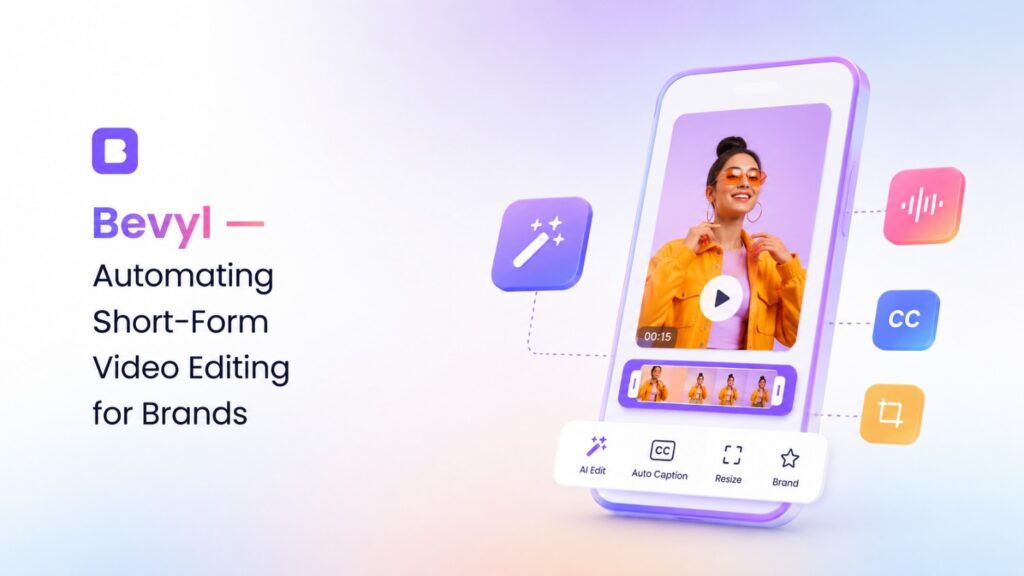
Founded in 2025, the New York startup emerged from stealth in 2026 with a $1.3 million seed financing backed by HearstLab and Launchpad Venture Group.
What Bevyl Is Trying to Automate
Short-form content creates a major operational challenge for brands.
Companies now need a constant supply of videos for Instagram, TikTok, YouTube Shorts, advertising campaigns, product launches, creator partnerships, and other digital channels.
In many cases, the raw footage already exists.
Editing becomes the bottleneck.
Bevyl is trying to learn a brand’s style and turn raw footage into finished short-form videos automatically.
The system can work with information such as fonts, visual identity, voice, and creative preferences.
Why This Category Could Grow Quickly
The economics of short-form content are very different from the economics of premium production.
A major national advertising campaign may justify weeks of professional editing and review.
A company trying to publish several social videos every week cannot use the same production process for every asset.
That creates a large opportunity for automation.
The most important competitive question will be whether these systems can learn taste rather than simply execute technical cuts.
Basic editing features will eventually become easier for competitors to copy.
A system that understands what a particular brand would actually choose may be much harder to replace.
9. Mission Media — Applying AI to Podcast and Cross-Platform Media Buying
Mission Media is another young company worth watching.
Founded in 2025, the New York media technology business works across podcasts, streaming audio, connected television, digital media, and creator content.
In June 2026, it launched Content Hub, a platform designed to help advertisers search, understand, and buy podcast inventory using audience data and contextual intelligence.
We excluded Mission Media from our funding calculations because a reliable public total was not available.
However, it remains strategically important because it shows how artificial intelligence is moving into another part of the media stack.
AI is increasingly being used to understand media inventory rather than simply create media.
That means buyers may eventually be able to search enormous catalogs by meaning, audience, context, topic, and campaign objective rather than depending mainly on manually maintained lists.
The Bigger Pattern: AI Is Entering Every Layer of the Media Stack
Looking at these companies one by one can make the market feel fragmented.
Looking at them together produces a much clearer picture.
New York’s Emerging AI Media Stack
| Layer | Old Workflow | Emerging AI Workflow | NYC Example |
| Ideation and generation | Manual creative development | Model-assisted generation | Runway |
| Video assembly | Manual editing | Automated editing and assembly | Mirage |
| Branded short-form | Agencies and editors | Brand-trained automated editing | Bevyl |
| Visual creation | Stock + manual production | Licensed-data generation | Bria |
| Media library | Folder and filename search | Semantic media search | Shade |
| AI content access | Open crawling | Controlled machine access | TollBit |
| Audience interaction | Static pages and ads | Conversational agents | Firsthand |
| Publisher monetization | Manual audience segments | AI-built audience products | ArcSpan |
| Media buying | Manual research | AI-driven inventory discovery | Mission Media |
The most important point is that these layers could eventually connect.
A media organization might generate content using one AI system, store and understand it with another, enforce rights through a third system, personalize it through an AI agent, and monetize the resulting audience through another platform.
At that point, the industry no longer looks like a collection of disconnected AI tools.
It starts to look like an operating system for media.
Original Finding #5: The Next Big Opportunity Could Sit Between Existing Tools
The current media AI market still contains many disconnected products.
That fragmentation creates integration work for media companies.
A video generator may not know which assets an organization already owns. A media library may not understand the legal rules attached to every clip. A publisher’s licensing system may not connect directly to its advertising platform, while an AI agent may not know which parts of a content archive it is allowed to expose.
Those gaps create a business opportunity.
The next major media AI company may not need to build the world’s best foundation model.
It could instead become the system that connects content, rights, identity, audience, and revenue.
That possibility is especially relevant to New York because the city is strongest where media becomes a business rather than simply a technical product.
AI Will Not Simply Make Media Cheaper
Cost reduction receives enormous attention whenever AI enters a workflow.
That is understandable because the benefit is easy to measure.
If an AI tool allows a creative team to make a video in two hours instead of two days, the immediate financial advantage appears obvious.
However, lower production costs usually change behavior.
Cheaper Content Usually Leads to More Content
When the cost of producing an asset falls, companies rarely keep production volume unchanged.
They create more versions, produce content for more platforms, test more creative ideas, personalize campaigns for more audience groups, and reuse older material in more ways.
That can increase the total amount of creative work even as the cost of each individual asset falls.
The bottleneck then moves somewhere else.
A company stops asking how it can create enough content and begins asking how it can control everything it is producing.
That is why systems focused on media management, rights, and provenance may become more important as generative technology improves.
What New York Publishers Should Do Now
Publishers should avoid starting with a vague instruction such as “use more AI.”
That approach often creates scattered experiments without a clear business goal.
A better strategy begins with the economics of the publishing workflow.
Measure Where Time and Money Actually Go
Publishers should understand how long it takes to research, produce, edit, package, distribute, update, archive, and monetize content.
AI should then be applied to the slowest or most expensive parts of that process.
For one publisher, the highest-value use case may be archive search.
For another, it could be turning reporting into video or creating audience segments for advertisers.
The best workflow to automate is not always the one that produces the most impressive demonstration.
Measure AI Crawler Activity Separately From Human Traffic
Publishers should also begin treating AI traffic as its own channel.
Knowing that a page received 100,000 visits is no longer enough.
Media companies increasingly need to understand which bots accessed their content, how frequently those systems returned, whether they followed publisher rules, whether visits produced referral traffic, and whether any commercial agreement exists.
That is the market TollBit is building around.
Even publishers that never use TollBit should understand the underlying problem because machine consumption of content is likely to become a permanent part of publishing economics.
What New York Agencies and Brands Should Do
The biggest opportunity for agencies may not come from replacing creative teams.
It may come from increasing the number of strong ideas those teams can test.
Separate High-Value Creative From High-Volume Creative
Not every piece of content deserves the same production process.
A national television campaign and a Tuesday Instagram Reel should not require the same economics.
AI makes it possible to build different production lanes.
Premium campaigns can continue to receive deep human craft, while high-volume social and performance content can use much more automation.
The important step is deciding which work belongs in each lane.
Build a Brand Memory Before You Automate Production
AI cannot reliably produce strong branded content if the organization has never clearly defined what the brand should sound and look like.
Companies should structure information such as tone, visual standards, approved claims, product positioning, target audiences, examples of strong work, prohibited language, and other brand rules.
That information becomes the context AI systems use when producing content.
As generative technology becomes more widely available, the quality of a company’s brand system may become just as important as the quality of the model itself.
What Film, Television, and Production Teams Should Do
Professional video organizations should treat generative AI as part of a production system rather than as a novelty.
That requires much stricter standards than casual experimentation.
Track Consistency, Not Just Visual Quality
A beautiful frame does not automatically make a useful production tool.
Professional workflows require repeatability.
Teams should evaluate whether an AI system can maintain characters, locations, costumes, visual direction, products, camera logic, lighting, and scene continuity.
Runway’s move toward world models is important partly because these problems require AI systems to understand far more than isolated images.
Keep Asset Provenance From Day One
Creative organizations should also record where AI-generated assets came from.
Useful information includes the model, prompt, source material, editor, version, creation date, rights conditions, and final approval.
Trying to reconstruct that information months later can become extremely difficult.
As AI becomes more common, provenance will become more important rather than less important.
The AI Media KPI Dashboard Every Company Should Build
Organizations should not measure AI adoption by counting how many employees opened an AI tool.
That number says very little about business impact.
Teams should measure outcomes instead.
| KPI | What It Tells You |
| Time to first usable draft | Whether AI actually speeds work |
| Human editing time | How much cleanup AI creates |
| Cost per approved asset | Whether economics improve |
| Approval rate | Whether outputs meet standards |
| Assets produced per employee | Whether creative capacity increases |
| Archive reuse rate | Whether existing content creates more value |
| Revenue per content asset | Whether greater production creates business value |
| Error or correction rate | Whether quality is being protected |
| Rights exceptions | Whether legal risk is increasing |
| AI referral traffic | Whether AI platforms send users back |
| Machine content accesses | How much AI systems consume |
| Revenue from AI licensing | Whether machine usage is being monetized |
The most important word in this dashboard is approved.
A system that generates 1,000 videos but produces only ten usable assets may create more work than value.
A system that generates 100 videos and produces 60 strong assets could be far more useful.
Raw output volume is therefore a weak metric on its own.
A Practical 90-Day AI Media Plan
New York media companies do not need to redesign their entire organizations immediately.

A focused 90-day process is usually safer and more useful.
Days 1–30: Build the Workflow Map
Start by mapping actual work.
Choose several recurring media workflows and document every important step.
Record who is involved, how long each stage takes, how much it costs, where delays happen, which outside vendors are used, how approvals work, what rights issues exist, and how much output the workflow produces.
A baseline is essential because without one, almost any AI pilot can be presented as successful.
Days 31–60: Run Narrow Experiments
Choose two or three workflows where AI could create measurable value.
One experiment might involve turning long-form video into short social clips.
Another could focus on searching a large archive.
A third might test whether AI can help create advertising audience segments.
Human approval should remain in place during these tests.
The same metrics used during the baseline period should also be used during the pilot so results can be compared fairly.
Days 61–90: Scale What Produces Real Value
At the end of the pilot, compare outcomes rather than impressions.
If a tool reduces initial production time but doubles correction time, investigate the cause.
If content volume rises sharply while engagement falls, the system is not creating enough value.
If an AI search product saves editors several hours every week, that workflow may be worth expanding.
AI adoption should follow evidence.
The Copyright Question Will Become a Product Question
Copyright is often discussed as a legal debate happening outside the software product.
That separation will become harder to maintain.
Rights information may eventually need to live directly inside media infrastructure.
Every asset could carry machine-readable information showing who owns it, where it came from, what models are allowed to use it, whether derivatives are permitted, which territories are covered, and how compensation should work.
TollBit is exploring part of this problem around web access, while Bria is addressing related issues through licensed training sources.
The companies operate at different layers, but both illustrate the same larger direction.
Rights could become part of the technical architecture of media.
For a city built around valuable intellectual property, that would be a major development.
AI Search May Change Media Economics More Than AI Writing
Publishers understandably worry about AI-generated articles.
However, AI interfaces replacing parts of traditional search may create an even larger economic disruption.
Traditional search historically helped generate traffic.
An AI answer engine can potentially satisfy the user before a publisher receives a visit.
That changes the value chain.
Publishers therefore need to answer a difficult question.
If artificial intelligence becomes an interface between journalism and the audience, how does economic value return to the organization that created the information?
Possible answers include licensing payments, attribution, direct links, paid APIs, subscription integrations, publisher-owned AI agents, commerce, advertising, and entirely new commercial models.
No single approach has won.
That uncertainty is exactly why the infrastructure layer is so important.
New York Has a Structural Advantage in Applied Media AI
New York does not need to outperform Silicon Valley at every layer of artificial intelligence research to become a major media AI center.
Its strength is application.
The city has thousands of technology startups and a growing AI ecosystem, while also containing some of the world’s largest concentrations of media, advertising, publishing, fashion, entertainment, finance, and commerce businesses.
That combination is especially powerful for applied AI.
The Customers Are Already Here
A startup building technology for publishers can meet publishers in New York.
A company building advertising technology can meet agencies, brands, and media buyers.
A video software startup can meet studios, marketers, fashion companies, creators, broadcasters, and production businesses.
That proximity can shorten the feedback loop between building a product and learning whether a real customer will pay for it.
The Talent Mix Is Different
Media AI requires more than machine-learning engineers.
Successful products also need strong editors, designers, producers, advertising professionals, rights experts, product managers, strategists, developers, and media buyers.
New York has deep talent pools across all of those disciplines.
Companies that successfully combine technical expertise with media judgment may therefore have an advantage over teams that treat media as just another software category.
What We Believe the Next Five Years Will Look Like
Predicting specific AI products five years into the future is difficult.
Models will change, companies will disappear, and entirely new categories will emerge.
The direction of the workflows is easier to see.
Generation Will Become a Feature Inside Larger Systems
Standalone generation will remain important, but basic image, text, audio, and video generation will become widely available.
Competitive advantage will increasingly move toward control, workflow design, brand memory, rights, distribution, and integration.
That shift favors companies that do more than simply provide access to a model.
AI Will Understand Media Libraries
Media archives will become much easier to search.
Users will increasingly search by meaning instead of folders and filenames.
An editor should eventually be able to request every shot of the Brooklyn Bridge at sunset without people in the foreground and receive useful results immediately.
That interface is far more powerful than trying to remember whether the correct clip was saved as Final_Final_V7.mov.
This change alone could unlock enormous amounts of dormant media value.
Content Rights Will Become Machine-Readable
AI systems need clearer ways to understand which content they can access and under what conditions.
Publishers need equally clear ways to define those rules.
The long-term solution will probably combine technical protocols, licensing agreements, policy, and legal precedent.
Companies such as TollBit are early examples of the commercial and technical infrastructure that could support that market.
Media Will Become More Personalized
Most media today is still designed as a fixed object.
Millions of people often see the same article, advertisement, video, or page.
AI makes it possible for media experiences to respond to individual users.
A publisher could offer different explanations depending on what the reader asks.
A brand video could be assembled differently for different markets.
A sports platform could immediately surface clips based on the player or team someone mentions.
That creates major opportunities, but it also creates serious risks.
Companies will need strong rules around truth, privacy, editorial independence, and fairness.
Original Finding #6: The Real Competition Is Moving From Generation to Decision
Our strongest conclusion is not about funding.
It is about where intelligence enters the media workflow.
The first generation of media AI focused heavily on creating content.
The next generation appears increasingly focused on deciding what should happen with that content.
Which footage should be used?
Which version fits the audience?
Which information should an AI agent surface?
Which publisher asset can an AI system legally access?
Which audience should an advertiser target?
Which archived clip should an editor reuse?
Which creative version is most likely to perform well?
Those decisions could eventually become more valuable than raw generation because businesses pay heavily for good judgment.
A model can generate ten thousand options.
Someone, or some system, still needs to decide which option is best.
The Biggest AI Media Opportunity May Not Be Creating More Content
Media companies already own enormous amounts of content.
Television networks have archives, publishers have decades of articles, brands have product photography, agencies have campaigns, sports organizations have games, and creators have years of footage.
The more important question may be how to turn those existing assets into more economic value.
Artificial intelligence can potentially identify them, understand them, translate them, edit them, personalize them, package them, surface them, license them, and help companies sell against them.
That may become a larger opportunity than generation alone.
A company does not always need another piece of content.
Sometimes it needs to extract more value from the content it already paid to create.
What Media Leaders Should Avoid
The greatest danger is not necessarily moving too slowly.
It is scaling AI without understanding what problem the technology is supposed to solve.
Buying five creative AI platforms does not create an AI strategy.
Neither does forcing every employee to generate more content.
The strongest media companies will treat artificial intelligence like any other major operating change.
They will measure economics, protect quality, document rights, redesign workflows, and decide where human judgment creates the most value.
They will also decide where machines can remove repetitive work without damaging the final product.
Most importantly, they will separate experimentation from production.
A tool can be extremely impressive in a demonstration and still fail inside a real business process.
Why New York Could Become the Capital of AI-Powered Media
New York already has the two ingredients required to build a major media AI ecosystem.
It has AI companies, and it has media companies.
The interaction between those two groups is more important than either one alone.
Runway can develop advanced video technology beside one of the world’s largest creative markets.
Mirage can build video software surrounded by agencies, creators, and brands.
TollBit can work on publisher economics in one of the most concentrated publishing markets in the world.
Firsthand and ArcSpan can test new audience and monetization models near major media organizations.
Shade can serve creative teams struggling with massive asset libraries, while Bria can bring rights-aware generative AI into professional production.
Bevyl can explore how brands automate the constant demand for short-form content.
Together, these companies create a reinforcing loop.
Media businesses provide real problems.
Startups build products around those problems.
Customers provide feedback.
Investors provide capital.

Talent moves between companies, agencies, publishers, studios, and technology firms.
New businesses then emerge around the gaps left behind.
That kind of ecosystem is difficult to reproduce.
Conclusion: New York Is Building the Business Layer of AI Media
The first wave of media AI focused heavily on generation.
Companies could suddenly create images, draft articles, clone voices, and generate video.
Those capabilities were extraordinary, but they were only the beginning.
The next stage is about connecting artificial intelligence to the machinery of the media business.
New York startups are already working across that machinery.
Runway and Mirage are changing video production. Shade is changing how creative assets are stored and found. Bria is exploring a licensed approach to generative visuals. TollBit is working on the economics of AI access to publisher content. Firsthand is rethinking how audiences, brands, and publishers interact. ArcSpan is applying AI to audience monetization, while Bevyl is pushing automation into everyday short-form production.
Our original funding analysis shows that capital is still heavily concentrated in generation, with roughly 92% of disclosed financing in our eight-company sample going to creation-focused businesses.
That balance may change.
As generative models become easier to access, competitive value may move higher in the media stack.
The scarce resource will not always be the ability to generate another image or video.
The more valuable capability may be knowing what should be created, finding what already exists, understanding what can legally be used, deciding who should receive it, and turning that activity into sustainable revenue.
Those are not only AI problems.
They are media business problems.
New York already has one of the deepest concentrations of media expertise anywhere in the world, which gives the city an unusual advantage as artificial intelligence moves from content generation into the economic infrastructure of the industry.
That is why the most important New York media AI companies may ultimately be the ones that do more than help people create content.
They may be the companies that help the media industry understand, control, distribute, and monetize everything AI makes possible.