

Insurance has always been a data business. An insurer collects information about a person, company, building, vehicle, employee, or event, decides how risky it is, sets a price, and then decides what should happen when a claim arrives.
The problem is that much of this work still depends on people reading emails, opening PDFs, checking spreadsheets, searching old systems, comparing policy language, writing letters, and moving information from one screen to another. Even at large insurers, an underwriter or claims professional can spend a surprising amount of the day doing work that is necessary but does not require their best judgment.
That is exactly the kind of problem the new generation of insurance AI companies is attacking.
And New York has become one of the most interesting places to watch this shift.
InsurTech NY’s 2026 New York City insurance technology map tracks 142 insurance technology companies, spanning underwriting, claims, distribution, risk, data, and other parts of the insurance market. The organization reports that companies on the map have raised about $7.8 billion in capital, with 124 having executives in New York City. The dataset was last updated on July 10, 2026.
But counting insurtech companies does not tell us which ones are actually changing how underwriting and claims work.
For this article, NYC Tech Journal went deeper.
We reviewed publicly available company information, funding announcements, customer deployments, product descriptions, accelerator records, case studies, insurance industry reports, and New York ecosystem data. We then created our own framework for measuring how deeply AI has entered the operating workflow at each company.
The result is a very different picture from the usual list of “AI insurance startups.”
New York’s most interesting insurance AI companies are increasingly building tools that do more than summarize documents or provide another dashboard. They are moving closer to the actual insurance decision.
Some can move an underwriting submission toward a quote. Some can evaluate evidence inside a claim. Some can draft regulated claims correspondence. Others are building AI agents that can contact third parties, inspect documents, identify missing information, and tell a claims professional what needs attention next.
That distinction matters.
The next large insurance AI company may not be the company with the flashiest chatbot. It may be the company that quietly removes five hours of work from every commercial underwriter or gives thousands of claims professionals better information before they make a costly decision.
The Short Answer: The AI Insurance Startups in NYC That Matter Most
Our research found nine private companies with enough evidence to merit particularly close attention when looking at AI applied directly to underwriting or claims.
They are not all trying to solve the same problem. Some are broad underwriting platforms. Others are highly specialized claims tools. A few are attempting to build much larger operating systems.
| Company | Main area | What makes it interesting | NYC Tech Journal Operating Depth Score* |
| Bevaya | Underwriting + claims | Insurance-specific AI agents across several operating workflows | 95/100 |
| Kalepa | Commercial underwriting | Broad underwriting workflow from submission through quote and portfolio work | 95/100 |
| Sixfold | Underwriting | AI moving toward quote-ready and bind-ready underwriting work | 93/100 |
| Elysian | Claims | AI-native third-party claims administration for complex commercial claims | 87/100 |
| Avallon AI | Claims | AI agents for intake, calls, documents, third-party contact and claim support | 72/100 |
| Satori Technology Underwriting | Underwriting | AI-assisted risk analysis with automated quote-and-bind workflows | 72/100 |
| Kyber | Claims | Highly focused automation of complex claims correspondence | 69/100 |
| Optimalex | Underwriting + claims decisions | Predictive tools built around insurance and legal decision support | 65/100 |
| Solva | Claims | AI agents designed to find weak evidence, policy issues and potentially incorrect payouts | 57/100 |
*The score is an original NYC Tech Journal editorial measure of public operating evidence, workflow breadth and proximity to an insurance decision. It does not measure model accuracy, financial strength, valuation, or investment quality. Narrow tools can score lower despite being excellent at the specific problem they solve.
The first major conclusion from our research is important: New York’s insurance AI market is no longer just an underwriting technology story.
In our nine-company core sample, five companies are primarily focused on claims, three are primarily focused on underwriting, and one has substantial products on both sides.
Original Chart: Where NYC Insurance AI Startups Are Concentrating
| Primary workflow | Companies in our sample | Share |
| Claims | 5 | 55.6% |
| Underwriting | 3 | 33.3% |
| Cross-workflow | 1 | 11.1% |
This is our own classification based on where each product appears to create its most direct operating value as of August 31, 2026.
Claims now represents the largest group in our sample.
But there is another side to the data. The most mature companies, the strongest public customer evidence, and much of the visible capital are still concentrated around commercial underwriting and broader insurance operations.
That creates a market with two different waves happening at once.
The first wave is getting much deeper.
The second is just getting started.
Why New York Is Becoming Such an Important Insurance AI Market
New York has an unusual advantage when it comes to insurance technology.
The city does not need to invent an industry around the technology. The customers, brokers, carriers, investors, law firms, financial institutions, consultants, and experienced insurance operators are already nearby.
That is especially valuable in insurance because building useful software requires more than knowing how to build an AI model.
Insurance AI Requires Industry Knowledge
Commercial insurance is filled with exceptions.
Two submissions that look almost identical can deserve very different decisions because of one policy condition, one exposure, one legal issue, one location, one claim, or one piece of missing information.
Claims are equally difficult.
An AI system may need to understand medical documents, photographs, invoices, legal language, policy terms, adjuster notes, regulatory deadlines, prior communications, and the history of an entire claim before it can safely recommend what someone should do next.
That creates an advantage for founders who understand both technology and insurance operations.
Bevaya, for example, was founded by executives with AIG experience. The company says it now has more than 120 production deployments and has trained its technology on more than 300 million insurance documents.
Sixfold was created specifically around commercial insurance underwriting. Its public company information says its technology has handled more than 1.5 million submissions across more than 50 lines of business and four continents.
Kalepa has also stayed tightly focused on commercial insurance. Its platform covers work including submission intake, clearance, triage, risk analysis, rating, quote and bind, and portfolio management.
These are not generic AI applications that happen to have insurance customers.
Insurance is the product.
New York Also Makes the Governance Problem Harder
The opportunity comes with a constraint.
Insurance is regulated, and New York regulators have already made clear that insurers cannot treat artificial intelligence as a black box.
The New York State Department of Financial Services issued guidance covering the use of artificial intelligence systems and external consumer data in insurance underwriting and pricing. Among other expectations, insurers need governance, risk controls, documentation, controls against unfair discrimination, vendor oversight, and appropriate transparency. DFS can examine how insurers are using these systems.
That specific circular focuses on underwriting and pricing rather than every use of AI across an insurance company. But its direction is still important.
A carrier cannot simply say, “The AI told us to do it.”
That means insurance AI companies selling in New York have a strong reason to make their systems traceable. Users need to see the information behind a recommendation. Humans need a way to review important decisions. Companies need records of what the technology did.
This may eventually become an advantage for New York startups.
The companies that survive demanding insurance buyers and strict governance requirements may produce stronger enterprise products than companies designed around simpler markets.
How NYC Tech Journal Conducted the Original Research
There is a problem with almost every “top AI startup” list.
The categories are too loose.
A company gets included because its website uses the words “artificial intelligence.” Another gets included because it sells software to insurance companies. Another may have an office in New York but actually be headquartered somewhere else.
We wanted a more useful test.
Step One: Build a Wider Company Universe
We started with the broader New York insurance technology market, including InsurTech NY’s 2026 map of 142 insurance technology companies. We then cross-checked company websites, public funding announcements, accelerator profiles, insurance publications and other publicly available sources.
Our main list only includes active private companies where AI is central to a product that directly touches underwriting or claims.
We also required a meaningful New York City connection. That can mean headquarters, a primary operating team, or a substantial New York presence. Where a company’s footprint is more complicated, we say so rather than quietly labeling every company a New York headquarters.
Step Two: Separate Real Insurance Work From Generic AI
A company did not receive a high score merely because it could read an insurance PDF.
We looked at how far the technology moves into the insurance workflow.
Extracting information is useful. Extracting it, comparing it with underwriting rules, assessing the risk, preparing the file for a decision, and helping move it toward quote or bind is much deeper.
The same distinction applies to claims.
Summarizing an adjuster’s notes is one thing. Finding missing evidence, checking coverage, communicating with outside parties, recommending the next action and documenting that work is much closer to the claim itself.
Step Three: Score Operating Depth
We created three dimensions and assigned each company a score from one to five in each category.
| Factor | Weight | What we looked for |
| Public production evidence | 40% | Named customers, documented implementations, production volumes, deployments or measurable operating results |
| Workflow breadth | 35% | Number of meaningful underwriting or claims steps the system appears able to handle |
| Decision proximity | 25% | How close the AI gets to an actual quote, bind, claim action, recommendation or other insurance decision |
We then converted the weighted result to a 100-point Operating Depth Score.
This weighting is intentional.
Production evidence receives the highest weight because a broad product demo is much less meaningful than software that insurance companies are actually using.
Step Four: Treat Vendor Metrics Carefully
Private startups rarely publish standardized audited operating data.
Many performance numbers in insurance technology come from company case studies. Those figures can still be useful, especially when tied to a named customer, but they should not be treated the same way as independently audited financial statements.
Throughout this article, phrases such as “the company reports” or “according to its case study” are deliberate.
Our scores reward the existence of public production evidence. They do not assume every marketing metric will reproduce perfectly at another insurer.
What Our Data Says About the Structure of NYC’s Insurance AI Market
The most useful result of the analysis is not the exact ranking.
It is the shape of the market.
Original Chart: Operating Depth
The score below combines public production evidence, workflow breadth and decision proximity.
| Company | Production evidence | Workflow breadth | Decision proximity | Weighted score |
| Bevaya | 5/5 | 5/5 | 4/5 | 95 |
| Kalepa | 5/5 | 5/5 | 4/5 | 95 |
| Sixfold | 5/5 | 4/5 | 5/5 | 93 |
| Elysian | 4/5 | 5/5 | 4/5 | 87 |
| Avallon AI | 3/5 | 4/5 | 4/5 | 72 |
| Satori | 3/5 | 4/5 | 4/5 | 72 |
| Kyber | 5/5 | 2/5 | 3/5 | 69 |
| Optimalex | 3/5 | 3/5 | 4/5 | 65 |
| Solva | 2/5 | 3/5 | 4/5 | 57 |
Kyber illustrates why this should not be read as a simple “best to worst” table.
Its workflow is deliberately narrow. That lowers its breadth score. But its public production evidence is unusually strong for a young claims company, which makes it one of the more interesting specialists in the market.
Solva presents the opposite case. Its technology is ambitious and close to important claims decisions, but the company was founded only in 2025 and has less public production evidence. Its lower score mainly reflects its age and public evidence base, not a conclusion that its technology is weaker.
Original Funding Analysis: Where the Visible Capital Has Gone
Funding is another area where startup lists can become misleading.
Some companies announce every financing. Others do not. Convertible notes, accelerator investments, extensions, strategic investments and unannounced rounds can make comparisons messy.
So instead of pretending we know the exact capital available to every company, we calculated a minimum directly verifiable public funding figure from rounds we could identify.
Minimum Publicly Verifiable Capital in Our Sample
| Company | Minimum funding we could verify | Important note |
| Sixfold | $51.5M | $6.5M seed, $15M Series A and $30M Series B |
| Bevaya / Roots Automation | $32.2M | Includes its $10M Series A and $22.2M Series B; some databases report additional financing beyond these major rounds |
| Kalepa | $16M | Includes reported $2M seed funding and $14M Series A |
| Elysian | At least $9M | A $3M pre-seed was followed by a $6M seed round |
| Avallon AI | $4.6M | Seed led by Frontline Ventures |
| Kyber | At least YC funding plus undisclosed strategic capital | YC records identify the company in its W2023 cohort; later strategic investment amounts have not been consistently disclosed publicly |
Across these six companies, we can directly verify a minimum of roughly $113.4 million using the conservative method above.
Sixfold, Bevaya and Kalepa account for approximately 87.9% of that minimum verified amount.
That does not mean they control 87.9% of all capital invested in our market. Several younger startups have undisclosed financing, and our method intentionally excludes amounts we could not verify confidently.
It does show something useful, however.
The largest pools of visible capital in this sample have gone to businesses that built deep insurance workflows rather than simple AI utilities.
1. Sixfold — Pushing AI From Underwriting Assistant Toward AI Underwriter
Sixfold may be the clearest example of how quickly the definition of underwriting AI is changing.
The New York company began with a straightforward goal: help commercial underwriters evaluate submissions faster by bringing scattered information, carrier guidelines and risk signals together.
That alone solves a painful problem.
Commercial underwriting teams can receive large volumes of submissions through email and broker systems. Each submission may include PDFs, spreadsheets, loss histories, application forms and other documents. Someone has to decide whether the risk fits the insurer’s appetite before the carrier spends more time on it.
Sixfold’s platform is designed to help with that process.
The company says its system has now handled more than 1.5 million submissions across more than 50 business lines, with an average adoption rate of at least 90% among customers it reports. It also lists a New York office at 121 East 24th Street.
Why Sixfold Matters More in 2026
The important development is that Sixfold is moving beyond underwriting assistance.
In June 2026, the company introduced a product called AI Underwriter, designed to take some cases further through the process and move them toward a quote-ready or bind-ready state before human approval.
That is a much bigger idea than document summarization.
If this model works reliably, the role of the human underwriter changes.
Instead of manually touching every routine part of every file, the underwriter can spend more time on exceptions, relationships, judgment calls, negotiation and difficult risks.
The Business Case Is About Throughput
Sixfold reports customer results including a 50% improvement in efficiency, 15% improvement in quote-to-bind performance and 30% more gross written premium per underwriter. Its published customer list includes insurers such as Zurich, AXIS, Generali Global Corporate & Commercial, Skyward Specialty, Guardian, Mosaic and others. These are company-reported results and should be validated independently during procurement.
But even if a carrier achieved only part of those gains, the economics could matter.
Commercial underwriting talent is expensive. Increasing the amount of good business each underwriter can intelligently evaluate can create value without simply asking employees to work faster.
Who Should Look Closely at Sixfold?
Sixfold is most relevant to commercial carriers with enough submission volume that manual review has become a real bottleneck.
The best buyer is probably not an insurer looking for a generic corporate chatbot.
It is a chief underwriting officer who can already point to a measurable operational problem: too many submissions untouched, slow response to brokers, low quote rates, expensive manual triage, or experienced underwriters spending too much time on routine analysis.
Sixfold’s $30 million Series B, announced in January 2026 and backed by investors including Brewer Lane and strategic investor Guidewire, also gives the company more resources to pursue large enterprise deployments.
2. Kalepa — Building a Wider Operating Layer for Commercial Underwriting
If Sixfold’s most interesting move is toward greater AI autonomy, Kalepa stands out for the width of its underwriting workflow.
Kalepa was founded in 2018 and is based in New York. Its Copilot platform addresses submission ingestion, clearance, triage, risk analysis, rating, quote and bind, and portfolio management.
That breadth matters because one of the biggest problems in insurance technology is fragmentation.
A carrier may have one system for submissions, another for policy administration, another for documents, another for rating, and still more external data sources. The underwriter becomes the person connecting everything.
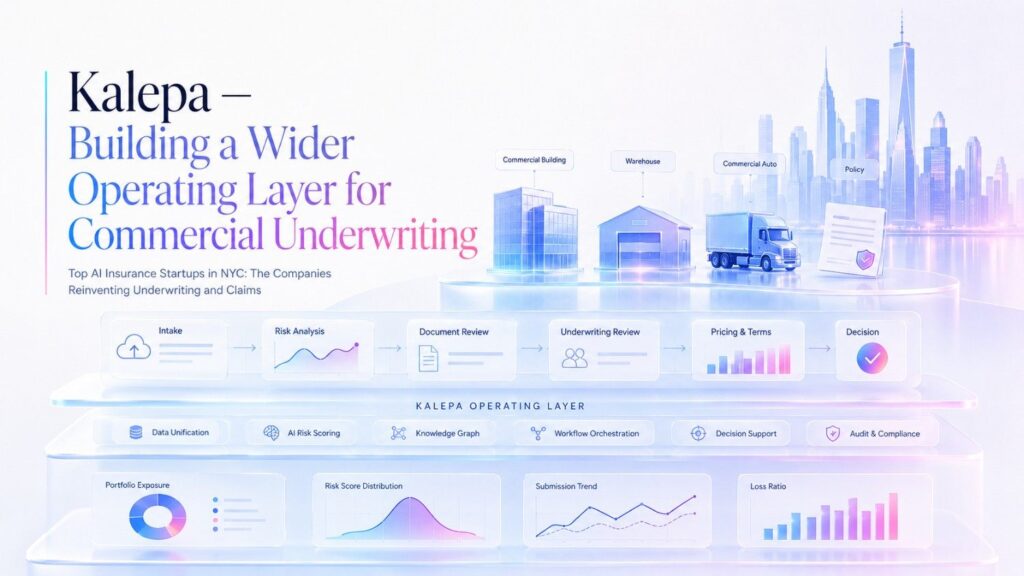
Kalepa is trying to put more intelligence across that chain.
Production Evidence Is One of Kalepa’s Strengths
Its customer and partner announcements include names such as Munich Re Specialty North America, Berkley companies, Canopius, Bowhead, SECURA and James River.
Kalepa also publishes performance results from its deployments.
Its site reports outcomes including more than 30% additional premium per underwriter and a 58% reduction in quote time in certain deployments. It also reports combined-ratio improvements measured in hundreds of basis points. Because these figures come from the company, a buyer should ask to see the exact calculation behind any relevant case.
One particularly useful example comes from Paragon.
According to Kalepa’s case study, Paragon moved from manually reviewing roughly 30% of its inbox to substantially broader automated coverage. The case study reports 98% to 99% accuracy in certain workflow tasks and says quote-to-bind performance doubled during the first year.
Again, those are vendor-published results.
The value is that they give prospective customers something specific to test instead of buying based on a demo.
Kalepa’s Strategic Advantage
Kalepa is especially interesting for insurers that do not want AI to remain a separate tool beside the underwriting process.
Its long-term opportunity is to become an intelligence layer connecting more of the underwriting workflow.
That creates a bigger possible market.
It also makes implementation harder.
The deeper a vendor moves into rating, quote preparation and underwriting decisions, the more the customer will care about integrations, data quality, audit history, underwriting rules, security, regulatory controls and human review.
That is exactly where insurance AI is becoming serious.
3. Bevaya — Bringing AI Agents Across Underwriting and Claims
Anyone researching New York insurance AI needs to know two names: Roots Automation and Bevaya.
They are now the same company.
Roots Automation was founded in 2018 by insurance operators with experience at AIG. In May 2026, the company introduced the Bevaya brand as it expanded its AI-agent platform across insurance workflows.
The rebrand is more than a cosmetic change.
It reflects where the insurance AI market is moving.
From Automation to Insurance-Specific AI Agents
Traditional robotic process automation was designed to reproduce predictable computer actions.
Click here. Copy that field. Open this screen. Move this value.
Generative and agentic AI can potentially handle less structured work.
An insurance AI agent may need to open an email, understand an attached document, extract relevant details, check them against rules, identify something that needs attention and prepare the next step.
Bevaya says its technology has been trained on more than 300 million insurance documents and has more than 120 production deployments. The company also says its customers include three of the five largest property and casualty carriers.
At the time of its May 2026 brand launch, Bevaya reported more than 115 production deployments and customer relationships spanning major carriers, brokers and third-party administrators.
Why Bevaya Scores So Highly in Our Analysis
Bevaya is one of the few companies in the core sample with meaningful products across both underwriting and claims.
Its insurance agents can support work such as submission triage, clearance, rating, claims processing and policy servicing.
That breadth gave Bevaya one of the highest workflow scores in our analysis.
The company also reports accuracy above 98% for many of its use cases and says a first production agent can often go live within eight to twelve weeks. Those are company claims rather than universal guarantees, but they provide useful targets for a proof of concept.
The Bigger Question for Bevaya
The opportunity is enormous if one vendor can provide reusable insurance agents across many departments.
The risk is equally clear.
Every additional workflow creates another integration, another set of rules, another group of employees, another set of exceptions and another way something could go wrong.
Bevaya therefore deserves to be evaluated less like a small productivity tool and more like operating infrastructure.
That is a much higher bar.
It is also why the company is one of the most important New York insurance AI businesses to watch.
4. Elysian — An AI-Native Claims Administrator
Claims technology becomes especially interesting when AI is not added to an old process but built into the operating model from the beginning.
That is the idea behind Elysian.
Founded in late 2024, Elysian is building what it describes as an AI-native third-party administrator, or TPA, for complex commercial insurance claims. Instead of merely selling software to claims departments, the company is going deeper into the actual handling of claims.
Its platform combines human claims professionals with automated review and AI-supported workflows. The company says its systems have analyzed more than one million claims, while its team brings experience connected to more than $50 billion in reserves. Those figures should be read as company-reported operating and experience metrics rather than as an audited statement that Elysian itself has personally managed all $50 billion.
Why the TPA Model Matters
Claims software often has a difficult adoption problem.
A carrier may like a new tool but still need to convince dozens or hundreds of adjusters to change the way they work.
A technology-enabled TPA can attack the problem differently.
The technology and the operating process can be designed together.
That allows Elysian to measure whether the AI changes actual claim outcomes rather than whether employees simply opened the software.
Funding and Expansion
Elysian announced a $6 million seed round in September 2025, led by Portage with participation from American Family Ventures and TenOneTen. Public founder communications had previously disclosed a $3 million pre-seed, bringing the publicly announced minimum to roughly $9 million.
The company has expanded its insurance relationships, including a 2026 partnership with Ascendex Underwriters.
Its geographic profile is worth explaining carefully. Elysian operates across multiple locations and publicly references New York as part of its footprint, while some current company materials also list Nashville and London. We therefore treat it as a materially New York-connected company rather than pretending its physical footprint fits neatly into one headquarters label.
Why Elysian Could Be Important
The most valuable claims AI may eventually disappear into the claims service itself.
Buyers may stop asking, “Which AI tool are my adjusters using?” and instead ask, “Which claims administrator produces the best outcomes, fastest response and lowest cost?”
If that happens, technology-enabled TPAs could become one of the most important parts of the claims AI market.
Elysian is an early New York-linked example of that model.
5. Avallon AI — AI Agents That Can Actually Chase the Claim
Claims professionals lose time on much more than reading.
They make calls.
They answer calls.
They send emails.
They ask for missing files.
They contact providers and other third parties.
They explain claim status.
They summarize documents.
They look for information buried inside a file.
Avallon AI is targeting this operational layer.
The New York company builds conversational AI agents for claims organizations, including workers’ compensation, property and casualty, and life insurance. Its products include agents for claim intake, status calls, third-party outreach and claims support.
This Is Where AI Agents Make Sense
The phrase “AI agent” has become overused.
In claims, however, there is a clear test.
Can the technology complete a useful piece of work?
For example, can it take information from a caller, write that information into a useful structure, contact another party, collect a document, summarize it and place the result where a claims professional needs it?
Avallon’s product direction is built around those types of jobs.
Frontline Ventures, which led the company’s $4.6 million seed round, described agents that can handle intake and status work through phone, email and file uploads, contact third parties, extract information from documents, analyze policy terms and flag exposures.
That is substantially more useful than putting a chatbot on top of a claim file.
The Metric Buyers Should Watch
Avallon is still young.
For that reason, buyers should care less about how natural an AI phone call sounds and more about the percentage of real tasks the system completes correctly.
A strong pilot should measure how many contacts require human takeover, how often information must be corrected, how much adjuster time is saved, how quickly missing information arrives and whether the automation changes the total life of the claim.
Those measures would tell a carrier whether it bought impressive AI or productive labor capacity.
6. Kyber — Proving That a Narrow Claims Problem Can Still Be Huge
Kyber is an important reminder that an insurance AI startup does not need to automate the entire claim to build a valuable product.
Sometimes one painful process is enough.
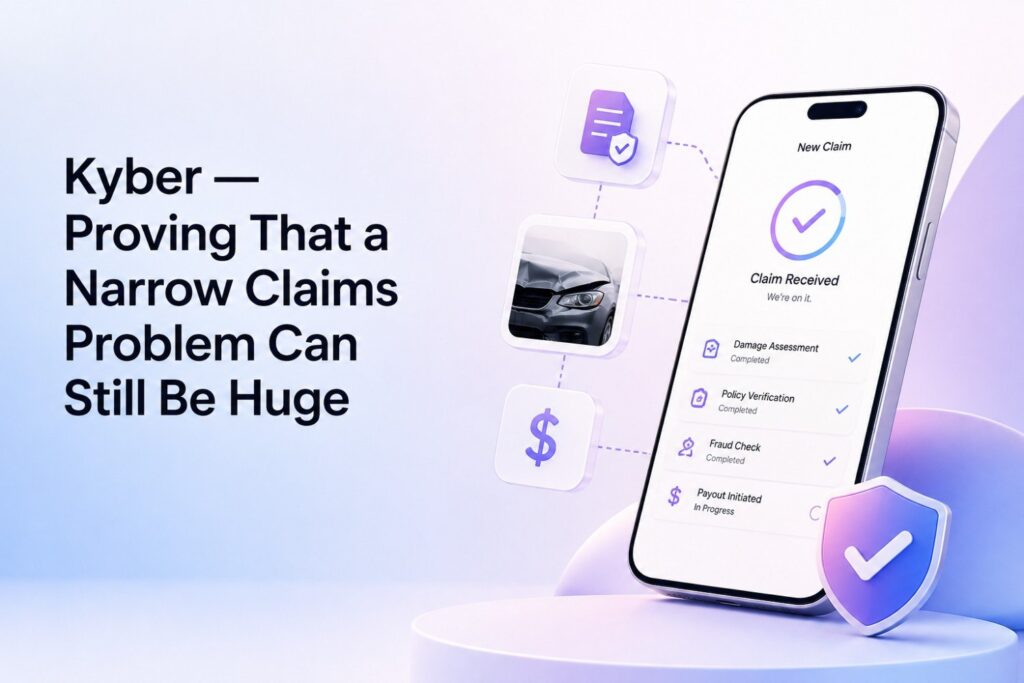
Kyber focuses heavily on claims correspondence.
Insurance claims generate large volumes of letters and notices. Those documents can be highly regulated. They may need specific language, facts, dates, reasons and policy information. Mistakes can create customer frustration, regulatory risk and additional work.
Kyber uses AI to help produce this correspondence.
The company was founded in 2022, went through Y Combinator’s Winter 2023 program and is based in New York City.
Kyber Has Unusually Strong Production Evidence for Its Size
This is where Kyber gets interesting.
In its 2025 review, the company said correspondence volume on its system had grown from roughly 7,000 documents a year to an annualized pace of approximately 800,000 documents, an increase of more than 100 times. It also said its customers represented programs with roughly $8 billion in gross written premium.
That is a meaningful production signal.
The company has also announced work with insurers and insurance organizations including Canal, Loggerhead, Kingstone and others.
One published implementation with Loggerhead went live in 43 business days. Kyber says the technology can reduce drafting time by 65% and make the broader letter workflow approximately five times faster. As always, those are company-reported outcomes and should be tested against the buyer’s own baseline.
Why Kyber’s Lower Score Is Misleading Without Context
Kyber receives only 69 out of 100 in our Operating Depth model.
That is mostly because our model rewards workflow breadth.
Kyber has deliberately attacked a narrower part of the claim than Elysian or Avallon.
Its production evidence, however, earns the highest possible score in our framework.
For a claims organization whose correspondence process is slow, inconsistent or expensive, Kyber could therefore be a better purchase than a much broader platform.
That is why software procurement should begin with the problem, not the ranking.
7. Satori Technology Underwriting — A More Focused AI Underwriting Bet
Satori Technology Underwriting is one of the smaller companies in our dataset, but its product is worth watching because it goes close to the commercial underwriting decision.
Its SIMPL platform uses public information and other data to help prefill underwriting questions, create risk scores, produce account narratives and support automated quote-and-bind workflows.
That puts it into the same broad market shift as Sixfold and Kalepa, although at a much earlier stage.
The Product Is Designed Around Speed
Satori says its system can reduce parts of management and professional liability underwriting from a process that may take more than a week to around 30 minutes. That is a company-reported product claim, so buyers should verify the conditions under which it applies.
The company has also publicly discussed work or collaboration involving a large national broker and insurers including AXIS, Berkley Financial Specialists, Markel and QBE.
That gives Satori enough public evidence to move beyond the purely experimental category.
Why Satori Matters Strategically
Underwriting AI does not have to be a giant horizontal platform.
Certain lines of business have enough public or structured company information that a specialist system can pre-build much of the risk picture before the underwriter begins.
That could create room for smaller AI underwriting companies specializing in particular products.
Satori therefore represents another possible direction for the market: not one AI underwriter for every insurance product, but deeper models built around a narrower class of risk.
8. Solva — Using AI to Question Claims Before Money Leaves the Insurer
Solva is one of the youngest companies on this list.
It is also attacking one of the largest financial problems in claims: paying money when the evidence, policy terms or facts do not fully support the payment.
The New York startup was founded in 2025 and participated in Y Combinator’s Summer 2025 cohort. YC currently lists the company as active and based in New York.
The Product Is About Verifiable Claims Reasoning
Solva describes AI agents that examine claims for incomplete evidence, possible breaches of policy terms, fraud indicators and other issues that may affect the right claim decision.
The important word is verifiable.
Instead of simply giving an answer, the company says its recommendations can point users back to supporting sources inside the claim.
That is exactly the direction insurance AI needs to take.
A claims professional should be able to ask, “Why are you telling me this?” and then inspect the evidence.
Solva Is High Potential but Early
Solva receives the lowest Operating Depth Score among our nine core companies because production evidence has not yet reached the level of older businesses such as Sixfold, Kalepa, Bevaya or Kyber.
That is normal for a company founded in 2025.
Its decision-proximity score is much stronger because its product goes directly toward claim evaluation.
If Solva can prove that its technology reliably finds material mistakes without creating excessive false alarms, it could become valuable very quickly.
A system that saves an adjuster ten minutes is useful.
A system that prevents a large unsupported payment can potentially pay for itself with a much smaller number of interventions.
9. Optimalex — Where Insurance AI Meets Legal Analytics
Optimalex sits at an interesting border between insurance technology, legal analysis and predictive decision support.
The company traces its work to research involving New York’s Columbia University and La Sorbonne in Paris. It has developed predictive analytics tools designed to support insurance underwriting, claims and dispute decisions.
That makes it somewhat different from the workflow automation companies on this list.
Predicting What Happens After the Claim
Many claims decisions depend not only on what has already happened but on what may happen next.
Will the dispute become more expensive?
What level of damages is plausible?
What legal path could the case follow?
What similar situations have produced in the past?
Software that can help answer those questions enters a high-value area of claims.
Optimalex’s Agatha product is aimed at that type of predictive decision support.
Why It Scores in the Middle of Our Framework
The company is close to important insurance decisions, which increases its decision-proximity score.
Its public production evidence and workflow breadth are less extensive than those of the largest platforms in our sample.
That places Optimalex in the middle of our Operating Depth Index.
But this part of insurance AI could become important as carriers begin connecting workflow automation with models that predict financial outcomes.
The company that reads the claim and the company that predicts the claim’s likely cost may eventually need to become the same platform.
The Workflow Map Shows Where These Companies Are Actually Competing
Looking at a company name tells us very little.
Looking at the workflow reveals much more.
The table below is our editorial mapping of the primary capabilities publicly described by each company. A full circle means the workflow appears central to the current product. A half circle means the company touches or supports it but it is not clearly the main product. A dash means it is not a major publicly visible focus.
| Company | Submission / intake | Risk or coverage reasoning | Quote / bind | Claim documents | Next-action support | Correspondence / contact | End-to-end claims |
| Sixfold | ● | ● | ● | — | — | — | — |
| Kalepa | ● | ● | ● | — | — | — | — |
| Bevaya | ● | ● | ◐ | ● | ● | ● | ◐ |
| Elysian | — | ◐ | — | ● | ● | ● | ● |
| Avallon | ● | ◐ | — | ● | ● | ● | ◐ |
| Kyber | ◐ | — | — | ● | ◐ | ● | — |
| Satori | ● | ● | ● | — | — | — | — |
| Solva | ◐ | ● | — | ● | ● | ◐ | — |
| Optimalex | — | ● | — | ● | ● | — | — |
This table exposes something that gets hidden when every company is described simply as “AI for insurance.”
There are already multiple distinct markets.
Sixfold, Kalepa and Satori are competing for underwriting work.
Kyber is deep in claims communications.
Solva is moving toward claims reasoning.
Avallon is attacking the operational communication and information-gathering burden around a claim.
Elysian is trying to own much more of claims operations by combining AI with TPA services.
Bevaya is attempting to stretch AI agents across several insurance departments.
Those are very different businesses.
The EvolutionIQ Exit Shows How Valuable Claims AI Can Become
One company is deliberately absent from our startup ranking: EvolutionIQ.
That is because it is no longer an independent startup.
The New York claims AI company was acquired by CCC Intelligent Solutions in a transaction originally announced at approximately $730 million. The acquisition closed on January 6, 2025. CCC’s later accounting disclosures reported approximately $674.3 million in total consideration after purchase accounting adjustments.
That makes EvolutionIQ an important benchmark for every younger claims AI company in New York.
Before the acquisition, EvolutionIQ had grown to a team of more than 190 people and said its platform supported decisions covering more than $10 billion in claims value annually.
The lesson is not that every claims AI company will be worth hundreds of millions of dollars.
The lesson is that claims intelligence can become strategically important enough for a major insurance technology provider to spend substantial capital acquiring it.
That validates the category.
It also helps explain why so many new claims AI startups are appearing now.
The Most Important Shift: AI Is Moving From Reading to Acting
The easiest insurance use case for modern AI is reading.
Read this email.
Summarize this submission.
Extract information from this PDF.
Explain this policy.
Those applications can save time, and many insurers should use them.
But our research suggests the market is moving beyond them.
Stage One Was Extraction
Early insurance automation focused heavily on turning documents into structured data.
That was necessary because insurance companies own mountains of unstructured information.
But extraction alone leaves a human with most of the important work.
Stage Two Is Reasoning
The next layer asks the AI to connect pieces of information.
Does this risk fit our appetite?
Which information is missing?
Does this evidence support the claim?
Which policy language applies?
What requires human attention?
This is where companies such as Sixfold, Kalepa, Solva and Optimalex become more interesting.
Stage Three Is Action
The biggest economic change happens when the system can complete a bounded task.
Prepare the quote.
Contact the claimant.
Ask a provider for a missing document.
Draft the regulatory letter.
Prepare a claim for review.
Advance a straightforward submission until human approval is needed.
This is the layer being targeted by companies such as Bevaya, Avallon, Kyber and Sixfold’s newer AI Underwriter.
The difference matters because the ROI calculation changes.
An AI system that produces summaries competes with an employee’s reading time.
An AI system that completes work competes with the cost, delay and error rate of an entire process.
Claims Could Become NYC’s Next Major Insurance AI Battleground
Our core sample contains more claims-focused companies than underwriting-focused companies.
That was not something we assumed before doing the analysis.
It emerged from the company coding.
Why Claims Is So Attractive to AI Founders
Claims departments contain almost every kind of difficult information.
There are calls, emails, policy documents, adjuster notes, invoices, images, repair estimates, medical records, legal documents and third-party data.
The work also involves large amounts of communication.
That is a good environment for modern multimodal and language models.
But the financial stakes are much higher than in many normal office workflows.
If a marketing AI writes a weak paragraph, someone can rewrite it.
If an insurance AI misunderstands a policy exclusion and affects a $500,000 claim, the consequences are very different.
That is why the winners will need evidence, traceability and human control.
The Best Claims AI May Not Remove the Adjuster
The more realistic near-term opportunity is to remove low-value work around the adjuster.
Imagine an experienced claims professional beginning the morning with 60 open files.
Instead of manually opening each one, the system identifies the five where something meaningful changed overnight.
A medical document arrived in one.
A claimant has not responded in another.
A reserve may need review.
A legal deadline is approaching.
A repair estimate conflicts with another piece of evidence.
That is a more useful vision than pretending a general-purpose model will independently settle every complex claim.
The adjuster stays in control.
The work around the adjuster becomes much smarter.
Underwriting AI May Have the Clearest Near-Term ROI
Claims has enormous potential, but underwriting currently has one advantage: the productivity case can be easier to measure.
A commercial carrier knows how many submissions it receives.
It knows how many are reviewed.
It knows how many become quotes.
It knows how long a broker waits.
It knows how many policies bind.
It knows how much gross written premium each underwriter manages.
That creates a clean measurement chain.
What an Underwriting AI Pilot Should Measure
| Measure | What it tells the insurer |
| Submission touch rate | Whether more incoming opportunities are actually evaluated |
| Time to first decision | Whether brokers receive faster responses |
| Quote rate | Whether improved triage is producing more useful quotes |
| Quote-to-bind rate | Whether the additional quotes are good business rather than noise |
| Premium per underwriter | Whether each underwriter can manage more productive work |
| Appetite compliance | Whether automation stays inside underwriting rules |
| Loss ratio | Whether faster decisions are still good risk decisions |
| Combined ratio | Whether underwriting improvement survives after claims and expenses are included |
This is where carriers need discipline.
A startup may demonstrate that an underwriter can process files 50% faster.
That sounds excellent.
But if those additional policies later produce worse losses, the productivity improvement was not actually a business improvement.
Underwriting AI therefore needs to be judged on both speed and quality.
How Insurance Companies Should Test These Startups
The worst way to buy insurance AI is to hold a one-hour demo, ask employees whether they liked it, and then declare the pilot successful.
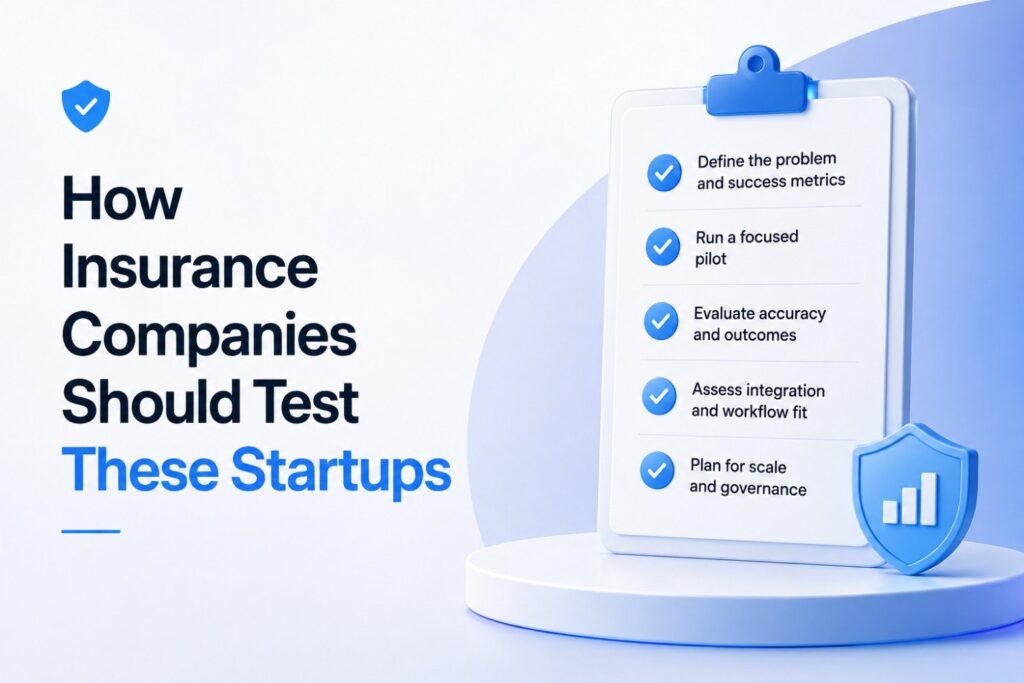
The better method starts before the startup touches any data.
Establish the Baseline First
Suppose an insurer wants to test underwriting AI.
Before implementation, it should know the current median time from submission to initial decision, the number of submissions reviewed, quote rate, bind rate, premium per underwriter and error or exception rates.
Claims pilots require the same discipline.
Measure current cycle times, correspondence turnaround, employee touches, claim leakage, reopen rates, litigation rates, customer contacts and whatever other measures fit the use case.
Without a baseline, nearly every AI pilot looks successful because the company can point to activity.
That is not ROI.
Use a Controlled Group Where Possible
Insurance companies should borrow a basic idea from experimentation.
Do not compare the new system with a vague memory of how things used to work.
Where operationally possible, run similar business through two groups.
One uses the current process.
The other uses the AI-assisted process.
Then compare the outcomes.
The groups will never be perfectly identical in a real insurance operation, but even a reasonable comparison produces better information than testimonials.
Measure Human Corrections
This may be one of the most underrated insurance AI metrics.
Suppose an AI processes 10,000 documents and claims 98% accuracy.
That sounds excellent.
But where are the 2% of errors?
If mistakes occur in unimportant fields, the system may be very useful.
If they occur specifically in high-risk coverage facts, the same headline accuracy number could hide a serious problem.
The insurer should track what humans change, how often they change it, and how financially important those corrections are.
Measure Exceptions, Not Just Average Performance
Average processing time can hide the cases that matter.
The best AI insurance system is not necessarily the one that produces the fastest average result.
It may be the one that knows when it is uncertain.
A system that correctly sends difficult cases to a human can be safer than one that aggressively automates everything.
That means carriers should test exception handling as carefully as straight-through processing.
A Practical Vendor Evaluation Framework
Insurance buyers should demand evidence that matches the risk of the workflow.
A drafting assistant should not need the same level of controls as an AI system moving cases toward automatic quote and bind.
The closer software gets to money or coverage decisions, the higher the burden of proof should become.
| Question to ask the startup | Why it matters | Evidence a buyer should request |
| What exact task is the AI completing? | “AI platform” is too vague to evaluate | Workflow diagram with clear start and end points |
| Which decisions can it influence? | Risk rises as software gets closer to coverage or payment | Decision matrix showing automated and human-controlled steps |
| What happens when confidence is low? | Good systems should know when to stop | Escalation rules and sample exception cases |
| Can every recommendation be traced? | Claims and underwriting decisions need support | Source links, logs and audit history |
| How is performance measured? | Generic accuracy can hide serious mistakes | Field-level and workflow-level testing |
| How often do humans correct it? | Correction rate reveals hidden workload | Production correction statistics |
| What customer data trains the model? | Insurance data can be sensitive | Written data-use and retention policy |
| Can customer data leak across tenants? | Enterprise insurers require separation | Security architecture and access controls |
| How are model changes managed? | Performance can change after updates | Version records and release governance |
| Can users override the AI? | Human control remains essential for many decisions | Documented override process |
| What happens during an outage? | Insurance work cannot simply disappear | Business continuity process |
| Can you prove ROI with our data? | Vendor averages may not apply | Baseline-based pilot plan |
This kind of procurement process does something else that is useful.
It forces the carrier to understand its own workflow.
Many insurers discover during an AI project that the biggest problem is not the model.
The real problem may be unclear underwriting rules, inconsistent claims procedures, missing data, broken integrations or years of workarounds inside legacy software.
AI can expose those weaknesses very quickly.
Which NYC Insurance AI Company Fits Which Problem?
There is no single “best” company because the problems are too different.
A carrier trying to speed commercial submission review should not evaluate the market in the same way as a TPA struggling with claims correspondence.
Our research suggests the following buyer map.
| If your biggest problem is… | Companies worth examining first | Why |
| Commercial submission triage and underwriting speed | Sixfold, Kalepa | Deep underwriting focus with substantial public production evidence |
| Wider AI automation across insurance operations | Bevaya | Broad insurance-agent strategy spanning underwriting, claims and servicing |
| End-to-end complex claims handling | Elysian | Technology combined with a claims administration operating model |
| Claims calls, intake and third-party outreach | Avallon AI | Agents built around communication-heavy claims tasks |
| Claims letters and regulated correspondence | Kyber | Narrow specialization with strong evidence of production scale |
| Focused automated underwriting | Satori | Risk analysis combined with quote-and-bind workflows |
| Finding weak evidence or questionable claims decisions | Solva | AI reasoning designed around policy terms and claim evidence |
| Predictive legal and claims decisions | Optimalex | Analytics centered on likely outcomes and decision support |
A carrier could eventually use more than one of these vendors.
That is another important market question.
Will insurers buy a single AI operating platform, or will they assemble a group of specialized products?
The answer is still open.
Why Specialization May Beat the “One AI Platform” Strategy
There is a strong argument for consolidation.
Insurance companies already have too many systems.
Chief information officers do not necessarily want twelve new AI vendors.
A platform that works across underwriting, claims and policy servicing could therefore be attractive.
That favors businesses such as Bevaya.
But specialization has its own advantage.
Kyber can focus intensely on insurance correspondence.
Solva can concentrate on claim evidence and payment quality.
A specialist may understand a difficult workflow more deeply than a giant platform designed to do everything.
We have seen this pattern in other enterprise software markets.
A broad suite wins where integration and simplicity matter most.
A specialist wins where the business problem is painful enough that customers demand the best possible tool.
Insurance AI will probably support both.
What Investors Should Look for Beyond the AI Demo
Insurance AI can look deceptively easy from the outside.
A founder can build a prototype that reads an insurance document in a few days.
That does not mean the founder has built an insurance company.
The moat is increasingly moving away from basic access to a language model.
Production Learning Is Becoming More Valuable Than the Model
Bevaya’s hundreds of millions of processed insurance documents matter because real production work reveals the edge cases.
Sixfold’s more than 1.5 million submissions matter for the same reason.
Kyber’s rapid growth in production correspondence matters because each document creates another opportunity to learn how real insurance organizations work.
The underlying foundation model will keep improving.
Competitors can often access similar models.
What is harder to copy is years of workflow design, integrations, customer trust, exception handling, insurance rules and operational data.
Distribution Could Become a Bigger Moat Than Technology
Large insurers do not buy critical software casually.
Security reviews take time.
Legal reviews take time.
Integrations take time.
Model governance takes time.
A startup that becomes trusted by several major carriers can therefore build an advantage that is difficult for a new competitor to reproduce quickly.
That is why the named production customers in this article matter at least as much as the funding numbers.
Outcome Data May Become the Strongest Moat of All
Imagine two underwriting AI companies.
Both can read the same submission.
But one has years of data connecting its recommendations to what later happened to the insured risk.
That company can potentially learn something far more valuable: which decisions were actually good.
The same applies to claims.
The long-term winner may be the company that connects AI recommendations with claim outcomes, litigation, settlement cost, reserve development and customer behavior.
That is a much stronger data loop than document extraction alone.
What Founders Can Learn From New York’s Strongest Insurance AI Startups
One lesson appears repeatedly across the companies with the strongest public evidence: they started with a painful insurance workflow.
They did not begin with “How can we use generative AI?”
They began with expensive underwriting review, messy submissions, slow correspondence, repetitive claims communication, difficult document analysis or bad claims decisions.
That order matters.
Sell a Business Result, Not an AI Feature
A chief underwriting officer does not need more artificial intelligence.
The officer needs faster broker response without hurting underwriting quality.
A claims leader does not need an agentic architecture.
The leader needs lower expense, fewer missed issues, faster claims, more consistent communication and better decisions.
The closer a startup’s sales pitch gets to those outcomes, the easier it becomes for the customer to build a business case.
Narrow Problems Can Become Large Companies
Kyber is a particularly useful example.
“Claims correspondence” sounds smaller than “reinvent the insurance industry.”
But large insurers may create enormous volumes of regulated correspondence every year.
A narrow workflow can therefore represent a substantial software market if it is painful enough and repeated often enough.
Founders should not mistake narrowness for a small opportunity.
What In-House Insurance Teams Should Do Right Now
Most insurers do not need to decide today whether AI will eventually automate 20%, 50% or 80% of insurance operations.
They need to find the next useful workflow.
The strongest starting point is usually a process with high volume, expensive human effort, reasonably clear inputs, measurable outcomes and a safe way to escalate exceptions.
Commercial submission triage often meets that test.
Claims correspondence can meet it.
Claim intake can meet it.
Document gathering can meet it.
Routine status inquiries can meet it.
The organization can then learn how to govern AI before attempting the hardest decisions.
Do Not Automate a Bad Process
This warning is especially important.
If an insurer has five teams following five different underwriting procedures, adding AI may reproduce the inconsistency faster.
If a claims department does not know which fields must be collected at intake, an AI agent will not magically create a stable process.
The best implementation often begins with boring operational work.
Define the workflow.
Remove unnecessary steps.
Agree on the rules.
Measure the baseline.
Then automate.
That makes the technology easier to test and the ROI much easier to prove.
What NYC Tech Journal Will Be Watching Next
Several developments could reshape this market over the next two years.
The first is whether underwriting AI crosses the line from assistant to controlled straight-through decision making at meaningful scale.
Sixfold’s move toward quote-ready and bind-ready cases is one early signal. If major carriers can safely automate a meaningful share of simpler commercial submissions while maintaining underwriting quality, the economics of commercial insurance could change quickly.
The second is whether claims AI produces measurable changes in claim severity rather than just employee productivity.
Saving adjuster time is valuable.
Finding a material piece of missing evidence, preventing an incorrect payment or identifying an important claim earlier could be much more valuable.
The third development is consolidation.
The current market contains specialists for underwriting, correspondence, claim reasoning, intake, communications and broader agent workflows.
Insurance companies may eventually decide they want fewer AI vendors.
If that happens, larger platforms could acquire specialists, just as CCC acquired EvolutionIQ.
The fourth is regulation and auditability.
As AI becomes more involved in decisions, insurers will demand clearer evidence for why a recommendation was produced. New York’s existing approach to AI governance in underwriting and pricing makes this especially relevant for companies selling to regulated insurers in the state.
The fifth is perhaps the most important.
We will be watching whether AI changes the economics of insurance talent.
If an experienced commercial underwriter can safely manage far more premium, the carrier may be able to grow without adding staff at the same rate.
If a claims adjuster can manage more files without losing control of critical issues, the economics of claims administration change.
Those are much larger effects than faster document summarization.
The Bigger Opportunity: Reinventing the Insurance Operating Model
It is tempting to describe all of this as automation.
That description may eventually be too small.
Insurance companies were designed around the limits of human information processing.
Work is divided partly because one person cannot read every submission, monitor every claim, remember every policy rule and continuously inspect every new piece of information arriving across thousands of files.
AI changes some of those limits.
A system can watch thousands of files continuously.
It can compare new information against rules.
It can identify which case changed.
It can prepare the routine work.
It can surface the exception.
That does not automatically remove the experienced insurance professional.
It may actually make that professional more important.
The human becomes the person who handles ambiguity, judgment, negotiation, relationships and unusual risk while software absorbs more of the mechanical load around those decisions.
This is why the best insurance AI companies should not be judged by how human their chatbot sounds.
They should be judged by how much better the insurance operation becomes.
Final Takeaway
New York’s AI insurance market is beginning to divide into clear specialist groups.
Sixfold and Kalepa are pushing deeper into commercial underwriting. Bevaya is building AI agents across several insurance functions. Elysian is combining technology with claims administration. Avallon is attacking the communication burden around claims. Kyber has found a narrow but important claims workflow and shown real production scale. Solva is moving AI closer to evidence-based claims decisions, while Satori and Optimalex are exploring more specialized forms of underwriting and predictive intelligence.
Our original analysis also shows something broader.
Among the nine private companies we examined most closely, 55.6% are primarily claims-focused, yet much of the strongest public production evidence and visible capital remains concentrated among more mature underwriting and cross-workflow platforms.
That gap creates opportunity.
The underwriting AI market is proving that insurers will pay for software that gets close to a real decision.
The claims AI market now has to prove the same thing at scale.
For New York, that could create another major technology category.
The city already has insurance companies, brokers, experienced operators, enterprise buyers, regulators, investors and a large financial-services technology ecosystem. InsurTech NY’s 2026 map of 142 companies shows how broad that foundation has become.
What happens next will depend less on which startup has the most impressive AI demo and more on which companies can prove three things at the same time: the technology works in production, insurance professionals trust it, and the economics improve after it is installed.
That is the standard that matters.
And based on what New York’s newest insurance AI companies are building, the market is moving much closer to it.