
Artificial intelligence is starting to change one of New York City’s oldest and most powerful industries: law.
The change is happening much faster than many people expected. Lawyers are using AI to read contracts, find evidence, draft documents, search old deals, review patents, monitor regulation, manage outside counsel, and identify lawsuits that may not have been discovered by humans alone.
But something even more important is beginning to happen.
A new group of New York startups is moving beyond building software for lawyers. Some are building entire legal workflows around AI. Others are creating AI-native law firms where software handles much of the repeatable work and human lawyers focus on judgment, negotiation, risk, and final approval.
That difference matters.
Legal AI is moving from “software that helps lawyers work faster” toward “technology that changes how legal work is produced, priced, and sold.”
New York may be one of the best places in the world for that transition.
The New York-Newark-Jersey City metro area had about 93,730 lawyers in 2024, according to U.S. Bureau of Labor Statistics data. That was almost twice the number in the Washington metro area and more than five times the number around San Francisco. The wider New York metro also had about 129,370 people working in legal occupations.
At the same time, legal AI adoption is moving quickly. Clio’s 2025 Legal Trends Report found that 79% of legal professionals surveyed were using AI somewhere in their firms, while 82% expected their AI use to increase over the following 12 months. Thomson Reuters separately reported that adoption of generative AI inside legal and other professional organizations had nearly doubled from 14% in 2024 to 26% in 2025.
That creates an unusual situation.
New York has enormous amounts of legal work, some of the world’s largest law firms, thousands of corporate legal buyers, deep financial markets, venture capital, highly regulated industries, and a growing AI ecosystem.
The result is a city that is becoming a real-world laboratory for the future of legal work.
This NYC Tech Journal analysis looks at the companies leading that shift, what they are actually building, where investors are placing money, and what the numbers tell us about the direction of New York’s legal AI market.
The Short Answer: The Legal AI Startups in NYC That Matter Most
NYC Tech Journal identified ten companies that meet our main inclusion rules and one early-stage company worth watching closely.
We did not simply search for companies with “AI” and “legal” in their marketing copy. We looked for companies with a real New York headquarters or meaningful co-headquarters, AI at the center of the product, and a clear connection to legal, regulatory, compliance, litigation, patent, contract, or legal-operations work.
| Company | Main NYC Legal AI Focus | Founded | Latest Publicly Disclosed Round Used in Our Analysis |
|---|---|---|---|
| Norm Ai | Agentic legal and compliance work + AI-native law firm | 2023 | $120M Series C |
| Crosby | AI-native commercial law firm | 2024 | $60M Series B |
| Patlytics | Patent and intellectual-property AI | 2023 | $40M Series B |
| Darrow | Litigation intelligence and legal-risk detection | 2020 | $35M Series B |
| Hadrius | AI-native financial compliance | 2023 | $22M Series A |
| Draftwise | Contract drafting and firm knowledge | 2020 | $20M Series A |
| LexCheck | AI contract review and negotiation | 2015 | $17M Series A |
| Priori | Outside-counsel selection and legal operations | 2013 | $15M A-1 round |
| Discernis | AI-native e-discovery and investigations | 2024 | $2.5M seed |
| Soxton | AI-powered legal services for startups | 2025 | $2.5M pre-seed |
| JusticeX | AI-assisted dispute and mediation infrastructure | Early stage | Not publicly disclosed |
Norm Ai announced a $120 million Series C in July 2026 at a reported $1.2 billion valuation, bringing total capital raised to more than $260 million. Crosby raised a $60 million Series B in March 2026 after earlier seed and Series A rounds, bringing its reported total to $85.8 million. Patlytics announced a $40 million Series B in April 2026, bringing its total funding to roughly $65 million.
Those three companies alone tell us something important.

New York is no longer producing only small legal-software tools.
It is producing legal AI companies with serious venture backing, large enterprise customers, ambitious product strategies, and business models that could change how major parts of legal work are delivered.
NYC Tech Journal Original Research: How We Built the Dataset
Legal AI lists are easy to create badly.
A company may call itself a New York legal-tech company because it has a salesperson in Manhattan. Another may have opened a small New York office while keeping its headquarters in London, Stockholm, Bengaluru, San Francisco, or another market.
That can make the New York ecosystem look much larger than it really is.
For this article, we used stricter rules.
Rule 1: The Company Needed a Strong New York Connection
We counted companies that publicly describe New York as their headquarters, are listed by credible startup databases as New York-based, or clearly maintain New York as one of their headquarters.
Draftwise, for example, is identified by Y Combinator as a New York City company and describes itself as headquartered in New York. Darrow publicly lists both New York and Tel Aviv as headquarters. Hadrius says its headquarters is in New York. LexCheck maintains its New York headquarters and a Manhattan address.
We did not automatically classify a company as an NYC startup simply because it maintains a New York office.
That distinction matters.
SpotDraft, for example, has a significant New York operation but describes itself as headquartered in Bengaluru, India. Crimson announced a New York office in 2026 but remains a London-based startup. Those companies matter to New York’s legal technology market, but we did not treat them as core NYC startups in the original funding analysis.
Rule 2: AI Needed to Be Central to the Product
We excluded traditional legal software companies that merely added a chatbot or AI search feature.
The companies in our core group use AI for tasks such as legal reasoning, contract drafting, contract review, patent analysis, evidence classification, regulatory monitoring, litigation intelligence, mediation analysis, or legal-service delivery.
That gave us a more useful view of where AI itself is changing legal work.
Rule 3: Legal Work Had to Be a Primary Use Case
Not every AI research tool used by lawyers is a legal AI company.
New York has broader enterprise-AI companies whose technology is useful inside law firms. Those businesses are important, but they are different from companies built specifically around legal workflows.
We therefore focused the main ranking on startups where lawyers, legal departments, compliance professionals, law firms, or legal-service buyers are central customers.
Rule 4: We Used Public Funding Announcements Instead of Estimated Private-Market Numbers
Private-company funding data can be messy.
Different databases may report different totals because of debt, secondary transactions, undisclosed seed rounds, extensions, or timing differences.
To make our analysis easier to reproduce, our main capital chart uses the latest clearly disclosed funding round that we could verify for each company.
This means the figures should not be interpreted as total capital raised.
They answer a narrower question:
How large was the latest publicly disclosed round for each company in our sample?
Rule 5: The Data Cutoff Is August 30, 2026
Legal AI is moving unusually fast.
Funding totals, valuations, customer numbers, and product strategies can change within months.
All analysis should therefore be read as a snapshot of the market as of August 30, 2026.
Original Analysis: New York’s Legal AI Funding Is Already Highly Concentrated
Ten companies in our core dataset had a latest funding round for which we could verify a clear amount.
Those ten latest rounds total approximately:
$334 million
That is not the companies’ combined lifetime funding.
It is the sum of the latest clearly disclosed rounds used in this analysis.
Chart 1: Latest Disclosed Round Across Our NYC Legal AI Sample
Norm Ai       $120M  ██████████████████████████████
Crosby         $60M  ███████████████
Patlytics      $40M  ██████████
Darrow         $35M  █████████
Hadrius        $22M  ██████
Draftwise      $20M  █████
LexCheck       $17M  ████
Priori         $15M  ████
Discernis     $2.5M  █
Soxton        $2.5M  █
Sources include company announcements, TechCrunch, Y Combinator profiles, and other public funding disclosures.
The concentration is striking.
The three largest latest rounds—Norm Ai, Crosby, and Patlytics—represent about $220 million, or 65.9%, of the $334 million sample.
The five largest represent approximately 82.9%.
| Capital Concentration | Amount | Share of Sample |
|---|---|---|
| Top 3 latest rounds | $220M | 65.9% |
| Top 5 latest rounds | $277M | 82.9% |
| Remaining 5 disclosed rounds | $57M | 17.1% |
| Total | $334M | 100% |
This suggests that investors are not spreading money evenly across dozens of similar legal AI tools.
Large amounts of capital are concentrating around a smaller group of companies that appear capable of owning an important legal workflow.
That is a common pattern when a technology category starts maturing.
Investors begin asking a harder question.
They stop asking, “Does this company have AI?”
They start asking, “Could this company become the operating system for an entire part of legal work?”
Original Analysis: 2026 Has Been a Major Capital Year for the NYC Cohort
Five companies in our funding sample announced the rounds used in this analysis during 2026: Norm Ai, Crosby, Patlytics, Hadrius, and Discernis.
Those rounds total approximately $244.5 million.
That is about 73.2% of the entire $334 million latest-round dataset.
Chart 2: Companies With 2026 Latest Rounds Versus Earlier Latest Rounds
2026 latest rounds   $244.5M  ████████████████████████████████████  73.2%
Earlier rounds        $89.5M  █████████████                            26.8%
Again, this is not a measure of total NYC legal-tech venture investment by calendar year. It compares the latest disclosed rounds in this specific company sample.
Still, the direction is useful.
Legal AI capital formation in New York is not simply the result of funding rounds raised during the first generative-AI excitement of 2023 and 2024.
Several of the largest companies have continued raising much larger rounds in 2026.
That suggests investors believe the category is moving from experimentation toward commercial scale.
New York Has a Customer Advantage That Is Hard to Copy
There is another reason to take the NYC legal AI ecosystem seriously.
The city already has a huge concentration of the people these startups want as customers.
BLS data shows the New York-Newark-Jersey City metro had roughly 93,730 lawyers in 2024. Washington, the second-largest metro in the BLS table, had about 48,170. San Francisco had about 16,940.
Chart 3: Lawyer Employment in Selected U.S. Metro Areas, 2024
New York       93,730  ████████████████████████████████████████
Washington     48,170  ████████████████████
Los Angeles    40,990  █████████████████
Chicago        28,380  ████████████
Miami          26,720  ███████████
Boston         18,900  ████████
San Francisco  16,940  ███████
This produces a powerful startup advantage.
Our calculation from BLS figures shows that the New York metro had approximately 1.95 times as many lawyers as Washington and roughly 5.5 times as many as San Francisco.
New York also had around 129,370 total legal occupations, compared with about 27,490 around San Francisco. That is roughly 4.7 times as many legal workers.
For a legal AI founder, that means potential design partners are nearby.
Customers are nearby.
Big Law attorneys are nearby.
Banks are nearby.
Insurance companies are nearby.
Private-equity firms are nearby.
Large corporate legal departments are nearby.
And many of the industries with the most complex regulatory problems are nearby.
That is why New York’s advantage in legal AI may have less to do with building better base AI models and more to do with having unmatched access to difficult legal workflows.
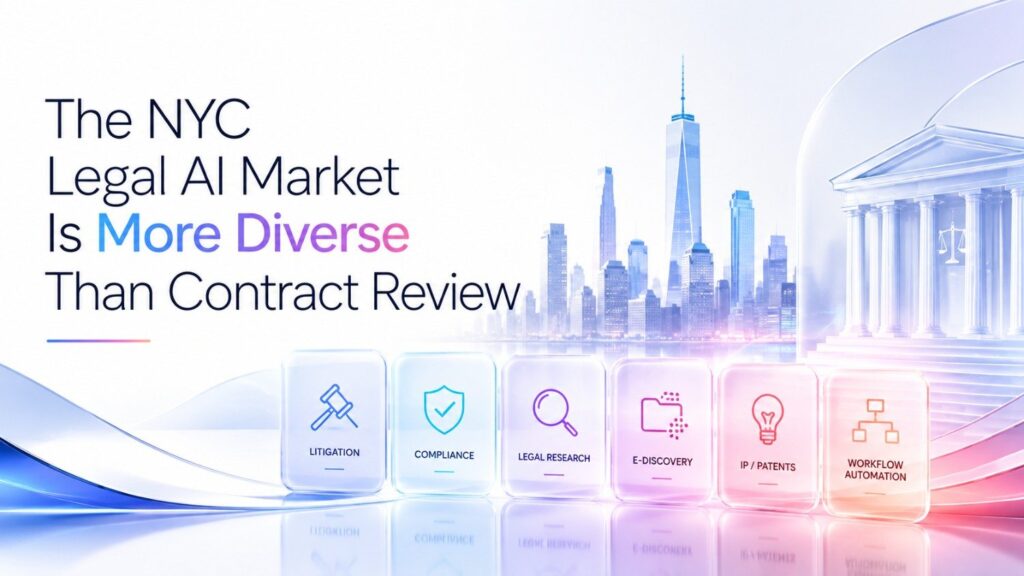
The NYC Legal AI Market Is More Diverse Than Contract Review
Contracts get much of the attention because contracts are everywhere and the business value is easy to understand.
But our sample shows New York legal AI moving across many parts of the industry.
| Workflow Cluster | Companies in Our Core Dataset |
|---|---|
| Contracts and commercial transactions | Crosby, Draftwise, LexCheck, Soxton |
| Litigation, discovery, and disputes | Darrow, Discernis, JusticeX |
| Patents and intellectual property | Patlytics |
| Regulatory and compliance work | Norm Ai, Hadrius |
| Legal operations and outside counsel | Priori |
Only four of the eleven companies are mainly centered on contracts or startup transactional work.
That is important.
If nearly every legal AI startup were attacking contract review, the New York market would look crowded and fragile.
Instead, companies are spreading into areas where the underlying data, workflows, buyers, and legal risks are very different.
That gives NYC a chance to develop several legal AI clusters rather than one.
Norm Ai — New York’s Most Ambitious Bet on Agentic Law
Norm Ai may be the clearest example of where legal AI could go next.
The company was founded in New York in 2023 by John Nay after years of research around the intersection of law and artificial intelligence. Norm describes its concept as “agentic law”: embedding rules and legal reasoning directly into AI agents that perform regulated work.
The company has moved rapidly.
In July 2026, Norm announced a $120 million Series C led by Khosla Ventures at a reported $1.2 billion valuation. TechCrunch reported that the round brought Norm’s total funding to more than $260 million.
Norm Is Not Only Selling Software
The most interesting part of Norm’s strategy may be Norm Law.
Norm Law is a New York-based AI-native law firm powered by Norm’s technology. Human attorneys supervise AI agents while the business moves toward outcome-based pricing rather than relying only on the classic hourly model.
That changes the economic question.
A normal legal AI startup sells software licenses to a law firm.
Norm has the potential to compete for some of the legal work itself.
That means its addressable market may eventually include not only legal software budgets, but parts of the much larger legal-services budget.
Why Norm Matters for New York
Norm says institutions using its technology manage more than $35 trillion in combined assets. Its focus on high-stakes regulated environments also fits New York extremely well because the city sits at the center of banking, investing, insurance, asset management, and other heavily regulated sectors.
This may become an important pattern in vertical AI.
The best company may not be the one that provides a general-purpose legal chatbot.
It may be the one that can understand a narrow regulatory workflow deeply enough to perform much of the work.
Crosby — Building an AI Law Firm Instead of Selling Lawyers Another Tool
Crosby is another company worth watching closely because it has made a similar strategic decision from a different starting point.
It is not primarily asking law firms to buy a software seat.
Crosby describes itself as a vertically integrated AI-native law firm.
The company was founded in New York in 2024 by Ryan Daniels and John Sarihan. It combines proprietary AI agents with licensed lawyers to review and negotiate commercial agreements for fast-growing companies.
Its Core Product Is Turnaround Time
When Crosby publicly launched in 2025, it said its median contract-review time was 58 minutes and that it had already reviewed more than 1,000 MSAs, DPAs, and NDAs.
The company then raised $20 million in a Series A in October 2025.
By March 2026, Crosby announced another $60 million Series B, led by Lux and Index, with participation from investors including Sequoia and Bain Capital Ventures. The round took reported total equity funding to about $85.8 million.
Forbes reported in March 2026 that about 100 companies were using Crosby.
The Bigger Idea Is More Important Than Contract Review
Crosby’s long-term idea is not simply faster redlining.
The company has discussed tools that simulate how counterparties may respond to proposed contract changes, AI voice agents that could participate in negotiations, and systems that allow customers to oversee legal work more directly.
That could move legal technology from document assistance toward negotiation automation.
It is still far too early to assume AI will negotiate important commercial agreements without human control.
But the direction deserves attention.
If Crosby can convert a legal process that takes days into one that takes an hour while maintaining acceptable quality, the economic impact is much larger than saving a lawyer a few minutes inside Microsoft Word.
Patlytics — New York Is Building a Serious Patent AI Company
Patent law is one of the strongest examples of why vertical AI can beat generic AI.
Patent work combines technical material, legal rules, enormous document sets, prior art, claim construction, prosecution history, infringement analysis, and litigation strategy.
A chatbot that is merely good at writing is not enough.
Patlytics is trying to build specifically for this complexity.
The New York company develops AI tools that support much of the patent lifecycle, including invention harvesting, drafting, infringement analysis, invalidity work, due diligence, litigation, and portfolio management.
Patlytics Has Become One of NYC’s Best-Funded Legal AI Startups
The company raised a $14 million Series A in 2025.
In April 2026, it followed that with a $40 million Series B led by SignalFire, bringing total reported funding to roughly $65 million.
Perhaps more important than the funding is customer penetration.
Patlytics said in 2026 that its technology was being used by more than 40% of Am Law 100 IP practices. Relativity also cited the same adoption figure when announcing its investment.
That is meaningful because patent lawyers are not casual users.
They work with commercially valuable intellectual property where errors can have very large consequences.
Why Patents May Become One of Legal AI’s Strongest Verticals
Patent work contains many repeated analytical steps.
Lawyers compare claims.
They search previous material.
They map product features to patent language.
They build charts.
They review portfolios during acquisitions.
They draft applications using information scattered across technical documents.
AI is good at reading and comparing large amounts of text.
When the AI is surrounded by strong legal workflows, citation systems, review steps, and structured patent data, the value can become much greater.
Patlytics is therefore a good example of a broader rule:
The highest-value legal AI products may come from combining AI with deep practice-area structure.
Darrow — Using AI to Find Legal Problems Before a Lawsuit Exists
Most legal software starts after somebody knows there is a legal matter.
Darrow works further upstream.
The company uses AI and large datasets to detect possible legal violations, identify litigation opportunities, evaluate cases, and help law firms understand potential exposure.
Darrow describes itself as an AI research lab for the legal ecosystem and currently lists New York and Tel Aviv as headquarters. Its technology processes large amounts of public data to identify signals that could point to legal risk.
This Changes the Role of Legal Technology
Traditional litigation software helps a lawyer handle an existing case.
Darrow can help identify the case itself.
That is a much more disruptive position in the workflow.
The company says it works with more than 80 law firms, detects millions of signals each month, and has identified billions of dollars in potential legal risk.
Darrow raised a $35 million Series B in 2023, bringing total capital raised at that point to nearly $60 million.
Darrow Is Turning Litigation Into Something Closer to Portfolio Analysis
In May 2026, the company launched a platform designed to let firms identify, evaluate, and manage litigation opportunities more like a portfolio.
That idea fits New York extremely well.
New York firms already understand portfolio thinking because the city is built around capital allocation, risk pricing, underwriting, and investment analysis.
Applying similar thinking to litigation could change how plaintiff firms decide which matters deserve time and money.
Instead of relying mainly on referrals and intuition, firms may increasingly use data to estimate case value, class size, likelihood of success, and expected recovery.
Hadrius — Bringing AI Into Financial Compliance
Hadrius sits at the border between legal tech, regtech, and financial technology.
That border may be exactly where some of the largest New York opportunities are.
The company was founded in 2023 and is headquartered in New York. It builds AI-powered compliance infrastructure for SEC- and FINRA-regulated businesses.
Hadrius says more than 500 financial institutions and investment firms use its platform and that its customers collectively manage roughly $5 trillion in assets.
The Company Is Automating Work That Used to Require Large Amounts of Manual Review
Compliance teams need to review marketing, communications, trading behavior, policies, employee activity, testing programs, and records.
The problem is volume.
Employees now communicate across email, Slack, Teams, messaging apps, and AI tools. A compliance department cannot manually inspect every interaction.
Hadrius uses AI agents to analyze information, surface possible problems, and send the cases that require judgment to humans.
In July 2026, Hadrius announced $27 million in combined seed and Series A funding, including a $22 million Series A led by CRV.
Why This Is a Very New York Business
Financial compliance is expensive.
But the bigger reason it matters is that errors can create enormous regulatory and reputational costs.
That means customers may pay well for systems they trust.
New York is full of firms with exactly that problem.
If vertical AI wins by being close to high-value workflows, financial compliance may become one of New York’s strongest AI categories.
Draftwise — Turning a Law Firm’s Old Contracts Into Intelligence
Every large law firm has an enormous hidden asset.
It is not only its lawyers.
It is the history of work those lawyers have already done.
A large firm may have years of contracts, negotiated language, fallback clauses, deal structures, concessions, internal guidance, and client preferences sitting inside document-management systems.
Traditionally, much of that information has been difficult to reuse.
Draftwise is trying to make it searchable and actionable.
The Product Is Built Around Institutional Knowledge
Founded in 2020 and based in New York, Draftwise uses AI to help lawyers draft, review, and negotiate contracts using the firm’s own historical work.
Instead of asking a generic model how a clause should be written, a lawyer can use intelligence drawn from the firm’s previous deals.
That distinction matters enormously.
A generic AI model may know what a market-standard clause often looks like.
A firm’s internal knowledge can show how that particular firm and client actually negotiated the issue in real transactions.
Draftwise raised a $20 million Series A led by Index Ventures in 2024. Stanford’s CodeX TechIndex currently lists total funding at $28 million.
The Moat May Be the Law Firm’s Own Data
Draftwise has increasingly described its goal in terms of legal intelligence rather than simple drafting automation.
In August 2026, it introduced a legal ontology platform intended to connect information about deals, clients, obligations, relationships, and legal knowledge across the firm.
This points toward an important future battle in legal AI.
Everyone may eventually have access to powerful models.
Not everyone will have access to a law firm’s proprietary institutional memory.
The winners may therefore be companies that make private legal data usable without compromising security or confidentiality.
LexCheck — One of New York’s Earlier AI Contract Companies
Legal AI did not begin with ChatGPT.
LexCheck is an important reminder of that.
The New York company was founded in 2015 and has spent years building AI-based contract-review technology. It is one of the older businesses in this dataset.
Its platform helps legal teams review and negotiate agreements using company-specific playbooks.
That last part is important.
Enterprise contract automation only becomes truly useful when the system understands what a particular company will accept, reject, or escalate.
LexCheck Has Already Lived Through Several Generations of Legal AI
The company raised a $3 million seed round in 2020, another $5 million in 2022, and a $17 million Series A later that year. TechCrunch reported at the time that LexCheck had raised $22 million in total.
Since then, the legal AI market has become dramatically more competitive.
That creates an interesting test.
Can companies built before the generative-AI boom adapt quickly enough to compete with startups born around foundation models?
LexCheck continues introducing AI capabilities, including newer contract-review products and automatically generated playbooks.
Its story therefore matters for a reason beyond its own product.
It may show whether the first generation of legal AI companies can evolve successfully into the agentic AI era.
Priori — Using AI to Change How Companies Buy Legal Services
Not all expensive legal problems involve drafting or research.
Large companies also spend huge amounts of time deciding which lawyers should receive the work.
Corporate legal teams manage relationships with many firms.
They need to choose outside counsel, evaluate rates, understand previous performance, manage panels, compare proposals, and decide whether work should go to a major law firm, specialist, flexible legal provider, or another option.
Priori has been attacking this problem for years.
The New York company began as a legal marketplace and has evolved into a broader outside-counsel intelligence platform.
AI Is Moving Into Legal Procurement
Priori’s Scout platform uses AI to help legal teams understand outside-counsel relationships and make better hiring decisions.
In April 2026, Priori announced additional AI capabilities for its RFP product. The system can bring together matter information, law-firm data, lawyer information, past billing, and internal guidelines to help teams choose where work should go and what it should cost.
Priori previously raised a $15 million A-1 financing round in 2022.
Why This Area Could Become Much Bigger
Most discussion about legal AI focuses on the supply side.
How can lawyers work faster?
Priori focuses partly on the demand side.
How can corporations buy legal services better?
That may eventually become just as important.
AI could help legal departments compare pricing, identify specialists, predict which firms are well suited to a matter, analyze performance, and move routine work toward lower-cost providers.
This may put more pressure on law firms than another drafting assistant.
If buyers become much smarter, firms will have to prove why their work deserves premium pricing.
Discernis — Applying AI to the Evidence Problem
Litigation creates a brutal data problem.
A major dispute can involve millions of emails, files, messages, presentations, spreadsheets, and other documents.
Humans cannot carefully read everything.
Traditional e-discovery software helped legal teams search and classify large collections, but generative AI creates the possibility of moving further.
Discernis is one of the newest New York companies attacking that problem.
The company builds AI-native discovery and investigation software that can analyze document collections, identify relationships, classify evidence, and explain why materials may matter.
Privacy Is Part of the Product
Discernis emphasizes that it builds and hosts its AI so customer information does not need to be sent to third-party AI providers. It also positions explainability as an important part of review.
That is especially important in litigation.
Legal teams handle privileged information, confidential business records, personal data, and evidence that may determine the outcome of a major case.
The cheapest AI model is not necessarily the best choice.
Security architecture can become a competitive advantage.
Discernis announced a $2.5 million seed round in August 2026, led by Newfund Capital.
It is much smaller than Norm or Crosby, but it deserves attention because e-discovery is already a large, established legal technology market.
If AI-native tools can materially reduce review costs, the opportunity is significant.
Soxton — Building an AI-Powered Law Firm for Startups
Soxton is another example of the growing move from legal software toward technology-enabled legal services.
The company is aimed at early-stage founders.
Instead of selling startups legal software and asking them to figure out what to do with it, Soxton combines automated workflows with human legal support for work such as incorporation, equity, financing, and basic company legal needs.
Business Insider reported that founder Logan Brown, a former Big Law attorney, raised $2.5 million in pre-seed financing in 2025 after leaving her law firm. The report said more than 270 startups had already used Soxton.
The Small-Business Legal Market Could Be Very Different From Big Law
Large corporate legal departments can spend hundreds of thousands or millions of dollars on technology.
Early startups cannot.
That makes a pure enterprise SaaS model harder.
But an AI-powered legal-services model can potentially spread technology costs across many customers.
A founder does not need to buy software.
The founder simply buys the legal outcome.
That is why businesses such as Soxton may eventually matter far beyond venture-backed startups.
AI could make basic legal help economical for customers who previously delayed hiring a lawyer because the traditional service was too expensive.
JusticeX — A Very Early Bet on AI-Assisted Dispute Resolution
JusticeX is far earlier than most companies in this ranking, so it should not be compared directly with heavily funded companies such as Norm, Crosby, or Patlytics.
It is included because the problem it is attacking is different.
The New York-based legal technology company is developing infrastructure for mediation and dispute comparison. Its stated goal is to create a neutral, auditable system that helps people and professionals compare positions and work toward settlement.
Settlement Is an Enormous Part of Law
Most civil disputes never reach a full trial.
Yet legal technology has historically concentrated heavily on research, document management, billing, contracts, and litigation support.
AI-assisted mediation could become another category.
The challenge will be trust.
Parties must understand how recommendations were produced.
Mediators need control.
Lawyers need confidence that important legal or factual details were not missed.
Bias, privacy, transparency, and unauthorized-practice issues will all matter.
JusticeX is therefore best viewed as an emerging NYC company to watch rather than a proven category leader.
Original Research: More Than Half of the Capital Is Going Toward Companies That Blur Software and Legal Services
One of the most interesting patterns in our dataset appears when we separate traditional legal software from companies that are beginning to combine software with direct legal-service delivery.
Norm Ai powers Norm Law.
Crosby operates an AI-native law-firm model.
Soxton provides legal services to startups through an AI-driven operating model.
Their latest disclosed rounds in our dataset total:
- Norm Ai: $120 million
- Crosby: $60 million
- Soxton: $2.5 million
Combined: $182.5 million
That represents roughly 54.6% of the $334 million latest-round dataset.
Chart 4: Software-Plus-Service Companies Versus Other Legal AI Companies
AI + legal-service delivery   $182.5M  ███████████████████████████  54.6%
Other workflow software       $151.5M  ██████████████████████       45.4%
This classification requires judgment, so it should not be treated like an official industry category.
But the directional signal is important.
More than half of the capital represented by the latest rounds in our sample went to companies that have moved beyond selling software alone.
Why Investors May Like the Model
A software company typically charges the legal team for technology.
A technology-enabled law firm can potentially charge for the legal result.
That gives it access to a much larger pool of spending.
For example, a company may hesitate to pay $100,000 for another software platform.
But it may already spend $1 million each year having lawyers perform the same work.
A technology-enabled provider can attack the $1 million service budget instead.
That is one reason AI could eventually produce a very different generation of legal companies.
Why New York Could Become a Capital of Vertical Legal AI
Silicon Valley has obvious advantages in foundation models, engineering networks, venture capital, and consumer technology.
New York has something different.
It has workflow density.
That may be equally valuable for vertical AI.
New York Has an Unusually Large Number of Expensive Problems
Legal AI produces the most value when the human workflow being automated is expensive.
New York contains large concentrations of those workflows.
Think about investment-bank agreements.
Private-equity transactions.
Hedge-fund compliance.
Insurance regulation.
Commercial litigation.
Patent disputes.
Real-estate transactions.
Mergers.
Securities offerings.
Corporate investigations.
Employment matters.
Advertising reviews.
Financial regulation.
These are not hypothetical AI use cases.
They are things New York professionals do every day.
Customers Can Become Product Development Partners
Vertical AI companies need more than training data.
They need people who understand the workflow deeply enough to tell engineers where the model fails.
A good legal product might need input from partners, associates, general counsel, compliance officers, patent lawyers, litigators, legal-operations leaders, and paralegals.
New York has all of them at unusual scale.
That shortens the feedback loop.
A founder can build a feature, put it in front of experienced legal professionals, find the failure points, improve it, and test again.
That can create a stronger product than building far away from the workflow.
AI Will Not Replace “Lawyers” as One Job
The question “Will AI replace lawyers?” is usually too broad to be useful.
A lawyer does many different things.
Some parts are highly repeatable.
Some require judgment.
Some require persuasion.
Some require relationships.
Some require accountability.
Some require signing your name to a professional opinion and being responsible when it is wrong.
AI will affect each part differently.
Work That Looks Most Exposed
First-pass contract review is already changing.
Basic research is changing.
Document summaries are changing.
Discovery review is changing.
Due-diligence extraction is changing.
Patent comparison is changing.
Regulatory monitoring is changing.
Routine drafting is changing.
These tasks often involve reading large amounts of information, finding patterns, comparing language, and producing structured output.
That is exactly where modern AI systems can be useful.
Work That Looks Harder to Fully Automate
A general counsel deciding how aggressively to handle a major regulator faces a different problem.
A trial lawyer deciding whether a witness will appear credible faces a different problem.
A partner persuading a board to accept a settlement faces a different problem.
A lawyer negotiating an unusual acquisition with several competing business goals faces a different problem.
These tasks contain politics, judgment, psychology, business context, accountability, and uncertainty.
AI can provide information.
It may eventually recommend strategies.
But humans are likely to remain important for much longer.
The Biggest Disruption May Be Pricing, Not Employment
This is where law firms should pay especially close attention.
Suppose AI allows an associate to complete a task in 45 minutes that previously took five hours.
That is good for productivity.
But traditional law firms often make money by selling hours.
Efficiency can therefore create a strange economic problem.
The firm becomes better at producing the work but may have fewer hours to bill.
Clio’s research points directly at this tension. Its 2025 report said firms using AI more widely were making more pricing adjustments, while hourly billing remained common even as automation increased.
AI-Native Firms Do Not Carry the Same Problem
Crosby can benefit financially when software makes a contract review faster because it does not need to sell more hours to create more revenue.
Norm has also emphasized outcome-oriented pricing through Norm Law.
Soxton can use automation to make smaller legal matters economical.
This aligns the economics differently.
If technology allows the provider to complete work with less labor, the provider can potentially keep part of the efficiency gain.
Traditional hourly firms may instead lose billable time.
That is why legal AI may eventually force pricing innovation even at firms that do not want to change.
What New York Law Firms Should Do Right Now
The worst strategy is to buy many AI tools because partners are worried about being left behind.
The second-worst strategy is to block AI completely and assume the problem will disappear.
A better approach starts with workflows.
Find the Work That Is Expensive but Repeatable
Do not begin by asking which AI platform your firm should buy.
Ask what work your lawyers repeat every week.
Look for situations where associates read similar documents, copy information between systems, compare language, search old matters, create first drafts, summarize evidence, review standard terms, or prepare structured reports.
Measure how much lawyer time the workflow consumes.
Then test whether AI can reduce it without creating unacceptable risk.
Measure Quality Before Speed
A tool that completes a contract review ten times faster but misses important clauses is not productive.
It simply moves the cost somewhere else.
Create a test set.
Use old matters where you already know the right answer.
Compare AI output with lawyer-reviewed output.
Track false positives.
Track missed issues.
Track unsupported claims.
Track whether citations point to real sources.
Track how much review time is still required.
Legal AI should be evaluated like infrastructure, not like a clever demo.
A Practical Legal AI Vendor Scorecard
NYC Tech Journal recommends evaluating vendors across factors that matter to the actual workflow.
| Evaluation Area | Questions to Ask |
|---|---|
| Accuracy | How often does the system miss legally important issues? |
| Source grounding | Can the lawyer trace the answer to documents, law, or firm data? |
| Security | Where is client information stored and processed? |
| Data use | Is customer data used for model training? |
| Human control | Where can a lawyer review, reject, or override output? |
| Integration | Does it work inside Word, DMS, email, CLM, or existing workflows? |
| Auditability | Can the firm reconstruct what the AI did? |
| Economics | Does it reduce total matter cost rather than just software cost? |
| Adoption | Will lawyers actually use it in daily work? |
| Business model | Is the vendor selling software, legal services, or both? |
This last question is becoming increasingly important.
A legal department buying software from Draftwise has a different vendor relationship than a company sending legal work to Crosby.
Procurement, privilege, professional responsibility, insurance, liability, supervision, and data handling can all be different.
The business model must therefore be part of the technology review.
Security Could Become One of the Biggest Moats in Legal AI
Consumer AI tools made experimentation easy.
They also created bad habits.
Lawyers deal with highly sensitive information.
Uploading confidential client documents into the wrong service can create serious privacy and professional-responsibility problems.
Clio’s research specifically warns that generic consumer AI products may lack confidentiality protections required for legal work.
This creates an advantage for legal AI startups that build security deeply into the platform.
The winning legal AI product may not always use the most powerful model.
It may use a slightly less impressive model inside a system that customers trust enough to deploy across real matters.
Security reviews, access controls, encryption, retention policies, data residency, model-training policies, audit logs, and private deployment options will therefore become major competitive features.
Discernis is already making private AI infrastructure a core part of its pitch.
Draftwise emphasizes integration with firm knowledge.
Hadrius talks about zero-data-retention AI for regulated financial customers.
This is not boring infrastructure.
In legal AI, trust infrastructure is part of the product.
Generic AI Will Become Cheap. Workflow Knowledge Will Become Valuable.
This may be the most important strategic lesson from the entire NYC legal AI market.
Models are getting better.
They are also becoming widely available.
Google, OpenAI, Anthropic, and other large technology companies can all build increasingly capable systems.
Google’s August 2026 launch of Gemini Enterprise for Legal is another reminder that the foundation-model companies themselves are moving deeper into legal workflows.
A startup therefore needs a stronger advantage than “we use a powerful model.”
The Moat Is Moving Up the Stack
Patlytics has patent workflows.
Darrow has litigation intelligence.
Draftwise has firm knowledge.
Hadrius has financial compliance workflows.
Priori has outside-counsel data.
Crosby has a technology-enabled legal delivery system.
Norm is encoding legal and regulatory work into agents.
These are harder to copy than a prompt box.
The best vertical AI company may eventually look less like an AI wrapper and more like a complete operating system for a profession.
The New York Legal AI Market Could Split Into Three Layers
Based on our analysis, the market appears to be developing into three broad layers.
Layer One: AI Tools for Lawyers
These products make existing lawyers faster.
Draftwise and LexCheck fit strongly into this category.
The customer still controls the workflow.
The AI improves how work gets done.
Layer Two: AI Systems That Operate Parts of the Workflow
These platforms take responsibility for larger blocks of work.
Patlytics, Darrow, Discernis, Priori, and Hadrius increasingly fit here.
They are not simply answering questions.
They are organizing and executing important processes.
Layer Three: AI-Native Legal Service Providers
This is the most disruptive category.
Crosby, Norm Law, and Soxton are attempting to sell legal outcomes using operating models built around AI from the beginning.
If this model works, the competitive battle changes.
The new company is no longer only competing against legal software.
It is competing against law firms.
What NYC Tech Journal Will Be Watching Next
Funding alone will not determine which companies win.
The next stage should be judged by operational evidence.
We will be watching whether AI-native law firms can maintain quality as volume increases.
We will watch whether large corporations trust autonomous agents with more complex matters.
We will watch whether law firms allow their proprietary knowledge to become deeply connected to AI platforms.
We will watch whether customers demand lower prices as lawyer productivity increases.
We will watch whether legal AI companies become acquisition targets for major legal-information businesses, law-firm technology providers, or enterprise software companies.
Most importantly, we will watch whether AI begins changing legal revenue rather than simply lawyer productivity.

That is the line between an interesting software trend and a true industry transformation.
The Bottom Line
New York’s legal AI market is becoming much more substantial than a collection of chatbot startups.
Our research identified a core group of companies working across contracts, patents, litigation, discovery, compliance, legal procurement, dispute resolution, and direct legal services.
The latest disclosed rounds across ten companies in our dataset total roughly $334 million. About 65.9% of that figure comes from just three companies: Norm Ai, Crosby, and Patlytics. Roughly 73.2% comes from companies whose latest rounds in our sample were announced in 2026.
More importantly, the market is moving beyond tools.
Norm is building agentic legal infrastructure and supporting an AI-native law firm.
Crosby is selling commercial legal work through an AI-first operating model.
Patlytics is building deep infrastructure around patents.
Darrow is using AI to discover legal exposure before litigation begins.
Hadrius is rebuilding financial compliance around AI agents.
Draftwise is turning law-firm history into usable intelligence.
New York has something unusually valuable for all of them: customers.
The metro area has more lawyers than any other U.S. metro in BLS data, a huge concentration of major law firms, some of the world’s largest banks and financial institutions, hundreds of corporate headquarters, powerful investors, and enormous amounts of expensive legal work.
That may become New York’s greatest AI advantage.
Silicon Valley built many of the technologies underneath modern artificial intelligence.
New York may become one of the places where those technologies are turned into industry-specific businesses.
And law could become one of the clearest examples.
The future of legal AI is unlikely to be one robot lawyer replacing an entire profession.
It will be thousands of individual workflows being rebuilt one by one.
Contracts will move faster.
Evidence will be easier to search.
Patents will be analyzed differently.
Regulation will be monitored continuously.
Corporate legal departments will buy outside counsel more intelligently.
Law firms will have to rethink how they price work.
And increasingly, customers may stop caring whether a task took a lawyer ten hours, one hour, or ten minutes.
They will care about the outcome.
The New York legal AI companies that understand that shift are the ones worth watching most closely.