

Wall Street has spent years talking about artificial intelligence. In 2026, the more important story is that AI is finally moving into the actual work.
It is reading thousands of pages of filings. It is helping investment bankers research companies. It is checking financial data before it enters a model. It is reviewing private credit deals, making lending decisions, finding fraud, monitoring compliance, processing insurance submissions, closing accounting books, and turning piles of financial documents into usable data.
A surprising amount of this work is being built in New York.
That should not be surprising for long.
New York already has one of the deepest pools of financial knowledge in the world. Banks, asset managers, hedge funds, private equity firms, insurers, accounting firms, fintech companies, law firms, family offices, and financial data companies all sit within a relatively small geographic area. AI startups building for finance therefore have something unusually valuable: their potential customers are often only a few subway stops away.
The numbers show how important the city has become. The Partnership Fund for New York City reported that NYC-based fintech companies raised about $6.9 billion in venture funding during 2024, compared with about $5.3 billion for Bay Area fintech companies. The organization says its FinTech Innovation Lab, created with Accenture, has helped more than 130 companies raise over $3 billion and create more than 3,000 jobs.
The direction has become even clearer in 2026. The FinTech Innovation Lab said much of its 2026 class is focused on agentic AI, including systems designed to automate complex financial workflows, research, enterprise operations, risk, compliance, fraud prevention, and autonomous transactions.
NYC Tech Journal wanted to understand what is happening underneath those headlines.
So we built our own dataset.
We analyzed 20 New York AI-fintech companies across funding, product focus, financial workflow depth, disclosed customer adoption, AI importance, and recent momentum. The resulting picture suggests that New York is not simply producing another generation of digital banks or payment apps.
It is building an AI operating layer for modern finance.
The Short Answer: The Top AI Fintech Startups in NYC
Our analysis places AlphaSense, Ramp, Rogo, Arch, Alloy, Taktile, Sixfold, Hebbia, Ocrolus, and Hadrius among the strongest companies in the current New York AI-fintech ecosystem.
But the ranking becomes more interesting further down the table. Startups such as Finster AI, ToltIQ, Ellis, and Claira are targeting narrow pieces of institutional finance that historically required large amounts of expensive human labor.
That is exactly where some of the next major AI companies could emerge.
NYC Tech Journal AI-Fintech Impact Ranking
| Rank | Company | Main Financial Workflow | Reference Funding Round* | NYC Tech Journal Impact Score |
| 1 | AlphaSense | Financial and market intelligence | $350M | 96.6 |
| 2 | Ramp | Corporate finance and spend | $750M | 90.0 |
| 3 | Rogo | Investment banking and investment research | $160M | 88.0 |
| 4 | Arch | Private markets operations | $52M | 84.0 |
| 5 | Alloy | Fraud, identity and risk | $100M | 83.9 |
| 6 | Taktile | Lending, claims and risk decisions | $110M | 83.3 |
| 7 | Sixfold | Insurance underwriting | $30M | 82.6 |
| 8 | Hebbia | Research and deal workflows | $130M | 82.1 |
| 9 | Ocrolus | Lending and financial document intelligence | $80M | 81.9 |
| 10 | Hadrius | Financial compliance | $22M Series A | 81.2 |
| 11 | Basis | AI accounting agents | $100M | 79.9 |
| 12 | Norm AI | Regulatory and legal compliance | $120M | 78.7 |
| 13 | Daloopa | Financial data infrastructure | $47M | 77.5 |
| 14 | Farther | AI-enabled wealth management | $150M | 76.7 |
| 15 | Finster AI | Investment banking and asset-management workflows | $26.5M disclosed filing | 75.0 |
| 16 | Tabs | Billing and revenue operations | $55M | 74.2 |
| 17 | ToltIQ | Private equity and credit due diligence | $12M | 71.6 |
| 18 | Concourse | Corporate finance agents | $12M | 70.6 |
| 19 | Claira | Private credit and deal intelligence | $7M | 66.4 |
| 20 | Ellis | Private credit operations | $10M+ | 65.9 |
*The reference round is a substantial publicly disclosed institutional financing used as a capital-scale indicator. It is not total company funding, and it is not necessarily every company’s most recent financing. Funding data changes quickly and undisclosed rounds are not included.
The rankings are NYC Tech Journal’s original analysis, not valuations or investment recommendations.
Original Research: How NYC Tech Journal Built This AI-Fintech Dataset
A ranking like this can become meaningless very quickly if every company that mentions AI on its website qualifies.
We used a stricter approach.
To enter the core dataset, a company needed a meaningful New York City presence and a product directly connected to financial work. AI also needed to play an important role in the product rather than appearing only as a marketing feature.
That eliminated many conventional fintech businesses and many general AI companies.
We then looked for public evidence through company announcements, funding releases, product documentation, public filings, customer disclosures, industry publications, and reports from organizations tracking the New York technology ecosystem.
Our Five-Part Scoring Model
We created a 100-point model designed to measure potential impact on financial work rather than simply ranking startups by valuation.
| Factor | Maximum Score | What We Measured |
| Capital signal | 30 | Size of a major disclosed funding round, normalized logarithmically so one giant round does not decide the entire ranking |
| Adoption signal | 25 | Public evidence of customers, institutions, assets, transactions or meaningful enterprise deployments |
| AI centrality | 20 | How essential AI is to the actual product |
| Financial workflow depth | 15 | How directly the product touches high-value financial work |
| Current momentum | 10 | Funding, product, adoption or expansion evidence, with the greatest weight on 2026 activity |
| Total | 100 | NYC Tech Journal AI-Fintech Impact Score |
We used a logarithmic calculation for the funding component because a simple dollar ranking would make Ramp’s $750 million financing overwhelm nearly every younger company.
That would answer the question, “Who raised the most money?”
It would not answer the more useful question: Which companies appear most capable of changing how finance actually operates?
Adoption was also scored in tiers. A company showing hundreds of institutional customers or hundreds of billions of dollars flowing through its platform received more credit than a startup with only a small number of disclosed deployments. Named enterprise relationships also counted because selling software into regulated financial institutions is itself meaningful evidence.
The result should be viewed as a structured editorial model. Different weightings would produce somewhat different rankings, but the bigger trends in the dataset are much harder to dismiss.
What the Dataset Says About AI Fintech in New York
The 20 companies in our sample account for roughly $2.32 billion in the reference funding rounds used for this study.
That figure should not be mistaken for total funding across the companies. Several have raised much more over their lifetimes. AlphaSense alone says it has raised well over $1 billion, while Rogo says it has raised more than $300 million.
The $2.32 billion figure is useful because it lets us compare the scale of major financing events across the same sample.
Chart 1: Capital Is Highly Concentrated
| Group | Reference Round Capital | Share of Sample |
| Top 5 companies | $1.54B | 66.3% |
| Companies ranked 6–10 | $510M | 22.0% |
| Companies ranked 11–20 | $273.5M | 11.8% |
| Total | $2.3235B | 100% |
About two-thirds of all reference-round capital in our sample belongs to just five companies.
The top ten account for roughly 88.2%.
That concentration tells us two things.
First, several NYC AI-fintech companies have already crossed from startup experiments into very large enterprise technology companies.
Second, there is a much younger layer underneath them. Companies such as ToltIQ, Concourse, Claira, Hadrius, Ellis, and Finster AI are still much smaller in capital terms but are attacking workflows with enormous financial value.
That gap matters.
The next winner may not currently look like a giant fintech business at all.
AI for Financial Work Is Attracting More Capital Than AI for Financial Products
We also grouped our 20 companies by the kind of work they are changing.
Chart 2: Where the Reference Capital Is Going
| AI-Fintech Layer | Companies in Sample | Reference Capital | Share |
| Finance operating systems | 4 | $917M | 39.5% |
| Front-office intelligence and deal work | 8 | $742.5M | 32.0% |
| Risk, compliance and decisioning | 4 | $352M | 15.1% |
| Wealth and private-market administration | 2 | $202M | 8.7% |
| Lending and insurance underwriting | 2 | $110M | 4.7% |
Ramp creates a major distortion because of its enormous $750 million 2026 financing. If Ramp is removed from the calculation, front-office intelligence and deal work represents about 47.2% of the remaining reference capital.
That category includes AlphaSense, Rogo, Hebbia, Finster AI, Daloopa, ToltIQ, Ellis, and Claira.
This may be the most important finding in our analysis.
The center of New York’s AI-fintech boom is not another consumer checking account.
It is knowledge work.
Why Wall Street Is Such a Good Target for AI
Financial institutions contain enormous amounts of repetitive intellectual work.
An analyst may need to find facts across hundreds of documents. A banker may rebuild an old presentation using updated numbers. A private equity associate may compare new diligence material against previous deals. An underwriter may review the same classes of documents hundreds of times.
None of these jobs is simple.
But large portions of the workflow are structured enough for software to help.
That combination is unusually attractive for AI companies because the labor being automated is expensive.
Saving one hour in a low-value workflow may not support a huge software business. Saving thousands of hours across investment bankers, credit professionals, accountants, compliance officers or insurance underwriters can.
New York is therefore becoming a laboratory for one of the most valuable forms of applied AI: software that understands a professional workflow deeply enough to do part of the work rather than simply help someone search for information.
1. AlphaSense — Building an AI Research Layer for Wall Street
AlphaSense sits at the top of our ranking because it combines scale, adoption, financial relevance and a very deep AI product.
The company announced a $350 million financing in June 2026 at a $7.5 billion valuation and said it had passed $600 million in annual recurring revenue. AlphaSense also said it serves a majority of Fortune 500 companies and nearly all of the world’s largest financial institutions. Its global headquarters is in Hudson Yards.
What makes AlphaSense especially important is how the product is moving beyond search.
Its newer SuperAnalyst system is designed to execute multi-step research workflows, continuously monitor information and produce decision-ready work. AlphaSense has also expanded into PowerPoint and Excel workflows, bringing research closer to the places where analysts and bankers create actual deliverables.
That is a major shift.
The old financial information business sold access to data.
The emerging model sells completed intelligence work.
2. Ramp — Turning Corporate Finance Into an Automated System
Ramp began as a corporate card and spend-management company, but its direction increasingly looks like a broader financial operating system.
In June 2026, Ramp announced a $750 million financing at a $44 billion valuation. The company explicitly said part of the capital would support further AI development, while reporting that transaction volume had grown about 170% year over year in March.
Ramp is important to this list because it shows how AI may enter finance through an existing workflow platform.
A standalone chatbot needs users to bring work to it.
Ramp already sits inside expenses, payments, procurement and financial operations. AI can therefore act on real transactions and real company rules.
The broader lesson for fintech founders is powerful: the strongest AI advantage may come from owning the workflow where the AI is expected to act.
3. Rogo — One of the Clearest Wall Street-Native AI Companies
Few companies in our dataset are as directly tied to traditional Wall Street work as Rogo.
The New York company raised a $160 million Series D in April 2026, bringing its total financing above $300 million. It says its platform is used by more than 250 investment banks and investment firms around the world.
Rogo is building AI specifically for finance rather than adapting a broad business assistant to financial users.
That difference matters because a financial model, investment memo or deal process has different requirements from a general business task. Numbers need sources. Confidential information must stay protected. Outputs have to fit existing processes. Errors can be extremely expensive.
New York State also announced in June that Rogo planned to expand its NYC headquarters, create more than 400 jobs and undertake over $40 million in research and development activity.
Rogo may therefore be one of the strongest examples of an emerging category: the AI-native Wall Street software company.
4. Arch — Bringing AI Into the Private Markets Back Office
Private markets grew rapidly while much of their operating infrastructure remained painfully manual.
Arch attacks that problem.
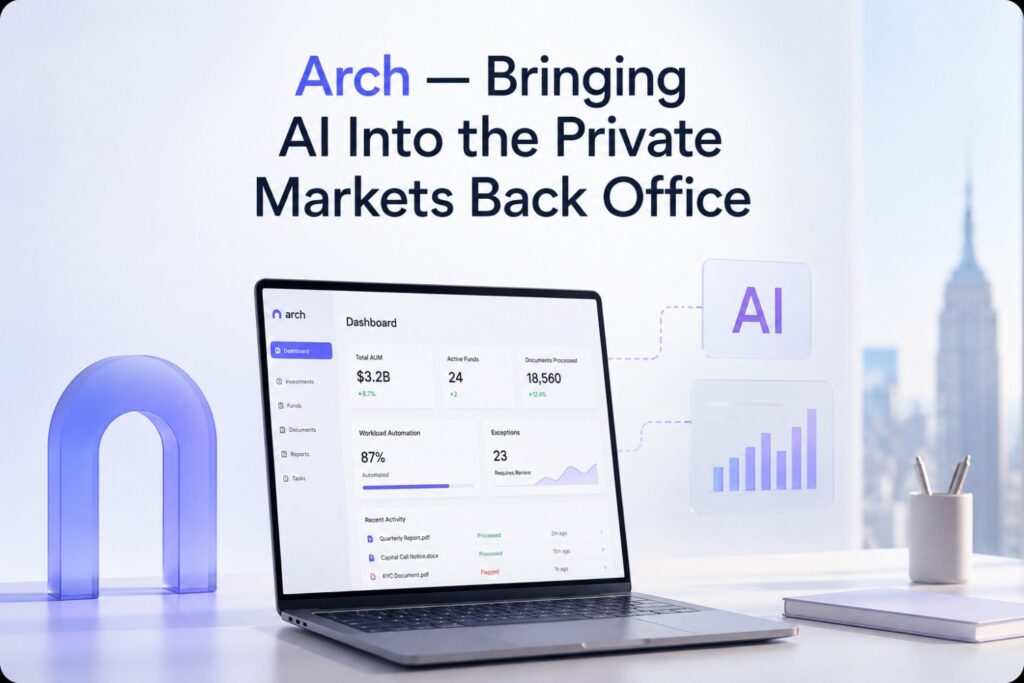
The New York company provides infrastructure for managing private investments, including documents, data and workflows. In July 2026, Arch said the amount of private-market assets represented on its platform had reached $539 billion, roughly double the previous year. It had previously raised a $52 million Series B.
This is exactly the kind of market where vertical AI can become powerful.
Private equity, venture capital, real estate, credit and other alternative investments generate huge volumes of statements, capital calls, tax documents, notices and portfolio information. Much of it has historically moved through email, PDFs and portals.
An AI system that can reliably organize that information is not simply saving clicks.
It can become infrastructure.
5. Alloy — AI Is Turning Fraud Prevention Into a Continuous Process
Alloy is one of the more established companies in the dataset.
It raised $100 million in a Series C in 2021 at a $1.35 billion valuation and later raised another $52 million. More importantly for the current AI story, Alloy reported in July 2026 that more than 900 financial institutions and fintech companies use its identity and fraud platform.
Alloy has been pushing beyond identity checks performed only when someone opens an account.
Its newer AI work focuses on continuously assessing risk across the customer lifecycle.
That change reflects a wider fintech trend. Fraud itself is becoming more automated, which means defense cannot depend entirely on static rules or isolated manual reviews.
The next generation of financial risk systems will probably need to observe behavior continuously and change their response as risk changes.
Alloy is positioned directly inside that transition.
6. Taktile — Automating the Decisions Banks Usually Treat as High Risk
Taktile is pursuing one of the hardest AI problems in finance: automated decision-making.
The company raised $110 million in Series C funding in June 2026, led by Goldman Sachs Alternatives. Its platform is designed for banks and insurers making decisions around underwriting, claims, onboarding and financial crime.
These are not low-risk tasks.
A wrong recommendation in a marketing system may hurt conversion.
A wrong lending, fraud or insurance decision can cost serious money and may create regulatory issues.
That is why Taktile’s emphasis on controlled and auditable AI is important.
The company says one large insurer is running several use cases with projected claims-processing efficiencies of more than $90 million.
If AI proves reliable enough in these environments, the impact could extend far beyond productivity.
It could reshape the economics of entire financial products.
7. Sixfold — Building an AI Underwriter
Sixfold is another good example of New York’s move toward industry-specific AI.
The company raised a $30 million Series B in 2026 to expand its AI underwriting platform. Sixfold says customers include Zurich North America, Guardian, AXIS and other insurers, and that its system has processed more than one million submissions across over 40 lines of business. Those insurers represent about $265 billion in gross written premium, according to the company.
Insurance underwriting is a strong AI use case because enormous amounts of information must be read before a decision is made.
The opportunity is not simply to make an underwriter type faster.
It is to give the underwriter a structured view of a risk that previously required reviewing emails, submissions, policy information and supporting documents one by one.
That is a far more valuable change.
8. Hebbia — Turning Mountains of Financial Documents Into Usable Work
Hebbia became one of New York’s most closely watched AI startups by attacking a simple but enormous problem: professionals have too much information to read.
The company raised a $130 million Series B in 2024 led by Andreessen Horowitz. Hebbia says its platform serves financial institutions and law firms and supports use cases spanning credit, advisory, real estate and asset management.
The company has continued changing its product as competition has grown. Its newer Matrix 2.0 includes an assistant capable of creating tables, reports and presentations while drawing from different information sources.
This competitive pressure is worth watching.
Basic document Q&A is becoming easier to copy.
The durable advantage may come from controlling the complete workflow: finding information, checking it, organizing it, calculating with it and turning it into a final work product.
9. Ocrolus — A Decade of Financial Documents Is Becoming an AI Advantage
Ocrolus has spent years solving a less glamorous problem: extracting usable information from financial documents.
That history may now be an important advantage.
The New York company raised an $80 million Series C in 2021, and its technology has been used by financial firms including PayPal, SoFi and LendingClub. More recently, Ocrolus has expanded into AI-driven mortgage and lending workflows.
One of the strongest assets in its current AI strategy may be data.
Ocrolus says its small-business cash-flow analytics have been trained using more than 15 million applications and are used by over 175 funders.
That demonstrates an important rule for financial AI.
Models alone rarely create a moat.
Years of labeled financial data, workflow knowledge and customer feedback can.
10. Hadrius — Compliance Is Becoming an Agentic Workflow
Compliance software is not usually the first category people imagine when they hear about billion-dollar AI markets.
That may be exactly why Hadrius is interesting.
The New York company announced $27 million in combined seed and Series A financing in July 2026, including a $22 million Series A. It says more than 500 firms use its platform, including organizations ranging from small registered investment advisers to very large financial institutions.
Hadrius uses AI agents across areas such as employee activity, marketing, communications, trading and compliance documentation.
The opportunity is enormous because compliance organizations often spend time looking for exceptions.
AI can inspect a much larger volume of activity and surface cases that deserve human attention.
If that works reliably, the compliance officer’s job changes from manually checking everything to supervising a system that checks everything.
11. Basis — Accounting Agents Are Moving From Demos Into Real Work
Basis is not a traditional Wall Street company, but it belongs in this dataset because accounting sits underneath nearly every financial decision.
The New York AI company raised $100 million in February 2026 at a $1.15 billion valuation. Its product is designed around AI agents that perform accounting work such as reconciliations, journal entries, tax workbooks and technical accounting tasks.
The significance is bigger than bookkeeping.
Accounting is full of rules, repeatable processes, supporting documents and review steps. That makes it well suited to long-running agents as long as humans can inspect and approve the work.
For fintech founders, Basis also points toward a major opportunity outside traditional banking.
The financial back office may be just as large an AI market as the financial front office.
12. Norm AI — Turning Regulation Into Software
Norm AI sits at the intersection of AI, regulation and financial services.
The company raised a $120 million Series C at a $1.2 billion valuation in July 2026, bringing total funding above $260 million. Investors include financial institutions and investment firms such as Blackstone, Vanguard, New York Life and TIAA.
Norm’s core idea is unusual.
Rather than simply asking a general model questions about regulations, the company aims to encode legal and regulatory requirements into agents that can perform regulated work.
This matters greatly in finance because regulation is not an extra layer added after a product is built.
It shapes the workflow itself.
Companies that can make rules machine-readable and executable may become important infrastructure as financial institutions deploy more autonomous systems.
13. Daloopa — AI on Wall Street Still Needs Reliable Numbers
Generative AI has created a new problem for financial institutions.
It can generate an answer quickly.
But is the number correct?
Daloopa is building the data layer underneath that question.
The New York company raised a $47 million Series C in May 2026, bringing total funding above $100 million. Daloopa provides source-linked financial data designed for investment research, modeling and AI workflows.
The company covers thousands of public companies and focuses heavily on traceability.
That may sound less exciting than an autonomous investment banker, but trustworthy data could be one of the most valuable pieces of the AI-finance stack.
An agent that reasons brilliantly from the wrong financial figures is still wrong.
Wall Street may therefore create huge demand for an entire layer of companies whose job is to make AI outputs auditable.
14. Farther — Wealth Management Becomes More Scalable When AI Handles Operations
Wealth management has always had a scaling problem.
Great advisers provide highly personal service, but human attention is limited.
Farther is trying to change that equation.
The New York wealth-management company raised $150 million in Series D financing in May 2026. At the time, it said recruited assets had passed $23 billion. Its platform combines advisers with technology for areas including portfolio management, risk, asset location and AI-driven insights.
This is an important business-model experiment.
If AI reduces the operational work required to serve each household, advisers may be able to support more assets without lowering service quality.
In that case, AI does more than reduce costs.
It changes the economics of a human-led financial business.
15. Finster AI — AI Infrastructure Designed Directly for Investment Banks
Finster AI is smaller than many of the companies above it, but it is unusually close to the Wall Street workflow.
The New York company builds AI for investment banking, asset management and financial research. A 2026 securities filing reported about $26.5 million raised toward a $34.5 million offering, while FactSet and UBS have both announced strategic involvement with the company.
FactSet also partnered with Finster to build AI-powered banking workflows.
That partnership is strategically important.
Startups do not always need to displace financial data incumbents.
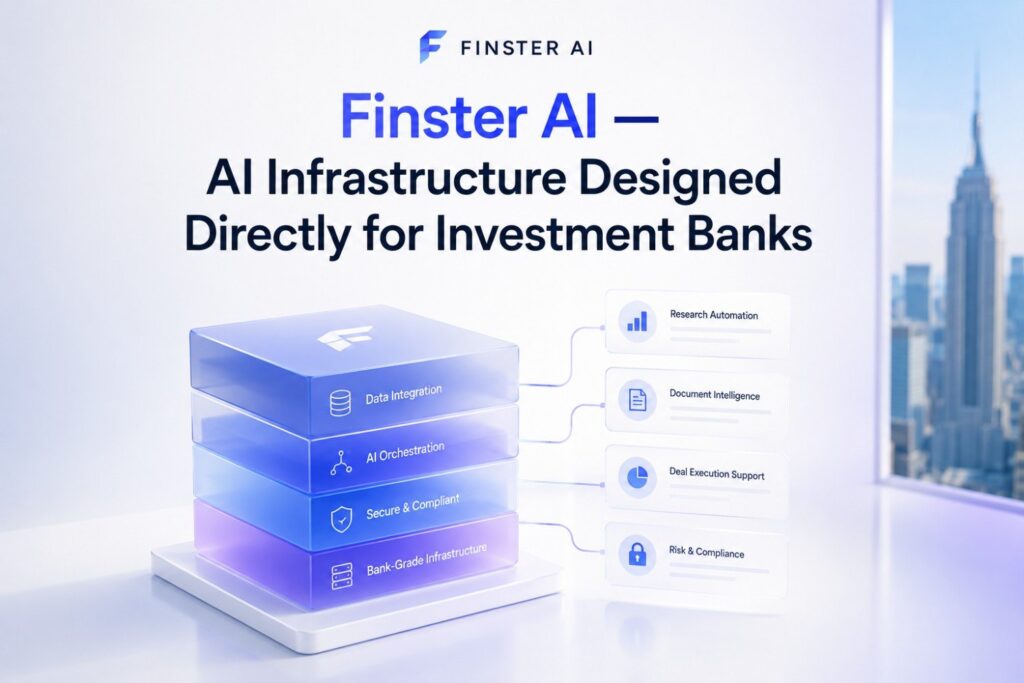
Some may become the AI execution layer that sits on top of established financial information platforms.
Finster is one of the companies testing that model.
16. Tabs — Revenue Operations Are Becoming Agentic
Tabs focuses on the finance work companies perform after they sell something.
The New York company raised a $55 million Series B in 2025 to expand its AI-powered billing and collections platform. At the time, it said it served more than 200 customers, had grown annual recurring revenue fivefold and was on track to automate more than $1 billion in annual invoice volume.
Billing looks simple until a company has complicated contracts, pricing structures, payment schedules and revenue-recognition rules.
Those details create exactly the kind of manual work AI can attack.
Tabs is therefore another example of the larger shift visible across our dataset.
The fastest-growing financial AI tools are often not generating new financial products.
They are rebuilding the machinery that runs existing businesses.
17. ToltIQ — Private Equity Due Diligence Is Becoming Software
Private equity diligence remains full of documents, spreadsheets, investment committee materials and repeated analyses.
ToltIQ is trying to automate that work.
The company, previously known as DiligentIQ, raised up to $12 million in Series A financing and has since expanded its AI-powered due-diligence platform. In 2026, it announced that H.I.G. Capital had selected the platform for firm-wide use and separately established a strategic relationship with PwC’s Deals practice.
This is a useful signal.
Private equity software becomes much more valuable when it captures how a firm evaluates investments rather than merely storing documents.
Over time, that can create something close to institutional memory.
A new deal can be evaluated not only against a generic model but against what the firm learned from dozens or hundreds of earlier transactions.
18. Concourse — AI Agents Are Entering the CFO’s Office
Concourse is building agents for corporate finance teams.
The New York company raised a $12 million Series A in January 2026. It says customers include large enterprises and fast-growing technology companies, while reporting 19-fold revenue growth and a 13-fold expansion in customers during the prior 12 months.
The product connects to systems such as accounting software, payment platforms and financial data sources so agents can perform analysis rather than operate as isolated chatbots.
That architecture makes sense.
Finance teams rarely need another place to type questions.
They need software that can pull information from the systems they already use, complete an analysis and explain how it reached the answer.
Concourse is betting that the agent becomes the interface connecting those systems.
19. Claira — Private Credit Is Becoming a Major AI Battleground
Private credit has grown into an enormous asset class, but many workflows remain dependent on manual deal review.
Claira is targeting that gap.
The New York company raised a $7 million seed round in 2025, co-led by Barclays, Citi and Reimagine Tech Ventures. Its platform is designed to help private credit funds, lenders and financial institutions analyze deals and reuse knowledge from previous transactions.
The size of the funding round makes Claira one of the smaller businesses in our ranking.
But the market could be much larger than its current scale suggests.
Private credit firms have proprietary underwriting frameworks, old deal files, credit agreements, internal memos and years of investment decisions.
Turning that history into searchable, usable institutional intelligence could create a very sticky product.
20. Ellis — AI-Native Infrastructure for Private Credit
Ellis is the youngest company in the core ranking, which is exactly why it is worth watching.
The New York startup emerged from stealth in 2026 with more than $10 million in seed funding. It is building an AI-native operating platform for private credit managers, with agents designed to work across documents, spreadsheets, correspondence and other fragmented data.
The company was founded by Ryan Williams, who previously helped build Cadre.
Ellis represents where the market may be heading next.
Instead of adding an AI assistant to an existing credit system, new companies can start with the assumption that agents will perform a significant share of the operating work from day one.
That creates a very different product architecture.
New York’s AI-Fintech Advantage Is Its Customer Density
It is tempting to explain New York’s AI-fintech rise entirely through venture funding.
That misses the more important advantage.
Customers are everywhere.
New York City had roughly half a million jobs in financial activities in mid-2025, including around 200,000 securities jobs. City forecasts also expected financial and securities employment to grow during 2026.
But the raw employment number does not fully capture the opportunity.
Financial companies in New York control trillions of dollars in assets and spend enormous amounts on research, compliance, operations, data and technology.
For an AI founder, that means product feedback can come directly from people doing the world’s most expensive financial work.
A startup can sit with bankers to understand how a pitch book is created. It can work with private equity firms on diligence. It can learn from compliance officers. It can hire former analysts, accountants, traders and underwriters.
Vertical AI improves when builders understand the details of the job.
New York supplies those details at extraordinary density.
Wall Street’s AI Winners Will Probably Own Workflows, Not Chat Windows
One of the clearest lessons from our dataset is that simple chat interfaces are unlikely to be enough.
Most leading companies are moving deeper into workflows.
AlphaSense is moving from information retrieval toward continuous research execution.
Rogo is expanding into end-to-end finance processes.
Taktile is targeting real decisions.
Hadrius is running compliance processes.
Tabs is automating billing.
Basis wants agents completing accounting tasks.
Ellis is building around private credit operations.
That progression is important.
A chatbot produces an answer.
A workflow system produces an outcome.
Financial institutions will pay far more for the second.
The Next Competitive Advantage Is Trust
Every founder building AI for finance eventually runs into the same problem.
Being impressive is not enough.
The system has to be trusted.
That creates several product requirements that matter more in finance than they do in many other AI markets.
Users need to know where numbers came from. They need to see the original source. They need permissions and security. They need audit trails. They need human approval at important points. They need systems that behave consistently.
This is why companies such as Daloopa focus heavily on source-linked data. It is why Taktile talks about controlled decisions. It is why finance-agent products emphasize enterprise security and traceability.
The winning financial AI company may therefore look less magical than a consumer AI demo.
That is a good thing.
In regulated industries, boring reliability can become an enormous competitive advantage.
Traditional Financial Data Companies Are Under Pressure
Another major battle is emerging around financial data.
For decades, Wall Street technology followed a fairly clear structure.
Data companies collected information.
Software companies helped users analyze it.
Humans did the final intellectual work.
AI is starting to compress those layers.
A system can now retrieve the underlying information, analyze it, compare it with previous work, create a table, draft commentary and eventually update the model or presentation.
AlphaSense is moving in this direction.
Daloopa wants to provide trusted data underneath those systems.
Rogo and Finster are attacking workflow execution.
Hebbia organizes and reasons across large document sets.
This means incumbents face a difficult question.
Do they remain data providers while AI companies control the user workflow?
Or do they build agents themselves?
The answer could reshape some of the most valuable software markets on Wall Street.
Private Markets May Be New York’s Most Underrated AI Opportunity
Several companies in our dataset cluster around private markets.
Arch handles private-market information and operations.
ToltIQ focuses on diligence.
Claira works on private credit intelligence.
Ellis is building private-credit infrastructure.
Rogo and Hebbia also serve deal professionals.
This concentration is not accidental.
Private markets are document heavy and relationship driven. Data is often spread across emails, PDF reports, portals, contracts, spreadsheets and internal systems.
That is painful for humans.
It is also fertile ground for AI.
Public equities already have highly developed data infrastructure.
Private markets often do not.

The company that turns fragmented private information into structured intelligence may therefore create more value than a company applying AI to an already automated market.
Compliance Could Become One of the Largest AI-Fintech Categories
Compliance usually grows when financial activity becomes more complex.
AI is making the environment much more complex.
Employees can generate more content. Fraudsters can produce more convincing documents. Financial companies are deploying more automated systems. Regulators still expect firms to understand and supervise what is happening.
That creates demand for AI on both sides.
Then they need AI to supervise AI.
Hadrius is moving into this market from financial compliance.
Norm AI is approaching the problem by turning rules into executable agents.
Alloy applies machine learning and agentic tools to identity and fraud.
Taktile provides systems for high-stakes financial decisions.
The result could be a new software category that barely existed several years ago: the AI governance and decision infrastructure layer for finance.
What Financial Institutions Should Learn From the NYC AI-Fintech Boom
Banks and investment firms should not start their AI strategy by asking which model they want.
They should start with work.
Look for a workflow where highly paid employees spend large amounts of time collecting information, moving data, checking documents or reproducing analysis.
Then measure it.
How many people touch the workflow?
How many hours does it consume?
What is the error rate?
What information is required?
Where does human judgment truly matter?
Where could AI complete a defined portion of the process?
This approach is far more useful than asking every department to experiment with a general chatbot.
The successful companies in our dataset are mostly selling measurable improvements to recognizable workflows.
Buyers should evaluate them the same way.
Do Not Measure AI Only by Headcount Reduction
The easiest business case for automation is reducing labor.
It is often the wrong starting point.
Consider an investment bank.
If an AI tool saves analysts three hours of document work, the bank does not necessarily need three fewer hours of labor.
It may use those hours to evaluate another client, complete another analysis or improve the quality of an existing deal.
The same applies in lending.
Faster document review can mean faster credit decisions and more applications processed with the same team.
In insurance, underwriting automation can increase the number of submissions an underwriter evaluates.
In compliance, automated review can expand the amount of activity a team can monitor.
Productivity is therefore only one part of the ROI.
Capacity, speed and decision quality matter too.
How to Evaluate an AI Fintech Startup Before Buying Its Software
The amount of funding a startup has raised tells you very little about whether its product will work inside your institution.
A better evaluation starts with evidence.
Ask the vendor to demonstrate a real workflow using realistic data. The demo should show where information comes from, how the AI handles conflicting sources, what happens when it is uncertain and where a human can intervene.
Then measure the workflow before deployment.
If a process currently takes four hours, record that baseline. If 12% of files require rework, record it. If three teams touch every case, document that as well.
Without the baseline, it is easy to buy an impressive AI product without ever knowing whether it created economic value.
Security and auditability deserve the same attention.
A financial AI product should not become a black box sitting between employees and important decisions.
The stronger architecture usually combines automation with evidence, controls and human review.
How Founders Can Build for Wall Street
The New York startups in this dataset suggest a repeatable strategy for founders.
Start narrower than feels comfortable.
Do not build “AI for banking.”
Build AI for commercial loan underwriting, private credit diligence, investment-banking research, adviser compliance, financial-document processing or another specific job.
The narrow market allows the product to learn the language, data and exceptions that matter.
Then expand along the workflow.
A startup that begins by extracting information from documents may eventually own underwriting.
A company that begins with research may expand into models and presentations.
A compliance tool may expand into the operating system through which regulated work is supervised.
The most valuable expansion usually happens by moving deeper into the customer’s existing job rather than sideways into unrelated features.
The Best AI Fintech Companies May Look Like Services Businesses at First
AI is also changing the old distinction between software and services.
Traditional software provides a tool.
Employees use the tool to do work.
AI increasingly allows the software itself to perform part of that work.
That changes what the customer is buying.
If a system performs 60% of a diligence process, the buyer is no longer comparing it only with other software licenses.
The buyer is comparing it with human labor.
This creates a much larger potential budget but also a much higher standard.
Software can occasionally be annoying.
A digital worker completing regulated financial work must be reliable.
That is why founders need deep domain knowledge, careful quality controls and close customer relationships even when the underlying technology is extremely sophisticated.
New York’s Biggest Advantage May Be Feedback Loops
Silicon Valley still has extraordinary advantages in foundational AI research, engineering talent and venture capital.
New York does not need to copy Silicon Valley to win in financial AI.
It can win differently.
A founder building a general model benefits from being close to AI researchers.
A founder building an AI private credit analyst benefits from being close to private credit professionals.
A company automating investment banking benefits from having investment bankers around.
A company building insurance underwriting AI benefits from understanding how underwriters actually think.
Those relationships create a feedback loop.
Financial experts explain the workflow.
Engineers build the product.
Customers test it.
Failures expose exceptions.
The product improves.
More customers arrive.
That cycle is particularly powerful in vertical AI because real-world edge cases matter so much.
New York has an extraordinary supply of those edge cases.
Chart 3: 2026 Is Accelerating the Market
Within our 20-company dataset, 14 companies have a reference financing round from 2026.
Those 14 rounds account for approximately $1.94 billion, or about 83.5% of all reference-round capital in the sample.
| Reference Round Year | Companies | Capital Represented |
| 2026 | 14 | ~$1.94B |
| 2025 | 3 | ~$74M |
| 2024 | 1 | $130M |
| 2022 | 1 | $100M |
| 2021 | 1 | $80M |
This does not prove that 83.5% of all NYC AI-fintech funding occurred in 2026. Our dataset intentionally selects leading active companies, so it is not a complete census of every fintech round.
What it does show is how recent the capital formation behind many of today’s strongest companies has been.
The acceleration is happening now.
AI Fintech Is Becoming Part of New York’s Broader AI Economy
The city is also seeing a wider wave of AI formation.
Tech:NYC reported that more than 240 NYC startups raised at least $1.13 billion in seed funding during the first half of 2026, with companies spanning AI, fintech, health, robotics, cybersecurity and other sectors.
Meanwhile, AlleyWatch’s 2026 finance funding index showed billions of dollars flowing into New York finance companies across more than 100 deals, including large rounds for Ramp, Rogo, Farther and other companies.
This matters because AI-fintech does not exist by itself.
The companies need machine-learning engineers, enterprise sellers, infrastructure providers, legal experts, cybersecurity teams, data specialists and investors.
As more of those people build careers in New York, the ecosystem becomes easier for the next founder to enter.
The Next Phase Will Be About Systems That Act
The first wave of generative AI in finance centered on questions.
“Summarize this document.”
“Find this number.”
“Explain this company.”
Those tasks were useful, but they still left most of the work with the employee.
The next phase looks different.
An agent could monitor a portfolio company, collect new information, update an analysis, identify changes, prepare a memo and notify the investment team.
Another could review loan documents, identify missing information, request documents and prepare a credit file.
Another could continuously monitor employee communications for compliance risks.
Another could reconcile accounting records and prepare proposed journal entries.
The difference is simple.
The AI does not just answer.
It acts.
That is why the companies moving deepest into real workflows deserve the most attention.
Wall Street Is Unlikely to Become Fully Autonomous
There is a temptation to take the agent story too far.
Finance is full of judgment.
Investment decisions involve uncertainty. Credit decisions can affect people’s businesses and lives. Compliance requires context. Wealth management depends on trust. Deals involve negotiation and relationships.
The most realistic near-term model is therefore not autonomous Wall Street.
It is AI-amplified Wall Street.
Humans will increasingly spend less time gathering and rearranging information.
They will spend more time reviewing, deciding, negotiating, advising and managing exceptions.
The startups that understand that division of labor may be more successful than companies promising to remove people entirely.
What NYC Tech Journal Will Be Watching Next
Three signals will matter most over the next several years.
The first is movement from pilots into production.
AI-fintech companies have no shortage of experiments. What matters is whether large institutions trust the technology enough to put it inside daily operations.
The second is expansion across workflows.
A company that owns one high-value task may eventually own several connected tasks. That is how a small vertical tool becomes a system of record or operating platform.
The third is measurable economics.

The strongest companies will increasingly disclose outcomes such as hours saved, cases processed, assets managed, financial decisions automated, conversion improved or losses reduced.
Funding gets attention.
Economic value builds companies.
Final Takeaway: New York Is Building the Intelligence Layer of Finance
The most interesting part of New York’s AI-fintech boom is not how many companies put the letters “AI” on their websites.
It is where they are going.
AlphaSense is moving from research toward execution.
Rogo and Finster are attacking investment-banking workflows.
Hebbia is organizing complex financial knowledge.
Daloopa is building trustworthy data infrastructure.
Taktile is automating decisions.
Hadrius and Norm AI are turning compliance into an agentic process.
Arch, ToltIQ, Claira and Ellis are rebuilding private-market workflows.
Sixfold is changing underwriting.
Basis, Tabs, Ramp and Concourse are pushing AI deeper into the finance office.
These companies are working on very different problems, yet they point toward the same future.
Financial software used to store information.
Then it helped people work with information.
The next generation will increasingly do the work itself.
New York is unusually well placed for that transition because it combines AI builders with one of the greatest concentrations of financial expertise and financial customers anywhere in the world.
Wall Street is not disappearing.
Its operating system is being rewritten.
And a growing share of that code is being written in New York.