
For more than a century, New York has been one of the most important advertising cities in the world. Madison Avenue became shorthand for the advertising business because New York brought major brands, media companies, publishers, creative talent, finance, fashion, entertainment, and some of the world’s largest agencies together in one place.
Artificial intelligence is now changing that system from almost every direction. AI can write copy, create images, edit video, study customer behavior, find audiences, adjust media bids, summarize research, build campaign variations, answer customer questions, and help decide where marketing dollars should go.
That does not mean Madison Avenue is about to disappear. It means the work that made Madison Avenue valuable is being reorganized, and some parts of the traditional agency model are becoming less important while other parts are becoming much more valuable.
Routine advertising production is getting cheaper. Brands can create more versions of campaigns, platforms can automate decisions that once required specialists, and internal marketing teams can complete tasks that previously had to be outsourced. At the same time, companies have a growing need for people who can decide what to say, understand customers, connect complicated data, protect brands, measure real business results, and decide where money should be invested.
The result is a very different advertising economy. AI makes it easier to produce advertising, but it also makes great advertising harder to manage because companies suddenly have far more choices, data, channels, creative variations, and automated decisions to control.
To understand what this shift means for New York, NYC Tech Journal examined public labor data, industry research, agency financial reports, major advertising-platform changes, and employment patterns across several marketing-related occupations. We also created our own analysis of New York metro employment data to see whether the structure of marketing work is already changing.
Our findings suggest that New York is not simply moving from human advertising toward machine-made advertising. Instead, the city appears to be moving from an industry centered heavily on producing campaigns toward one increasingly focused on designing, directing, measuring, governing, and improving marketing systems.
That distinction may determine what happens to Madison Avenue over the next decade.
The Short Version: AI Is Moving Deeper Into Advertising
The first wave of generative AI in advertising was easy to understand because the tools produced visible things. A marketer could enter a prompt and create a headline, picture, storyboard, email, social post, presentation, or rough video in seconds.
The more important shift is now happening behind the creative output. AI is moving into media planning, audience selection, search advertising, personalization, measurement, customer conversations, ecommerce, campaign optimization, and decisions about how marketing budgets should be distributed.
Google’s Performance Max already uses machine learning across bidding, audience signals, creative combinations, attribution, and placement across several Google services. Google’s newer AI Max capabilities are pushing automation further by allowing AI to expand search matching, adapt advertisements, and select landing pages that may better match what a customer wants.
Meta is moving in a similar direction. Its Advantage+ products automate parts of audience selection, placement, bidding, and creative development, while its newer business-focused AI tools are moving toward product recommendations, lead qualification, appointment booking, customer conversations, and sales support.
These changes matter because agencies are no longer simply using AI as another productivity tool. They are increasingly operating inside advertising platforms that are themselves performing work that agencies used to sell as specialist expertise.
| Part of advertising | Traditional model | AI-heavy model emerging now |
| Research | Teams manually gather and summarize information | AI processes large amounts of information while humans interpret meaning |
| Strategy | Planning happens in fixed cycles | Planning becomes more continuous and connected to live data |
| Copywriting | Teams create a limited number of options | AI creates many variations that humans refine and test |
| Design | Designers manually adapt assets | Systems generate, resize, and adapt many versions |
| Video | High production costs limit experimentation | More video variations can be produced and tested |
| Media buying | Specialists make many daily adjustments | Platforms automate more bidding, targeting, and allocation |
| Measurement | Reports mainly explain past performance | Systems increasingly recommend future actions |
| Search | Brands optimize mainly for traditional search engines | Brands must consider search engines and AI-generated answers |
| Customer response | Advertising and customer service remain separate | Marketing, commerce, messaging, and AI agents begin to overlap |
| Agency value | Labor and production capacity | Judgment, data, strategy, systems, measurement, trust, and business outcomes |
The biggest threat to a New York advertising agency is therefore not that an AI tool can write a headline. The deeper threat is that the client, the agency, and the media platform may eventually have access to similar creative and optimization technology.

When basic production becomes widely available, agencies have to prove that their decisions are better.
NYC Tech Journal Original Research: How We Studied New York’s Advertising Shift
To move beyond broad predictions, NYC Tech Journal examined public employment data covering several occupations closely connected with advertising and marketing in the New York metropolitan area. Our goal was not to claim that every job change was caused by AI, but to understand whether different layers of advertising work were already moving in different directions.
We used U.S. Bureau of Labor Statistics Occupational Employment and Wage Statistics data from 2018, 2023, and 2025. We then compared employment levels across occupations that represent management, research, marketing operations, advertising leadership, and creative production.
Why We Studied Occupations Instead of Only Advertising Agencies
Advertising work is no longer concentrated inside businesses officially classified as advertising agencies. A marketing manager might work for JPMorgan Chase, a fashion company, a software startup, a hospital, a retailer, a media company, a professional-services business, or an agency.
Occupational data therefore provide a wider view of the New York marketing economy. This approach helps us understand how the type of work being performed may be changing, even when the employer itself is not classified as part of the advertising industry.
Our research used several types of public information.
| Dataset or source | How it was used |
| BLS OEWS May 2018 | Pre-generative-AI employment baseline |
| BLS OEWS May 2023 | Early generative-AI-era comparison |
| BLS OEWS May 2025 | Latest available New York metro employment picture |
| BLS Occupational Outlook Handbook | National projections and comments on automation |
| IAB industry research | AI adoption, media spending, video, measurement, and consumer attitudes |
| Agency financial reports | Evidence of organizational and technology investment |
| Google and Meta product updates | Evidence of advertising-platform automation |
There are important limits to this analysis. The latest BLS New York metropolitan area includes New York City as well as surrounding counties, so the figures should be understood as a New York metro study rather than a five-borough-only analysis.
Metro definitions and BLS methods can also change over long periods. For that reason, our 2018-to-2025 comparison is best treated as directional evidence rather than a perfect apples-to-apples measurement of every job in exactly the same geographic area.
Most importantly, we do not assume that generative AI caused every employment change. Digital media, automation, agency consolidation, offshoring, changing client behavior, economic cycles, self-service platforms, and in-house marketing teams were already changing the advertising business before ChatGPT became widely used.
That context makes the findings more useful rather than less useful. AI appears to be accelerating a structural transformation that was already taking place.
Original Finding #1: New York Still Has an Unusually High Concentration of Marketing Leaders
The first major finding is easy to overlook because so much discussion around AI focuses on layoffs and automation. New York still has an extraordinary concentration of senior marketing and advertising roles.
BLS data for May 2025 estimated roughly 54,730 marketing-manager jobs in the New York metropolitan area. Their location quotient was 2.27, which means marketing managers made up more than twice the share of employment in New York that they did nationally.
Advertising and promotions managers were even more concentrated. Their location quotient was 2.77, while public relations managers also appeared at levels well above the national employment share.
New York’s Marketing Leadership Density
| Occupation | NY metro employment, May 2025 | Location quotient | Mean annual wage |
| Advertising and promotions managers | 3,630 | 2.77 | $202,940 |
| Marketing managers | 54,730 | 2.27 | $207,770 |
| Public relations managers | 7,940 | 1.74 | $208,800 |
New York’s wider creative economy also remains unusually large. Arts, design, entertainment, sports, and media occupations account for a larger share of employment in the New York metro than they do across the country as a whole.
This matters because New York’s advantage has never depended only on the number of people who can physically produce an advertisement. The city’s deeper strength comes from having brands, agencies, publishers, investors, strategists, artists, executives, technology companies, retailers, producers, journalists, designers, and cultural institutions operating close to one another.
AI can distribute production capacity around the world. Reproducing an entire business and cultural ecosystem is much harder.
Original Finding #2: New York Advertising Employment Is Moving in Two Different Directions
The employment data becomes more interesting when different marketing occupations are compared over time. Our analysis found very different trends depending on whether a role sits closer to marketing leadership, market analysis, advertising management, or creative execution.
NYC Tech Journal compared four occupations using BLS employment estimates from 2018, 2023, and 2025. The result suggests that New York’s marketing labor market is not moving uniformly in one direction.
The New York Marketing Labor Shift
| Occupation | 2018 employment | 2023 employment | 2025 employment | Approx. change, 2018–2025 |
| Marketing managers | 24,300 | 46,610 | 54,730 | +125.2% |
| Market research analysts and marketing specialists | 69,230 | 81,100 | 79,290 | +14.5% |
| Advertising and promotions managers | 6,640 | 3,960 | 3,630 | -45.3% |
| Graphic designers | 22,250 | 19,050 | 15,160 | -31.9% |
The difference between the categories is striking. Marketing-manager employment more than doubled across the comparison period, while market research and marketing-specialist employment also remained higher than it was in 2018.
Graphic-design employment moved in the opposite direction. Advertising and promotions managers also declined sharply during the period, although changes in industry structure and occupational definitions mean those numbers should not be interpreted as a pure measure of AI disruption.
Chart 1: Approximate Employment Change From 2018 to 2025
Marketing managers +125% █████████████████████████
Market research / marketing +15% ███
Graphic designers -32% ██████
Advertising & promotions managers -45% █████████
The direction matters more than any single percentage. Higher-level marketing management and analytical work have remained strong, while some execution-heavy and narrower advertising occupations have faced considerably more pressure.
The 2023-to-2025 Period Shows a Similar Divide
The shorter period covering the early mainstream generative-AI era also produces an interesting pattern. Marketing-manager employment increased by roughly 17%, while market research and marketing-specialist employment remained broadly stable.
Advertising and promotions management declined, while estimated graphic-designer employment fell more sharply. Two years is not enough time to claim that generative AI caused these movements, but the differences are worth watching.
Chart 2: Approximate Employment Change From 2023 to 2025
Marketing managers +17.4% █████████
Market research specialists -2.2% █
Advertising & promotions managers -8.3% ████
Graphic designers -20.4% ██████████
The pattern fits a broader economic idea. When software makes repeatable production faster, the number of people required for routine execution can decline even if the total amount of marketing activity increases.
At the same time, businesses still need people who allocate budgets, understand markets, coordinate teams, interpret data, manage brands, and take responsibility for major decisions. AI may change how those people work without removing the need for their judgment.
Original Finding #3: The Advertising Bottleneck Is Moving From Production to Decision-Making
Consider a campaign that needs 20 media formats, five customer groups, and three main message ideas. Even before changing photography, headlines, offers, calls to action, language, geography, or products, that campaign already creates 300 possible combinations.
Under the traditional advertising model, production cost naturally limited how many versions could be made. It was expensive and slow to ask copywriters, designers, photographers, producers, editors, and media teams to develop hundreds of polished variations.
Generative AI weakens that constraint. A company may soon be able to generate hundreds or thousands of technically acceptable creative variations without needing a huge increase in production staff.
The problem then changes. Instead of asking whether the team can produce 300 advertisements, marketers have to decide which 300 deserve to exist, who should see them, which messages fit the brand, which claims are legally safe, which versions are genuinely different, and which ones improve business results rather than simply generating more clicks.
This is one of the most important economic changes AI creates for Madison Avenue. The bottleneck gradually moves away from making things and toward choosing, testing, controlling, and measuring them.
Chart 3: Where the Advertising Bottleneck Is Moving
TRADITIONAL MODEL
Idea → Production ████████████████████ → Distribution → Measurement
Main bottleneck
AI-HEAVY MODEL
Idea → Production ███ → Selection ███████ → QA ███████ → Measurement ███████████
New bottlenecks
The agency that understands this shift has a better chance of protecting its value. Future clients may not need an agency because they cannot produce enough content, but they may desperately need one because they cannot decide what content to produce, how to test it, and what the results actually mean.
Video Advertising Shows How Quickly Production Economics Are Changing
Video provides one of the clearest examples of what happens when creative production becomes cheaper. Historically, high production costs naturally limited the number of finished video advertisements a company could create.
Generative AI changes that equation. Industry research from IAB found that the large majority of advertising buyers were already using or planning to use generative AI in video advertising, with buyers expecting AI-assisted creative to account for a significant share of future video advertisements.
This does not mean every major television commercial will suddenly be created entirely by machines. A brand may still hire directors, actors, photographers, editors, designers, and sound teams for its most important creative work.
What changes is everything that can happen around that original production. AI can help create storyboards, test scenes, change backgrounds, build shorter edits, produce localized variations, translate content, resize assets, adapt product shots, test different openings, and create social versions at a much lower cost.
The high-end human production can therefore become the starting point for a much larger content system rather than one finished advertisement.
What Becomes Cheaper and What Becomes More Valuable
| Likely to become cheaper or faster | Likely to become more valuable |
| First drafts | Original insight |
| Basic image variations | Creative direction |
| Resizing and formatting | Brand systems |
| Content versioning | Taste and judgment |
| Transcription | Cultural understanding |
| Early translation | Local review |
| Background replacement | Rights management |
| Basic copy alternatives | Distinctive brand voice |
| Routine desk research | Proprietary information |
| Campaign summaries | Experiment design |
| Mechanical optimization | Causal measurement |
| Reporting production | Business interpretation |
| Simple audience expansion | First-party customer knowledge |
The important conclusion is not that creativity becomes unnecessary. Instead, AI is likely to make average-looking creative work abundant, which may actually increase the value of distinctive ideas.
If every competitor can produce polished images and acceptable copy, the company with stronger taste, sharper cultural understanding, clearer positioning, and more memorable ideas may become easier to notice.
Original Finding #4: Advertising Platforms Are Becoming More Like Automated Agencies
One of the largest threats to traditional agency economics does not come from a small AI startup. It comes from the major platforms where advertising money is already being spent.
Google, Meta, Amazon, TikTok, and other advertising companies have spent years automating campaign management. Generative AI now gives them another way to reduce the amount of manual work required from advertisers and agencies.
Google Performance Max already uses automation across bidding, audience signals, creative combinations, attribution, and multiple Google properties. Newer AI-focused search products move further by allowing systems to expand matching, adjust creative, and help determine which landing page is most appropriate.
Meta’s advertising products are following a similar path. Advantage+ automates parts of targeting, placements, bidding, and creative optimization, while Meta is also moving AI into conversations between businesses and customers.
The result is important for Madison Avenue because the platforms are steadily reducing the technical difficulty of operating sophisticated campaigns.
The Agency’s Old Technical Advantage Is Getting Smaller
Paid-search advertising provides a useful example. Agencies once created significant value by knowing how to structure campaigns, organize keywords, adjust bids, choose match types, create variations, and manually monitor thousands of changes.
Those skills still matter, but many mechanical parts of the job are becoming automated. The agency therefore has to move toward questions that a single platform cannot answer fairly or completely.
Should the client invest another $5 million in paid search at all? Would some of those customers have purchased anyway? Is the company paying to reacquire customers it already owns? How much profit remains after discounts, returns, shipping, and customer-service costs?
The larger question is how Google, Meta, Amazon, TikTok, creators, email, television, retail media, PR, events, organic search, and AI discovery should work together. A platform can optimize activity inside its own system, but a strong agency can help optimize the business across systems.
That independent view may become one of the agency’s most important advantages.
Advertising Spending Can Rise Even While Advertising Labor Becomes More Productive
AI is entering an advertising market that remains enormous. Digital advertising spending continues to grow, and newer channels such as connected television, commerce media, social advertising, and retail media continue attracting large budgets.
That matters because growing advertising spending does not automatically mean advertising employment will grow at the same rate. Technology can allow the industry to manage more media, more creative, more customers, and more campaigns without increasing headcount proportionally.
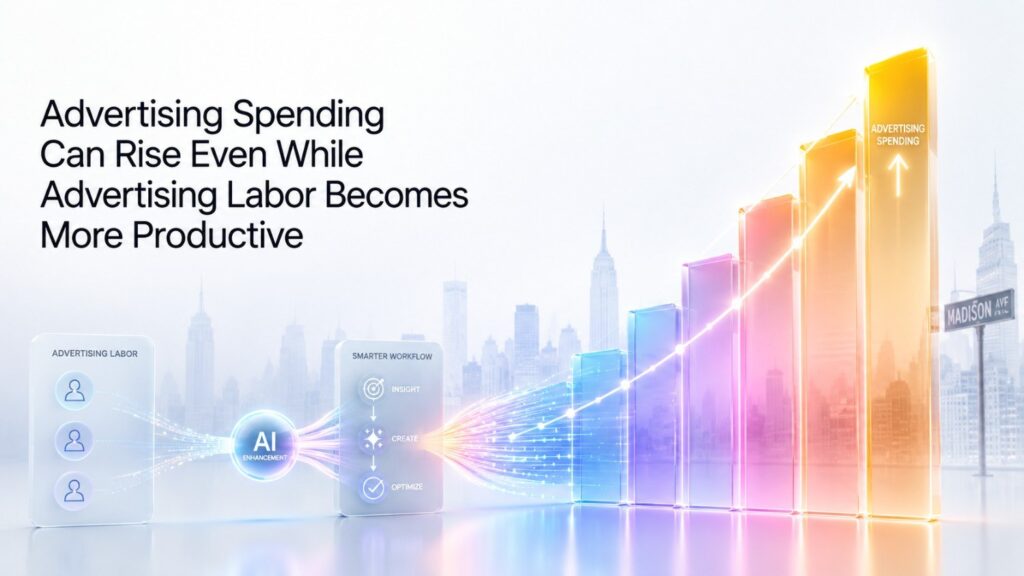
A brand may therefore spend more money on advertising while using fewer people for repetitive campaign tasks. The amount of marketing activity can grow at the same time that the labor required for each individual advertisement falls.
Chart 4: The New Advertising Equation
MORE MEDIA SPEND
+
LOWER COST PER CREATIVE VERSION
+
MORE AUTOMATED CAMPAIGN MANAGEMENT
=
MORE ADVERTISING DECISIONS PER EMPLOYEE
This is why productivity should be at the center of the Madison Avenue conversation. The question is not simply whether AI removes jobs, but how much more advertising activity one team can manage once routine production and optimization become faster.
The next question is even more important: who captures the economic value created by that productivity?
Madison Avenue’s Largest Holding Companies Are Becoming Technology Systems
If AI were simply another software tool, large advertising groups could buy licenses and continue operating almost exactly as they did before. The actual changes taking place are much deeper.
Major agency groups are reorganizing platforms, production, data, operations, and client services around AI. They increasingly want shared systems that can connect many agencies and disciplines instead of allowing each team to work through separate processes.
Omnicom and IPG Show How Consolidation Fits the AI Era
One of the largest structural changes in advertising came through Omnicom’s acquisition of Interpublic. The deal combined two giant networks whose agencies have long played major roles in the New York advertising market.
The importance of this kind of consolidation goes beyond company size. Large networks increasingly need significant investment in data, engineering, AI tools, production systems, identity technology, measurement, and shared infrastructure.
Scale makes it easier to spread those costs across thousands of clients. It also gives holding companies more reasons to connect creative, media, commerce, production, data, and analytics through one shared operating layer.
The traditional holding company mainly owned multiple agency brands. The emerging holding company also wants to own the systems connecting those brands.
WPP Is Moving Toward a More AI-Native Operating Model
WPP provides another example of how the traditional agency network is changing. Its strategy increasingly focuses on WPP Open, a shared platform designed to connect creative, media, production, data, and other marketing services.
The direction is significant because AI is not being placed in one experimental department. The goal is to make AI part of everyday work across the company and create a more connected operating model.
This approach is likely to spread. Agencies that maintain dozens of isolated tools, databases, production processes, and reporting systems may find it increasingly difficult to compete with firms that can connect them.
Stagwell Shows How Agency Networks Can Move Toward Products
New York-based Stagwell offers another model. The company has invested in proprietary technology and AI systems while also growing software-like marketing products.
That approach matters because software economics are different from service economics. A traditional agency often needs to add more employees as the amount of client work increases, while software can sometimes serve more customers without increasing headcount at the same rate.
A future advertising company may therefore earn money from a combination of consulting, creative work, media, data, software, and intellectual property rather than relying mainly on billable labor.
Madison Avenue Is Gradually Becoming an Operating-System Business
The classic agency model was organized around departments. Strategy created the brief, creative developed ideas, production made the assets, media distributed them, analytics measured performance, and account teams coordinated the relationship.
AI increasingly cuts across all of those departments. A customer-data system may identify an opportunity, an AI tool may suggest an audience, a creative system may produce variations, a media platform may decide which version to show, and measurement data may automatically influence the next round of decisions.
As that system becomes more connected, the workflow can become more important than the department.
Traditional Agency Structure Versus an AI-Native Workflow
| Traditional sequence | AI-native sequence |
| Annual or quarterly brief | Continuously updated market signals |
| Research presentation | Searchable intelligence layer |
| Creative concept | Human concept supported by brand rules and generation systems |
| Production request | Automated or semi-automated production pipeline |
| Media plan | Continuously optimized allocation |
| Campaign launch | Ongoing experimentation |
| Monthly report | Continuous measurement |
| Retrospective | Results feed into future decisions automatically |
Specialists will not disappear simply because the workflow becomes connected. Their role changes because they enter the process where their judgment creates the most value.
Strategists can spend less time building research slides and more time deciding what the research means. Designers can spend less time manually creating dozens of file sizes and more time building the visual rules that guide an entire campaign system.
Analysts can spend less time preparing monthly reports and more time determining whether marketing genuinely increased sales or profit. The agency becomes more valuable when its people use AI to remove low-value work rather than simply produce more output.
Creative Agencies Will Need to Sell Taste Instead of Volume
Generative AI creates an uncomfortable situation for creative agencies because it can produce work that looks polished without being especially memorable. A campaign can be grammatically correct, visually attractive, technically on-brand, and completely easy to ignore.
As more companies use similar models, the market could become flooded with competent advertising. Producing another acceptable image or headline will not create much advantage if every competitor can do the same thing.
This is where creative judgment becomes more important.
Distinctiveness Becomes Scarcer Than Production
When almost anyone can produce a clean product image, producing the image itself becomes less valuable. Knowing what kind of image could make someone stop, remember the brand, and feel something becomes more important.
The same principle applies to copy. If a marketing team can generate 100 headlines in a minute, the advantage is no longer the ability to produce 100 headlines.
The advantage is understanding which promise the brand can own, which customer tension matters, which words sound different from competitors, and which idea is strong enough to survive repeated exposure.
New York may have a strong advantage in this environment because advertising sits inside a much larger cultural system. Fashion, Broadway, finance, art, publishing, music, television, sports, luxury, technology, food, and entertainment constantly influence one another across the city.
AI can learn patterns from culture after those patterns already exist. Agencies that remain close to people creating new culture may still help brands recognize important shifts before those shifts become obvious training data.
Media Agencies May Face an Even Larger Change Than Creative Agencies
Creative AI receives more public attention because people can immediately see an AI-generated image or video. Media automation may have an even larger effect on agency economics because much of the work happens quietly inside platforms.
Advertising buyers are already interested in systems that can automate campaign execution and media decisions. At the same time, marketers are placing greater importance on cross-platform measurement because each advertising platform naturally presents its own view of performance.
Those two changes are closely connected. The more execution becomes automated, the more valuable independent measurement becomes.
Media Planning Starts to Look Like Capital Allocation
The future media strategist may look less like someone operating advertising software and more like someone allocating investment capital. The central question becomes where the next dollar should go and why.
Should additional budget go to Google, Meta, TikTok, Amazon, YouTube, connected television, creators, retail media, events, sponsorships, email, direct mail, or customer retention? Each platform has an incentive to recommend more spending inside its own ecosystem.
Clients therefore need an independent layer that can compare those options using the same business objectives. This could become one of the strongest long-term roles for media agencies.
The agency does not create the most value by clicking buttons inside the platform. It creates value by deciding when the platform should be trusted and when the client should do something different.
Measurement May Become One of the Most Valuable Advertising Services
AI makes it easier to optimize whatever goal a platform provides. The problem is that the platform’s goal may not be the same as the company’s real business goal.
A platform might report strong purchase performance while giving itself credit for customers who were already planning to buy. A campaign might produce cheap leads that never become paying customers, while a promotion might increase revenue but reduce profit because discounts become too aggressive.
As execution becomes easier, independent measurement becomes more important. Agencies that can prove which advertising caused additional business may become more valuable than agencies that simply report what a platform dashboard says.
New York agencies should therefore invest more heavily in incrementality testing, marketing-mix modeling, experiment design, customer economics, clean data, and financial analysis.
The strongest agencies will move beyond saying that return on ad spend increased. They will help clients understand how much additional profit advertising created that would not otherwise have existed.
AI Search Is Pulling Advertising, SEO, PR, and Content Together
Search marketing is changing from two directions at the same time. AI is changing how advertisements are managed inside traditional search platforms, while AI-generated answers are changing how consumers discover information before clicking a website.
This matters because brands can no longer think about search only as a ranking problem. AI systems may use information from company websites, product pages, media coverage, reviews, structured data, forums, publishers, and many other sources when generating an answer.
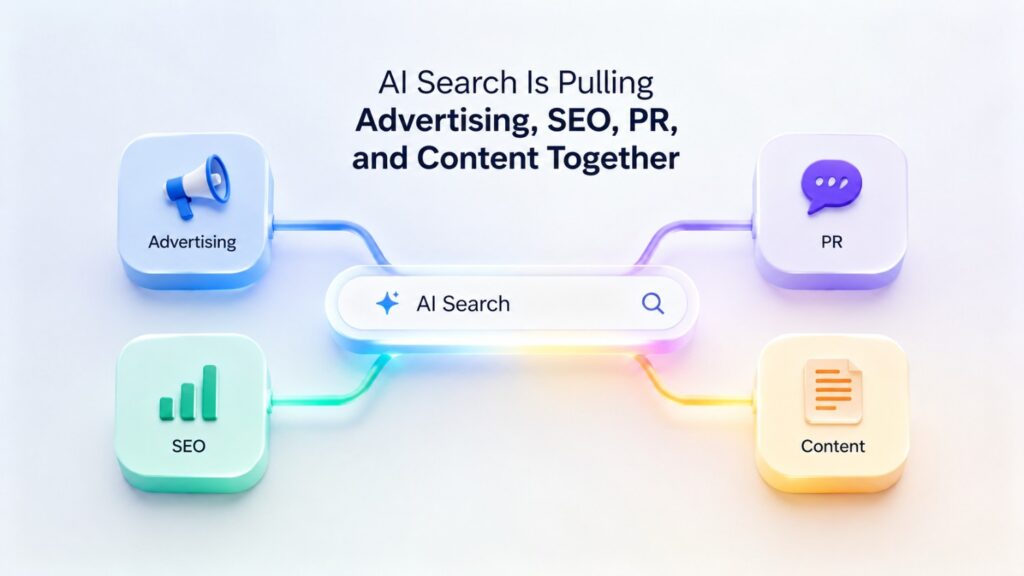
That pulls several marketing disciplines closer together. Paid search, SEO, content marketing, public relations, reputation management, ecommerce information, and brand publishing increasingly influence the same discovery journey.
The New Question Is Whether Machines Can Understand and Trust the Brand
Brands will need information that is clear, consistent, accurate, useful, and supported across multiple sources. Companies with confusing product information, contradictory facts, weak third-party coverage, and thin owned content may become harder for AI systems to understand.
This creates a major opportunity for New York agencies. Teams that once operated separately across PR, SEO, media, content, ecommerce, and brand strategy may need to work together around AI discovery.
The agency that helps a company become understandable to both customers and machines could create value well beyond traditional search optimization.
Original Finding #5: The Most Exposed Tasks Are Not Always the Most Exposed Jobs
One of the biggest mistakes in discussions about AI and employment is asking whether AI can perform an entire job. Most jobs contain many different tasks, and those tasks do not have the same level of exposure to automation.
A creative director may brainstorm ideas, judge work, manage teams, present to executives, protect a brand, negotiate with partners, understand cultural risk, and make final decisions. AI may help with several parts of that job without being capable of replacing the entire role.
NYC Tech Journal therefore created an editorial Advertising AI Exposure Matrix. This is not a government forecast and should not be read as a prediction of layoffs.
Instead, we assessed types of advertising work using four broad factors: how repetitive the task is, whether it takes place entirely in digital systems, how easily quality can be checked, and how much human trust or responsibility is required.
NYC Tech Journal Advertising AI Exposure Matrix
| Type of work | Automation potential | Human judgment requirement | Likely direction |
| Asset resizing and formatting | Very high | Low | Heavily automated |
| Basic copy variations | Very high | Medium | AI-first, human-reviewed |
| Transcription and summaries | Very high | Low | Mostly automated |
| Routine campaign reporting | Very high | Medium | Strong automation |
| Basic media optimization | High | Medium | Increasingly platform-led |
| Desk research | High | Medium | AI-assisted |
| Performance analysis | High | High | AI-assisted, analyst-owned |
| Market research interpretation | Medium-high | High | Human judgment remains important |
| Brand strategy | Medium | Very high | AI-assisted |
| Creative direction | Medium | Very high | Human-led |
| Client leadership | Low-medium | Very high | Human-led |
| Cultural judgment | Medium | Very high | Human-led |
| High-stakes claims approval | Medium | Very high | Human accountability |
| Experiment design | Medium | Very high | Human-led with AI support |
| Crisis communications | Medium | Very high | Human-led |
| Final budget allocation | Medium-high | Very high | AI-assisted but human-accountable |
The matrix makes the junior-talent question especially important. Many traditional entry-level agency tasks involve collecting references, resizing assets, summarizing meetings, cleaning information, creating first drafts, preparing reports, and building routine presentation materials.
These tasks are particularly easy to accelerate with AI. That creates a productivity opportunity, but it also creates a training problem that agencies will need to solve deliberately.
Madison Avenue Has a Junior-Talent Problem to Solve
Advertising has traditionally trained people through work that was useful but not always exciting. Junior planners gathered research before learning how to interpret markets, while designers created variations before becoming responsible for larger visual systems.
Junior media buyers managed smaller campaigns before controlling large budgets. Account executives tracked projects and wrote notes before eventually leading major client relationships.
AI can now perform or accelerate much of that early-stage work. Agencies could respond by reducing junior hiring, but that approach creates a long-term problem because senior talent has to come from somewhere.
A better solution is to redesign junior roles around supervised judgment. New employees can become involved earlier in research interpretation, customer interviews, experiment design, creative review, AI quality control, data analysis, and client discussions.
They still need structured training, but the training should focus less on performing repetitive tasks slowly and more on understanding why decisions are made.
An agency that uses AI only to remove junior employees may reduce costs in the short term. Several years later, it may discover that it has also weakened its future leadership pipeline.
New Roles Will Grow Around the Problems AI Creates
Advertising agencies do not need to invent strange job titles simply to appear modern. They do, however, need people who can take ownership of responsibilities that did not previously exist at the same scale.
An AI marketing operations lead, for example, could connect models, client data, brand rules, approvals, and campaign workflows. A content-systems designer could decide how thousands of AI-assisted assets remain visually consistent.
Measurement specialists may become more important because clients need independent testing. Rights and provenance specialists may also grow in importance as agencies manage questions about model outputs, training sources, voices, likenesses, photography, ownership, and approved use.
The common feature is responsibility. Companies will pay for people who can safely turn AI capability into repeatable business outcomes.
Agency Pricing Will Need to Change
AI creates a serious problem for advertising agencies that depend heavily on hourly billing. If a job once required ten hours and AI allows the same agency to complete better work in two hours, charging purely for time can punish the agency for becoming more productive.
Clients will also resist paying yesterday’s production prices for work they know can now be produced faster. This does not mean every service must immediately switch to performance-based pricing, but it does mean agencies need a clearer explanation of what clients are buying.
How Agency Economics Could Change
| Old pricing logic | Emerging pricing logic |
| Hours worked | Outcomes delivered |
| Number of assets | Value of the system or program |
| Production markup | Technology or platform fee |
| Large project team | Smaller senior team supported by AI |
| Individual campaign | Continuous optimization |
| Fixed deliverable | Ongoing experiment program |
| Media execution labor | Measurement and allocation expertise |
| Custom work every time | Reusable proprietary IP |
Performance pricing also has limits because agencies do not control every factor that affects business results. Product quality, inventory, pricing, economic conditions, sales teams, customer support, and competitor behavior can all influence revenue.
The important change is that agencies should charge for the value they create rather than automatically tying value to the number of labor hours required.
If a client is paying for a better decision, the agency should not measure that decision by the number of slides used to explain it.
AI Will Make Small Agencies Much Stronger Competitors
The technology disrupting large agencies also lowers the cost of starting a smaller one. A team of five specialists can now perform research, create concepts, produce variations, build reports, analyze campaigns, write simple code, automate operations, and prepare client materials at a scale that once required far more people.
This could be especially important in New York, where talented employees have historically left large agencies to start specialized firms. AI reduces the operational cost of making that move.
The strongest new agencies may be extremely focused. One could specialize in AI discovery for financial companies, while another focuses on creative systems for luxury brands or measurement for retail media.
Another might build an entire practice around regulated healthcare advertising. Smaller agencies will not have the resources of global networks, but they can compete through deep expertise and speed.
Large agencies gain advantages from scale. Small agencies gain advantages from specialization, and AI strengthens both.
The Middle of the Agency Market May Face the Greatest Pressure
A global holding company can spread the cost of technology, data, engineering, and AI infrastructure across thousands of clients. A small specialist can stay lean and win because it solves one difficult problem extremely well.
The most difficult position may belong to agencies that are neither large nor strongly differentiated. If their main value is producing normal digital advertising with normal talent using the same tools available to everyone else, clients have little reason to accept premium pricing.
This could create a more barbell-shaped market.
Chart 5: A Possible Future Agency Market
VALUE
High ████████ ████████
Specialist Scaled
expertise platforms
+ focus + data
Low ███████
Generic
execution
Small Mid-market Large
SCALE
This chart is a strategic model rather than a forecast of how many agencies will survive. Its purpose is to show why AI can benefit both highly specialized firms and very large networks while making generic execution more difficult to defend.
Agencies in the middle will need to decide what they want to become. Remaining average is likely to become an increasingly expensive strategy.
Brands Will Bring More Work In-House, but Agencies Will Still Matter
AI makes in-house marketing more practical because internal teams can complete a wider range of work without hiring the same number of specialists. Self-service media platforms, generative creative tools, analytics systems, and AI agents all make this easier.
The trend does not mean every company should build a giant internal agency. In-house teams have their own weaknesses because they can become too close to the organization and may struggle to challenge internal assumptions.
They may also lack exposure to enough industries, campaigns, and experiments to recognize wider changes quickly. Highly specialized talent can also be difficult to justify internally when a company only needs that expertise several times a year.
The future agency therefore becomes valuable for different reasons. Clients may hire agencies less because they physically cannot perform the work themselves and more because they need outside judgment, specialist talent, cross-client learning, independent measurement, and a perspective that internal teams cannot easily create.
Consumer Trust Could Become an Advantage for Responsible Agencies
Advertising executives often appear more optimistic about AI-generated advertising than consumers. Industry research has shown a meaningful gap between how marketers believe people feel about AI advertising and how consumers actually describe their reactions.
That gap should concern brands that focus only on reducing production costs. If AI makes an advertisement cheaper but also makes customers trust the brand less, the company has not improved efficiency.
It has simply found a cheaper way to create weaker advertising.
Quality Has to Become an AI KPI
Marketing teams should therefore track much more than money saved or content produced. They need to understand how AI-assisted work affects attention, brand memory, consideration, conversion, customer satisfaction, distinctiveness, and profit.
They should also monitor factual mistakes, strange imagery, unsupported claims, cultural errors, bias, rights issues, and complaints. A production system that creates ten times more content but requires constant correction may not actually be more efficient.
The strongest agencies will treat quality control as part of the system rather than something added at the end.
AI Governance Is Becoming Normal Advertising Infrastructure
As AI moves deeper into advertising, agencies need clear rules for how it can be used. Those rules should not exist only inside a legal document that most employees never read.
Governance needs to become part of everyday production. Teams should know which models can be used, what client information can enter them, which data must remain private, what source material is allowed, and when a human must approve the output.
Agencies also need clear rules around factual claims, likenesses, voices, copyrighted material, disclosure, and record keeping. If an AI-generated advertisement creates a legal or reputational problem, someone must know who approved it and how it was created.
The agencies that solve these problems without making every campaign painfully slow will have an advantage with large clients.
New York’s Regulated Industries Create a Major Responsible-AI Opportunity
New York agencies operate close to industries where advertising mistakes can become extremely expensive. Finance, insurance, healthcare, pharmaceuticals, legal services, and other regulated sectors all have major operations in the region.
These companies cannot simply generate thousands of claims and allow algorithms to run whichever version receives the highest click-through rate. The cost of an unsupported statement can be far higher than the value of faster production.

This creates an opportunity for controlled generation. AI systems can be limited to approved claims, legal language, product facts, brand terminology, audience rules, and specific review processes.
The most valuable agency may not be the one that promises unlimited content. It may be the one that can increase production dramatically while keeping the company inside clearly defined boundaries.
What New York Agencies Should Build Now
A company-wide message telling everyone to “use more AI” is not a strategy. It usually creates scattered experiments, duplicate software subscriptions, inconsistent quality, and little competitive advantage.
Agencies should instead identify repeated client problems where AI can improve speed, quality, insight, or economics in a measurable way.
A Practical Agency AI Investment Framework
| Question | Weak response | Strong response |
| What problem are we solving? | “We need an AI strategy.” | “Client localization takes 12 days; reduce it to two while maintaining quality controls.” |
| What is proprietary? | Access to a public model | Data, workflows, benchmarks, expertise, templates, and integrations |
| Where is the human needed? | “Human in the loop” | Clearly defined approval and decision points |
| How do we measure value? | Hours saved | Faster launches, higher conversion, lower waste, better quality, fewer errors |
| How will it scale? | Individual employee prompts | Repeatable workflow |
| What stops competitors copying it? | Nothing | Data, domain knowledge, integrations, and accumulated learning |
| Who owns risk? | Unclear | Defined reviewer and escalation process |
A public AI model is not a meaningful competitive advantage because every competitor can usually access the same model. The advantage comes from everything an agency builds around it.
That might include proprietary data, strong workflows, integrations, evaluation methods, brand knowledge, industry expertise, or years of structured campaign learning.
Proprietary Data May Become One of the Most Important Agency Assets
When every agency has access to powerful AI models, access itself stops being special. Data and accumulated knowledge become more important.
That does not simply mean buying more third-party audience information. Agencies can create value by organizing first-party customer data, historical campaign results, creative performance, brand research, sales outcomes, search behavior, customer-service questions, geographic differences, product economics, and experiment results.
An agency that has spent ten years learning what influences luxury buyers could possess something valuable if that knowledge has been carefully structured. If the same knowledge exists only inside scattered presentations, old emails, and forgotten folders, it is much less useful.
The difference comes from turning experience into infrastructure.
Every Agency Needs a Creative Evaluation System
Generation receives most of the attention because people can see the output. Evaluation is more important because evaluation determines which output should actually reach customers.
Agencies should develop explicit systems for reviewing AI-assisted creative. A strong process can check whether the asset follows brand rules, uses approved claims, appears visually accurate, suits the audience, differs meaningfully from other versions, and supports a real marketing hypothesis.
Important work should still receive human review. The goal is not to automate judgment entirely but to make judgment more consistent.
Without a strong evaluation system, agencies risk using AI to produce thousands of pieces of content that nobody needed.
Brands Need to Change the Way They Brief Agencies
Clients also need to adapt because traditional briefs often focus too heavily on deliverables. A request for ten social posts, five banners, three videos, and two landing pages defines the amount of content before the team has established what the company actually needs to learn.
An AI-native brief should begin with the business problem. The client might want to increase first-time purchases among younger New York customers without increasing acquisition cost, for example.
That type of objective allows the agency to develop hypotheses, create variations, run experiments, measure results, and adjust investment based on evidence. It also prevents AI from becoming a machine for generating content without purpose.
The future brief should describe the problem clearly enough that creative, media, data, and AI systems can work toward the same outcome.
A Practical 90-Day AI Roadmap for New York Agencies
Agencies do not need to rebuild their entire business in one quarter. They do need to stop treating AI as a side experiment that employees explore individually whenever they have spare time.
A focused 90-day program can identify where genuine value exists.
| Period | Main objective | Practical output |
| Days 1–15 | Map the work | Document common workflows, cost, time, error rate, and business value |
| Days 16–30 | Rank opportunities | Identify repetitive, high-volume tasks with clear quality checks |
| Days 31–45 | Build controlled pilots | Automate two or three useful workflows |
| Days 46–60 | Measure results | Compare speed, quality, cost, results, and errors with the old process |
| Days 61–75 | Add governance | Define data rules, approvals, disclosure, and escalation |
| Days 76–90 | Productize what works | Turn successful experiments into repeatable client services |
Measurement is the most important part of this process. If a workflow becomes 60% faster but requires so much checking that total improvement is only 10%, the agency should report the 10% rather than celebrating the larger number.
The same principle applies to creative volume. Producing 100 times more advertisements creates no value if performance stays the same and the marketing team cannot review the output effectively.
A Practical 90-Day AI Roadmap for New York Brands
Brands should perform a similar review, but they need to answer a different question. They should identify which parts of agency spending buy genuine outside expertise and which parts mainly pay for repeatable production that technology can now reduce.
The next step is deciding what belongs inside the company and what should remain with outside partners.
| Area | Build or keep internally when… | Use an agency when… |
| Brand knowledge | It is core institutional knowledge | Outside perspective is valuable |
| Routine production | Volume is constant and predictable | Needs vary or require specialist talent |
| Media execution | Team has scale and platform expertise | Independent cross-platform strategy is needed |
| Measurement | Internal analytics teams are mature | Independent testing or advanced analysis is needed |
| Creative strategy | Internal creative culture is strong | Fresh thinking and cultural expertise matter |
| AI governance | Enterprise rules need central ownership | Agency must apply rules inside production |
| Specialist campaigns | Work repeats constantly | Need is occasional or highly specialized |
The objective should not be maximum in-housing. It should be clear ownership of the capabilities that matter most.
A company that brings everything inside without enough expertise can create just as many problems as one that outsources everything.
How New York Advertising Jobs Are Likely to Change
Most advertising roles will probably change gradually rather than disappear overnight. AI will remove or accelerate certain tasks while leaving other responsibilities firmly in human hands.
Copywriters may spend less time producing ten routine headline variations and more time developing a distinctive voice, interviewing customers, refining concepts, and creating the main idea from which many versions can be generated.
Designers may spend less time on resizing and repetitive execution while moving toward art direction, brand systems, motion, experiences, and visual quality control. Strategists can spend less time collecting information and more time interpreting it.
Media specialists may move away from manual campaign mechanics and toward cross-platform allocation, experimentation, measurement, and platform governance. Account leaders may become more valuable because clients need someone who can connect creative, technology, data, media, finance, and risk.
This fits the wider pattern visible in our New York labor analysis. The strongest pressure appears around repeatable execution, while higher-level marketing coordination and decision-making remain highly valuable.
What Happens to Madison Avenue’s Creative Culture?
One risk of algorithmic advertising is that campaigns become more similar. If every brand uses comparable models trained on comparable historical data and optimized toward similar platform goals, marketing may slowly converge toward whatever has already performed well.
The industry could become extremely efficient at producing variations of yesterday.
That creates an opportunity for New York’s creative culture. The role of a great creative agency may increasingly be to introduce ideas that an optimization system would not naturally discover from past performance.
A campaign could use an unusual visual language, an unexpected partnership, a surprising piece of humor, a new cultural observation, or a physical experience that looks risky in historical data but creates attention precisely because it is different.
AI works exceptionally well when the objective is clear and the data contains useful patterns. Advertising often creates its greatest value by changing the pattern rather than following it.
The Future Agency May Have Fewer Management Layers
Traditional agencies accumulated layers partly because coordinating information required people. Account managers, project managers, department heads, specialists, analysts, production teams, and executives all helped move work through complicated organizations.
AI can reduce some of that coordination cost. Meeting summaries can be generated automatically, project information can become searchable, routine requests can be routed automatically, and campaign performance can be monitored continuously.
That may allow smaller senior teams to supervise much larger amounts of work. It could also lead to flatter organizations with fewer roles built mainly around moving information from one team to another.
For employees, this makes expertise more important. A role based primarily on transporting information becomes harder to defend when software can transport the information instantly.
People who interpret, challenge, approve, decide, persuade, or take responsibility remain much harder to replace.
The Future Agency Will Become More Technical
Advertising companies have described themselves as technology businesses for many years. AI may finally force them to operate like technology businesses in practice.
An AI-native agency needs people who understand APIs, data architecture, model evaluation, privacy, workflow automation, customer databases, experimentation, and software integration. That does not mean every copywriter or art director has to become a programmer.
It does mean creative and technical teams need to work much more closely. A campaign may increasingly be a system containing customer data, creative rules, models, measurement logic, workflows, and hundreds of generated assets rather than one fixed advertisement.
Technical literacy becomes part of the agency’s operating model rather than a service offered by one specialist department.
New York Could Benefit From Advertising and Software Moving Together
New York has an important advantage because it is no longer only an advertising and media center. It also has a large technology ecosystem, major enterprise-software businesses, AI startups, venture investors, ecommerce companies, and one of the world’s most important financial sectors.
That creates natural opportunities for advertising talent and software talent to mix.
Some of the next important Madison Avenue companies may not look like traditional agencies at all. One could resemble a software company staffed with strategists, while another might look like a measurement company with creative talent.
Another could combine media buying with proprietary AI agents. Others may blend consulting, production, data, search, public relations, and software into completely new business models.
The boundary between marketing services and marketing technology is likely to become increasingly difficult to see.
Original Finding #6: Madison Avenue’s Real Competitive Advantage Is Moving Up the Value Chain
When our labor analysis is combined with changes in agency structure and advertising platforms, a consistent pattern begins to appear.
AI reduces the cost of routine production while platforms automate more operational decisions. Brands bring some work in-house, and large networks respond by building common technology, data, and production systems.
At the same time, companies face more possible messages, more customer segments, more channels, more data, and more automated decisions than ever before.
The value therefore moves upward toward the areas where judgment matters most.
Chart 6: NYC Tech Journal’s Madison Avenue Value Migration Model
HIGHER VALUE
Business growth strategy
▲
Budget allocation
▲
Measurement + experiments
▲
Brand / creative direction
▲
Data + customer intelligence
▲
AI workflow orchestration
▲
Creative production
▲
Asset formatting / routine execution
LOWER DIFFERENTIATION
This does not mean everyone in advertising needs to become a strategist. It means specialists will increasingly need to understand the decision their work improves.
A designer who can explain how a visual system improves recognition is more valuable than someone who only delivers files. An analyst who can determine whether advertising created incremental profit is more valuable than someone who simply builds dashboards.
A media buyer who knows when to challenge a platform’s attribution is more valuable than one whose expertise is limited to adjusting campaign settings.
AI raises the value of people who can connect their specialist knowledge to larger business decisions.
What Madison Avenue Could Look Like by 2030
The most likely future is not one giant AI system replacing New York’s advertising industry. A more realistic outcome is a market that becomes both more automated and more fragmented.
Large holding companies will operate shared AI, data, media, and production systems across many agency brands. Specialist independents will use similar underlying technologies to compete with companies many times their size.
Brands will perform more execution themselves, while advertising platforms automate more of the buying and optimization process. At the same time, clients will continue facing problems that technology does not automatically solve.
Companies will have too much content, too many channels, conflicting measurement systems, complicated customer data, changing discovery behavior, legal risk, short-term sales pressure, and a constant need to build brands that remain valuable over many years.
AI gives companies more capability, but greater capability also creates more complexity.
Someone still has to make sense of that complexity.
That is where Madison Avenue can remain important.
The Agencies Most at Risk
The agencies facing the greatest pressure will be those whose value can mainly be described as access to labor. If the pitch is that the agency has people who can create banners, write standard copy, prepare reports, resize assets, manage routine paid-media settings, and convert briefs into predictable deliverables, clients now have far more alternatives.
That work will not disappear immediately, but pricing pressure is likely to increase as the production process becomes easier.
The problem becomes even greater when an agency uses public AI tools behind the scenes but continues charging as though every step requires the same amount of manual work as it did five years ago.
Clients will eventually recognize the difference. Agencies therefore need to move their value proposition away from the amount of labor consumed and toward the quality of the outcome produced.
The Agencies Most Likely to Win
The strongest New York agencies will combine several abilities that are difficult for clients to purchase separately. They will understand the client’s business, possess useful proprietary knowledge, produce strong creative work, connect customer data, understand AI systems, measure real impact, manage rights and risk, and know when an algorithm is pushing the company in the wrong direction.
They will also turn repeated expertise into intellectual property.
That IP could be software, a measurement method, a testing system, an industry dataset, a workflow, a benchmark, a model-evaluation framework, or a deeply developed process for solving a specific type of problem.
The exact format matters less than the principle. Every successful client engagement should leave the agency smarter than it was before.
If every project starts from zero, too much of the agency’s learning is being lost.
What New York Business Leaders Should Do Now
The wrong question for a chief marketing officer is whether AI can replace part of the agency. That question encourages short-term cost reduction without considering where the savings should be reinvested.
A better question is which parts of the marketing system should become dramatically cheaper and where the company can use the savings to create a stronger advantage.
If localization becomes cheaper, the company might enter more markets. If creative production becomes faster, the team might run more controlled experiments rather than simply producing more content.
If reporting requires fewer analyst hours, analysts can spend more time understanding profitability and customer behavior. If routine media management becomes automated, specialists can concentrate on cross-platform allocation and measurement.
Productivity creates the most value when the company reinvests it intelligently.
What Advertising Professionals Should Do
People working in New York advertising should not spend the next decade trying to outperform machines at the tasks machines perform best. Competing on the speed of first drafts, basic summaries, file resizing, or routine reporting is unlikely to create a durable career advantage.
A stronger path is to become excellent at framing problems, evaluating outputs, understanding customers, creating original ideas, working with data, connecting disciplines, communicating clearly, and taking responsibility for outcomes.
AI literacy will still be essential. A creative professional who refuses to use modern tools may become slower than colleagues, while a strategist who blindly trusts AI output may become less reliable.
The advantage comes from knowing where AI should be trusted, where it should be questioned, and where a human needs to make the final decision.
The Biggest Opportunity Is Better Decisions, Not More Automated Advertising
Madison Avenue originally became powerful because companies needed help navigating a complicated new mass-media economy. Businesses had products to sell, national markets to reach, newspapers and television channels to understand, customers to study, and brands to build.
The technologies changed repeatedly, but the underlying need remained.
AI creates another version of the same problem. Companies can suddenly generate more content than employees can review, while media platforms can make more decisions than executives can personally inspect.
Customer data can create more possible segments than planning teams could ever manage manually. AI-generated answers can change how brands are discovered before marketers even understand how their companies are being represented.
More capability produces more complexity, and greater complexity increases the need for good judgment.
That may become the most valuable part of Madison Avenue’s future.
Conclusion: Madison Avenue Is Not Disappearing. Its Job Is Changing.
New York advertising is entering a period in which physically producing an advertisement may become one of the least difficult parts of advertising. The harder work will involve deciding what deserves to be produced, what customers actually care about, where money should go, how results should be measured, and how brands can remain distinctive in a world filled with machine-generated content.
Our analysis of New York metro employment data already shows very different pressures across marketing occupations. Marketing management remains unusually concentrated and has expanded substantially across our comparison period, while some creative and traditional advertising roles have moved in the opposite direction.
Those changes cannot be attributed to AI alone. Digital platforms, self-service advertising, consolidation, in-housing, globalization, automation, and economic shifts were changing the industry long before generative AI became mainstream.
AI is now accelerating many of those trends.
The largest agency networks are responding by building shared technology systems, connecting data, centralizing parts of production, investing in AI, and reorganizing how client work moves through their companies. Small specialist agencies are gaining powerful tools that allow tiny teams to compete far above their weight.
Clients are gaining more control over execution, while Google, Meta, and other platforms continue automating tasks that once required specialist agency labor.
Yet the human part of advertising does not automatically become less important because machines become more capable. In many areas, it becomes more valuable because the number of possible decisions increases dramatically.
Companies will still need people who understand what customers care about and what a brand should represent. They will need people who can tell the difference between a technically polished advertisement and a genuinely memorable idea.
They will need independent experts who can challenge platform data, measure incremental business results, protect customer trust, manage legal risks, and decide whether an automated recommendation actually makes sense.
They will also need people who are willing to take responsibility when the machine is wrong.
Madison Avenue therefore does not need to defend every task from automation. It needs to move toward the parts of advertising where human and business judgment matter most.
The old Madison Avenue became famous for making advertisements.
The next Madison Avenue may become valuable for something much bigger: deciding what marketing should do, building the systems that make those decisions possible, and proving whether those decisions actually worked.