

Fashion has always moved quickly in New York, but artificial intelligence is making the industry move at a pace that would have seemed impossible only a few years ago. A trend can appear on a Manhattan runway, spread across social media that evening, influence buyers the next morning, and start shaping product ideas before the week is over. AI is now shortening that cycle even further by helping fashion companies move from an idea to a visual concept, a product decision, a marketing asset, or a customer recommendation much faster than before.
The biggest change, however, is not simply that designers can type a prompt and generate an image of a dress. That is only one small part of a much wider shift taking place across the fashion business. AI is beginning to influence almost every stage between the first design idea and the moment a shopper decides whether to buy.
New York startups are using AI to turn sketches into realistic product images, help merchandising teams build thousands of outfit combinations, improve online product search, create digital wardrobes, power virtual styling, automate clienteling, generate product photography, and help brands prepare for a future in which AI shopping assistants may influence what consumers purchase.
This matters because New York remains one of the world’s most important fashion centers. NYCEDC says the city’s fashion industry generated roughly $8 billion in economic impact in 2024 and supported about 32,200 jobs under its current definition of the sector. New York is also home to thousands of fashion companies and a dense network of designers, retailers, showrooms, manufacturers, agencies, investors, schools, photographers, stylists, and technology businesses.
At the same time, the industry is under significant pressure. Research published by the Partnership for New York City and McKinsey found that the city’s fashion sector had lost tens of thousands of jobs over the previous decade while economic output declined. High operating costs, changing consumer habits, ecommerce competition, global manufacturing shifts, and rising customer acquisition costs have made efficiency more important than ever.
That is why the current AI boom deserves more attention than another passing technology trend. The most useful question for New York fashion leaders is not whether AI can create impressive images. The better question is where AI can remove slow and expensive work without removing the human taste, judgment, creativity, cultural awareness, and brand identity that make fashion valuable in the first place.
Our research suggests that many New York startups are beginning to answer that question.
AI in Fashion Is Moving Far Beyond Image Generation
The easiest way to understand what is happening is to stop thinking about fashion AI as one product category. There is no single technology that can be described simply as “fashion AI” because different forms of artificial intelligence are entering different parts of the industry and solving very different problems.
A designer may use one system to turn a rough sketch into a realistic image. A merchandising team may use another system to decide which shoes, pants, and accessories should appear beside that product online. A customer may use a conversational shopping assistant to discover the item, while the retailer uses another AI platform to decide which marketing message should be shown to that customer later.
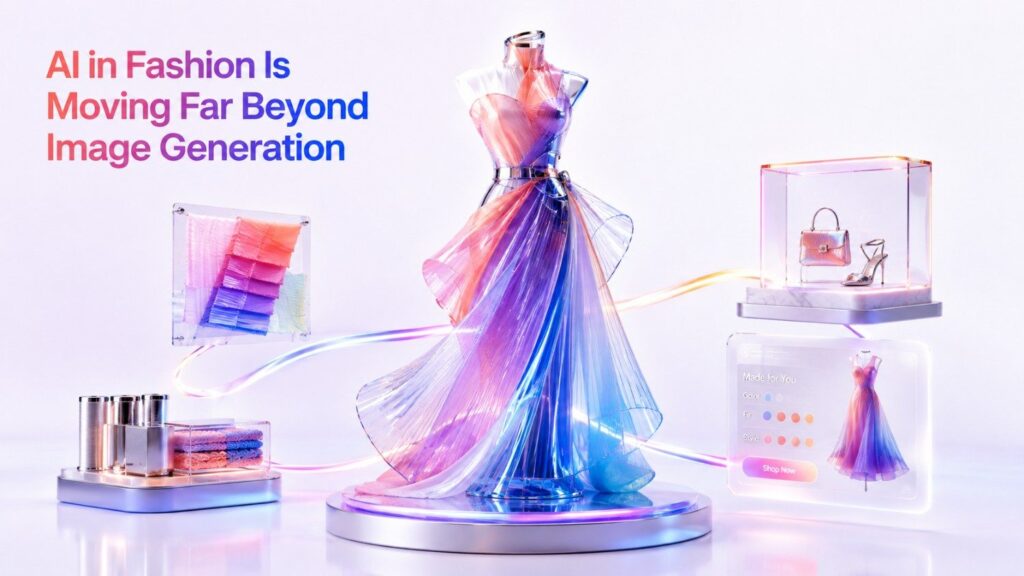
AI is therefore becoming part of the operating system of fashion rather than one isolated tool.
Where AI Is Entering the Fashion Value Chain
| Fashion workflow | Traditional challenge | How AI is changing the process |
| Trend and concept development | Research and ideation can take significant time | AI can organize inspiration and generate concepts quickly |
| Design visualization | Teams often need several rounds before judging an idea properly | AI can turn rough concepts into realistic product visuals |
| Sampling | Physical samples require time, materials, labor, and shipping | Digital visualization can eliminate some unnecessary samples |
| Creative production | Every product requires photography, styling, editing, and campaign assets | AI can generate visual variations at much greater scale |
| Merchandising | Teams manually build outfits and product combinations | AI can automate compatible looks and recommendations |
| Product search | Keyword search struggles with vague fashion intent | Conversational AI can understand occasions, style, fit, and context |
| Personalization | Many shoppers still see similar recommendations | AI can build more detailed individual style profiles |
| Clienteling | Ecommerce lacks the guidance of a strong store associate | AI can answer product and styling questions conversationally |
| Virtual try-on | Shoppers find it difficult to judge products online | AI can visualize garments and looks before purchase |
| Customer retention | Marketing often relies on broad audience groups | AI can predict which products may interest individual customers |
| Circularity and returns | Returned and used items are expensive to process | AI can improve sorting, classification, resale, and routing |
This wider view is important because the economic value of AI may not come from the most visually impressive application. A fashion company can save substantial money even when the AI output is invisible to the customer.
For example, reducing unnecessary sampling could be more valuable than generating a campaign image. Improving product discovery could produce more revenue than creating thousands of social posts. Automating routine merchandising may have a larger financial impact than building a flashy consumer chatbot.
The strongest business cases tend to appear wherever AI reduces the distance between information and a useful decision.
Why New York Is Such an Important Test Market for Fashion AI
New York has an advantage that many technology centers cannot easily copy because a major fashion industry operates beside a major technology ecosystem. That proximity creates opportunities for startups to build software around real fashion problems rather than assumptions about how the industry works.
Fashion AI companies need more than strong engineers. Their systems have to understand how designers develop products, how merchants select assortments, how ecommerce teams manage large catalogs, how luxury brands protect their identity, how stores serve customers, and how consumers describe clothes when they do not know the exact product name.
New York gives startups unusually close access to all of these groups.
Fashion and Technology Talent Exist in the Same Market
Within a relatively small geographic area, founders can meet fashion designers, buyers, retailers, stylists, photographers, ecommerce executives, manufacturers, investors, luxury groups, agencies, and AI researchers. That makes it easier to test products against real operating conditions.
The relationship between fashion and AI became even more formal when the CFDA and OpenAI launched a two-year Innovation Hub in 2026. The initiative was designed to connect AI developers with fashion brands so that new technology could be tested against actual industry workflows rather than developed separately from the people expected to use it.
The first group of developer finalists included companies such as Alta, Cadenova, Curbon, O.Studio Design, OpenStudio, and New York-based Raspberry AI. Participating fashion brands included alice + olivia, Araks, Public School, Rebecca Minkoff, Simkhai, and Tory Burch.
That development is significant because it shows that fashion companies are moving beyond general conversations about artificial intelligence. They are beginning to test specific AI products inside design, production, merchandising, shopping, and customer experience workflows.
New York’s High Costs Also Create Strong Incentives
New York is an expensive place to operate a fashion business. Creative labor, studio production, photography, physical samples, showrooms, office space, retail locations, marketing, logistics, and customer acquisition can all carry substantial costs.
Those economics create a strong reason to remove repetitive work wherever possible.
The purpose does not need to be replacing a designer, stylist, merchant, or salesperson. A more useful application might be helping a designer avoid spending hours producing several nearly identical mockups or allowing a merchandising team to create thousands of sensible product combinations without manually styling every SKU.
When AI removes repetitive work while preserving human judgment, the economics become much more attractive.
NYC Tech Journal Original Research: Mapping New York’s Fashion AI Market
To understand where the market is actually developing, NYC Tech Journal created a focused dataset of companies operating at the intersection of artificial intelligence, fashion, ecommerce, merchandising, creative production, and shopping.
The purpose was not to build another generic directory of startups. Instead, we wanted to identify where investors are placing capital, which fashion workflows are attracting the most AI development, and what those patterns reveal about where companies believe the largest commercial opportunities may exist.
Our Research Methodology
We reviewed publicly available company announcements, funding releases, startup websites, major technology publications, CFDA material, New York economic data, investor announcements, and retail research available through August 2026.
Companies were included when they met two primary conditions. They needed a meaningful connection to New York or the city’s fashion technology ecosystem, and artificial intelligence had to be central to the company’s product rather than a minor feature added to otherwise conventional software.
For our recent funding analysis, we created a narrower group of seven AI-native companies that announced meaningful financing rounds during 2025 or the first half of 2026. Their products directly affect fashion design, visual production, shopping discovery, wardrobe intelligence, ecommerce conversion, virtual clienteling, or agentic commerce.
The seven-company funding sample includes Raspberry AI, Alta, Remark, Phia, Flock AI, Vêtir, and Nudge.
We used publicly announced round sizes rather than estimated valuations or unconfirmed funding numbers. This approach avoids mixing confirmed investment data with speculative private-market estimates and makes the comparison easier to reproduce.
The funding figures should therefore be treated as a focused indicator of where investor interest is building rather than a measurement of the entire New York fashion AI market.
The Broader New York Fashion AI Landscape
| Company | Main AI opportunity | Public market signal |
| Raspberry AI | Fashion design and product development | $24M Series A announced in 2025 |
| Daydream | Conversational fashion search | $50M seed round |
| Phia | AI shopping and price intelligence | $35M Series A announced in 2026 |
| Alta | AI wardrobe and personal styling | $11M seed round |
| Stylitics | Automated outfitting and merchandising | About $100M total funding reported after Series C |
| FindMine | Automated styling and complete-the-look merchandising | Works with large fashion retailers |
| Remark | AI clienteling and virtual try-on | $16M Series A announced in 2025 |
| Flock AI | AI-generated visual commerce | $7.5M total funding after 2026 seed financing |
| Vêtir | AI luxury wardrobe and shopping | $5.5M Series A first close |
| Nudge | Infrastructure for AI shopping discovery | $1.1M pre-seed financing |
| Bluecore | Retail personalization and customer intelligence | More than $225M in reported funding |
| SuperCircle | AI-assisted textile circularity | $24M Series A announced in 2025 |
Several of these companies operate outside apparel as well, but fashion, retail, and product discovery remain important parts of their businesses.
Original Finding #1: More Than Half of Recent Funding Is Focused on Helping Shoppers Make Decisions
We classified the seven-company 2025-2026 funding sample according to the main commercial problem each business is trying to solve.
Together, the financing rounds in our focused sample represent approximately $98.6 million.
The largest share did not go toward pure fashion design.
Recent Funding by Fashion AI Layer
| AI layer | Funding represented in sample | Share |
| Shopping decision and discovery | $52.6M | 53.3% |
| Design and visual creation | $30.0M | 30.4% |
| Clienteling and conversion | $16.0M | 16.2% |
| Total | $98.6M | 100% |
More than half of the capital represented in our recent sample went toward tools designed to help consumers discover, compare, understand, or select products. That is notable because public discussion around fashion AI still tends to focus heavily on image creation.
Investors appear to be looking further down the shopping funnel.
The Real Opportunity Is Moving From Search Toward Decision Support
Traditional ecommerce search is designed mainly to retrieve products. A shopper types “black dress,” and the retailer returns hundreds or perhaps thousands of black dresses.
Technically, the search engine has done its job. The shopper, however, may still have no idea which dress is right.
Fashion purchases often involve factors that are difficult to express through simple filters. Someone might want something appropriate for an outdoor wedding in Brooklyn during September, but not too formal, not too warm, flattering for a certain shape, easy to wear again, and below a particular budget.
That request contains information about weather, occasion, location, formality, personal taste, practicality, fit, and price.
Traditional keyword search was never designed to understand all of those signals together.
Conversational AI is much better suited to the problem.
This helps explain why startups such as Daydream, Phia, Alta, and Vêtir are concentrating on the decision layer. They are not simply trying to return products more quickly. They are trying to help shoppers understand which products make sense for a specific situation.
That could become a much larger commercial opportunity.
Original Finding #2: First-Half 2026 Funding Nearly Matched the Sample’s Entire 2025 Total
Our seven-company funding sample represented approximately $51 million in announced financing during 2025.
During only the first six months of 2026, companies in the same sample announced another $47.6 million.
| Period | Funding represented in our focused sample |
| 2025 | $51.0M |
| January-June 2026 | $47.6M |
The first half of 2026 therefore reached roughly 93% of the sample’s total funding for all of 2025.
This is deliberately a narrow dataset, so the result should not be presented as a complete measure of venture funding across the fashion technology market. It does, however, suggest that investor interest did not disappear after the first wave of generative AI excitement.
Capital is continuing to move into specialized fashion and commerce applications.
That distinction matters because venture markets often move from broad excitement toward more selective investment as technologies mature. The question stops being whether artificial intelligence is interesting and becomes whether a company can own an important and valuable workflow.
Fashion AI appears to be entering that stage.
Original Finding #3: New York’s Advantage May Be Vertical AI Rather Than Bigger AI Models
Very few of New York’s most interesting fashion AI companies are trying to build the world’s largest general-purpose artificial intelligence model.
Instead, they are combining existing AI capabilities with fashion-specific product information, merchandising rules, customer behavior, workflow data, brand knowledge, visual information, and human expertise.
Daydream provides a useful example.
The company built a fashion shopping system that combines frontier AI models with technology specifically designed to understand fashion concepts such as silhouette, fit, fabric, style, and customer intent. At its public beta launch in June 2025, Daydream said the platform contained close to two million products from more than 8,000 fashion brands.
That is a very different strategy from trying to compete directly with the companies building foundation models.
The value comes from understanding fashion better than a general-purpose system can.
New York may have an unusually strong advantage here because vertical AI depends on access to the industry being transformed. Fashion companies, merchants, designers, retailers, stylists, agencies, and manufacturers all provide the context that makes specialized software more useful.
Raspberry AI Is Compressing the Fashion Design Cycle
Raspberry AI is one of the clearest examples of fashion-specific generative AI coming out of New York.
The company helps fashion teams turn early ideas and sketches into realistic product images while also allowing users to experiment with colors, fabrics, styling, product views, campaign settings, and on-body visualizations.
Raspberry announced a $24 million Series A led by Andreessen Horowitz in January 2025 after previously raising a $4.5 million seed round.
The Real Product Is Faster Decision-Making
It is easy to look at Raspberry AI and conclude that the product is simply an advanced image generator. That interpretation misses the more important business opportunity.
The real value is potentially the reduction in time between a concept and a confident decision.
Fashion product development contains large amounts of waiting. Teams may wait for sketches, revisions, physical samples, photographs, recoloring, internal approvals, buyer feedback, and updated prototypes before deciding whether an idea should move forward.
High-quality AI visualization allows some of those decisions to happen earlier.
If a team can see a believable version of a proposed garment before producing a physical sample, weak concepts can be rejected before more money is spent on them.
Raspberry currently promotes workflows covering sketch-to-render creation, virtual try-on, multi-view generation, background generation, lifestyle photography, product video, and other visual tasks. The company has also published customer examples reporting significant time savings in certain workflows.
Those results should be treated as company-reported rather than universal benchmarks, but the operating logic is important.
AI May Change Sampling Before It Changes Creative Direction
One of the strongest near-term uses of generative AI in fashion may be reducing unnecessary physical sampling rather than replacing creative decision-making.
Imagine that a New York brand develops ten possible variations of a garment before eventually selecting three.
Traditionally, several of those concepts might require expensive physical development before decision-makers feel confident enough to reject them.
If realistic digital visualization allows weak options to be eliminated earlier, fewer ideas need to enter physical production.
The economic value comes from avoiding unnecessary material use, labor, shipping, photography, and development time.
AI therefore becomes less about making more designs and more about preventing weak designs from traveling too far through an expensive process.
Flock AI Is Turning Creative Production Into a Scalable System
Fashion companies need far more visual content than they did a decade ago.
A single product might appear on an ecommerce site, in social advertising, in email, on marketplace listings, across several regions, and inside personalized campaigns. Every one of those channels may perform better with a different background, composition, styling approach, or audience-specific creative treatment.
Producing all of those variations through conventional photography and editing can become extremely expensive.
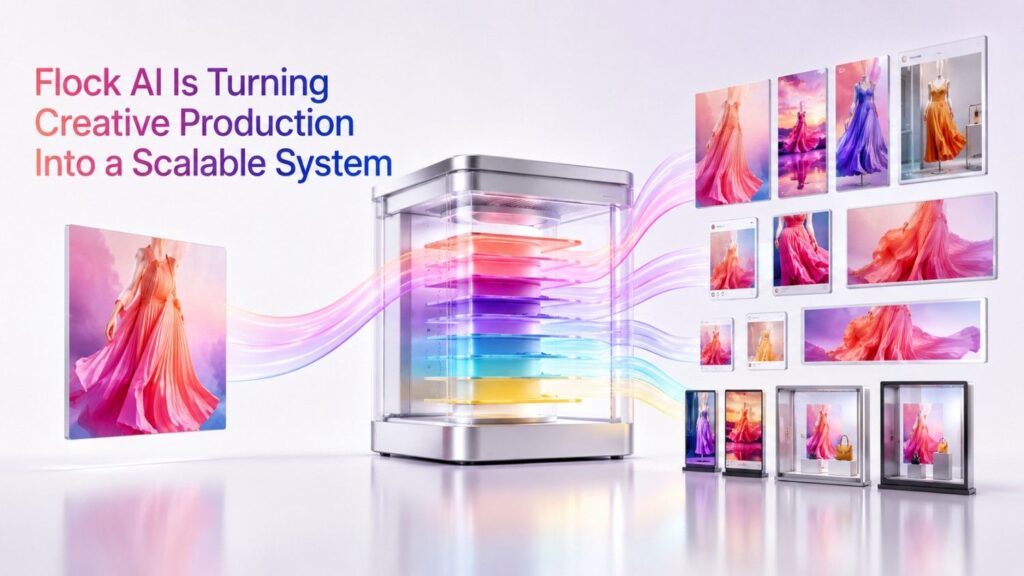
New York-based Flock AI is building technology around this problem.
The company announced a $6 million seed round in February 2026, bringing its reported funding to approximately $7.5 million.
The Opportunity Is Bigger Than Cheap Product Images
The most important question is not whether AI can create an attractive background behind a handbag.
The larger opportunity is whether brands can turn creative production into a scalable software workflow without losing control over visual identity.
A large fashion catalog may contain thousands of products. Each item could theoretically require multiple visual versions based on customer type, campaign, market, season, channel, and device.
Manual production does not scale easily to that level.
AI makes it possible to generate and test many more variations, but luxury and fashion brands will need strong controls. They cannot simply ask a public image model to create something “on brand” and hope for the best.
The winning systems will need to understand the visual rules that define the brand, including composition, tone, lighting, styling, model treatment, approved environments, and unacceptable creative choices.
That makes brand control part of the product rather than an optional feature.
Stylitics Is Automating the Work Behind “Complete the Look”
A shopper who buys a jacket may also need trousers, shoes, a shirt, or accessories.
Retailers have understood this behavior for decades. The challenge is that creating useful combinations across thousands of products requires enormous merchandising effort.
New York-based Stylitics has spent years building technology around automated outfitting and visual merchandising.
The company raised approximately $80 million in Series C financing in 2022, bringing reported total funding at the time to roughly $100 million. Its technology has been used by major retailers including Macy’s, Kohl’s, Revolve, Walmart, and others.
Merchandising Knowledge Is Becoming Software
Historically, a merchant or stylist might manually decide which products should appear together. That works when the assortment is relatively small, but the method becomes much harder to manage when an ecommerce business carries tens of thousands of SKUs.
AI allows some merchandising rules to be translated into software.
A retailer can define which colors work together, which products should not be combined, which inventory should receive more exposure, how seasonal priorities should influence results, and which unavailable products should disappear from recommendations.
The system can then apply those rules across a much larger catalog.
Human judgment does not disappear. Instead, human merchandising knowledge becomes scalable.
That is an important distinction because the strongest enterprise AI tools often do not remove expert decisions. They allow those decisions to influence far more situations than a small team could manage manually.
FindMine Is Giving Products More Useful Context
FindMine is another New York company working on automated styling, curation, and product combinations.
Its technology helps retailers show customers complete outfits or related product groupings rather than treating every product as an isolated item.
The company says its systems deliver styling experiences to more than 100 million consumers each month and have been used by retailers including Gap, Victoria’s Secret, Chico’s, LOFT, and others.
Ecommerce Is Moving From Products Toward Outcomes
Traditional product pages are built around individual SKUs.
Customers rarely think about fashion that way.
A shopper may not actually want a shirt. They may want something suitable for the office tomorrow. Another customer may not want a pair of trousers in isolation. They may need something that works with shoes and jackets already in their wardrobe.
That difference creates a major opportunity for AI.
Instead of organizing ecommerce entirely around individual products, retailers can increasingly organize experiences around customer goals, occasions, outfits, and combinations.
AI makes those contextual experiences much easier to create at scale.
Over time, this could change the design of ecommerce sites themselves because the customer journey may move away from searching through isolated items and toward solving complete dressing problems.
Daydream Is Rebuilding Fashion Search Around Conversation
Daydream represents one of the largest recent bets on AI-native fashion discovery.
The company announced a $50 million seed round in 2024 backed by investors including Forerunner Ventures, Index Ventures, GV, and True Ventures. It publicly launched its conversational fashion shopping experience in June 2025.
At launch, Daydream said the platform contained nearly two million products across more than 8,000 fashion brands and more than 200 retail and brand partners.
Instead of forcing customers to depend entirely on filters and keywords, Daydream allows shoppers to explain what they want through normal conversation.
A user can describe an occasion, budget, preferred style, color, or inspiration. They can upload an image and ask for something similar, then refine the result by changing price, shape, formality, or other details.
Conversational Search Could Become Retail Infrastructure
An important development came in July 2026 when Daydream launched “Powered by Daydream,” a product that allows fashion retailers and brands to place its natural-language and visual discovery technology directly into their own websites.
Early customers included STAUD, alice + olivia, Couper, Cult Mia, and Hampden Clothing, while the company said more than 25 additional businesses had signed on.
That shift reveals an important technology pattern.
A startup may begin by building a consumer destination because that gives it direct access to users and behavioral data. Once the technology becomes strong enough, the same system can be sold as infrastructure to other businesses.
For fashion retailers, that means conversational discovery may eventually become less of a novelty and more like standard ecommerce functionality.
Customers could begin to expect stores to understand requests written in normal language rather than forcing them through menus, categories, and filters.
Phia Is Turning AI Into a Shopping Decision Tool
Phia is another fast-growing New York shopping company that sits directly inside the decision layer.
Founded by Phoebe Gates and Sophia Kianni, the company combines shopping assistance, product discovery, price comparison, price tracking, and resale information.
Phia announced an $8 million seed round in September 2025 and followed it only a few months later with a $35 million Series A in January 2026. At the time of the Series A announcement, the company said it had passed one million users and connected with more than 6,200 retail brands.
Price Intelligence Can Change Consumer Behavior
Finding an item does not end the shopping process.
Once consumers identify a product they like, they may still wonder whether the price is fair, whether the item can be found elsewhere, whether a secondhand version exists, whether the price may fall later, or whether a similar product offers better value.
AI shopping systems can combine those questions into a single decision layer above individual retailers.
This creates a strategic challenge for brands.
Historically, a retailer controlled much of the shopping experience once a consumer entered its website. AI assistants can weaken that control because the consumer may interact with the assistant before interacting with the retailer.
If the assistant compares products across thousands of stores, it may influence which brands enter the customer’s consideration set in the first place.
That makes AI shopping visibility increasingly important.
Alta Is Building an AI Wardrobe Rather Than Another Product Feed
Alta approaches fashion from a different direction by starting with what the customer already owns.
The company allows users to create a digital wardrobe and then receive AI-generated outfit suggestions and shopping recommendations based partly on those existing clothes.
Alta announced an $11 million seed round in June 2025 led by Menlo Ventures.
The concept is more powerful than a traditional recommendation engine because understanding a customer’s wardrobe creates additional context.
A system does not need to recommend a jacket simply because someone previously clicked on jackets. It could recommend the jacket because it works with several shirts, shoes, and trousers that the customer already owns.
The Digital Closet Could Become Valuable Data Infrastructure
Traditional retailers know what customers purchased from their own stores.
A digital wardrobe system has the potential to understand what a person owns across many brands and retailers.
That creates a much richer picture of personal style.
If the platform also understands weather, calendar events, preferred silhouettes, colors, previous decisions, price sensitivity, and lifestyle needs, recommendations can become much more useful.
In February 2026, Alta was working with New York fashion label Public School as it expanded its styling technology toward brand websites.
That move reflects another recurring pattern across fashion AI.
Consumer applications and enterprise tools are beginning to overlap.
A company may begin by building a shopper-facing application, learn from millions of interactions, and later provide the same intelligence to retailers and brands.
Vêtir Is Applying AI to Luxury Wardrobe Management
Vêtir is pursuing a related opportunity from the luxury end of the market.
The New York company announced a $5.5 million first close of its Series A in May 2026 at a reported valuation of $150 million.
Its platform combines digital wardrobe management, shopping, calendar information, AI assistance, and access to human styling expertise.
Luxury May Favor a Human-and-AI Model
The luxury market is an important test of how far automation should go.
Luxury customers often expect personalization, discretion, taste, trust, and service. Those qualities are difficult to reproduce with completely automated software.
That does not mean AI has limited value.
It means the strongest model may combine machine speed with human judgment.
An AI system can organize wardrobes, identify products, compare options, remember preferences, prepare recommendations, and reduce research time. A skilled stylist can then focus on taste, personal context, relationship building, and final judgment.
In high-value fashion categories, AI may therefore make human experts more productive rather than make them unnecessary.
Remark Is Bringing the Store Associate Into Ecommerce
Remark is attacking one of online fashion retail’s oldest weaknesses: the absence of a knowledgeable salesperson.
In a strong physical store, shoppers can ask questions that product pages cannot anticipate. A salesperson can explain how a garment feels, whether the fit runs small, what shoes work with it, which version is easier to maintain, or whether another product better suits the customer’s needs.
Remark uses AI to recreate part of that guidance online.
The company raised $10.3 million in 2024 and another $16 million Series A in July 2025. Its current platform combines conversational advice, product knowledge, styling guidance, and virtual try-on.
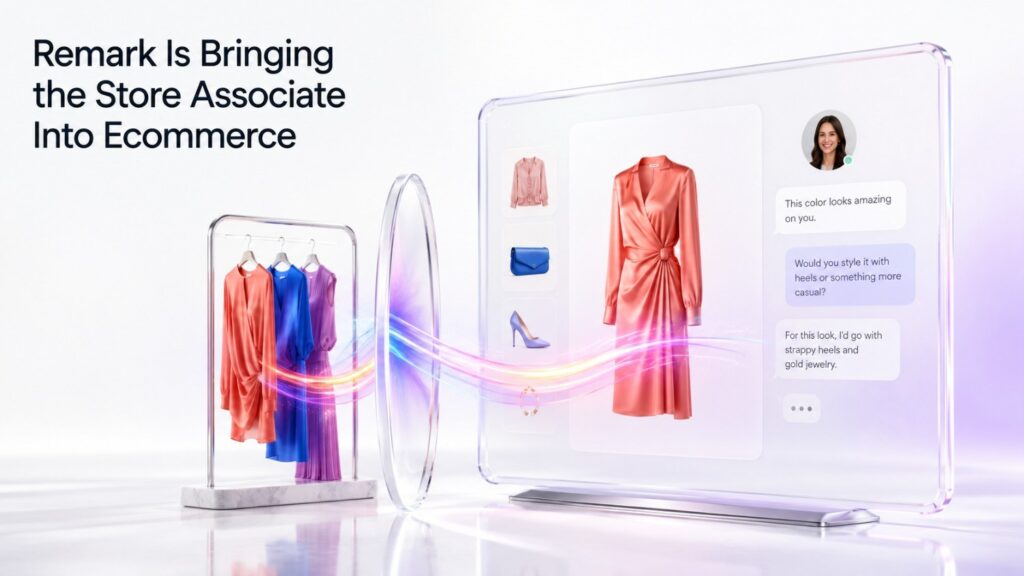
Remark says it works with more than 85 brands and has generated significant revenue lift for customers, although those figures are company-provided and should be independently tested by any retailer considering the software.
In August 2026, the company also announced a new real-time virtual try-on system designed to show garments responding as shoppers move.
Ecommerce Has Spent Years Removing Helpful Conversation
Online stores are efficient because customers can search, compare, and purchase products without speaking to anyone.
That efficiency also removed some of the most useful parts of physical retail.
A customer with an unusual question often has to search through reviews or leave the product page entirely.
Generative AI makes it possible to bring conversation back into ecommerce without requiring a human employee to handle every interaction.
This may be especially useful in premium fashion, beauty, luxury, and other categories where customers need more reassurance before buying.
Nudge Is Preparing Brands for AI Shoppers
Nudge represents a newer part of New York’s fashion and commerce technology ecosystem.
The company raised $1.1 million in pre-seed funding in June 2026 for technology designed to help brands understand and improve how their products appear inside AI shopping systems.
The problem is becoming increasingly important.
Retailers traditionally think about discovery through search engines, social media, marketplaces, advertising, and direct traffic.
AI assistants create another route.
A consumer could ask an AI system for the best minimalist white sneakers below $200 and receive only a handful of recommendations.
The brand’s first challenge is no longer simply ranking on Google. It may also need to make sure that AI systems can correctly understand its products and consider them relevant.
Fashion Brands Are Beginning to Serve Two Audiences
The first audience is human.
Human shoppers respond to photography, storytelling, emotion, design, culture, reputation, and aspiration.
The second audience is increasingly machine.
AI systems depend on clear and structured information about price, sizing, materials, availability, shipping, reviews, return policies, product identifiers, fit, and other attributes.
Fashion brands will therefore need to communicate beautifully to people while also communicating clearly to machines.
Those two goals are related, but they are not identical.
Bluecore Shows How AI Can Create Value After the Shopper Arrives
Bluecore is broader than fashion, but it remains an important part of New York’s retail AI ecosystem.
The company raised a $125 million Series E in 2021 at a $1 billion valuation, taking reported total funding above $225 million.
Its technology connects shopper behavior with product information to help retailers decide which products and messages individual customers are most likely to respond to.
Fashion and retail companies including Gap, Nike, Tommy Hilfiger, Lane Bryant, and Foot Locker have appeared among its customer references over time.
Personalization Is Less Visible but Commercially Important
Retail AI does not always need to create a completely new customer interface.
Sometimes the value comes from making a better decision behind the scenes.
If a retailer has 50,000 products and millions of customers, deciding which five items to place in front of each person is an enormous optimization problem.
Even a small improvement can create meaningful financial impact because the decision is repeated millions of times.
This is another reason high-frequency workflows attract so much attention from AI companies and investors.
The value of automation grows when the decision happens repeatedly at scale.
AI Could Also Change What Happens After a Product Is Used
The fashion AI opportunity does not stop when a customer completes checkout.
New York-based SuperCircle is using technology to address textile waste, product disposition, recycling, and circular retail systems.
The company announced a $24 million Series A in December 2025 and describes its platform as infrastructure for managing textile waste across retail supply chains.
Machine-learning tools are also being used to improve product identification, material classification, and large-scale sorting.
Fashion Intelligence May Eventually Follow the Entire Product Life Cycle
Future fashion systems may need to understand a product long after the first sale.
AI could help determine whether an item should be resold, repaired, refurbished, recycled, donated, or broken down for material recovery.
That creates a much broader view of fashion technology.
Artificial intelligence could influence not only what gets designed and sold but also what happens when the first owner no longer wants the product.
Circularity may therefore become another important AI workflow as regulation, sustainability pressure, resale growth, and waste costs increase.
Original Finding #4: New York Fashion AI Is Clustering Around Four Expensive Problems
After reviewing the companies in our broader dataset, we grouped them according to the main business problem their technology is designed to attack.
Four clusters stand out.
| Business problem | Representative New York companies |
| Creating products and creative assets faster | Raspberry AI, Flock AI |
| Turning catalogs into useful merchandising | Stylitics, FindMine |
| Helping shoppers find and choose products | Daydream, Phia, Alta, Vêtir |
| Increasing confidence and conversion | Remark, Bluecore, Nudge |
The pattern reveals something more useful than a simple startup list.
The strongest AI opportunities appear to be developing around work that happens frequently and carries measurable financial cost.
Fashion companies develop products continuously. Ecommerce teams merchandise products continuously. Customers search continuously. Marketing teams personalize messages continuously. Retailers try to improve conversion continuously.
Reducing five minutes from a task performed a few times each year may not matter very much.
Reducing five minutes from a task repeated 100,000 times can create an entirely different economic result.
That is why frequency matters almost as much as the amount of time saved.
AI Shopping Is Growing, but Fully Autonomous Purchasing Is Still Limited
It is easy to imagine a future in which AI assistants shop completely independently for consumers.
Current behavior suggests that the transition will probably happen more gradually.
NielsenIQ reported in May 2026 that 42% of surveyed consumers had used at least one AI tool while shopping during the previous month. However, only a small percentage had used a fully autonomous agent to place an order.
Gartner found a similar gap in consumer comfort. People were much more willing to use AI to research products, narrow choices, compare information, and make recommendations than to give an AI system complete authority over a purchase.
The Near-Term Winner May Be the AI Adviser
That distinction has important consequences for fashion.
Customers already understand the value of tools that help them compare prices, discover brands, identify alternatives, build outfits, understand products, and narrow large catalogs.
They remain more cautious about allowing AI to make final purchasing decisions without human involvement.
For the next several years, the strongest shopping products may therefore be systems that improve human decisions rather than systems that remove humans from decisions altogether.
That model also fits fashion particularly well because clothing choices are personal, emotional, social, and highly contextual.
Fashion Search Could Start Feeling More Like Talking to a Great Sales Associate
Keyword search forces customers to think like databases.
Conversational AI allows databases to begin thinking more like customers.
That sounds like a small user-interface improvement, but the effect could be much larger.
Consider someone searching for a lightweight jacket that works with jeans during the day but still looks polished enough for dinner in Manhattan.
A traditional search engine has to translate that request into a limited group of product attributes.
A strong AI system can interpret the meaning behind the request.
It can understand that the shopper needs versatility rather than simply a lightweight fabric. It can understand that dinner requires a different level of polish than an afternoon errand. It can consider season, formality, styling, budget, and other contextual signals at the same time.
Fashion is well suited to this kind of interaction because shoppers often know the outcome they want without knowing the correct product terminology.
AI can help bridge that gap.
Virtual Try-On Will Matter When It Solves Real Uncertainty
Fashion companies have experimented with virtual try-on for many years, but recent advances in generative AI are improving what can be visualized and how quickly.
The commercial opportunity is not simply allowing shoppers to generate entertaining images of themselves in different outfits.
Virtual try-on becomes valuable when it reduces uncertainty before purchase.
Online returns remain expensive across retail, while apparel businesses often face particularly difficult return economics because customers struggle to judge size, fit, drape, color, and appearance through a screen.
AI could help address some of that uncertainty, but only if the underlying experience is reliable.
A beautiful image that misrepresents fit could create more returns rather than fewer.
Accuracy Matters More Than Novelty
The strongest virtual try-on systems will need good sizing information, accurate garment data, realistic rendering, consistent product photography, and clear limits around what the visualization actually represents.
Retailers should therefore measure the technology by business outcomes rather than engagement alone.
A high number of try-on sessions may look impressive, but the more important questions involve conversion, return rates, customer confidence, and satisfaction after delivery.
Proprietary Fashion Data Could Become the Real Competitive Advantage
Most AI startups can access similar foundation models.
That makes the underlying model less likely to become the company’s strongest long-term advantage.
The more defensible asset may be the data surrounding the model.
A fashion AI platform can learn from product catalogs, approved outfits, rejected recommendations, purchasing behavior, customer feedback, styling decisions, return reasons, merchandising rules, and brand preferences.
Over time, those signals can become increasingly valuable.
Better Feedback Loops Create Better Fashion Intelligence
Imagine an AI system that creates outfit combinations for a retailer.
The first version may generate looks based on product attributes.
Human merchandisers then approve some combinations and reject others.
Those decisions become feedback.
Customers begin interacting with the approved outfits. Some combinations generate higher click-through rates, stronger conversion, more units per transaction, or better average order value.
That creates another layer of information.
The system can then learn from AI suggestions, human judgment, customer behavior, and commercial outcomes.
The resulting loop looks like this:
AI suggestion → human review → customer response → commercial result → improved future recommendation
Companies capable of building high-quality feedback loops may become much harder to replace because the system becomes increasingly informed by proprietary experience.
Fashion Companies Should Be Careful With AI Performance Claims
AI vendors often publish strong numbers.
They may report faster product development, higher conversion, lower production costs, fewer returns, larger baskets, or greater content output.
Some of those results may be accurate.
Fashion leaders should still avoid assuming that vendor averages will automatically apply to their own businesses.
Measure Incremental Value Rather Than Activity
A retailer testing automated outfitting should compare results against a proper control group.
A design team testing generative visualization should record how long the old workflow actually takes before launching the pilot.
A company experimenting with virtual try-on should examine return reasons rather than looking only at the overall return rate.
A shopping assistant should be evaluated on profitable conversions and customer outcomes instead of conversation volume.
The purpose of an AI pilot should not be proving that artificial intelligence works in general.
The purpose should be determining whether a specific workflow produces enough measurable value to justify its cost, integration effort, training requirements, and operational complexity.
A Practical Measurement Framework for New York Fashion Companies
Fashion leaders should establish baseline data before launching an AI pilot.
That baseline makes it possible to distinguish real improvement from excitement around a new tool.
| AI use case | Useful baseline | Useful AI performance metric |
| Design visualization | Hours from concept to approved visual | Time saved per approved design |
| Sampling | Samples created per approved product | Physical samples avoided |
| Creative production | Cost per usable visual asset | Cost per approved AI-assisted asset |
| Merchandising | Hours spent styling products | SKUs merchandised per employee hour |
| Product discovery | Search exit rate | Search-to-product-view conversion |
| Recommendations | Revenue per session | Incremental revenue versus control |
| Clienteling | Conversion without guidance | Assisted conversion improvement |
| Virtual try-on | Returns caused by fit or appearance uncertainty | Change in preventable returns |
| AI shopping visibility | Presence across important AI recommendations | Qualified AI-referred revenue |
This measurement approach turns AI from an innovation discussion into a business decision.
A tool that appears less exciting may ultimately create more value if it improves an important metric repeatedly across the organization.
What AI Is Unlikely to Replace
Fashion is not simply an optimization problem.
Customers buy identity, emotion, culture, aspiration, belonging, novelty, and personal expression.
They sometimes buy products specifically because those products are unexpected, unusual, risky, or different from what historical data would suggest.
That creates a natural limit to pure algorithmic optimization.
Human Taste May Become More Valuable
AI is extremely good at producing variations.
Humans still decide which variations deserve attention.
That difference is fundamental.
A model can generate hundreds of handbag concepts. A strong creative director still has to recognize which idea could define a collection, strengthen the brand, or create something customers have not seen before.
As generative capacity becomes cheap, the ability to generate more ideas will become less unusual.
The ability to recognize the right idea may become more valuable.
There is also a risk that brands relying on similar models, similar data, and similar optimization targets could gradually become more alike.
Distinctive human judgment may therefore become an even stronger competitive advantage.
Copyright, Data Control, and Brand Governance Will Become More Important
Fashion companies also need clear policies governing how AI tools are used.
Employees should know which systems are approved, what information can be uploaded, how customer data is handled, whether proprietary design material is retained, what rights apply to generated content, and whether company data may contribute to future model training.
These questions become more serious as AI moves from experimentation into core workflows.
Entering a general marketing prompt into a public chatbot carries one level of risk.
Uploading confidential designs from an unreleased luxury collection creates a very different problem.
Fashion companies should therefore treat AI governance as part of data security, intellectual-property protection, brand management, and vendor risk.
Product Data May Become Fashion’s Hidden AI Infrastructure
Generative images receive most of the attention because they are easy to see.
Structured product information may ultimately create just as much practical value.
AI shopping systems cannot reliably recommend a product when the information surrounding that product is unclear, incomplete, or inconsistent.
Fashion brands should understand whether their catalogs clearly describe material, color, size, fit, dimensions, availability, care instructions, pricing, shipping rules, returns, product identifiers, and intended use.
Those fields previously supported ecommerce filters and customer information.
They are increasingly becoming signals used by machines.
Product Information Is Becoming Machine-Readable Marketing
A beautiful campaign can make a customer desire a product.
An AI shopping assistant may first need to decide whether that product satisfies the customer’s request.
Those are two very different communication problems.
Human-facing marketing must create interest and emotion.
Machine-facing information must create clarity and confidence.
The strongest fashion brands will need to do both.
AI Shopping Agents Could Change Ecommerce Strategy
For more than two decades, brands fought to rank on Google.
Later, they fought for visibility across Instagram, TikTok, marketplaces, and other social platforms.
Another discovery layer is now emerging.
Consumers are increasingly using AI systems to research products, compare options, narrow choices, and look for deals.
That does not mean traditional search disappears.
It means product discovery becomes more fragmented.
AI Recommendation Visibility Could Become a Standard KPI
Fashion companies may eventually need to measure questions that currently sound unusual.
How often does an AI assistant mention the brand when customers ask relevant shopping questions?
Which products does it recommend?
Does it understand the brand’s sizing correctly?
Are prices accurate?
Does it identify materials properly?
Does it understand what differentiates the product?
Does it send the shopper to the right page?
Do AI-referred customers convert?
Those questions could eventually become ordinary parts of ecommerce reporting.
The same way brands monitor Google rankings today, they may monitor their visibility across AI shopping systems tomorrow.
AI Could Help Small New York Brands Compete More Effectively
Large fashion companies can afford specialists across design, marketing, ecommerce, merchandising, analytics, photography, customer service, and operations.
Smaller New York labels often cannot.
That difference is one reason AI could have an unusually large effect on young brands.
A small team could use AI to accelerate concept visualization, organize product information, produce first drafts of product descriptions, create campaign variations, build merchandising combinations, summarize sales information, answer common customer questions, and prepare buyer presentations.
That does not mean one designer can suddenly operate a global fashion company alone.
It means small teams can gain access to capabilities that previously required more employees, agencies, or contractors.
In a city where operating costs are high and many young labels work with limited resources, that improvement could be meaningful.
Local Manufacturing Creates Another New York AI Opportunity
AI design tools become even more useful when they connect with faster physical production.
New York is also investing in that side of the fashion ecosystem.
In April 2026, NYCEDC and the CFDA announced a combined $1.7 million investment in a Local Production Fund designed to connect fashion brands with local manufacturers.
The city’s wider Fashion Manufacturing Initiative has also supported factory upgrades, workforce development, and production capacity.
Digital Speed Becomes More Valuable When Physical Feedback Is Nearby
Consider what happens when AI-assisted design is combined with local sampling and small-batch manufacturing.
A New York designer can generate several early ideas quickly, create realistic visualizations, reject weak concepts, send a smaller number of stronger designs to a nearby manufacturing partner, examine samples locally, and revise the product without waiting for long international shipping cycles.
That creates a faster feedback loop between software and physical production.
The opportunity is therefore much more interesting than the idea that “AI can design clothes.”
AI can make the entire development cycle more responsive when digital tools are connected with local production capability.
What New York Fashion Leaders Should Do Now
The weakest AI strategy is to buy several fashionable tools and encourage teams to experiment without a clear business purpose.
A stronger approach begins with operational bottlenecks.
Leadership should identify where time, money, or customer attention is being lost.
A design department may spend too many hours producing visual revisions.
An ecommerce team may have thousands of products that receive almost no merchandising attention.
Customers may search repeatedly without discovering suitable products.
Campaign production may fail to keep pace with new launches.
Return rates may be rising because shoppers lack confidence before ordering.
These are measurable problems.
Start With the Workflow Rather Than the Technology
Do not begin with the statement, “We need generative AI.”
Begin with a specific problem such as, “Our team spends 700 hours each quarter producing product imagery.”
That framing immediately improves the quality of the AI project.
The company now has an existing cost, a defined workflow, and a baseline against which any technology can be measured.
A Practical 90-Day AI Plan for a New York Fashion Company
Days 1-30: Find the Expensive Repetition
During the first month, focus on understanding where repetitive work creates the greatest cost.
Speak with designers, merchants, ecommerce employees, marketers, customer-service teams, store associates, production staff, and finance leaders.
Look for tasks that people describe as repetitive, slow, frustrating, difficult to scale, or dependent on large amounts of manual work.
Once a promising workflow has been identified, measure the current state.
How many hours does it require?
How much money is spent on agencies or outside vendors?
How many samples are created?
How many products receive little merchandising attention?
How often do searches end without a product view?
How many returns are caused by fit or expectation problems?
Those numbers create the baseline.
Without them, the company will not know whether AI produced a meaningful improvement.
Days 31-60: Run One Controlled Pilot
The second month should focus on one clearly defined workflow.
If the company is testing AI design visualization, begin with one product category.
If the company is testing automated merchandising, limit the pilot to a specific assortment.
If conversational search is being tested, expose only a portion of site traffic and retain the existing experience as a comparison.
Whenever possible, create a control group.
The purpose is to produce credible evidence rather than an impressive internal presentation.
Small controlled pilots make it easier to identify both benefits and hidden problems.
Days 61-90: Measure the Full Business Impact
During the final month, compare the AI-assisted workflow against the original baseline.
Measure whether employees actually saved time, whether conversion changed, whether shoppers discovered more products, whether content production became cheaper, and whether the technology created additional review work somewhere else.
That last point is particularly important.
AI can make one task faster while accidentally creating a new burden in another part of the organization.
A system that generates hundreds of images may not create value if employees must spend large amounts of time correcting them.
The full workflow needs to be measured before the company decides to scale.
The Fashion AI Companies Most Likely to Win Will Understand Fashion Operations
Creating an impressive demonstration is relatively easy.
Building software that major fashion companies can depend on every day is much harder.
Enterprise fashion technology has to handle changing inventory, brand rules, regional assortments, product data, permissions, security requirements, ecommerce integrations, merchandising priorities, major launches, and peak traffic.
It also has to create results that finance teams can measure.
That is why vertical knowledge matters so much.
The fashion AI company with the best general-purpose model may not win the market.
The stronger company may be the one that understands how fashion teams actually work and can fit technology into those workflows without creating new problems.
Why New York Could Become One of the Best Places to Build Fashion AI
New York’s fashion industry faces real challenges.
Employment has declined over the last decade, manufacturing has changed, operating costs remain high, and competition has become global.
Ecommerce has transformed distribution, while social platforms have changed how trends form and spread.
Artificial intelligence will not automatically solve those problems.
However, New York has an unusual combination of assets that could make it one of the strongest environments for building fashion-specific AI companies.
The city has designers, brands, retailers, luxury groups, agencies, investors, technology talent, fashion schools, manufacturers, the CFDA, and thousands of businesses capable of testing new tools against real commercial problems.
The city’s advantage is not simply that AI engineers live here.
The customers, experts, and workflows those engineers need to understand are here as well.
That combination can accelerate the development of vertical AI.
The Bigger Story: Fashion Is Moving From Search Toward Decision
For many years, ecommerce optimization concentrated on helping customers find products more efficiently.
Artificial intelligence is moving the opportunity one step further by helping people make better decisions once those products have been found.
That theme connects many of New York’s most interesting fashion AI companies.
Raspberry AI helps design teams decide which product ideas deserve further development.
Flock AI helps creative teams decide how products should be presented across different contexts.
Stylitics and FindMine help retailers decide which products belong together.
Daydream helps shoppers express what they really want rather than forcing them through rigid filters.
Phia helps consumers compare options and understand value.
Alta and Vêtir try to understand the wardrobe surrounding a potential purchase.
Remark gives online shoppers more confidence before they buy.
Nudge is preparing brands for a world in which AI systems may influence which products even enter the customer’s consideration set.

These companies operate at different points in the market, but they are moving toward the same fundamental opportunity.
They are trying to improve decision quality.
Conclusion
Artificial intelligence is unlikely to make New York fashion less dependent on creativity. In many ways, it may make creativity, taste, brand identity, and human judgment even more important.
As software becomes capable of generating endless images, variations, recommendations, and product combinations at low cost, simply producing more options will no longer be unusual. The valuable skill will be deciding which options deserve attention and which ones should never reach the customer.
The largest near-term opportunity is therefore not replacing fashion professionals. It is removing the repetitive work surrounding their most valuable decisions.
Design teams can evaluate more ideas before committing to physical samples. Merchandisers can bring useful context to larger catalogs. Ecommerce teams can understand customer intent more clearly. Shoppers can describe what they need through conversation rather than endless filters. Retailers can provide online guidance that feels closer to the experience of speaking with a knowledgeable store associate.
Our focused analysis of recent New York fashion AI financing also suggests that investor interest is moving beyond the first excitement around generative imagery. More than half of the financing represented in our 2025-2026 sample went toward shopping discovery and decision-support tools, while meaningful capital also moved into design visualization, creative production, clienteling, and AI-assisted commerce.
That shift is worth watching because it reveals where commercial value may ultimately concentrate.
The future of fashion AI will probably not be won by the company capable of producing the largest number of images. It will be won by companies that understand where fashion businesses lose time, where customers lose confidence, where products disappear inside enormous catalogs, and where better information can produce a better decision.
New York has the designers, retailers, brands, investors, manufacturers, creative talent, and technology ecosystem needed to test those ideas at meaningful scale.
The next chapter of fashion technology may therefore look less like machines replacing designers and more like thousands of small decisions across the fashion business becoming faster, better informed, and easier to execute.
If that happens, New York will not simply be one of the cities using fashion AI.
It could become one of the places where the industry’s most valuable AI workflows are built.