

Online shopping has spent more than 20 years getting faster without becoming much easier.
A shopper who wants “comfortable black shoes for walking around New York all day that still look good at dinner” still has to search, open tabs, compare products, check reviews, think about sizing, hunt for discounts, check shipping dates, and finally decide what to buy. The websites have improved, but much of the work has stayed with the customer.
AI shopping agents are starting to change that.
Instead of asking a shopper to translate what they want into keywords and filters, an AI agent can start with the actual need. It can understand a full sentence, search across products, compare choices, remember preferences, explain trade-offs, watch prices and, in some cases, help complete the purchase.
This is not only a Silicon Valley story. New York City has quietly become one of the most interesting places to watch the next phase of e-commerce.
Companies such as Wizard, Daydream, Phia, Remark, Channel3, Shoppable, Nudge, Pango and Stylitics are attacking different parts of the shopping journey. Some want to become the interface consumers use to shop. Others want to provide the product data, recommendations, checkout systems or merchant infrastructure those agents need.
Our NYC Tech Journal analysis suggests something important: the future of AI shopping will probably not be controlled by one giant shopping chatbot. It is more likely to be built as a stack of specialized systems that work together.
That creates a very different future for retailers.
The next e-commerce battle may not be about who ranks first on Google. It may be about which products an AI agent understands, trusts, recommends and can actually buy.
AI Shopping Agents Are Moving From Experiments to Real Commerce
The clearest evidence is not another AI demo. It is what shoppers are already doing.
Adobe found that traffic from generative AI services to U.S. retail websites increased 393% year over year during the first quarter of 2026. Its consumer research also found that 39% of surveyed consumers had already used AI for online shopping, and 85% of those users said AI improved the experience.
The 2025 holiday season showed an even more dramatic increase. Adobe measured a 693.4% year-over-year increase in traffic from generative AI tools to U.S. retail sites between November and December 2025 across data covering more than one trillion retail visits.
More important, these shoppers are not only curious.
Adobe reported that AI-referred shoppers converted 31% better than other traffic sources during the 2025 holiday season. They were also 33% less likely to leave a retail site immediately, suggesting that shoppers arriving through AI often reach the retailer with a clearer idea of what they want.
McKinsey’s February 2026 U.S. ConsumerWise research found that 68% of consumers had used at least one AI tool during the previous three months. Among all respondents, 19% said they were using AI to discover or make decisions about brands, products or services.

The behavior is real. What remains uncertain is how much control consumers will eventually give the agent.
Consumers Want Help Before They Want Full Automation
There is an important difference between asking AI what headphones to buy and giving AI permission to spend $300 without asking.
Gartner found that consumer willingness to let AI independently make purchase decisions reached only 11% even in lower-risk categories. Consumers were much more comfortable letting AI narrow choices, with 31% willing to use it that way for household supplies and 28% for electronics.
This distinction matters because much of the discussion around agentic commerce jumps too quickly to fully autonomous shopping.
The immediate market may be much bigger for AI-assisted decisions than for fully autonomous purchasing.
A useful shopping agent does not need permission to run somebody’s entire household budget. It simply needs to save the shopper 30 minutes of searching while producing a better answer.
That is already enough to change e-commerce.
What Is an AI Shopping Agent?
An AI shopping agent is more than a chatbot sitting in the corner of a product page.
A basic retail chatbot responds when a shopper asks, “What is your return policy?” A more advanced shopping agent can understand something like, “I need a waterproof jacket for commuting in Manhattan that does not look like hiking gear, preferably under $250.”
The difference is action.
Search Engines Find Pages
Traditional search engines are mainly built to retrieve information. You enter keywords and get possible destinations.
The work of deciding remains with you.
Recommendation Engines Rank Products
Traditional recommendation systems improve this process by predicting what shoppers may like based on browsing history, product relationships and previous purchases.
They are useful, but the shopper still operates inside a retailer’s existing structure.
Shopping Agents Start With Intent
An AI shopping agent can start with the shopper’s actual objective.
It can turn vague preferences into structured requirements, search products, compare options and adjust the answer as the shopper gives more information.
The conversation becomes the filter.
Agentic Commerce Adds the Ability to Act
The next step is allowing the software to do something.
That may mean adding products to a cart, applying a promotion, checking availability, monitoring price changes, completing checkout, changing an order, processing a return or solving a delivery problem.
Visa describes agentic commerce as a model where agents can help consumers discover and compare products and, with appropriate authorization, complete purchases.
That action layer is what turns AI shopping from an improved search experience into a new commerce channel.
The Infrastructure for Agentic Shopping Is Arriving Quickly
Shopping agents would not matter much if they remained isolated demonstrations. The bigger story in 2026 is that large technology and payments companies are building the infrastructure required to make agent-led buying practical.
OpenAI introduced Instant Checkout and the Agentic Commerce Protocol in September 2025, allowing eligible purchases to move from product discovery to checkout within ChatGPT while keeping the merchant responsible for payments, fulfillment, returns and customer service.
Google introduced the Universal Commerce Protocol in early 2026 as an open standard designed to connect consumer interfaces, merchants and payment providers. Google then announced Universal Cart in May, allowing shoppers to collect products across Google services and merchants.
Visa and Mastercard are also building systems for trusted agent-initiated transactions. Visa says its infrastructure is designed to let merchants recognize legitimate agents, verify consumer permission and accept agent-led payments safely, while Mastercard is developing similar trust, payment and identity layers for agentic commerce.
This changes the startup opportunity.
A company no longer has to build every piece of AI commerce itself. Startups can build a superior product search engine, product graph, checkout layer, merchant agent or post-purchase system and connect into a much larger ecosystem.
New York companies are already doing exactly that.
Why New York City Is Such an Important Market for AI Shopping
New York has an unusual combination of industries that makes it a natural place to build commerce technology.
The city has major retailers, fashion brands, luxury companies, advertising firms, media companies, financial institutions, payment businesses, venture firms and millions of demanding consumers living close together.
That matters because shopping agents are not purely an AI problem.
They require understanding of products, consumer psychology, retail economics, payments, merchandising, brand positioning, logistics and customer service. New York already has deep talent across almost every part of that chain.
Fashion Gives New York an Especially Strong Advantage
NYCEDC estimates that New York City’s fashion industry generated about $8 billion of economic impact in 2024. The city remains home to major brands, retailers, designers, fashion schools and creative businesses.
Fashion also happens to be one of the hardest categories for traditional search.
A shopper may know exactly what a USB-C cable needs to do. Describing the perfect jacket, dress or pair of shoes is different.
Words such as polished, understated, edgy, relaxed, timeless, work-friendly or “something I could wear downtown” are difficult to represent with a row of checkboxes.
Generative AI is much better suited to this type of fuzzy intent.
That helps explain why several of New York’s most visible AI commerce startups started with fashion.
New York Also Has a Huge Retail Workforce
Retail remains a major part of New York’s economy. The NYC Comptroller estimated roughly 294,900 retail trade jobs in its 2025 economic review.
AI shopping therefore matters in New York for more than venture capital.
Changes in product discovery, merchandising, customer service, marketing and store operations can affect an industry that employs hundreds of thousands of people across the city.
NYC Tech Journal Original Research: How We Studied New York’s AI Shopping Ecosystem
To understand what is actually happening, NYC Tech Journal created a focused dataset of New York companies working directly on AI-powered shopping or the infrastructure needed to support it.
Our goal was not to create the longest possible startup list. We wanted a smaller dataset where every company had a clear connection to the future shopping journey.
Our Inclusion Rules
A company had to meet two conditions.
First, it needed clear evidence of being headquartered in New York City or operating as a New York-based startup. Second, its current product needed to influence at least one important part of AI-driven commerce: discovery, comparison, personalization, checkout, merchant integration or post-purchase operations.
That gave us the following core sample.
| Company | Primary role in AI commerce | Founded | Publicly disclosed funding used in our analysis |
| Stylitics | AI merchandising and styling | 2011 | About $100M |
| Wizard | Consumer AI shopping agent | 2021 | $50M+ |
| Daydream | AI fashion shopping agent | 2023 | $50M |
| Phia | AI fashion shopping and price comparison | 2025 launch | $43M across seed + Series A |
| Remark | Merchant-side AI shopping guidance | 2022 | $26.3M |
| Channel3 | AI-ready product data infrastructure | 2025 | $6M |
| Shoppable | Universal checkout infrastructure | 2011 | At least $5M publicly reported |
| Nudge | Agentic commerce infrastructure for brands | — | $1.1M pre-seed |
| Pango | AI post-purchase e-commerce operations | 2025 | Funding announced; amount not included |
Location, funding and product classifications were checked against company materials, accelerator profiles and public reporting. For example, Wizard lists New York City as its headquarters; Channel3 and Pango are listed by Y Combinator as New York City companies; Stylitics is headquartered in New York; Remark is based in New York; and Nudge lists New York as its headquarters.
What We Deliberately Excluded
We did not automatically include every retail AI company that made an announcement in New York.
That matters because NRF and other major retail conferences generate many “New York” AI press releases from companies that are actually headquartered elsewhere.
For example, Shopsense AI is an important AI commerce company, but its public contact information lists Redwood City, California. It therefore does not belong in a strict NYC startup sample.
The same rule helps keep the analysis from turning into a generic list of AI commerce companies with weak New York connections.
How We Handled Funding
Private-company funding data is messy.
Some companies disclose every round. Others disclose only a major round. Databases sometimes disagree about totals, and undisclosed financings cannot be measured accurately.
We therefore used a conservative approach.
Our funding analysis counts only amounts that can be supported through public company announcements or credible public reporting. When total capital is unclear, we use the minimum publicly disclosed figure rather than estimating.
Pango announced new investors in February 2026 but did not provide a financing amount in the announcement we reviewed, so we exclude its capital from funding totals rather than inventing a number.
That means our funding totals should be read as a minimum, not an exact measurement of all investment in NYC agentic commerce.
How We Built the Agentic Commerce Coverage Index
Funding tells us where money has gone. It does not tell us what the companies actually do.
We therefore created a second framework based on six parts of the shopping journey:
| Capability | What we looked for |
| Discovery | Can the product help find relevant items? |
| Comparison | Can it compare, rank or reconcile competing products or offers? |
| Personalization | Can recommendations change based on user needs, style or context? |
| Transaction | Can it directly support cart creation or checkout? |
| Merchant connection | Does it integrate with brands, retailers or merchant systems? |
| Post-purchase | Can it act after checkout, such as handling order changes or returns? |
Each company received one point when we found clear public evidence of a capability.
This is a coverage score, not a quality ranking. A company building excellent checkout infrastructure may intentionally cover fewer parts of the journey than a broad consumer assistant.
That distinction is important.
Original Finding #1: At Least $281 Million Is Already Behind Our NYC AI Commerce Sample
Across the eight companies in our dataset with usable public financing numbers, we identified at least $281.5 million in disclosed funding.
The real figure is likely higher because not every financing amount is public.
Disclosed Funding in Our NYC Sample
| Company | Minimum disclosed funding used |
| Stylitics | $100.0M |
| Wizard | $50.0M |
| Daydream | $50.0M |
| Phia | $43.0M |
| Remark | $26.3M |
| Channel3 | $6.0M |
| Shoppable | $5.1M |
| Nudge | $1.1M |
| Total | $281.5M+ |
Stylitics announced an $80 million Series C in 2022 that brought its total funding to about $100 million. Wizard previously raised a $50 million Series A. Daydream raised $50 million at seed, while Phia raised an $8 million seed followed by a $35 million Series A. Remark has disclosed a $10.3 million seed financing and a later $16 million Series A.
Channel3 raised $6 million in December 2025, while Nudge announced a $1.1 million pre-seed round in June 2026.
Funding Concentration Is More Interesting Than the Total
We grouped those companies by the main layer they are trying to own.
| Main layer | Companies | Disclosed funding | Share of measured total |
| Consumer-facing shopping agents | Wizard, Daydream, Phia | $143.0M | 50.8% |
| Merchant-side shopping and merchandising | Stylitics, Remark | $126.3M | 44.9% |
| Product, discovery and transaction infrastructure | Channel3, Shoppable, Nudge | $12.2M | 4.3% |
| Post-purchase operations | Pango | Not disclosed | Not calculated |
This produced one of the most interesting findings in our analysis.
Only about 4% of the measurable capital in this sample sits in companies whose primary role is the underlying agentic-commerce infrastructure.
The consumer interface and merchant-side shopping experience have attracted almost all the disclosed money so far.
That may not remain true.
Why Infrastructure Could Become a Much Bigger Investment Category
Consumer shopping assistants are easy to understand.
If millions of people use an application to decide what to buy, the business can become extremely valuable.
But agents also need clean product information, availability, prices, variants, checkout connections, merchant authorization and transaction systems.
Those layers are difficult to see, but they may become extremely valuable if thousands of agents depend on them.
The history of the internet provides a useful pattern. Large value was created not only by websites consumers visited, but also by payments platforms, cloud providers, databases, advertising infrastructure and developer tools sitting underneath them.
Agentic commerce may develop the same way.
Original Finding #2: NYC Startups Are Much Better at Helping Shoppers Decide Than Acting After the Purchase
We next measured how many of our nine startups have clear public capabilities across the six stages of agentic commerce.
NYC Agentic Commerce Capability Coverage
| Capability | Companies with clear coverage | Share of sample |
| Merchant connection | 9 of 9 | 100% |
| Discovery | 8 of 9 | 89% |
| Personalization | 6 of 9 | 67% |
| Comparison/ranking | 5 of 9 | 56% |
| Native transaction support | 3 of 9 | 33% |
| Post-purchase action | 2 of 9 | 22% |
The exact classifications will evolve as products change, but the pattern is clear.
New York’s shopping-agent ecosystem is far more developed around finding and deciding than around autonomously completing and managing a transaction.
That makes sense.
Product discovery carries less financial and legal risk than allowing an agent to spend money, change an order or issue a refund.
Chart: Where NYC Shopping Startups Are Concentrating
Merchant connection █████████ 9
Discovery ████████ 8
Personalization ██████ 6
Comparison █████ 5
Transaction ███ 3
Post-purchase ██ 2
This also lines up with broader consumer behavior.
People are increasingly happy to let AI research products and narrow choices, while full purchasing autonomy remains much less accepted. Gartner’s 2026 findings show that consumers are more willing to let AI narrow options than make the final decision.
The startup ecosystem appears to be following the customer.
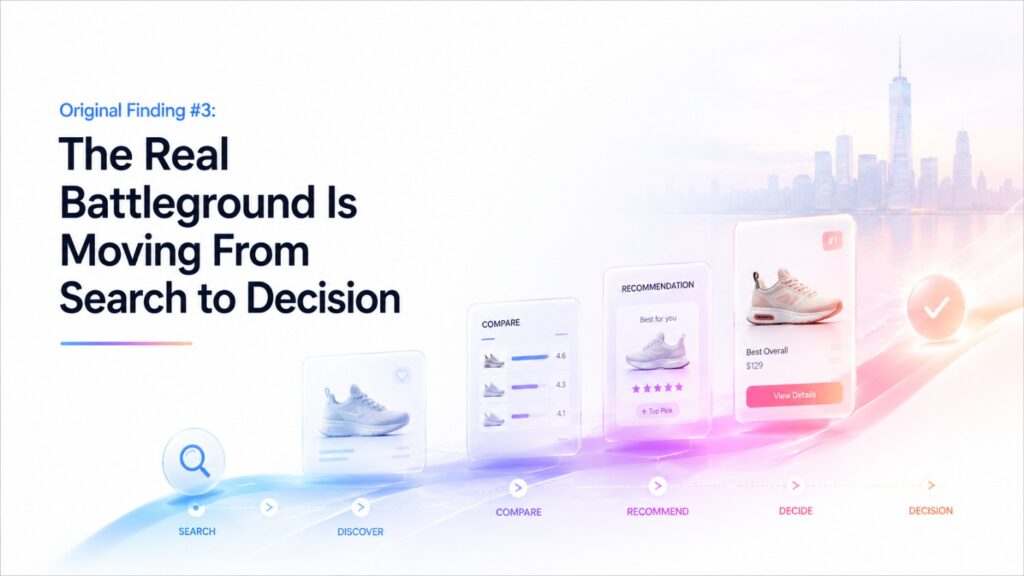
Original Finding #3: The Real Battleground Is Moving From Search to Decision
Most e-commerce competition has historically focused on getting traffic.
Retailers fought for Google rankings. They bought paid search ads. They built affiliate programs, influencer campaigns, marketplaces and social media channels.
AI changes the location of the competition.
A shopper may now ask an assistant:
“Which carry-on suitcase is most durable under $300?”
The agent may inspect dozens or hundreds of options before returning only three.
The retailer is therefore competing before the shopper ever visits its site.
This is a major change.
The Old Funnel
Search
↓
10 blue links / ads
↓
Retail website
↓
Browse categories
↓
Compare products
↓
Read reviews
↓
Add to cart
↓
Checkout
The Emerging Agentic Funnel
Natural-language request
↓
AI interprets intent
↓
Agent searches products + evidence
↓
Agent compares choices
↓
2–5 recommendations
↓
Purchase or merchant visit
The number of visible choices collapses.
That may make recommendation placement far more valuable.
Ranking fifth on a traditional search page is inconvenient. Being excluded entirely from an AI-generated shortlist is much worse.
The New York AI Shopping Companies to Watch
The companies in New York’s emerging commerce ecosystem are not all trying to build the same product.
Understanding those differences is essential.
Wizard — Building a General-Purpose AI Shopping Agent
Wizard may represent the clearest version of the consumer shopping-agent idea.
The New York company was co-founded by former Walmart e-commerce leader Marc Lore and Melissa Bridgeford. It originally focused on conversational commerce and raised a $50 million Series A in 2021.
In February 2026, Wizard publicly launched an AI shopping agent designed to search across the web, understand detailed natural-language requests and narrow the market to a small number of recommendations. The company says its ranking system analyzes product attributes, reviews and editorial sources rather than simply returning a large page of products.
Why Wizard Matters
Wizard is not limiting itself to fashion.
That gives it the chance to become a horizontal shopping interface covering many categories.
Its Best Buy integration is particularly important because Wizard can support native checkout for participating products. Best Buy publicly highlighted the integration during its fourth-quarter earnings discussion.
The long-term idea is simple but powerful.
If a shopper can say what they need and receive five strong recommendations, why should that person scroll through 500 search results?
Wizard is betting that curation replaces browsing.
Daydream — Building a Fashion-Native Shopping Agent
Daydream attacks the same problem from the opposite direction.
Instead of trying to understand every shopping category, Daydream is going deep into fashion.
The New York company was founded by Julie Bornstein and raised a $50 million seed round in 2024. Its backers included Forerunner Ventures, Index Ventures, GV and True Ventures.
Daydream publicly launched its chat-based fashion agent in June 2025. Rather than requiring structured filters, the product lets shoppers describe what they want naturally and refine the results through conversation.
Its current product says it searches more than 10,000 stores and can remember shopper preferences through its Style Passport. It can also work from screenshots and monitor products for price changes.
Daydream Is Moving From Destination to Infrastructure
A particularly important development happened in 2026.
Daydream started embedding its AI shopping technology directly into retailer websites, including Alice + Olivia and Staud. Instead of forcing shoppers to visit Daydream, brands can bring Daydream-style natural-language discovery into their own stores.
That move changes the business model.
Daydream no longer has to win every customer relationship directly. It can potentially become technology that powers AI search across many fashion retailers.
That is strategically important because retailers are unlikely to surrender their entire customer relationship to outside agents without a fight.
Phia — Combining Price Discovery, Fashion Search and Consumer Distribution
Phia has grown at unusual speed.
Founded by Phoebe Gates and Sophia Kianni, the company launched its shopping product in April 2025. It raised an $8 million seed round in September 2025 and announced a $35 million Series A in January 2026.
The company said it had surpassed one million users by the Series A announcement and was working with more than 6,200 retail brands. Its product focuses on price comparison, product information, resale value, price tracking and AI-assisted fashion discovery.
Phia is interesting because it starts from a very practical consumer problem.
Shoppers often want to know whether they are paying too much.
That is easier to explain than a vague promise of “AI-powered personalization.”
Phia Also Shows Why Attribution Will Become a Major Agentic-Commerce Issue
Phia became part of a wider industry controversy in 2026 after reporting alleged that its browser extension had used affiliate tracking practices that could claim credit for transactions the product did not generate. Phia subsequently said problematic features were removed, began reviewing transactions and said it would reverse misattributed commissions.
This issue matters beyond one startup.
AI shopping agents may receive affiliate commissions, transaction fees, placement revenue or retailer payments. As they influence more purchase decisions, merchants need a reliable way to determine whether an agent actually created incremental demand.
For that reason, NYC Tech Journal deliberately did not use startup-reported GMV, revenue growth or merchant conversion claims as inputs to our core ecosystem ranking.
Funding and observable product capabilities are easier to validate consistently.
Remark — Bringing the Store Associate Into E-Commerce
Remark is pursuing a different model.
Instead of building a shopping destination that sits above retailers, Remark helps brands create guided shopping experiences inside their own channels.
The New York company originally built its system around tens of thousands of human product experts. Their knowledge could then help train AI personas capable of answering detailed shopping questions. Remark announced a $10.3 million seed financing in 2024 and a $16 million Series A in 2025.
The current Remark platform can recommend products, guide customers through decisions and carry out actions inside a conversation. Its published product materials describe capabilities such as changing an address or swapping a size without forcing the customer into a separate support workflow.
Remark Is Moving Beyond Chat
In August 2026, Remark launched a real-time virtual try-on system aimed at luxury commerce. The system is designed to render clothing on a moving shopper rather than attaching a static garment image to a photo.
That development points toward a much broader definition of a shopping agent.
The winning interface may eventually combine conversation, product knowledge, visual search, try-on, human experts and transaction support.
Remark’s own current figures say its technology has produced more than $60 million in brand revenue lift across more than 85 brand partners, although those figures are company-reported and should be treated as such.
For luxury retailers, this approach may be more attractive than sending valuable customers into a third-party general shopping agent.
Channel3 — Building the Product Database Agents Need
Channel3 may be one of the most strategically interesting companies in this group because consumers may never know it exists.
The Y Combinator-backed New York startup is trying to build a universal, AI-ready product graph. It raised $6 million in seed funding led by Matrix in December 2025.
Its argument is straightforward.
AI models can reason about products only if they have high-quality product information.
Retail data is messy. The same shoe may appear on five websites with different titles, descriptions, images, colors and variant structures.
Channel3 uses multimodal models to identify products, connect variants and match identical items across merchants. Its database can then be exposed to developers building AI shopping experiences.
Product Graphs Could Become Critical Infrastructure
Google already operates a Shopping Graph containing tens of billions of product listings. Google said in May 2026 that its graph covered more than 60 billion product listings.
Independent shopping agents need something similar.
Very few startups can afford to crawl and clean the entire commerce web themselves.
If Channel3 becomes a common product-data layer for independent AI applications, its value could come from powering thousands of shopping experiences rather than attracting millions of consumers directly.
This is why the relatively small amount of capital currently flowing toward agent infrastructure is worth watching.
Shoppable — Solving the Universal Checkout Problem
Shoppable is much older than the latest AI wave.
Founded in 2011 and based in New York, the company spent years building technology that lets consumers buy products from different retailers through a unified checkout experience.
That technology suddenly looks highly relevant.
An AI agent can recommend the perfect lamp, rug and coffee table from three separate stores. But if the shopper then has to open three websites, create three carts and complete three checkouts, much of the benefit disappears.
Shoppable is trying to remove that problem.
In May 2026, it launched an MCP server intended to let AI assistants work with its catalog and universal checkout infrastructure. The company said the system could expose more than 500 million products and support multi-brand carts.
In July 2026, Shoppable also announced a ChatGPT integration for multi-retailer discovery and cart building.
Checkout May Be the Hardest Part of Agentic Commerce
Recommending a sweater is technically easier than buying one.
Checkout involves live inventory, tax, payment credentials, fraud, merchant rules, shipping addresses, cancellations and refunds.
This is why transaction infrastructure may become one of the strongest moats in agentic commerce.
The AI model itself can change.
Reliable connections to hundreds of merchant systems are harder to replace.
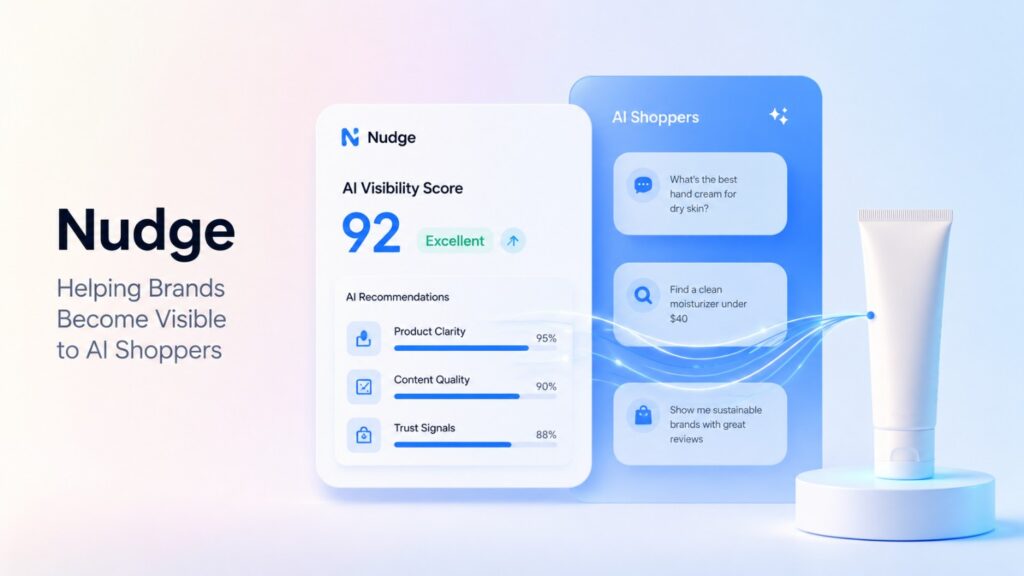
Nudge — Helping Brands Become Visible to AI Shoppers
Nudge is approaching the market from the retailer’s side.
The New York company raised $1.1 million in pre-seed financing in June 2026 and launched what it calls an Agentic Commerce Platform.
Its core argument reflects a problem many retailers are beginning to notice.
Brands spent years learning how to rank on Google. They now need to understand why ChatGPT, Gemini, Claude or another agent recommends one product over another.
That requires a new form of commerce optimization.
AI Visibility Is Becoming a New Marketing Discipline
Search engine optimization traditionally tries to make a webpage easy for Google to understand and rank.
Agent optimization is different.
An AI system may need clear product specifications, structured variants, trustworthy reviews, comparisons, evidence, prices, inventory and policies.
Nudge is betting that retailers will need systems that measure their presence inside AI recommendations and help make products easier for AI agents to interpret.
That could become extremely important if fewer shoppers start their journey on a traditional search results page.
Pango — Automating What Happens After Checkout
Most AI shopping conversations focus on discovery.
Pango focuses on what happens after somebody clicks buy.
Y Combinator lists the company as an active New York City startup founded in 2025. Pango describes its product as an agentic operating system for e-commerce operations covering delivery, tracking, returns, exchanges and customer service.
The company says it spent time working with dozens of e-commerce brands and found that many relied on five to seven separate tools to manage post-purchase operations. Its goal is to automate those workflows through AI agents.
Post-Purchase AI Is an Underrated Opportunity
Finding a product is only one part of commerce.
Customers also ask:
Where is my package?
Can I change the address?
Can I exchange medium for large?
Can I return one item from this order?
Can I get a refund?
These tasks are repetitive but operationally complicated.
That makes them a strong target for AI agents.
Our dataset contains fewer startups focused primarily on this stage, which suggests post-purchase commerce may still have more open space than product discovery.
Stylitics — A Reminder That AI Merchandising Started Before ChatGPT
Stylitics is the oldest company in our core group, but it belongs in the analysis because its work shows where shopping agents came from.
The New York company has spent years building automated outfitting, bundling and merchandising systems for major retailers. Stylitics raised an $80 million Series C in 2022, bringing its announced total funding to roughly $100 million.
Its technology helps retailers recommend complete outfits or related products instead of treating every item independently.
That idea becomes even more useful in an agentic environment.
A shopping agent answering “What should I wear to an outdoor September wedding?” needs to understand combinations rather than simply retrieve one dress.
Merchandising Intelligence Will Not Disappear
Large language models are powerful, but retailers still possess valuable information about assortment, inventory, margin, seasonality, product relationships and brand rules.
Companies such as Stylitics can help connect that merchant intelligence to AI-driven discovery.
The future is therefore unlikely to be a clean replacement of traditional recommendation technology.
More likely, generative interfaces will sit on top of increasingly sophisticated merchandising systems.
The Shopping Agent Stack Is Starting to Take Shape
When the nine New York companies are viewed together, a clearer architecture appears.
| Layer | What it does | NYC examples |
| Consumer intent | Understand what the shopper wants | Wizard, Daydream, Phia |
| Guided selling | Help shoppers decide | Remark, Stylitics |
| Product intelligence | Make products understandable to AI | Channel3, Nudge |
| Transaction | Turn recommendations into orders | Wizard, Shoppable, Remark |
| Merchant systems | Connect agents to retailers | Daydream, Remark, Channel3, Shoppable, Nudge |
| Post-purchase | Manage the order after checkout | Pango, Remark |
No one company needs to dominate every layer.
That could be good news for New York startups.
General AI platforms will have enormous advantages in distribution, but specialists can still own high-value infrastructure or category expertise.
Why Fashion Is Becoming the First Big Test for Shopping Agents
A striking share of New York’s activity is connected to fashion.
Daydream is entirely focused on fashion. Phia built its early growth around fashion price discovery. Remark has moved deeply into luxury shopping. Stylitics has years of experience in styling and outfitting.
This is probably not accidental.
Fashion Has an Intent Problem
Traditional e-commerce databases like concrete attributes.
Size: medium.
Color: navy.
Price: under $200.
But shoppers think differently.
“I need something for a rooftop dinner.”
“I want a bag that feels expensive but is not covered in logos.”
“I like this jacket but want something less corporate.”
These are reasoning problems.
Modern AI models are much better at translating those statements into product characteristics than old search systems.
Fashion Also Has a Confidence Problem
Many shoppers abandon purchases because they are unsure.
Will this fit?
What goes with it?
Is this worth $600?
Would another brand offer something similar?
Can I wear it to work?
AI can reduce that uncertainty before checkout.
Remark’s work on expert guidance and virtual try-on, Phia’s price comparison approach, Daydream’s style understanding and Stylitics’ outfitting all attack different parts of the same confidence gap.
That makes fashion an unusually good laboratory for agentic commerce.
AI Shopping Could Change the Economics of Customer Acquisition
For more than a decade, many retailers have rented traffic.
They pay Google.
They pay Meta.
They pay influencers.
They pay affiliates.
They pay marketplaces.
AI shopping agents could create another powerful intermediary.
That should make every commerce leader uncomfortable enough to prepare.
Product Discovery May Move Upstream
Today, a retailer can influence a shopper once the person lands on its site.
Tomorrow, an AI agent may narrow the entire market before the shopper arrives.
The retailer that never enters the recommendation set has no chance to convert.
This shifts some marketing work from persuading humans after the click to providing machines with enough information to consider the product before the click.
AI Traffic Already Looks Different
Adobe’s 2026 research found that AI-generated retail traffic was growing rapidly and producing stronger engagement than ordinary traffic. AI-referred visitors were increasingly arriving with high purchase intent.
This suggests that lower traffic does not automatically mean worse economics.
A brand may eventually receive fewer visits while converting a higher percentage because AI performs much of the research before the shopper arrives.
That would force marketing teams to rethink traffic as their primary success measure.
Product Pages Must Start Serving Machines as Well as Humans
Retail product pages were designed for people.
Now they also need to communicate with AI.
That does not mean stuffing pages with machine-generated text.
It means removing uncertainty.
An agent should be able to determine exactly what a product is, what makes it different, who it suits, what materials it uses, which variants exist, whether it is available, when it ships and how returns work.
Weak Product Data Becomes an AI Visibility Problem
Imagine two retailers selling similar winter coats.
Retailer A provides vague copy:
“Premium stylish coat perfect for every occasion.”
Retailer B provides actual evidence:
“Water-resistant wool blend, mid-thigh length, removable insulated liner, designed for temperatures between 25°F and 45°F, two interior pockets, relaxed fit.”
The second product gives an AI system far more useful information.
If a shopper asks for a warm but not overly heavy coat for a New York commute, Retailer B has a much better chance of matching the request.
This is the next version of product-page optimization.
Brand Loyalty May Become Harder to Defend
Retail brands have spent decades building shortcuts in the consumer’s mind.
Someone who trusts Nike may start at Nike.
Someone who loves Apple may not compare every laptop.
AI agents can weaken those shortcuts by making comparison easier.
Deloitte’s 2026 global retail research found that 81% of surveyed retail executives expected generative AI to weaken brand loyalty by 2027 by focusing shoppers more heavily on fit or value.
That does not mean brands disappear.
It means brands may need to repeatedly prove why their product is the right choice instead of relying solely on familiarity.
Strong Brands Still Have Advantages
AI also needs signals of trust.
Product reviews, independent coverage, return rates, customer satisfaction, durability information and brand authority can all help a recommendation system understand whether a product is credible.
Brands with real customer love may therefore perform extremely well.
The vulnerable companies are those whose advantage depends mainly on paid visibility rather than product strength.
Agentic Commerce Creates a New Attribution Problem
The affiliate economy already struggles with attribution.
AI agents make it harder.
Suppose a shopper sees a handbag on Instagram, researches it in ChatGPT, compares prices with Phia, reads Vogue, then buys through a retailer’s website after receiving a discount code.
Who created the sale?
Every participant may claim influence.
The Phia controversy in 2026 made this issue visible, but the underlying question is much larger than one company.
Retailers Need Incrementality, Not Just Attribution
The important question is not:
“Which tracking cookie appeared last?”
It is:
“Would this customer have bought without this agent?”
That is much harder to measure.
Retailers should begin running controlled experiments where some traffic or product groups receive agent exposure and others do not.
Measured lift in new customers, conversion, order value and contribution margin will be more useful than affiliate-attributed GMV alone.
Returns Could Become One of the Best Tests of Shopping-Agent Quality
An agent that increases conversion is valuable.
An agent that increases conversion by recommending the wrong products can destroy value through returns.
This matters especially in fashion.
If an AI stylist convinces more shoppers to buy but creates twice as many size or fit returns, the merchant may lose money.
Companies will therefore need to optimize for successful purchases, not simply purchases.
A strong commerce agent should eventually understand:
What was bought?
Was it returned?
Why was it returned?
Did the customer keep the replacement?
Did the customer purchase again?
That feedback can create a much stronger recommendation system over time.
The Winning Shopping Agent May Not Be the One With the Best Language Model
Retailers should be careful about assuming that the company with the smartest chatbot automatically wins.
Language models are improving quickly and becoming widely available.
Competitive advantage may come from everything surrounding the model.
That includes product data.
It includes merchant integrations.
It includes customer history.
It includes real purchase outcomes.
It includes checkout.
It includes trusted reviews.
It includes returns data.
It includes category expertise.
It includes the permission to act.

This is why companies such as Channel3 and Shoppable may matter as much as consumer-facing assistants.
The visible chatbot is only the front door.
What New York E-Commerce Companies Should Do Now
Retailers do not need to rebuild their business around agents tomorrow.
They should, however, start preparing now.
The right approach is controlled experimentation rather than a giant AI transformation program.
A Practical 90-Day Agentic Commerce Plan
| Period | Main goal | Practical work |
| Days 1–30 | Make products understandable | Audit catalog data, PDPs, structured data, policies and feeds |
| Days 31–60 | Measure AI visibility | Test major assistants, track citations/referrals and identify information gaps |
| Days 61–90 | Test one agentic experience | Launch a guided-shopping, conversational search or checkout pilot |
Days 1–30: Fix the Product Data Foundation
Start with the catalog.
Select your 50 or 100 highest-value products and ask whether a machine could understand them without guessing.
Review titles, descriptions, specifications, variants, pricing, availability, shipping information, return policies, sizing and imagery.
Then ask real shopping questions.
“Best jacket for commuting in New York rain under $250.”
“Minimal gold earrings for everyday office wear.”
“Small sofa for a narrow Brooklyn apartment.”
See whether the product information contains enough evidence to answer those questions.
Most retailers will find large gaps.
Write for Decisions, Not Keywords
Do not replace one SEO mistake with another.
The answer is not adding thousands of words of AI-generated copy to every product page.
The objective is decision usefulness.
Every important sentence should help a shopper or agent understand what the product is, who it is for or how it differs.
Days 31–60: Audit Your Brand Inside AI Systems
Create 30 to 50 realistic customer questions.
Run them through major AI discovery platforms and record what happens.
Does your brand appear?
Which competitors appear?
Which sources does the AI rely on?
Are your product prices correct?
Are old products being recommended?
Does the system understand your main differentiators?
This should become a recurring marketing exercise.
Search rankings are not enough anymore.
Measure AI Referral Traffic Separately
Analytics teams should identify traffic coming from generative AI platforms.
Do not mix it into referral traffic and forget about it.
Measure conversion, average order value, new-customer rate, bounce rate, revenue per session and returns separately.
Adobe’s data suggests AI traffic can behave differently from other channels, so retailers need their own numbers rather than assuming paid search benchmarks will apply.
Days 61–90: Test One High-Value Use Case
Avoid launching a generic chatbot simply because competitors have one.
Choose one place where shoppers clearly struggle.
A furniture retailer might build conversational product discovery.
A fashion brand might build occasion-based styling.
A beauty company might focus on routines.
An electronics retailer could build specification comparison.
A luxury company could test AI clienteling with human escalation.
A marketplace could test multi-product discovery and cart building.
Keep the experiment narrow enough that performance can be measured.
How Retailers Should Measure an AI Shopping Pilot
Traditional chatbot metrics are not enough.
A bot can answer thousands of questions while creating almost no business value.
The measurement framework should connect AI activity directly to commerce outcomes.
| Metric | Why it matters |
| Agent engagement rate | Shows whether shoppers actually use the experience |
| Product discovery rate | Measures whether useful products are surfaced |
| Recommendation click rate | Tests relevance |
| Assisted conversion rate | Measures purchases after agent interaction |
| Incremental conversion lift | Shows whether the AI caused additional sales |
| Average order value | Tests whether guidance improves basket quality |
| Units per order | Useful for styling and bundling agents |
| Return rate | Protects against low-quality recommendations |
| Gross margin after returns | Measures economic value instead of headline GMV |
| New-customer rate | Shows whether agents expand acquisition |
| Human escalation rate | Reveals where AI still fails |
| Customer satisfaction | Measures trust |
| Cost per assisted order | Tests whether the system is economically scalable |
The most important metric may eventually be incremental contribution margin per agent-assisted shopper.
That measure forces retailers to account for revenue, discounts, returns, agent fees and operating costs at the same time.
New SEO Will Include Optimization for AI Recommendations
Search engine optimization is not disappearing.
But it is becoming one part of a larger discovery strategy.
Retailers increasingly need to think about whether their information can be extracted, understood and trusted by AI systems.
That includes merchant feeds, product pages, reviews, editorial coverage, structured data, third-party references and price information.
AI Agents Need Evidence
A model can understand persuasive marketing language.
That does not mean it will trust it.
Claims such as “best,” “premium” or “revolutionary” are weak unless supported.
Brands should provide specific evidence.
If a product is lightweight, provide the weight.
If a jacket is waterproof, explain the rating or material.
If an appliance is quiet, publish the measured noise level.
If a skincare product is designed for a particular skin type, explain why.
Detailed product evidence helps both humans and machines.
Merchants Must Decide How Much Control to Give Outside Agents
There is a strategic question hiding beneath the technical work.
Who should own the customer interface?
An independent agent may create enormous demand for a retailer, but it may also sit between the retailer and the consumer.
The same tension already exists with Amazon, Google, social networks, delivery platforms and travel aggregators.
Shopping agents could make it stronger.
There Are Three Likely Models
One model is the general agent, where consumers shop through platforms that span many merchants.
Wizard is moving in this direction.
The second is the specialist agent, where consumers use a system focused on a category such as fashion.
Daydream and Phia fit this model more closely.
The third is the merchant-owned agent, where the intelligence lives inside a retailer or brand experience.
Remark, Stylitics and Daydream’s embedded search products show how this could work.
Retailers should probably prepare for all three.
Trust Will Become the Real Moat
Shopping agents must convince two groups at once.
Consumers need to trust the recommendations.
Merchants need to trust the economics.
That is difficult.
Consumers Will Ask Whether Recommendations Are Truly Best
If the agent recommends Brand A, shoppers will eventually want to know why.
Was it the best product?
Did the brand pay?
Did the agent earn a bigger commission?
Was it simply easier to transact?
Was another product excluded because its merchant data was poor?
Recommendation transparency will become increasingly important.
Merchants Will Ask Whether Agents Create Real Sales
Retailers will ask different questions.
Did the agent bring a new shopper?
Did it increase conversion?
Did it increase returns?
Did it override another affiliate?
Did it push unnecessary discounts?
Did the agent preserve the customer relationship?
An agent that cannot answer these questions may struggle to maintain merchant trust even if consumers enjoy the product.
The Biggest Opportunity May Be the Agent That Knows When Not to Act
There is a tendency in AI product design to celebrate autonomy.
More automation is treated as progress.
Shopping may be different.
A good agent should understand the boundaries of its authority.
Buying the same dishwasher tablets every two months may be appropriate for automation.
Choosing a $2,000 sofa probably needs confirmation.
Buying an anniversary gift almost certainly deserves human involvement.
European McKinsey research has already found stronger consumer acceptance of AI assistance than autonomous purchasing. Consumers were comfortable with recommendation support while showing greater resistance to giving AI full control of recurring purchases.
The best shopping agents may therefore feel less like robots and more like excellent assistants.
They do the research.
They remove tedious work.
They explain the options.
They act when permission is clear.
And they stop when human judgment matters.
Where NYC’s AI Shopping Market Still Has Open Space
Our research suggests several parts of the stack remain less crowded.
Post-purchase automation is one.
Merchant-neutral product infrastructure is another.
Agent identity and authorization could become another major category.
Independent attribution infrastructure is also likely to matter.
Returns intelligence is particularly interesting because it can help agents learn not simply what people buy, but what they regret buying.
Local commerce is another open opportunity.
Imagine an agent that understands which products are available within walking distance in Manhattan, which store has your size in Williamsburg, whether same-day delivery is possible in Queens and which nearby retailer offers the best combination of price and convenience.
New York would be an unusually strong market for testing that experience.
What Could Happen Over the Next Three Years
The safest prediction is not that autonomous agents will suddenly buy everything for everyone.
The transition will probably happen in stages.
First, AI becomes a normal research tool.
That is already happening.
Next, conversational search becomes a standard feature of retail sites and shopping applications.
We are seeing this now through companies such as Daydream, Wizard and Remark.
Then, more agents gain reliable checkout capability through merchant APIs and standards such as UCP, MCP and agent-focused payment systems.
Finally, consumers may delegate specific repeatable purchases once the trust model becomes strong enough.
The key word is specific.
Consumers do not need to hand their entire wallet to AI for agentic commerce to become a huge market.
The Bigger Shift Is From Browsing to Delegation
E-commerce was built around browsing.
Open a store.
Look around.
Filter.
Scroll.
Compare.
Decide.
AI allows the shopper to delegate pieces of that work.
“Find the best three.”
“Compare these.”
“Watch the price.”
“Build the outfit.”
“Tell me which has better reviews.”
“Buy it if the price falls below $150.”
“Exchange it for medium.”
Every instruction removes another manual step.
That is the deeper transformation.
What This Means for New York Founders
There is still plenty of room to build.
But another generic shopping chatbot will not be enough.
The strongest startups are likely to own something difficult.
That could be extraordinary product data.
It could be a large merchant network.
It could be category-specific intelligence.
It could be payments.
It could be post-purchase operations.
It could be trusted attribution.
It could be return prediction.
It could be proprietary consumer preference data.
It could be a workflow retailers cannot easily replace.
The language model should make the product better.
It should not be the entire business.
What This Means for New York Retailers
The most dangerous response is waiting for the final winner.
There probably will not be one final platform.
Consumers may use several agents, just as they currently use search engines, social networks, marketplaces, retailer apps and review sites.
Retailers therefore need adaptable infrastructure.
Products should be easy for AI systems to understand.
Inventory should be accurate.
Policies should be explicit.
Checkout should be easy to connect.
Attribution should be measurable.
Customer data should be protected.
Brand information should be consistent across the web.

And teams should know how agent-driven shoppers behave differently from ordinary visitors.
Those foundations will remain useful regardless of which agent becomes popular.
Conclusion: New York Is Building More Than AI Shopping Apps
The biggest lesson from New York’s emerging AI shopping ecosystem is that agentic commerce is much larger than a chatbot recommending sneakers.
Our analysis identified at least $281.5 million in disclosed funding behind a focused group of New York companies spanning consumer shopping agents, AI merchandising, product data, checkout and post-purchase automation.
The money is currently concentrated near the front of the shopping journey. Roughly half of the measured capital sits in consumer-facing shopping agents, while another large share sits in merchant-side shopping and merchandising technology. Only a small portion of the disclosed funding in our sample is currently concentrated in pure agentic-commerce infrastructure.
That imbalance may create opportunity.
As AI moves from answering “What should I buy?” to actually helping people buy it, the hard problems become product data, permissions, payments, merchant connections, attribution, trust, fulfillment and returns.
New York already has startups working across nearly every one of those layers.
For retailers, the message is not to replace their website with an AI agent.
It is to make the business ready for a world in which AI becomes another customer interface.
For founders, the opportunity is not simply building a smarter search box.
It is deciding which part of the new commerce stack is valuable enough, difficult enough and trusted enough to own.
The first generation of e-commerce asked businesses to put their stores online.
The next may ask them to make their entire business understandable and actionable to software.
That transition has already started.