

Artificial intelligence is starting to change almost every part of shopping, but the most important changes are not always the ones consumers can see.
Some AI companies are building shopping assistants that understand a request such as, “Find me a black dress for a rooftop wedding under $300.” Others are helping retailers decide which products belong together, predict trends, improve product data, process returns, find missing inventory, manage stores, recover lost revenue, or remove checkout lines.
New York City has quietly become one of the most interesting places to watch this shift.
That makes sense. New York combines several industries that matter to retail technology in one place. It has fashion brands, department stores, luxury companies, advertising agencies, consumer startups, large retailers, venture investors, and thousands of physical stores. A retail AI company can build software in Manhattan and test the idea against some of the hardest retail problems in the world without leaving the city.
The market is also moving much faster than it was even two years ago. Shopping search is becoming conversational. Product catalogs are being prepared for AI agents. Merchandising is becoming more automated. Physical stores are getting smarter. Post-purchase operations are being handed to software agents.
NYC Tech Journal’s analysis of Y Combinator’s current New York retail startup directory shows just how important AI has become. YC currently lists 12 active retail startups headquartered in New York. Nine of those 12 explicitly describe themselves as using AI or machine learning, or have AI in their YC category tags. That works out to 75% of the active NYC retail cohort in our analysis.
That does not mean 75% of all New York retail startups use AI. The YC directory is only one sample. It does, however, offer a useful signal: among one of the world’s most closely watched startup portfolios, AI has moved from being a small retail feature to becoming a core part of how many new New York retail companies are being built.
This article looks at the startups leading that change, explains where the real opportunities are, and provides original NYC Tech Journal research on where retail AI appears to be heading next.
NYC Tech Journal Original Research: How We Studied New York’s Retail AI Market
Before ranking companies, we needed a clear definition of what counts as a retail AI startup.
Simply searching for companies that put “AI” on their homepage would create a weak list. Almost every software company can now add an AI feature. That does not mean AI is central to the product.
For this analysis, we looked for New York companies where artificial intelligence, machine learning, computer vision, AI agents, recommendation systems, generative AI, or related technologies are important to the main retail problem being solved.
We also separated active independent companies from businesses that have already been acquired.
That distinction matters in 2026.
Bluecore, for example, was one of New York’s most important retail technology companies. It raised more than $225 million and reached a $1 billion valuation while building AI-driven retail marketing technology. But Insider One acquired Bluecore on May 13, 2026. It therefore belongs in the story of New York retail AI, but it should no longer be presented as an independent NYC startup.
Caper AI is another important New York success story. Instacart acquired the smart-cart and checkout startup for approximately $350 million in 2021. Its technology used AI and computer vision to make physical shopping and checkout easier.
Those exits matter because they show that New York has already produced retail-AI technology valuable enough for large commerce platforms to buy.
Our Research Method
NYC Tech Journal reviewed publicly available information from company websites, funding announcements, Y Combinator’s company directory, investor pages, customer case studies, press releases, and New York economic data.
For the original analysis, companies were coded into four broad areas:
| Retail AI layer | What the technology does |
| Shopping and discovery | Helps consumers search, compare, discover or choose products |
| Merchandising and product intelligence | Improves recommendations, styling, catalogs, content and product data |
| Store and retail operations | Helps physical stores manage inventory, checkout, security or staff workflows |
| Back-office commerce operations | Automates returns, logistics, deductions, customer service or other operational work |
We also looked at publicly disclosed fundraising for companies where reliable figures were available. Private startup funding data is often incomplete, so the capital analysis below should be read as a public-disclosure sample, not a complete estimate of all money invested in New York retail AI.
That limitation is important. Good original research should explain where the data ends instead of pretending private-company information is complete.
Original Research Finding #1: AI Now Dominates NYC’s Newest Retail Startup Cohort
Y Combinator currently lists 14 New York retail startups. Two are marked as acquired, leaving 12 active companies.
Our review found that nine of the 12 active companies clearly use AI or machine learning as part of the business.
Chart: AI Adoption in the Active YC New York Retail Cohort
| Category | Companies | Share |
| Explicit AI or machine-learning focus | 9 | 75% |
| No clear AI-first positioning in public YC description | 3 | 25% |
| Total active companies | 12 | 100% |
NYC Tech Journal analysis of Y Combinator’s September 2026 New York retail directory.
The nine companies include Pango, Channel3, Kirana AI, Handled, Airgoods, Vendora, Glimpse, SPATE and RADAR. Their products cover everything from post-purchase automation and grocery management to trend prediction and autonomous checkout.
What makes this important is not simply the number.
The companies are using AI in very different places.
Retail AI is no longer just a recommendation engine sitting underneath an online store. It is moving across the entire retail operating system.
Original Research Finding #2: The Biggest Opportunity Is Moving Beyond Recommendations
For years, “AI in retail” often meant one thing: suggesting another product.
You viewed a pair of shoes. The website recommended a shirt.
That model is becoming much more advanced.
Our review of leading New York retail AI companies shows four distinct layers forming.
Chart: Where NYC Retail AI Companies Are Building
Using 12 of the strongest active NYC examples covered in this article:
| AI layer | Companies in our sample | Share |
| Shopping, discovery and merchandising | 6 | 50% |
| Back-office and post-purchase automation | 3 | 25% |
| Physical-store intelligence | 2 | 17% |
| Wholesale and procurement intelligence | 1 | 8% |
Source: NYC Tech Journal coding of company products and public descriptions.
The biggest group still works close to the shopper. That includes companies such as Stylitics, Daydream, Wizard, FindMine, Channel3 and SPATE.
But half of our sample works elsewhere.
Pango, Handled and Glimpse use AI to reduce expensive operational work. RADAR and Kirana AI focus on physical stores. Airgoods applies AI to how independent grocers discover and purchase inventory.
That suggests the next phase of retail AI will not simply make websites feel smarter.
It will make retail companies operate differently.
Original Research Finding #3: Publicly Disclosed Funding Is Highly Concentrated
We also compared five New York retail-AI companies for which reasonably clear public financing numbers could be established.
Stylitics has reported approximately $100 million in total funding. Daydream announced a $50 million seed round. Wizard announced a $50 million Series A. FindMine has reported multiple funding rounds, while CB Insights currently reports approximately $19.1 million raised. Channel3 announced a $6 million seed round in December 2025.
Chart: Publicly Disclosed Capital in a Five-Company NYC Sample
| Company | Publicly reported capital | Share of sample |
| Stylitics | ~$100M | 44.4% |
| Daydream | $50M | 22.2% |
| Wizard | $50M | 22.2% |
| FindMine | ~$19.1M | 8.5% |
| Channel3 | $6M | 2.7% |
| Total | ~$225.1M | 100% |
Source: NYC Tech Journal calculations using publicly reported financing.
The three largest companies in this five-company sample account for roughly 88.8% of disclosed capital.
That concentration tells us something useful.
Investors appear willing to put large amounts of money behind companies trying to rebuild major consumer shopping experiences or create large enterprise platforms. Younger infrastructure companies can start with much smaller rounds, but the capital requirements rise quickly when a company wants to aggregate huge catalogs, train proprietary systems, support major retailers or acquire consumers at scale.
Why Retail AI Matters So Much in New York City
Retail remains a major part of New York’s economy even as the industry becomes more digital.
The New York City Comptroller reported roughly 297,000 retail trade jobs in January 2026. The sector had lost about 1,900 jobs compared with January 2025.
The earlier December 2025 data told a similar story. Retail employment stood at roughly 290,600 jobs, down about 6,200 over 12 months.
Those numbers should not be interpreted to mean AI caused those job losses. Many forces affect retail employment, including consumer spending, store closures, rents, labor costs, economic conditions and changes in where people shop.
But the numbers do explain why retailers care so much about productivity.
New York is an expensive place to operate. Rent is expensive. Labor is expensive. Inventory mistakes are expensive. Returns are expensive. Bad merchandising is expensive.
A technology that increases conversion by a few percentage points or removes hours of manual work can therefore have a large financial effect.
This is exactly the environment in which retail AI startups can prove whether their products create real value.
Top Retail AI Startups in NYC
1. Stylitics — Building an AI Merchandising Layer for Major Retailers
Stylitics is one of the clearest examples of a New York company that was working on retail AI long before generative AI became fashionable.
The company is headquartered in New York and focuses on automated outfitting, bundling, product intelligence, imagery and personalization.
Its basic idea is simple.
A shopper normally sees individual products on a retailer’s website. Stylitics helps retailers show how those products work together.
A customer viewing a jacket might see a complete outfit built around that jacket. A person browsing furniture might see coordinated products that make a whole room work.
That changes the commercial goal from selling one item to helping a shopper solve a larger need.
Stylitics says its current platform supports more than 150 enterprise retailers, processes more than $60 billion in annual transaction data, sees roughly 30 billion product-page views a year and works across more than 5,000 brands.
Those numbers are company-reported, but they show the scale at which vertical retail AI can operate.
Why Stylitics Matters
Stylitics is particularly interesting because it combines algorithms with years of retail-specific data.
That could become an important competitive advantage.
Retailers can access powerful general AI models from many providers. What they cannot instantly recreate is a decade of information showing which products fit together, how merchandisers make decisions, what shoppers click, what shoppers buy and which recommendations work for different retailers.
Stylitics said in 2023 that its systems were recommending outfits and bundles across more than 50 billion shopper sessions per year. It also reported a 23% increase in units per transaction and a 21% increase in average order value among participating retailers.
These are vendor-reported results rather than independent industry benchmarks, so retailers should validate performance against their own control groups.
Still, the direction is important.
The strongest retail AI companies are increasingly selling outcomes instead of AI features.
2. Daydream — Rebuilding Fashion Search Around Conversation
Traditional ecommerce search asks shoppers to convert what they want into keywords.
That is often a terrible way to shop.
A person may know that she needs an outfit for a July wedding in Italy, wants something relaxed rather than formal, prefers certain brands and has a $400 budget. Traditional search systems usually force that person to translate the need into a sequence of filters.
Daydream is trying to reverse that process.
The New York company was founded by ecommerce veteran Julie Bornstein and a team with deep retail and technology experience. In June 2024, Daydream announced a $50 million seed round co-led by Forerunner Ventures and Index Ventures, with participation from GV and True Ventures.
The company built a conversational fashion shopping experience using generative AI, machine learning and computer vision.
Instead of typing “blue summer dress,” a shopper can explain what she actually needs.
Daydream opened its AI shopping product more broadly in June 2025. Users can describe a situation in natural language or upload an image and then refine the search conversationally.
Why Daydream Matters
Daydream represents one of the biggest possible changes in ecommerce.
Search could move from:
keyword → filter → product grid
to:
intent → conversation → small set of suitable products
That sounds like a small interface change.
It is not.
If this model works, the search box stops behaving like a database query and starts behaving more like an experienced salesperson.
That could change what product data retailers need, how brands get discovered and even how merchants think about search engine optimization.
3. Wizard — Building an AI-Native Shopping Agent
Wizard is pursuing an even broader version of conversational shopping.
The New York company publicly launched its AI shopping agent in February 2026 after spending several years developing conversational commerce technology.
Wizard is co-founded by Marc Lore and Melissa Bridgeford. The startup previously raised a $50 million Series A led by NEA, with participation from Lore and Accel.
Its current product searches for products across the web, compares choices and attempts to help consumers move toward checkout.
Wizard says its system can interpret complex queries such as looking for noise-canceling headphones suitable for both travel and the gym under a certain price. It then analyzes product information, customer reviews and editorial information before ranking options.
The company also launched with a Best Buy relationship that included native checkout functionality.
The Bigger Question Wizard Is Testing
Wizard is testing whether shopping agents can become destinations themselves.
Today, consumers often begin shopping with Google, Amazon, a retailer’s website, TikTok, Instagram or a marketplace.
AI agents could add another starting point.
The winner may be the company that reduces the greatest amount of work between “I need something” and “I bought the right thing.”
That means accuracy matters more than conversation alone.
A shopping agent must understand products, compare prices, identify trustworthy sellers, process availability, consider reviews, understand personal preferences and eventually handle payment reliably.
Building a chatbot is easy.
Building a shopping agent people trust with real purchasing decisions is much harder.
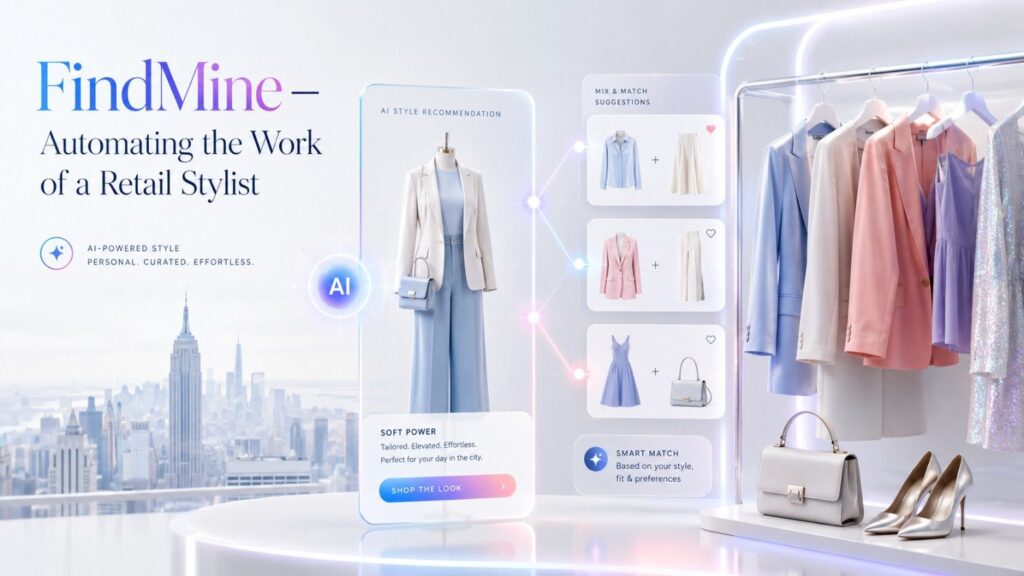
4. FindMine — Automating the Work of a Retail Stylist
FindMine tackles one of retail’s oldest problems.
A good salesperson does not simply hand customers the item they requested. The salesperson shows them how to use it.
FindMine uses AI to automate that idea across ecommerce.
The New York company generates outfits, product combinations and contextual merchandising that help consumers understand how products can work together. It says its content reaches more than 100 million consumers each month.
FindMine was founded in 2014 and remains headquartered in New York. Its customers have included well-known retailers and brands such as Gap and Anine Bing.
The company has raised multiple financing rounds. CB Insights reports approximately $19.1 million in total funding, including an $8.9 million Series A in 2024.
Where FindMine Gets Interesting
FindMine’s value is not simply generating another “complete the look” widget.
The deeper opportunity is automating merchandising decisions across enormous product catalogs.
A large retailer might have tens or hundreds of thousands of products.
Human merchandising teams cannot manually create useful combinations for every item, every shopper, every inventory situation and every channel.
Software can.
FindMine says one Fortune 500 retailer expanded the product from two initial brand-market deployments to ten brand-market deployments across three countries. The company reports $888 million in FindMine-influenced revenue for that portfolio during 2025.
Again, “influenced revenue” is not the same thing as incremental revenue caused entirely by the software. Decision-makers should examine test design carefully.
The case still shows why AI merchandising is becoming strategic: automation lets retailers apply merchandising logic to a scale that would be impossible for people alone.
5. Channel3 — Building Product Infrastructure for AI Shopping Agents
Shopping agents have an enormous hidden problem.
The internet does not contain one clean database of every product.
A pair of shoes might be listed differently by five retailers. Product names may vary. Images may vary. Sizes may be structured differently. Colors may have different names. One merchant may have incomplete specifications.
Humans can often look at those pages and understand that they refer to the same product.
Computers need structured information.
Channel3 is building infrastructure for this problem.
The New York startup wants to create a connected product database that developers can use when building new shopping experiences. Y Combinator describes Channel3 as creating a database of products across the internet and using image classification and reasoning models to identify matches and variants.
In December 2025, Channel3 announced a $6 million seed round led by Matrix, with participation from several additional investors.
Why Product Data Could Become Extremely Valuable
AI shopping creates a strange shift in ecommerce.
For decades, stores were designed mainly for humans.
Now product catalogs may increasingly need to be understandable to machines acting on behalf of humans.
An agent needs to know that two listings represent the same item. It needs accurate price, availability, shipping information, specifications, attributes and merchant information.
That could make the product graph one of the most important infrastructure layers in agentic commerce.
Channel3 is therefore not simply another consumer shopping assistant.
It is trying to build plumbing that many shopping assistants could eventually use.
6. RADAR — Bringing Machine Intelligence Into Physical Stores
Online retailers know a great deal about shopper behavior.
They know what people search, what they click, which products they view, what they put in their carts and where they leave the purchase process.
Physical stores are much harder to measure.
RADAR has spent years trying to close that gap.
Y Combinator describes New York-based RADAR as an RF sensing platform designed to automate and improve retail-store processes. Its system can support inventory counts, replenishment, stock checks and autonomous checkout while also giving stores information about interactions between customers and products.
This matters because physical retail still contains enormous information gaps.
A retailer’s inventory system may say an item is in the store while nobody knows exactly where it is.
A shopper may want a product that is sitting in the wrong area.
Employees may spend time counting inventory instead of helping customers.
Physical Retail Is Becoming a Data Problem
The long-term opportunity is bigger than checkout.
A digitally aware store could continuously understand where inventory is, which items customers interact with, what needs replenishment and where operations are breaking.
That makes the store behave more like a measurable digital environment.
New York is a strong place to test that idea because store economics are unforgiving. Even small improvements in space productivity, labor efficiency and inventory accuracy can matter when operating costs are high.
7. Glimpse — Using AI to Recover Money Retailers and Brands Lose
Not every important retail AI company works on something visible to shoppers.
Glimpse is a good example.
The New York startup uses AI to automate financial and back-office workflows for consumer packaged goods companies.
Y Combinator says Glimpse’s agents can work on deductions management, revenue recovery and cash application. In one example published by YC, an agent reviewed 17,000 deductions in less than 24 hours and identified more than $10 million in revenue for a $1 billion CPG company.
The point is not that every company will achieve that result.
The important idea is that a large amount of retail work happens after products have already been manufactured, shipped or sold.
Invoices need to be checked. Retail deductions need to be reviewed. Claims must be investigated. Payments need to be matched.
Much of this work involves reading documents, comparing information and following rules.
Those are exactly the kinds of workflows where AI agents are improving quickly.
AI May Create More Value in Boring Work
Consumer-facing AI receives more attention because it is easy to demonstrate.
Back-office AI may sometimes produce a clearer financial return.
If software can recover money that would otherwise be lost, reduce outside service costs or prevent companies from hiring additional operational staff, the ROI can be measured directly.
That is one reason enterprise retail AI could become a much larger category than consumer shopping apps alone.
8. Pango — Building an Agentic Operating System for Ecommerce
Every ecommerce order creates work.
A package needs to leave a warehouse. Tracking information must update. Delays happen. Customers request returns. Refunds need approval. Shipping labels need to be created. Carriers may need to be contacted.
Fast-growing ecommerce companies often solve these problems by adding tools and people.
Pango wants AI agents to do much of that work instead.
The New York startup is part of Y Combinator’s Summer 2026 batch. YC describes Pango as an “agentic OS for e-commerce operations” that handles areas such as deliveries, tracking, returns, transport and customer service.
Pango says it spent about 12 months studying operations across 30 ecommerce brands before building the product. It claims its system has automated 99% of returns and shipping operations in some deployments and reduced operational costs by 20%. Those figures are company-reported and should be independently validated during procurement.
Why Pango Represents the Newest AI Wave
Older automation software follows fixed rules.
AI agents promise something different.
Instead of configuring every workflow in advance, a company can increasingly describe what it wants to happen.
The system then handles tasks across connected tools.
That model could be especially valuable in ecommerce because no two merchants operate exactly the same way.
Returns policies differ. Warehouses differ. Carriers differ. Markets differ. Customer-service policies differ.
The ability to reason across those differences could allow AI-native operating systems to replace collections of narrow tools.
9. Handled — Automating Everything That Happens After Checkout
Handled is working on a problem similar to Pango from another angle.
The New York company focuses on post-order operations for ecommerce brands and third-party logistics companies.
Y Combinator describes the problem clearly: after an order is placed, operations teams still spend large amounts of time checking shipments, processing returns, handling invoices, resolving exceptions and responding to internal requests.
Handled combines order, warehouse, carrier and support information into an operational layer that can detect problems and perform follow-up actions automatically.
That could include handling shipping delays, filing claims, processing returns or adjusting orders.
Why This Market Could Grow Quickly
Post-purchase operations are often invisible until something fails.
When everything works, customers barely notice.
When something breaks, the retailer may need several employees and several software systems to solve one problem.
AI agents are well suited to these workflows because much of the work involves gathering information, understanding an exception, deciding which rule applies and taking actions across other systems.
That is more difficult than generating text.
But it is also much more valuable.
10. Airgoods — Using AI to Modernize Independent Grocery Distribution
Retail technology often focuses on large chains.
Independent stores face many of the same problems but usually have fewer engineers, smaller technology budgets and less negotiating power.
Airgoods is trying to change part of that equation.
Y Combinator describes the New York company as an AI-native distributor serving independent grocers. Its technology combines data and automation across product discovery, purchasing, receiving and merchandising.
That makes Airgoods interesting because it brings AI into the relationship between stores and suppliers rather than focusing only on the consumer.
Procurement Is Another AI Opportunity
Imagine a small grocery owner deciding what to stock.
The owner needs to know which products are selling, what customers want, which new brands are growing, how much inventory is available and what margins different items produce.
Large retailers can employ teams of analysts and buyers.
Independent stores cannot.
AI could give smaller operators some of the decision support that was historically available only to much larger organizations.
This is one reason AI could eventually have a democratizing effect on retail technology.
The largest retailers will still have data advantages. But sophisticated decision tools may become much cheaper.
11. Kirana AI — Building an AI Store Manager
Kirana AI takes the idea of store automation further.
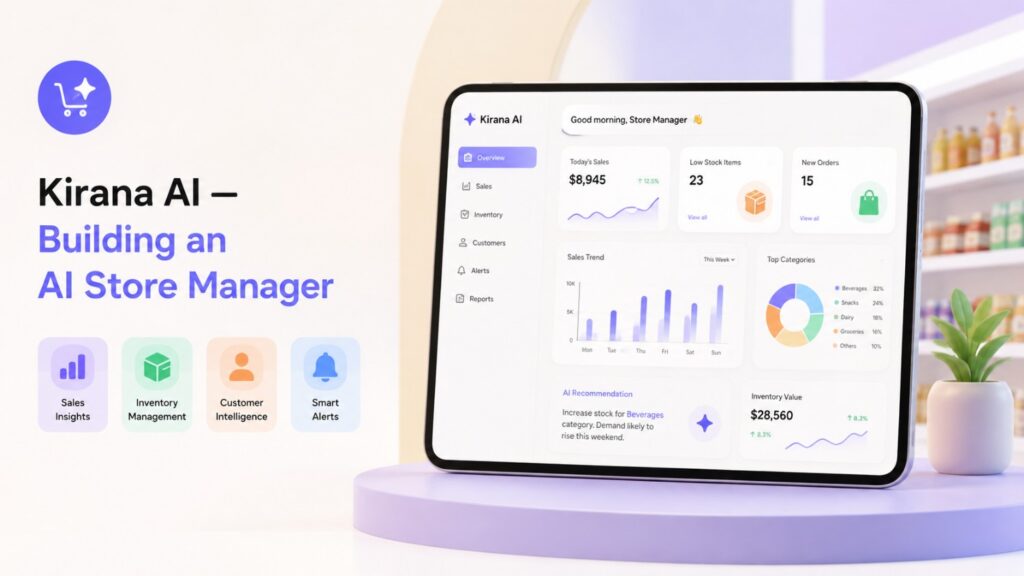
Y Combinator describes the New York startup as building a “full-stack AI store manager,” beginning with grocery stores.
Its early system uses an on-premise GPU to monitor stores, detect theft, identify health and safety problems and improve customer service. The company’s longer-term plan includes using point-of-sale and ordering information to automate tasks such as pricing, assortment and ordering.
This is a much broader vision than putting a camera in a store.
The goal is to give the store a software intelligence layer.
Store Management Could Become Partly Autonomous
A modern store generates a constant stream of small decisions.
Does this shelf need restocking?
Is shrink increasing in one part of the store?
Should more of a certain product be ordered?
Is a safety problem developing?
Which task should an employee handle next?
Most stores still depend heavily on people noticing problems and deciding what to do.
A good AI store manager could watch more variables continuously than any human manager can.
The challenge will be trust.
Retailers will need to know when the AI is correct, when people should override it and how decisions are documented.
12. SPATE — Using Machine Intelligence to Find Consumer Trends
SPATE approaches retail from the demand side.
The New York company uses machine intelligence to identify emerging trends, particularly in areas such as beauty and food.
Y Combinator describes SPATE as a machine-intelligence platform that helps companies identify trends and notes examples including turmeric, face masks and cold brew.
Trend intelligence sounds less dramatic than AI shopping agents.
For retailers and consumer brands, however, it can be extremely valuable.
If a company notices a shift in consumer demand months earlier than competitors, that information can influence product development, purchasing, marketing and inventory.
Prediction Matters Before the Product Reaches the Shelf
Retail AI is often discussed at the moment of sale.
But enormous decisions happen months before a shopper sees anything.
Brands decide what to design. Merchants choose what to purchase. Marketing teams decide what stories to promote.
AI that detects changing consumer interest can influence all of those decisions.
This means the real retail AI stack begins much earlier than ecommerce search.
New York’s Retail AI Market Is Splitting Into Two Major Camps
The companies above may look very different, but the market is beginning to organize around two large ideas.
Camp One: Make Shopping Easier
Daydream, Wizard, Stylitics and FindMine sit close to the customer.
Their goal is to reduce one of ecommerce’s biggest problems: too much choice with too little useful guidance.
Traditional ecommerce gave shoppers access to enormous catalogs.
The next generation of software is trying to help people understand those catalogs.
That changes the question from:
“What products match these keywords?”
to:
“What should this specific person buy for this specific need?”
Camp Two: Make Retail Operations More Autonomous
Pango, Handled, Glimpse, Kirana AI, Airgoods and RADAR work closer to the operating system of retail.
They are trying to reduce repetitive work, catch problems earlier and make more decisions automatically.
This category may eventually have the larger economic impact.
Every retailer has operational work.
Not every retailer needs another consumer shopping app.
AI Shopping Agents Could Change How Retailers Get Discovered
One of the most important questions for New York brands is what happens when the consumer is no longer the only person browsing the website.
Imagine asking an AI agent:
“Find me five men’s waterproof jackets under $250 that can handle a New York winter, are available in medium, have strong reviews and can arrive before Friday.”
The agent might check dozens of merchants.
The shopper may never visit most of those sites.
That creates a new type of competition.
Product Data Becomes Marketing
Retailers traditionally invest heavily in photography, copywriting, SEO and advertising.
Those things will remain important.
But AI agents need structured facts.
They need accurate product attributes, availability, shipping information, sizing, price, material details and return policies.
A beautiful product page with incomplete machine-readable information could become less competitive in an agent-driven world.
Companies such as Channel3 are effectively betting on this shift.
Retailers May Need “Agent Optimization”
SEO helps a company become understandable and attractive to search engines.
Retailers may eventually need a similar discipline for shopping agents.
The goal will not be tricking an AI model.
It will be making product information complete, reliable, structured and easy for machines to use.
Brands with clean catalogs could gain an advantage.
Brands with messy product data could disappear from AI-generated recommendations even if their products are excellent.
Visual Merchandising Could Become Almost Infinite
Traditional merchandising has a scaling problem.
A human team may create several outfits for a product.
AI can potentially create hundreds.
But volume alone is not useful.
The combinations need to match the brand, stay within current inventory, make commercial sense and feel useful to customers.
This is why companies such as Stylitics and FindMine may have stronger defenses than their basic product descriptions suggest.
The valuable asset is not simply the ability to generate combinations.
It is knowing which combinations should exist.
AI Could Merchandise Each Shopper Differently
Imagine two customers viewing the same jacket.
One usually buys minimalist clothing.
The other prefers bright streetwear.
The retailer does not necessarily need to show both shoppers the same outfit.
AI merchandising could eventually assemble a different store around each visitor.
That is much more powerful than today’s basic personalization.
Instead of changing the order of products, the retailer changes the way products are presented together.
Physical Stores May Become Much More Measurable
New York is also an important test market because physical stores remain central to the city.
Online shopping generates extremely detailed data.
A store often does not.
Retailers may know that an item sold, but they may know much less about what happened before the sale.
Did shoppers pick it up?
Did they try to find another size?
Was the item difficult to locate?
Was the shelf empty for two hours?
Did customers abandon the purchase because checkout took too long?
Technologies from companies such as RADAR and Kirana AI could help close those information gaps.
The Goal Is Not Necessarily a Store Without Employees
Much of the conversation about retail automation focuses on eliminating labor.
That is too narrow.
A more useful model is using AI to eliminate low-value tasks so employees can spend more time doing work customers actually value.
If software continuously counts inventory, employees do not need to.
If an AI system finds a missing product, workers do not need to search the stockroom manually.
If operational software automatically resolves routine exceptions, managers can focus on unusual problems.
The best retail AI deployments may therefore change jobs more than they remove them.
Why New York Is an Ideal Test Market for Retail AI
New York is unusually difficult for retailers.
That is exactly what makes it useful.
NYC Has Almost Every Type of Shopper
Luxury shoppers, tourists, students, office workers, families and price-sensitive consumers can all exist within a few subway stops.
That diversity makes personalization harder.
It also makes successful technology more meaningful.
A system that works across New York’s customer base has been tested against many types of shopping behavior.
Fashion Gives NYC a Natural Advantage
New York is one of the world’s major fashion centers.
That matters for companies such as Stylitics, FindMine and Daydream.
Fashion search is difficult because shoppers often cannot describe exactly what they want.
Taste matters.
Context matters.
Fit matters.
Brand matters.
Visual similarity matters.
That creates a rich environment for AI systems that combine language, images, product knowledge and personalization.
The City’s Costs Force ROI Discipline
New York businesses cannot afford technology experiments forever.
Software eventually needs to save money or make money.
That is healthy for the startup ecosystem.
It pushes retail-AI companies toward measurable problems.
Can conversion increase?
Can returns fall?
Can inventory productivity improve?
Can employee time be saved?
Can lost revenue be recovered?
Can average order value rise?
Those are better questions than asking whether a demo looks impressive.
What Retail Leaders Should Learn From NYC’s AI Startups
The biggest mistake retailers can make in 2026 is starting with the question, “Where can we add AI?”
That produces random pilots.
Start with the economic problem.
Find the Expensive Friction
Look across the shopping journey and ask where customers or employees are wasting the most time.
Search may be poor.
Product data may be incomplete.
Merchandising may require too much manual work.
Customer-service teams may handle the same questions repeatedly.
Returns may consume too much labor.
Inventory may be difficult to locate.
Deductions may be leaking money.
Each problem requires a different type of AI.
Choose One Measurable Outcome
A pilot should have one primary business metric.
For a shopping assistant, that might be conversion.
For merchandising software, it could be average order value.
For an operations agent, it might be cost per order.
For inventory technology, it might be inventory accuracy.
Do not approve a project because “engagement increased” unless engagement clearly connects to financial value.
A Practical Retail AI Scorecard for New York Companies
Retailers evaluating startups can use a simple framework.
| Question | What good looks like |
| Is the AI solving a costly problem? | The problem can be connected to revenue, margin, labor or customer retention |
| Can performance be tested? | Vendor supports controlled experiments |
| Is the system using retailer-specific data? | Recommendations improve using catalog, transaction or operational information |
| Can humans override decisions? | Important actions have clear controls |
| Is implementation realistic? | Integration does not require a year-long rebuild |
| Can results be audited? | Retailer can understand what the system did |
| Does it work at catalog scale? | Performance remains strong across long-tail SKUs |
| Is the vendor retail-specific? | Team understands real merchandising and operational constraints |
| Is data portable? | Retailer can retain access to its own data |
| Is the business case clear? | Expected value is larger than software and implementation costs |
This scorecard prevents one of the biggest mistakes in AI procurement: judging software mainly by the quality of the demonstration.
A demo shows what the technology can do once.
Retailers need to know what it can do millions of times.
How Retailers Should Run a 90-Day AI Pilot
A good pilot does not need to transform the entire company.
It needs to answer a specific question reliably.
Days 1–15: Establish the Baseline
Measure the current process before introducing AI.
If the problem is ecommerce discovery, measure search conversion, zero-result searches, product-page exits and time to purchase.
If the problem is returns, measure processing time, cost per return, resolution time and number of manual touches.
Without a baseline, the company will not know whether AI helped.
Days 16–30: Clean the Required Data
AI cannot magically fix every data problem.
Retailers may need to clean product attributes, connect inventory feeds, organize customer information or standardize workflows.
Do not hide this work.
Data quality is often one of the biggest reasons AI projects underperform.
Days 31–60: Run a Controlled Test
Whenever possible, create a treatment group and a control group.
Compare shoppers exposed to the AI experience with similar shoppers using the existing experience.
For operational systems, compare locations, workflow categories or time periods carefully.
The objective is isolating the effect of the technology.
Days 61–90: Decide Based on Economics
Calculate actual value.
If conversion improved, how much incremental gross profit resulted?
If labor decreased, how many hours were actually removed?
If AOV increased, did return rates change?
If the system recovered revenue, how much would have been recovered without it?
AI should survive normal financial scrutiny.
The Metrics That Matter Most
Retailers should resist the urge to collect 50 AI metrics.
A small set is usually enough.
For customer-facing systems, monitor conversion, revenue per visitor, average order value, units per transaction and return rate.
For operational AI, measure cost per order, time per case, automation rate, exception rate and human escalation rate.
For store systems, focus on inventory accuracy, out-of-stock time, shrink, labor hours and checkout time.
For merchandising technology, look at conversion lift, AOV lift, product coverage, incremental margin and sell-through.
The best metric depends on the problem.
The important part is choosing it before the pilot begins.
Do Not Trust Vendor ROI Numbers Without Understanding the Test
Retail AI companies often publish impressive results.
Those numbers are useful, but they are not guarantees.
A customer who clicks an AI-generated outfit may already be more likely to buy than the average visitor.
That creates selection bias.
Similarly, “influenced revenue” does not necessarily mean all of that revenue was caused by the technology.
The strongest evidence comes from randomized or carefully controlled testing.
Retail leaders should ask four questions.
How was the control group created?
How long did the test run?
Was the result statistically meaningful?
Was the metric incremental revenue or simply revenue associated with users who engaged?
These questions matter more than the size of the percentage on a sales slide.
AI Could Change Retail Organizational Design
The most interesting effect of AI may eventually be organizational.
Retail companies were built around limitations in human attention.
Merchandisers can only review so many products.
Customer-service agents can only answer so many questions.
Store managers can only monitor so many situations.
Analysts can only investigate so many financial exceptions.
AI increases the number of decisions an organization can process.
That means teams may change.
Merchandisers Become System Designers
Instead of manually building every outfit, a merchandising team might define rules, review quality and teach an AI system what good merchandising looks like.
Operations Teams Manage Exceptions
Instead of processing every shipment problem manually, employees may focus only on cases the agent cannot resolve.
Store Managers Receive Continuous Signals
Instead of walking around trying to notice everything, managers may receive prioritized alerts about inventory, safety or service problems.
The work does not disappear.
The level at which humans operate moves upward.
The Biggest Competitive Advantage May Be Proprietary Retail Data
Large language models are becoming widely available.
That makes access to a general AI model less defensible.
Retail-specific data is different.
Stylitics has years of styling and merchandising information.
FindMine has data around outfit combinations and shopper behavior.
Channel3 is building structured product intelligence.
SPATE studies consumer trends.
RADAR gathers information from physical retail environments.
These data assets can improve systems in ways a generic model may struggle to reproduce.
This could create an important rule for retail AI investing:
The model may become cheaper. The proprietary learning loop may become more valuable.
Companies that simply wrap a general AI model in a retail interface will face intense competition.
Companies that learn something unique every time customers use the product have a better chance of building durable value.
The Next Battle Will Be Control of the Shopping Interface
Retail has gone through several major interfaces.
First came physical stores.
Then ecommerce websites.
Then mobile apps.
Then social commerce.
AI agents could become another major interface.
Whoever controls that interface can influence which products consumers see.
That is why Daydream and Wizard matter.
It is also why product infrastructure companies such as Channel3 matter.
And it explains why retailers should care even if they never build their own consumer agent.
If outside agents begin influencing large volumes of purchases, retailers need to understand how those agents see their products.
What Happens to Google Search and Traditional Ecommerce?
Traditional search will not disappear overnight.
Neither will category pages.
Many shoppers enjoy browsing.
But AI could capture journeys where consumers already know the outcome they want.
A shopper who says, “I need a birthday gift for my 10-year-old nephew who likes astronomy and Lego, under $60,” does not want 28,000 search results.
The shopper wants a decision.
This difference between browsing and solving is crucial.
Retail websites were largely designed for browsing.
AI agents are designed for solving.
The companies that understand that difference are likely to shape the next generation of commerce.
What Could Slow Retail AI Down?
The opportunity is large, but several problems could slow adoption.
Bad Recommendations Destroy Trust Quickly
Shopping involves money.
A hallucinated answer is not merely annoying if it causes someone to buy the wrong item.
Agents therefore need stronger grounding than ordinary chatbots.
Product Data Is Often Messy
Retail catalogs contain inconsistent attributes, missing information and outdated availability.
AI performance can only be as reliable as the information underneath it.
Retail Margins Can Be Thin
A retailer cannot spend unlimited amounts on technology.
AI systems must eventually produce enough margin improvement to justify their cost.
Privacy Still Matters
Personalization becomes stronger when systems know more about shoppers.
Retailers therefore need clear rules around consent, storage and use of customer information.
Brands Will Want Control
A luxury fashion house may not want an automated system describing or pairing its products in ways that damage the brand.
The strongest retail AI platforms will need guardrails, not just intelligence.
NYC Tech Journal Prediction: Retail AI Will Move From Copilot to Operator
The first generation of enterprise AI mostly helped people create things.
Write this email.
Summarize this document.
Generate this product description.
The retail startups emerging now increasingly do something else.
They act.
Pango processes operational workflows.
Handled resolves post-order problems.
Glimpse investigates deductions.
Kirana AI wants to operate parts of a store.
Wizard wants to help move consumers all the way from a question toward a purchase.
This is a major shift.
The AI Agent Becomes Part of the Workflow
The useful question will increasingly become:
“What decisions can this system safely own?”
That requires a much higher standard than a chatbot.
The system must understand the task, use current information, make the correct decision, take an action, record what happened and escalate unusual situations.
Companies that solve this reliably could become deeply embedded in retailer operations.
NYC Tech Journal Prediction: Product Catalogs Will Become AI Infrastructure
Retailers have historically treated catalog management as operational work.
That may change.
Clean product information could become a competitive distribution asset.
When millions of consumers use shopping agents, merchants will want those agents to understand their products accurately.
This means catalog completeness, product attributes, availability feeds and structured data become part of customer acquisition.
The retailer with better machine-readable information may receive more AI recommendations.
That makes companies working on product intelligence strategically important.
NYC Tech Journal Prediction: Store AI Will Take Longer but Could Create Enormous Value
Digital AI moves faster because software can be deployed without changing a physical environment.
Store technology is harder.
Hardware may need installation.
Cameras or sensors may be involved.
Workers need training.
Privacy questions become more complex.
Legacy store systems need integration.
But the upside is enormous.
Physical stores still contain manual inventory work, checkout friction, shrink, misplaced merchandise and large amounts of unmeasured customer behavior.
Companies that solve these problems reliably may have extremely valuable businesses.
New York’s dense retail environment makes it a natural place to prove them.
What New York Retailers Should Do Now
Retail leaders do not need to predict exactly which AI startup will win.
They do need to prepare their businesses for the shift.
Start with product data.
Clean attributes, inventory feeds and product descriptions will support almost every future AI use case.
Then identify expensive manual workflows.
Returns, customer service, merchandising, catalog enrichment, inventory investigation and financial reconciliation are strong places to look.
Finally, build an experimentation process.
Retailers should be able to test new AI products quickly without committing the entire company.
The organizations that learn fastest may gain more than the organizations that simply spend the most.
The Bigger Story: New York Is Becoming a Retail AI Laboratory
The most important conclusion from our research is not that New York has a handful of promising AI startups.
It is that those companies are attacking almost every layer of retail.
Stylitics and FindMine are changing merchandising.
Daydream and Wizard are changing product discovery.
Channel3 is building infrastructure for AI shopping agents.
SPATE is helping companies understand demand.
RADAR and Kirana AI are bringing intelligence into physical stores.
Airgoods is changing wholesale purchasing.
Pango and Handled are automating ecommerce operations.
Glimpse is applying agents to financial work that most shoppers never see.
That variety is important.
It suggests retail AI is becoming an operating model rather than a software category.
Final Takeaway
New York’s next generation of retail companies is not simply adding chatbots to ecommerce sites.
The strongest startups are rebuilding the systems underneath shopping.
Our analysis of Y Combinator’s current New York retail portfolio found that nine of its 12 active NYC retail companies — 75% — explicitly use AI or machine learning in their products or positioning. That is only one startup sample, but it shows how quickly AI has moved toward the center of retail entrepreneurship in the city.
At the same time, earlier New York companies have already produced meaningful exits. Caper AI was acquired by Instacart for approximately $350 million, while Bluecore built a billion-dollar retail technology company before being acquired by Insider One in May 2026.
The next winners may look very different.
Some will help people decide what to buy. Others will never interact with a shopper at all. They will manage inventory, clean catalogs, resolve returns, recover revenue, predict demand or operate stores quietly in the background.
For New York retailers, that is the practical message.
Do not think about retail AI as one tool.
Think about every decision involved in moving a product from a supplier to a shelf, from a shelf to a shopper, and from a shopper to a completed purchase.
Then ask which of those decisions machines can now make faster, cheaper or better.
That is where the real retail AI opportunity is beginning.