


New York City has always been one of the hardest places in America to build. A construction project here must deal with expensive labor, crowded sites, strict building codes, complicated permitting rules, aging buildings, demanding owners, large teams of consultants, and schedules where even a small delay can become very expensive.
That complexity is exactly why artificial intelligence is beginning to matter so much in New York construction.
The biggest change is not happening through futuristic robots that can build skyscrapers without workers. Instead, AI is being used to solve the daily problems that slow projects down. Construction companies are using it to review drawings, prepare permit applications, search project documents, track job-site progress, create estimates, monitor safety, identify new project opportunities, and organize large amounts of information that would otherwise take people hours to process.
New York has quietly developed one of the most interesting construction AI ecosystems in the country. Companies such as PermitFlow, GreenLite, Trunk Tools, OnSiteIQ, Dextall, Gryps, Structured AI, Kwant.ai, Cascade, and Bidflow are building tools around some of the most expensive and frustrating parts of the construction process.
What makes this market especially important is where the money is going. Our analysis suggests that investors are not mainly betting on AI replacing physical construction workers. They are investing heavily in technology that removes information problems surrounding those workers.
For this article, NYC Tech Journal reviewed publicly available construction spending forecasts, New York City Department of Buildings information, company funding disclosures, startup databases, corporate announcements, and product information. We then built our own dataset to understand which areas of construction AI are attracting the most investment and where the strongest opportunities may exist for contractors, developers, architects, engineers, and building owners.
One conclusion stands out clearly. In our conservative sample, about 91.6% of the publicly verifiable capital we identified was concentrated in two broad areas: permitting and code compliance, and project-data and visual intelligence.
That tells us something important about how AI is likely to change construction in New York. The first major wave is not about replacing the people who physically construct buildings. It is about helping those people make faster decisions, find information more easily, reduce mistakes, and spend less time on administrative work.
Why Construction AI Matters So Much in New York City
New York is already one of the world’s largest construction markets, which means even a small improvement in productivity can create significant value.
The New York Building Congress forecasts approximately $73.1 billion in nominal construction spending across New York City during 2026. Residential construction is expected to account for about $31.16 billion, while non-residential construction and government construction are each expected to contribute almost $21 billion.
That spending creates a huge market for technologies that can reduce delays, improve planning, prevent errors, and help skilled employees handle more work.

A construction AI tool does not need to completely transform the industry to become valuable. If it solves one expensive problem across hundreds or thousands of projects, the financial impact can become large very quickly.
NYC’s 2026 Construction Market at a Glance
Using the New York Building Congress forecast, we calculated how much of the city’s construction market is expected to come from each major category.
| 2026 construction category | Forecast spending | Share of NYC total |
| Residential | $31.161B | 42.6% |
| Non-residential | $20.976B | 28.7% |
| Government | $20.971B | 28.7% |
| Total | $73.108B | 100% |
Residential work represents the largest share of expected spending, but the other two categories are large enough to create major markets on their own. This mix gives construction AI companies several different types of customers to serve.
Why This Market Mix Matters for AI Companies
Residential developers need help with permits, renovations, estimating, schedules, design coordination, and building-code compliance. Commercial construction teams deal with huge drawing sets, complicated subcontractor coordination, and large volumes of project documentation.
Government projects create additional requirements around reporting, approvals, inspections, compliance, and long-term record keeping. For construction AI companies, New York is therefore not one market but several enormous markets operating within the same city.
New York’s Complexity Creates a Natural Market for AI
One of the most important reasons AI can become useful in New York construction is that so much work happens before anyone physically builds anything.
Projects begin with research, design, zoning questions, code requirements, applications, reviews, revisions, drawings, permits, approvals, bids, contracts, and coordination between many different parties. Every additional handoff creates another opportunity for information to be lost, misunderstood, delayed, or duplicated.
Permitting Shows Why Information Friction Is So Expensive
New York City Department of Buildings data helps show the scale of this administrative system.
In March 2026 testimony, the Department said approximately 95% of job filings were being submitted through DOB NOW. It also reported that the average first review was taking approximately five days, compared with 3.5 days during the same period in the previous fiscal year.
The Department also reported roughly 2,500 additional resubmissions and approximately 650 more cases in which applicants chose a full plan examination instead of professional certification.
Those numbers do not prove that AI would solve the problem, and they should not be interpreted that way. More complicated filings, changes in project types, staffing, resubmissions, and many other factors can affect review times.
However, the numbers do show that permitting remains a high-value workflow where better preparation, better document management, and earlier identification of problems could save time.
Average First-Review Time Increased About 42.9%
An increase from 3.5 days to five days represents an increase of roughly 42.9%.
That does not necessarily mean the government review itself is the largest source of delay. In many cases, the larger problem may be everything surrounding that review.
Architects and consultants must prepare the application. Requirements must be understood correctly. Documents need to be complete. Review comments must be answered. Revised drawings have to remain coordinated with the rest of the design. Teams need to track status and make sure nothing is missed.
Those tasks create a strong opening for AI because they involve large amounts of information and repeated administrative work.
The Department of Buildings Is Also Testing Technology
The Department of Buildings is itself exploring technology. Its 2026 testimony described the Buildings Tech Lab, which was created with the Partnership Fund for New York City.
The Department said it was preparing pilots with five companies focused on improving plan reviews, permitting, and inspections.
That development matters because it suggests construction technology is moving beyond software used only by private contractors and developers. It is beginning to move closer to the government processes that shape how construction actually happens.
Original Research: The NYC Construction AI Capital Map
To understand where the market is going, NYC Tech Journal built a dataset of construction AI startups connected closely to New York City.
The goal was not to create a perfect record of every dollar raised by every company. Private-company financing data is often incomplete, and different companies disclose their funding in different ways.
Instead, we wanted to build a transparent snapshot that could help answer a more useful question: which construction problems are investors currently most willing to fund?
How We Built the Dataset
We used September 1, 2026 as the research cut-off date.
To qualify for the analysis, a company needed to be headquartered in New York City or clearly identified as New York based. Its main product also had to serve construction, architecture, engineering, property development, or capital-project workflows.
AI, machine learning, computer vision, or AI-driven automation also needed to play a meaningful role in the product. We did not include companies that simply added a small AI feature to a broader product and then marketed themselves as AI companies.
How We Handled Funding Data
Where a reliable total-funding figure was publicly available, we used it. When no comparable total was available, we relied only on clearly disclosed rounds and avoided estimating undisclosed funding.
PermitFlow reports that it has raised $90.5 million. Trunk Tools says its 2025 Series B brought its total funding to $70 million. CB Insights reports approximately $45.03 million in funding for OnSiteIQ.
GreenLite publicly disclosed an $8 million seed round, a $28.5 million Series A, and a $49.5 million Series B. Those rounds total approximately $86 million.
Gryps disclosed $1.8 million in funding in 2021 and another $6 million in 2023, giving us a minimum disclosed figure of $7.8 million.
Structured AI says it has raised $5 million. Kwant.ai announced a $3.9 million seed round, while Cascade announced $3.5 million in financing in July 2026.
For Dextall, we used its publicly announced $15 million expansion investment from 2025 rather than trying to estimate a lifetime funding total from less directly comparable forms of capital.
Bidflow is included in the company analysis later in this article, but we excluded it from the funding calculation because we could not verify a comparable public funding figure.
Funding should not be confused with product quality, customer satisfaction, revenue, or profitability. A startup that raises more money is not automatically a better company. We use funding only as one way to understand which construction problems investors believe could support significant technology businesses.
We Identified at Least $326.7 Million in Comparable Capital
Across the nine companies for which we could build a reasonable funding comparison, we identified approximately $326.73 million in publicly verifiable financing.
The most interesting part was not simply the amount. It was how concentrated that capital was.
Publicly Verifiable Capital in Our NYC Construction AI Sample
| Company | Capital figure used | Share of sample |
| PermitFlow | $90.50M | 27.7% |
| GreenLite | $86.00M | 26.3% |
| Trunk Tools | $70.00M | 21.4% |
| OnSiteIQ | $45.03M | 13.8% |
| Dextall | $15.00M | 4.6% |
| Gryps | $7.80M | 2.4% |
| Structured AI | $5.00M | 1.5% |
| Kwant.ai | $3.90M | 1.2% |
| Cascade | $3.50M | 1.1% |
| Total | $326.73M | 100% |
Four Companies Represent 89.2% of the Funding We Measured
PermitFlow, GreenLite, Trunk Tools, and OnSiteIQ together represent approximately $291.53 million of the capital in our sample.
That equals roughly 89.2% of the total.
Why This Concentration Matters
The significance becomes clearer when we look at what those four companies actually do. They primarily help construction teams understand, prepare, review, organize, or act on information.
They are not mainly developing autonomous machines that perform physical construction work.
This suggests that investors see a very large opportunity in what could be called the invisible side of construction. Buildings may be physical, but every large building is surrounded by an enormous digital system of plans, permits, specifications, images, approvals, documents, schedules, and decisions.
Our Biggest Finding: 91.6% of Capital Targets Information Friction
We then grouped the startups according to the main construction problem they are trying to solve.
PermitFlow and GreenLite were placed in permitting and code compliance. Trunk Tools, OnSiteIQ, and Gryps were grouped under project-data and visual intelligence.
Dextall was classified under AI-enabled prefabrication, Structured AI under design quality checks, Kwant.ai under workforce and safety, and Cascade under project pursuit intelligence.
Where NYC Construction AI Capital Is Concentrating
| Main workflow | Capital in sample | Share |
| Permitting and code compliance | $176.50M | 54.0% |
| Project data and visual intelligence | $122.83M | 37.6% |
| AI-enabled prefabrication | $15.00M | 4.6% |
| Design quality checks | $5.00M | 1.5% |
| Workforce and safety | $3.90M | 1.2% |
| Project pursuit intelligence | $3.50M | 1.1% |
| Total | $326.73M | 100% |
Permitting, compliance, project data, and visual intelligence together account for approximately 91.6% of the capital in our sample.
What This Tells Us About the Construction AI Market
This is probably the most important finding from our original analysis.
The near-term construction AI opportunity appears to be less about replacing physical labor and more about making expensive professionals more effective.
A project manager who spends fewer hours searching for information can manage more work. An estimator who completes a takeoff faster can bid more projects. An architect who identifies a compliance issue earlier may avoid a later revision. A developer that submits a cleaner permit package may reduce unnecessary delays.
These gains are easier to achieve because they do not require the entire construction process to be redesigned.
NYC Construction Needs More Productivity From Every Dollar
Another piece of New York Building Congress data strengthens this argument.
The organization estimates that construction jobs supported per $1 million of spending have fallen from an average of about 2.7 during 2017 through 2019 to approximately 1.9 during its 2025 through 2027 forecast period.
That represents a decline of approximately 29.6%.
Why This Creates a Stronger Case for AI
This change should not be blamed on AI. Inflation, material prices, labor costs, project types, financing conditions, and many other factors affect the relationship between spending and employment.
However, it does create a strong reason for construction businesses to care about productivity.
When the same level of spending supports fewer workers, companies need to find ways for highly skilled employees to accomplish more.
The Most Valuable AI May Save Time Rather Than Headcount
This creates an ideal environment for AI tools that reduce repetitive work rather than replace the people making important decisions.
A tool that gives a project manager two hours back every day may be more valuable than one that tries to automate an entire role and fails.
The same logic applies to estimating, permitting, design review, field reporting, and project administration.
Top Construction AI Startups in NYC
The strongest companies in New York’s construction AI ecosystem are not all attacking the same problem.

Some are focused on permits, while others are working on drawings, project documents, visual data, prefabrication, estimating, workforce intelligence, or project discovery.
Together, they show how broad the opportunity is becoming.
PermitFlow — Automating One of Construction’s Most Frustrating Workflows
PermitFlow is one of the strongest examples of how large the administrative side of construction has become.
Founded in 2021 and based in New York City, the company is building an AI-powered platform around permitting and pre-construction.
Its technology helps teams research jurisdictions, prepare permit applications, submit documentation, track progress, manage inspections, handle licenses, and coordinate related permit work.
PermitFlow reports that it has raised $90.5 million and supported more than $20 billion in construction value across more than 7,000 permitting authorities.
Its major 2026 financing was a $54 million Series B announced in March.
The company has reported that some customers reduced timelines by as much as 60% and workloads by up to 90%. Those numbers come from PermitFlow and should be treated as company-reported performance rather than an expectation for every construction project.
Why PermitFlow Fits the New York Market
Permitting is a strong AI use case because the workflow contains many repetitive information tasks.
Someone needs to understand what a jurisdiction requires, collect the correct documents, check whether anything is missing, submit the package, follow its status, respond to comments, and make sure revisions move through the process properly.
A city as complicated as New York increases the value of doing that work well.
A permit problem does not remain an administrative problem for long. If approvals are delayed, mobilization can move, subcontractor schedules can change, financing costs can increase, tenant delivery can be affected, and the start of revenue can move further into the future.
For that reason, contractors and developers should not evaluate a permitting AI platform by asking whether it can magically make an agency approve projects.
A more useful question is whether it can reduce internal preparation time, missed requirements, unnecessary revision cycles, status-tracking work, and avoidable delays.
GreenLite — Bringing AI Into Code and Plan Review
GreenLite is attacking a similar market from a different angle.
The New York-based company combines software, artificial intelligence, regulatory information, and human plan-review expertise. Its platform is designed to identify potential compliance problems earlier and help construction teams move through permitting with fewer surprises.
GreenLite publicly disclosed an $8 million seed round, followed by a $28.5 million Series A and a $49.5 million Series B. Together, those rounds equal approximately $86 million.
The company has also reported permit-timeline reductions of as much as 75% on certain Fortune 500 projects.
Those results should be viewed as specific company case studies rather than guaranteed outcomes. Every project, jurisdiction, design team, and application can be different.
Why AI Is More Likely to Support Experts Than Replace Them
Building-code work is a good example of why construction AI cannot simply become a general chatbot.
Code questions depend heavily on context. The correct answer may change depending on occupancy, project type, building condition, jurisdiction, design, and the exact part of the building being reviewed.
That means a useful system needs more than language skills. It needs reliable access to the right rules and the ability to connect those rules to specific project information.
Human expertise also remains essential.
In highly regulated construction work, the most practical model may therefore be AI supporting qualified professionals rather than replacing them.
Trunk Tools — Making Construction Documents Easier to Understand
Large projects often create thousands of pieces of information.
Drawings change throughout construction. Specifications are revised. Requests for information move between companies. Submittals are approved or rejected. Meeting notes accumulate. Schedules change. Important decisions become spread across several software systems.
Trunk Tools is building AI around that information problem.
The New York-headquartered company raised a $40 million Series B in July 2025, bringing its total funding to $70 million.
Its platform connects information across drawings, specifications, schedules, submittals, RFIs, and other project records so construction teams can ask questions and receive answers tied back to project sources.
The company is also expanding beyond simple information search by developing AI agents that can assist with more complete construction workflows.
Why Document Intelligence Has So Much Potential
Construction companies have spent years moving information into digital systems.
That did not always make the information easier to use.
A specification stored in the cloud is more accessible than a specification in a filing cabinet, but someone may still need to search through hundreds of pages to find the exact requirement they need.
AI changes that relationship.
A superintendent should ideally be able to ask a project-specific question and quickly receive a reliable answer with a clear source.
The source is especially important because construction teams cannot safely work from an answer they cannot verify.
OnSiteIQ — Using Computer Vision to Understand What Is Happening on Site
Project documents describe what a team expects to happen.
Site imagery provides evidence of what is actually happening.
OnSiteIQ, which is headquartered in New York City, has built its business around capturing construction sites with 360-degree imagery and turning that information into useful project intelligence.
Its platform combines visual documentation with AI capabilities for progress monitoring, verification, collaboration, and analysis.
CB Insights reports that OnSiteIQ has raised approximately $45.03 million across multiple financing rounds. The company has also said it was monitoring more than 2,200 projects across more than 110 markets in the United States and Canada by 2024.
Visual Records Can Improve Owner Oversight
A large developer may have several projects underway at the same time.
Senior executives, lenders, and investors cannot visit each site every day. They often depend on reports prepared by people working on the project.
Computer vision creates another source of evidence.
The technology can potentially help teams understand what changed between site visits, verify installed work, monitor progress, document conditions, and create a better historical record of what happened during construction.
The value does not come from the fact that AI can recognize objects in an image. The value comes when that visual information improves a business decision.
Dextall — Connecting AI With the Physical Building
Most companies in our research work primarily with information.
Dextall is different because its technology also connects with physical construction.
The New York City-based company develops prefabricated façade systems and operates an AI-supported design platform called Dextall Studio.
In 2025, Y Capital announced a $15 million expansion investment in Dextall to support growth and further development of the platform.
At the time of that announcement, the company was reported to have a project backlog of approximately $110 million, with about 90% connected to affordable housing.
Prefabrication Gives AI a More Controlled Environment
Traditional construction contains enormous variation.
Sites are different. Conditions change. Weather can interfere. Workers from several trades need to coordinate. Existing buildings may contain surprises.
Off-site manufacturing changes some of those conditions by moving work into a more controlled setting.
That creates repeatable components and cleaner information that software can optimize more easily.
In a city that needs more housing while dealing with high construction costs, that combination could become especially important.
Gryps — Creating Intelligence Across Existing Construction Systems
Large construction owners often have another problem.
They already own too much software.
One system may hold project documents. Another may contain schedules. A third may manage financial information. Different contractors may use different tools, and important information can become trapped across those systems.
Gryps was founded in 2020 to help connect and analyze data across capital projects.
The company says it raised $1.8 million in 2021 and another $6 million in 2023.
It has since launched AI-assisted enterprise search and other tools designed to help users ask questions across project information that already exists in multiple systems.
The Integration Layer Could Become Extremely Valuable
Replacing every construction platform inside a major organization is rarely realistic.
It can take years and create huge disruption.
That means some of the most useful construction AI products may not replace existing systems at all.
Instead, they may sit above them.
An owner could continue using its current software while adding an AI layer that makes information easier to search, compare, and understand.
Structured AI — Finding Drawing Problems Earlier
Many expensive field problems begin as small design problems.
A missing note, inconsistent detail, coordination error, or overlooked code requirement can appear minor while drawings are being prepared. Once construction begins, the same issue can lead to delays, RFIs, redesign, rework, and disputes.
Structured AI is developing technology around that problem.
Founded in 2025 and based in New York City, the Y Combinator company builds AI agents designed to review engineering and construction drawings.
Its technology can examine drawings for code issues, coordination problems, company standards, and other possible quality concerns.
The company says it has raised approximately $5 million.
Early Error Detection Has Unusually High Leverage
The earlier a problem is identified, the cheaper it usually is to fix.
An engineer can change a drawing relatively quickly. Changing installed construction is much harder.
That creates a powerful economic argument for AI-supported drawing review.
However, companies need to measure these tools carefully. A system that identifies thousands of weak warnings may create more work rather than reducing it.
The better measures are genuine issues found, false-positive rates, engineering hours saved, and downstream questions prevented.
Kwant.ai — Applying AI to Workforce and Safety Data
Not every construction AI company begins with drawings and documents.
Kwant.ai focuses more closely on what is happening with workers and equipment.
The New York-based company announced a $3.9 million seed round in 2022.
Its platform has used connected devices, smart badges, equipment tracking, location information, and AI to help construction teams understand workforce patterns, productivity, and safety conditions.
Workforce AI Needs Strong Trust
There is significant potential in this area, but there is also risk.
Collecting information about workers can quickly feel like surveillance if companies do not explain why the technology exists.
The strongest use cases are therefore those that create clear operational benefits.
AI might help identify unusual safety conditions, understand where workers are needed, improve emergency response, automate time-consuming reports, or make it easier to understand workforce allocation.
Companies should also establish clear rules about what data is collected, who can access it, how long it remains stored, and how it is used in management decisions.
Cascade — Using AI to Find Construction Opportunities Earlier
Most construction technology focuses on a project after it has already become real.
Cascade is trying to help companies identify the opportunity earlier.
The New York City company announced $3.5 million in financing in July 2026.
Its platform analyzes information such as permits, capital plans, public budgets, property transactions, meeting minutes, bonds, and other signals to identify potential projects before formal requests for proposals are released.
Cascade has reported surfacing more than $10 billion in project opportunities for customers.
That number represents company-reported opportunity value rather than revenue, but it shows how AI could change another part of construction that receives less attention: business development.
AI Can Help Contractors Decide Where to Spend Their Time
Construction remains a relationship-driven industry.
AI is unlikely to replace those relationships.
It can, however, help companies understand which relationships deserve attention first.
A contractor that learns about a potential project months before the market can research the owner, build partnerships, understand the funding environment, and prepare for the opportunity.
Bidflow — Bringing AI Into Electrical Takeoffs
Estimating is another major construction workflow that AI companies are beginning to target.
Bidflow is a young New York City startup founded in 2025 and part of Y Combinator’s Winter 2026 group.
The company is developing AI-powered takeoff software for electrical contractors.
Its system uses computer vision to identify and count information from construction drawings so estimators can complete parts of the takeoff process more quickly.
Bidflow remains much earlier than companies such as PermitFlow or OnSiteIQ, but that makes it useful for understanding where the market could go next.
Trade-Specific AI Could Be Bigger Than General Construction AI
Different trades work with very different information.
Electrical contractors care about circuits, fixtures, devices, conduit, cable, panels, and other electrical components. Mechanical contractors work with different equipment and drawings.
Concrete contractors care about quantities, forming, reinforcing, production rates, and other specialized details.
This suggests the construction AI market may become increasingly vertical. Instead of one giant AI platform handling every part of construction, the industry could develop dozens of specialized systems designed around individual trades and workflows.
Pre-Construction May Change Faster Than the Job Site
When we look across the companies in this market, another pattern becomes visible.
AI is progressing fastest in construction workflows where the information is already digital.

Drawings are digital. Specifications are digital. Permit applications are increasingly digital. Schedules are digital. Job-site photographs are digital. Cost databases and correspondence are digital.
AI can work with those inputs immediately.
Physical construction is harder because the real world is unpredictable.
A Large Amount of Construction Work Happens Before Construction Starts
Before workers arrive on a site, teams have already completed enormous amounts of work.
They have researched opportunities, evaluated properties, reviewed zoning, created drawings, checked codes, estimated costs, submitted permits, answered comments, coordinated consultants, priced trade packages, and negotiated contracts.
Saving time in those workflows can move the entire project forward.
Why Permitting and Pre-Construction Are Attracting Capital
This helps explain why PermitFlow and GreenLite alone represent approximately 54% of the capital in our comparable funding dataset.
The money is following workflows where delays are expensive, information is already digital, and automation can be added without completely changing how physical construction happens.
Drawing AI Is Moving From Search Toward Action
The first wave of project-document AI mainly helped users find information.
The next wave is beginning to do more.
AI systems can compare drawing revisions, identify potential problems, review requirements, prepare workflow steps, and alert teams when project information changes.
Trunk Tools and Structured AI represent different parts of that transition.
Human Oversight Still Matters
The important issue is how much authority companies should give the system.
Construction businesses should remain cautious about allowing AI to make final technical, legal, safety, or code decisions without professional review.
The Cost of an Error Should Determine the Level of Human Review
The more expensive the consequence of an error, the more important human oversight becomes.
An AI-generated meeting summary may require light review. A recommendation that affects structural design or fire safety should require far stronger professional control.
That risk-based approach gives companies a more sensible way to decide where AI can act independently and where it should remain an assistant.
Original Analysis: Small Efficiency Gains Could Be Worth Hundreds of Millions
The New York Building Congress’s $73.108 billion 2026 construction-spending forecast gives us another way to understand why investors care about this sector.
We calculated the economic value represented by several hypothetical improvements against that spending base.
These figures are not forecasts. They do not assume AI can improve every dollar of construction spending, nor do they estimate actual AI savings.
They simply show the scale of the market.
What Small Efficiency Gains Could Represent
| Hypothetical improvement | Dollar value |
| 0.10% | $73.1M |
| 0.25% | $182.8M |
| 0.50% | $365.5M |
| 1.00% | $731.1M |
Even a hypothetical 0.5% improvement against a $73.1 billion construction market represents more than $365 million.
That helps explain why construction AI does not need to produce a dramatic industry-wide transformation to become financially important.
Private Construction Alone Creates a Huge Opportunity
The private residential and non-residential construction forecast totals approximately $52.14 billion for 2026.
A hypothetical 0.5% efficiency gain against that amount would equal roughly $260.7 million.
Again, this is a scale calculation rather than a prediction.
The point is that very small improvements can matter when they are applied across such a large market.
Where Construction Companies Should Begin With AI
Construction businesses do not need to purchase dozens of AI products at once.
They should begin with one expensive and measurable problem.
The best starting workflow usually happens often, consumes skilled employee time, already produces digital information, and has a result that can be measured.
Start With the Most Expensive Repeated Problem
For one company, the problem might be permit preparation. Another may spend too much time searching drawings and specifications.
An engineering firm could begin with design review, while a specialty contractor might focus on takeoffs.
The correct starting point depends on where the business currently loses the most time or money.
Avoid Starting With the Most Impressive Demo
The best AI pilot is not necessarily the tool that looks most futuristic.
The better starting point is often the dull workflow employees complain about every week.
If a process is repeated hundreds of times each year, even a modest improvement can create more value than a highly advanced tool used only occasionally.
Establish the Baseline Before Buying the Software
One of the biggest mistakes companies make during AI pilots is failing to measure the old process.
Suppose a project team spends 35 hours each week looking for information across drawings and documents.
That number should be recorded before the AI system is introduced.
If the team later performs the same work in 18 hours, management has something concrete to evaluate.
Without a baseline, most AI pilots end with employees saying that a tool feels useful. That is not the same as proving value.
A Practical 60-Day Construction AI Pilot Scorecard
A good pilot should be small enough to measure but large enough to represent real work.
| Workflow | Baseline to capture | AI pilot metric | What management should examine |
| Permitting | Staff hours, revision cycles and preparation time | Hours saved and avoidable issues caught | Did the workflow become faster and more predictable? |
| Document search | Average time required to answer project questions | Time required to reach a sourced answer | Were answers accurate and easy to verify? |
| Drawing review | Review hours and issues discovered later | Useful issues identified before release | Did false alarms create unnecessary work? |
| Site intelligence | Reporting hours and verification gaps | Reporting time and progress visibility | Did the information improve actual decisions? |
| Estimating | Hours required per takeoff | Takeoff time and correction rate | Could estimators safely price more opportunities? |
| Workforce analytics | Reporting workload and safety gaps | Useful alerts and management time saved | Did managers act on the information? |
The Pilot Should Answer One Business Question
The purpose of a pilot should not be to prove that artificial intelligence is impressive.
It should determine whether one specific product creates enough measurable value to justify changing the company’s workflow around it.
Measure Dollars, Hours, Errors, and Delays
Management should focus on hard outcomes whenever possible.
Hours saved, revision cycles avoided, bids completed, errors caught, days removed from a workflow, and rework prevented are far more useful than asking users whether they liked the interface.
Construction AI Must Show Its Sources
The first question a construction company should ask an AI vendor is where its answers come from.
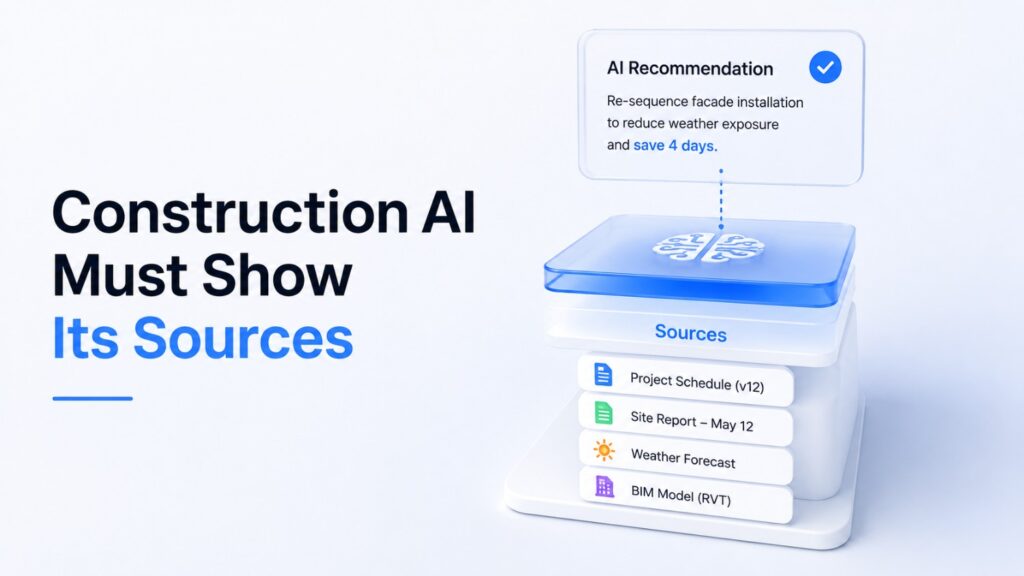
This matters because construction teams cannot safely rely on confident statements without evidence.
Traceability Should Be a Core Product Requirement
If a system answers a specification question, the user should be able to see the specification section behind the answer.
If the system identifies a drawing issue, the reviewer should be able to see where the issue exists.
If the tool recommends something based on building code, the relevant requirement should be traceable.
The Audit Trail Is Part of the Product
For construction AI, traceability should not be treated as an optional feature.
It is part of the product itself.
The more important the decision, the more important it becomes to understand exactly why the AI produced its answer.
Version Control Could Become One of the Biggest AI Risks
Construction projects change constantly.
A detail that was correct six weeks ago may no longer be correct today.
This creates a serious problem for AI systems.
A Correct Answer From an Old Drawing Is Still Wrong
A perfect answer based on the wrong drawing revision can still create expensive problems.
Contractors should therefore test version control carefully before allowing a construction AI tool to become widely used.
Deliberately Test Superseded Information
One useful test is to upload both current and superseded information and ask questions where the answer changed between versions.
If the system cannot reliably distinguish between them, it may create more risk than value.
This is particularly important on large projects where hundreds of drawings may change over time.
Test AI on Real Construction Data, Not Perfect Demo Data
AI demonstrations are usually clean.
Real construction projects are not.
Projects contain duplicate drawings, poor naming, handwritten notes, old files, missing metadata, inconsistent folder structures, revision clouds, scanned PDFs, and information produced by many different companies.
The Messiest Project Is Often the Best Pilot
That messy environment should be part of the pilot.
A construction AI platform should not be judged by how well it performs on a carefully prepared demo project.
It should be judged by how well it performs on the kind of information the company actually produces.
Weak Data Can Expose Weak AI Quickly
A strong system should still be able to explain uncertainty, identify missing information, and help users reach the correct source.
A weak system may simply produce confident answers from incomplete data.
That difference is critical in construction.
Automating a Bad Process Can Make the Problem Worse
AI does not automatically repair weak operations.
If a contractor has poor document control, adding an AI search system could simply make bad information easier to find.
If outdated drawings are stored incorrectly, the system may provide outdated answers faster.
If permit responsibilities are unclear, automation may speed up confusion instead of removing it.
AI Implementation Is an Operations Project
This is why AI deployment should be treated as an operations project rather than a simple software purchase.
Companies may need to improve their underlying process before automation delivers its full value.
Standardization Often Comes Before Automation
Teams may need better naming rules, cleaner document structures, clearer ownership, better approval processes, or stronger version control.
Those changes may sound boring compared with AI, but they often determine whether the technology succeeds.
Human Review Will Remain Essential
Construction is different from many other industries because digital mistakes eventually become physical.
An incorrect recommendation can become steel, concrete, electrical work, piping, walls, contracts, invoices, change orders, or safety problems.
That creates a much higher cost of error.
AI Will Be Strongest as a Force Multiplier
The strongest near-term construction AI model will probably automate research, organization, preparation, comparison, and detection while leaving final judgment with qualified people.
That approach may sound less futuristic than fully autonomous construction.
It is also much more practical.
Human Judgment Should Focus on the Highest-Value Decisions
The real benefit of AI may be that experienced people spend less time collecting information and more time making decisions from it.
That is a much more realistic way to improve productivity than trying to remove experienced professionals from the process entirely.
Renovation Could Become One of NYC’s Best AI Opportunities
New York’s existing building stock creates another important opportunity.
A large amount of construction in the city involves renovation rather than brand-new buildings.
Renovation work can be particularly difficult because teams often begin with incomplete information.
Existing Buildings Create Messy Data Problems
Existing conditions may differ from old drawings. Previous renovations may not have been documented perfectly.
Mechanical and electrical systems may have changed. Teams may need to work around occupants or keep parts of the building operating during construction.
These conditions create strong use cases for visual capture, document intelligence, permit automation, code research, and AI-assisted comparison.
AI That Understands Imperfect Buildings Could Have a Major NYC Advantage
A new building can begin with a clean digital model.
A 100-year-old building usually cannot.
Companies that become particularly good at understanding imperfect existing-building information could find a major market in New York.
Public Construction Could Become a Major AI Market
Government construction is expected to represent nearly $21 billion of New York City’s 2026 construction spending.
Public projects also create enormous amounts of information.
Contracts, approvals, drawings, meeting records, invoices, schedules, change orders, inspection reports, correspondence, and closeout records can follow a project for many years.
Public Owners Have an Information Problem at Portfolio Scale
This makes public infrastructure a natural environment for AI-powered document search and data integration.
The long-term opportunity extends beyond finding individual files.
AI could help public agencies compare similar projects, understand repeated causes of cost growth, identify patterns in schedule delays, find missing closeout information, and preserve institutional knowledge when experienced employees leave.
The Opportunity Is Larger Than Chat
The real value may come when AI can analyze information across hundreds of projects rather than answer one question about one document.
That could help public owners understand what is happening across entire capital programs.
Construction AI Will Become More Specialized
The first wave of generative AI made many products look similar.
A user opened a chat box, asked a question, and received an answer.
Construction AI is moving beyond that model.
PermitFlow is building around permitting. Structured AI is focused on drawing review. Trunk Tools is developing project-focused AI agents. Cascade is focused on project pursuit intelligence. Bidflow is working on electrical takeoffs.
Vertical AI Could Become the Winning Model
This specialization is likely to continue.
Different construction roles deal with different documents, rules, quantities, and decisions.
A tool built specifically for electrical estimating may be much more useful to an electrical contractor than a broad construction chatbot.
The Best Models Will Understand Construction Objects, Not Just Words
A door on a construction drawing is not simply a rectangle.
It has a size, type, hardware set, fire rating, location, detail, specification, schedule, and revision history.
The same applies to walls, pipes, ducts, fixtures, structural members, mechanical equipment, and thousands of other building components.
Construction AI becomes significantly more valuable when it understands those relationships rather than simply reading text.
The Next Battle Will Be Over Construction Data
Every AI system needs information.
Construction companies therefore need to think carefully about who controls the information they provide.
Project data may include pricing, customer information, proprietary designs, subcontractor data, employee information, building-security details, legal records, and other commercially sensitive material.
Data Governance Should Be Part of the Buying Process
Before purchasing an AI platform, buyers should understand where their information is stored, how long it is retained, whether it can be deleted, who can access it, and whether it is used to train models shared with other customers.
The right question is not only whether the AI gives good answers.
Companies also need to understand what happens to their data while those answers are being produced.
Construction Firms Should Protect Their Long-Term Data Advantage
Historical project information can become extremely valuable.
Years of estimates, schedules, drawings, change orders, production rates, and project outcomes can create a private dataset that helps a company understand how it actually builds.
That information should be treated as a strategic asset.
AI Vendors Will Face Much Tougher ROI Questions
The early phase of construction AI buying was driven partly by curiosity.
Many companies wanted to experiment because leadership believed they needed to understand the technology.
That phase will not last forever.
Construction businesses operate on tight margins, and employees do not have unlimited time to test software that produces no measurable return.
Construction AI Will Need to Prove Financial Value
The strongest AI vendors will increasingly need to prove value in financial terms.
Companies can evaluate return across several broad areas.
| Value source | What to measure |
| Labor capacity | Skilled employee hours returned to the organization |
| Speed | Days removed from repeated workflows |
| Error reduction | Rework, corrections and revisions avoided |
| Risk reduction | Problems identified before they become expensive |
| Revenue | More projects estimated, pursued or delivered |
Use Conservative ROI Assumptions
The financial model should remain conservative.
A company should compare those benefits with the complete cost of the technology, including subscriptions, implementation, integrations, training, supervision, and process changes.
If the business case only works when every marketing claim is assumed to be true, the business case probably needs more testing.
New York Construction AI Is Still a Young Market
Despite the amount of investment, construction AI remains early.
PermitFlow and Trunk Tools were founded in 2021. GreenLite arrived in 2022. Structured AI and Bidflow were founded in 2025. Cascade announced its financing in 2026.
Many of these companies are still developing their products and expanding into new parts of the construction workflow.
Buyers Should Expect the Vendor Landscape to Change
Some startups will grow into larger platforms. Others may be acquired.
Established construction software companies will add competing AI features. Some products may disappear entirely.
Construction companies should avoid building their operations so tightly around one startup that changing vendors later becomes impossible.
Data Portability Matters More Than Ever
Data portability, integrations, clear internal processes, and ownership of core project records should remain priorities.
The best AI system today may not be the system a company uses five years from now.
What NYC Tech Journal Will Be Watching Next
The next stage of construction AI will be more interesting than the first.
The first generation mainly helped people search, summarize, and organize.
The next generation will increasingly attempt to perform parts of the workflow.
AI Agents Will Move Deeper Into Construction Workflows
Permitting agents may prepare larger portions of applications.
Drawing systems may not only identify issues but help coordinate corrections.
Estimating platforms may develop deeper trade-specific intelligence, while computer-vision systems may connect visual progress with schedules, payment applications, and cost controls.
Software Categories Will Start to Blur
We also expect the boundaries between software categories to become less clear.
A permitting platform can expand into pre-construction. A document-intelligence company can move into submittals and contracts. A visual-intelligence company can expand into schedule risk. A workforce platform can add safety agents.
The major competition will therefore be over who owns the workflow rather than who offers a single AI feature.
The Best Construction AI May Be the Technology Workers Barely Notice
There is a natural temptation to judge artificial intelligence by how futuristic it appears.
Construction may reward something much less dramatic.
The highest-value system could be the one that identifies a missing permit requirement before an application is submitted. It could be the tool that finds a drawing conflict three months before a subcontractor encounters it in the field.
It might give a superintendent the correct specification in seconds instead of forcing that person to search for 20 minutes. It could help an estimator complete another bid before the deadline or help a contractor identify a major opportunity months before the formal RFP appears.
The Data Supports an Information-First AI Market
None of those examples looks like a robot building Manhattan.
They may nevertheless create more economic value in the near term.
Our original funding analysis supports that view. Approximately 91.6% of the publicly verifiable capital in our comparable nine-company sample is concentrated in permitting, code compliance, project information, and visual intelligence.
The four largest companies in that dataset represent roughly 89.2% of the capital we measured.
New York Is an Ideal Test Market for Construction AI
Investors appear to be betting that the first major construction AI winners will remove the information bottlenecks surrounding physical construction.
New York is an unusually strong place to test that idea.
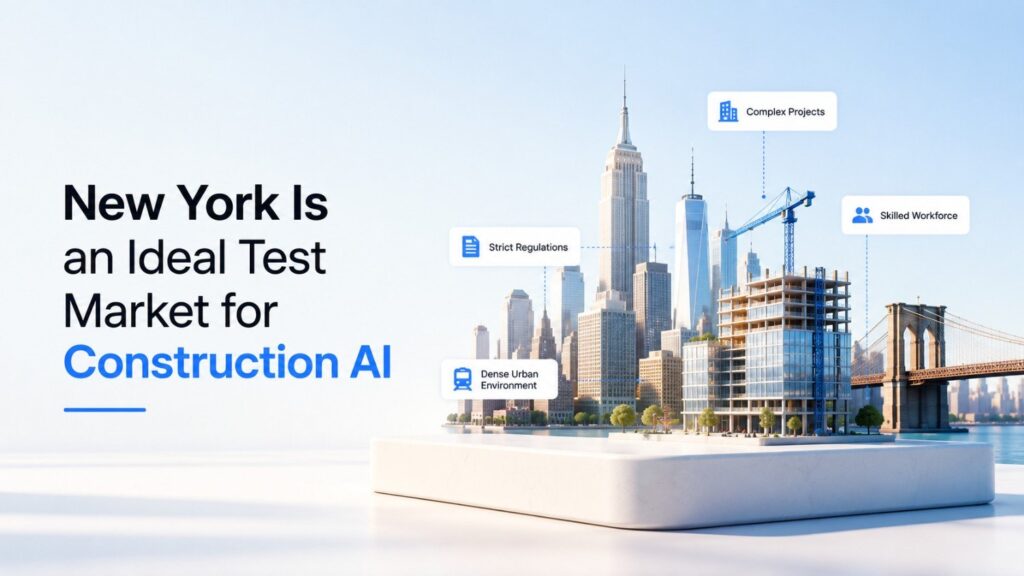
The city is expected to support more than $73 billion in construction spending during 2026. It has enormous residential, commercial, and public markets. Renovation work remains important. Regulation is complex. Labor is expensive. Large projects generate enormous quantities of information, while delays can quickly create financial consequences.
Conclusion: Construction AI Will Change New York One Workflow at a Time
For contractors, developers, owners, architects, and engineers, the goal should not be to adopt AI simply because artificial intelligence is fashionable.
The goal should be to identify the repeated work that consumes valuable human attention without requiring valuable human judgment.
Companies should measure the current process, automate a narrow part of it, keep qualified people responsible for important decisions, require the AI to show its sources, and track the results in hours, dollars, errors, and delays.
If the numbers prove the technology deserves a larger role, the company can expand from there.
Artificial intelligence is unlikely to change New York construction through one dramatic breakthrough. The more realistic transformation will happen as thousands of slow, repetitive, expensive tasks become easier to complete, easier to measure, and increasingly difficult to justify doing manually.
That is how AI is likely to change the way New York builds.