

Artificial intelligence is beginning to reshape commercial real estate in New York City in ways that go far beyond chatbots, automated emails, and faster document writing. The bigger shift is happening inside the core business of real estate itself. AI is starting to influence which tenants landlords pursue, how buildings are operated, how leases are reviewed, where investors put money, how development projects are evaluated, and which aging office buildings may no longer make sense as offices.
New York is especially interesting because AI is changing both sides of the market at the same time. On one side, AI companies are becoming important office tenants, with several fast-growing firms taking large blocks of space in Manhattan. On the other side, owners, brokers, lenders, developers, and property managers are beginning to use AI to make faster and better decisions about expensive real estate assets.
This creates a much bigger story than simply asking whether commercial real estate companies are adopting new software. The more important question is whether AI is starting to change the economics of New York property itself. Based on our analysis of public leasing, investment, building, conversion, and energy data, the answer is increasingly yes.
NYC Tech Journal Original Research: How We Studied AI’s Impact on New York Commercial Real Estate
There is no single public database that tracks the impact of AI on New York commercial real estate. To understand what is happening, we therefore combined several groups of public data and looked for patterns across them.
We reviewed Manhattan office leasing data, technology and AI tenant demand, office-to-residential conversion activity, commercial property investment, building emissions rules, and several examples of major AI company leases. We then used those numbers to calculate additional indicators that are not normally presented together.
Our goal was not to create a perfect forecast of the New York property market. Instead, we wanted to identify the areas where AI is already producing measurable changes and where those changes could become much larger over the next several years.
The Data Behind Our Analysis
| Area studied | Public data used | What we examined |
| Manhattan office market | Brokerage market reports | Leasing activity, availability, asking rents, absorption |
| AI tenant demand | VTS market research | Number, size, and location of active AI requirements |
| Office conversions | NYC Comptroller and city data | Buildings, square footage, and housing conversion potential |
| Investment market | Capital markets research | Transaction volume, deal activity, office investment |
| Building energy | NYC Department of Buildings | Local Law 97 coverage and financial exposure |
| AI leasing examples | Company announcements and brokerage reports | Large office commitments from growing AI firms |
We also calculated several original measures from this information. These include the approximate total square footage represented by active AI requirements, the concentration of those requirements in Midtown and Midtown South, the difference between New York AI office requirements and national averages, the implied housing density of the conversion pipeline, and several measures showing how Manhattan’s office submarkets are moving differently.
These calculations should be treated as directional analysis rather than official market statistics. However, they make one thing clear: AI is already becoming a meaningful force in New York commercial real estate.
AI Is Becoming an Office-Demand Engine in New York
For the past several years, much of the debate around artificial intelligence and office real estate has focused on one concern. If companies use AI to automate white-collar work, they may eventually need fewer employees, which could reduce long-term demand for office space.
That risk may still exist in some industries, but another force is showing up much faster. The companies building AI products are expanding, raising large amounts of capital, hiring specialized workers, and leasing expensive Manhattan offices.
VTS reported 45 active AI office requirements in New York, with an average requirement of roughly 61,000 square feet. Fourteen of those requirements were for at least 50,000 square feet.
This is important because it shows that New York’s AI office market is no longer made up only of tiny startups looking for a few desks in a flexible workspace. A growing portion of demand is coming from companies preparing to become much larger organizations.
New York AI Companies Are Looking for Larger Offices
If we multiply the 45 active requirements by the reported average of approximately 61,000 square feet, the result suggests about 2.75 million square feet of implied active AI office demand.
The exact number should not be treated as a committed pipeline because requirements can change, overlap, or disappear before a lease is signed. Even so, it provides a useful picture of the scale of the market.
The size of these requirements is also unusually large when compared with technology demand elsewhere.
| Tenant group | Average active requirement |
| National technology tenants | ~27,000 SF |
| National AI tenants | ~37,000 SF |
| New York AI tenants | ~61,000 SF |
New York’s average AI requirement is therefore about 65% larger than the national AI average and more than twice the average requirement across the broader technology sector.
That difference matters because large office requirements dramatically reduce the number of buildings that can compete for a tenant. A company looking for 5,000 square feet can choose from hundreds of spaces across Manhattan. A company searching for 100,000 or 200,000 square feet needs large connected floor blocks, strong infrastructure, convenient transportation, suitable building systems, and enough room to keep expanding.
For landlords, this means AI demand may benefit high-quality buildings more than it benefits the office market evenly.
Major AI Companies Are Already Taking Large Manhattan Offices
The growing influence of AI tenants becomes easier to understand when we look at real leases rather than market averages.
Anthropic, one of the world’s best-known AI companies, committed to approximately 466,000 square feet at 330 Hudson Street. Before this expansion, the company occupied only a small fraction of that amount in Manhattan. The move represented a dramatic increase in its New York footprint and showed that a fast-growing AI firm could suddenly become one of the larger office tenants in a major building.
Harvey, which develops AI tools for legal and professional services, also expanded significantly at One Madison Avenue. Its footprint grew to roughly 185,000 square feet after it initially took a much smaller amount of space.
EliseAI, a New York-based company building AI tools for property management and healthcare, announced a headquarters lease of more than 100,000 square feet at 401 Fifth Avenue. Other firms such as AirOps and ElevenLabs have also taken Manhattan offices, although on a smaller scale.
Selected AI-Related Manhattan Office Commitments
| Company | Approximate office commitment |
| Anthropic | ~466,000 SF |
| Harvey | ~185,000 SF |
| EliseAI | ~109,000 SF |
| AirOps | ~13,500 SF |
| ElevenLabs | ~11,500 SF |
These companies serve very different markets and are at different stages of growth, so the numbers should not be treated as a single market sample. However, they demonstrate that AI office demand now stretches from relatively small startup leases to buildings capable of accommodating hundreds of thousands of square feet.
This creates opportunities across several types of Manhattan properties. Smaller renovated buildings in areas such as SoHo and Chelsea can attract growing companies that want character and flexibility, while larger institutional properties can target companies preparing to add hundreds of employees.
Midtown South Is Emerging as a Major AI Office Cluster
One of the strongest findings from our analysis is the geographic concentration of AI demand.
Of the 45 active AI office requirements identified by VTS, 41 were located in Midtown or Midtown South. That means roughly 91% of the requirements were concentrated in those two large Manhattan office markets.
Midtown South is particularly interesting because broader leasing activity is also accelerating there.
Recent market data showed monthly Midtown South leasing of approximately 988,000 square feet, compared with a five-year monthly average of around 494,000 square feet. That means leasing during the period was roughly double its recent historical average.
Comparing Manhattan’s Major Office Markets
| Metric | Midtown | Midtown South | Downtown |
| Monthly leasing | 1.69M SF | 988K SF | 305K SF |
| Five-year monthly average | 1.36M SF | 494K SF | 282K SF |
| Activity vs. five-year average | +24% | +100% | +8% |
| Availability | 12.3% | 16.8% | 16.3% |
| Asking-rent change YoY | +4% | +2% | +8% |
| YTD leasing change YoY | +1% | +10% | -10% |
This does not mean Midtown South is automatically stronger than every other Manhattan market. Midtown still has lower availability, while Downtown has recently shown stronger asking-rent growth in some data sets.
The important point is that Midtown South combines high leasing activity with a strong concentration of technology and AI demand. This creates the conditions for a deeper technology cluster to develop.
Why Clusters Matter in Commercial Real Estate
Technology companies rarely choose office locations in isolation. They care about access to employees, investors, customers, restaurants, transportation, professional services, and other technology companies.
Once enough similar businesses gather in one part of a city, the cluster can become self-reinforcing. Employees move between nearby companies, investors spend more time in the area, service providers follow their customers, and founders increasingly want offices near other founders.
New York has seen this process before in finance, media, advertising, and fashion. AI could become another major industry shaping Manhattan’s commercial geography.
AI Could Make the Flight to Quality Even Stronger
It would be a mistake to assume that rising Manhattan leasing automatically helps every office building equally.
The New York office market remains deeply divided between high-quality buildings that tenants actively want and older properties that struggle to compete.
Research from the New York City Comptroller has shown that occupancy in top-quality office buildings increased after 2019 even while occupancy across the rest of the Manhattan market fell sharply. This suggests that the post-pandemic office problem was never simply about whether workers would return to offices. It was also about which offices they would return to.
AI companies could strengthen this divide.
Fast-growing AI firms compete aggressively for engineers, researchers, salespeople, and senior executives. For these companies, a high-quality office can become part of their recruiting strategy.
The office therefore does more than provide desks. It becomes a place used to signal ambition, build culture, meet customers, and convince talented employees that they should join the company.
A growing AI firm may therefore be more willing to pay for attractive design, strong amenities, advanced building systems, good transportation access, and a neighborhood that employees enjoy.
For New York landlords, the lesson is simple. The most important question is not whether overall office demand is improving. The better question is whether a particular building is positioned to compete for the companies that are expanding.
AI Is Changing How Landlords Find Tenants
The impact of AI is not limited to companies leasing office space. Artificial intelligence is also beginning to change how landlords identify and pursue potential tenants.
Traditional leasing strategy depends heavily on broker relationships, market reports, tenant lists, lease-expiration data, tours, proposals, and conversations. Those things will remain important because commercial real estate is still a relationship business.
What AI changes is the ability to connect information much faster.
Imagine a landlord that owns 15 office properties across Manhattan. The leasing team may have thousands of pieces of useful information spread across different systems. Some tenants are expanding, some are shrinking, some leases expire soon, and some companies are actively touring space.
A human team can process this information, but it takes time. AI can help identify patterns across the entire portfolio.
Leasing Can Become More Predictive
A sophisticated leasing system could help answer questions such as which tenants are most likely to need 30,000 to 70,000 square feet during the next 18 months. It could also identify which buildings fit those requirements and which tenants are already looking at similar properties.
The value does not come from AI somehow predicting the future with perfect accuracy. The value comes from connecting weak signals faster than a human team could do manually.
In Manhattan, that speed can matter enormously.
One major lease can change a building’s occupancy, financing outlook, or value. Finding a potential tenant several months earlier may therefore be worth far more than simply saving a few hours of analyst work.
AI Can Help Landlords Price Office Space More Intelligently
Office pricing in New York is far more complicated than the asking rent that appears in a brokerage listing.
Two tenants may both agree to pay $80 per square foot while producing very different economics for the landlord. One deal may require large tenant-improvement spending and a long free-rent period, while another may require fewer concessions.
Lease length, annual increases, operating expense recoveries, broker commissions, renewal options, credit quality, and future rollover risk can all change the real value of the transaction.
AI can help asset managers analyze these combinations much more quickly.
Faster Lease Scenario Analysis
Suppose a landlord receives three proposals for the same office space.
One tenant may offer a higher rent but demand a large construction allowance. Another might accept a lower rent but require fewer concessions. A third may offer a shorter lease that provides flexibility but creates more future vacancy risk.
Traditionally, analysts may need to build several spreadsheet models to compare these options properly.
AI-assisted financial tools can make it much easier to test different assumptions and calculate the long-term impact of each proposal.
The final decision still requires human judgment because no model can fully understand every relationship, tenant risk, or strategic goal. However, teams can examine far more scenarios before making a decision.
In a market where individual leases can represent tens of millions of dollars in future revenue, this can create meaningful value.
Lease Abstraction May Be One of the Most Practical CRE AI Applications
Commercial leases contain enormous amounts of important information, yet much of that information remains trapped inside documents.
A lease may include rent schedules, renewal rights, termination options, operating expense rules, subletting restrictions, insurance requirements, construction obligations, repair responsibilities, expansion rights, and dozens of important deadlines.
For one building, experienced asset managers may know many of these details from memory. Across a portfolio containing hundreds of leases and amendments, however, understanding every obligation becomes extremely difficult.
AI can help turn this unstructured information into searchable data.
The Bigger Opportunity Is Portfolio Intelligence
The basic use case is simple. AI can read a lease and create a summary much faster than a person.
That alone saves time, but the more valuable opportunity appears when the system can analyze every lease in the portfolio together.
An asset manager could ask which leases larger than 20,000 square feet expire during the next 30 months. The same system could identify tenants with contraction rights, renewal options below current market rent, or unusual landlord obligations.
It could also help flag amendments that changed the terms of an earlier document.
That changes lease abstraction from an administrative task into a strategic tool.
Once the information becomes structured, management can use it for leasing, budgeting, capital planning, valuation, and risk management.
New York’s Real Estate Data Problem Could Slow AI Adoption
Commercial real estate companies have one major obstacle when implementing AI.
Their information is often messy.
Property data may be spread across leases, spreadsheets, emails, property-management software, accounting systems, work orders, capital plans, broker notes, engineering reports, and local file folders.
Different departments may even use different names for the same building.
This creates a basic problem. An AI system can only analyze the information it receives.
If the rent roll is outdated, the model will analyze outdated information. If lease amendments are missing, the system may confidently return the wrong answer.
The technology can therefore make bad information move faster just as easily as it can make good information move faster.
Data Cleaning Should Come Before Large AI Projects
New York commercial real estate companies should treat data preparation as part of their AI strategy.
Property names should be standardized. Lease documents should be connected with amendments. Rent rolls should follow consistent formats. Building systems should use reliable identifiers.
Historical proposals, work orders, capital projects, and vendor records should also be organized where possible.
This work may not sound exciting, but it creates the foundation for every advanced AI use case that follows.
Companies with clean data will be able to use better models, ask better questions, and trust the answers more confidently.
Building Operations Could Become One of the Largest AI Opportunities
Leasing receives more public attention because large deals produce headlines. Building operations may create even more long-term financial value.
A major Manhattan office building produces huge amounts of information every day.
HVAC systems generate operating data. Elevators generate alerts. Access systems record movement. Tenants create service requests. Utility meters track energy use. Engineers complete work orders. Vendors submit invoices.
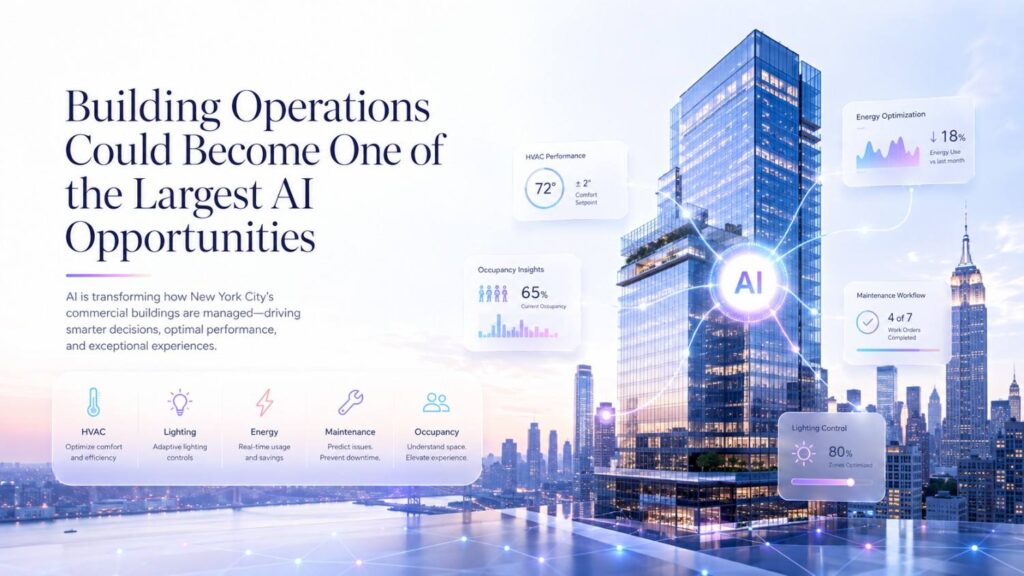
Historically, these data sources have often been managed separately.
AI can help connect them.
AI Can Find Problems Before Equipment Fails
Traditional maintenance is often reactive.
Equipment breaks, a tenant complains, and the property team responds.
Predictive maintenance aims to identify signs of failure before that happens.
An AI-supported system could notice that a pump is drawing more electricity than normal, an air-handling unit is taking longer to reach the required temperature, or an elevator is generating an unusual pattern of faults.
None of these issues may be serious enough to create an immediate alarm. When several abnormal signals occur together, however, they may indicate that something needs attention.
This gives engineering teams an opportunity to inspect equipment before a major failure.
For a large Manhattan property, that can matter because one failed system can disrupt hundreds or thousands of employees and create expensive emergency work.
AI Can Make Work Orders Easier to Manage
Property-management teams also spend enormous amounts of time processing tenant requests.
Not every request deserves the same priority.
A loose door handle and a possible water leak should not be treated as equal problems. However, basic ticketing systems can place both requests into similar queues.
AI can read incoming requests and classify them by urgency, building system, location, and likely risk.
It can also group related complaints.
For example, ten different employees may report that one part of a building is too warm. A basic system may treat these as ten independent tickets, while an AI system can recognize that they likely point to the same HVAC problem.
This reduces noise for the property team.
More importantly, it allows engineers to focus on the underlying cause rather than handling each complaint separately.
Local Law 97 Makes AI More Valuable in New York Buildings
Building efficiency matters everywhere, but New York has an additional reason to take it seriously.
Local Law 97 creates greenhouse gas limits for many large buildings in the city. Most buildings larger than 25,000 gross square feet fall within the law, although the exact requirements depend on the building and ownership structure.
The first emissions limits began in 2024, while stricter requirements are scheduled for 2030.
This means building energy performance is no longer only about reducing utility bills.
For covered properties, emissions can create compliance costs, affect capital planning, and influence the long-term value of an asset.
The Financial Exposure Can Become Significant
The law allows penalties based on the amount by which a building exceeds its permitted emissions limit.
Using the commonly cited maximum penalty formula of $268 per metric ton of carbon dioxide equivalent above the applicable limit, exposure can become meaningful for buildings that miss their target by a large amount.
| Emissions above limit | Illustrative penalty |
| 50 metric tons | $13,400 |
| 250 metric tons | $67,000 |
| 500 metric tons | $134,000 |
| 1,000 metric tons | $268,000 |
| 2,500 metric tons | $670,000 |
These figures are only simple illustrations of the formula and should not be treated as a prediction of what an individual building will actually owe. Adjustments, enforcement rules, and building-specific conditions can change the final result.
The larger point is that energy data now has direct financial importance.
AI Can Make Building Energy Management Much Smarter
A basic approach to energy savings is to turn equipment off when it is not needed.
AI allows a much more detailed approach.
Commercial buildings operate under changing conditions throughout the day. Weather changes, occupancy changes, sunlight changes, and different tenants use their offices at different times.
Static schedules cannot perfectly respond to every one of these factors.
AI-supported building systems can analyze historical performance, current weather, occupancy patterns, and equipment behavior to adjust operations more precisely.
Small Changes Can Produce Large Annual Results
Consider a 700,000-square-foot Midtown office building.
The cooling system may currently begin operating at the same time every weekday because that has been the schedule for years. Yet occupancy information might show that only a small share of tenants arrive before 8:30 a.m.
A smarter system may determine that some floors can begin cooling later without affecting comfort.
The saving from one morning may be small.
Repeating the improvement across hundreds of days and many building systems can create significant annual savings.
That is one of AI’s strengths. It can find thousands of small decisions that humans do not have enough time to review every day.
AI Could Help Owners Prepare for the 2030 Emissions Limits
The stricter Local Law 97 limits scheduled for 2030 mean many owners will need more than basic operational improvements.
Some properties may require major capital projects involving heating systems, cooling systems, insulation, lighting, electrification, controls, or other building infrastructure.
Owners therefore need to make multi-year decisions.
AI can help management teams compare different capital plans and understand how each one changes expected building performance.
For example, an owner could test the effect of replacing a central plant in 2027 instead of 2029. The same model could compare the emissions reduction created by different projects and show which investment produces the greatest improvement per dollar spent.
The system could also model different occupancy, weather, or energy-price assumptions.
Engineers still need to validate the results because these are physical systems with serious safety and financial consequences. However, AI can help teams explore far more scenarios before committing capital.
AI Is Changing Commercial Real Estate Investment Analysis
Buying a New York commercial property requires the review of an enormous amount of information.
An acquisition team may need to understand leases, operating expenses, financing, taxes, construction requirements, zoning, environmental reports, comparable sales, market rents, capital projects, and future tenant rollover.
Junior analysts traditionally spend significant time collecting and organizing this information before senior decision makers can begin evaluating the actual investment.
AI can reduce that preparation time.
Instead of replacing investment professionals, it can allow them to reach the most important questions much faster.
That becomes especially valuable when transaction activity begins to rise.
Original Analysis: More Investment Capital Is Moving Through Fewer NYC Properties
Recent New York investment data provides an interesting signal.
New York City recorded roughly $31.6 billion in property transaction volume during 2025, representing a significant increase from the previous year. At the same time, the reported number of properties sold declined slightly.
Using the published changes, we can derive approximate figures for the prior year.
| Metric | Approx. 2024 | 2025 | Change |
| Transaction volume | ~$26.85B | $31.60B | +17.7% |
| Properties sold | ~2,874 | 2,814 | -2.1% |
| Capital per property sold* | ~$9.34M | ~$11.23M | +20.2% |
*This is a simple market-intensity calculation rather than an average transaction price because individual deals may include multiple properties.
The combination is useful because it suggests that larger amounts of capital were moving even while slightly fewer properties changed hands.
That environment increases the value of good underwriting.
When investors are evaluating larger transactions, errors become more expensive. AI can therefore create significant value by helping teams test risks more quickly.
AI Can Make Downside Analysis Faster
One of the best investment uses for AI may not be finding reasons to buy a property.
It may be finding reasons not to buy it.
A disciplined acquisitions team can use AI to test multiple downside scenarios before presenting a deal to an investment committee.
The team could examine what happens if lease-up takes one year longer than expected, construction costs rise 15%, tenant improvement packages increase, financing costs remain high, or the largest tenant exercises an early termination option.
It can also test what happens when multiple risks occur at the same time.
This type of analysis has always been possible using spreadsheets.
AI simply makes it faster to create and compare many scenarios.
That gives investment professionals more time to challenge the assumptions instead of spending most of their time building the model.
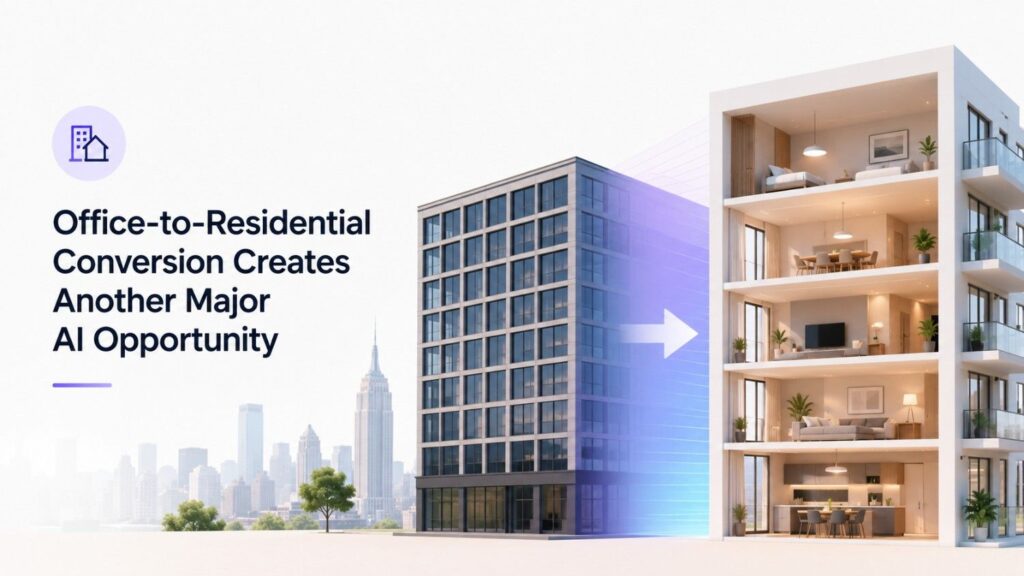
Office-to-Residential Conversion Creates Another Major AI Opportunity
Not every office building that struggles to attract tenants should remain an office building.
New York’s growing office-to-residential conversion pipeline shows how important this question has become.
An analysis by the New York City Comptroller examined 44 completed, ongoing, or potential conversion projects representing roughly 15.2 million gross square feet and more than 17,000 possible apartments.
This is a meaningful amount of real estate.
If those projects are completed, they could remove a significant amount of older office inventory while simultaneously adding badly needed housing.
Original Analysis of the Conversion Pipeline
| Measure | Approximate result |
| Projects examined | 44 |
| Total gross area | 15.2M SF |
| Potential apartments | 17,432 |
| Gross SF per potential apartment | ~872 SF |
| Units per 100,000 gross SF | ~115 |
| Rental conversion area | 13.5M SF |
| Lower Manhattan share of rental area | ~58% |
The concentration in Lower Manhattan makes sense.
Downtown contains many older office properties and has already experienced several waves of residential conversion over the past few decades.
The more interesting question is whether AI can help identify the next group of buildings that should be converted.
AI Can Help Investors Screen Buildings for Conversion Potential
Office-to-residential conversions are complicated because a building can look suitable from the outside while failing financially or physically once detailed work begins.
Floor depth matters because apartments need windows and natural light. Plumbing locations matter. Elevator cores matter. Structural conditions matter. Zoning, acquisition price, apartment rents, construction costs, and tax incentives also matter.
Because of this complexity, investors can spend large amounts of money studying properties that never become viable projects.
AI can help with the first stage of screening.
A model could combine public property records, zoning information, building dimensions, age, current office availability, surrounding residential rents, neighborhood demand, and previous conversion activity.
It could then rank properties that deserve deeper review.
Architects, lawyers, engineers, and zoning experts would still need to conduct the real feasibility work.
The advantage is that their time would be focused on better candidates.
AI Could Improve Development Decisions Before Construction Begins
Development is one of the most uncertain parts of commercial real estate.
Before construction begins, developers need to make assumptions about demand, costs, interest rates, rents, building design, tenant preferences, and project timing.
These assumptions interact with one another.
Changing the floor plan can affect construction cost. Changing the amenity package can affect achievable rents. Delays can increase financing expenses.
AI can help development teams test many versions of a project before committing large amounts of money.
This becomes especially useful when repositioning older office buildings.
An owner may need to compare whether to keep a property as lower-cost office space, invest heavily to reposition it as a premium property, or convert part of the building to another use.
Each strategy requires dozens of assumptions.
AI can make it much easier to compare those assumptions side by side.
Construction Management Can Become More Predictive
Once construction begins, AI can also help project teams understand whether work is moving according to plan.
Progress photographs can be compared with schedules. Invoices can be checked against contract information. Change orders can be categorized and analyzed for recurring causes.
Schedule deviations can also be identified earlier.
This does not eliminate the need for experienced construction managers.
Instead, it helps them focus on problems before those problems become expensive delays.
That is especially valuable in New York, where construction costs are high and delays can quickly damage project returns.
Tenant Experience Is Becoming a Valuable Data Source
Commercial landlords historically know surprisingly little about how tenants actually use a building after signing a lease.
They know how much space the tenant occupies and whether rent is being paid. They may also see service requests and complaints.
However, the owner may not understand which amenities employees use, when conference rooms are busiest, which building events perform well, or where repeated problems are affecting satisfaction.
Digital access systems, occupancy technology, building apps, and amenity platforms create more information about these behaviors.
AI can help connect the information and identify patterns.
For example, a property team may discover that conference facilities are overwhelmed from Tuesday through Thursday but rarely used on Monday. Another building may find repeated temperature complaints from the same area during afternoon hours.
These insights can guide future capital spending and operations.
The building becomes less like a static product and more like a service that can improve over time.
Brokers Will Still Matter, but Their Work Will Change
Commercial brokerage depends heavily on relationships, local knowledge, trust, and negotiation.
Those qualities are not disappearing.
A business signing a 10-year or 15-year headquarters lease will still need experienced advisers who understand the market and can negotiate complicated terms.
However, AI can automate or accelerate many parts of the process surrounding those relationships.
Brokers can use AI to build tenant lists, review building options, summarize tours, compare proposals, research transactions, and prepare market updates.
That shifts the value of the broker.
Access to raw information becomes less important because information becomes easier to obtain. Interpretation, judgment, negotiation, and relationships become more important.
The strongest brokers will therefore use AI to spend less time collecting information and more time helping clients make difficult decisions.
The Biggest AI Advantage May Be Better Decisions Rather Than Fewer Employees
Many business leaders still evaluate AI mainly through headcount savings.
Commercial real estate companies should think more broadly.
Imagine a five-person asset-management team that adopts AI without reducing staff.
If those same five people can monitor twice as many leases, evaluate more capital projects, respond to tenants faster, review more acquisition opportunities, and identify problems earlier, the value created may be much greater than the cost of one employee.
Real estate is an industry where individual decisions can move millions of dollars.
Saving 20 hours of administrative work is useful.
Avoiding one poor lease, missing one important renewal right, or preventing one major equipment failure can be far more valuable.
Clean Data Could Become a Major Competitive Advantage
As commercial real estate firms adopt AI, the quality of their internal data will become increasingly important.
Consider two landlords with similar portfolios.
The first company has ten years of standardized leases, historical proposals, capital plans, maintenance records, work orders, and building-system information stored in clean databases.
The second company has the same information spread across inboxes, spreadsheets, PDFs, shared drives, and individual employee folders.
Both companies can buy access to the same AI model.
They will not receive the same value.
The first company has something far more important than software. It has institutional knowledge that can be searched and analyzed.
That information could become a long-term competitive advantage.
AI Also Creates New Risks for Commercial Real Estate
The growing value of AI does not mean every output should be trusted.
AI models can make mistakes while sounding extremely confident.
This creates serious risks in an industry dealing with contracts, large financial decisions, physical buildings, and legal obligations.
A model could misunderstand a lease amendment. It could miss an important termination right. It could use an incorrect comparable transaction or summarize a building condition incorrectly.
These errors can have real financial consequences.
Companies therefore need controls around important AI workflows.
High-risk answers should link back to the original documents. Permission systems should protect sensitive tenant information. Important legal and financial conclusions should always receive human review.
The basic rule should be straightforward.
The greater the financial, legal, or safety impact of the decision, the stronger the human review process should be.
How NYC Commercial Real Estate Companies Should Evaluate AI Vendors
The market is filling with companies that describe their products as AI-powered.
That label by itself means very little.
Real estate companies should evaluate whether a product solves a specific problem and whether the financial value can be measured.
| Question | Why it matters |
| Can every important answer link to the original source? | Teams need to verify leases and financial facts |
| Can the system understand amendments? | Earlier lease language may no longer apply |
| Can it search the whole portfolio? | Portfolio intelligence creates more value than isolated summaries |
| Does it connect with existing systems? | Another isolated database creates more complexity |
| Can humans correct mistakes? | Feedback improves reliability |
| Are user permissions strong? | Tenant and financial information can be sensitive |
| Can performance be measured? | AI should create measurable business value |
| Does the vendor understand CRE workflows? | Industry-specific context matters |
The best products are likely to be those that fit naturally into existing real estate workflows rather than forcing companies to redesign every process around the software.
A Practical 90-Day AI Plan for a New York CRE Company
Commercial real estate companies do not need to begin with a massive AI transformation.
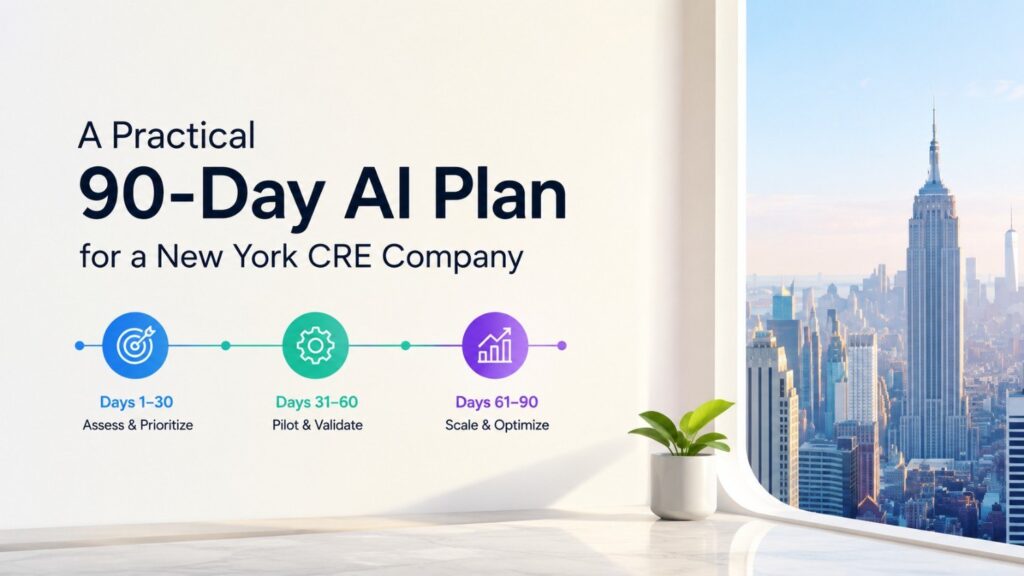
A focused 90-day pilot can reveal far more about whether a use case is worth expanding.
Days 1–30: Find One Expensive Repetitive Problem
The first step is to identify a workflow that already consumes significant time or money.
A landlord may find that lease abstraction takes too long. A property team may struggle with work-order classification. An acquisitions group may repeatedly enter the same information into underwriting models.
The goal should not be to find somewhere to use AI.
The goal should be to find an expensive problem that AI might solve.
Management should then measure the current performance of that process so there is a clear baseline.
Days 31–60: Run AI Beside the Existing Workflow
During the second month, the company should run the AI-assisted process alongside the current process.
If people currently review leases manually, AI should analyze the same documents while employees continue their normal work.
The company can then compare accuracy, speed, and the number of corrections required.
This approach is safer than immediately replacing an established process.
It also creates real evidence about where the technology succeeds and where it fails.
Days 61–90: Measure the Financial Result
The final month should focus on outcomes.
Management should compare the new process with the original baseline.
| Metric | Before | After | Possible target |
| Time per lease abstraction | — | — | -70% |
| Acquisition review time | — | — | -40% |
| Work-order routing time | — | — | -60% |
| Energy issues identified | — | — | +100% |
| Proposal turnaround time | — | — | -50% |
| Errors requiring correction | — | — | Lower |
| User adoption | — | — | >75% |
The exact targets will vary by company.
What matters is that AI should be evaluated using business results rather than excitement about the technology.
Where NYC CRE Companies Should Use AI First
Not every AI use case deserves the same level of investment.
Some workflows are relatively easy to improve because they involve repetitive information processing. Others carry greater financial or operational risk and should be introduced more slowly.
| Use case | Potential value | Difficulty | Good early project? |
| Lease abstraction | High | Low–medium | Yes |
| Portfolio lease search | High | Medium | Yes |
| Proposal analysis | High | Medium | Yes |
| Work-order classification | Medium | Low | Yes |
| Energy anomaly detection | High | Medium | Yes |
| Investment memo support | Medium | Low | Yes |
| Automated underwriting scenarios | High | Medium | Yes |
| Predictive maintenance | High | Medium–high | Later |
| Automated rental pricing | Very high | High | Later |
| Autonomous investment decisions | Potentially high | Very high risk | No |
This order keeps humans closely involved in decisions where judgment matters most while using AI aggressively in areas where manual information processing adds little value.
The Bigger Opportunity Is Connecting the Entire Building
The most powerful commercial real estate AI system may not be a tool built for one department.
The larger opportunity is connecting leasing, finance, operations, energy, tenant information, and building data.
Imagine that a large tenant tells an owner it may leave a building.
A connected AI system could immediately show the tenant’s lease expiration, square footage, renewal rights, current market rents, recent comparable deals, expected tenant improvement costs, likely downtime, historical utility usage, and the impact of the vacancy on the building’s financing.
The system could also identify possible replacement tenants that have active requirements in the same submarket.
That type of analysis closely resembles the way experienced owners think.
The difference is that the information currently lives in several systems and may take days to assemble.
AI can reduce that delay.
Original Finding: AI Is Creating a Two-Sided Real Estate Shift in New York
The most important conclusion from our analysis is that AI is influencing New York commercial property in two directions at the same time.
The first effect is direct demand.
AI companies themselves are renting office space. Their New York requirements are unusually large, and the vast majority of current requirements identified in market research are concentrated in Midtown and Midtown South.
The second effect is operational productivity.
The real estate companies owning and managing those buildings are increasingly able to use AI for leasing, investment analysis, energy management, operations, lease review, and development.
These two forces can reinforce each other.
Growing AI companies create demand for high-quality offices. Landlords use AI to operate those buildings better. Better buildings attract more tenants. More leasing creates more data, which improves future decisions.
That is a much more complex outcome than the early prediction that AI would simply reduce office demand by eliminating jobs.
Midtown South Could Become New York’s Main AI Office Cluster
The concentration of AI requirements already points strongly toward Midtown and Midtown South.
If more companies continue choosing areas such as Chelsea, Flatiron, NoMad, Hudson Square, and nearby neighborhoods, the cluster may become increasingly difficult for competing submarkets to replicate.
Talent plays a major role.
AI employees value access to other technology employers because it creates career opportunities. Founders want to be near investors, customers, and other founders.
Professional services then follow.
Law firms, recruiters, consultants, venture investors, and other businesses increasingly spend time near the companies they serve.
Commercial real estate often follows these networks.
Trophy Office Space Could Become Harder to Find
Another likely outcome is growing competition for high-quality office space.
As technology, finance, legal, and professional-services firms compete for the best buildings, prime properties may experience very different conditions from older commodity buildings.
This means citywide vacancy rates can become less useful.
A Manhattan office market may appear to have plenty of available space in total while a tenant looking for 150,000 square feet of modern space in a specific neighborhood faces very few good options.
For owners, this strengthens the argument for investment in quality.
For tenants, it means large searches may need to begin earlier.
Older Commodity Offices Face a Difficult Choice
Buildings that cannot compete for premium tenants will increasingly need to make a strategic decision.
Some owners will invest heavily in improvements.
Others will compete mainly on price.
A third group will explore conversions or alternative uses.
New York’s growing office-to-residential pipeline shows that conversion is already moving from theory into actual development.
AI can accelerate this sorting process.
By combining building characteristics, leasing performance, renovation costs, zoning, and expected residential economics, investors can identify which strategy deserves deeper analysis.
This could gradually create a healthier office market because some weaker inventory may leave the market rather than remaining partially empty for years.
Building Operations Could Become One of NYC’s Largest AI Markets
New York contains thousands of large commercial buildings producing enormous amounts of operational information every day.
Local Law 97 adds pressure to use that information more effectively.
As the stricter 2030 limits approach, owners will need better systems for understanding energy consumption, equipment performance, emissions, capital projects, and expected savings.
This creates a large opportunity for software companies.
However, the winners may not be the companies with the most impressive AI demonstrations.
The strongest companies will be those able to prove that their technology reduces real operating costs, improves equipment performance, saves energy, or lowers compliance risk in actual New York buildings.
The Best CRE AI Companies Will Need to Prove ROI in Dollars
Commercial real estate ultimately forces technology companies to answer a simple question.
Did the product improve the economics of the property?
Owners will eventually care less about how advanced the model sounds and more about measurable outcomes.
Did vacancy fall?
Did the lease close faster?
Did tenant retention improve?
Did energy use decline?
Did engineers prevent an equipment failure?
Did the system identify an important lease obligation?
Did analysts review more acquisitions?
Did a capital project create a stronger return?
Those are the questions that will separate useful technology from expensive experimentation.
New York is one of the toughest places in the world to prove that value because almost every cost is high.
Labor is expensive. Construction is expensive. Office leases are expensive. Property values are high. Regulatory requirements are significant.
That also makes New York an ideal testing ground.
If an AI product can create measurable value in a complicated Manhattan office portfolio, that result becomes powerful evidence that the product can work elsewhere.
What Commercial Real Estate Leaders Should Do Now
Commercial real estate companies should neither ignore AI nor buy every product carrying an AI label.
The best approach is more disciplined.
Owners should begin by improving the quality of their own information. Lease records should be organized, property names should be standardized, amendments should be connected, historical proposals should be saved, and operating information should be easier to access.
Once that foundation exists, management can choose small workflows where improvement can be measured.
The companies that do this well will gradually build an important advantage.
Commercial real estate firms have spent decades creating enormous amounts of private information about tenants, buildings, expenses, leases, construction, and operations.

Much of that information has never been fully used because humans could not manually process it at scale.
AI changes that equation.
The value may therefore come less from the model itself and more from the information that a company already owns.
Conclusion
Artificial intelligence is not replacing New York commercial real estate. It is beginning to change how the market works.
The most visible change is the rise of AI companies as office tenants. Growing firms are taking substantial space, particularly in Midtown and Midtown South, and some are becoming major Manhattan occupiers much faster than traditional technology companies did in the past.
The second shift is happening inside real estate companies themselves. AI is helping owners read leases, compare proposals, test investment scenarios, detect energy problems, improve building operations, evaluate conversions, and organize information that previously sat in separate systems.
These changes will not benefit every property equally.
High-quality buildings in strong locations may gain more from growing AI demand, while older properties will face greater pressure to improve, discount, or change use.
The companies that gain the most from AI will also not be those that simply purchase the most software.
They will be the owners, operators, brokers, developers, and investors that connect reliable property data with real operating decisions.
New York commercial real estate has always rewarded better information, better timing, and better judgment.
AI does not remove those advantages.
It makes them more powerful.