

Artificial intelligence is moving into New York real estate much faster than most people realize. But the biggest change is not a chatbot that helps someone search for an apartment. The more important shift is happening behind the scenes, inside the daily work that keeps buildings leased, maintained, financed, insured, permitted, developed, and profitable.
That distinction matters in New York City.
New York is one of the most complex property markets in the world. The city has more than 1.08 million building footprint records. Its current rolling 12-month property sales dataset contains more than 80,000 recorded sales. The Department of Finance placed the tentative market value of all New York City property at $1.659 trillion for fiscal year 2027.
At the same time, running these properties involves a huge amount of repetitive work. NYC’s DOB NOW dataset alone contains roughly 988,000 permit records issued since 2016. The city’s current Local Law 84 energy dataset contains about 103,000 property-year records and 265 fields. Manhattan office leasing reached 14.89 million square feet in the first half of 2026, while the citywide median asking residential rent reached $4,200 in July.
That is exactly the kind of environment in which vertical AI can become valuable.
The most interesting AI real estate startups in NYC are not simply adding artificial intelligence to old software. They are trying to remove expensive steps from the property workflow. Some answer leasing inquiries and process applications. Others read leases, manage maintenance, navigate permits, analyze construction sites, verify insurance documents, organize property data, or help brokers prepare deals.
Our research suggests this is the real story of artificial intelligence in New York real estate in 2026. AI is moving away from novelty and toward operations.
Why New York Is Such a Strong Test Market for Real Estate AI
Real estate has always generated enormous amounts of information. The problem is that much of that information has historically been trapped inside PDFs, spreadsheets, email threads, leases, inspection reports, property-management systems, construction drawings, permitting portals, and individual employees’ heads.
New York makes the problem even harder because the market is so dense.
A multifamily operator may oversee thousands of apartments. A commercial landlord may manage millions of square feet. A brokerage team can be working on many active assignments at once. A developer must coordinate architects, contractors, consultants, inspectors, lenders, lawyers, agencies, and investors.
AI becomes useful when it can understand those streams of information and do something with them.
That last part is critical.

The first generation of generative AI was mostly about producing text. The emerging generation of real estate AI is increasingly about completing work.
The Cost of Slow Work Is Higher in New York
Consider the residential rental market.
StreetEasy reported a citywide median asking rent of $4,200 in July 2026. Manhattan’s median was $4,995, Brooklyn’s was $3,990, and Queens’ was $3,400. Across those three boroughs plus the broader NYC measure, available rental inventory remained limited relative to the scale of the market.
In a market like this, a leasing inquiry that sits unanswered overnight is not simply an administrative issue. It can become lost revenue.
The same logic applies to maintenance requests, delinquency follow-ups, building system problems, insurance documents, permit delays, construction questions, and commercial real estate deal materials.
The more expensive the underlying asset, the more valuable small workflow improvements can become.
Commercial Real Estate Is Moving in the Same Direction
JLL’s 2025 Global Real Estate Technology Survey found that 88% of investors, owners, and landlords surveyed had started piloting AI. Most were working on an average of five use cases. JLL separately found that 92% of surveyed corporate real estate teams had begun or planned AI pilots, yet only a small group reported achieving most of their program goals.
That gap is important.
Buying AI software is easy. Changing an operating process is much harder.
Deloitte’s 2026 commercial real estate research found that 19% of respondents believed their organizations remained in the early stages of AI adoption, while 27% reported implementation challenges. Tenant relationship management, lease drafting, and portfolio management were among the areas attracting attention.
That gives us a useful way to evaluate the NYC market. The startups worth watching are not necessarily those with the most impressive AI demo. They are the companies that connect artificial intelligence to a workflow with a clear owner, clear data, and a measurable financial result.
Original Research: Building the NYC AI Real Estate Startup Index
To go beyond another generic startup list, NYC Tech Journal built an original dataset covering a selected group of New York-based AI real estate companies.
The goal was not to rank companies based on hype or estimated valuation. We wanted to understand where AI is actually being deployed across the property lifecycle and where investors appear to be placing capital.
Our Methodology
We started with private companies that are headquartered in New York City or have a clearly established New York operating base. A company also had to use AI as a meaningful part of a real estate, building, construction, leasing, or property workflow.
We then reviewed company announcements, investor materials, YC profiles, industry reports, and current product information available through August 31, 2026. The final core sample contains 12 companies covering multifamily leasing, commercial real estate, building operations, construction, permits, insurance, data, and brokerage workflows.
We use the word “startup” broadly. VTS and Runwise, for example, are much more mature than a traditional early-stage startup. They remain in the study because they are privately held New York technology companies whose current products help show where AI-enabled property software is heading.
For our capital analysis, we used the latest clearly announced primary equity round that we could verify consistently. We did not simply add every “financing” headline because financing packages can combine equity and debt. Runwise is a good example: its 2025 capital announcement totaled $55 million, but reporting shows that the package consisted of a $30 million Series B equity round and $25 million in debt financing. Our equity comparison therefore uses $30 million.
This approach is still imperfect. Private companies do not disclose financing in a uniform way, and funding does not equal product quality. We therefore use the data as a market signal rather than a definitive ranking of company value.
Original Analysis: The Size of NYC’s Real Estate AI Opportunity
Before looking at individual companies, it helps to understand the scale of the system they are trying to improve.
| NYC property-market indicator | Current public-data signal | Why it matters for AI |
| Building footprint records | 1,083,016 | Huge recurring operating surface |
| Recorded property sales in current rolling 12-month dataset | 80,407 | Large transaction and diligence workflow |
| FY2027 tentative NYC property market value | $1.659 trillion | Small efficiency gains can affect enormous asset value |
| DOB NOW approved permit records since 2016 | Roughly 988,000 | Permitting creates a large document and coordination workload |
| Current LL84 energy dataset | About 103,000 property-year records | Creates structured data for building-energy analysis |
| Manhattan office leasing, H1 2026 | 14.89 million sq. ft. | Large volume of leasing and asset-management work |
| NYC median asking residential rent, July 2026 | $4,200 | High-value leasing makes fast response economically important |
The figures come from NYC Open Data, the Department of Finance, CBRE, and StreetEasy. They measure different things and different periods, so they should not be added together or treated as directly comparable units.
The Most Important Number May Be the One Million Buildings
The city’s building-footprint dataset currently contains more than 1.08 million records. The rolling sales file contains a little more than 80,000 sale records for its latest 12-month period.
Those counts are not apples-to-apples. A single building can contain many individual condominium or cooperative transactions, while building footprint data has its own mapping rules.
But the scale difference still points toward an important business idea.
Real estate technology has historically received enormous attention around the moment when a property is bought, sold, financed, or rented. Yet buildings must be operated every day.
Heating systems run every day. Tenants send requests every day. Vendors need documents. Applications must be reviewed. Insurance certificates expire. Leases contain deadlines. Equipment fails. Energy is consumed. Invoices arrive.
That creates a much larger recurring software opportunity.
Our research suggests AI companies that become part of this recurring operating layer may ultimately build stronger businesses than companies that only help with occasional transactions.
Original Research: Where Funding Is Going
We next compared the latest clearly announced equity rounds for the 12 companies in our core sample.
| Company | Main workflow | Latest equity round used in our analysis |
| EliseAI | Leasing and resident operations | $250M |
| VTS | Commercial leasing and asset intelligence | $125M |
| PermitFlow | Permitting and preconstruction | $54M |
| Trunk Tools | Construction project intelligence | $40M |
| Findigs | Rental application decisioning | $32M |
| Runwise | Building operations and energy | $30M equity |
| Cherre | Real estate data infrastructure | $30M |
| Visitt | Commercial property operations | $22M |
| Henry AI | CRE deal production and research | $16.5M |
| Jones | Insurance verification and compliance | $15M |
| OnsiteIQ | Construction intelligence | $14M announced Series B |
| Uniti | AI agents for property operations | $12M |
EliseAI announced its $250 million Series E in August 2025. Findigs announced a $32 million Series C in June 2026, PermitFlow announced a $54 million Series B in March 2026, and Trunk Tools announced a $40 million Series B in July 2025.
VTS raised more than $125 million in its 2022 Series E, while Cherre announced a $30 million Series C in 2024. Visitt raised $22 million in January 2026, and Jones announced a $15 million Series B in January 2025.
Uniti announced a $12 million Series A in July 2026. Henry AI followed with a $16.5 million Series A later that month. OnsiteIQ’s formal announced Series B was $14 million in 2023, while Runwise’s $55 million 2025 financing package included $30 million of Series B equity and $25 million of debt.
Chart 1: Latest Announced Equity Rounds in Our NYC Sample
| Company | Equity round | Relative scale |
| EliseAI | $250M | ████████████████████ |
| VTS | $125M | ██████████ |
| PermitFlow | $54M | ████ |
| Trunk Tools | $40M | ███ |
| Findigs | $32M | ███ |
| Runwise | $30M | ██ |
| Cherre | $30M | ██ |
| Visitt | $22M | ██ |
| Henry AI | $16.5M | █ |
| Jones | $15M | █ |
| OnsiteIQ | $14M | █ |
| Uniti | $12M | █ |
These rounds total approximately $640.5 million in our sample. This is not the amount raised by NYC AI proptech during one period; several rounds occurred in earlier years. It is a snapshot of the latest comparable announced equity event for each company.
The Capital Is Extremely Concentrated
EliseAI alone represents about 39.0% of the $640.5 million sample.
The top three companies by round size represent roughly 67.0%. The top five account for about 78.2%.
That matters because a simple funding total can create the impression that capital is spread evenly across dozens of real estate AI ideas. It is not.
A small number of businesses have reached a very different scale from the rest.
Our Recency-Weighted AI Proptech Momentum Model
There is another problem with comparing funding rounds directly.
VTS’s latest major equity round in our dataset occurred in 2022. Henry AI and Uniti raised capital in July 2026. Treating a four-year-old funding event as equally representative of current investor momentum would distort the picture.
So we created a simple recency adjustment.
For every company, we multiplied the size of its selected equity round by a decay factor. The score falls by half every 24 months.
In simple terms:
Momentum score = equity round size × 0.5^(months since round ÷ 24)
This is not a valuation model. It does not measure revenue, product quality, or future investment returns. It simply asks a narrower question: where does recent capital momentum appear strongest after older funding events are discounted?
Chart 2: Share of Recency-Weighted Capital Momentum
| Workflow category | Share of our recency-weighted score |
| Leasing and resident operations | 53.6% |
| Construction and permitting | 19.5% |
| CRE data, deals and compliance | 17.7% |
| Building operations | 9.3% |
The most striking result is the dominance of leasing and resident operations.
More than half of our adjusted capital signal sits in companies helping owners respond to renters, make leasing decisions, communicate with residents, collect payments, manage service needs, or automate similar front-line work.
What This Tells Us About the Market
The money is not primarily chasing a machine that predicts whether a Manhattan apartment will appreciate 7% instead of 5%.
It is chasing work.
That is a major distinction.
The companies attracting meaningful capital tend to sit close to a repeated business process where labor is expensive and the financial outcome is visible. Leasing, permitting, construction administration, insurance verification, lease abstraction, resident communication, and maintenance all meet that test.
This may be one of the most useful lessons for anyone evaluating artificial intelligence in New York property.
Do not start by asking where you can add AI. Start by asking where your organization repeatedly spends money moving information from one place to another.
That is where the highest-value opportunity often sits.
The Top AI Real Estate Startups in NYC
The companies below represent different parts of the property lifecycle. Some compete directly, but many do not. Together, they show how broad AI’s role in New York real estate is becoming.
EliseAI — Building an AI Operating Layer for Housing
EliseAI is one of the clearest examples of vertical AI reaching real scale in real estate.
The New York company builds AI systems for housing and healthcare operations. In housing, its technology can handle conversations and workflows around apartment availability, leasing, tours, resident requests, and other operational tasks. EliseAI announced a $250 million Series E in August 2025 led by Andreessen Horowitz, with participation from Bessemer Venture Partners and existing investors.
Why EliseAI Matters in New York
The opportunity becomes easier to understand when we look at the economics of NYC rentals.
With a citywide median asking rent around $4,200 in July 2026 and Manhattan asking nearly $5,000, a prospective tenant can represent tens of thousands of dollars in annual rent. A missed inquiry at 9 p.m. can therefore have a real cost.
The traditional response has been to hire more leasing and support staff. AI creates another option: allow software to handle common conversations instantly while sending unusual or sensitive issues to people.
That model can become especially powerful for operators with thousands or tens of thousands of units.
What Real Estate Leaders Should Learn From EliseAI
The biggest lesson is that AI does not need to replace the property management system to become valuable.
It can sit on top of existing systems and attack the communication layer first.
That provides a practical starting point for landlords exploring AI. Measure response times, abandoned inquiries, tour conversion, maintenance-response time, collections work, and hours spent answering routine questions before buying anything.
Then find one bottleneck where faster communication can directly improve a business result.
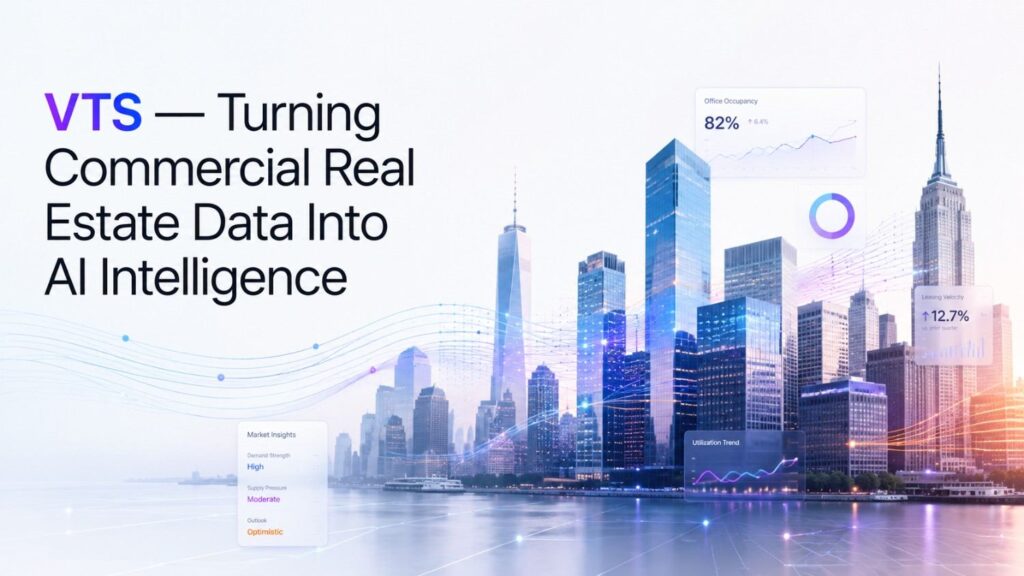
VTS — Turning Commercial Real Estate Data Into AI Intelligence
VTS represents a different type of company.
Rather than starting as a generative AI startup, the New York company spent years building software and data infrastructure across commercial leasing, asset management, property operations, and tenant experience. It launched VTS AI in September 2025 and said in January 2026 that its platform covered more than 13 billion square feet globally and was used by more than 1.2 million users, including more than 45,000 real estate professionals. Those scale metrics are company-reported.
Why Existing Workflow Data Becomes an AI Moat
VTS demonstrates one of the most important principles in vertical AI: the model is only part of the product.
Commercial buildings generate information about tenants, leasing activity, space, proposals, renewals, prospects, concessions, rents, and market demand. A company that already sits inside those workflows can build AI on top of years of structured activity.
In April 2026, VTS launched Asset Intelligence, which uses AI-driven lease abstraction to turn lease information into operational data that can support renewals, compliance, and asset decisions.
That is much harder to copy than a standalone chat window.
The New York Use Case Is Especially Strong
Manhattan office leasing totaled 14.89 million square feet in the first half of 2026. CBRE reported an average asking rent of $80.17 per square foot at the end of the second quarter.
At that level of activity and value, shortening the time needed to compare leases, understand buildings, track prospects, or prepare asset decisions can matter.
The strategic lesson is simple: in commercial property, AI becomes more useful when it is connected to proprietary portfolio data rather than operating as a separate assistant.
Findigs — Using AI to Change Rental Screening and Decisioning
Findigs is attacking one of the least glamorous but most important parts of residential leasing: deciding whether an applicant should be approved.
The New York company announced a $32 million Series C in June 2026, bringing its reported total funding to $80 million. Findigs says operators covering more than 500,000 rental units use its platform.
Screening Is Becoming Decisioning
Traditional rental screening often produces information that a human team must then review.
Findigs is trying to move further down the workflow. Its system can return an application decision rather than simply giving the operator another report to interpret.
That difference captures the broader shift happening across AI software.
The old software model gave employees information.
The new model increasingly tries to complete a step.
Why This Is a High-Stakes Area
Rental decisioning is also an area where accuracy, explainability, consistency, and human oversight matter enormously.
A faster decision is not automatically a better decision. Owners adopting AI in tenant screening should pay close attention to false positives, appeal processes, data quality, fair-housing risk, and the legal requirements that apply to their exact workflow.
The most important KPI should therefore not be “percentage automated.”
It should be a balanced group of measures that includes decision time, manual-review rate, fraud detection, delinquency outcomes, errors, applicant disputes, and compliance results.
Runwise — Bringing AI Into the Physical Building
Runwise is important because it pushes AI beyond documents and conversations and into the operation of actual buildings.
The New York-based company combines sensors, hardware, wireless connectivity, and software to help control building systems. Its technology is used for heating and other building infrastructure, allowing operators to respond to conditions rather than relying only on fixed schedules or manual adjustments. MassMutual Ventures lists Runwise as headquartered in New York and describes its platform as operating heating, cooling, electric, and water systems more intelligently.
Runwise’s 2025 financing included $30 million of Series B equity plus $25 million in debt. At the time, reporting said the platform was installed across more than 10,000 buildings.
Why NYC Building AI Could Become Much Bigger
This opportunity extends far beyond labor savings.
New York building owners face energy costs, equipment problems, tenant-comfort demands, and emissions rules. Local Law 84 creates annual energy and water benchmarking requirements for qualifying large buildings, while Local Law 97 establishes emissions limits for covered properties.
Beginning with required reports in the current compliance period, an owner whose reported emissions exceed applicable limits can face a potential civil penalty calculated using a maximum rate of $268 for each metric ton of emissions above the limit, subject to the law and applicable mitigation rules.
That creates a very different AI business case.
Saving energy is no longer only an environmental project. It can affect operating expenses, regulatory exposure, asset plans, and long-term capital decisions.
PermitFlow — Making Permitting a Software Workflow
Anyone who has worked on New York construction understands why permitting is a technology opportunity.
Rules differ by jurisdiction. Documents move among many parties. Status must be tracked. Inspections matter. A missing requirement can hold up an entire project.
PermitFlow was founded in 2021 and is based in New York City. Y Combinator describes the company as an AI platform helping general contractors and developers manage preconstruction.
The company announced a $54 million Series B led by Accel in March 2026. Its newer materials describe AI agents supporting permitting, licensing, inspections, and project closeout.
Why Permitting Is a Perfect Vertical AI Problem
Permitting contains exactly the features that vertical AI handles well.
There are large numbers of documents. There are repeat processes. Rules depend on location and project type. Status information is spread across systems. People spend large amounts of time checking whether something has happened.
NYC’s DOB NOW approved-permits dataset contains close to one million records issued through the system since 2016, which gives a sense of the administrative scale even before older permit systems and other permit types are considered.
For developers, the practical KPI is not “AI usage.”
It is days removed from the preconstruction schedule.
Trunk Tools — Giving Construction Teams an AI Interface to Project Data
Construction projects create enormous amounts of information.
Drawings change. RFIs arrive. Specifications are updated. Schedules move. Submittals must be reviewed. People in the field need answers, but the answer may be buried in hundreds or thousands of pages.
New York-headquartered Trunk Tools is trying to make that information easier to use. The company announced a $40 million Series B in July 2025, taking total reported funding to $70 million. Its platform applies AI to construction documents including drawings, specifications, RFIs, schedules, and submittals.
The Bigger Idea Is Construction Memory
The value of this model is not simply faster document search.
A construction company can begin building a digital memory of how its projects work.
That memory can eventually answer questions such as what the current specification says, whether a scope has changed, which document controls a decision, what task is at risk, and what similar issues occurred on earlier projects.
For a NYC developer, that can reduce dependence on information living inside one project manager’s inbox.
The strategic opportunity becomes much larger when AI moves from “find this file” to “understand the current state of this project.”
Cherre — Building the Data Foundation AI Needs
Cherre may be less visible to everyday renters or brokers, but it addresses a foundational problem.
Real estate data is messy.
One company may have property information in a warehouse, leases in another system, financial records in an ERP, market data from vendors, operational information inside property-management software, and spreadsheets everywhere else.
Cherre, based in New York, focuses on connecting and managing real estate data. It announced a $30 million Series C in September 2024 to expand its data intelligence capabilities.
AI Cannot Fix Bad Data by Itself
This is one of the most important lessons in the entire article.
A powerful model sitting on unreliable property data can produce unreliable answers faster.
Deloitte’s commercial real estate research has repeatedly pointed to data readiness, fragmentation, security, and reliability as major AI challenges. Its 2026 outlook again argues that useful AI depends on having the right data underneath it.
That means companies like Cherre could become more important as AI adoption grows.
Owners should therefore resist the urge to start with a chatbot.
Start by mapping the systems that hold your leases, units, rent rolls, vendors, work orders, financial records, documents, and building data.
AI sits on top of that foundation.
Visitt — AI Agents for Commercial Property Operations
Visitt is another company moving directly into daily building work.
The New York AI-native commercial property operations company announced a $22 million Series B in January 2026. It said it had more than 150 customers and reported 900% growth in managed square footage during 2025. Those figures are company-reported and should be viewed in that context.
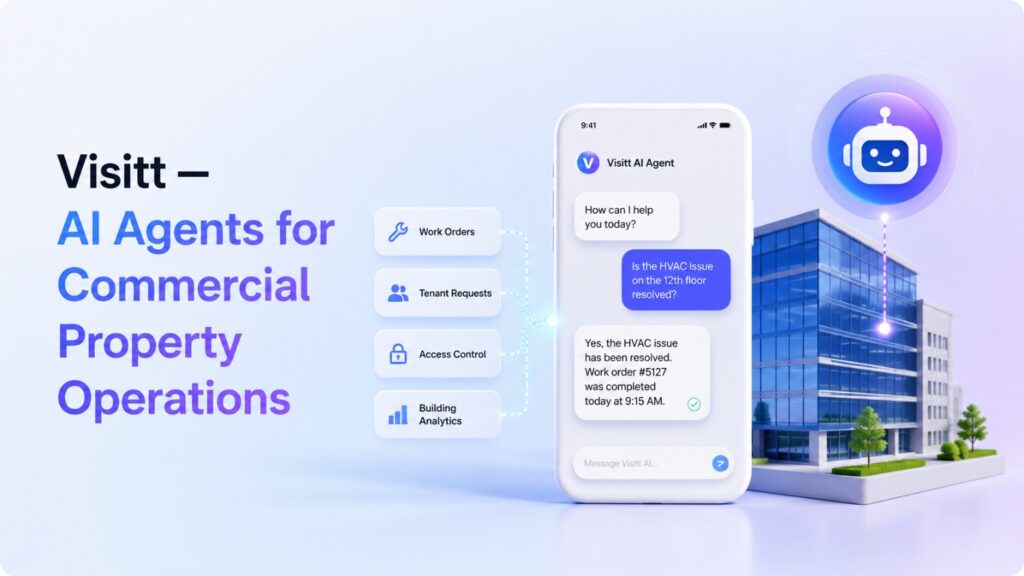
Its platform brings together work orders, tenant communication, compliance, vendor processes, and other building operations. Visitt has also introduced AI agents designed to handle work such as work-order triage, vendor follow-ups, recurring issues, and insurance-certificate processes.
Property Management May Become Exception Management
This suggests a useful future operating model.
Today, many property managers spend a large part of their time moving routine work forward. They assign a request, ask a vendor for an update, chase a document, respond to a tenant, check whether a task closed, and then update another system.
AI agents can potentially handle parts of that chain.
If they work reliably, the property manager’s role shifts toward exceptions.
The human spends less time pushing every process forward and more time dealing with unusual situations, relationships, negotiations, safety issues, judgment calls, and unhappy tenants.
That is a more realistic view of AI’s impact than saying property managers will simply disappear.
Jones — Automating the Insurance Work Hidden Inside Real Estate
Insurance verification is exactly the type of workflow that receives little public attention but consumes significant employee time.
Real estate owners and construction companies need certificates of insurance, endorsements, policies, and proof that vendors meet requirements. Employees frequently collect documents, review them, identify missing information, follow up, and repeat the process when documents expire.
Jones, a New York-based vertical software company, announced a $15 million Series B in January 2025. The company said its system covered more than 25,000 properties and construction projects across more than 2.5 billion square feet at the time of the announcement. These are company-reported figures.
Why Narrow AI Can Build a Big Business
Jones illustrates why the best vertical AI opportunity may look boring at first.
Insurance verification is narrow. Yet it exists across massive real estate portfolios, involves expensive risks, contains repeated document review, and must interact with other enterprise systems.
That combination is powerful.
The lesson for founders and property companies is that a narrow workflow can be more valuable than a broad “AI assistant.”
If it owns an important step completely, customers know exactly why they are paying for it.
Uniti — Building AI Agents Across Property Operations
Uniti is one of the younger companies in this group and a useful signal of where the market is moving next.
Founded in 2024 and based in Manhattan, the company builds AI agents for real estate operators. It announced a $12 million Series A in July 2026. Its product is aimed at operational workflows including leasing, maintenance, resident communication, collections, payments, and support.
The Key Word Is “Agent”
A traditional chatbot waits for a question.
An AI agent can potentially take an action.
That could mean contacting a prospect, following up on a payment, creating a work order, routing a problem, updating a system, or continuing a workflow until a defined result is reached.
The distinction is important because much of real estate operations consists of multi-step work.
The next competitive battle may therefore be less about which company has the best conversational interface and more about which platform can safely complete the greatest number of useful actions.
Henry AI — Automating the Commercial Real Estate Deal Desk
Henry AI is one of the fastest-moving companies in our sample.
The New York startup initially focused on the repetitive analytical and presentation work done by commercial real estate teams. In July 2026, it announced a $16.5 million Series A led by FirstMark Capital, following its earlier seed financing.
Henry says its platform can automate work around underwriting, comparisons, pitch materials, offering memorandums, and other deal documents. The company has reported use by more than 150 firms and says more than $150 billion of underlying deal value has moved through its platform. Those metrics come from the company and its investors rather than an independent audit.
Why Brokerage Is Ready for This
Commercial brokers and analysts spend large amounts of time producing materials before a deal closes.
That work matters, but much of it follows patterns.
Data must be collected. Comparables must be found. Maps and tables are created. Financial information is organized. Existing information gets moved into a new presentation.
Generative AI is extremely well suited to this kind of information transformation.
The high-value broker remains important because clients still need relationships, negotiation, judgment, market knowledge, and trust.
But the analyst work underneath that broker can become much faster.
OnsiteIQ — Turning Construction Sites Into Structured Data
OnsiteIQ attacks a different kind of information problem: understanding what is actually happening on a construction site.
The New York-headquartered company uses 360-degree site imagery and AI tools to create a more consistent record of construction progress. Its website says the company had monitored more than 2,200 projects across more than 110 markets by 2024.
OnsiteIQ announced a $14 million Series B in October 2023. Its platform is aimed at owners, developers, investors, and lenders that want greater visibility into progress and project risk.
Computer Vision Creates a Different Kind of AI Opportunity
Most discussion about generative AI centers on text.
Buildings are physical.
That means some of real estate’s most valuable AI systems will use images, sensor data, drawings, schedules, and other physical-world inputs rather than simply reading documents.
For developers and lenders, this can make construction progress easier to verify across many projects.
That could improve draw reviews, delay detection, schedule discussions, payment verification, and investor reporting.
Other NYC AI Property Companies Worth Watching
The market is broader than our core funding sample.
New York’s startup ecosystem contains newer companies working on autonomous brokerage, drawing review, real estate finance, market intelligence, property data, and building controls. Y Combinator’s current NYC real estate and construction directory, for example, includes companies such as HOMLI and Structured AI alongside PermitFlow.
There are also established New York proptech companies such as Lev, Keyway, LocalizeOS, and Nantum AI operating in adjacent areas of financing, investment workflows, brokerage, data, and building intelligence.
We did not force every possible company into our capital model because doing so would reduce comparability. The point of the index is not to create the longest startup list on Google. It is to identify where AI appears to be creating a durable operating advantage.
What AI Is Actually Changing in New York Real Estate
Looking across all these companies reveals several clear patterns.
Leasing Is Becoming a 24/7 Function
Leasing used to depend heavily on office hours.
AI changes that.
A renter searching at midnight can ask a question, confirm availability, schedule a tour, receive instructions, or begin a process immediately. The same system can continue conversations across thousands of prospects without forcing a leasing team to grow at the same rate.
In a high-rent city with constrained supply, speed matters.
But the advantage will not come from sending more messages.
It will come from identifying which conversations move a qualified prospect toward a signed lease while keeping humans available for cases that require judgment.
Property Management Is Moving Toward Continuous Automation
A similar transformation is happening after the tenant moves in.
Maintenance requests can be categorized automatically. Duplicate problems can be detected. Vendors can be contacted. Residents can receive updates. Tasks can be routed and checked.
The deeper opportunity comes when these activities are connected.
A resident reports a leak. AI identifies the unit, creates the work order, determines urgency, alerts the right team, provides the resident an update, notices similar requests in nearby units, and flags the possibility of a larger building problem.
That is much more useful than a chatbot that simply says, “Your request has been received.”
Commercial Real Estate Research Is Getting Much Faster
AI can read the documents that have historically consumed analyst time.
It can extract lease terms, compare properties, summarize market information, prepare early underwriting work, create presentations, and search internal deal history.
Companies such as VTS and Henry AI show two paths toward this future.
One starts with an enormous workflow and data platform, then adds AI.
The other starts with AI and attacks a specific high-cost production workflow.
Both approaches can work.
The important question for customers is whether the system has access to the data needed to give a reliable answer.
Construction Is Becoming Machine-Readable
Construction remains one of real estate’s largest information-management problems.
Drawings, schedules, RFIs, photographs, specifications, permits, inspections, invoices, and contracts all describe different parts of the same project.
AI is beginning to connect them.
PermitFlow attacks the government and preconstruction side. Trunk Tools makes project documents easier to understand and act on. OnsiteIQ creates structured visibility from the physical construction site.
Taken together, these products suggest a future in which a development team can ask not only, “What does the document say?” but also, “What is holding this project up?”
That second question is worth much more money.
Building Operations Could Become One of NYC’s Biggest AI Markets
This is the segment we believe deserves more attention.
NYC’s current Local Law 84 dataset has about 103,000 property-year records covering energy and water information from qualifying properties. Local Law 97 adds another reason for many owners to understand emissions and building performance more closely.
The building itself is becoming a data source.
Temperatures, boiler activity, occupancy, energy use, work orders, water consumption, complaints, equipment alerts, inspections, and weather can all inform how a property is run.
Over time, AI can move from telling an operator that something happened to helping decide what should happen next.

Runwise sits particularly close to this opportunity because its software interacts with physical building systems.
The companies that eventually dominate building AI may therefore be those that combine software intelligence with the ability to influence the real world.
Original Finding: Distribution Is Becoming the Moat
One of our strongest conclusions from reviewing these companies is that AI models themselves may not be the strongest long-term advantage.
Distribution could matter more.
EliseAI can create value because it is embedded in housing workflows. VTS has an enormous installed real estate platform. Findigs sits directly in rental applications. Runwise connects to buildings. Cherre connects property data. Jones sits in insurance compliance. Visitt sits in daily work orders and tenant operations.
Once a company controls an important workflow, it can add more intelligence over time.
A new competitor may be able to access a similar language model.
It cannot instantly reproduce years of integrations, customer data structures, workflow history, user behavior, or enterprise trust.
That is why real estate AI could become a vertical software battle rather than a model battle.
Where NYC Property Companies Should Use AI First
Real estate companies often start AI adoption in the wrong place.
Someone on the leadership team sees a demo and asks, “Where can we use this?”
A better question is:
Where does our team repeatedly spend expensive human time transferring, checking, summarizing, routing, or chasing information?
That is where AI should be tested.
| Real estate business | Strong first AI workflow | Measure this first |
| Multifamily owner | Leasing inquiries | Lead-response time and conversion |
| Property manager | Maintenance triage | Time to assignment and resolution |
| Commercial landlord | Lease abstraction | Minutes per lease and error rate |
| Brokerage | Deal research and materials | Analyst hours per assignment |
| Developer | Permitting | Days between submission milestones |
| General contractor | Project-document questions | Response time and rework |
| Asset manager | Portfolio reporting | Hours per reporting cycle |
| Building operator | Energy optimization | Energy use, cost and comfort |
| Vendor-management team | Insurance verification | Documents handled per employee |
| Residential operator | Application decisioning | Decision time, exceptions and outcomes |
The common theme is measurable work.
Do not begin with “employee productivity” as the only metric.
That is too broad.
Choose something observable.
If an employee currently spends 45 minutes extracting a lease and the AI-assisted process takes 10 minutes with the same or better accuracy, the result is visible.
If nothing can be measured, the pilot is poorly designed.
A Practical 90-Day AI Real Estate Pilot for NYC Companies
The best way to adopt AI is not to spend a year writing a huge strategy document.
Choose one meaningful workflow and learn quickly.
Days 1–15: Measure the Current Process
Before introducing AI, observe what happens today.
How many people touch the workflow? How many minutes does each case require? How long does the customer wait? How often do errors occur? How much rework is needed?
Do not estimate when you can measure.
Take a real sample.
If you want to automate lease abstraction, select perhaps 50 or 100 leases and record the current human process.
If you want to automate maintenance triage, measure several weeks of requests.
The baseline prevents vendors from claiming a 70% improvement against a number nobody actually knew.
Days 16–45: Run AI Beside the Existing Team
Do not hand control over immediately.
Run the new tool beside the existing process.
Compare its decisions and outputs with what trained employees do.
Record every meaningful error.
More importantly, classify errors.
A formatting mistake and a wrong renewal date are not equally serious.
For high-risk tasks, create a weighted-error score that gives larger penalties to mistakes with financial, safety, legal, or customer consequences.
Days 46–75: Connect the Workflow
This is where many AI pilots fail.
A tool may perform impressively in a demo but still create more work because employees must copy information between systems.
The AI needs the right inputs and a clear destination for its output.
Ask whether it can connect with your property-management software, CRM, document storage, lease system, ERP, work-order system, energy platform, or other systems that actually run the business.
Measure how much manual movement remains.
An AI tool that saves five minutes but adds six minutes of copying is not automation.
Days 76–90: Scale It or Kill It
At the end of 90 days, leadership should make a decision.
Did the workflow become faster?
Did accuracy stay within an acceptable range?
Did employees actually use it?
Did customer experience improve?
Did risk increase?
Did the economics work after software cost, implementation, review time, and integration costs were included?
If the answer is no, stop.
A disciplined company should be willing to kill an AI pilot.
The goal is not AI adoption.
The goal is a better business.
A Practical NYC Real Estate AI Scorecard
Leaders need more than a vendor’s case study.
Use a scorecard.
| Metric | What good performance looks like | Warning sign |
| Cycle time | Material reduction | Little difference after implementation |
| Human touches | Fewer routine handoffs | Employees still re-enter everything |
| Accuracy | Equal to or better than current process | Frequent corrections |
| High-impact errors | Near zero | Wrong legal, financial or safety information |
| User adoption | Team uses it without being forced | Staff creates workarounds |
| Customer experience | Faster, clearer service | More escalations and frustration |
| Cost per task | Falls at meaningful volume | Software cost exceeds labor saved |
| Integration | Data moves automatically | Copy-and-paste remains common |
| Auditability | Decisions can be reviewed | No useful record of what AI did |
| Override rate | Stable and explainable | Humans constantly reverse the system |
| Revenue impact | Conversion or retention improves | No connection to commercial outcomes |
| Time to value | Weeks or months | Endless implementation |
No single metric is enough.
A leasing AI system could reduce response time while hurting conversion.
A screening product could improve speed while creating unacceptable false positives.
A building-control system could reduce energy use while creating comfort complaints.
Good AI management means optimizing the entire operating result, not one impressive number.
The Biggest AI Risk in Real Estate Is Not Hallucination Alone
Hallucinations receive plenty of attention, but the bigger business risk is often blind automation.
A person can usually recognize when ChatGPT writes something strange.
Problems become harder when an AI system performs thousands of actions quietly inside a business process.
Wrong Data Can Become Wrong Decisions at Scale
If a lease is extracted incorrectly once, an employee may catch it.
If an automated system incorrectly extracts the same type of clause across 8,000 leases, the problem becomes much larger.
That is why companies need testing sets based on their own documents.
Do not accept a vendor’s general “98% accuracy” claim without asking what was measured.
Test the fields that matter to your company.
Fair Housing and Screening Require Special Care
Any system involved in tenant advertising, qualification, screening, pricing, or decisioning deserves additional review.
AI does not remove an owner’s legal responsibilities.
Real estate businesses should involve experienced legal and compliance professionals, create clear human-review pathways, test for unintended outcomes, and maintain records showing how consequential decisions were made.
Speed does not justify hidden discrimination or a decision nobody can explain.
Property Data Is Sensitive
Real estate systems may contain names, income information, payment history, bank details, leases, building access information, vendor records, legal documents, financial models, and confidential deal information.
Sending everything into whichever AI tool an employee happens to find is not a strategy.
Companies need clear rules covering which tools can access which data, how information is retained, who can see outputs, and whether vendor systems use customer data for model training.
Human Review Should Depend on Risk
Not every AI task needs the same control.
Automatically formatting a marketing presentation is relatively low risk.
Approving a tenant, interpreting an insurance exclusion, controlling a building system, or extracting a major lease obligation is very different.
The higher the consequence of an error, the stronger the review process should be.
Why New York Could Produce More Real Estate AI Winners
New York has something that many technology markets do not: enormous quantities of real-world customers sitting next to technology talent and capital.
A founder building commercial real estate software can talk to some of the country’s largest owners, lenders, brokers, developers, insurers, and asset managers without leaving the city.
A housing AI startup can test problems created by expensive rents, large apartment portfolios, high inquiry volume, complex regulation, and demanding residents.
A building-operations company can work in one of the densest collections of large properties in the world.
A permitting company can learn inside a market where construction administration genuinely hurts.
These are difficult conditions.
That is exactly why New York can be a useful proving ground.
A product that creates measurable value in NYC property operations has a strong story when it expands into other cities.
The Bigger Opportunity Is Not “AI for Real Estate”
There may eventually be no separate category called AI real estate software.
AI could simply become part of how good real estate software works.
No one advertises modern property software by saying it uses databases. Databases are expected.
The same could eventually happen with AI.
Leasing software will be expected to understand conversations.
Property-management systems will be expected to categorize and route work automatically.
Construction platforms will be expected to understand drawings.
Asset-management platforms will be expected to read leases.
Building software will be expected to predict and respond to operating conditions.
Brokerage systems will be expected to produce analysis instantly.
The competitive question will shift from “Does this product have AI?” to “How much useful work does this product actually complete?”
That is a much healthier standard.
What NYC Tech Journal Will Be Watching Next
Our current dataset suggests four areas deserve particularly close attention during the next phase of the market.
AI Agents Will Move From Conversation to Execution
The first wave answered questions.
The next wave will take actions.
That means creating work orders, following up with vendors, updating records, preparing applications, checking compliance, scheduling tasks, generating documents, and moving processes forward without requiring a person at every step.
Companies such as Uniti and Visitt already show where that model can go.
The winners will not be the systems that take the most actions.
They will be those that take the right actions reliably.
Building AI Could Gain Ground on Leasing AI
Our recency-weighted funding model currently gives leasing and resident operations a very large lead.
That does not mean it will stay that way.
Building energy, maintenance, emissions, equipment performance, and physical asset intelligence create significant long-term opportunities in NYC. The city’s Local Law 84 and Local Law 97 framework makes building data increasingly important to owners.
Runwise may therefore represent the beginning of a much broader category.
Proprietary Data Will Matter More
Generic AI is getting cheaper and more widely available.
That makes proprietary context more valuable.
The useful system will know your building, your lease, your tenant, your portfolio, your project, your insurance requirement, or your company’s historical deals.
That is why companies with strong data foundations may have a lasting advantage over products built mainly around a generic model.
The Best AI Companies Will Prove ROI in Dollars
The real estate industry is already moving through the AI experimentation phase.
JLL found widespread piloting but much lower success in reaching full AI goals. Deloitte also found meaningful implementation challenges among commercial real estate organizations.
The next stage should therefore be less forgiving.

A vendor will need to show that leasing conversion rose, a permit arrived faster, analyst hours fell, energy consumption declined, bad debt improved, maintenance became faster, errors fell, or a portfolio required fewer administrative resources.
“Uses advanced AI” will not be enough.
Final Takeaway: AI Is Becoming Part of the Property Operating Model
The most important development in New York real estate AI is not that artificial intelligence can write listing descriptions.
It is that software is beginning to do pieces of real estate work that previously required people to read, interpret, copy, route, chase, summarize, and update information manually.
EliseAI is attacking housing operations. Findigs is changing rental decisioning. VTS is embedding AI inside commercial real estate data and asset workflows. Runwise connects software to physical buildings. PermitFlow and Trunk Tools attack construction administration. Henry AI focuses on the commercial deal desk. Visitt and Uniti are pushing property management toward AI agents. Jones automates insurance compliance. Cherre builds the data foundation. OnsiteIQ makes construction sites easier to understand digitally.
Our original analysis of 12 NYC companies found approximately $640.5 million across their latest comparable announced equity rounds. About 78.2% of that amount sits with the five largest rounds in our sample.
More importantly, after we adjusted those rounds for age using our 24-month funding half-life model, 53.6% of the current momentum signal came from leasing and resident operations. Construction and permitting represented another 19.5%.
That tells us something important about where artificial intelligence is creating value.
AI in New York property is moving toward the work that happens every day.
The companies that win will probably not be those with the cleverest demo. They will be the businesses that control a painful workflow, connect to reliable property data, fit inside the systems people already use, make fewer costly mistakes, and prove that every dollar spent on AI produces a measurable operating result.
For New York landlords, developers, brokerages, contractors, lenders, and asset managers, that is the standard worth using.
Do not ask whether your real estate business needs AI.
Ask where good employees are still spending hundreds of hours doing work that software should already understand.
That is where the opportunity starts.