
Drug discovery has always been a strange business. Scientists can spend years finding a molecule that looks promising, only to discover later that it does not work in people, cannot reach the right tissue, creates an unwanted side effect, or is simply too hard to turn into a useful medicine.
Artificial intelligence is not going to make those problems disappear. What it can do is help researchers ask better questions earlier, test far more possibilities, and learn faster from every experiment. That shift is already creating a new class of biotech company, and New York City is becoming one of the most interesting places to watch it happen.
The NYC story is also different from the easy headline about AI “designing a drug in seconds.” Many of the strongest companies here are building much deeper systems. They combine machine learning with immune-cell data, RNA biology, atomic simulation, automated chemistry, organoids, wet labs, clinical samples, or actual drug trials. In other words, the important race is not simply to build the smartest model. It is to build the fastest and most reliable learning loop between computers and biology.
That is the central finding from NYC Tech Journal’s original analysis of the New York AI-biotech market.
For this article, we reviewed public company materials, funding announcements, government records, accelerator databases, scientific descriptions, partnership announcements, current company websites, and recent operating activity. We then built our own dataset of 15 active private companies that have meaningful New York City roots and use AI as an important part of therapeutic discovery or development.
The result shows a market that is more mature, more varied, and more capital-intensive than the phrase “AI drug discovery startup” might suggest.
The Short Version: What Is Happening in New York AI Biotech?
Three patterns stand out.
First, New York’s AI-biotech market is no longer made up mostly of experimental software companies. Several companies now have drug programs, wet-lab systems, pharmaceutical partnerships, or clinical-stage assets.
Second, capital is highly concentrated. In our lower-bound analysis of ten companies with usable public capital figures, we found at least $1.57 billion in reported funding, financing, grants, or cumulative capital. Roughly three quarters of that minimum observed pool sits with just three companies: Formation Bio, Owkin, and Immunai. We explain the limitations of that calculation below.
Third, the New York model increasingly looks like closed-loop biotech. The computer proposes something. A lab, clinical dataset, organoid, assay, or drug trial tests it. The result flows back into the system. That feedback loop may matter more than having the flashiest foundation model.
New York City is building physical infrastructure around the same idea. NYCEDC says the broader LifeSci NYC effort involves more than $1 billion of public investment, while the city says its life-sciences ecosystem draws on nearly 20 academic medical or research centers and more than $2.5 billion in annual NIH funding across the metro area. LifeSci NYC says its investments have helped enable more than 3.5 million square feet of lab-capable space. (edc.nyc)
That matters because AI-biotech still needs biology. GPUs alone cannot tell you whether a candidate actually works inside a living system.
Original Research: How We Built the NYC AI Biotech Startup Dataset
We Used a Stricter Definition Than “Company With an AI Page”
There are hundreds of healthcare and life-sciences companies with some connection to artificial intelligence. Calling all of them AI-biotech startups would make this list almost meaningless.
To make the analysis more useful, we required companies to meet several conditions. They had to be private and active, have a meaningful New York City base or headquarters, operate in therapeutics or the drug-discovery/development chain, and make AI, machine learning, computational modeling, or AI-driven automation an important part of how the business works.
We excluded pure diagnostic businesses, general healthcare software companies, CROs with no meaningful AI-discovery layer, public companies, universities, and companies that simply have a small sales office in New York.
We also excluded EvolutionaryScale from the current startup dataset even though it would have been one of the most important names on an earlier version of this list. The New York-founded protein-AI company raised $142 million in 2024, but its team joined Biohub in November 2025 as part of a strategic transaction with the Chan Zuckerberg Initiative. It therefore no longer fits our definition of an independent NYC startup. (TechCrunch)
The 15 Companies That Passed Our Screen
| Company | Founded | Primary AI-biotech focus | Evidence of real-world validation |
| Formation Bio | 2016 | AI-native drug development | Clinical assets and human trials |
| Owkin | 2016 | Multimodal biological AI | Patient data, pharma partnerships, wet-lab infrastructure |
| Immunai | 2018 | Immune-system AI and single-cell data | High-throughput lab and pharma programs |
| Accutar Biotech | 2015 | AI-guided small-molecule discovery | Wet-lab validation and clinical assets |
| Excelsior Sciences | 2024 | AI + automated small-molecule chemistry | Closed-loop automated synthesis and testing |
| Proxima | 2019 | AI for proximity therapeutics | Proprietary data-generation system and biopharma collaborations |
| Fathom Therapeutics | 2023 | Quantum chemistry + AI | Preclinical pipeline and partner programs |
| Envisagenics | 2014 | AI-driven RNA-splicing discovery | Wet lab, therapeutic pipeline and pharma collaborations |
| Genetic Leap | 2017 | AI-designed RNA medicines | Clinical-stage program and major pharma collaborations |
| Rumi Scientific | 2017 | AI + human organoid models | Experimental disease models and screening |
| Redesign Science | 2017 | Physics + generative AI | Internal small-molecule pipeline |
| Ordaos Bio | 2019 | Generative AI protein design | In-house wet lab and design-build-test loop |
| OneThree Biotech | 2018 | Biology-first machine learning | Partner validation and preclinical discovery |
| Junction Bioscience | 2024 | AI hypothesis engine for medicines | Wet-lab molecular experimentation |
| Output Biosciences | 2021 | Biological foundation models | Model-to-experiment discovery loop |
The founding dates and company descriptions come from company materials and current corporate or accelerator records. Examples include Formation Bio’s history as TrialSpark, Immunai’s stated 2018 founding, Fathom’s 2023 founding, Ordaos’ 2019 founding, Junction’s YC profile, and Output’s YC profile. (Formation Bio)
This is not meant to be a complete census of every scientist or stealth company working on computational biology in the five boroughs. It is a reproducible editorial sample of the private companies for which we could find enough current public evidence to make a meaningful assessment.
Chart 1: NYC’s AI-Biotech Companies Are Not All New
One of the more surprising findings is that New York’s AI-biotech sector did not suddenly appear with ChatGPT.
Founding year of the 15-company NYC sample
2014 █
2015 █
2016 ██
2017 ███
2018 ██
2019 ██
2020
2021 █
2022
2023 █
2024 ██
The median founding year is 2018.
Nine of the 15 companies in our dataset were founded in 2018 or earlier. That matters because many have had enough time to build biological datasets, complete experiments, form pharma relationships, and discover where machine learning does and does not help.
At the same time, a second wave is clearly forming. Output Biosciences arrived in 2021, Fathom in 2023, and Excelsior Sciences and Junction Bioscience in 2024. Those newer companies are being built after the rise of large foundation models, better protein models, cheaper cloud computing, modern robotics, and stronger AI research talent.
The result is an ecosystem with two generations operating at once: older machine-learning biotechs that have spent years learning biology, and newer AI-native companies that can start with tools that barely existed five years ago.
Original Analysis: At Least $1.57 Billion Has Gone Into a Small Group of NYC AI-Biotech Companies
Funding is difficult to compare cleanly in biotech.
Some companies announce total capital raised. Others disclose only a recent round. Some receive government grants. Some sign pharmaceutical deals worth hundreds of millions of dollars in potential milestones, but those milestones are not the same thing as cash in the bank. Private-company databases can also disagree.
So we used a conservative method.
We selected ten companies for which we could find a usable public capital figure. When a source said “more than $600 million,” we entered $600 million. When Accutar said it had raised “over $100 million,” we entered $100 million. That makes the results floor values, not exact totals.
Chart 2: Minimum Publicly Observable Capital Among Selected Companies
Approximate minimum observed capital ($ millions)
Formation Bio 600+ | ██████████████████████████████
Owkin 304 | ███████████████
Immunai 295 | ███████████████
Accutar Biotech 100+ | █████
Excelsior Sciences 95 | █████
Proxima 80+| ████
Fathom Therapeutics 47 | ██
Envisagenics 26.6 | █
Redesign Science 15 | █
Ordaos Bio 11.1 | ▌
Formation Bio raised a $372 million Series D in 2024, bringing reported cumulative funding above $600 million. Owkin currently says it has raised $304 million. Immunai said its $215 million Series B took total funding to $295 million. Accutar reported in 2021 that cumulative funding had passed $100 million. (PR Newswire)
Excelsior announced $70 million in Series A venture financing plus a $25 million Empire State Development grant. Proxima announced an $80 million seed financing in January 2026. Fathom raised a $47 million Series A in April 2026. Envisagenics has at least $26.61 million of reported financing and grant capital in CB Insights’ dataset, while Redesign Science disclosed $15 million of seed financing and Ordaos has reported more than $11 million in total funding according to CB Insights. (Excelsior Sciences)
Using those conservative floor values, the ten-company pool comes to approximately $1.574 billion.
Formation, Owkin, and Immunai account for about 76% of that lower-bound pool. Add Accutar and Excelsior, and the top five represent roughly 89%.
Those percentages should not be mistaken for precise venture-market-share numbers because the underlying disclosures are not perfectly standardized. They are still useful for one reason: they show just how top-heavy AI-biotech capital has become in New York.
Why That Funding Concentration Matters
It would be easy to read this concentration as a weakness. It may be the opposite.
Drug discovery needs unusually large amounts of money once companies start generating proprietary biological data, running labs, manufacturing compounds, licensing assets, or entering clinical studies. It is therefore normal for companies that move closer to real drugs to pull away financially from companies still proving a platform.
The more interesting question is whether the next group can cross that gap.
Fathom’s $47 million Series A, Proxima’s $80 million seed financing, and Excelsior’s combined $95 million package all arrived during 2025-2026. Those are large early-stage commitments by ordinary software-startup standards. They suggest investors increasingly understand that the next generation of AI-biotech requires both computing and expensive physical experimentation.
Original Analysis: New York’s Strongest AI-Biotech Theme Is Small-Molecule Discovery
We also classified each company according to the main biological or drug-discovery problem it attacks.
Chart 3: Primary Technology Focus
Primary focus in our 15-company sample
Small molecules / molecular chemistry 6 ██████ 40%
Biological data / omics 3 ███ 20%
RNA 2 ██ 13%
Protein design 1 █ 7%
Organoid / phenotypic discovery 1 █ 7%
AI-native clinical development 1 █ 7%
General biological foundation models 1 █ 7%
The six companies we classified primarily around small molecules or molecular chemistry are Accutar, Excelsior Sciences, Proxima, Fathom Therapeutics, Redesign Science, and Junction Bioscience.
That 40% share is meaningful.
Small-molecule discovery is one of the areas where AI can create a tight economic loop. Models propose or rank molecules, scientists synthesize them, experiments measure what happened, and the new measurements can improve the next round of predictions.
New York is not betting on one version of that loop. Accutar combines computational design with wet-lab validation. Fathom models the physical motion of proteins. Redesign simulates dynamic molecular structures. Proxima focuses on protein-protein interactions and proximity therapeutics. Excelsior is redesigning the actual chemistry so robots can perform it more easily. Junction is attempting to automate parts of scientific hypothesis generation.
Those are six different attacks on the same bottleneck: how do we explore more useful chemistry without physically making every possible molecule?
Original Analysis: NYC’s AI-Biotech Market Is Becoming a Lab Market, Not Just a Model Market
The most important finding in our research may not involve funding at all.
Based on our review of public company descriptions, 14 of the 15 companies in our sample describe some form of experimental, biological, clinical, or physical data feedback loop. The exact depth differs by company, but the pattern is hard to miss.
Immunai combines machine learning with high-throughput generation of single-cell immune data and functional genomics. Accutar explicitly describes computational drug design followed by wet-lab validation. Excelsior is building automated synthesis-and-test loops. Rumi runs human-cell-derived disease models. Ordaos has an internal wet-lab operation feeding experimental results into its protein-design system. Output describes using CRO experiments to validate model output and create new training data. (Immunai)
This is the opposite of the simplistic idea that AI will remove experimental science.
The companies that look strongest are often doing more experiments, not fewer. Their advantage is that AI helps decide which experiment should happen next.
That is a much more believable way to improve drug research.
The Top AI Biotech Startups in NYC
1. Formation Bio — Building an AI-Native Drug Development Company
Formation Bio is unusual because it starts later in the drug lifecycle than most companies on this list.
Instead of mainly inventing molecules from scratch, Formation acquires or licenses promising drug assets and uses technology to move them through development more efficiently. The company began as TrialSpark in 2016, originally building technology around clinical trials, before evolving into an AI-native pharmaceutical company with its own portfolio. (Formation Bio)
That distinction is important. Better AI discovery could eventually create more drug candidates than the pharmaceutical industry can afford to develop. Formation’s thesis is essentially that the bottleneck will shift from finding molecules to deciding which molecules deserve capital, selecting the right indications, designing trials, finding patients, generating evidence, and getting drugs through clinical development.
The company now has real clinical activity. In June 2026, Formation announced that it had dosed the first participant in a Phase 1 study of BLKR201, a CNS-penetrant TYK2 inhibitor. Formation said it moved the drug from licensing deal to first participant dosed in five months. Its current pipeline also includes sprifermin in Phase 2 and a miR-124 program in preclinical development. (Formation Bio)
Why Formation Bio Matters
Formation may tell us something important about where AI creates value.
The winning AI-pharma company may not be the company that invents the largest number of molecules. It could be the company that becomes exceptionally good at allocating development capital.
If AI can tell a drug developer that Candidate A deserves a trial in Disease X rather than Disease Y, help produce the protocol, improve recruitment, organize evidence, and shorten execution, that can create enormous value without generating a single molecule from scratch.
Formation is one of the clearest NYC experiments in that model.
2. Owkin — Trying to Build an AI Scientist for Biology
Owkin is taking one of the broadest approaches in the market.
The company is building what it calls an AI scientist for biomedical research. Its system combines biological models with multimodal patient data, pharmaceutical research workflows, hospital partnerships, and wet-lab infrastructure. Owkin says it has worked with more than 100 academic hospitals and eight of the top ten pharmaceutical companies, and its website currently lists New York as one of its major operating locations. (Owkin)
The core idea is powerful because drug discovery does not fail only because chemists cannot create molecules.
Researchers may choose the wrong biological target. They may misunderstand which patients have the disease mechanism. A target could work in a mouse model but not in people. Biomarkers may be weak. Clinical subgroups can hide very different biology.
Owkin is trying to reason over those layers together.
The Real Asset Is the Patient-Data Network
AI models will become easier to obtain.
Unique, high-quality biological data will not.
Owkin’s long-term position therefore depends less on whether it has a clever language model and more on whether its hospital relationships, multimodal data, biological feedback systems, and scientific expertise create information competitors cannot easily reproduce.
That is a useful framework for evaluating almost every AI-biotech company in this article.
3. Immunai — Mapping the Immune System at Single-Cell Scale
Immunai is one of the strongest examples of New York’s data advantage.
Founded in 2018, the company is trying to understand the immune system through large-scale single-cell and multi-omic data. Its AMICA platform brings together generated data, curated datasets, machine learning, and experimental validation to help companies answer questions about drug targets, candidate selection, mechanism of action, patient groups, and treatment response. (Immunai)
The company has a substantial New York laboratory presence and lists its address at 430 East 29th Street. Its platform uses high-throughput lab workflows to generate immune data, then applies computational methods to find patterns that would be extremely difficult for researchers to identify manually. (Immunai)

Immunai’s partnership activity is also continuing. The company reported an expanded AstraZeneca oncology collaboration in May 2026 and has additional work involving AstraZeneca, Teva, and research institutions. (Immunai)
Why Immunai Is Strategically Interesting
Immunai is not simply asking AI to predict a molecule.
It is trying to build a better map of human immune biology.
That could create value at several points in drug development. The system might identify a target, show why a candidate is or is not working, reveal which patients should receive it, or uncover the immune pathway behind an unexpected clinical result.
That wider position could be more defensible than a narrow molecule-generation tool.
4. Accutar Biotech — One of NYC’s Clearest AI-to-Clinic Stories
Accutar may be the most useful company for anyone who asks the obvious question: Has AI drug discovery produced anything that reached people?
The Brooklyn-based company uses computational drug design followed by wet-lab validation. It says it uses AI to model physical and chemical properties of biological systems and has built its own therapeutic pipeline. (Accutar Bio)
That pipeline has moved beyond preclinical claims. Accutar presented Phase 1 data for AC699 in ER-positive, HER2-negative breast cancer and received FDA Fast Track designation for the program in 2024. In July 2026, the company also announced a new partnership with HEC Pharm around a prostate-cancer program based on RIPTAC technology. (Accutar Bio)
Accutar reported in 2021 that cumulative funding had exceeded $100 million.
What Makes Accutar Important
There is a huge difference between showing that an algorithm can rank molecules and building a drug that survives the path into clinical testing.
Accutar’s significance therefore comes from translation.
The company offers one of the better opportunities in New York to study whether an AI-heavy discovery process can produce compounds with useful clinical characteristics, not merely impressive benchmark results.
5. Excelsior Sciences — Building the Automated Chemistry Lab AI Actually Needs
Excelsior Sciences is one of the most important newer companies on this list because it attacks a problem many AI discussions ignore: making molecules is still slow.
A computer can propose millions of chemical structures. That does not help very much if the lab cannot synthesize and test those structures at useful speed.
Excelsior is building its platform around “Blocc chemistry,” a modular approach intended to make small-molecule chemistry easier for machines and automation systems to perform. Its goal is a closed loop in which AI decides what to make, robotic systems synthesize it, experiments test it, and the results return to the models. (Excelsior Sciences)
The company announced a $70 million Series A in December 2025 along with a $25 million Empire State Development grant. New York State’s support is tied to an AI- and automation-driven preclinical drug-discovery facility in Manhattan. (Excelsior Sciences)
Why Excelsior Could Matter More Than Another Generative Model
AI drug discovery has a physical-world bottleneck.
When model capability improves faster than experimental throughput, the lab becomes the limiting factor. Excelsior’s bet is that chemistry itself should be redesigned for an era of automation.
That is a more fundamental idea than simply adding AI to a medicinal chemist’s workflow.
6. Proxima — Using AI to Make Protein Interactions Programmable
Proxima, formerly VantAI, is focused on proximity therapeutics and difficult protein interactions.
The company describes its Neo-1 model as an all-atom foundation model combining structure prediction and molecular generation. Its broader platform is meant to help researchers discover compounds such as molecular glues that influence what happens when proteins come together. (Ashby)
In January 2026, Proxima announced an $80 million seed financing led by DCVC, with participation from investors including NVentures, Braidwell, Roivant, AIX Ventures, Yosemite, and others. The company says its collaboration track record exceeds $5 billion in potential partnership value. (BioSpace)
Why Proximity Therapeutics Are a Big AI Opportunity
Traditional drugs often depend on finding a convenient pocket on a protein and designing a molecule that binds there.
Biology is not always that cooperative.
Proximity approaches attempt to control interactions between proteins or bring biological components together in useful ways. The possible chemical space becomes extremely complicated, which creates a natural role for powerful structural models and proprietary experimental data.
This is exactly the kind of problem where better computation could open biology that was previously too difficult to search systematically.
7. Fathom Therapeutics — Modeling What Proteins Actually Do, Not Just What They Look Like
Fathom Therapeutics was known as Atommap until 2026.
The New York company uses quantum chemistry, physics, and AI to model how proteins move and behave inside living systems. Its Microcosmos engine simulates protein dynamics at atomic resolution and uses those insights to design molecules around biological function. (PR Newswire)
Fathom raised a $47 million Series A in April 2026. At the 2026 BIO International Convention, the company described itself as preclinical and said it had built 12 partnerships in less than three years. (PR Newswire)
Why Protein Motion Matters
A protein is not a frozen shape.
It bends, moves, changes state, interacts with other molecules, and behaves differently depending on its environment. A model built around one static picture can therefore miss important drug opportunities.
Fathom’s thesis is that improved physics and AI can reveal those dynamic opportunities.
This is one of the more scientifically ambitious small-molecule approaches in the NYC market.
8. Envisagenics — Using AI to Find Drug Targets Hidden in RNA Splicing
Envisagenics is one of New York’s longest-running AI-biotech startups.
Founded in 2014 as a Cold Spring Harbor Laboratory spinout, the company focuses on RNA splicing. Its SpliceCore platform uses RNA-sequencing data, AI, and high-performance computing to identify disease-specific splicing events that could become therapeutic targets or biomarkers. (LinkedIn)
Envisagenics has built both platform partnerships and its own therapeutic work. It announced a Bristol Myers Squibb research collaboration in 2022 and raised a Series B in 2024 with participation from BMS, Empire State Development, Red Cell Partners, and others. (envisagenics.com)
Why RNA Splicing Is a Good AI Problem
The human genome is not a simple instruction list.
Cells can process RNA in different ways, creating different versions of proteins from the same underlying genes. Disease can alter that process. The resulting data is huge and difficult to analyze manually.
AI becomes useful because it can search across enormous numbers of possible splicing patterns and prioritize the ones most likely to matter biologically.
Envisagenics shows that NYC’s AI-biotech sector existed well before today’s foundation-model boom.
9. Genetic Leap — Using AI to Design Medicines Against RNA
Genetic Leap approaches RNA from another direction.
Instead of primarily finding abnormal splicing events, the company uses AI to discover genetically defined targets and design medicines that act on RNA itself. Its technology includes systems for target discovery as well as design of small molecules and oligonucleotide medicines. (genetic-leap.com)
Genetic Leap has also moved into a more advanced stage than many small AI-biotech companies. It describes itself as clinical-stage and says the FDA has cleared an IND for one of its programs. (genetic-leap.com)
Its partnership strategy is worth watching. In 2024, Genetic Leap announced a collaboration with Eli Lilly worth up to $409 million in upfront and milestone payments plus royalties, focused on AI-designed RNA-targeted genetic medicines. (PR Newswire)
The Strategic Lesson
A small startup does not necessarily need hundreds of millions of dollars of venture capital to create value.
If its platform can repeatedly solve a difficult scientific problem for large pharma companies, partnerships can become an alternative path to financing development.
Genetic Leap is a particularly useful example because its publicly reported outside equity funding appears modest compared with the potential value of its pharmaceutical collaborations.
10. Rumi Scientific — Combining Human Development Models With Machine Learning
Rumi Scientific attacks a different weakness in traditional discovery: many laboratory models do not behave enough like human disease.
The Brooklyn company builds stem-cell-derived, organoid-like systems that model aspects of human development and disease. Machine learning is then used to measure differences between healthy and diseased cells and identify compounds that appear to reverse the disease state. (rumiscientific.com)
Its work has focused on difficult central nervous system and genetic disorders, while also expanding into kidney disease. The company has received federal SBIR support, including a reported Phase II award of just over $1 million. (SBIR)
Why This Approach Is Important
AI is only as useful as the experiment it is learning from.
If a model is trained against a weak biological system, it may become very good at predicting results that do not matter in people.
Rumi’s approach tries to improve the physical model first. That makes it an important reminder that the future of AI drug discovery may depend as much on better experimental biology as better machine learning.
11. Redesign Science — Simulating Dynamic Biology With Physics and Generative AI
Redesign Science combines molecular simulation with generative AI.
Its NUVO platform uses physics-based molecular dynamics to study how drug targets move, then applies generative models and machine learning to create and rank molecules against those dynamic structures. The company is developing an internal pipeline of small-molecule programs in areas including oncology and autoimmune disease. (redesignscience.com)
Redesign raised $15 million across two seed financings announced in 2021 and remains based on Varick Street in Manhattan. (PR Newswire)
What to Watch
The real test will be whether richer simulations translate into better drug candidates.
Physics-based systems are computationally demanding. Their advantage has to be more than scientific elegance. They must find molecules that simpler and cheaper systems would miss.
Redesign is one of the NYC companies attempting to prove that case.
12. Ordaos Bio — Designing Mini-Proteins From Scratch
Ordaos is a useful counterpoint to New York’s small-molecule companies.
Its Design Engine uses generative AI, reinforcement learning, and other machine-learning methods to create mini-proteins from scratch. These are smaller than conventional antibodies and can potentially be designed around features such as stability, binding, solubility, and manufacturability. (ordaos.bio)
The company raised a $5 million seed round in 2022 and later opened laboratory space at JLABS@NYC. That lab allows Ordaos to generate experimental data and feed it back into its design system rather than depending only on computational scores. (ordaos.bio)
Why Its Wet Lab Is More Important Than It Looks
The biggest danger in generative protein design is making beautiful digital molecules that are useless in reality.
Proteins have to express properly, remain stable, bind the right target, avoid unwanted immune reactions, and eventually be manufacturable.
Ordaos’ design-build-test loop directly addresses that gap. Its AI gets a chance to learn from failure instead of only learning from public protein databases.
13. OneThree Biotech — Designing AI Around Specific Biological Questions
OneThree Biotech takes a more focused approach to machine learning.
The New York company says it designs models around specific biological questions rather than treating AI as a universal answer. Its work spans target discovery, compound selection, combination therapy, toxicity, biomarkers, and related preclinical problems. (LinkedIn)
That sounds less dramatic than promising an autonomous scientist, but it reflects an important practical lesson.
Biology Often Rewards Narrow Models
The best algorithm for predicting toxicity may not be the best algorithm for signaling pathways.
The best representation of a molecular structure may not help answer a patient-stratification question.
OneThree’s approach therefore represents the specialist side of the AI-biotech debate: instead of building one giant model and expecting it to understand everything, build models around the structure of each scientific problem.
That philosophy could remain valuable even as general biological foundation models become more powerful.
14. Junction Bioscience — A New York Bet on the Autonomous Scientific Hypothesis Engine
Junction Bioscience is much younger than companies such as Envisagenics or Accutar.
The YC Winter 2024 company describes itself as building an AI hypothesis engine for molecular discovery. Its focus is the intersection of neuroinflammation and immunology, and its stated goal is to let an AI system iterate between scientific hypotheses and laboratory measurements. (Y Combinator)
Junction says it secured a six-figure partnership soon after incorporation and developed a research collaboration with a large pharmaceutical company. It is still early, so investors and partners should treat bold autonomy claims as hypotheses that need to be proven rather than finished capabilities. (Y Combinator)
Why Junction Belongs on the Watch List
AI-biotech companies are moving from prediction toward reasoning.
Instead of asking, “Which molecule scores highest?” the next generation of systems wants to ask, “What scientific experiment should we run next, and what would each possible result teach us?”
If that works reliably, the productivity gain could be much larger than faster virtual screening.
15. Output Biosciences — Building a General Biological Reasoning Model in NYC
Output Biosciences is one of the more ambitious and secretive companies in the group.
The YC-backed New York startup says it is building foundation models that reason across biological systems, from molecules toward larger biological scales. Current recruiting materials describe a workflow in which model outputs are experimentally tested through external lab partners and those results produce new data for the system. (Y Combinator)
The company remains small, with YC listing a team size of eight, which makes its ambition notable.
Why Output Is Worth Watching Carefully
The upside of a general biological model is obvious.
If one system could meaningfully reason across molecular interaction, pathways, cell states, disease mechanisms, and therapeutic design, it could become a powerful research platform.
The challenge is equally obvious. Biology contains enormous context, hidden variables, noisy measurements, and causal relationships that are much harder to capture than patterns in text.
Output therefore sits close to the frontier between an extraordinary opportunity and one of AI-biotech’s hardest unsolved problems.
Table: The NYC AI-Biotech Market Is Really Several Markets
| Segment | NYC examples | What AI is trying to improve | Main proof investors should demand |
| Small-molecule discovery | Accutar, Fathom, Redesign, Proxima, Junction | Search chemical space and understand molecular interactions | Better experimental hits and development candidates |
| Automated chemistry | Excelsior Sciences | Increase physical experiment speed | Molecules synthesized, tested and learned from faster |
| RNA medicine | Envisagenics, Genetic Leap | Find RNA targets and design RNA-directed drugs | Validated targets, candidates and clinical progress |
| Protein design | Ordaos | Generate new therapeutic proteins | Binding, stability, function and manufacturability |
| Immune biology | Immunai | Decode complex immune response | Better targets, biomarkers and treatment decisions |
| Multimodal biological reasoning | Owkin | Connect patient data with biological discovery | Prospective scientific and drug-development wins |
| Human disease modeling | Rumi Scientific | Improve relevance of preclinical experiments | Predictive value for human disease |
| AI-native drug development | Formation Bio | Move existing drug assets through trials faster | Real reductions in development time and cost |
| Biological foundation models | Output | Generalize reasoning across biology | Reproducible discoveries that survive experiments |
This table matters because “AI drug discovery” is too broad to be useful as an investment category.
Two companies can both call themselves AI-biotech companies while solving entirely different problems.
Why New York Has an Unusual Advantage in AI Biotech
New York Sits Between Three Industries That Usually Live Apart
The obvious advantage is science.
New York has major research institutions, academic medical centers, hospitals, biotech labs, and one of the largest concentrations of biomedical research in the United States. NYCEDC says the metro has nearly 20 academic medical or research centers, more than 150,000 life-sciences jobs, nearly 5,100 related businesses, and over $2.5 billion in annual NIH grants. (edc.nyc)
But the city’s second advantage is technology.
New York has become a major AI and software market. That makes it possible to recruit machine-learning engineers, product people, data engineers, and technical founders without building the company inside a traditional biotechnology cluster.
Its third advantage is finance.
Drug discovery needs unusually patient capital. New York has deep networks across venture capital, private equity, hedge funds, pharmaceutical finance, investment banking, and public markets.
AI biotech sits directly at the intersection of those three worlds.
Kips Bay Could Become a Physical Center of the Market
Several companies in this article have already operated around the East Side life-sciences corridor.
Immunai lists 430 East 29th Street. Rumi previously operated from Alexandria LaunchLabs on East 29th before establishing its current Brooklyn headquarters. The area already contains major medical and research institutions.
Now the city is putting much more infrastructure around it.
SPARC Kips Bay is planned as a roughly two-million-square-foot education, public-health, and life-sciences campus. NYCEDC says the project is expected to support more than 15,000 jobs and generate $42 billion in economic impact over 30 years. The plans explicitly include wet labs, dry labs, translational research, and space for fields such as machine learning in drug discovery. (edc.nyc)
This could be strategically important.
The ideal AI-biotech cluster is not just an office building full of data scientists. It needs labs, hospitals, clinical samples, scientists, automation, compute, and founders within easy reach of one another.
The Most Important NYC AI-Biotech Trend: From “Prediction” to “Closed-Loop Discovery”
The first generation of AI drug-discovery companies often sold prediction.
Predict whether a compound will bind. Predict whether a target matters. Predict toxicity. Predict a protein structure. Rank molecules.
Those tools can be valuable, but prediction by itself has a limit.
The New Model Looks More Like This
| Step | Traditional workflow | Emerging AI-native workflow |
| 1 | Scientist chooses hypothesis | Scientist + AI choose hypothesis |
| 2 | Team designs experiment | AI prioritizes most informative experiment |
| 3 | Lab performs experiment | Automated or high-throughput lab performs experiment |
| 4 | Team analyzes results | Models analyze structured results immediately |
| 5 | Researchers plan next round | System proposes next design from new data |
| 6 | Cycle repeats | Cycle repeats faster with proprietary data |
This is where companies such as Excelsior, Immunai, Accutar, Ordaos, Rumi, Junction, and Fathom become particularly interesting.
Their potential moat is not the initial algorithm.
It is the accumulating dataset created every time the model interacts with the real world.
Why Proprietary Experimental Data Could Become the Real Competitive Advantage
Public models can be copied.
Research papers can be read.
Open-source architectures can spread in weeks.
But a company that has run 100,000 carefully controlled experiments on exactly the biological problem it wants to solve may have something far harder to reproduce.
The resulting competitive flywheel is simple:
Better model
↓
Better experiment choice
↓
More useful proprietary data
↓
Better model
↓
Better candidates
↓
More experiments
This is the AI-biotech version of a data network effect.
The best NYC companies are increasingly trying to build it.
How Pharma Companies Should Evaluate NYC AI Biotech Startups
Pharma executives should not evaluate these businesses as if they were ordinary enterprise-software vendors.
A beautiful interface tells you almost nothing about whether the system can discover a useful medicine.
Use This Evaluation Scorecard Instead
| Question | What a strong answer looks like | Warning sign |
| What proprietary data does the AI learn from? | Unique experiments, clinical samples or hard-to-recreate datasets | Mostly public databases |
| How are predictions validated? | Prospective wet-lab or clinical testing | Retrospective benchmark only |
| Does the model improve after experiments? | Clear closed-loop learning process | AI and lab operate separately |
| What has reached the next development stage? | Named targets, leads, candidates or trials | Only platform demos |
| Does AI change a measurable business outcome? | Faster cycles, fewer experiments or better success rates | Vague claims about “acceleration” |
| Can the company explain failure? | Failed predictions improve the system | Failures disappear from presentations |
| Is the system useful outside one cherry-picked example? | Multiple programs or independent partners | One showcase result |
| Who owns resulting IP? | Clear contractual structure | Ambiguous ownership of models, data or compounds |
Ask for Prospective Evidence
This is the most important point.
A model can look brilliant when researchers choose the test after seeing the data. What matters is whether it can make a useful prediction before the laboratory result is known.
A strong diligence process should therefore focus on prospective validation.
Give the platform a new target.
Freeze the prediction.
Run the experiment.
Measure what actually happened.
Then compare the result with an appropriate conventional process.
That exercise tells you far more than a hundred polished AI slides.
Investors Should Stop Asking Whether AI “Works” in Drug Discovery
That question is too broad.
AI already works for many narrow tasks.
The better question is whether a specific AI system improves an economically important part of the drug-development process enough to justify its cost.
A Useful Economic Framework
Suppose a conventional discovery team needs 10 experimental cycles to reach a good candidate.
An AI system does not have to magically find the finished drug in one attempt to create value.
If it reduces that process from 10 cycles to seven, and every cycle requires chemistry, assays, staff time, animal studies, and months of work, the value can be substantial.
The same logic applies later.
If Formation can start the correct clinical study months earlier, that matters.
If Immunai helps a pharma company avoid advancing the wrong patient population, that matters.
If Fathom reveals a druggable protein state that conventional modeling missed, that matters.
If Excelsior can physically produce useful experimental data several times faster, that matters.
The correct unit of analysis is the bottleneck removed, not the sophistication of the AI model.
Original Analysis: Clinical Translation Is Still Rare — Which Makes It More Valuable
Only a small part of our 15-company sample currently has clearly disclosed human clinical-stage therapeutic assets.
Formation Bio has clinical programs including BLKR201. Accutar has reported Phase 1 data for AC699. Genetic Leap describes itself as clinical-stage and reports FDA IND clearance for a program. (Formation Bio)
Several others have internal preclinical pipelines, while another large group currently creates value mainly through platforms, partner research, experimental data, or earlier-stage therapeutic programs.
That divide deserves much more attention than it gets.
Chart 4: The AI Hype Funnel
AI model
████████████████████
Interesting prediction
████████████████
Experimental validation
████████████
Drug-like candidate
████████
Preclinical package
██████
Human clinical testing
███
Approved medicine
?
This chart is conceptual rather than a count of industry-wide programs, but it captures the central problem.
Every stage removes candidates.
AI can increase the quality of what enters the funnel, but it does not eliminate the funnel itself.
That is why clinical progress from companies such as Accutar and Formation is strategically important even if another startup has a technically more impressive model.
Where the Next NYC AI-Biotech Opportunities May Be
Better Experimental Data Infrastructure
AI is creating demand for data that existing laboratories were never designed to produce.
Models need structured, consistent measurements. Experimental conditions must be machine-readable. Failed experiments must be captured rather than forgotten. Metadata needs to remain attached to results.
There is a large business opportunity in building the infrastructure that turns biotech labs into reliable learning systems.
Excelsior’s strategy already points in this direction.
AI for Translational Biology
Much of the industry has concentrated on molecule generation because molecules are easy to represent computationally.
The harder problem is deciding whether the biology actually matters in people.
New York’s hospital networks give startups a potential advantage in connecting molecular discovery with clinical phenotype, pathology, longitudinal records, tissue, biomarkers, and patient response.
Owkin and Immunai already operate close to this opportunity.
There is room for many more companies.
Better Models of Human Disease
Rumi’s organoid approach highlights another major opportunity.
If AI continues getting better while preclinical disease models remain poor, drug discovery will simply produce bad answers faster.
Companies that improve human-relevant experimental systems could therefore capture an outsized share of the value created by better AI.
The next breakthrough may come from combining AI with organoids, advanced imaging, spatial biology, engineered tissues, or other experimental systems rather than from another general-purpose model.
Automated Biology
Chemistry is only part of the lab.
Cell culture, protein expression, microscopy, sequencing, sample preparation, screening, and biological assays still contain enormous amounts of manual work.
The winners may build AI systems that can not only interpret experiments but plan them and control automation.
That would move drug discovery closer to a continuous research loop.
The Biggest Risk: AI Can Make Bad Science Move Faster Too
Speed is not automatically good.
A system that confidently optimizes the wrong biological hypothesis can waste money faster than a human team.
A model trained on biased or low-quality data can produce highly consistent but misleading answers. A drug-design engine can over-optimize properties that are easy to predict while ignoring properties that are difficult to measure. A benchmark can look impressive because the training data accidentally contains information about the test set.
These problems are not arguments against AI.
They are reasons to demand strong scientific controls.
Watch for the “AI Theater” Problem
The weakest AI-biotech businesses often describe every normal computational tool as artificial intelligence.
A statistical model becomes AI.
Standard computational chemistry becomes AI.
A researcher asking a language model to summarize papers becomes an AI discovery platform.
The label tells investors almost nothing.
A better diligence question is simple: If the AI disappeared tomorrow, which important part of this company’s process would stop working?
If the answer is “not much,” the company is probably a biotech business using AI rather than an AI-native biotech company.
There is nothing wrong with that. It simply should not receive an AI premium without evidence.
Why New York Could Become Stronger Over the Next Five Years
New York’s biggest historical weakness in biotech was straightforward: Boston and the Bay Area had denser commercial lab clusters.
That gap is narrowing.
LifeSci NYC says city-backed investments have helped establish more than 3.5 million square feet of lab-capable space. West End Labs is adding graduation suites for growing startups, while SPARC Kips Bay and Innovation East are intended to add significant new capacity. (edc.nyc)
The state is making AI drug discovery an explicit investment category too. Empire State Development’s 2025 life-sciences report highlighted Excelsior Sciences’ “Lab of the Future” as a major AI-driven drug-discovery investment. (Empire State Development)
Those projects matter because AI changes what a biotech cluster needs.
A young biotech company may need fewer traditional benches than an older discovery company, but it may need far more compute, robotic equipment, imaging, data engineering, and flexible combinations of wet and dry space.
NYC’s next-generation facilities have a chance to be designed for that reality rather than copied from a 1990s pharmaceutical laboratory.
What NYC Tech Journal Will Be Watching Next
Which Companies Produce Clinical Proof?
AI-biotech ultimately has to reach patients.
Formation and Accutar give New York early clinical signals to watch. Genetic Leap’s clinical-stage work adds another test.
The most important future milestone will not be another giant foundation model launch. It will be evidence that AI-derived decisions produce medicines that perform well in human studies.
Whether the New $50 Million-Plus Startups Build Proprietary Data Moats
Proxima, Fathom, and Excelsior have all attracted substantial capital relatively early.
Money alone does not create a defensible biotech platform.
We will be watching whether these companies use that capital to generate unique experimental datasets that make their systems meaningfully better over time.
If they do, the models and data could become much harder to copy.
Whether Pharma Partnerships Turn Into Repeat Business
A single partnership is good marketing.
A second program from the same pharmaceutical partner is much more interesting.
Repeat collaborations suggest the first project produced enough value for the buyer to come back.
That is one reason the continuing relationships around companies such as Immunai, Owkin, Envisagenics, and Proxima deserve close attention.
Whether NYC Creates More Formation-Style Development Companies
One of the deepest questions in AI biotech is what happens if discovery becomes dramatically more productive.
Imagine the industry produces twice as many credible drug candidates.
Clinical trial capacity does not automatically double.
Regulatory teams do not double.
Drug-development budgets do not double.
Patients do not suddenly become easier to recruit.
That could create a major downstream bottleneck.
Formation Bio is essentially positioning itself for that world.
If its model works, expect more AI-native companies to attack asset selection, indication design, clinical operations, evidence generation, regulatory strategy, and portfolio management instead of competing to generate the ten-millionth virtual molecule.
A Practical NYC AI-Biotech Scorecard for 2026
Businesses, investors, pharma teams, and economic-development groups can use a simple framework to track this market over the next few years.
| Metric | What to measure | Why it matters |
| AI-derived assets entering clinic | Number and clinical stage | Tests whether AI survives real development |
| Prospective prediction accuracy | Prediction made before experiment | Reduces benchmark gaming |
| Experiment cycle time | Days from hypothesis to validated result | Measures actual R&D acceleration |
| Cost per useful lead | Fully loaded discovery cost | Tests economic value |
| Repeat pharma partnerships | Partners expanding initial work | Strong external validation |
| Proprietary experimental data growth | New unique measurements generated | Measures potential moat |
| Internal pipeline progression | Programs moving stage to stage | Tests translation |
| Lab automation throughput | Experiments per employee/time period | Measures closed-loop scalability |
| NYC scientific headcount | Research jobs actually based locally | Measures ecosystem depth |
| NYC lab expansion | New wet/dry/automation capacity | Measures physical commitment |
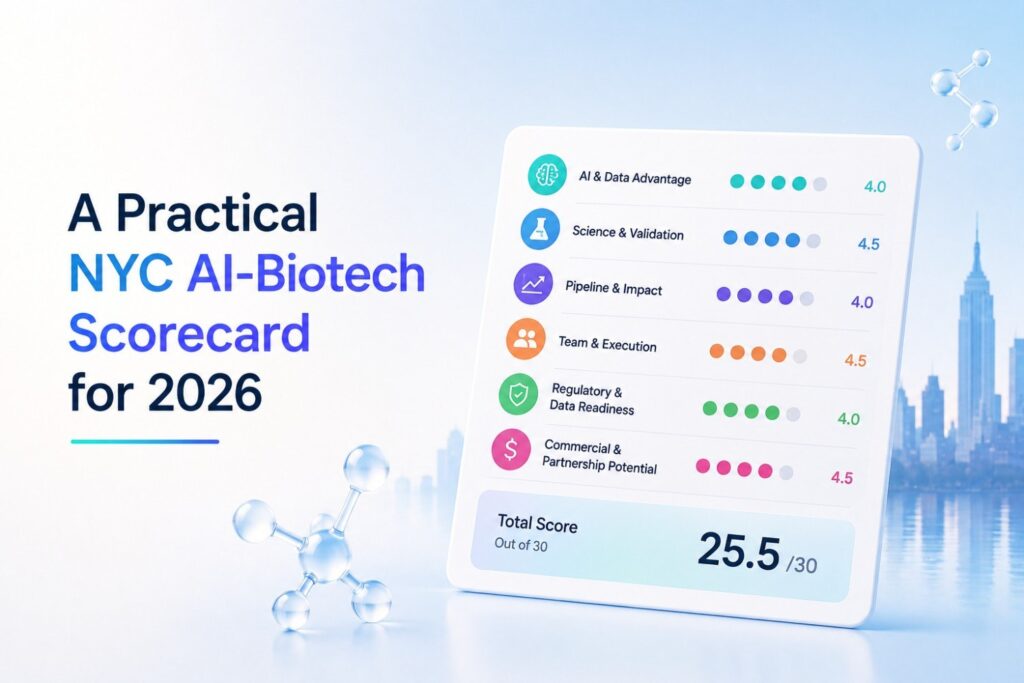
This is a better scoreboard than counting how many startups put “AI” on their websites.
Final Take: New York’s Drug-Discovery Race Is Becoming Much More Serious
New York has not won the AI-biotech race.
There is no winner yet.
AI has helped the industry search chemical space, analyze biological data, design proteins, understand RNA, model molecular motion, and plan experiments. But the final standard is much tougher: medicines have to work in humans.
What makes NYC interesting in 2026 is that its strongest companies are beginning to move beyond the first AI-biotech era.
They are not simply training models on public data and selling predictions.
Formation Bio is testing whether AI can speed clinical development. Immunai is combining massive immune datasets with real biological experiments. Owkin is trying to connect patient data and research reasoning. Accutar has advanced AI-guided assets into clinical testing. Excelsior is redesigning chemistry for robotic experimentation. Fathom and Redesign are using physics to understand dynamic molecular systems. Envisagenics and Genetic Leap are attacking RNA. Rumi is improving human disease models. Ordaos is closing the loop between generated proteins and wet-lab evidence. Proxima is trying to make difficult protein interactions computationally accessible. Junction and Output are pushing toward broader scientific reasoning.
Our original analysis also points to the market’s biggest structural shift.
The competitive advantage is moving from AI alone to AI plus proprietary experimental feedback.
That is good news for New York.
The city already has what purely digital AI hubs find difficult to manufacture: major hospitals, medical schools, biomedical researchers, clinical data, pharmaceutical relationships, venture capital, software talent, and a growing supply of advanced laboratory infrastructure.
The next stage is execution.
Over the coming years, the companies that matter will not be the ones that generate the most molecules, publish the largest model, or make the biggest claims about autonomous science.
They will be the companies that can repeatedly turn computation into a good experiment, a good experiment into better data, better data into a stronger drug candidate, and eventually a stronger drug candidate into a medicine that works.
That is the race New York is now entering.