

New York City has become one of the most interesting places in the world to watch the next phase of mental health technology. The first wave of digital behavioral healthcare was mostly about putting therapy online, building provider directories, making insurance easier to use, and moving psychiatry onto video calls. The new wave is much more ambitious.
Many of the most important mental health AI startups in NYC are now trying to change what happens before, during, and after a therapy or psychiatry appointment. Some use artificial intelligence to help people between sessions. Others help clinicians write notes, spot useful patterns, personalize treatment, manage billing, route patients, or operate an entire behavioral health practice.
The important point is that these companies are not all building “AI therapists.” In fact, our research suggests that the biggest near-term opportunity may be much less dramatic. AI is moving into the hidden operating layer of mental healthcare: intake, documentation, care matching, clinical support, follow-up, billing, referrals, and the 167 hours each week when a patient is not sitting with a therapist.
That matters in New York because the access problem is enormous. A major 2023 NYC Neighborhood Wellness Survey included 43,606 completed surveys. It estimated that 23.9% of adults had received a mental health diagnosis during their lifetime, 18.4% had been diagnosed with anxiety, 10.8% with depression, and 8.2% were experiencing serious psychological distress. About 14% reported unmet mental health treatment needs. (PubMed Central (PMC))
The New York City Health Department later translated that unmet-need figure into roughly 945,000 adults who said they had not received all the mental health treatment they needed during the previous year. (New York City Government)
At the same time, New York has a serious mental health workforce problem. The City Council has cited post-pandemic vacancy rates of 30% to 40% in some parts of the mental healthcare workforce. (New York City Council)
Those three facts create the opening for AI: enormous demand, limited clinical capacity, and a system filled with administrative work.
But the companies most likely to win will not simply be the ones with the smartest chatbot.
They will be the companies that can use AI safely while connecting it to actual clinicians, insurance networks, health systems, clinical records, workflows, and measurable outcomes.
The Short Answer: The NYC Mental Health AI Companies That Matter Most
For this article, NYC Tech Journal reviewed companies with a meaningful New York City presence and public evidence that artificial intelligence is already part of their behavioral health product or current product strategy.
We divided the market into AI-native companies, large behavioral healthcare platforms adding significant AI capabilities, and emerging startups where AI is being built into the core operating model.
| Company | Main AI angle | Main customer or user | Why it matters |
| Spring Health | AI-led care navigation, personalization and ongoing support | Employers, health plans, patients | Shows what AI looks like when connected to a huge care network |
| Slingshot AI | Purpose-built conversational mental health AI | Consumers | One of NYC’s clearest pure-play bets on AI-delivered mental health support |
| Grow Therapy | Clinician-supervised AI coaching and between-session support | Patients, therapists, payers | Combines consumer AI with a large provider network |
| Jimini Health | Clinician-supervised patient-facing AI | Behavioral health organizations | Builds an AI layer providers can place around existing clinical care |
| Ease Health | AI-native EHR, CRM and revenue operations | Behavioral health providers | Targets the massive administrative cost of delivering care |
| Blossom Health | AI operating system and copilot for psychiatry | Psychiatrists and patients | Uses AI across psychiatric decision support, documentation and operations |
| Headway | AI documentation and workflow automation | Independent mental health providers | Gives AI tools access to one of the industry’s largest provider networks |
| Talkiatry | AI-enabled psychiatry operations and care infrastructure | Patients, psychiatrists, health systems | Combines employed psychiatrists with a rapidly growing AI engineering layer |
| Oasys Health | AI-native practice operations, notes and clinical data | Behavioral health practices | Rebuilds the software stack specifically for therapy organizations |
| Marble Health | AI-native youth mental health infrastructure | Students, families, schools, payers | Applies AI to a difficult access problem involving schools and adolescents |
| Pelago | Conversational AI added to addiction and broader behavioral health care | Employers, health plans, patients | Shows how an established digital clinic can extend into AI mental wellness |
| Allia Health | AI-native mental health clinical group | Providers, practices, payers | Very early, but represents a possible new model combining software and clinical ownership |
There are also NYC companies that matter to the market but do not fit the startup definition cleanly anymore. Talkspace, for example, is publicly traded, yet its June 2026 launch of Tee, a mental-health-focused AI agent, makes it impossible to ignore when thinking about where this category is going. (Talkspace)
Original Research: How NYC Tech Journal Built the Mental Health AI Startup Dataset
There is a basic problem with most lists of “AI mental health companies.” They often mix very different businesses together.
A company using machine learning to match people with therapists is treated the same as a company offering a conversational AI companion. An AI documentation tool may be compared with a virtual psychiatry practice. Companies headquartered thousands of miles from New York sometimes appear in supposedly NYC-focused lists simply because they sell to New Yorkers.
We wanted a cleaner method.
Our Inclusion Rules
For the NYC Tech Journal analysis, a company needed to meet three tests.
First, behavioral health, mental health, psychiatry, addiction treatment, or related care had to be a meaningful part of the company’s business. General healthcare AI companies were not included simply because a mental health provider could theoretically use their software.
Second, there had to be public evidence of AI being used in the product, not simply an old marketing page containing the words “data” or “technology.” We looked for AI assistants, machine-learning matching, generative AI, AI documentation, clinical support, conversational AI, AI-native infrastructure, or clearly announced AI engineering programs.
Third, the company needed a strong New York connection. We prioritized New York headquarters, New York-founded businesses, or companies that publicly identify NYC as a main operating base.
We Also Divided AI Into Different Jobs
Our research coded the companies by what AI is actually being asked to do.
That distinction is critical because “mental health AI” is not one market. It is becoming several markets that overlap.
| AI job | What it means in practice | NYC examples |
| Patient support | Conversations, coaching or exercises between clinical visits | Slingshot, Grow Therapy, Jimini, Spring Health, Pelago |
| Care navigation | Matching people with appropriate care or helping them move through treatment | Spring Health, Grow Therapy, Headway |
| Clinician assistance | Notes, summaries, clinical context and decision support | Headway, Blossom, Ease, Oasys |
| Practice operations | Intake, scheduling, CRM, billing and revenue workflows | Ease, Oasys, Blossom |
| Care delivery | Technology embedded directly inside therapy, psychiatry or clinical programs | Grow, Blossom, Talkiatry, Marble, Jimini |
| Network infrastructure | Software connecting providers, payers and patients | Headway, Spring, Grow, Marble, Allia |
The result is a much more useful picture of what is happening.
The NYC mental health AI boom is not mainly a chatbot boom.
It is an attempt to rebuild the whole behavioral healthcare stack.
Original Analysis: At Least $1.87 Billion Has Already Been Invested Across Our Core Sample
We also compiled publicly disclosed capital raised by 11 companies in our core dataset. Allia Health was excluded from this calculation because comparable cumulative funding information was not publicly disclosed at our research cutoff.
We deliberately used conservative figures where sources disagreed and treated descriptions such as “more than $400 million” as $400 million. Talkiatry’s figure includes financing that is not purely venture equity, so this is best read as capital raised, rather than a perfectly standardized venture-funding dataset.
Publicly Disclosed Capital Across the Sample
Spring Health █████████████████████████ $465.1M
Talkiatry █████████████████████ $400M+
Grow Therapy █████████████████ $328.0M
Headway ████████████████ $321M+
Pelago ████████ $151.0M
Slingshot AI █████ $93.0M
Ease Health ██ $41.0M
Jimini Health █ $25.0M+
Marble Health █ $20.5M
Blossom Health █ $20.0M
Oasys Health $4.6M
Our conservative total comes to roughly $1.87 billion. Public sources put Spring Health’s known capital at roughly $465 million, Grow Therapy at $328 million, Headway above $321 million, Talkiatry above $400 million, and Pelago at $151 million. (Caplight)
The newer AI-focused companies are smaller but well funded for their age. Slingshot says it has raised $93 million, Jimini more than $25 million, Ease launched with $41 million, Blossom announced $20 million, Oasys raised $4.6 million, while publicly available company information places Marble’s total around $20.5 million. (talktoash.com)
The Most Important Number Is 81%
The four biggest capital pools in our dataset belong to Spring Health, Talkiatry, Grow Therapy, and Headway.
Together, they account for roughly 81% of the disclosed capital in our sample.
Add Pelago and the top five represent about 89%.
That produces an important finding.
AI Startups Are Attacking a Market Where Distribution Already Has a Huge Capital Advantage
We grouped Spring Health, Grow Therapy, Headway, Talkiatry, and Pelago as the established digital-care and access cohort. These companies were building provider networks, payer relationships, employer distribution, or virtual care systems before the current generative AI boom.
Together, they represent roughly $1.67 billion of the $1.87 billion in our dataset.
The younger AI-native cohort of Slingshot, Jimini, Ease, Blossom, Marble, and Oasys represents roughly $204 million.
Established care/access platforms ████████████████████████████████ ~$1.67B
Newer AI-native cohort ████ ~$204M
That is an advantage of a little more than 8 to 1.
This does not mean established companies will automatically win. It means a new AI startup cannot think only about model quality.
Behavioral healthcare is a distribution problem, a trust problem, an insurance problem, a clinical workflow problem, and a safety problem at the same time.
A brilliant model without access to clinicians or patients may struggle against a slightly less impressive model sitting inside 50,000 provider workflows.
That may become the defining competitive battle in mental health AI.
Why New York City Is Such an Important Market for Mental Health AI
There are good reasons so many approaches are appearing in New York at once.
The Demand Problem Is Large Enough to Support Many Business Models
New York’s mental health challenge is not limited to people with severe diagnoses.
The NYC Neighborhood Wellness Survey found serious psychological distress in 8.2% of adults, while 14% reported unmet mental health treatment needs. Anxiety was the most common reported lifetime diagnosis among the categories measured, at 18.4%. (PubMed Central (PMC))
The City’s broader mental health report also found important problems among younger New Yorkers, including high levels of depressive symptoms among teenagers. (New York City Government)
That creates demand at several levels. Someone may need light support after a stressful day, weekly psychotherapy, medication management, intensive psychiatric care, addiction treatment, or emergency intervention.
One AI product cannot safely or effectively cover that entire spectrum.
That is why specialization matters.
NYC Has the Buyers That Behavioral Health AI Needs
A mental health startup does not succeed just because consumers download an app.
Someone eventually has to pay for care.
New York gives companies access to major employers, insurers, health systems, universities, schools, clinical groups, investors, and enormous provider networks within one market.
The strongest NYC companies are increasingly designing products around those buyers.
Grow is partnering with health plans, employers and healthcare organizations. Headway sits between clinicians and insurers. Talkiatry partners with major health systems. Marble enters through schools. Ease and Oasys sell infrastructure to behavioral health practices.
That diversity is one reason New York’s mental health AI market is strategically interesting.
Spring Health — Showing What Happens When AI Meets Distribution
Spring Health is the hardest company to ignore when discussing mental health AI in New York.
The company was built around the idea of using data and machine learning to help people find care that is more likely to work for them. It has since grown into a much broader mental healthcare platform serving employers and health plans.
In April 2026, Spring launched Guide, an AI-led mental health experience designed to maintain context across a person’s care journey. Spring said users supported by Guide improved faster on measures of depression and anxiety in its study, with some higher-need groups seeing as much as 25% greater symptom improvement. Those are company-reported results and should not be treated as the same thing as an independent large-scale clinical trial, but the important point is that Spring is explicitly trying to connect AI deployment to measured outcomes. (springhealth.com)
Why Spring Health’s Position Is So Powerful
The company’s advantage is not merely the AI.
Spring Health already has the surrounding infrastructure.
When it raised $100 million in 2024 at a $3.3 billion valuation, the company said it supported more than 10 million lives and worked with more than 10,000 care providers. (springhealth.com)
Its distribution footprint has since expanded considerably. In January 2026, when announcing plans to acquire Alma, Spring said it supported more than 50 million lives through employer and health plan relationships. The Alma transaction closed in May. (springhealth.com)
That deal may be more important than another flashy AI feature.
AI gets much more valuable when a company can combine it with a large clinical network, payer relationships, longitudinal data, and control over the care journey.
The Strategic Lesson
Mental health AI may eventually behave like other software markets.
The model itself can become cheaper and easier to reproduce.
Distribution, data quality, workflow integration, trusted clinical relationships, and measurable results are much harder to copy.
Spring is building around all five.
Slingshot AI — The Purest Big Bet on AI-Delivered Mental Health Support
If Spring represents AI connected to a large healthcare platform, Slingshot AI represents almost the opposite strategy.
The company began work in January 2024 on what it describes as a psychology-focused foundation model and ultimately launched Ash, a conversational product built specifically for mental health support. (slingshotai.com)
Slingshot announced Ash publicly in July 2025 after testing it with roughly 50,000 beta users. At the same time, the company announced that total capital raised had reached $93 million. (STAT)
By 2026, Ash’s website was reporting more than 250,000 people helped and more than 15 million messages sent. These are company-reported usage numbers rather than independently audited clinical outcomes, but they show how rapidly conversational mental health tools can achieve engagement. (talktoash.com)
Slingshot Is Testing a Much Bigger Question
The real question is not whether people will talk to an AI about their feelings.
They already do.
The question is whether a purpose-built model can deliver a meaningfully safer and more useful experience than a general-purpose chatbot.
Slingshot says Ash is trained around psychology and guided by mental health experts. The service is explicitly designed for emotional support and longer-term personal growth.
At the same time, its own product information says Ash is not designed for crisis use. (talktoash.com)
That boundary is important.
A company in this category must become extremely good not only at generating useful answers, but also at knowing when AI should stop being the answer.
Grow Therapy — Bringing AI Into the 167 Hours Between Therapy Sessions
Grow Therapy is one of the best examples of the hybrid approach taking shape in New York.
Instead of asking AI to replace therapists, Grow is putting AI around an existing therapist relationship.
In April 2026, Grow introduced an AI-powered Coach designed to help users between sessions. The company emphasized clinician oversight and said the feature was built to complement rather than replace therapy. By the time of the announcement, Grow reported more than 800,000 patient messages had already been sent through Coach. (growtherapy.com)
Grow had already introduced another AI feature called Between-Session Reflections, designed to help patients identify issues or thoughts they might want to bring into their next therapy appointment. (growtherapy.com)
Why This Model Makes Sense
Traditional therapy has a strange operating model.
A patient may see a clinician for one hour and then spend the next 167 hours living with whatever they discussed.
Many important moments happen outside the appointment.
A difficult interaction with a partner happens Tuesday night. Work stress spikes Thursday morning. A patient remembers an insight Saturday afternoon.
AI can help capture some of that context.
Then the therapist can potentially start the next session with a much clearer picture.
Grow Also Has Distribution
This is where the company’s strategy becomes more interesting.
Grow raised $150 million in Series D funding in March 2026. The company said that more than two million people had used the service and that it facilitated seven million visits during 2025 alone. (growtherapy.com)
New York State also announced in late 2025 that Grow would expand its Lower Manhattan headquarters, make a $16 million research and development investment, and plan for at least 186 new full-time jobs over five years. (Governor Kathy Hochul)
That means Grow is not testing conversational AI in isolation.
It can put that AI inside an already active network of patients, providers and payers.
That changes the competitive equation dramatically.
Jimini Health — Building Clinician-Supervised AI Instead of an AI Therapist
Jimini Health may be one of the most strategically important companies in this group because of how it defines the role of AI.
The New York company is building patient-facing AI infrastructure for behavioral healthcare organizations. Its platform is designed so licensed clinicians remain involved rather than handing the entire relationship to a bot.
Jimini announced a $17 million seed round in March 2026, bringing total funding to more than $25 million. (jiminihealth.com)
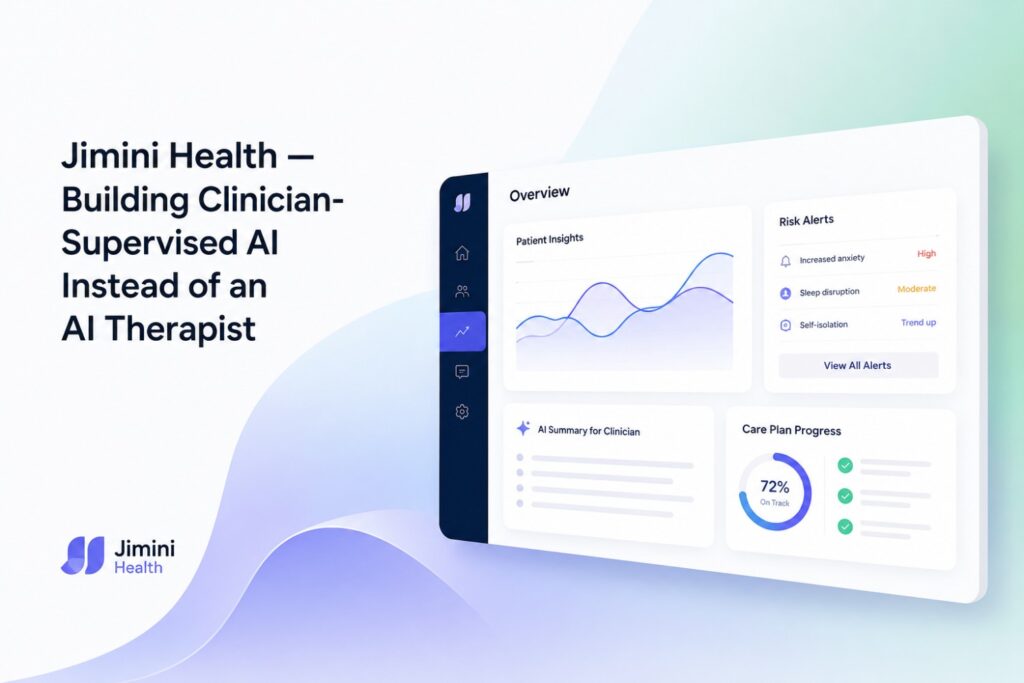
Its product, Sage, can provide support between appointments, capture information from patient interactions and surface relevant information back into clinical care. The company also describes pathways for moving higher-risk situations toward appropriate human care. (Behavioral Healthcare Network)
Why the Infrastructure Model Could Be Huge
Thousands of behavioral health organizations already have clinicians.
They already have patients.
They already have billing relationships.
They do not necessarily want to become AI companies.
Jimini’s opportunity is to let those organizations add AI without having to build models, risk systems, patient interfaces, monitoring tools and clinical escalation infrastructure themselves.
Think of it less as creating another therapy brand and more as creating an AI layer behavioral health providers can install.
If provider organizations decide that patient-facing AI must remain clinically supervised, that could become a large enterprise software category.
Ease Health — Using AI to Attack Behavioral Healthcare’s Back Office
Some of the largest financial gains from mental health AI may have nothing to do with giving patients advice.
Ease Health is making that bet.
The New York City company emerged from stealth in March 2026 with $41 million in Series A funding led by Andreessen Horowitz. (Venturebeat)
Ease is building an AI-native operating system for behavioral health providers.
Instead of forcing a treatment organization to run separate systems for customer relationships, clinical records and billing, Ease combines CRM, EHR and revenue cycle functions.
Documentation Is Only the Beginning
Ease’s system includes AI-powered documentation that can capture visits and help generate clinical notes. But the broader idea is to let AI move through the administrative workflow.
That means information captured during intake should not have to be typed again during care.
Information created during treatment should connect with billing.
Billing problems should feed back into operations.
Reporting should draw from the same underlying system instead of another spreadsheet.
Ease says its platform supports AI across admissions, documentation, billing and other behavioral health workflows. (Ease Health)
Why This Could Be More Valuable Than a Chatbot
Every hour a psychiatrist or therapist spends completing repetitive paperwork is an hour that cannot be used to treat another patient.
The same applies to admissions teams, billing teams and practice managers.
That makes administrative AI a capacity technology.
If AI reduces the nonclinical work required per appointment, the same number of clinicians may be able to serve more people.
In a city dealing with both high demand and workforce shortages, that may be one of AI’s most practical contributions.
Blossom Health — Building an AI Operating System for Psychiatry
Psychiatry creates a particularly strong opportunity for AI because the workflow involves both complex clinical decisions and large amounts of documentation.
Blossom Health is building around that problem.
The New York company announced $20 million across seed and Series A funding in March 2026. It describes itself as an AI operating system for psychiatry. (PR Newswire)
Blossom says its technology can help psychiatrists with medical decision-making, billing, treatment personalization and medication-related workflows while keeping human psychiatrists involved.
The company told Fortune that its platform was already being used by hundreds of clinicians treating more than 10,000 patients. (Fortune)
Psychiatry Is Different From General Wellness
This distinction matters.
Helping someone reflect on a stressful day is very different from helping manage psychiatric medication.
The consequences of inaccurate information can be much greater.
That pushes companies like Blossom toward a copilot model where AI supports a licensed psychiatrist rather than pretending to be one.
The Economic Case Is Also Clear
Blossom says its tools can save clinicians 30 minutes or more for each patient visit.
That claim needs to be tested independently and across different practices, but the underlying economics are worth watching. (Behavioral Health Business)
Even modest time savings can become enormous when multiplied across thousands of psychiatric appointments.
Headway — Turning a Huge Therapist Network Into an AI Distribution Engine
Headway began with an access problem.
Many therapists do not accept insurance because credentialing, billing and administration can be painful. Headway built infrastructure to make insurance-based private practice much easier.
That strategy helped the New York company grow to more than 65,000 mental health providers by the end of 2025, with more than 30 million appointments delivered through its network since launch. (Headway)
Now AI is moving into that infrastructure.
Headway’s Scribe Shows Where AI Can Produce Immediate Value
In August 2026, Headway published details about Scribe, its optional AI documentation tools.
One use case is generating a draft progress note from a session transcript. The company says documentation can add more than 30 minutes around some provider visits, making note generation an obvious workflow to automate carefully. (Headway)
Headway also brought talent from AI-native company Tezi into its engineering and product organization in 2026 as part of a broader push toward human-AI collaboration. (Built In NYC)
Headway Has Something Most AI Startups Do Not
It already has provider distribution.
The company raised a $100 million Series D in 2024 at a $2.3 billion valuation, after raising $125 million in its previous round. (PR Newswire)
If Headway can place useful AI tools directly inside the everyday work of tens of thousands of clinicians, it does not need to persuade users to adopt another separate AI application.
That could become a powerful advantage.
Talkiatry — Putting AI Around a National Psychiatry Workforce
Talkiatry has taken a different approach from therapist marketplaces.
It directly employs psychiatrists.
By February 2026, the New York company said it employed more than 800 full-time psychiatrists and had completed roughly three million patient visits. Its $210 million Series D brought total financing to more than $400 million. (TechTarget)
AI is now becoming a bigger part of the technology layer supporting that network.
Talkiatry has been hiring specifically for AI engineering roles covering model deployment, retrieval systems, agent-like workflows, evaluation and AI safety in healthcare. (Ashby)
The Interesting Asset Is the Clinical Workforce
A general AI startup may have sophisticated technology but no psychiatrists.
Talkiatry has hundreds.
That creates the possibility of building AI alongside clinicians who actually use the system every day.
Talkiatry also launched Talkiatry Connect in 2026, a referral product that integrates with more than 30 cloud-based electronic medical record systems. (PR Newswire)
The long-term opportunity is larger than documentation.
AI could potentially help with referral routing, pre-visit preparation, patient follow-up, measurement, administrative work and care coordination while psychiatrists retain responsibility for medical decisions.
Oasys Health — Rebuilding Practice Management for Behavioral Health
Oasys is smaller than many companies in this article, which is precisely why it is interesting.
The company announced $4.6 million in funding in January 2026 to build an AI-native operating system specifically for behavioral health organizations. (PR Newswire)
Its platform combines practice management, AI-assisted clinical notes, billing, intake and reporting.
Oasys is also exploring connections with wearable devices and health applications, which opens the door to incorporating information generated outside therapy appointments.
Behavioral Health Needs Specialized Software
A therapy group does not operate exactly like a dental practice, hospital or primary care clinic.
There are different documentation needs, privacy concerns, payer processes, group sessions, treatment plans, clinical measures and workflows.
Oasys is betting that behavioral health organizations will increasingly choose software designed around those realities rather than general healthcare systems with mental health features bolted on later.
Its current product positions AI as part of practice infrastructure rather than as the main thing a patient sees. (Oasys)
That may turn out to be the more durable place to build.
Marble Health — Using AI to Fix Youth Mental Health Access
Youth mental healthcare has a special access problem.
A teenager usually does not shop for a therapist the same way an adult might.
Schools, parents, counselors, insurance plans and clinicians may all be involved.
Marble Health is building infrastructure around that network.
The New York company raised $15.5 million in Series A funding in October 2025 to expand its school-centered youth mental health model. (PR Newswire)
Its public service connects students to individual, group and family therapy, works with school counselors and accepts commercial insurance as well as Medicaid. (marblehealth.com)
AI Is Moving Deeper Into the Platform
Recent Marble recruiting materials describe the company as building an AI-native youth mental health platform.
The company’s AI engineering roles have referenced AI-first products spanning school tools, therapist tools, internal systems and a patient companion called Marty. (LinkedIn)
That does not mean every part of Marble’s current clinical service should be described as AI-delivered.
It does show where the product architecture is moving.
Youth mental health will also be one of the hardest places to deploy conversational AI safely. New York regulators are already paying close attention to AI systems interacting with minors, which means companies operating here may face a higher safety bar than many ordinary consumer applications.
Pelago — Expanding From Addiction Care Into AI Behavioral Health
Pelago began as Quit Genius and built a digital clinic focused on substance use.
The company raised $58 million in Series C funding in 2024, taking total capital raised to $151 million. (pelagohealth.com)
In 2026, Pelago began extending beyond its traditional substance-use focus.
Behavioral Health Business reported that the New York City company had quietly launched Sona, an AI chatbot for mental wellness support, as part of a move into broader behavioral health. The system can escalate concerning interactions toward Pelago’s clinical team. (Behavioral Health Business)
Why Pelago Belongs in This Conversation
Behavioral healthcare does not divide neatly into separate boxes.
Substance use, anxiety, depression, stress and other conditions often overlap.
A company that already has clinical infrastructure around addiction treatment therefore has an interesting path into broader behavioral health.
Pelago also demonstrates another trend we expect to see repeatedly.
AI will not only create new startups.
It will cause existing digital health companies to expand into neighboring categories that were previously expensive to serve.
Allia Health — A Very Early AI-Native Clinical Group to Watch
Allia Health is the least mature company on our main list, so it should not be evaluated on the same basis as Spring Health or Headway.
But its model is interesting enough to watch closely.
The Summer 2026 Y Combinator company describes itself as a full-stack, AI-native mental health clinical group headquartered in New York City.
Rather than selling only software, Allia says it is bringing independent practices into a broader clinical organization running on a shared intelligent system.
According to its YC profile, the company has relationships with more than 600 providers across 70 locations in 32 states and says thousands of independent clinicians already use its underlying practice software. It planned to begin delivering care through the new clinical group in September 2026. (Y Combinator)
Why the Model Is Different
Most behavioral health AI startups fall into one of two camps.
They either sell technology to providers or provide care directly.
Allia is attempting to combine both.
If that model works, AI would not simply make an outside clinic more efficient. AI would sit inside the organization that controls clinical operations, data infrastructure and payer relationships.
Because the care model is so new, it needs time before its impact can be judged. Still, it points toward a possible future in which the dividing line between healthcare software company and healthcare provider becomes increasingly blurry.
The NYC Company That Is Not a Startup Anymore: Talkspace
Talkspace deserves a separate category because it is publicly traded.
It is nevertheless an important competitive signal for every startup in this article.
In June 2026, the New York company announced Tee, a mental-health-focused AI agent built using a fine-tuned large language model. Talkspace says the system includes mechanisms for identifying suicide risk, violence risk, abuse risk and other potentially dangerous situations, with pathways to licensed clinicians when intervention is needed. (Talkspace)
Why should startups care?
Because AI-native entrants are not competing only with other startups.
They are competing with established behavioral healthcare companies that already have clinicians, users, payer relationships, brands and years of operating data.
The AI race is therefore becoming a distribution race.
Original Analysis: The Market Is Splitting Into Four AI Layers
When we coded the companies by workflow rather than marketing language, four clear layers appeared.
Layer One: Patient-Facing AI
Slingshot’s Ash is the clearest example.
Grow Coach, Spring Guide, Jimini’s Sage, Pelago’s Sona and Talkspace’s Tee show variations on the same underlying idea.
AI can be available when a human clinician is not.
The strategic question is what that AI should be allowed to do.
Should it listen?
Help a patient reflect?
Suggest an exercise?
Summarize thoughts for the next appointment?
Identify warning signs?
Contact a clinician?
Companies will draw these boundaries differently.
The winners will need to prove that those boundaries are safe.
Layer Two: Clinician Copilots
This category may commercialize faster because the AI is not being asked to carry clinical responsibility alone.
Headway can draft notes.
Blossom can help psychiatrists process information.
Ease can reduce documentation work.
Oasys can automate parts of practice workflows.
The clinician remains the decision-maker.
That lowers some of the product risk while offering an obvious return: time.
Layer Three: Administrative AI
This is the least glamorous category and potentially one of the largest.
Behavioral healthcare contains enormous amounts of manual work.
Someone must process referrals.
Someone must schedule visits.
Someone must verify insurance.
Someone must complete documentation.
Someone must submit claims.
Someone must follow rejected claims.
Someone must respond when records are incomplete.
AI agents that perform these jobs reliably could have a direct effect on provider economics.
Layer Four: AI-Native Care Networks
This is where the market may ultimately go.
Instead of an AI application sitting next to a healthcare organization, AI becomes part of the infrastructure of the healthcare organization itself.
Spring is moving in this direction.
Grow is moving in this direction.
Blossom is designed around it.
Allia is explicitly proposing it.
The result could be a new type of mental healthcare company in which clinical teams, software, AI, payer relationships and patient communication are designed together.
Original Analysis: The Biggest Opportunity May Not Be Replacing Therapists
The most common question about AI and mental health is whether AI will replace therapists.
Our dataset points to a different question.
How much work around the therapist can be rebuilt?
Consider a simplified therapy journey.
A patient searches for care, checks whether insurance is accepted, completes intake, gets matched, schedules an appointment, fills out forms, attends the session, receives follow-up materials, tracks progress, communicates between appointments, changes appointments and eventually receives another bill.
The therapist may then document the visit, update a treatment plan, communicate with other clinicians, monitor measures, handle insurer requirements and manage practice administration.
Only part of that journey is the actual human conversation.
The rest is infrastructure.
That is why Headway, Ease, Oasys, Grow and Spring matter just as much to this market as the most sophisticated conversational model.
AI does not need to conduct therapy autonomously to reshape the economics of mental healthcare.
The Safety Problem Cannot Be Treated Like a Normal Software Bug
Mental health AI is different from an AI tool that writes marketing copy.
A bad paragraph can be edited.
A harmful response to a person experiencing psychosis or suicidal thoughts can have much more serious consequences.
That is why buyers should be skeptical of any company whose safety explanation ends with “our model has guardrails.”
Independent Research Still Shows Serious Gaps
A 2025 Stanford study found that AI therapy systems could display harmful biases or provide troubling responses in some mental health situations. (Stanford Graduate School of Education)
More recent research shows another problem: even mental health experts do not always agree about what a safe AI response looks like. In a 2026 Stanford study, three board-certified psychiatrists assessed 360 synthetic mental-health-related AI responses and frequently disagreed, with some of the biggest challenges appearing in higher-risk situations. (Stanford News)
A 2026 systematic review and meta-analysis covering 52 studies and 13 commercial chatbots found modest evidence of improvement for depression, while results for anxiety were less certain. It also found that harms reporting in the underlying trials was weak, making strong safety conclusions difficult. (PubMed)
Another systematic review of 160 studies found that large-language-model mental health chatbots were growing quickly but that only a minority of LLM studies had reached clinical efficacy testing. (PubMed)
That does not mean mental health AI cannot work.
It means the evidence needs to catch up with the speed of product launches.
New York Is Already Raising the Regulatory Bar
Companies building emotional AI in New York should pay close attention to state policy.
A New York law covering AI companions went into effect in November 2025. Among other requirements, covered companion systems must provide disclosures that users are not interacting with humans and implement safety protocols when conversations involve suicide or self-harm. (Governor Kathy Hochul)
New York lawmakers have gone further in 2026.
S9051B, legislation aimed at unsafe AI companion features for minors, passed both the Senate and Assembly by June 2026. As of our August 31 research cutoff, the official Senate page listed it as having passed both chambers rather than as signed law. (NYSenate.gov)
Lawmakers have also considered rules dealing with chatbots that impersonate licensed professionals. (NYSenate.gov)
This Is Actually Good for Serious Startups
Regulation is often described as a threat to innovation.
In this market, sensible regulation may help good companies.
If every random chatbot can call itself a therapist, companies investing millions of dollars in clinical safety are placed at a disadvantage.
Higher standards can separate serious behavioral health infrastructure from consumer AI wrapped in medical language.
That distinction will become increasingly important.
How NYC Employers, Health Systems and Behavioral Health Groups Should Evaluate These Startups
The wrong way to buy mental health AI is to watch a polished ten-minute demo and ask employees whether it “feels intelligent.”
Behavioral health buyers need a much harder test.
Start With the Job, Not the Model
A buyer should be able to complete this sentence clearly:
“We are using AI to reduce ______.”
The blank might be documentation time.
It might be missed referrals.
It might be wait time.
It might be billing denials.
It might be gaps between therapy sessions.
It might be time to psychiatric care.
If the organization cannot define the problem, it will struggle to determine whether the AI helped.
A Practical Mental Health AI Evaluation Scorecard
| Measure | What to record before the pilot | What improvement should look like |
| Access | Days from referral to appointment | Shorter waits |
| Intake | Staff minutes per intake | Less manual work without lower completion |
| Documentation | Minutes spent after each visit | Lower documentation burden |
| Clinical capacity | Visits per clinician | More capacity without quality loss |
| Follow-up | Patients successfully contacted | Higher completion |
| Engagement | Between-session participation | Useful engagement, not simply more screen time |
| Escalation | High-risk cases detected and routed | Faster, reliable human intervention |
| Outcomes | PHQ-9, GAD-7 or relevant clinical measure | Equal or better outcomes |
| Provider experience | Clinician satisfaction and correction rate | Less burden, low AI rework |
| Patient experience | Trust, satisfaction and complaints | No decline in trust or safety |
| Economics | Cost per completed episode | Lower total cost or stronger capacity |
| AI quality | Incorrect or unsafe outputs | Very low and continuously monitored |
The most important row may be AI quality.
A tool that saves ten minutes but creates five minutes of correction work has not really saved ten minutes.
A chatbot with spectacular engagement numbers but weak clinical escalation is not automatically a success.
A note generator that produces beautiful notes but invents clinical details may be dangerous.
Measure the failure modes, not just the success cases.
A Better 90-Day Pilot for Mental Health AI
Organizations do not need a year-long transformation program to test these products.
They do need discipline.
Days 1–30: Establish the Baseline
Do not switch on AI immediately.
Measure the existing workflow first.
If clinicians currently spend 18 minutes completing documentation after a session, record it.
If 23% of referrals fail to schedule, record it.
If insurance verification takes twelve minutes, record it.
If psychiatric appointments take three weeks to secure, record that.
Without a baseline, nearly any new product can create a convincing-looking success story.
Days 31–60: Run a Narrow Pilot
Start with one workflow and a limited group.
Do not deploy a patient-facing mental health chatbot across an entire organization simply because a five-person test went well.
Use a defined patient population, clinician group or administrative team.
Record every correction.
Record every escalation.
Record complaints.
Record cases where staff ignored the AI.
Those failures may teach you more than overall usage.
Days 61–90: Compare Outcomes, Not Excitement
By the third month, the buyer should be able to answer practical questions.
Did documentation time fall?
Did clinicians actually use the product after the novelty disappeared?
Did patient access improve?
Did the organization handle more appointments?
How many AI outputs needed meaningful correction?
Were high-risk situations escalated correctly?
Did costs fall?
If the answers are unclear, expanding the pilot will not make them clearer.
What Investors Should Notice About the NYC Market
The funding data tells a useful story.
A lot of capital has already gone into companies that own access and distribution.
The new AI-native companies are now trying to insert intelligence into that network.
This creates several possible outcomes.
Existing Platforms Could Absorb the Best AI Features
A documentation feature is difficult to defend forever if every EHR can buy access to similar models.
A generic chatbot is difficult to defend if every large mental health platform can launch one.
That means standalone tools need something stronger than an interface.
They may need proprietary clinical data, exceptional evaluation systems, specialized models, deep integrations or unusual distribution.
AI Startups Could Become Acquisition Targets
Spring’s acquisition of Alma shows that behavioral health infrastructure is already consolidating. (springhealth.com)
As AI becomes more important, large platforms may decide it is faster to acquire specialist teams than to build every component internally.
A small company with excellent psychiatric decision support, safety evaluation, behavioral health billing automation or clinical workflow AI could become strategically valuable even without millions of consumer users.
Full-Stack Companies Could Become Much More Powerful
The most interesting scenario is not necessarily acquisition.
Some AI-native companies may build enough of the stack themselves to become major care providers.
Blossom is moving in this direction in psychiatry.
Allia is explicitly pursuing a software-plus-clinical-group model.
Jimini is building infrastructure that provider organizations can place around care.
If those models work, the next generation of behavioral health giants may look very different from today’s therapist directories.
What Founders Building Mental Health AI in NYC Should Learn From This Market
A founder entering this category should resist the urge to begin with the model.
Start with the bottleneck.
There are still enormous bottlenecks in behavioral healthcare that do not require replacing a human clinician.
Referral leakage is a problem.
Insurance complexity is a problem.
Credentialing is a problem.
Notes are a problem.
Billing is a problem.
Patient follow-up is a problem.
Finding an appropriate clinician is a problem.
Keeping care connected between appointments is a problem.
The best startup idea may come from solving one of those issues exceptionally well.
Clinical Trust Has to Be Designed Into the Product
A healthcare company cannot add trust later like a new website feature.
Clinicians need to understand what information the AI uses.
They need to know when it is uncertain.
They need ways to correct it.
High-risk events need defined escalation paths.
Organizations need logs showing what happened.
Patients need to know when they are talking to AI.
If humans remain accountable for the outcome, they need enough visibility to exercise that responsibility.
The Real Moat May Be Workflow Data
Foundation models will continue improving.
That makes it risky to build a company whose entire advantage is access to a slightly better general model.
The more defensible asset may be the system around the model.
A behavioral health company can learn how a referral moves through a clinic, why patients drop out, which documentation causes payment problems, where psychiatrists lose time, how clinicians correct AI notes and what types of support actually lead people back to appropriate care.
That workflow knowledge is harder to download from an API.
Why Human-Supervised AI Is Emerging as the Strongest Pattern
One pattern appears repeatedly across the NYC companies we reviewed.
Grow emphasizes clinician oversight.
Jimini is built around clinician-supervised patient AI.
Talkspace says its Tee system can bring human clinicians into higher-risk situations.
Blossom positions AI alongside psychiatrists.
Headway’s AI supports provider documentation.
Ease puts AI into clinician and administrative workflows.
That is unlikely to be accidental.
The market appears to be learning that the easiest story to tell investors is “AI replaces the professional,” while the easier product to trust may be “AI makes the professional more capable.”
Those are very different businesses.
The second model may also fit how healthcare actually changes.
Hospitals did not eliminate doctors when electronic medical records arrived.
Accounting software did not eliminate every accountant.
AI is likely to remove tasks, change roles and expand capacity unevenly before it replaces entire licensed professions.
Mental healthcare may follow the same pattern.
What Could Go Wrong With the Mental Health AI Boom?
There is a danger in assuming that every increase in AI usage represents progress.
It does not.
Engagement Can Become the Wrong Metric
A social network wants more time on platform.
A mental health product should be more careful.
If someone becomes emotionally dependent on an AI and talks with it for six hours a day, that may produce extraordinary engagement numbers without representing a good health outcome.
Companies therefore need to distinguish beneficial use from compulsive use.
Sometimes the correct product decision may be to encourage a person to close the app.
AI Can Sound More Certain Than It Is
Large language models are very good at producing confident language.
Mental healthcare contains enormous uncertainty.
Symptoms overlap.
Context matters.
Medication decisions are complex.
People may omit important information.
Cultural differences can change how distress is expressed.
An AI system needs the ability to say, in effect, “I do not have enough information.”
That may be more valuable than sounding smart.
Privacy Risk Is Especially Serious
A mental health conversation may contain some of the most personal information a person ever shares.
Patients may discuss trauma, relationships, substance use, medication, sexual experiences, family conflict or thoughts they have never told anyone else.
Any startup collecting that information needs an unusually strong approach to data storage, model training, access controls, deletion, consent and vendor relationships.
“AI-powered” cannot become an excuse for vague data practices.
What NYC Tech Journal Will Be Watching Next
The market is moving too quickly to judge these companies only on what they offer today.
Several questions will matter much more over the next two years.
Can Purpose-Built Mental Health Models Beat General AI?
Slingshot is making a direct bet that a psychology-focused system can create a meaningfully better experience.
Jimini, Spring, Grow and Talkspace are also building specialized safety and clinical structures around mental health interactions.
General AI models will keep improving, however.
Specialists therefore need to prove that domain-specific training, clinical context, safety systems and integrations produce a real advantage.
Will AI Improve Outcomes or Mainly Improve Operations?
Operational improvement will be easier to prove.
Documentation can be timed.
Claims can be counted.
Wait times can be measured.
Staff costs can be compared.
Clinical outcomes take longer.
This may cause provider-facing AI to scale faster than autonomous patient-facing AI, even though consumer chatbots attract more attention.
Who Owns the Relationship Between Sessions?
This could become one of the biggest strategic battles in behavioral healthcare.
Therapists see a patient during the appointment.
General-purpose AI companies are available outside the appointment.
Mental health platforms now want to fill that gap with clinically connected AI.
Grow, Spring, Jimini, Slingshot, Pelago and Talkspace are all approaching this opportunity from different directions.
Whichever companies become the trusted layer between sessions could gain an extraordinary amount of context about a patient’s care journey.
Can AI Make Behavioral Healthcare Cheaper Without Making It Worse?
This is ultimately the test that matters.
Mental healthcare does not simply need more technology.
It needs more effective care delivered to more people at a cost people, employers and health plans can afford.
If AI saves clinicians time but increases software spending by the same amount, little has changed.
If AI makes care cheaper but harms outcomes, the trade is unacceptable.
If AI can reduce administrative cost, increase provider capacity, shorten wait times and maintain or improve clinical outcomes, then the technology becomes much more consequential.
The Bigger Opportunity: Rebuilding the Behavioral Healthcare Operating Model
It is tempting to view all these companies as competing for the same prize.
They are not.
Slingshot is trying to create a new consumer mental health experience.
Ease wants to rebuild provider infrastructure.
Headway is adding intelligence to a large insurance-enabled therapist network.
Talkiatry has a national psychiatrist workforce.
Blossom is redesigning psychiatry around an AI copilot.
Marble is attacking youth access through schools.
Jimini wants behavioral healthcare organizations to have a safe patient-facing AI layer.
Oasys is rebuilding practice software.
Spring and Grow are putting AI inside large care ecosystems.
Those differences explain why the market can support many companies for now.
But boundaries will blur.
The patient-support company may add provider tools.
The practice-management company may add patient communication.
The provider network may add an AI coach.
The psychiatry group may build AI infrastructure.
Eventually, several of these businesses will collide.
The winners are likely to be the companies that control enough of the care journey to make AI useful without asking patients and clinicians to manage ten separate tools.
Our Most Important Finding: Distribution Is Becoming the Moat Around AI
After reviewing the companies, their funding, product launches and market positions, one conclusion stands above the rest.
The mental health AI race in New York is becoming less about who has AI and more about who has somewhere valuable to put it.
Nearly every serious behavioral health technology company can gain access to powerful language models.
Far fewer have 65,000 providers.
Far fewer employ hundreds of psychiatrists.
Far fewer serve millions of patients.
Far fewer have national insurance contracts.
Far fewer sit inside hospital referral workflows.
Far fewer have direct relationships with school counselors.
That is why our funding analysis matters.
Roughly 81% of the capital in our core dataset sits with four large platforms: Spring Health, Talkiatry, Grow Therapy and Headway.
They have money, but more importantly, they have distribution.
AI-native entrants therefore need to build something that those platforms cannot easily reproduce.
That could mean a superior domain model.
It could mean uniquely strong safety infrastructure.
It could mean proprietary clinical evidence.
It could mean owning a narrow workflow more deeply than anyone else.
Or it could mean building a new distribution network of their own.

Simply attaching a chatbot to a mental health problem is unlikely to be enough.
Conclusion
New York’s mental health AI market is moving beyond the simple idea of an “AI therapist.”
The more important transformation is happening across the entire behavioral healthcare system.
AI is helping patients reflect between sessions. It is helping clinicians write notes. It is helping practices manage intake and billing. It is helping companies match people with care, support psychiatrists, organize referrals and build new models of clinical delivery.
Our original analysis found at least $1.87 billion in publicly disclosed capital across 11 core NYC mental health AI and AI-enabled behavioral health companies, with roughly 81% concentrated in Spring Health, Talkiatry, Grow Therapy and Headway. That tells us the next battle will not be won by model quality alone.
The young AI-native companies bring speed and new ideas.
The established platforms bring patients, clinicians, payers and distribution.
The companies that connect those two advantages while proving that their technology is safe, useful and economically meaningful have the best chance to reshape behavioral healthcare.
For New York businesses, health systems, investors and clinicians, that is the trend worth watching.
AI may eventually change what therapy itself looks like.
But first, it is changing almost everything around it.