
Artificial intelligence in healthcare used to sound like a narrow idea. A computer would look at an X-ray, spot something a doctor might miss, and help make a diagnosis.
That is still happening. But it is only one small part of what is now being built in New York City.
The new generation of healthcare AI companies is moving into almost every part of medicine. AI is helping people find doctors, match with mental health care, understand medical records, schedule appointments, code hospital visits, review insurance claims, discover drugs, analyze cancer data, navigate surgery, and decide which patients may benefit from a clinical trial.
New York has become one of the most interesting places to watch this shift.
Digital Health New York reported that New York healthcare companies raised $1.6 billion across 36 deals in the first quarter of 2026, 60% more than in the same quarter of 2025. Another 40 companies raised $1.2 billion in the second quarter. That means the first half of 2026 alone produced roughly $2.8 billion of healthcare funding across the ecosystem, although summing the quarterly company counts may double-count any business that raised more than once.
The momentum did not appear overnight. New York healthcare innovation funding had already jumped 60% in 2024 compared with 2023. Digital Health New York then reported that funding for NYC companies increased another 20% in 2025.
AI is now sitting near the center of that market.
But the biggest change is not simply that New York has more AI startups. It is what those startups are trying to control.
Some are becoming care providers. Some are building operating systems for medical practices. Others are becoming an intelligence layer between patients and hospitals. Still others are attacking biology itself.
That makes NYC’s healthcare AI market much broader—and more important—than a list of chatbot companies.
For this article, NYC Tech Journal analyzed active private healthcare AI companies connected to New York, normalized publicly available funding data where possible, classified each company by the part of healthcare it is trying to change, and examined where commercial adoption appears strongest.
The result is a market map of 20 companies that show where healthcare AI in New York is going next.
Original Research: How We Built the NYC Healthcare AI Startup List
Before looking at the companies, it is important to explain what qualifies for this list.
That matters because almost every healthcare software company can now say it “uses AI.” If that standard were enough, the list would become meaningless.
We used a much stricter test.
AI Had to Be Important to the Core Product
AI could not simply be a feature added to an older software product.
The company’s value had to depend heavily on machine learning, language models, computer vision, predictive models, automated reasoning, AI agents, biological models, or another form of artificial intelligence.
This is why the list includes companies such as Nym, which uses AI to automate medical coding, and Manas AI, which is applying AI to drug discovery.
It also includes companies such as Spring Health and K Health, where AI is part of a broader healthcare delivery system rather than a standalone piece of software.
Healthcare Had to Be the Main Market
A general AI company selling occasionally to hospitals did not qualify.
The startup needed to be primarily focused on healthcare, medicine, life sciences, medical research, health insurance, clinical operations, or another closely related healthcare problem.
The Company Had to Be Active and Private
We also checked current company status because older “top healthcare startup” articles become outdated quickly.
For example, Paige was one of New York’s best-known pathology AI companies. Tempus completed its acquisition of Paige in August 2025, so Paige is no longer included here as an independent startup. Aetion, another major New York health technology business, was acquired by Datavant in July 2025.
That distinction matters. An ecosystem should be judged not only by the startups it creates, but also by whether those companies grow into major independent businesses, get acquired, or become infrastructure inside larger healthcare platforms.
We Normalized Funding Where the Public Data Allowed It
Funding comparisons are surprisingly difficult.
One company may announce a $50 million equity round. Another may announce $200 million that includes venture equity, debt, and a lending facility. Treating those figures as identical would badly distort the analysis.
Nitra is a good example. In March 2026, the company announced $187 million in new financing and $205 million of total capital raised. However, Nitra specifically said total equity raised was $90 million. For our cross-company capital analysis, we therefore use the $90 million equity figure rather than $205 million.
Funding figures should still be treated as approximations. Private companies do not all disclose financing in the same way, and some early rounds may not be publicly visible.
Our Data Is Frozen as of August 31, 2026
Healthcare AI is moving extremely quickly. Companies raise money, launch products, add health system customers, receive regulatory clearances, and get acquired constantly.
This analysis therefore represents a snapshot based on public information available through August 31, 2026.
The NYC Healthcare AI Market at a Glance
Our 20-company sample produces a useful picture of what founders and investors in New York are actually building.
| Healthcare AI layer | Companies in our sample | Share |
| AI-enabled care delivery and prevention | 6 | 30% |
| Healthcare operations, access, claims and administration | 6 | 30% |
| Clinical research, oncology and medical data | 3 | 15% |
| AI drug discovery and computational biology | 3 | 15% |
| Imaging, surgery and procedural intelligence | 2 | 10% |
| Total | 20 | 100% |
Chart: Where NYC Healthcare AI Companies Are Building
Care delivery & prevention ██████ 6
Operations, access & claims ██████ 6
Clinical research & data ███ 3
Drug discovery & biology ███ 3
Imaging & surgery ██ 2
The most interesting finding is the balance.
Only 10% of our sample sits mainly in imaging and surgery. Yet medical imaging was once one of the areas most closely associated with healthcare AI.
Today, 60% of the companies in our sample sit either in care delivery or in the administrative systems surrounding care.
That tells us something important about the direction of the market.
AI is moving from analyzing medicine to helping run medicine.
Original Research: NYC Healthcare AI Capital Is Deep, but Highly Concentrated
We were able to establish reasonably comparable publicly disclosed or trackable equity figures for 17 of the 20 companies in our sample.
Those 17 companies account for approximately $1.48 billion of disclosed or trackable equity capital in our dataset.
That number should not be interpreted as the total amount ever raised by the NYC healthcare AI industry. Several companies have undisclosed financing, and public data is imperfect.
The concentration inside the sample is far more interesting than the absolute total.
Spring Health and K Health together represent approximately 57% of the capital in the 17-company comparable dataset.
The five largest companies by the funding figures used here account for roughly 76%.
The median is about $36 million.
Chart: Selected Disclosed Equity Capital in Our NYC Sample
Spring Health ~$465M ███████████████████████
K Health ~$380M ███████████████████
Hyro $95M █████
Nym ~$95M █████
Nitra $90M ████
Alaffia Health >$73M ████
Manas AI ~$51M ███
Ezra $41M ██
Triomics >$36M ██
Counsel Health ~$36M ██
Prosper AI $35M ██
Dandelion Health ≥$29M █
Medivis ≥$22M █
Ilant Health >$22M █
Clarion ~$5M
Century Health ≥$5M
CellType ~$0.5M
The exact figures are less important than the shape of the chart.
New York has a handful of heavily financed healthcare AI platforms at the top and a much longer group of younger companies underneath them.
That is healthy for the ecosystem because it creates several possible paths.
Employees can move from mature healthcare companies into new startups. Experienced founders can become investors. Hospitals already familiar with one generation of healthcare technology can become customers for the next.
It also means new companies face a much higher bar.
Simply attaching a large language model to a healthcare workflow is unlikely to be enough.
The 20 Healthcare AI Startups in NYC to Watch
| Company | Main AI opportunity | Main buyer/user | Public capital signal used in our analysis |
| Spring Health | Precision mental healthcare | Employers, plans, patients | ~$465M |
| K Health | AI primary care | Patients, health systems | ~$380M |
| Counsel Health | AI-assisted physician care | Patients, plans, employers | ~$36M |
| Ilant Health | Obesity care | Employers, health plans | >$22M |
| Empirical Health | Preventive heart health | Consumers/patients | Not consistently disclosed |
| Allia Health | AI-native mental healthcare | Clinicians, payers, patients | Early-stage/YC |
| Ezra | AI MRI cancer screening | Consumers, imaging providers | ~$41M |
| Medivis | AI + AR surgical navigation | Hospitals and surgeons | ≥$22M |
| Triomics | Oncology AI | Cancer centers, research teams | >$36M |
| Dandelion Health | Multimodal clinical data | Life sciences and AI teams | ≥$29M announced |
| Century Health | Clinical data intelligence | Life sciences | ≥$5M latest disclosed seed |
| Hyro | Patient-access AI agents | Health systems and health plans | $95M |
| Nym | Autonomous medical coding | Hospitals and providers | ~$95M |
| Nitra | AI practice operations | Medical practices | $90M equity |
| Alaffia Health | AI claims review | Health plans | >$73M |
| Prosper AI | Healthcare operations agents | Providers and health groups | $35M |
| Clarion | AI patient communication | Providers and insurers | ~$5.4M |
| Manas AI | AI drug discovery | Biopharma | ~$50.6M disclosed rounds |
| Output Biosciences | Biological AI models | Drug developers | Funding not consistently public |
| CellType | AI-driven drug discovery | Pharma and biotech | Very early-stage |
The table is not intended as a strict ranking from best to worst. Comparing an AI surgery platform with an insurance claims agent or a computational biology company would create false precision.
Instead, these 20 businesses represent different parts of the healthcare AI stack emerging in New York.
AI-Enabled Care Delivery Is Becoming a Major NYC Category
Some of New York’s most valuable healthcare AI companies are not selling software to doctors.
They are trying to redesign how care itself is delivered.
That difference is critical.
Software vendors earn money by helping healthcare organizations work better. Care-delivery businesses can potentially sit directly inside the relationship between the patient, clinician, payer, and treatment.
That is a much bigger opportunity, but also a harder one.
Spring Health — Building AI Into the Mental Health Care System
Spring Health is one of the clearest examples of how far a New York healthcare AI company can scale.
The company has built a mental health platform around what it describes as an AI-native approach to matching people with appropriate care. Rather than treating mental health as a directory of therapists, Spring Health attempts to guide people toward different kinds and levels of treatment based on their needs.
Its scale makes it especially important.
Spring Health said in January 2026 that its platform supported more than 50 million lives through employer and health-plan relationships. In May 2026, it completed its acquisition of fellow New York mental health company Alma, combining Spring’s technology and benefits platform with Alma’s large network of independent clinicians.
Why Spring Health Matters
The deeper story is consolidation.
Healthcare AI markets may not remain divided into dozens of narrow tools forever. Large platforms can use acquisitions to add provider networks, distribution, data, and specialized care.
Spring Health is beginning to look less like an “AI feature” and more like healthcare infrastructure.
That is an important lesson for smaller NYC healthcare startups. The long-term advantage may not come from having the smartest model alone. It may come from combining intelligence with distribution and actual care delivery.
K Health — Testing Whether AI Can Become the Front Door to Primary Care
K Health has spent years pursuing one of healthcare AI’s biggest ideas: can software handle a meaningful part of the first medical conversation?
Its platform uses AI to collect symptoms and health information before connecting patients with medical care. The goal is not simply to replace a search engine. It is to make the path from “something feels wrong” to clinical help faster and more structured.
K Health raised another $50 million in 2024, bringing total financing at the time to roughly $380 million, according to company leadership reported by TechCrunch.
Why K Health Is Strategically Important
Primary care creates an unusually powerful position.
If an AI system becomes the first place a patient turns, it can potentially influence what happens next: whether someone needs urgent care, a prescription, a specialist, monitoring, or reassurance.
That is much more valuable than answering isolated health questions.
But it also creates a much higher safety bar.
The winning companies in AI primary care will have to prove that automation and clinical oversight can work together. Trust will matter as much as convenience.
Counsel Health — Putting Doctors Behind the AI
Counsel Health is approaching AI primary care with an important design choice: physician supervision remains part of the product.
The company raised a $25 million Series A in October 2025 after an earlier $11 million seed financing, putting publicly announced funding around $36 million. Its service uses AI to help gather and organize patient information while licensed physicians remain involved in the care process.
By 2026, Counsel was expanding beyond one-off medical questions into services for chronic conditions, moving closer to an ongoing primary-care relationship.
The Model to Watch
Counsel highlights a question every healthcare organization should ask when assessing AI:
Where should the machine stop and the clinician begin?
The best answer may change by task.
Scheduling can often tolerate very high automation. Diagnosing a serious condition cannot.
Counsel’s model is interesting because it treats AI as a way to increase the capacity of doctors rather than as a reason to remove doctors entirely.
Ilant Health — Using AI to Make Obesity Care More Precise
The market for obesity treatment has changed dramatically because of GLP-1 drugs. But prescribing an expensive medicine is only one part of treating obesity.
Ilant Health is building a care platform around the broader problem.
The New York company announced a $15 million Series A in June 2026, taking its total financing above $22 million. Its approach uses technology and AI to help determine treatment paths while combining medication, behavioral support, clinical care, and other interventions.
Why This Category Could Grow Quickly
The real business problem is not simply identifying who wants a GLP-1 prescription.
Employers and health plans want to know which treatments work, for which patients, at what cost, and for how long.
That creates room for AI to help with care selection, monitoring, risk prediction, and treatment changes.
Companies that can connect those decisions to measurable health and financial outcomes may have stronger long-term value than simple online prescription services.
Empirical Health — Turning the iPhone Into a Preventive Health Tool
Empirical Health is one of the smaller companies on this list, but its product direction deserves attention.
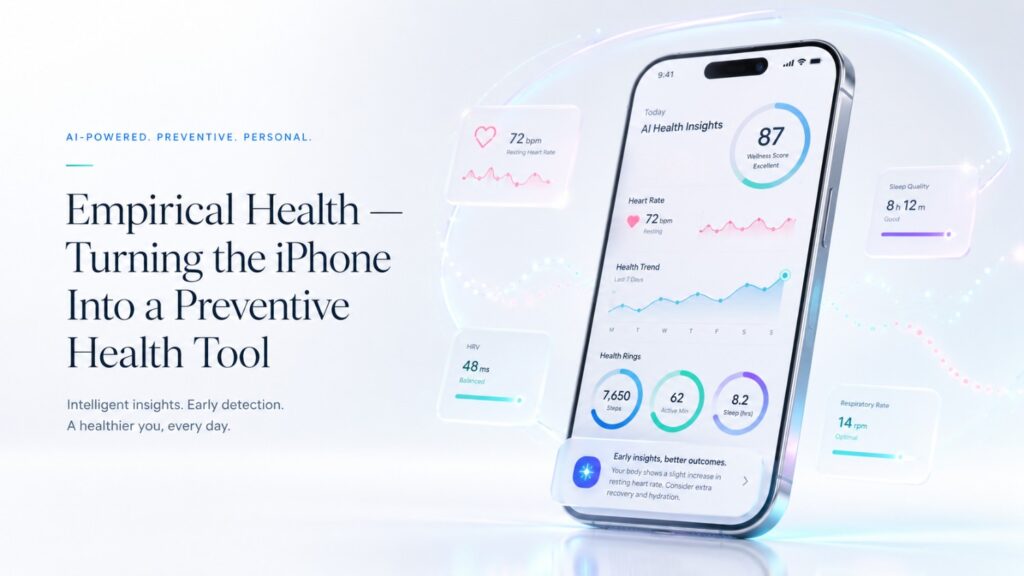
The YC-backed New York startup is building what it describes as AI-native preventive care, with a strong focus on heart health. Its system combines health information with signals such as wearable data and advanced laboratory testing, while medical care remains supported by clinicians.
The company says it is licensed across more than 30 states and can serve a large share of the U.S. population.
Why Continuous Data Changes Medicine
Traditional healthcare often sees a person only occasionally.
Wearables can create data every day.
The hard problem is turning that flood of information into something medically useful.
AI may become valuable here not because it produces a flashy diagnosis, but because it notices meaningful change across thousands of small signals over time.
That could shift some medicine from “treat the problem after it happens” toward “spot risk while there is still time to act.”
Allia Health — An Early Bet on an AI-Native Mental Health Practice
Allia Health is at a much earlier stage than Spring Health, which is exactly why it is worth watching.
The New York startup joined Y Combinator’s Summer 2026 batch. It describes itself as an AI-native clinical group for mental healthcare and says its system is already being used across hundreds of provider locations. The company also says it has signed national contracts representing substantial future care capacity.
There is an important timing detail: as of August 31, 2026, Allia’s YC profile says its direct care delivery is scheduled to begin in September 2026.
What Makes Allia Interesting
Allia represents the next phase of AI healthcare company formation.
Earlier health-tech companies often started with care and later added AI.
A newer group is starting with the assumption that much of the administrative and information work around every clinician can be AI-native from day one.
That could create a very different cost structure.
Whether it creates better outcomes remains to be proven.
NYC Is Still Producing AI That Touches Diagnosis and Surgery
Administrative AI may be attracting enormous attention, but New York has not abandoned harder clinical problems.
Two companies in particular show how AI is moving closer to actual diagnosis and procedures.
Ezra — Making AI-Powered MRI Screening Faster
Ezra is building around a simple but ambitious idea: use MRI and artificial intelligence to make cancer screening easier and more affordable.
The New York company announced a $21 million financing in 2024, taking reported total funding to approximately $41 million. Its technology uses AI to support MRI analysis and shorten the scanning and interpretation process.
The company has also expanded geographically. By March 2026, Ezra said it had grown from its original New York presence to 18 facilities across seven U.S. cities.
Ezra Shows Why Workflow Matters as Much as Accuracy
Medical AI is often judged by how accurately a model can identify something.
That is only one economic lever.
If AI can reduce the time required to produce or interpret a scan, it may lower the cost of delivering that scan.
That can expand the addressable market.
For healthcare buyers, this creates a useful evaluation rule: never ask only, “Is the AI accurate?”
Also ask, “What part of the workflow becomes cheaper, faster, safer, or available to more patients because the AI exists?”
Medivis — Bringing AI and Augmented Reality Into Surgery
Medivis sits at the intersection of AI, augmented reality, medical imaging, and surgery.
The Flatiron District company says its systems turn medical imaging into three-dimensional visual information that surgeons can use during planning and procedures. Medivis has received FDA clearances for surgical navigation products, including Spine Navigation and, in December 2025, Cranial Navigation.
Its technology has been deployed across major medical centers, and the company says more than 2,000 surgeries have been performed using its SurgicalAR technology.
Medivis raised a $20 million Series A and had previously announced $2.3 million in earlier funding.
The Bigger Opportunity Is Surgical Intelligence
Medivis is useful because it shows that the future of healthcare AI does not need to look like a chat window.
AI can live inside a physical workflow.
In surgery, that can mean helping process images, identify anatomy, understand location, and present information at the moment a surgeon needs it.
This type of company may take longer to build because regulation, hardware, hospital purchasing, clinical training, and medical evidence all matter.
The advantage is that successful products can become deeply embedded in clinical work.
Oncology and Clinical Data Are Becoming a Major New York Strength
Cancer care generates enormous amounts of information.
A single patient may have years of notes, laboratory results, imaging, pathology, treatments, genomic information, and medication history.
That makes oncology one of the areas where modern AI could create unusually large gains.
Triomics — Building an AI Layer for Cancer Centers
Triomics is one of the most important companies in the current New York oncology AI market.
The company raised a $22 million Series B in May 2026, taking total financing above $36 million. It is developing AI infrastructure designed specifically for oncology, including tools that can understand clinical records and help identify patients who may qualify for trials.
Its customer and partner list includes major cancer institutions.
The most important NYC evidence came from Mount Sinai. In January 2026, Mount Sinai announced a systemwide rollout of Triomics’ PRISM technology for oncology clinical-trial matching.
Why Trial Matching Is Such a Strong AI Use Case
Clinical-trial matching sounds simple until you look at how a real trial works.
Eligibility may depend on cancer type, stage, previous treatments, laboratory values, mutations, age, health history, and dozens of exclusion rules.
The information may be scattered through years of medical records.
Humans can do this work, but it takes time.
AI can potentially read large volumes of records and turn an unstructured search problem into a smaller set of candidates for a clinical team to review.
That is exactly the type of use case where AI has a clear reason to exist.
Dandelion Health — Turning Hospital Data Into AI Infrastructure
Dandelion Health is not building a single patient-facing application.
It is trying to provide the data foundation on which many other healthcare AI applications can be built and tested.
Dandelion announced a $15 million seed round in 2023 and another $14 million Series A in May 2026. The company says its platform now includes data covering more than 15 million patients across 73 hospitals and more than eight petabytes of multimodal healthcare information.
That includes more than simple claims data.
Multimodal medical data can combine notes, images, signals, laboratory results, and other information.
Why Data Infrastructure May Become More Valuable Than Another AI App
Healthcare AI has an uncomfortable problem.
Models need enormous amounts of representative medical information, but medical data is highly sensitive, fragmented, and difficult to use.
A company that makes high-quality clinical data easier to access responsibly can become part of the infrastructure behind many other companies.
This creates a “picks and shovels” opportunity.
Instead of betting on one diagnostic model or one treatment area, data infrastructure can potentially benefit from growth across the entire healthcare AI market.
Century Health — Using AI to Unlock Real-World Clinical Evidence
Century Health sits in a related but distinct part of the market.
The New York startup is using AI to turn messy clinical information into structured data that life-sciences companies can use for research.
Century announced a $5 million seed financing in May 2026. Its platform focuses on extracting useful evidence from medical records and other real-world clinical sources.
The Opportunity Is Bigger Than “Reading Charts”
Drug companies spend huge amounts of money trying to understand whether therapies work, which patients respond, where treatments fail, and what happens outside controlled clinical trials.
Much of that knowledge already exists inside healthcare records.
The problem is that it is not stored in a clean research database.
AI can help close that gap.
If Century and companies like it can produce reliable, auditable clinical datasets faster, they may shorten parts of the research cycle without having to invent a new drug themselves.
The Biggest NYC Healthcare AI Opportunity May Be the Back Office
The administrative side of American healthcare is enormous.
Patients make calls.
Doctors document visits.
Hospitals code treatments.
Insurers review claims.
Staff check eligibility.
Practices buy supplies.
People chase prior authorizations.
Someone has to reconcile every payment.
This work rarely receives the attention given to cancer diagnostics or surgical robots, but it creates one of the biggest markets for AI.
Our sample reflects that.
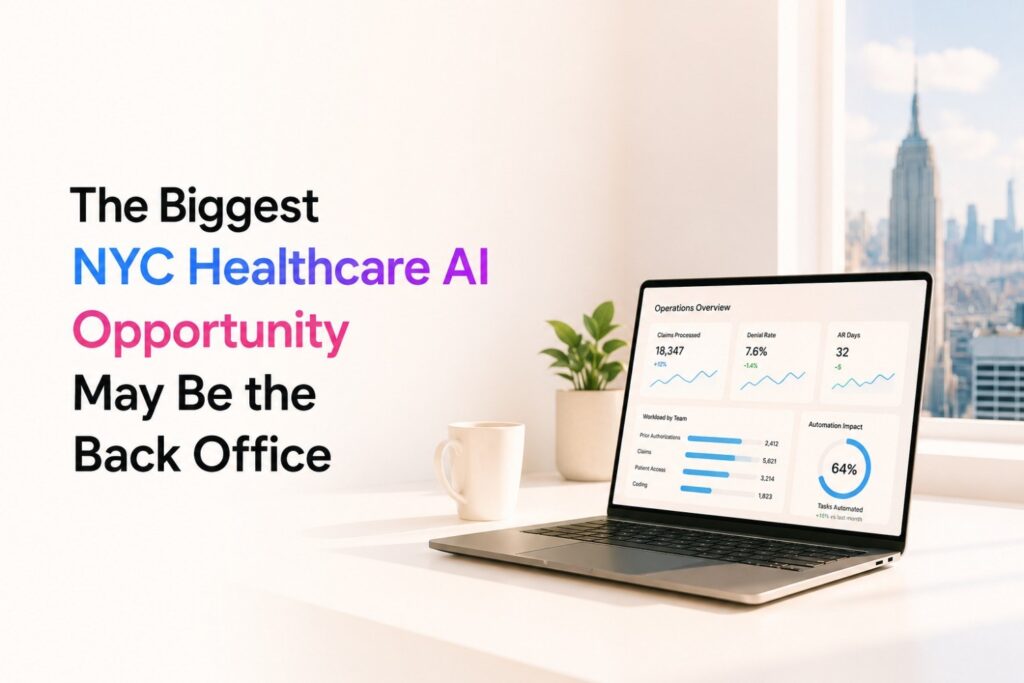
Six of the 20 companies are primarily attacking access, claims, coding, communication, or healthcare operations.
Hyro — Turning the Healthcare Call Center Into an AI System
Hyro was created at Cornell Tech and has become one of New York’s clearest examples of enterprise healthcare AI.
The company raised $45 million in October 2025, taking total funding to $95 million. At the time, Hyro said its AI agents were deployed across more than 45 health systems and could serve interactions involving more than 30 million patients.
Its software handles tasks such as appointment scheduling, registration, prescription questions, call routing, and other common patient requests.
Why Hyro’s Position Is More Important Than It Looks
Patient access sits at the front door of a health system.
When that front door fails, the effects spread everywhere.
Patients wait longer. Calls pile up. Staff spend time answering repetitive questions. Appointments are missed. Revenue can disappear.
That makes access automation attractive because its value can often be measured.
For hospitals buying AI, this should be a major principle: start with workflows where success can be seen in numbers such as call resolution, abandoned calls, scheduling conversion, staff hours, appointment completion, and patient wait time.
Nym — Automating the Language of Medical Billing
Medical coding is one of healthcare’s strange but essential systems.
After care is delivered, information in the medical record must be translated into codes used for billing, reimbursement, reporting, and other functions.
Nym is using AI to automate much of that work.
The company is headquartered in New York City, with research and development operations in Tel Aviv. Public funding trackers put total financing around $94.5 million after a $47 million growth investment announced in 2024.
Nym says its technology is used across more than 300 healthcare facilities and processes millions of patient charts.
Explainability Is Especially Important Here
A coding system cannot simply return an answer.
Healthcare organizations need to know why a particular code was selected.
That makes explainability more than a marketing phrase. It is part of the workflow.
This principle extends beyond coding.
The closer an AI decision gets to money, treatment, safety, or regulation, the more valuable a clear audit trail becomes.
Nitra — Building an AI Operating System for Medical Practices
Nitra may be one of the most interesting examples of where healthcare AI is going.
Instead of focusing on diagnosis, the company is trying to run more of the business around a medical practice.
That can include purchasing, payments, finance, inventory, scheduling, insurance work, and other back-office processes.
In March 2026, Nitra announced $187 million across equity rounds, venture debt, and a warehouse facility. It said total capital raised had reached $205 million while total equity funding stood at $90 million.
The company also said it had surpassed $1 billion in annualized processing volume across more than 700 practices and 2,500 physicians.
This Could Become a Very Large Category
Independent medical groups often use a patchwork of software.
One product schedules patients. Another handles payments. A different system manages inventory. Another checks insurance.
AI agents make it possible to imagine a new layer sitting across these systems and doing work rather than simply storing information.
If that model works, the winning healthcare software company may not be another “system of record.”
It may be a system of action.
Alaffia Health — Using AI to Review Healthcare Claims
Alaffia Health attacks the payer side of the healthcare economy.
The New York company uses AI to help health plans review claims and medical information, particularly where there may be billing errors, waste, or inappropriate charges.
Alaffia announced a $55 million Series B in February 2026, taking total funding above $73 million.
Why Claims AI Will Face a Different Trust Test
There is obvious financial value in finding claim errors.
There is also obvious risk.
If an AI system incorrectly blocks or delays legitimate care, the consequences can reach patients.
That means payer AI should be judged on more than savings.
Buyers should ask about false positives, human review, appeal processes, evidence trails, clinical oversight, and whether financial incentives could push the system toward overly aggressive decisions.
The strongest products will make review more accurate, not simply more restrictive.
Prosper AI — Giving Healthcare Organizations AI Workers
Prosper AI is part of a new group of startups explicitly building AI agents for healthcare operations.
The New York company raised a $30 million Series A in June 2026 after an earlier $5 million seed, bringing announced funding to $35 million.
Prosper says its technology works across tasks such as scheduling, insurance verification, billing, and phone calls with payers. By June 2026, the company said it supported more than 150,000 providers across over 60 healthcare organizations.
The Metric That Matters Is Work Completed
The healthcare AI market is gradually moving beyond measuring the number of conversations an AI can have.
The better question is whether the system finishes useful work.
Did the appointment get booked?
Was eligibility confirmed?
Was the authorization request completed?
Was the patient’s problem resolved without creating another task for an employee?
This shift from “AI conversation” to “completed workflow” could become one of the most important buying criteria in enterprise healthcare.
Clarion — Creating an AI Communication Layer for Healthcare
Clarion is smaller than Hyro or Nym, but it belongs on the list because it represents another important architecture.
The NYC-based YC company says it has raised about $5.4 million and is building AI agents that manage patient communication around scheduling, billing, refills, and other workflows. It says its systems already interact with tens of thousands of patients each month.
Small Companies Can Win by Going Deep
Healthcare organizations do not necessarily need one giant AI product.
A younger company can still build a strong business by becoming extremely good at a narrow but painful workflow.
The challenge is defensibility.
As foundation models improve, simply generating good language becomes easier for everyone.
The stronger moat comes from integrations, workflow data, healthcare rules, reliability, deployment knowledge, and the ability to complete actions inside real systems.
New York Is Building AI Companies That Target Biology Itself
The longest-term opportunity may be the most ambitious one.
Several NYC companies are not trying to make an existing healthcare workflow faster.
They are using AI to change how new medicines are discovered.
Manas AI — Building an AI-Native Drug Discovery Company
Manas AI launched with an unusually high-profile combination of artificial intelligence and medicine.
The New York company was co-founded by cancer researcher and physician Siddhartha Mukherjee and technology entrepreneur Reid Hoffman.
It announced approximately $24.6 million in initial seed financing and followed that with another $26 million seed extension in September 2025, putting publicly disclosed rounds at roughly $50.6 million.
The company is applying AI to the search for new medicines, initially including work in cancer.
Why Drug Discovery Is Different
An AI tool for scheduling can show value in weeks.
A new medicine can take years.
That changes everything about how these businesses should be assessed.
Revenue today matters less. Scientific validation matters more.
Investors evaluating AI drug discovery should therefore ask whether the model is actually producing better candidate molecules, whether laboratory results confirm those predictions, whether the company can move programs toward clinical trials, and whether pharmaceutical partners see enough value to commit capital.
Output Biosciences — Trying to Build Models That Reason About Biology
Output Biosciences is pursuing an even broader ambition.
The NYC YC company describes itself as an AI laboratory building large biological models that can reason about biological systems and help generate new therapies.
The idea is similar in spirit to what happened in language AI.
A language model learns patterns across enormous amounts of text. A biological foundation model attempts to learn useful structure from biological information.
The Prize Is Enormous, but So Is the Proof Burden
Biology does not behave like a software benchmark.
A model can produce an answer that sounds convincing and still be biologically wrong.
That means laboratory validation remains critical.
The important question is not whether an AI model can generate thousands of possible drug ideas. It is whether it can increase the percentage of those ideas that survive the expensive path through laboratory testing and eventually human trials.
CellType — An Early NYC Bet on Agentic Drug Discovery
CellType is one of the youngest companies in this article.
The YC Winter 2026 startup describes itself as an agentic drug company. Its founders are using biological foundation models and AI agents to search for treatments and generate scientific hypotheses.
The company says it screened more than 4,000 drugs in an early cancer project, predicted a previously overlooked treatment signal, and then validated the result experimentally. It also says it is working with a major pharmaceutical company. These are company-reported results and should be treated as early evidence rather than established clinical proof.
Why CellType Belongs on the Watchlist
Early-stage AI drug companies can look tiny beside Spring Health or K Health.
That does not mean the opportunity is tiny.
A single successful drug program can create enormous value.
The difficult part is that investors may wait years to know whether early technical promise translates into medicine.
CellType therefore represents the high-risk, high-upside edge of New York’s healthcare AI market.
Original Research: The Two NYC Healthcare AI Economies
Looking across all 20 companies reveals something deeper.
New York appears to be developing two healthcare AI economies at the same time.
The first tries to improve the delivery and administration of today’s healthcare system.
The second tries to change the science underneath tomorrow’s medicine.
Economy One: AI That Makes Today’s Healthcare System Work
Spring Health, K Health, Counsel, Hyro, Nym, Nitra, Prosper, Clarion, Alaffia, and Ilant all fit broadly into this side of the market.
Their immediate economic opportunity is connected to things healthcare organizations already spend money on.
Labor.
Care delivery.
Claims.
Scheduling.
Billing.
Mental health.
Patient access.
Administrative work.
Because budgets already exist, these companies can often prove financial value more quickly.
Economy Two: AI That Expands What Medicine Can Do
Manas AI, Output Biosciences, CellType, Triomics, Dandelion, Century Health, Ezra, and Medivis are closer to this second economy.
They deal with harder scientific or clinical problems.
Drug discovery.
Cancer detection.
Clinical evidence.
Surgical guidance.
Medical data.
Trial matching.
The sales and regulatory cycles can be longer. However, the upside can extend beyond reducing cost.
These companies may enable something that could not previously be done at practical scale.
That distinction should matter to investors.
A healthcare AI company reducing administrative labor should be evaluated partly through ROI and workflow adoption.
A company discovering medicines should not be judged using the same short-term revenue framework.
Why New York Has an Unusual Advantage in Healthcare AI
New York does not dominate healthcare AI because it has one giant technology company.
Its advantage is density.
The city has major academic medical centers, large hospital systems, pharmaceutical companies, insurance businesses, universities, venture funds, enterprise buyers, and one of the largest pools of software and AI talent in the country.
That mixture matters.
Triomics can build oncology AI and work with Mount Sinai.
Hyro was created at Cornell Tech before selling AI into large healthcare systems nationwide.
Medivis can develop surgical technology from the Flatiron District while working with institutions such as Northwell, MD Anderson, UPMC, and other medical centers.
Digital Health New York’s own data shows the depth of the wider ecosystem. Its 2025 report found healthcare innovation funding rebounded sharply in 2024, while its 2026 reporting showed another year of active capital formation and practical AI adoption.
There is also a policy dimension.
New York State’s 2026 agenda includes work around healthcare AI evaluation and partnerships, including initiatives intended to help healthcare institutions examine how AI can be deployed responsibly. That creates both an opportunity and a warning: the companies that win in New York will increasingly need evidence, safety, governance, and clear accountability alongside technical performance.
How Hospitals Should Evaluate NYC Healthcare AI Startups
Healthcare buyers should resist the temptation to begin with the model.
Start with the problem.
A beautiful AI demo is almost meaningless if the underlying workflow is not painful enough to justify implementation.
Measure the Current Problem Before Buying AI
Suppose a hospital is considering an AI patient-access product.
Before evaluating vendors, measure the existing baseline.
How long do patients wait?
What percentage of calls are abandoned?
How many calls require staff?
How many scheduling opportunities are lost?
How much does the call center cost?
How many tasks have to be reopened because information was incomplete?
Without those numbers, it becomes difficult to know whether the AI created real improvement.
Separate Automation Rate From Resolution Rate
This distinction will become increasingly important.
An AI agent might handle 80% of conversations without a human.
That sounds excellent.
But perhaps only half of those conversations actually solve the patient’s problem.
The rest may create another call, message, or staff task later.
Healthcare leaders should therefore measure successful end-to-end resolution, not just containment.
Measure False Positives Wherever AI Flags Problems
This matters in claims review, clinical alerts, diagnosis, coding, and risk detection.
Imagine a system catches 95% of possible problems but incorrectly flags a huge number of normal cases.
Employees may spend so much time investigating false alarms that the AI creates more work than it removes.
Precision matters.
Demand an Escalation Path
Every healthcare AI system will eventually encounter something it cannot safely handle.
Buyers should know exactly what happens next.
Who receives the case?
How quickly?
What information is transferred?
Does the user have to repeat everything?
Can staff see what the AI already did?
Strong healthcare AI does not pretend humans are unnecessary. It knows when humans become necessary.
Ask What Evidence the Vendor Can Actually Show
Customer logos are useful, but they do not prove impact.
Ask for before-and-after numbers.
If a vendor says its system reduces administrative work, ask by how much.
If it improves scheduling, ask how many more appointments are completed.
If it improves coding, ask about accuracy and audit results.
If it helps identify patients for trials, ask how many qualified candidates were found and how much manual review was saved.
The closer the AI gets to clinical decisions, the stronger the evidence should become.
A Practical Healthcare AI Buyer Scorecard
| Question | What a strong answer looks like |
| Is the problem expensive enough? | Clear baseline cost, delay or safety burden |
| Does AI need to solve it? | AI handles complexity that simpler software cannot |
| Is the system integrated? | Works inside existing EHR, scheduling, billing or clinical tools |
| Can results be measured? | Clear before-and-after operational or clinical KPIs |
| Are humans involved appropriately? | Defined review and escalation rules |
| Can decisions be audited? | Logs, source information and clear reasoning trails |
| Does the system fail safely? | Uncertain cases are stopped or routed to humans |
| Is patient data protected? | Strong privacy, access and security controls |
| Are users actually adopting it? | Sustained use beyond a pilot |
| Does the economics work? | Savings or revenue gain exceeds full deployment cost |
This type of framework is more useful than asking whether a startup uses GPT-5, a proprietary model, or another fashionable technical approach.
The model will change.
The workflow and economics matter longer.
What Founders Can Learn From New York’s Strongest Healthcare AI Startups
The 20 companies in this analysis show several patterns that newer founders should study.
Narrow Problems Can Create Large Companies
Nym is focused on medical coding.
Hyro began around patient communication.
Triomics went deep into oncology.
Ezra focused on MRI-based cancer screening.
These are not small opportunities simply because they begin with a specific problem.
Healthcare rewards depth.
A startup that understands a difficult workflow better than anyone else can expand from that starting point.
Distribution Can Be a Bigger Moat Than the Model
AI models are becoming easier to access.
Healthcare distribution is not.
Selling to hospital systems can take months. Integrating into medical systems is hard. Security reviews take time. Clinicians need training. Payers have complex procurement processes.
Once a startup has reliable integrations and trusted healthcare relationships, those assets can be harder to copy than its underlying model.
AI Startups Need Healthcare-Native Metrics
Generic software metrics are not enough.
Healthcare companies may need to demonstrate clinical accuracy, reimbursement impact, safety, time saved, coding accuracy, patient outcomes, treatment adherence, claims savings, trial enrollment, or regulatory performance.
The metric depends on the workflow.
The rule is simple: measure the thing the healthcare buyer actually cares about.
What Investors Should Watch in the Next Wave of NYC Healthcare AI
Funding alone is a poor way to predict the winner.
The capital concentration in our sample proves why.
Spring Health and K Health represent the majority of tracked capital, but some of the most technically ambitious companies remain tiny by comparison.
A better investment framework looks at several signals together.
Watch Revenue Quality, Not Just Revenue Growth
AI agents can produce fast early revenue because almost every healthcare organization wants to test AI.
The question is what happens after the pilot.
Do customers expand?
Do they add workflows?
Do contracts renew?
Does the technology become mission-critical?
Expansion inside existing customers may eventually become a stronger signal than the number of new pilots announced.
Watch Whether AI Moves From Assistant to Operator
The first generation of generative AI helped people write.
The next generation is trying to do.
Prosper wants agents to complete healthcare operations.
Nitra wants AI to help run practices.
Hyro wants agents to resolve patient-access needs.
This move from “generate an answer” to “complete a workflow” could produce much larger businesses.
It also introduces much larger risks because software is taking actions inside important systems.
Watch the Companies With Proprietary Feedback Loops
Every time a healthcare AI product performs a task, the company may learn something.
Which coding decision was corrected?
Which trial candidate was actually eligible?
Which patient request required escalation?
Which drug prediction worked in a laboratory?
Which treatment led to a better result?
The companies that can legally and responsibly turn those outcomes into product improvement may build strong data advantages over time.
NYC Tech Journal’s Healthcare AI Market Map
One way to understand the market is to place each company according to what it is fundamentally trying to improve.
| Layer | Representative NYC companies | Core outcome |
| Patient care | Spring Health, K Health, Counsel, Ilant, Empirical, Allia | Better or more accessible care |
| Patient access | Hyro, Clarion | Easier healthcare navigation |
| Provider operations | Nitra, Prosper | Lower administrative burden |
| Payment and claims | Nym, Alaffia | Faster, more accurate financial workflows |
| Diagnostics | Ezra | Earlier or more efficient detection |
| Surgery | Medivis | Better procedural guidance |
| Oncology intelligence | Triomics | Faster clinical research and trial matching |
| Clinical data | Dandelion, Century | Better AI and research infrastructure |
| Drug discovery | Manas AI, Output Biosciences, CellType | Faster creation of new therapies |
This table explains why simply calling the sector “healthcare AI” can be misleading.
These companies do not really compete in one market.
They are using similar advances in AI to attack entirely different parts of a multi-trillion-dollar healthcare economy.
The Most Important Trend: AI Is Moving From Tool to Infrastructure
The first wave of enterprise AI often looked like an assistant.
A doctor wrote a note, and AI summarized it.
An employee received an email, and AI drafted an answer.
A patient asked a question, and a chatbot responded.
Useful, but limited.
The next wave looks very different.
AI is beginning to sit between systems.
It reads one system, makes a decision, moves information into another system, starts the next task, checks the result, and asks a human for help only when necessary.
That is why companies such as Hyro, Nitra, Prosper, Nym, and Alaffia deserve attention even though they are not discovering diseases.
Healthcare cannot function without the operational machinery around medicine.
If AI becomes part of that machinery, the business opportunity could be enormous.
But Clinical AI May Ultimately Create the Greatest Value
Administrative AI can save money quickly.
Clinical and scientific AI could eventually change what is medically possible.
Imagine cancer trials that identify every eligible patient automatically.
MRI screening that becomes cheaper because scans and analysis take less time.
Surgeons who can see important anatomy and imaging information directly in the operating field.
Biological models that reduce the number of dead ends researchers explore before finding a promising drug.
Preventive systems that spot a meaningful health change months before the patient would normally visit a doctor.
Those are much harder problems.
They are also the reason healthcare AI matters beyond software productivity.
What NYC Tech Journal Will Be Watching Next
The first question is whether healthcare AI moves from pilots into permanent budgets.
Healthcare organizations experimented heavily with generative AI after 2023. By 2026, experimentation alone is no longer impressive.
Companies now need to show that their systems survive procurement, security review, clinical governance, integration, deployment, and renewal.
The second question is whether “agentic AI” produces measurable economics.
Agents are now one of the most popular ideas in healthcare technology. The winners will be the companies that demonstrate completed work, not clever conversations.
The third question is whether New York can produce more clinically deep AI companies.
The city is already strong in healthcare operations and care delivery. Companies such as Triomics, Ezra, Medivis, Manas AI, Output Biosciences, and CellType show that a deeper clinical and scientific layer is also forming.
The fourth question is consolidation.
Spring Health’s acquisition of Alma and the earlier acquisitions of companies such as Paige and Aetion show that the market is already moving beyond startup creation toward platform building.
Over the next few years, some AI point solutions will disappear.
Others will be acquired.

A smaller group may become large independent healthcare companies.
The Bottom Line
New York’s healthcare AI market is entering a more serious phase.
The question is no longer whether artificial intelligence can generate medical text, answer patient questions, or analyze information.
The important question is whether AI can become dependable enough to perform meaningful work inside healthcare.
The 20 companies in this analysis show how broad that work has become.
Spring Health and K Health are using AI inside care delivery. Hyro, Nym, Nitra, Prosper, Clarion, and Alaffia are attacking the enormous administrative layer around medicine. Ezra and Medivis bring AI closer to imaging and procedures. Triomics, Dandelion Health, and Century Health are making clinical information more useful. Manas AI, Output Biosciences, and CellType are pushing further upstream into biology and drug discovery.
Our original analysis also shows that this is not a market where capital is spread evenly.
The roughly $1.48 billion of comparable disclosed or trackable equity in our 17-company funding sample is highly concentrated. Two mature companies account for about 57%, while the top five account for approximately 76%.
That leaves a large field of younger startups trying to become the next major New York healthcare platform.
Some will fail.
Some will become features inside larger systems.
Some will be acquired.
A few may become companies that permanently change how medicine is delivered.
For healthcare leaders, the opportunity is not to “adopt AI” as quickly as possible. It is to find workflows where intelligence can create a measurable improvement without sacrificing safety, trust, or accountability.
For founders, the challenge is no longer building a convincing demo. It is proving that an AI product can survive the complicated reality of healthcare.
And for New York, that may be the city’s real advantage.
NYC has the hospitals, researchers, clinicians, payers, investors, software talent, universities, and patients needed to test healthcare AI against the real world.
The next phase will show which companies can turn that environment into durable businesses—and which can turn AI from an interesting technology into better medicine.