


For most of the last two decades, the center of gravity in American technology seemed easy to find. Silicon Valley built the biggest consumer platforms, the most important cloud companies, and many of the technologies that shaped the modern internet.
Artificial intelligence may create a different map.
The next major phase of AI is increasingly about applying powerful models to very specific industries. Instead of asking an AI system to do almost anything, companies are teaching AI to understand apartment leasing, financial compliance, medical administration, patent work, construction rules, investment research, insurance claims, advertising, accounting, and dozens of other narrow but valuable jobs.
That shift plays directly into New York City’s strengths.
New York is not simply a large technology market. It is one of the world’s densest collections of customers for specialized business software. Banks sit beside law firms. Hospitals sit beside life sciences companies. Property owners, insurers, media groups, advertising agencies, fashion companies, accounting firms, asset managers, construction companies, and professional service businesses operate within a relatively small geographic area.
For vertical AI, that matters enormously.
NYC Tech Journal’s analysis of public startup, funding, employment, and ecosystem data suggests that New York is developing a particularly strong position in this new layer of artificial intelligence. Our research found that nearly half of the companies in one current early-stage NYC AI dataset already fall into clearly identifiable industry-focused categories. If workflow-specific enterprise AI is included, roughly two-thirds of the dataset is tied to a defined business function, buyer, or industry rather than general-purpose AI.
That does not prove New York has already overtaken every other AI hub. Silicon Valley remains extraordinary in foundation models, chips, infrastructure, research, and venture capital.
But it points toward something more interesting.
New York may be becoming the city where AI gets turned into businesses.
And that may prove to be one of the most valuable positions in the entire AI economy.
The Short Answer: New York Has the Customers Vertical AI Companies Need
The easiest way to understand New York’s advantage is to stop thinking about artificial intelligence as a single industry.
AI is becoming a layer inside almost every industry.
A financial compliance system needs AI.
A law firm reviewing thousands of documents needs AI.
A hospital scheduling patients needs AI.
A property manager answering tenant questions needs AI.
An insurance company reviewing claims needs AI.
A construction company checking payroll and regulatory records needs AI.
A pharmaceutical company searching scientific information needs AI.
These businesses have something important in common: the AI model itself is only part of the product.
The harder work is understanding the customer.
Vertical AI companies have to learn the language, rules, data, software, risks, approvals, exceptions, and daily tasks of the industry they serve. A clever chatbot is not enough.
New York gives founders access to those complicated environments at unusual scale.
NYCEDC says the city has more than 25,000 tech-enabled startups, more than 2,000 AI startups, over 1,200 active venture capital firms, and a metropolitan economy of roughly $2 trillion. The organization describes New York’s opportunity specifically in terms of Applied AI, pointing to the city’s strength across finance, healthcare, real estate, media, fashion, professional services, retail, and other industries. (edc.nyc)
That economic diversity is not a side detail.
It may be the central reason vertical AI is becoming such an important part of New York tech.
What Is Vertical AI?
Vertical AI is artificial intelligence built for a particular industry or specialized business problem.
A general AI assistant might help anyone write an email.
A vertical AI platform for financial advisers might review employee communications for potential compliance problems, maintain regulatory records, identify unusual activity, and understand rules from the SEC or FINRA.
A general AI system might summarize a document.

A vertical AI platform for patent teams might analyze claims, compare prior art, search technical records, and help professionals manage the patent process.
The difference is depth.
Horizontal AI Versus Vertical AI
Horizontal AI tries to solve a problem that exists across many industries.
Examples include general coding assistants, meeting transcription, enterprise search, email writing, generic customer service, or model infrastructure.
Vertical AI goes deeper into one market.
| Horizontal AI | Vertical AI |
|---|---|
| Works across many industries | Built for a particular industry |
| Broad customer base | Narrower customer group |
| General workflows | Industry-specific workflows |
| Usually easier to explain | Often requires deep domain knowledge |
| Competes largely on product and technology | Competes on technology, data, workflow knowledge, trust, and integration |
| May be easier to copy | Can become harder to replace once deeply embedded |
There is no perfect border between the two.
Some businesses start with one workflow and eventually become vertical platforms. Others start vertically and later apply their technology to another industry.
EliseAI is a useful New York example. It began by automating communication and operating workflows in housing before expanding into healthcare. The company says its technology is now used across roughly one in six U.S. apartments and by millions of patients. (eliseai.com)
That path illustrates an important idea.
Vertical AI does not necessarily mean staying small.
It often means starting narrow enough to become extremely good at something valuable.
Original Research: How NYC Tech Journal Analyzed New York’s Vertical AI Economy
There is no official government database labeled “vertical AI startups.”
That creates a research problem.
Different databases define AI companies differently. Some include traditional software companies that have added AI features. Some classify infrastructure companies alongside specialized applications. Funding databases often hide detailed records behind subscriptions.
Instead of pretending a perfect dataset exists, NYC Tech Journal built a transparent analysis from several public sources.
Our Research Method
We used four primary data layers.
Layer 1: NYC AI ecosystem data
We used NYCEDC data to establish the overall size and direction of New York’s AI ecosystem.
NYCEDC reports:
- more than 2,000 AI startups in New York City;
- more than 40,000 workers in the metro area with AI or AI-related skills;
- $21.4 billion in venture funding to NYC AI companies between 2018 and 2022;
- more than 1,200 active venture capital firms;
- more than 25,000 tech startups overall. (edc.nyc)
Layer 2: Early-stage AI company categories
We analyzed the category totals published by AI Atlas NYC, an early-stage NYC AI directory that organizes companies by buyer, workflow, and product area.
At the time of our analysis, its visible categories contained 74 companies across fintech, legal and compliance, cybersecurity, media, healthcare, life sciences, consumer AI, infrastructure, enterprise sales software, and data products. (AI Atlas NYC)
We separated those categories into three groups:
Industry-specific vertical AI: finance, legal/compliance, cybersecurity, media/advertising, healthcare, and life sciences.
Workflow-specific applied AI: enterprise sales, support, revenue operations, and related business workflow products.
Horizontal or infrastructure AI: agent infrastructure, data layers, broad consumer AI, and model tooling.
This approach is intentionally conservative. We did not automatically call every enterprise AI company “vertical AI.”
Layer 3: Recent startup financing
We checked publicly reported New York AI financing activity, including SEC Form D-based records collected by TinyTechFund and current funding coverage from Tech:NYC and individual companies.
TinyTechFund’s July 2026 New York AI page showed 27 companies with recent public Form D records and approximately $492.1 million in disclosed capital across the displayed dataset. (TinyTechFund)
Layer 4: Industry and employment structure
Finally, we compared the startup data with public employment figures.
The New York metropolitan area had approximately:
- 2.39 million education and health services jobs;
- 1.62 million professional and business services jobs;
- 814,000 financial activities jobs;
- 309,000 information jobs,
as of May 2025. (Bureau of Labor Statistics)
The point was not to claim that everyone in those sectors buys AI software.
The question was simpler:
Does New York contain unusually large pools of workers and businesses doing the kinds of complicated knowledge work vertical AI can automate?
The answer is clearly yes.
Finding No. 1: Nearly Half of One Early-Stage NYC AI Dataset Is Already Industry-Specific
We classified the 74 companies shown across AI Atlas NYC’s visible category counts.
The clearly industry-focused groups contained:
- Fintech and trading AI: 8
- Legal and compliance AI: 5
- Cybersecurity AI: 4
- Media, advertising and creative AI: 8
- Health and clinical AI: 8
- Life sciences AI: 3
That produces 36 clearly industry-specific companies out of 74, or approximately 48.6%.
This is our calculation, not a figure published by AI Atlas.
Chart: Clearly Vertical AI Share in the Dataset
Industry-specific vertical AI     48.6%  ████████████████████████
Other / horizontal / workflow     51.4%  ██████████████████████████
Source dataset: AI Atlas NYC category totals. NYC Tech Journal classification and calculation. (AI Atlas NYC)
That result is notable because we used a narrow definition.
We did not count general enterprise AI automatically.
We did not count agent infrastructure.
We did not count data infrastructure.
We did not count general consumer AI.
Even with that conservative approach, almost half of the observed startup set was already organized around particular industries.
Finding No. 2: Two-Thirds of the Dataset Targets a Defined Industry or Business Workflow
The picture becomes even stronger if we include specialized enterprise workflows.
AI Atlas lists another 13 companies under Enterprise GTM and RevOps AI, covering areas such as sales, support, insurance distribution, customer communication, and revenue operations. (AI Atlas NYC)
Adding those companies to our 36 clearly vertical startups produces 49 companies.
That means approximately 66.2% of the dataset is focused on a defined industry or specialized business workflow.
Chart: NYC Early-Stage AI by Product Orientation
Industry-specific vertical AI     36  ████████████████████████
Workflow-specific applied AI      13  █████████
Horizontal / infrastructure       25  █████████████████
                                  ──
Total                             74
Share of Dataset
| Product orientation | Companies | Share |
|---|---|---|
| Clearly industry-specific AI | 36 | 48.6% |
| Specialized enterprise workflow AI | 13 | 17.6% |
| Horizontal, consumer or infrastructure AI | 25 | 33.8% |
| Total | 74 | 100% |
Source: NYC Tech Journal analysis of AI Atlas NYC visible category totals. (AI Atlas NYC)
This matters because it gives us a better way to describe New York’s AI ecosystem.
It is not simply a collection of companies building models.
A large part of the emerging ecosystem appears to be building AI around work.
That is a very New York pattern.
Finding No. 3: New York’s Vertical AI Activity Is Spread Across Several Major Industries
Another important result is the diversity inside the vertical group.
No single industry completely dominates the 36-company clearly vertical sample.
NYC Tech Journal Vertical AI Distribution
| Vertical | Companies | Share of vertical sample |
|---|---|---|
| Fintech and trading | 8 | 22.2% |
| Media, ads and creative | 8 | 22.2% |
| Health and clinical | 8 | 22.2% |
| Legal and compliance | 5 | 13.9% |
| Cybersecurity | 4 | 11.1% |
| Life sciences | 3 | 8.3% |
| Total | 36 | 100% |
Source: NYC Tech Journal calculations using AI Atlas category totals. (AI Atlas NYC)
Chart: Vertical AI Companies by Category
Fintech & trading          8  ████████
Media & advertising       8  ████████
Health & clinical         8  ████████
Legal & compliance        5  █████
Cybersecurity             4  ████
Life sciences             3  ███
This is arguably more important than the total company count.
A strong vertical AI ecosystem should not depend entirely on one fashionable market.
New York’s emerging AI activity maps onto several industries in which the city already has deep customer networks.
Finance gives founders banks, hedge funds, asset managers, insurers, advisers, exchanges, fintech companies, accountants, compliance specialists, and investors.
Healthcare gives them hospital systems, clinics, physicians, insurers, health-tech businesses, researchers, and administrators.
Real estate brings property owners, managers, developers, lenders, brokers, construction companies, architects, and building operators.
Media and advertising bring publishers, agencies, entertainment companies, brands, creators, and large advertising buyers.
Professional services bring law firms, accounting firms, consultants, recruiters, and other knowledge-intensive businesses.
That creates many different places for specialized AI companies to start.
New York’s Greatest AI Asset May Be Industry Density
Much of the discussion around AI cities focuses on engineering talent.
Talent obviously matters.
But vertical AI has another scarce resource:
domain access.
To build excellent software for lawyers, it helps to speak to lawyers every week.
To build software for hedge funds, it helps to understand how investment teams actually work.
To build software for property owners, it helps to observe leasing, maintenance, collections, resident communication, and property management systems.
To build healthcare software, founders must understand patient intake, insurance, medication access, billing, scheduling, privacy rules, documentation, and clinical operations.
You cannot learn all of that from an API.
The Customer Can Become Part of the Product Development Team
This is where geography becomes surprisingly important again.
Software was supposed to make location irrelevant.
Vertical AI makes location useful.
A founder in Manhattan can potentially meet a financial customer in Midtown in the morning, a law firm around lunch, an investor in the afternoon, and a prospective enterprise partner later that day.
The value is not the short subway ride itself.
The value is the number of learning cycles that can happen.
Vertical AI founders need constant feedback:
Does the AI understand the document correctly?
Which mistakes are unacceptable?
Who approves the output?
Where does data live?
What old system must the product connect with?
What regulations matter?
How does the buyer calculate ROI?
Which tasks are annoying but unimportant?
Which tasks cost millions when done badly?
Those details create the product.
New York is packed with people who know the answers.
Why Finance Makes New York a Natural Vertical AI Laboratory
No industry better demonstrates the New York advantage than finance.
Financial businesses produce enormous amounts of structured and unstructured information.
Analysts read filings.
Compliance teams review communications.
Advisers document activity.
Investment firms examine companies.
Banks monitor transactions.
Insurers evaluate risk.
Private equity firms review deals.
Fund administrators reconcile records.
All of these jobs contain the basic ingredients vertical AI needs: high-value labor, repeated workflows, large amounts of data, and a strong reason to improve accuracy.
Recent Funding Shows the Pattern
Tech:NYC’s analysis of July 2026 Series A activity found that financial infrastructure companies attracted roughly $111 million that month, representing more than 40% of the month’s Series A capital in its tracked cohort.
The same report highlighted AI systems for investment research, financial compliance, fraud prevention, commercial real estate, education, cybersecurity, and other specialized workflows. (Tech:NYC Blog)
Importantly, the categories overlap. An AI fintech company can be counted as both financial technology and AI, so those percentages should not be added together.
But the direction is useful.
Capital is moving toward companies that combine technology with industry knowledge.
Hadrius Shows Why Financial Compliance Is Made for Vertical AI
Hadrius is a good example of the model.
The company is building AI for financial compliance rather than trying to sell a general-purpose assistant to every company.
In July 2026, Hadrius announced $27 million in combined seed and Series A financing, including a $22 million Series A.
The company says more than 500 financial institutions and investment firms use its platform. Its AI agents analyze information across areas such as employee communications, trading, marketing, branches, and internal compliance work. (hadrius.com)
Why is this a strong vertical AI market?
Because the work is complicated.
A compliance officer does not merely search for a bad word.
Context matters.
Rules matter.
The person’s role matters.
The communication channel matters.
The financial product matters.
Documentation matters.
Escalation matters.
A horizontal language model can help with pieces of the task.
A vertical platform can potentially own the whole workflow.
That is a much larger opportunity.
Legal AI Could Become Another Major New York Cluster
Law shares many of the same characteristics.
Legal work is document-heavy, expensive, repetitive, and highly dependent on specialized knowledge.
New York also offers a massive concentration of legal customers.

U.S. Census Bureau data shows more than 12,600 legal services employer establishments across New York State, while 2024 Census occupational data estimated more than 96,000 people working in legal occupations in New York City itself. (Census Data)
That creates fertile ground for legal AI.
Norm AI Shows How Large the Market Can Become
Norm AI provides one of the strongest recent examples.
In July 2026, the company announced a $120 million Series C at a valuation of $1.2 billion. It said it had raised more than $260 million since being founded less than three years earlier. (norm.ai)
Norm is attempting something deeper than legal document summarization.
It builds AI agents around law and regulatory work and has also created an affiliated AI-native law firm where lawyers supervise AI-powered workflows. (norm.ai)
Whether that exact model becomes the dominant form of legal AI remains uncertain.
The more important signal is the amount of capital and organizational experimentation moving into specialized legal systems.
Patent AI Shows How Narrow Verticals Can Still Be Large Businesses
Patent work provides an even narrower example.
Patent professionals deal with highly technical documents, claims, prosecution histories, prior art, litigation records, scientific language, and large search spaces.
That sounds like a small market compared with generic office software.
But specialized work can support valuable businesses because the economic value of each decision is high.
Patlytics, a New York company building an AI platform around patent workflows, disclosed a $40.5 million Form D filing in March 2026 in TinyTechFund’s SEC-based dataset. (TinyTechFund)
That is another sign of the emerging vertical AI playbook:
Find expensive knowledge work.
Understand the process deeply.
Automate more than one isolated task.
Become part of the professional’s core operating system.
Healthcare Gives New York Another Huge AI Test Market
Finance may be New York’s most famous industry, but healthcare is even larger in employment terms.
The New York metropolitan area’s education and health services sector employed approximately 2.387 million people in May 2025, according to the Bureau of Labor Statistics.
Healthcare and social assistance also drove much of the region’s recent employment growth. (Bureau of Labor Statistics)
That creates an enormous operating environment for AI.
New York Metro Employment in Major AI-Relevant Sectors
Education & health services      2.387M  ██████████████████████████████
Professional & business svcs     1.618M  ████████████████████
Financial activities             0.814M  ██████████
Information                      0.309M  ████
Source: BLS, May 2025 metropolitan employment. (Bureau of Labor Statistics)
These figures should not be interpreted as the number of potential AI users.
They demonstrate something different: the scale of the operating systems into which AI can be inserted.
Healthcare alone contains scheduling, billing, medical records, insurance approvals, patient communication, medication workflows, clinical documentation, staffing, procurement, coding, collections, and many other processes.
Each can support specialized AI products.
New York’s Healthcare AI Opportunity Is Often Administrative Before It Is Clinical
When people hear “healthcare AI,” they often imagine a model diagnosing cancer.
That is only one part of the market.
Many of healthcare’s biggest daily problems happen before or after the clinical decision.
Patients need appointments.
Insurance must be checked.
Documents have to be processed.
Prescriptions require approval.
Billing questions must be answered.
Medical offices need to follow up.
Records have to move between organizations.
These administrative workflows are attractive AI markets because they are repetitive yet filled with exceptions.
Vertical AI can potentially reduce the burden without requiring a machine to replace the physician.
EliseAI’s Expansion Is an Interesting Signal
EliseAI originally gained scale in housing and later moved into healthcare.
The company raised a $250 million Series E in 2025 to expand its work across healthcare and housing. Its public materials now say it serves approximately one in six U.S. apartments and roughly two million patients. (eliseai.com)
In January 2026, EliseAI announced a 109,000-square-foot New York headquarters at 401 Fifth Avenue, expanding its Midtown footprint. (eliseai.com)
The company is especially interesting because it shows how a vertical AI company can expand without becoming generic.
Instead of saying, “we build AI for everyone,” the company moves from one complicated operating environment into another where similar automation patterns can be applied.
That could become a common growth strategy.
Real Estate Might Be New York’s Most Underestimated AI Advantage
New York is also an unusually useful place to build AI for buildings.
The city has apartments, office towers, retail space, industrial property, hotels, public housing, construction projects, landlords, developers, property managers, lenders, brokers, architects, engineers, and building service companies.
Real estate produces enormous amounts of operational work.
A building is essentially a collection of workflows.
There is leasing.
Maintenance.
Energy use.
Resident communication.
Rent collection.
Vendor management.
Compliance.
Capital planning.
Insurance.
Heating.
Security.
Construction.
Vertical AI can attack these processes one at a time.
Runwise Shows That Vertical AI Can Reach the Physical World
Runwise is a New York company building software for building operations.
In June 2025, it raised a $55 million Series B, bringing reported total funding to $79 million. Its platform focuses on running building systems more efficiently, including heating and energy operations. (PR Newswire)
This is important because vertical AI is not limited to office workers staring at documents.
AI is gradually becoming connected to physical systems.
Buildings are a natural New York test bed because the city contains a dense collection of aging, expensive, energy-intensive properties.
The potential value is easy for customers to understand.
Use less energy.
Reduce operating costs.
Improve comfort.
Identify problems faster.
Make old buildings smarter without rebuilding them.
This is vertical AI attached to physical infrastructure.
Construction Compliance Shows How Deep Vertical AI Can Go
Some of the most interesting vertical AI opportunities are almost invisible to consumers.
Construction compliance is one.
Dili, a New York AI company focused on infrastructure and construction compliance, announced $21.7 million in total financing in July 2026, including a $15 million Series A. (TechCrunch)
The company says its software has processed billions of dollars in wages and millions of labor hours across hundreds of federally related projects.
Why does this matter?
Because it demonstrates what vertical AI looks like when taken seriously.
The problem is not simply:
“Can AI read a payroll document?”
The real problem is:
Can the system understand thousands of records, identify rule violations, know which regulations apply, maintain evidence, flag exceptions, fit inside an audit process, and do all of this reliably enough for a customer facing serious financial risk?
That is much harder.
It is also much more valuable.
Vertical AI Is Really a Workflow Business
This leads to a crucial point for founders.
The strongest vertical AI companies may not win because their models are dramatically better than everyone else’s.
They may win because they understand workflows better.
Consider a financial compliance task.
A model might identify a suspicious communication.
But then what?
Someone has to review it.
An investigation might need to start.
Evidence may need to be preserved.
The employee may need to respond.
A compliance officer needs a record.
A supervisor may need approval.
The event may eventually appear in an audit.
The software that owns all those steps has a very different position from the software that merely generates an answer.
The Unit of Value Is Moving From “Answer” to “Completed Work”
Early generative AI was heavily focused on outputs.
Write this email.
Summarize this PDF.
Generate this image.
Answer this question.
Vertical AI is increasingly focused on outcomes.
Review these files.
Find the problems.
Update the system.
Ask for the missing information.
Prepare the report.
Route the exception.
Escalate the risky case.
Keep the audit trail.
When necessary, ask a human to approve it.
That is a much stronger product.
New York Is Well Suited to AI Agents Because Its Industries Have Long Workflows
This is one reason the rise of AI agents could favor New York.
An agent is useful when it can execute several connected steps instead of answering one prompt.
Vertical industries contain exactly these kinds of workflows.
A commercial real estate analyst may need to gather property information, compare leases, model financial performance, find comparable transactions, prepare an investment memo, and update a system.
A healthcare administrator may need to contact a patient, collect insurance information, request authorization, follow up with the insurer, update the practice system, and schedule the visit.
A compliance officer may need to identify a potential issue, examine supporting records, request clarification, record a decision, and document the case.
Each is a chain.
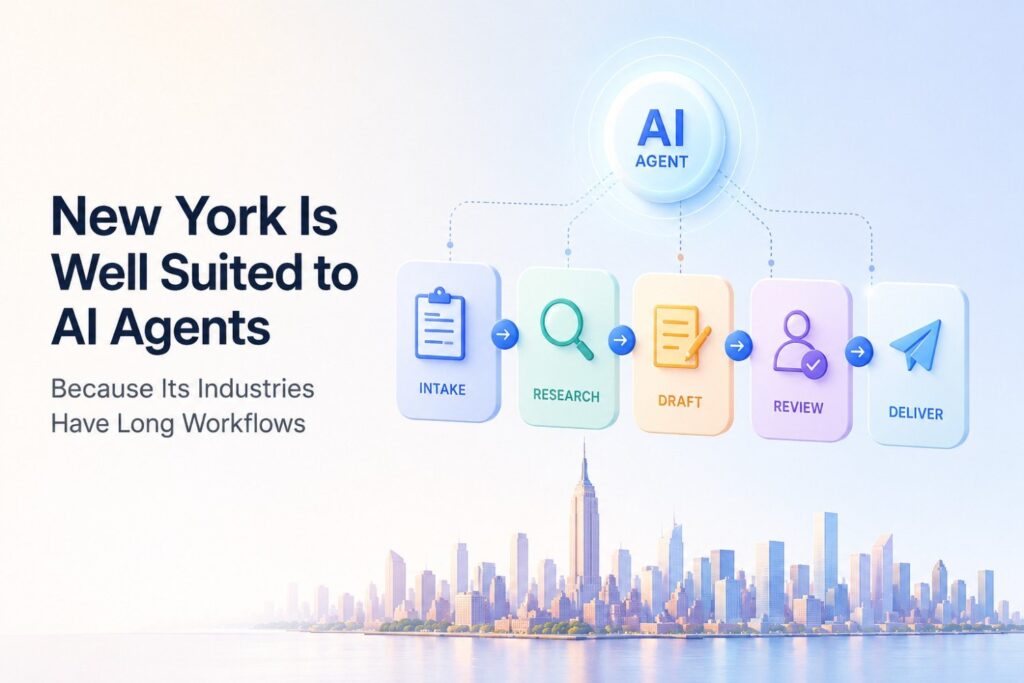
Companies that understand the whole chain can build AI that does much more than chat.
New York’s AI Capital Has Grown Dramatically
The customer base is only one side of the equation.
New York also has increasingly deep AI capital.
NYCEDC reports that AI companies in the city received approximately $21.4 billion in venture capital between 2018 and 2022, compared with roughly $3.8 billion during the preceding five-year period. (edc.nyc)
NYC Tech Journal calculates that this represents approximately a 5.6x increase, or about 463% growth between the two periods.
Chart: NYC AI Venture Funding
Previous five years     $3.8B   █████
2018-2022              $21.4B   ████████████████████████████
Source: NYCEDC. Growth calculation by NYC Tech Journal. (edc.nyc)
NYCEDC also reports that New York’s share of nationwide AI venture funding increased from 7.7% to 11.3% across those periods.
That is a rise of 3.6 percentage points, or roughly 47% on a relative basis. (edc.nyc)
Funding alone does not make a vertical AI hub.
But funding plus customers plus talent creates a far more powerful combination.
Recent Filing Data Suggests Capital Is Still Flowing Into Specialized AI
TinyTechFund tracks public SEC Form D filings from New York AI companies.
Its July 2026 dataset listed 27 companies associated with approximately $492.1 million of recorded financing. (TinyTechFund)
Several highly specialized companies appear among recent filings.
| Company | Focus indicated in public data | Latest disclosed amount in dataset |
|---|---|---|
| Norm AI | Legal and regulatory AI | $120.0M |
| Patlytics | Patent AI | $40.5M |
| Finster AI | Financial services AI | $26.5M |
| Acai Travel | Travel AI | $245K |
| Uniti AI | Applied AI | $11.9M |
Source: TinyTechFund SEC Form D dataset. Amounts represent the filing information shown by the source, not NYC Tech Journal estimates. (TinyTechFund)
This table should not be treated as a ranking of total company funding.
Form D records have limitations. Some rounds are not captured in exactly the same way, some companies may file under legal names, and filing amounts do not always equal cash ultimately raised.
But as a directional dataset, it reinforces the broader pattern.
Specialized AI companies are attracting meaningful capital.
The July 2026 Series A Cohort Offers Another Useful Snapshot
Tech:NYC tracked 13 New York companies reaching Series A in July 2026.
Together, they raised approximately $265.5 million in Series A financing.
Tech:NYC calculated that businesses centered on AI, enterprise software, and workflow automation accounted for about $113.5 million, or roughly 43% of the cohort’s Series A capital. It specifically pointed to vertical AI in commercial real estate, education, construction compliance, and other markets. (Tech:NYC Blog)
July 2026 NYC Series A Snapshot
| Metric | Amount |
|---|---|
| Companies tracked | 13 |
| Series A capital | $265.5M |
| AI / enterprise / workflow capital | ~$113.5M |
| Approximate share | ~43% |
| Financial infrastructure capital | ~$111M |
Source: Tech:NYC. Categories can overlap and should not be summed. (Tech:NYC Blog)
One month is not enough to establish a long-term trend.
But when the same pattern appears across ecosystem directories, financing reports, individual startup rounds, city strategy, and industry structure, it becomes harder to dismiss as noise.
New York Has Another Advantage: AI Buyers Are Already AI Users
Vertical AI adoption becomes easier when potential customers are already experimenting with the technology.
The New York City Comptroller reported in 2026 that AI adoption was especially strong across finance, information, and professional services—the same sectors that play an unusually important role in New York’s employment, wages, and tax base. (NYC Comptroller’s Office)
This matters.
A startup does not have to convince a large financial firm that artificial intelligence exists.
The conversation is increasingly about something more practical:
Which workflow?
Which model?
Which data?
Which controls?
What ROI?
What risk?
How do we deploy it?
That is a more mature buying environment.
NYC’s Professional Workforce Gives Vertical AI a Huge Surface Area
New York’s workforce composition helps explain why specialized business AI is developing so quickly.
According to 2024 American Community Survey estimates, New York City had approximately:
- 786,000 workers in management, business, and financial occupations;
- 188,000 in computer and mathematical occupations;
- 96,000 in legal occupations;
- 210,000 in arts, design, entertainment, sports, and media occupations. (Census Data)
Selected Knowledge-Work Occupations in NYC
Management/business/financial    786K  ██████████████████████████████
Arts/media                       210K  ████████
Computer/math                    188K  ███████
Legal                             96K  ████
Source: U.S. Census Bureau ACS 2024. (Census Data)
These are precisely the kinds of jobs where generative and agentic AI can be useful.
The opportunity is not necessarily to eliminate those roles.
It is often to automate part of the workload surrounding them.
That difference is important.
Vertical AI Works Best When the Human Is Expensive and the Task Is Repetitive
Founders looking for vertical AI markets should pay attention to the economics of work.
The ideal workflow often has five characteristics.
First, skilled people spend significant time doing it.
Second, part of the work repeats.
Third, there is enough data for AI to reason about the task.
Fourth, errors are costly enough that customers care deeply about improvement.
Fifth, the workflow happens frequently enough that solving it creates measurable value.
New York contains enormous numbers of these tasks.
Think about a lawyer reviewing agreements.
An analyst examining businesses.
A property manager answering renter questions.
A compliance professional reviewing communication.
An accountant reconciling information.
A physician’s office chasing insurance approvals.
A construction auditor checking wage records.
A media team reviewing thousands of creative assets.
The opportunity is not simply “AI for industry X.”
It is AI for expensive task Y inside industry X.
That is where founders should start.
Why Small Industry Niches Can Produce Very Large AI Companies
One mistake founders make is rejecting markets that sound too narrow.
Vertical AI changes the economics of niche software.
Imagine a workflow previously requiring five hours of a highly paid professional.
If software reduces that work to 30 minutes, the product can create significant value even when the number of customers is relatively small.
A company may therefore build a major business with far fewer customers than a consumer app needs.
Depth Can Matter More Than Market Breadth
A horizontal AI company might sell a $30 monthly subscription.
A specialized enterprise system might be worth thousands or tens of thousands of dollars per month because it controls critical work.
The more of the workflow the system owns, the larger the potential contract.
That is why a niche such as patent analysis, financial compliance, medical administration, or construction assurance can support substantial venture investment.
The market sounds narrow.
The dollars moving through the workflow are not.
Regulation Is Not Necessarily a Weakness for Vertical AI
Highly regulated industries are often treated as bad startup markets.
They can be slower to enter.
Sales cycles can be longer.
Buyers demand security.
Mistakes can carry serious consequences.
But those same barriers can become advantages after a company earns trust.
A system that understands regulations, permissions, audit trails, review processes, and customer data can become deeply embedded.
The difficulty becomes part of the moat.
New York Has More of These Hard Markets Than Most Startup Hubs
Finance is regulated.
Healthcare is regulated.
Insurance is regulated.
Law is regulated.
Construction is regulated.
Real estate is heavily shaped by local rules.
Public-sector work is regulated.
That makes New York harder for shallow AI products.
It may make the city better for deep ones.
The Best Vertical AI Companies Will Build Trust Before Autonomy
One of the biggest mistakes in enterprise AI is trying to automate too much too quickly.
Customers in high-stakes industries rarely want a black box making important decisions on day one.
The better path is usually gradual.
First, the AI observes.
Then it assists.
Then it recommends.
Then it performs low-risk work automatically.
Then it performs more complicated work with human review.
Finally, certain workflows may become largely autonomous.
This creates trust.
It also produces data.
Every correction helps the product understand the industry better.
Vertical AI companies that build these feedback systems can improve in ways a generic model cannot easily reproduce.
Proprietary Workflow Data Could Become New York’s Real AI Moat
Foundation models are becoming widely available.
That changes where competitive advantage may live.
If several companies can access similarly powerful models, the differentiator moves upward.
Who has the better customer data?
Who has more workflow history?
Who understands the exceptions?
Who knows which outputs professionals approve?
Who has integrations into the systems customers already use?
Who can measure the final business result?
That data is extremely valuable.
The Vertical Flywheel
A strong vertical AI company can create a loop:
More customers
     ↓
More workflow data
     ↓
Better product understanding
     ↓
Higher automation
     ↓
Better customer outcomes
     ↓
More customers
The company does not necessarily train a giant foundation model from scratch.
It creates a specialized intelligence layer around an industry.
This is one reason proximity to sophisticated customers may matter so much during the early years.
New York’s Universities Strengthen the Talent Side
The argument for New York is not only about customers.
The city also has a significant education and research base.
NYCEDC says institutions including Columbia University, Cornell Tech, CUNY, and NYU produced more than 87,000 AI-ready degree holders between 2018 and 2023.
It also estimates that the metropolitan region has more than 40,000 workers with AI and AI-related skills. (EBS PublicNow)
That combination helps solve a problem vertical AI companies frequently face.
They do not need only engineers.
They need people who can sit between technology and industry.
A legal AI startup may need lawyers who understand models.
A healthcare company may need operators who understand software.
A fintech company may need engineers comfortable with regulatory systems.
New York’s workforce has unusually deep pools of both technical and industry talent.
The City Is Explicitly Building Around Applied AI
New York’s public strategy also increasingly reflects this opportunity.
NYCEDC describes its goal as making New York a global leader in Applied AI rather than simply competing to build the largest foundation model. (edc.nyc)
Its NYC AI Nexus program is particularly revealing.
The program supports applied AI companies across areas including:
- healthcare and biotechnology;
- climate and energy;
- robotics and advanced manufacturing;
- retail;
- professional services;
- legal and HR;
- media and advertising;
- real estate;
- travel and hospitality. (edc.nyc)
The list reads almost exactly like a vertical AI market map.

That alignment between public strategy and New York’s existing economy could accelerate company formation.
Vertical AI May Fit New York Better Than the Foundation Model Race
New York does not need to beat Silicon Valley at every layer of AI.
That would be the wrong competition.
Training frontier foundation models requires enormous amounts of computing infrastructure, specialized engineering talent, and capital.
California has major strengths there.
New York’s opportunity is different.
The AI Stack Is Splitting Into Layers
A simplified AI economy might look like this:
┌──────────────────────────────┐
│ Vertical AI applications     │
│ Legal, health, finance, etc. │
├──────────────────────────────┤
│ Agents & workflow platforms  │
├──────────────────────────────┤
│ Model / data infrastructure  │
├──────────────────────────────┤
│ Foundation models            │
├──────────────────────────────┤
│ Chips & computing            │
└──────────────────────────────┘
New York can participate in every layer.
But its greatest natural advantage may be near the top.
That is where technology meets customers.
And customer proximity is unusually valuable in vertical software.
New York Versus Silicon Valley Is the Wrong Question
The common question is whether New York will “beat” Silicon Valley in AI.
That framing is too simple.
The two ecosystems may specialize.
Silicon Valley can remain the world’s leading center for frontier model development, cloud infrastructure, chips, developer tools, and foundational research while New York becomes exceptionally important in applying those technologies to industries.
Both outcomes can happen at once.
In fact, they can strengthen each other.
A model developed in California can power a compliance platform created in Manhattan.
Infrastructure built by a Bay Area company can run a healthcare agent designed in New York.
Vertical AI companies do not need to own every layer of the stack.
They need to own the customer problem.
What NYC Founders Should Learn From This Shift
The opportunity is large, but merely adding AI to a vertical is not enough.
Many companies will fail because they build technology first and search for a problem later.
New York founders should do the reverse.
Start With a Painful Workflow, Not an Industry
“AI for insurance” is too broad.
“AI that reviews commercial insurance submissions before underwriting” is more useful.
“AI for healthcare” is too broad.
“AI that completes medication prior authorization workflows for specialty clinics” is far better.
“AI for law firms” is too broad.
“AI that turns a particular type of case file into a first-pass timeline with source citations” is testable.
The smaller definition helps you learn.
Once the workflow works, expand.
Find Work That Happens Hundreds of Times
AI products are easier to justify when the workflow repeats.
Ask potential customers:
How often do you do this?
Who does it?
How long does it take?
What happens when it is delayed?
How much does an error cost?
What software is involved?
Where is the source data?
Who approves the result?
If the customer cannot answer those questions, the workflow may not be important enough.
Measure the Current Cost Before Building
Founders often measure AI accuracy but forget economics.
A product can have impressive technology and still create little business value.
Before building, calculate the current cost.
Suppose a workflow takes two employees three hours per day.
That is six employee-hours.
If your AI reduces it to one hour total, you have recovered five hours per day.
Now multiply that by salary, working days, error costs, delayed revenue, and any other measurable consequences.
That gives you a value model.
Enterprise customers buy outcomes more easily than demonstrations.
Build Around the Human Review Process
Do not assume the user wants full autonomy.
Ask what the ideal review process should look like.
Maybe the AI should complete 80% of routine cases while sending 20% to a professional.
That can still create enormous value.
The goal is not maximum automation.
The goal is maximum useful automation at an acceptable risk level.
Own the Workflow Around the Model
This may be the most important strategic lesson.
Do not build a thin prompt box if the customer needs a system.
Capture documents.
Store context.
Run the analysis.
Create the output.
Request missing information.
Manage approval.
Record corrections.
Send updates.
Maintain history.
Connect to existing software.
Measure results.
The model then becomes one component inside a much more valuable product.
What New York Investors Should Look For
Investors evaluating vertical AI should also change how they judge companies.
A beautiful AI demo can be misleading.
The strongest vertical businesses may look less magical during a five-minute demonstration because much of their value lives in integration, reliability, domain knowledge, and workflow ownership.
Ask Whether the Company Is Becoming Harder to Replace
Useful questions include:
Does usage generate proprietary workflow data?
Does the system improve when professionals correct it?
Is the product integrated with core customer systems?
Does it sit inside an important approval process?
Can the company prove measurable savings?
Does expansion occur naturally after the first workflow?
Could a generic model provider easily copy the product?
Those questions reveal more than raw model performance.
What Established NYC Businesses Should Do Right Now
The vertical AI boom is not only an opportunity for startups.
Existing companies can benefit enormously if they approach adoption correctly.
Do Not Begin With “Where Can We Use AI?”
That question is too broad.
Start with:
Where is expensive knowledge work repeated?
Where do employees copy information between systems?
Where do teams review large numbers of documents?
Where do customers wait because staff cannot process work quickly enough?
Where are errors expensive?
Where does a backlog frequently form?
Those areas are strong candidates.
Build a Workflow Inventory
A bank could map compliance and operations work.
A law firm could map research, discovery, document review, drafting, and administrative workflows.
A property company could map leasing, resident requests, collections, maintenance, inspection, and vendor processes.
A healthcare provider could map scheduling, insurance checks, referrals, billing, patient communication, and documentation.
Then score each workflow based on volume, labor cost, data availability, risk, and ease of automation.
That is much more useful than launching a company-wide chatbot and calling it an AI strategy.
A Simple Vertical AI Opportunity Score
NYC Tech Journal created a basic framework companies can use.
Score each workflow from 1 to 5.
| Factor | Question |
|---|---|
| Labor intensity | How much skilled employee time does the task consume? |
| Repetition | How often does roughly the same process happen? |
| Data availability | Is the information needed to complete the task accessible? |
| Economic impact | Would faster or better completion create meaningful savings or revenue? |
| AI suitability | Can language, vision, prediction or reasoning models perform much of the work? |
| Integration feasibility | Can the product connect to existing systems? |
| Risk manageability | Can human review control important mistakes? |
A workflow scoring highly across most categories should move toward the top of the AI roadmap.
This framework is intentionally simple.
The purpose is to force teams to compare opportunities based on business value rather than excitement.
Where NYC Tech Journal Expects the Next Vertical AI Companies to Emerge
Our analysis points toward several markets where New York has both customer density and complicated work.
Accounting AI
Accounting may become one of the largest vertical AI opportunities.
Accounting teams reconcile information, classify transactions, review documents, prepare reports, investigate differences, answer questions, and operate under strict rules.
The work is full of repeatable reasoning.
That makes it highly suitable for agentic systems.
The biggest companies may not simply “help accountants.”
They may take control of complete financial workflows.
Insurance AI
Insurance has nearly every trait vertical AI needs.
There are documents.
Images.
Rules.
Claims.
Policies.
Pricing decisions.
Customer communication.
Fraud checks.
Regulation.
Human review.
Large amounts of historical data.
New York’s financial and insurance ecosystem gives founders close access to both incumbents and experienced workers.
Commercial Real Estate AI
Commercial property remains remarkably dependent on documents, spreadsheets, phone calls, research, and human knowledge.
AI can assist with underwriting, leasing, property operations, construction, asset management, due diligence, valuation, and compliance.
Tech:NYC’s July 2026 Series A analysis already highlighted multiple AI companies working around real estate and construction workflows. (Tech:NYC Blog)
Expect this category to deepen.
Legal and Regulatory AI
The Norm AI and Hadrius rounds show the level of capital moving into legal and compliance work.
But both markets remain enormous.
Hundreds of specialized workflows exist beneath the broad words “legal” and “compliance.”
Vertical AI startups can attack individual areas before expanding into broader operating platforms.
Healthcare Administration
The size of New York’s healthcare workforce makes this especially important.
AI does not need to replace clinical judgment to create enormous value.
Reducing telephone volume, paperwork, scheduling work, referral delays, billing errors, insurance friction, and documentation burden can itself support large companies.
Media and Advertising AI
New York’s media and advertising industries offer another natural laboratory.
AI can generate creative work, but the larger business opportunities may sit around planning, testing, rights management, campaign operations, measurement, audience understanding, brand control, and production workflows.
Our analyzed early-stage dataset already contained eight companies in the media, advertising, and creative category—the same count as fintech and healthcare. (AI Atlas NYC)
The Biggest Risk: Every Vertical AI Market Will Become Crowded
The opportunity will attract competition.
Hundreds of companies can call themselves AI for law, AI for healthcare, or AI for finance.
That is not enough.
As models improve and become cheaper, thin product layers will become easier to reproduce.
The defensible company will need something deeper.
Customer relationships.
Unique data.
Integrations.
Regulatory knowledge.
Workflow history.
Distribution.
Brand trust.
Human expertise.
A superior feedback system.
A founder who understands only AI may struggle.
A founder who understands only the industry may also struggle.
The best teams will understand both.
Another Risk: AI Accuracy Is Not the Same as Business Reliability
A model can score well on a benchmark and still fail inside a real workflow.
Enterprise users care about more than whether the answer sounds correct.
They need to know:
Where did the information come from?
What happens when data is missing?
What happens when the model is uncertain?
Can a person review the result?
Who has permission to see the information?
Can the system explain what happened later?
Can the decision be audited?
Does it reliably integrate with existing software?
These issues become increasingly important as AI moves from suggestions to actions.
Vertical AI companies that solve them can create powerful advantages.
The Original Research Points to a Broader Shift in New York Tech
Put the data together and a clear picture emerges.
NYCEDC reports more than 2,000 AI startups in the city and over 40,000 metro-area workers with AI-related skills. (edc.nyc)
The city’s share of U.S. AI venture funding increased materially in the period measured by NYCEDC. (edc.nyc)
Our classification of one 74-company early-stage NYC AI dataset found:
48.6% were clearly industry-specific vertical AI companies.
66.2% were either industry-specific or specialized around a defined enterprise workflow.
The vertical group itself was spread across finance, healthcare, media, law, cybersecurity, and life sciences rather than being concentrated in a single sector. (AI Atlas NYC)
Tech:NYC’s July 2026 Series A data separately found significant capital flowing into AI, workflow automation, fintech, commercial real estate, construction, and specialized enterprise software. (Tech:NYC Blog)
Recent financings for Norm AI, Hadrius, Dili, EliseAI, Runwise, and other companies provide individual examples of the same pattern. (norm.ai)
None of these datasets is perfect.
Together, however, they describe an ecosystem increasingly organized around applying AI to specific economic problems.
NYC Tech Journal’s Vertical AI Thesis
Our research suggests that New York’s advantage can be summarized through five connected forces.
1. Industry density
New York contains extraordinary concentrations of customers in industries where complicated knowledge work is common.
2. Expensive workflows
Finance, law, healthcare, real estate, media, insurance, accounting, and professional services contain many tasks where skilled labor is costly.
3. Data-rich operations
These industries produce documents, messages, transactions, records, images, contracts, and other information AI can process.
4. Capital
New York has developed a large venture ecosystem willing to fund specialized AI companies.
5. Talent that crosses disciplines
The city combines engineers with lawyers, bankers, doctors, property professionals, marketers, researchers, operators, and other domain specialists.
Each advantage reinforces the others.
The NYC Vertical AI Flywheel
Large industry clusters
        ↓
More domain experts
        ↓
More painful workflows discovered
        ↓
More vertical AI startups
        ↓
More venture investment
        ↓
More enterprise adoption
        ↓
More workflow data and talent
        ↓
Stronger vertical AI ecosystem
        ↺
This is the mechanism that could make New York difficult for other cities to reproduce.
What Would Prove the Thesis Wrong?
Good research should also explain what could invalidate its argument.
New York’s vertical AI position is not guaranteed.
The thesis would weaken if most specialized companies failed to reach meaningful revenue, if enterprise buyers concentrated purchases among a handful of general AI vendors, or if remote selling made industry proximity largely irrelevant.
Another possibility is that foundation model companies themselves move aggressively into vertical workflows.
If one general platform can cheaply perform legal, finance, healthcare, real estate, and accounting work with sufficient reliability, the space available to specialized companies could shrink.
But that outcome is far from certain.
Industries contain different data, systems, rules, buyers, incentives, and risks.
Those differences have supported specialized software companies for decades.
AI may reduce some technical barriers while making workflow knowledge even more important.
What We Would Track Next
To determine whether New York truly becomes the leading vertical AI ecosystem, several metrics deserve continued attention.
The most useful would be vertical AI company formation, venture capital by industry, enterprise revenue, customer retention, job creation, company exits, large funding rounds, and the number of specialized AI companies expanding from one workflow into complete operating platforms.
Another useful measure would be AI office expansion.
Companies that maintain large technical and commercial teams in New York create stronger ecosystem effects than businesses that merely register a corporate address in the city.
EliseAI’s recent expansion to a roughly 109,000-square-foot headquarters is therefore more significant than a simple financing announcement. It represents a long-term operating commitment to the city. (eliseai.com)
Over time, similar moves will tell us whether New York is merely funding AI companies or building an enduring AI industrial cluster.
Why the Next Great New York AI Company May Look Boring at First
The most interesting implication may be cultural.
The next major New York AI startup may not begin with a dazzling consumer application.
It might automate something that almost nobody outside one industry understands.
Certified payroll compliance.
Commercial insurance submissions.
Patent claim analysis.
Medication authorization.
Lease administration.
Investment memo preparation.
Financial marketing review.
Healthcare collections.
Building heating systems.
Those problems can sound boring.
That is exactly why they are attractive.
Boring workflows are often where businesses spend extraordinary amounts of money.
They may also have less competition from founders chasing fashionable consumer products.

Vertical AI turns specialized knowledge into software.
New York contains an enormous amount of specialized knowledge.
Conclusion: New York Does Not Need to Become Silicon Valley
New York’s path to AI leadership does not require recreating Silicon Valley in Manhattan.
Its strongest opportunity is more closely connected to the city that already exists.
A city of bankers.
Lawyers.
Doctors.
Property operators.
Advertisers.
Accountants.
Investors.
Insurers.
Researchers.
Publishers.
Builders.
Consultants.
Retailers.
Entrepreneurs.
Each industry contains thousands of tasks that AI can make faster, cheaper, and more accurate.
Our analysis of current public datasets suggests that New York founders are already moving aggressively toward those opportunities. Nearly half of the observed early-stage AI dataset we examined falls into clearly industry-specific categories, while roughly two-thirds is tied either to an industry or specialized enterprise workflow.
That is why the phrase “vertical AI capital” may ultimately be more useful than simply calling New York another AI hub.
The city does not need to build every model.
It needs to build the best businesses on top of them.
And when artificial intelligence moves out of the laboratory and into the operating systems of finance, law, healthcare, buildings, media, insurance, accounting, and professional services, few places in the world offer a larger or more concentrated market for learning what those systems actually need.
That may become New York’s defining advantage in the next phase of AI.